
Life, 1905-01-05 · page 27 of 36
Life — January 5, 1905 — page 27: what you’re looking at
What you’re looking at
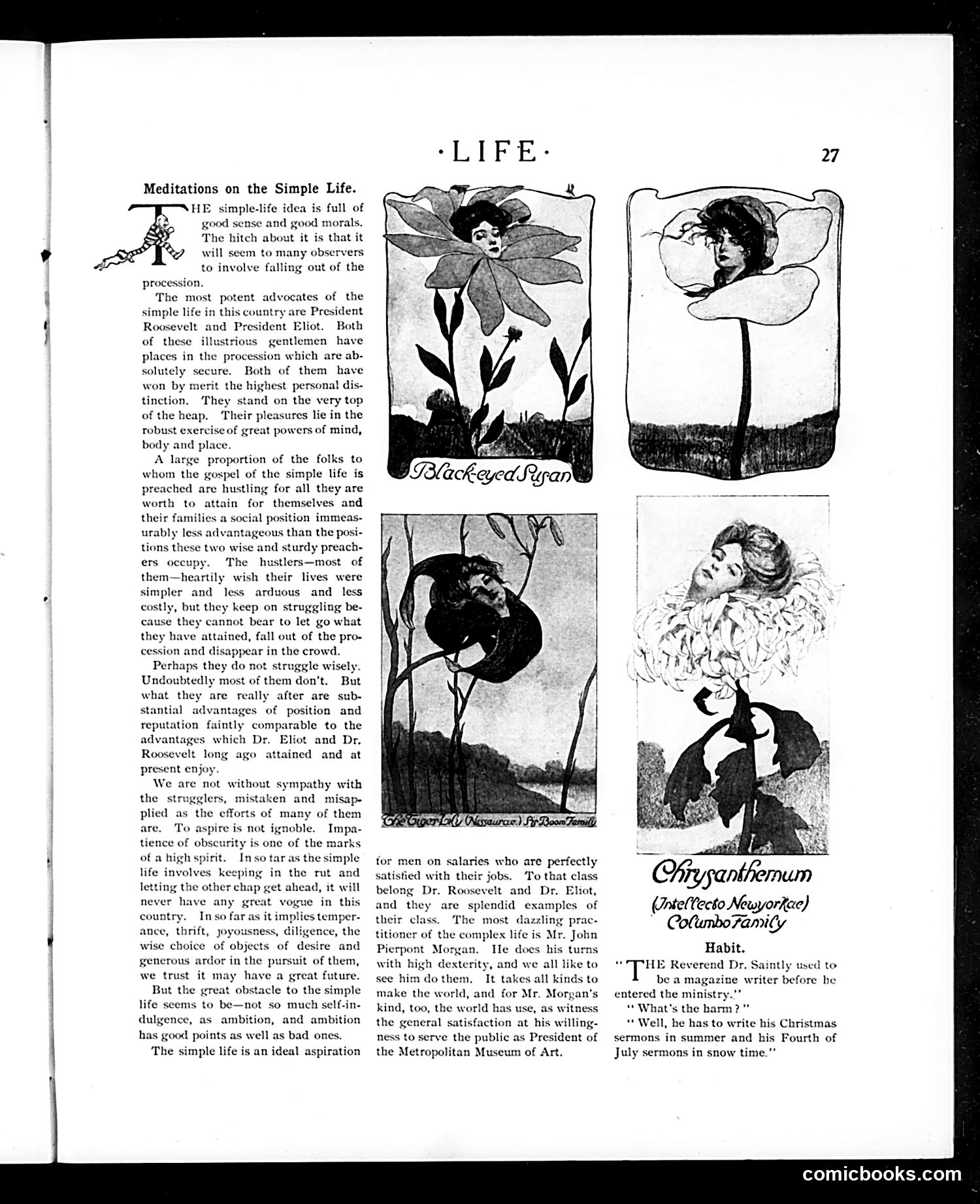
This satirical essay critiques the "simple life" movement championed by President Theodore Roosevelt and Harvard President Charles W. Eliot. The text argues these leaders advocate simplicity from positions of absolute security and achievement—they've already "won" and occupy the "top of the heap." The accompanying botanical illustrations (Black-eyed Susan, what appears to be morning glory, and chrysanthemum) are ironic visual metaphors for simplicity itself. The essay's central irony: ordinary working people cannot afford the simple life because ambition drives them to accumulate status and wealth. They're trapped in the "procession"—caught pursuing social advancement they feel compelled to maintain. The piece contrasts Roosevelt and Eliot with John Pierpont Morgan, the wealthy industrialist, suggesting the "complex life" of ambition and acquisition has its own validity. The final joke about "Reverend Dr. Saintly" underscores how even spiritual figures cannot escape society's pressures—he must write summer Christmas sermons in advance, failing to live simply or naturally.
📄 Transcribed text from this page (OCR, searchable)
Machine-transcribed from the original scan — historical spelling and the odd misread are preserved.
— Meditations on the Simple Life. HE simple-life idea is full of * good sense and good morals. ‘The hitch about it is that i will seem to many observers to involve falling out of the procession, The most potent advocates of the simple life in this country are President Roosevelt and President Eliot. Both of these illustrious gentlemen have places in the procession which are ab- solutely secure. Both of them have won by merit the highest personal dis- tinction. They stand on the very top of the heap. Their pleasures lie in the robust exercise of great powers of mind, body and place. A large proportion of the folks to whom the gospel of the simple life is preached are hustling for all they are worth to attain for themselves and their families a social position immeas- urably less advantageous than the posi- tions these two wise and sturdy preach- ers occupy. The hustlers—most of them—heartily wish their lives were simpler and less arduous and less costly, but they keep on struggling be- cause they cannot bear to let go what they have attained, fall out of the pro- cession and disappear in the crowd. Perhaps they do not struggle wisely. Undoubtedly most of them don’t. But what they are really after are sub- stantial advantages of position and reputation faintly comparable to the advantages which Dr. Eliot and Dr. Roosevelt long ago attained and at present enjoy. We are not without sympathy with the strugglers, mistaken and misap- plied as the efforts of many of them are, To aspire is not ignoble. Impa- tience of obscurity is one of the marks it. Inso tar as the simple keeping in the rut and her chap get ahead, it will great vogue in this country. In so far as it implies temper- ance, thrift, joyousness, diligence, the wise choice of objects of desire and generous ardor in the pursuit of them, we trust it may have a great future. But the great obstacle to the si life seems to be—not so much s dulgence, as ambition, and ambition has good points as well as bad ones. The simple life is an ideal aspiration of a high sp’ life involv letting t never have an: e « tor men on salaries who are perfectly satisfied with their jobs. ‘To that class belong Dr. Roosevelt and Dr. Eliot, and the are splendid examples of s. The most dazzling prac- titioner of the complex life is Mr. John Pierpont Morgan. He does his turns y, and we all like to see him do them, It takes all kinds to make the world, and for Mr. Morgan's kind, too, the world has use, as witness the general satisfaction at his willing- ness to serve the public as President of the Metropolitan Museum of Art. Ofiysanthemum (nke(Cecto Newyorkze) Columbo7amily Habit. “CHE Reverend Dr, Saintly used to be a magazine writer before he entered the ministry.” “What's the harm?" “Well, he has to write his Christmas sermons in summer and his Fourth of July sermons in snow time.” comicbooks.com