
Life, 1905-01-05 · page 20 of 36
Life — January 5, 1905 — page 20: what you’re looking at
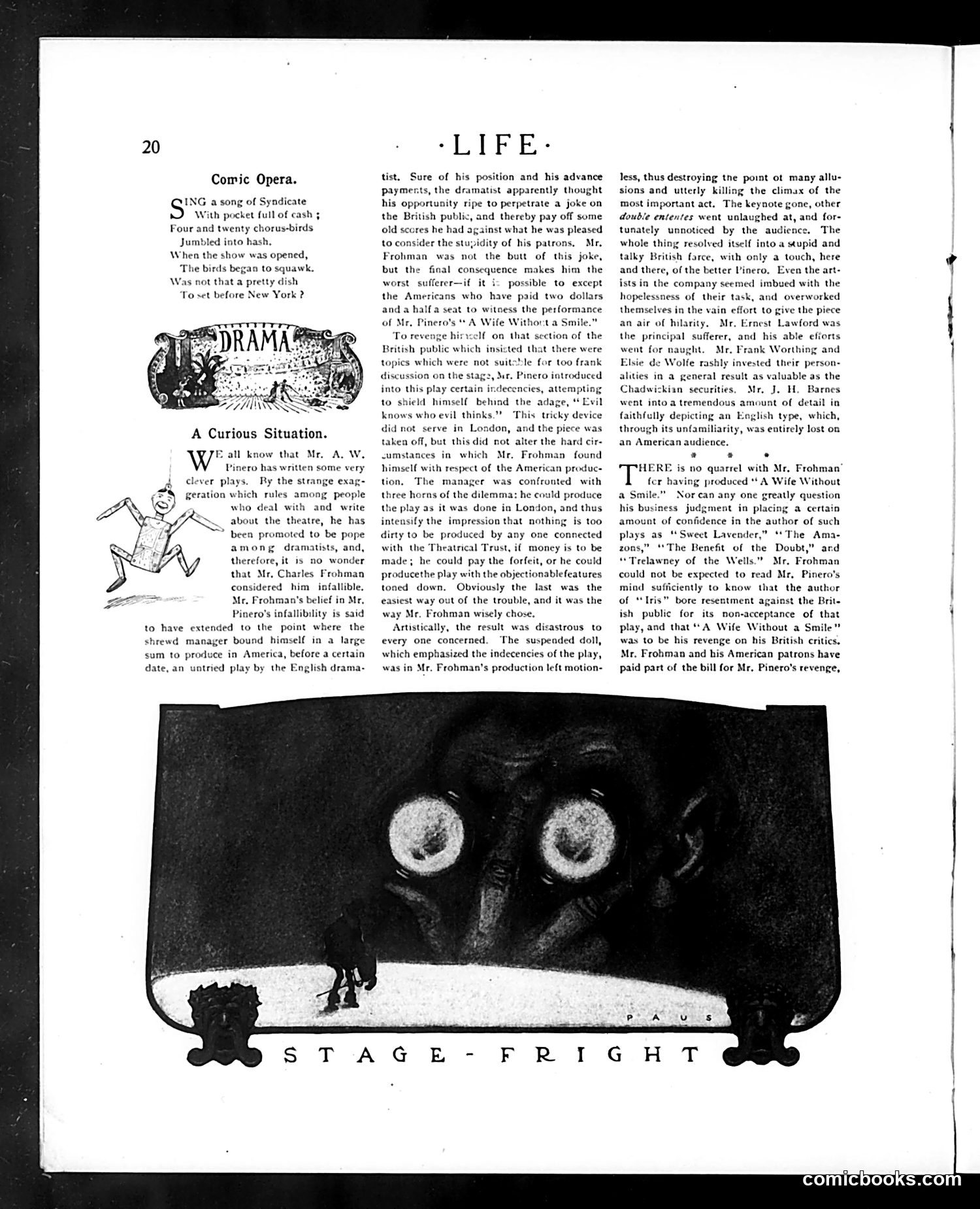
What you’re looking at
This page satirizes theatrical business practices of the early 1900s. The "Comic Opera" verse mocks the Syndicate system—a theatrical trust controlling Broadway productions—which bundled inferior shows for profit ("pocket full of cash," "four and twenty chorus-birds / Jumbled into hash"). The main article targets impresario **Charles Frohman** and British playwright **Arthur Wing Pinero**. The satire explains that Frohman, overestimating Pinero's infallibility, contracted to produce Pinero's untried play "A Wife Without a Smile" in America. The joke: Pinero allegedly inserted indecent material as revenge against the British public's prudishness. When Frohman removed these elements for American audiences, he accidentally destroyed the play's comedic structure—the "suspended doll" prop that emphasized the jokes became pointless. The result was a "stupid and talky British farce," wasting talent like **Elsie de Wolfe**. The satire mocks both theatrical monopolies and the collision between British theatrical conventions and American sensibilities.
📄 Transcribed text from this page (OCR, searchable)
Machine-transcribed from the original scan — historical spelling and the odd misread are preserved.
Comic Opera. ING a song of Syndicate With pocket full of cash 5 Four and twenty chorus-birds Jumbled into hash, When the show was opened, The birds began to squawk. Was not that a pretty dish To set before New York ? A Curious Situation. W = all know that Mr. A.W. Pinero has written some very | clever plays geration which rules among people who deal with and write about the theatre, he has been promoted to be pope dramatists, and, therefore, it is no wonder that Mr, Charles Frohman considered him infallible. Mr. Frohman’s belief in Mr, Pinero’s infallibility is said to have extended to the point where the shrewd manager bound himself in a large sce in America, before a certain date, an untried play by the English drama- Ry the strange exag- among sum to prod -LIFE- Sure of his position and his advance tist, payments, the dramatist apparently thought his opportunity ripe to perpetrate a joke on the British public, and thereby pay off some old scores he had against what he was pleased to consider the stupidity of his patrons, Mr. Frohman the butt of this joke, but the final consequence makes him the sufferer—if it i: possible to except the Americans who have paid two dollars and a half a seat to witness the performance of Mr, Pinero's * A Wife Withort a Smile.” hirxcclf on that section of the h public which insisted that there were was not worst To rever B topics which were not suitshle for too frank discussion on the stage, Ser. Pinero introduced, ing Evil This tricky device did not serve in London, and the piece was takea off, but this did not alter the hard cir- Mr. found himself with respect of the American produce with three horns of the dilemma: he could produce ¢ play as it was done in London, and thus intensify the impression that nothin dirty to be produced by any one connected with the Theatrical Trust, if money is to be made; he could pay the forfeit, or he could producethe play with the objectionablefeatures toned Obviously the last easiest way out of the trouble, and it was the way Mr, Frohman wisely chose. Artistically, the result’ was disastrous to every one concerned. The suspended doll, which emphasized the indecencies of the play, was in Mr. Frohman’s production left motion- into this play certain indecencies, attem, to shield himself behind the adage, knows who evil thinks. cumstances in which Frohman tion, The manager was confronted is too down. was the less, thus destroying the point ot many allu- sions and utterly killing the climax of the most important act. The keynote gone, other double ententes went unlaughed at, and for- tunately unnoticed by the audience, The whole thing resolved itself into a stupid and talky British farce, with only a touch, here and there, of the better Pinero, Even the art- ists in the company seemed imbued with the hopelessness of their task, and overworked themselves in the vain effort to give the piece an air of hilarity, Mr, Ernest Lawford was the principal sufferer, and his able efforts Mr. Frank Worthing and Elsie de Wolfe rashly invested their person- alities in a general result as valuable as the Chadwickian securities, Mr, J. H, Barnes went into a tremendous amount of detail in faithfully depicting an Eoglish type, which, through its unfamiliarity, was entirely lost on an American audience * * . T SRE is no quarrel with Mr, Frohman fer having produced A Wife Without a Smile.” Nor can any one greatly question his business judgment in placing a certain amount of confidence in the author of such plays as ‘Sweet Lavender,” “The Ama- zons,” “The Benefit of the Doubt,” and “Trelawney of the Wells.” Mr. Frohman could not be expected to read Mr, Pinero's mind sufficiently to know that the author of “Iris” bore resentment against the Brite ish public for its non-acceptance of that play, and that A Wife Without a Smile" was to be his revenge on his British critics, Mr. Frohman and his American patrons have paid part of the bill for Mr, Pinero's revenge, went for naught.