
Life, 1905-01-05 · page 21 of 36
Life — January 5, 1905 — page 21: what you’re looking at
What you’re looking at
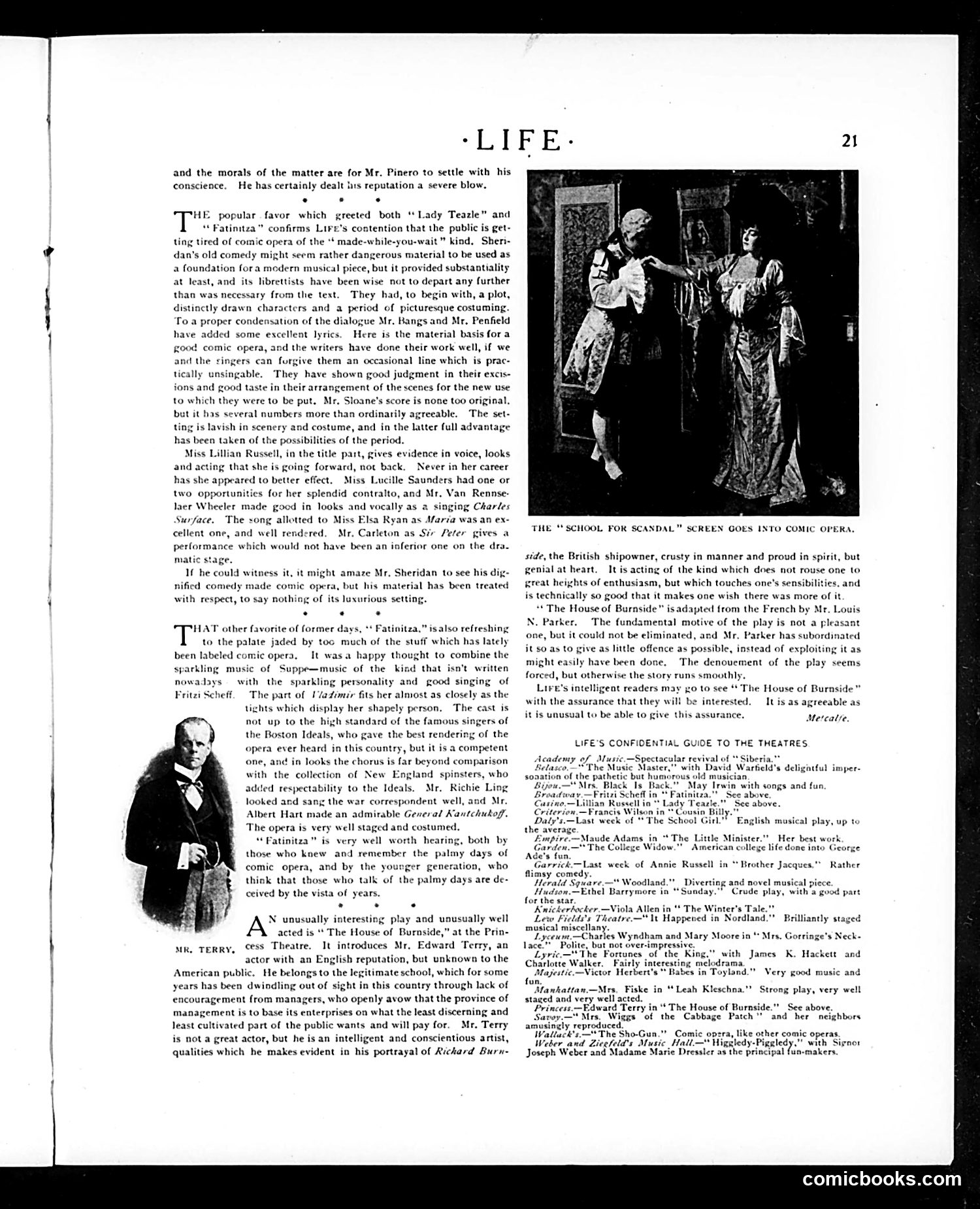
This page reviews theatrical productions, primarily discussing musical adaptations and stage performances. The key content focuses on: **Main Reviews:** - Adaptations of classic plays into comic operas ("Lady Teazle" and "Fatinitza"), which Life praises for moving away from frivolous "made-while-you-wait" comic opera toward more substantive material - Lillian Russell's starring role in the title part, praised for her voice and acting - "The House of Burnside," featuring English actor Edward Terry (pictured), presented as introducing sophisticated legitimate theater rather than lightweight entertainment **The Satire's Point:** Life critiques the popular trend of adapting serious classical comedies (like Sheridan's work) into musical vehicles, though acknowledges this represents an improvement over purely commercial comic operas. The reviews suggest Life's editorial stance favoring substantive drama over formulaic entertainment—a common position for the magazine's educated readership. The photograph of Mr. Terry underscores Life's interest in theatrical legitimacy and cultural sophistication.
📄 Transcribed text from this page (OCR, searchable)
Machine-transcribed from the original scan — historical spelling and the odd misread are preserved.
~~ es -LIFE- 1 and the morals of the matter are for Mr. Pinero to settle with his conscience. He has certainly dealt ins reputation a severe blow, . . . HE popular favor which greeted both ‘Lady Teazle” and “ Fatinitza”” confirms Lire’s contention that the public is get- ting tired of comic opera of the ** made-while-you-wait” kind, Sheri- dan’s old comedy might seem rather dangerous material to be used as a foundation fora modern musical piece, but it provided substantiality at least, and its librettists have been wise not to depart any further than was necessary from the text, They had, to begin with, a plot, distinctly drawn characters and a period of picturesque costuming. To a proper condensation of the dialogue Mr, Bangs and Mr, Penfield have added some excellent lyrics. Here is the material basis for a good comic opera, and the writers have done their work well, if we and the singers can forgive them an occasional line which is prac- tically unsingable. They have shown good judgment in their excis- ions and good tast to which they were to be put. Mr, Sloane's score is none too original, but it has several numbers more than ordinarily agreeable. The set- ting is lavish in scenery and costume, and in the latter full advantage has been taken of the possibilities of the period. Miss Lillian Russell, in the title part, gives evidence in voice, looks and acting that she is going forward, not back. Never in her career has she appeared to better effect, Miss Lucille Saunders had one or two opportunities for her splendid contralto, and Mr, Van Rennse- in their arrangement of the scenes for the new use laer Wheeler made good in looks and vocally as a singing Charles Surface. The » cellent one, and well perform: matic stage. If he could witness it, it might amaze Mr, Sheridan to see his dig- rial has been treated ng allotted to Miss Elsa Ryan as Afaria was an ex- endered, Mr, Carleton as Sir Peter gives a ¢ which would not have been an inferior one on the dra. nified comedy made comic opera, but his m: with respect, to say nothing of its luxurious setting. HAT other favorite of former days, * Fatinitza,” isalso refreshin, to the palate jaded by too much of the stuff which has lately been labeled comic opera, It wasa happy thought to combine the sparkling music of Suppe—music of the kind that isn’t written nowadays with the sparkling personality and good singing of Pritzi Scheff. The part of 1/adimir fits her almost as closely as the tights which display her shapely person. The cast is not up to the high standard of the famous singers of the Boston Ideals, who gave the best rendering of opera ever heard in this country, but it isa competent one, and in looks the chorus is far beyond comparison with the collection of New England spinsters, who added respectability to the Ideals. Mr. Richie Ling looked and sang the war correspondent well, and Mr. Albert Hart made an admirable General Kantchuhof,. The opera is very well staged and costumed. “Fatinitza” is very well worth hearing, both by those who knew and remember the palmy days of comic opera, and by the younger generation, who think that those who talk of the palmy days are de- ceived by the vis a of years. . . . N unusually interesting play and unusually well acted is The House of Burnside,” at the Prin- Mk. TERRY, CeSS Theatre. It introduces Mr, Edward Terry, an actor with an English reputation, but unknown to the American public. He belongs to the legitimate school, which for some years has been dwindling out of sight in this country through lack of encouragement (rom managers, who openly avow that the province of management is to base its enterprises on what the least discerning and east cultivated part of the public wants and will pay for. Mr. Terry is not a great actor, but he is an intelligent and conscientious artist, qualities which he makes evident in his portrayal of Richard Burn- 4i. —— he > on AS APG ee THE “SCHOOL FOR SCANDA\ SCREEN GOES INTO COMIC OPERA. side, the British shipowner, crusty in manner and proud in spirit, but genial at heart, It is acting of the kind which does not rouse one to great heights of enthusiasm, but which touches one’s sensibilities, and is technically so good that it makes one wish there was more of it “The House of Burnside” is adapted from the N. Parker. The fundamental motive of the play is not a pleasant one, but it could not be eliminated, and Mr. Parker has subordinated “rench by Mr. Louis it so as to give as little offence as possible, instead of exploiting it as might easily have been done, The denovement of the play seems forced, but otherwise the story runs smoothly, Lire’s intelligent readers may yo to see The House of Burnside” with the assurance that they wi be interested. It is as agreeable as it is unusual to be able to give this assuranc Metcalfe. LIFE’S CONFIDENTIAL GUIDE TO THE THEATRES ademy of Music.—Spectacular revival of * Siberia."* Relasco,—" The Music Master,” with David Warfield’s deligatful imper- of the pathetic but humorous old musician “Mrs. Black Is Back." irwin with songs and fun. ay.—Fritzi Scheff in ** Fatinitza.”” | See above. no.—Lillian Russell ia" Lady Teale." See above. Criterion. —Francis Wilson in * Cousio B Daly's.—Last week of " The School ¢ the average empire.—Maude Adams ji Garden.—* The College Widow Ade’s fun Garrick—Last week of Annie R flimsy comedy, Herald Square. —* Woodland." Diverting and novel musical piece. Hudion.—Ethel Barrymore in “Sunday.”” Crude play, with'a good part for the star Knickerbocker." a Allen in ‘* The Winter's Tale.” Lew Fields's T —"It Happeved in Nordland." Brilliantly su musical miscellany. Lyceunt—Charles Wyndham and Mary Moore in * Mrs, Gorringe’s Neck- lace." Polite, but not over-impressive. i Lyric ‘The Fortunes of the King.” with James K. Hackett and Charlotte Walker. Fairly interesting melodrama. Majestic.—Victor Herbert's * Babes in Toylans fon, ‘Mankattan.—Mrs, Fiske in “Leah Kleschna."” Strong play, very well staged and very well acted. Princess.—Edward Terry in “‘ The House of Burnside." See above. Saroy—" Mrs. Wiggs of the Cabbage Patch” and her neighbors amusingly reproduced. Wallack's.—"* The Sho-Gun."", Comic opera, like other comic operas. Weber and Zieefeld’s Music Hall. Higgledy-Piggledy,"" with Signor Joseph Weber and Madame Marie Dressler as the principal fun-makers. aglish musical play, up te tle Minister.” Her best work. nerican college life done into George sell in“ Brother Jacques." Rather ab d Very good music and comicbooks.com