
Life, 1905-01-05 · page 16 of 36
Life — January 5, 1905 — page 16: what you’re looking at
What you’re looking at
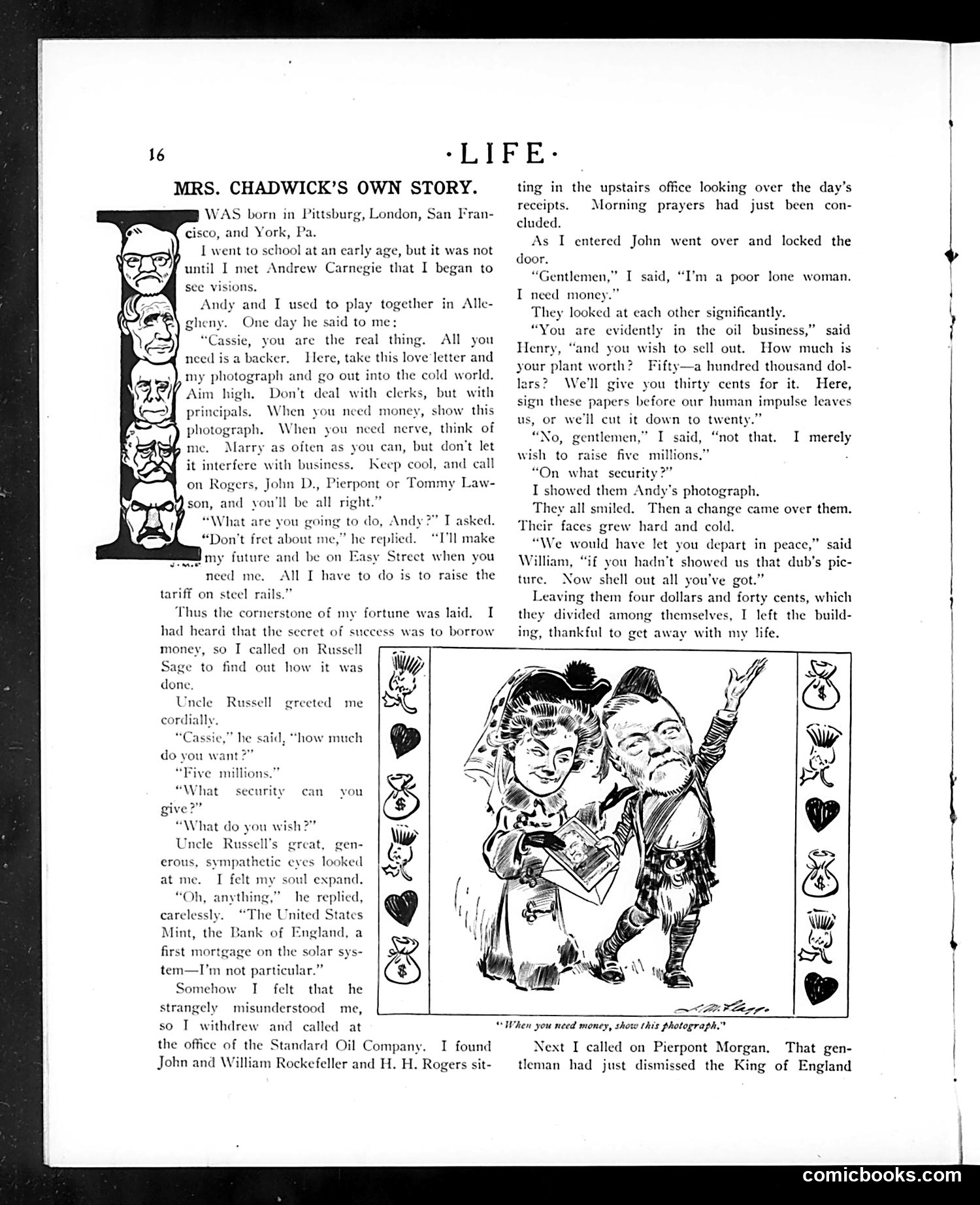
This is a mock autobiography of **Cassie Chadwick**, a real con artist who defrauded banks around 1904 by claiming to be Andrew Carnegie's illegitimate daughter. The satire ridicules both Chadwick's audacious fraud and the gullibility of wealthy industrialists. The joke: Chadwick claims Carnegie, John D. Rockefeller, Russell Sage, and J.P. Morgan all encouraged her criminal schemes and accepted dubious "security" (Carnegie's photograph, the Bank of England, even "a first mortgage on the solar system"). The cartoon shows her duping these titans of industry, who are depicted as either easily manipulated or complicit. The final line—that Morgan had "just dismissed the King of England"—hyperbolically suggests these men wielded absurd power. The satire targets wealthy financiers' arrogance and carelessness with money, and Chadwick's brazen exploitation of her name-dropping. Life magazine presents her fictional confession as dark comedy about American greed and credulity.
📄 Transcribed text from this page (OCR, searchable)
Machine-transcribed from the original scan — historical spelling and the odd misread are preserved.
16 -LI MRS. CHADWICK’S OWN STORY. WAS born in Pittsburg, London, San Fran- cisco, and York, Pa. I went to school at an early age, but it was not until I met Andrew Carnegie that I began to see visions. Andy and I used to play together in Alle- gheny. One day he said to me: “Cassie, you are the real thing. All you llere, take this love letter and need is a backer. my photograph and go out into the cold world, Don't deal with clerks, but with When you need money, show this When you need nerve, think of n, but don’t let Keep cool, and call {Aim high, princi photograph. me. it interfere with business. rs, John D., Pierpont or Tommy Law- Marry as often as you son, and you'll be all right.” “What are you going T asked. “Don't fret about me,” he replied. ‘Il make Strect when you to do, Andy my future and be on E need me. All I have to do is to raise the tariff on steel rails.” I had heard that the secret of success was to borrow Thus the cornerstone of my fortune was laid. FE- ting in the upstairs office looking over the day’s receipts. Morning prayers had just been con- cluded. As I entered John went over and locked the door, Sentlemen,” I said, “I’m a poor lone woman. I need money.” They looked at each other significantly. “You are evidently in the oil business,” said Henry, “and you wish to sell out. How much is your plant worth? ty—a hundred thousand dol- lars? We'll give you thirty cents for it. Here, sign these papers before our human impulse leaves us, or we'll cut it down to twenty.” “No, gentlemen,” I said, “not that. wish to raise five millions,” “On what security?” I showed them Andy's photograph. They all smiled. Then a change came over them. Their faces grew hard and cold. “We would have let you depart in peace,” said William, “if you hadn't showed us that dub’s pic- ture. Now shell out all you've got.” ving them four dollars and forty cents, which ‘y divided among themselves, I left the build- ing, thankful to get away with my life. I merely money, so I called on Russell Sage to find out how it was done. Uncle Russell greeted me cordially. said, “how much “Cassie,” he do you wan “Five millions.” “What security can you give?” “What do you wish?” Uncle Russell’s great, gen- erous, sympathetic eves looked at me. I felt my soul expand. “Oh, anything,” he replied, carelessly. “The United States Mint, the Bank of England, a first mortgage on the solar sys- tem—I’m not particular.” Somehow I felt that he strangely misunderstood me, so I withdrew and called at the office of the Standard Oil Company. I found John and William Rockefeller and H. H. Rogers sit- “When you need money, show this photograph. Next I called on Pierpont Morgan, tleman had just dismissed the King That gen- of England comicbooks.com