
Life, 1905-01-05 · page 10 of 36
Life — January 5, 1905 — page 10: what you’re looking at
What you’re looking at
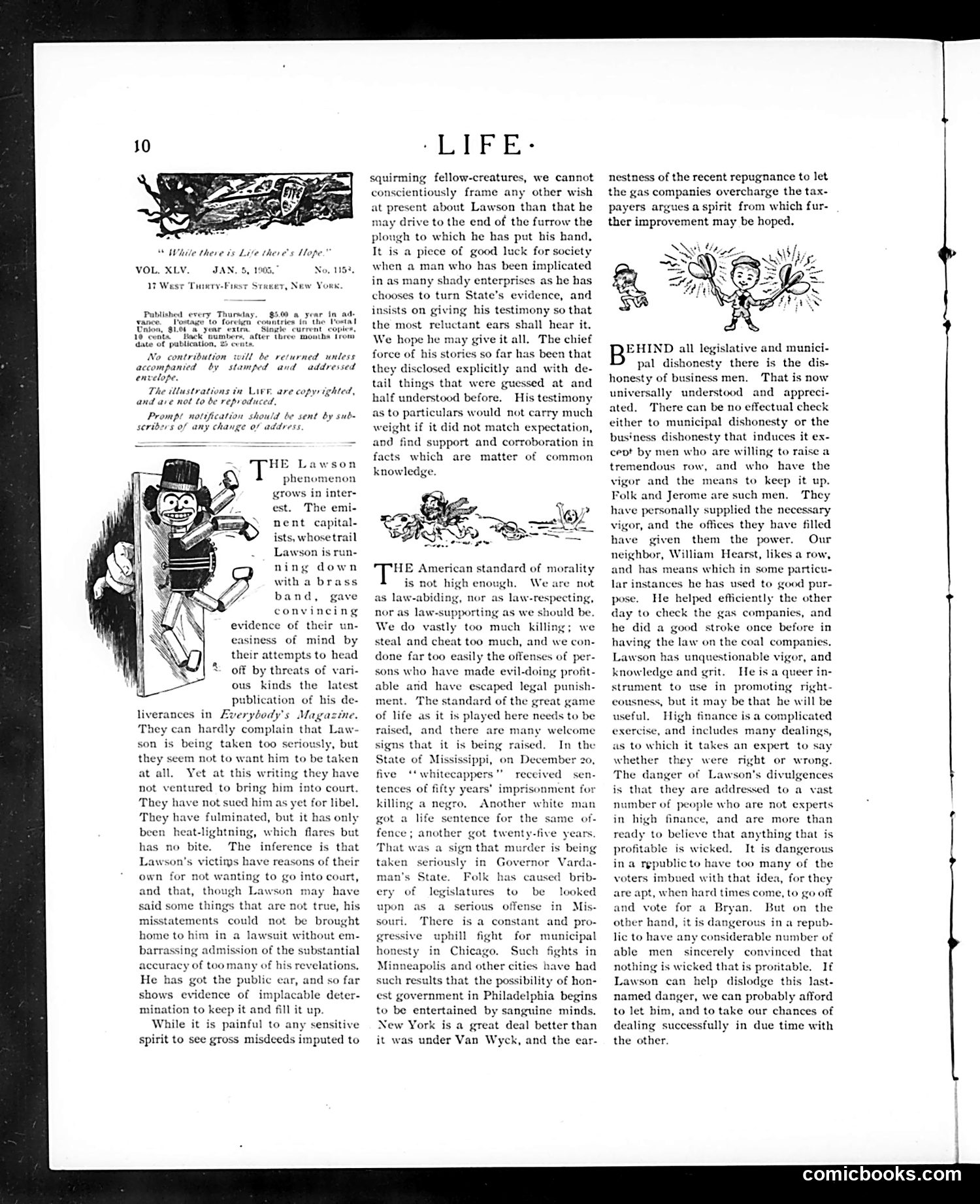
This page from *Life* magazine (Vol. XIV, Jan. 5, 1895) contains editorial commentary rather than a political cartoon. The left illustration shows a caricatured figure labeled "The Lawson phenomenon" being publicly ridiculed. The text indicates this refers to someone named Lawson who has been involved in exposing shady business practices but refuses to testify in court about his findings. The editorial criticizes Lawson's reluctance to provide sworn testimony while simultaneously publicizing his allegations. The author argues this behavior undermines credibility and suggests Lawson wants public attention without legal accountability—a common satirical criticism of public figures who make accusations but avoid legal consequences. The page also discusses municipal corruption and dishonesty more broadly, praising individuals like William Hearst for actively combating such practices.
📄 Transcribed text from this page (OCR, searchable)
Machine-transcribed from the original scan — historical spelling and the odd misread are preserved.
“While there is Life there's Hope.” VOL. XLV. 17 West Tuiery-Fiest Streer, New Yors JAN, 5, 1905," No, 15%, € pablication, No contribution accompanied by envelope. Wt be returned untess stamped and addressed The illustrations in Lier. are copyrighted, and ave not to be reproduced. Prompt notification should be sent by sub- seribers of any change of address HE Lawson phenomenon grows in inter- est. The emi- nent capital- ists, whose trail Lawson is run- ning down with a brass band, convincin evidence of their un- easiness of mind by their attempts to head off by threats of vari- ous kinds the latest publication of his de- liverances in Everybody's Magazine. They can hardly complain that Law- son is being taken too seriously, but they seem not to want him to be taken at all, Yet at this writing they have not ventured to bring him into court. They have not sued him as yet for libel. They have fulminated, but it has only been heat-lightning, which flares but has no bite. The inference is that Lawson's victitys have reasons of their own for not wanting to go into court, and that, though Lawson may said some things that are ni misstatements could have true, his not be brought home to him in a lawsuit without em- barrassing admission of the substantial accuracy of toomany of his revelations. He has got the public car, and so far shows evidence of implacable deter- mination to keep it and fill it up. While it is painful to any sensitive spirit to see gross misdeeds imputed to -LIFE- squirming fellow-creatures, we cannot conscientiously frame any other wish at present about Lawson than that be may drive to the end of the furrow the plough to which he has put his hand, t is a piece of good luck for society when a man who has been implicated in as many shady enterprises as he has chooses to turn State’s evidence, and insists on giving his testimony so that the most reluctant ears shall hear it, We hope he may give it all. The chief force of his stories so far has been that they disclosed explicitly and with de- tail things that were guessed at and half understood before. His testimony as to particulars would not carry much weight if it did not match expectation, and find support and corroboration in facts which are matter of common knowledge. Vey a O Tee a HE American st is not high enough. ndard of morality We are not ding, nor as law-respecting, 5 law-supporting as we should be We do vastly too much killin; steal and cheat too much, and we con- done far too y the offenses of per- sons who have made evil-doing protit- able atid have escaped legal punish- ment. The standard of the great game of life as it is played here needs to be raised, and there are man signs that it is being raised. welcome In the ate of Mississippi, on December 20, five ‘‘whitecappers” received tences of fifty years’ imprisonment for killing a negro. Another white man got a life sentence for the fence; another got twenty That was a sign that n: taken seriously in Gov 1's State. Folk legislatures to be as a serious offense in There is a constant and pro- uphill fight for municipal honesty in Chicago. Such fights in Minneapolis and other cities have had such results that the possibility of hon- est government in Philadelphia begins to be entertained by sanguine minds. New York is a great deal better than it was under Van Wyck, and the ear- sen- me of five years arder is being nor Varda- brib- looked Mis- has caused souri. gressive nestness of the recent repugnance to let the gas companies overcharge the tax- payers argues a spirit from which fur- ther improvement may be hoped. EHIND all legis pal dishonesty there is the dis- honesty of business men. That is now universally understood and appreci ated. There can be no effectual check either to municipal dishonesty or the business dishonesty that induces it ex- cept by men who are willing to raise a tremendous row, and who have the vigor and the means to keep it up. Folk and Jerome are such men, They have personally supplied the necessary vigor, and the offices they have filled have given them the power, Our neighbor, William Hearst, likes a row, and has means which in some particu- lar instances he has used to good pur- pose. He helped efficiently the other day to check the gas companies, and he did a good stroke once before in having the law on the coal companies. Lawson has unquestionable vigor, and knowledge and grit. He is a queer in- strument to use in promoting right- cousness, but it may be that he will be High finance is a complicated exercise, and includes many dealings, as to which it takes an expert to say whether they were right or wrong. The danger of I is that they useful. wson's divulgences re addressed to a vast number of people who are not experts in high finance, and are more than ready to believe that anything that i profitable is wicked. It is dangerous in a republic to have too many of the voters imbued with that idea, for they are apt, when hard times come, to go off and vote for a Bryan. But on the other hand, it is dangerous in a repub- lic to have any considerable number of able men sincerely convinced that nothing is wicked that is proritable. If Lawson can help dislodge this last- named danger, we can probably afford to let him, and to take our chances of dealing successfully in due time with the other. comicbooks.com