
Life, 1905-01-05 · page 22 of 36
Life — January 5, 1905 — page 22: what you’re looking at
What you’re looking at
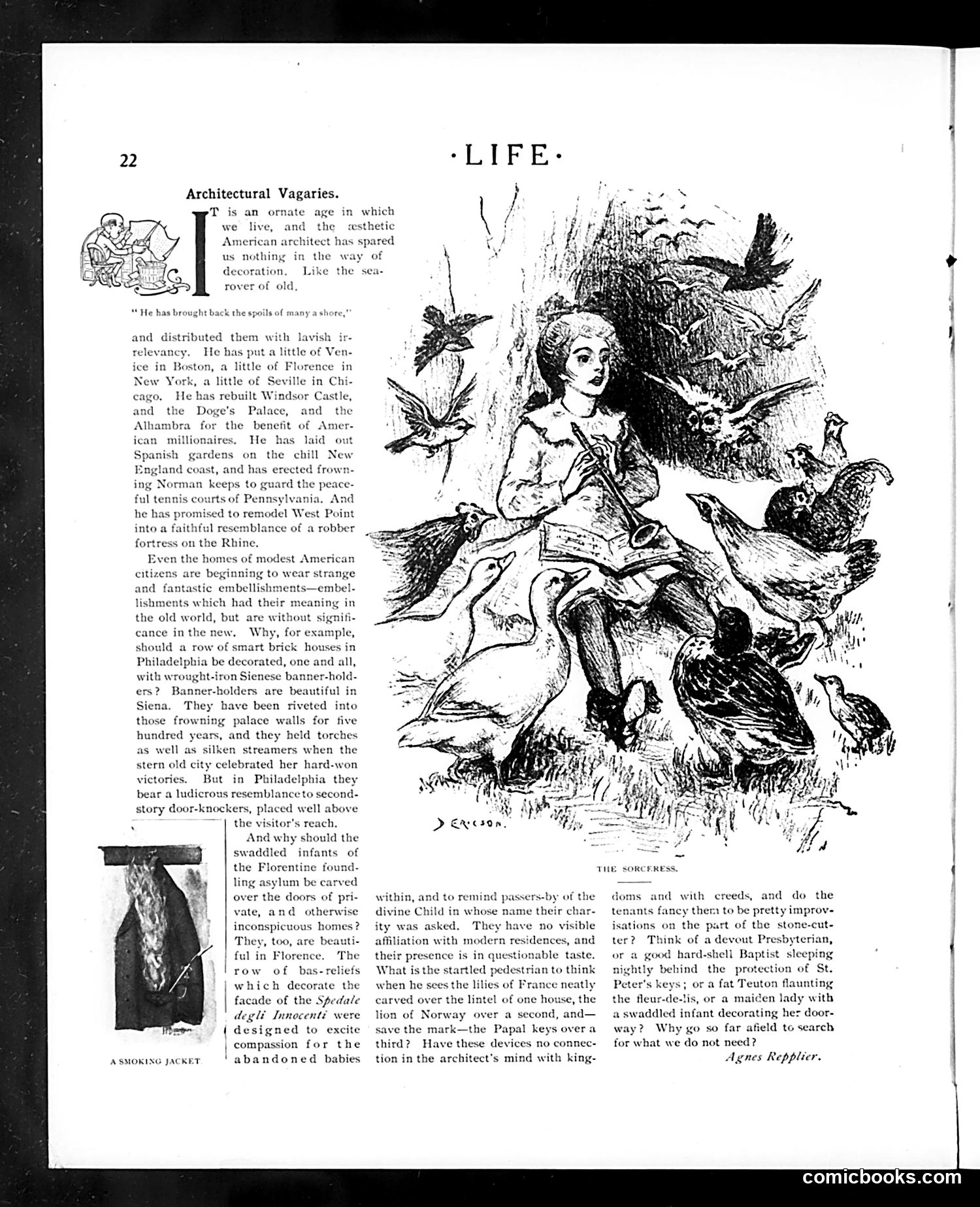
This article by Agnes Repplier satirizes wealthy American architects and homeowners who indiscriminately copy European architectural ornaments without understanding their original meaning or context. The piece attacks a specific architect (likely Stanford White, though unnamed) who has scattered Italian, Spanish, and Norman elements across America—banner-holders from Siena, foundling-hospital reliefs from Florence, Papal keys, Norwegian lions, and French fleur-de-lis on Philadelphia rowhouses. Repplier's satire targets the absurdity: these decorative elements are meaningless in American homes. A banner-holder designed to hold medieval torches becomes a ridiculous door-knocker. Symbols of Catholic charity or European nobility serve no purpose on Presbyterian or Baptist homes. The illustration "The Sorceress" appears to accompany this critique of imported artificiality, suggesting the almost magical spell these foreign styles cast over American taste. Repplier argues Americans should develop their own architectural identity rather than slavishly copying Europe's historical ornamentation.
📄 Transcribed text from this page (OCR, searchable)
Machine-transcribed from the original scan — historical spelling and the odd misread are preserved.
A SMOKING Architectural Vagaries. ation, Like the of old, de rover ack the spoils of relevancy. He has put ice in Boston, a little little of cago. and th the Alhambra for the benefit of Amer- ican millionaire: He laid out Spanish gardens on the chill Ne and has erected f ing Norman keeps to g’ ful tennis urts of Pennsyly. sed to remodel West Point into a faithful resemblance of a robber fortress on the Rhine. Even the homes of modest American citi are beginning to wear strange and fantastic embellishments—embe lishments which had their meaning the old world, but are with: cance in the new. Why, for example, should a row of smart brick houses in Philadelphia be decorated, one and all, with wrought-iron Sienese banner-hold- ers? Banner-holders are beautiful in Siena, They have been riveted into those frowning palace walls for five hundred years, and they held torches as well as silken streamers when the stern old city celebrated her hard-won But in Philadelphia they bear a ludicrous resemblance to second- story door-knockers, placed well above . ~~") the visitor's reach, And why should the swaddled infants of the Florentine found- ling asylum be carved over the doors of pri- and inconspicuous homes? They, too, are beauti- ful in Florence. The row bas- reliefs which decorate the facade of the Spedale deglé Innocenti were designed to excite compassion for the abandoned babies at signifi- victories. vate, otherwise of JACKET T is an ornate age in which f , we live, and the «esthetic H American architect has spared S$ us nothing in the way of sea- within, and to remind passers-by of the divine Child in whose name their t ity was asked. They have no visible affiliation with modern residences, and their presence is in questionable taste. What is the startled pedestrian to think when he sees the lilies of re neatly ra carved over the lintel of one house, the lion of Norway over save the mark—the Papal keys over a third? Have these devices no connec- tion in the architect's mind with king- a second, and— THE SORCERESS, and with creeds, and do the tenants fancy ther to be pretty improv isations on the t of the stone-cut- ter? Think of a devout Presbyterian, or a good hard-shell Baptist sleeping nightly behind the protection of St. Peter's keys; or a fat Teuton flaunting the fleur-de-lis, or a maiden lady with a swaddled infant decorating her door- ay? Why go so far afield to search for what we do not need? Agnes Repplier. doms, v comicbooks.com