
Life, 1905-01-05 · page 4 of 36
Life — January 5, 1905 — page 4: what you’re looking at
What you’re looking at
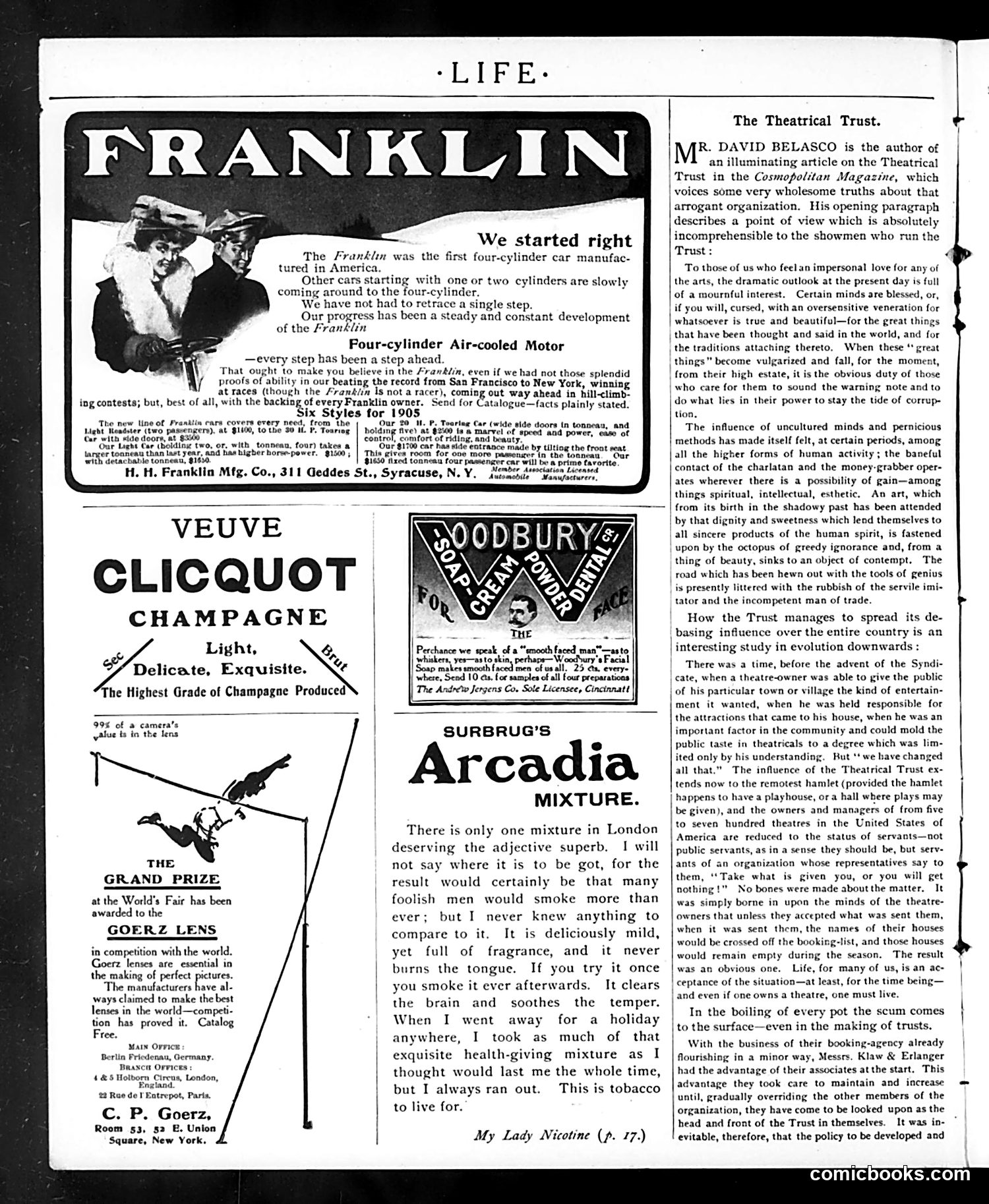
This page is primarily **advertising**, not political cartoon content. The main advertisements are: - **Franklin automobiles** (top): promoting their four-cylinder, air-cooled motor as superior technology - **Veuve Clicquot Champagne** (left): luxury goods marketing - **Woodbury's Soap** (center): beauty product advertisement - **Surbrug's Arcadia Mixture** (center-right): tobacco product The only editorial content is "The Theatrical Trust" article (right), which **does contain social criticism**. It criticizes an unnamed theatrical organization's monopolistic control over American theaters, describing how they manipulated public taste and prevented independent theater management. The author argues the Trust abused power and exploited theater owners. The page reflects early 1900s concerns about corporate monopolies controlling American industries, but it's fundamentally a commercial publication featuring luxury goods.
📄 Transcribed text from this page (OCR, searchable)
Machine-transcribed from the original scan — historical spelling and the odd misread are preserved.
FRANKLIN We started right The Frankin was the first four-cylinder car manufac- tured in America. Other cars starting with one or two cylinders are slowly coming around to the four-cylinde . We have not had to retrace ingle step. Our progress has been a steady and constant development of the Franklin Pour-cylinder Air-cooled Motor —every step has been a step ahead. That ought to make you believe in the Fravsdin, even if we had not those splendid proofs of ability in our beating the record from San Francisco to New York, winning at races (though the Frankiim Is not a racer), coming out way ahead in hill-climb- ingcontests; but, best ofall, with the backing of eyery Franklin owner, ‘Send for Catalogue—facts plainly stated. ix Styles for 1905 ‘The new line of Franktin cars covers every need, from the t Keadsier (two passengers), at $1109, to the 30 Mt. P. T Car with side doors, at $300 ur Bo IP. Tearag Car (wide a8 doors (n toanee noid eral career loner, snd ae ore ae tne mae Se BOT Ss te, or. with tonaenn, four taten« | Meier elt Rasen eee TGs we niee the onto Mae ee nes eaten ene SES | aq oetrencae poe eatrnce me by Ultog the foot eat with detachable tonneau, $1630. $1650 fixed tonneau four pamenger car will be a prime favorite. H. H. Franklin Mfg. Co., 311 Geddes St., Syracuse, N.Y. (nes ihtecyition Licensed + Automobile “Manufacturers, VEUVE CLICQUOT CHAMPAGNE THE .-— Light, q ag of re ee Sohn Wet iF i 5, Soap makes emooth faced men of vsall. 25 ~ Delicate, Exquisite | Seat (0 an (er mane call (ce procntoe The Highest Grade of Champagne Produced The Andrew Jergens Co. Sote Licensee, Cincinnatt | | Perchance we speak of a iS youl rp man”. | 99% of a camera's value ts in the lens SURBRUG’S Arcadia MIXTURE. There is only one mixture in London deserving the adjective superb. I will not say where it is to be got, for the result would certainly be that many foolish men would smoke more than ever; but I never knew anything to compare to it. It is deliciously mild, yet full of fragrance, and it never burns the tongue. If you try it once THE GRAND PRIZE at the World's Fair has been awarded to the GOERZ LENS in competition with the world. Goerz lenses are essential in the making of perfect pictures. t The manufacturers have al- | you smoke it ever afterwards. It clears ways claimed to make the best | the brain and soothes the temper. lenses in the world—competi- a : tion has proved it, Catalog When I went away for a_ holiday Free. anywhere, I took as much of that MaIx Ornice Dos ale : Berlin Fricdenau, Germany. exquisite health-giving mixture as I Braxcit Orvices : 4&5 Holborn Circus, London, England, 2 Reo dol Entrepot, Parts, C. P. Goerz, Room 53, 2 E. Union Square, New York. thought would last me the whole time, but I always ran out. This is tobacco to live for. | My Lady Nicotine (p. 17.) The Theatrical Trust. R. DAVID BELASCO is the author of an illuminating article on the Theatrical Trust in the Cosmopolitan Magazine, which | voices some very wholesome truths about that arrogant organization. His opening paragraph describes a point of view which is absolutely incomprehensible to the showmen who run the Trust : To those of us who feelan impersonal love for any of the arts, the dramatic outlook at the present day is full of a mournful interest. Certain minds are blessed, or, if you will, cursed, with an oversensitive veneration for whatsoever is true and beautiful—for the great things that have been thought and said in the world, and for the traditions attaching thereto, When these * great things” become vulgarized and fall, for the moment, from their high estate, it is the obvious duty of those who care for them to sound the warning note and to do what lies in their power to stay the tide of corrup- tion, The influence of uncultured minds and pernicious methods has made itself felt, at certain periods, among all the higher forms of human activity; the baneful contact of the charlatan and the money-grabber oper- ates wherever there is a possibility of gain—among things spiritual, intellectual, esthetic. An art, which from its birth in the shadowy past has been attended by that dignity and sweetness which lend themselves to all sincere products of the human spirit, is fastened upon by the octopus of greedy ignorance and, from a thing of beauty, sinks to an object of contempt, The road which has been hewn out with the tools of genius is presently littered with the rubbish of the servile imi- tator and the incompetent man of trade. How the Trust manages to spread its de- basing influence over the entire country is an interesting study in evolution downwards : There was a time, before the advent of the Syndi- cate, when a theatre-owner was able to give the pub! | of his particular town or village the kind of entertain- ment it wanted, when he was held responsible for the attractions that came to his house, when he was an important factor in the community and could mold the public taste in theatricals to a degree which was lim- ited only by his understanding. Rut ‘we have changed all that.” The influence of the Theatrical Trust ex- tends now to the remotest hamlet (provided the hamlet | happens to have a playhouse, or a hall where plays may | be given), and the owners and managers of from five |to seven hundred theatres in the United States of America are reduced to the status of servants—not public servants, as in a sense they should be, but serv- ants of an organization whose representatives say to them, Take what is given you, or you will get nothing !"" No bones were made about the matter. It was simply borne in upon the minds of the theatre- owners that unless they accepted what was sent them, when it was sent them, the names of their houses would be crossed off the booking-list, and those houses would remain empty during the season. The result was an obvious one. Life, for many of us, is an ac- | ceptance of the situation—at least, for the time being— and even if one owns a theatre, one must live. In the boiling of every pot the scum comes to the surface—even in the making of trusts. With the business of their booking-agency already flourishing in a minor way, Messrs, Klaw & Erlanger had the advantage of their associates at the start. This advantage they took care to maintain and increase until, gradually overriding the other members of the organization, they have come to be looked upon as the head and front of the Trust in themselves. It was in- evitable, therefore, that the policy to be developed and comicbooks.com