
Life, 1905-01-05 · page 24 of 36
Life — January 5, 1905 — page 24: what you’re looking at
What you’re looking at
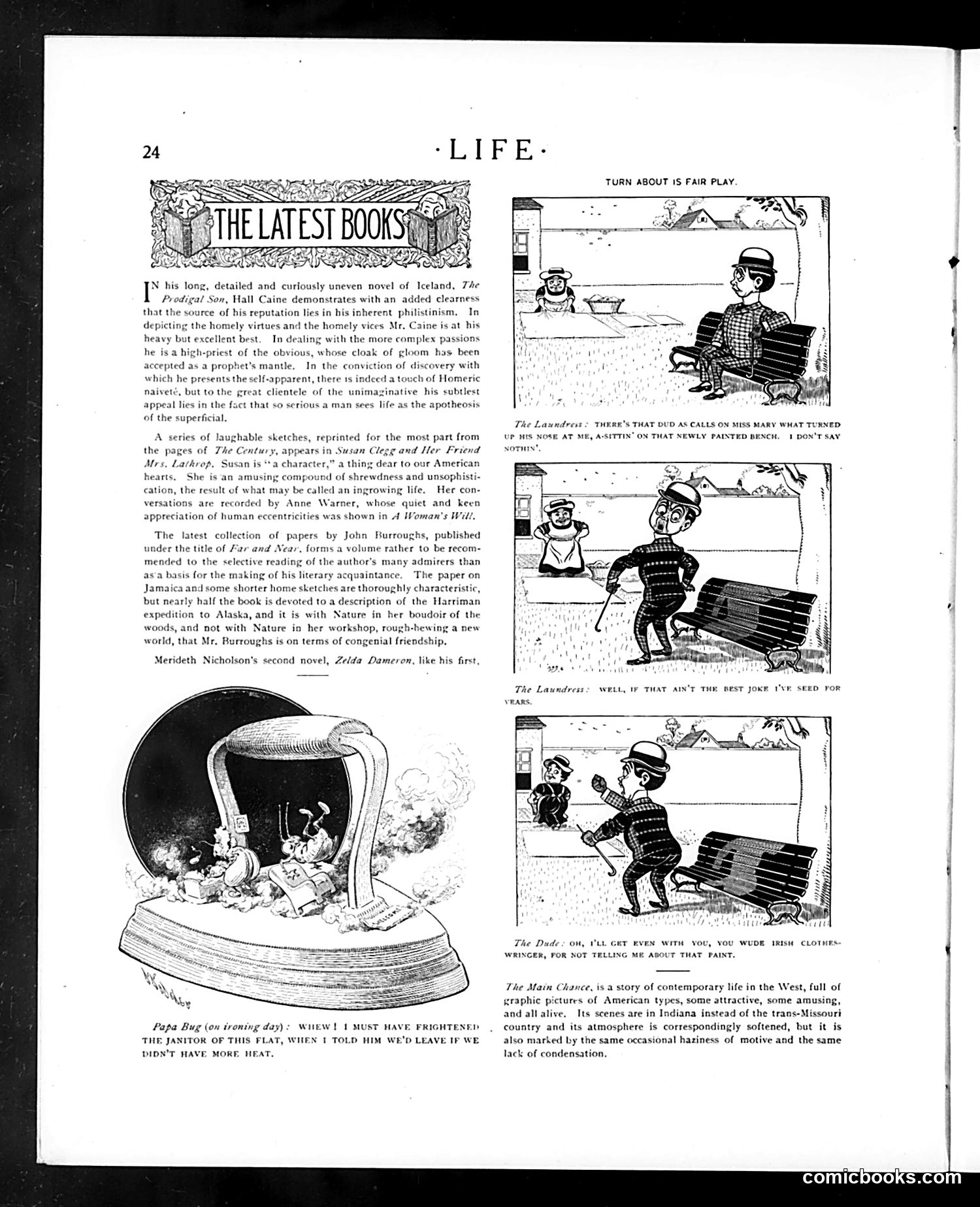
This page combines literary criticism with humorous comic strips depicting working-class domestic life. The title "Turn About Is Fair Play" appears to reference the comics below, which show servants or working people getting revenge on their employers or social betters. The three illustrated strips feature dialect-heavy dialogue typical of early 20th-century American humor: a laundress complaining about a woman who snubbed her, and a domestic worker threatening retaliation against an employer over paint damage. The "Papa Bug" cartoon at left shows an exasperated tenant threatening to leave over inadequate heat. These comics mock both the servants' resentment of class treatment and the employers' obliviousness. The page's upper section reviews contemporary novels by Hall Caine, John Burroughs, and Meredeth Nicholson—serious literary criticism contrasted sharply against the lowbrow humor below, itself perhaps satirizing Life's mixed readership.
📄 Transcribed text from this page (OCR, searchable)
Machine-transcribed from the original scan — historical spelling and the odd misread are preserved.
TURN ABOUT IS FAIR PLAY. I his long, detailed and curiously uneven novel of Iceland, 7he Prodigal Son, Hall Caine demonstrates with an added clearness that the source of his reputation lies in his inherent philistinism, In depicting the homely virtues and the homely vices Mr, Caine is at his heavy but excellent best. In dealing with the more complex passions he isa high-priest of the obvious, whose cloak of gloom has been accepted as a prophet’s mantle. In the conviction of discovery with which he presents the self-apparent, there 1s indeed a touch of Homeric tive his subtlest naiveté, but to the great clientele of the unimazir appeal lies in the fact that so serious a man sees life as the apotheosis of the superficial. The Laundrest ! THERE'S THAT DUD AS CALLS ON MISS MARY WHAT TURNED series of laughable sketches, reprinted for the most part {rom UP _ MIS NOSE AT ME, A-SITTIN’ ON THAT NEWLY PAINTED BENCH. 1 DON'T SAY pages of The Century, appears in Susan Clegg and Her Friend NoTwy’. 5 the Mrs, Lathrop, Susan is “a character,” a thing dear to our Ameri hearts, She is an amusin, cation, the result of what may be called an ingrowing life. Her con- corded by Anne Warner, whose quiet and keen compound of shrewdness and unsophisti- versations are appreciation of human eccentricities was shown in A Woman's Will, The latest collection of papers by John Burroughs, published under the title of Far and Near, forms a volume rather to be recom- mended to the selective reading of the author's many admirers than as'a basis for the making of his literary acquaintance. The paper on Jamaica and some shorter home sketches are thoroughly characteristic, but nearly half the book is devoted to a description of the Harriman expedition to Alaska, and it is with Nature in her boudoir of the woods, and not with Nature in her workshop, rough-hewing a new world, that Mr. Burroughs is on terms of congenial friendship, Merideth Nicholson's second novel, Zelda Dameron, like his first, The Dude WUDE IRISH CLOTHES: WRINGER, FOR NOT TELLING ME AGOUT THAT PAINT. OM, VLL GeT EVEN wiTH vou, you The Main Chance, isa story of contemporary life in the West, full of graphic pictures of American types, some attractive, some amusing, and all alive, Its scenes are in Indiana instead of the trans-Missouri Papa Bug (on troning day): WHEW! 1 MUST HAVE FRIGHTENED | country and its atmosphere is correspondingly softened, but it is THE JANITOR OF THIS FLAT, WHEN 1 TOLD HIM WE'D LEAVE IF WE also marked by the same occasional haziness of motive and the same DIDN'T HAVE MORE HEAT. lack of condensation. ate comicbooks.com