
Life, 1905-01-05 · page 12 of 36
Life — January 5, 1905 — page 12: what you’re looking at
What you’re looking at
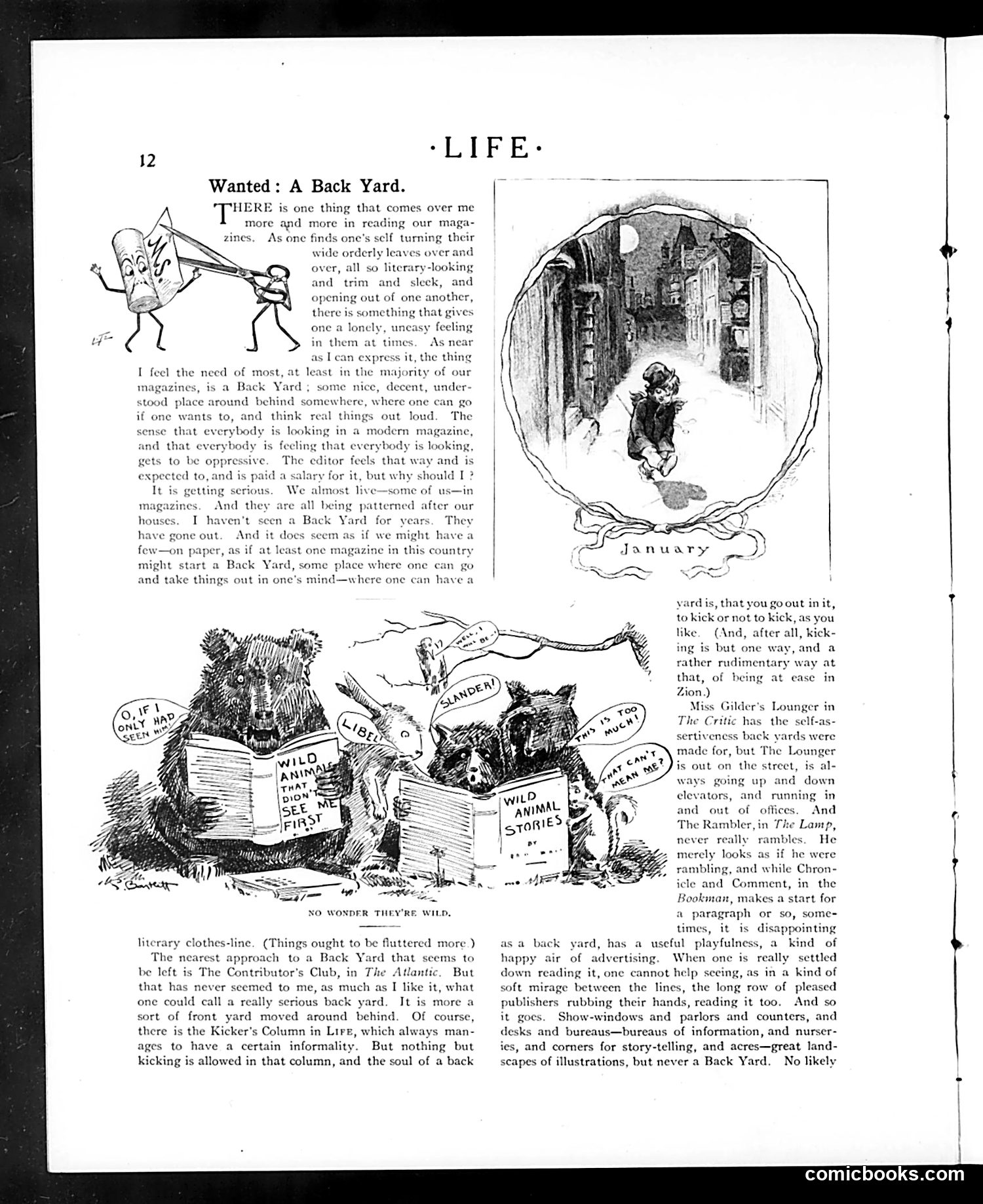
This page satirizes the absence of back yards in early 20th-century urban magazine culture. The author laments that magazines—patterned after houses—have lost their "back yards," those informal spaces where one could relax away from public scrutiny. The cartoon shows two animals (a bear and what appears to be a fox or similar creature) reading "Wild Animal Stories," humorously illustrating the point that even fictional narratives lack informal, comfortable spaces. The illustration labeled "January" depicts a solitary figure in an urban alley or narrow passage, visually reinforcing the author's complaint about cramped city living without private outdoor space. The satire critiques how modern magazines, like contemporary homes, have become overly formal and "literary-looking," losing the casual accessibility of earlier publications.
📄 Transcribed text from this page (OCR, searchable)
Machine-transcribed from the original scan — historical spelling and the odd misread are preserved.
Wanted: A Back Yard. HERE is one thing that comes over me more and more in reading our maga- zines. As one finds one’s self turning their wide orderly leaves over and over, all so literary-looking and trim and sleck, and op there is somethir ning out of one anothe at gives: one a lonely, uncasy feeling in them at times. As near as Lean express it, the thing I feel the necd of most, at least in the majority of our magazines, is a Back Yard ; some nice, decent, under- stood place around behind somewhere, where one can go if one wants to, and think real things out loud. The sense that everybody is looking in a modern magazine, and that everybody is fecling that everybody is looking, gets to be oppressive. The editor feels that way and is expected to, and is paid a sal It is getting serious. W ry for it, but why should I? almost live—some of us—in magazines. And they are all being patterned after houses. I haven't seen ur Back Yard for years. They have gone out. And it docs seem as if we might h 1g lace where one can go where one can have a vea few—on paper, as if at least one rt might start a Back Yard, some and take things out in one’s mir ne in this country literary clothes The neare: ach to a Back Yard that seems to be left is The Contributor's Club, in The Atlantic. But that has never seemed to me, as much as I like it, what one could call a really serious back yard. It is more a sort of front yard moved around behind. Of course, there is the K: t's Column in Lire, which always man- ages to have a certain informality. But nothing but kicking is allowed in that column, and the soul of a back *LIFE< yard is, that you go out in it, to kick or not to kic like. (And, after all, ing is but one way rather rudimentary way at that, of being at ease in Zion.) Miss Gilder’s Lounger in The Critic has the self-as- sertiveness back yards were made for, but The Lounger is out on the street, is al- ways going up ¢ and down elevators, and running in and out of offices. And The Rambler, in The Lamp, never really rambles. He merely looks as if he were rambling, and while Chron- icle and Comment, in the Bookman, makes a start for a paragraph or so, some= times, it is disappointing asa back yard, has a useful playfulness, a kind of happy air of advertising, When one is really settled down reading it, one cannot help sceing, as in a kind of soft mirage between the lines, the long row of pleased publishers rubbing their hands, reading it too. And so it goes. Show-windows and parlors and counters, and desks and bureaus—bureaus of information, and nurset ies, and corners for story-telling, and acres—great land- scapes of illustrations, but never a Back Yard. No likely comicbooks.com