
Life, 1905-01-05 · page 13 of 36
Life — January 5, 1905 — page 13: what you’re looking at
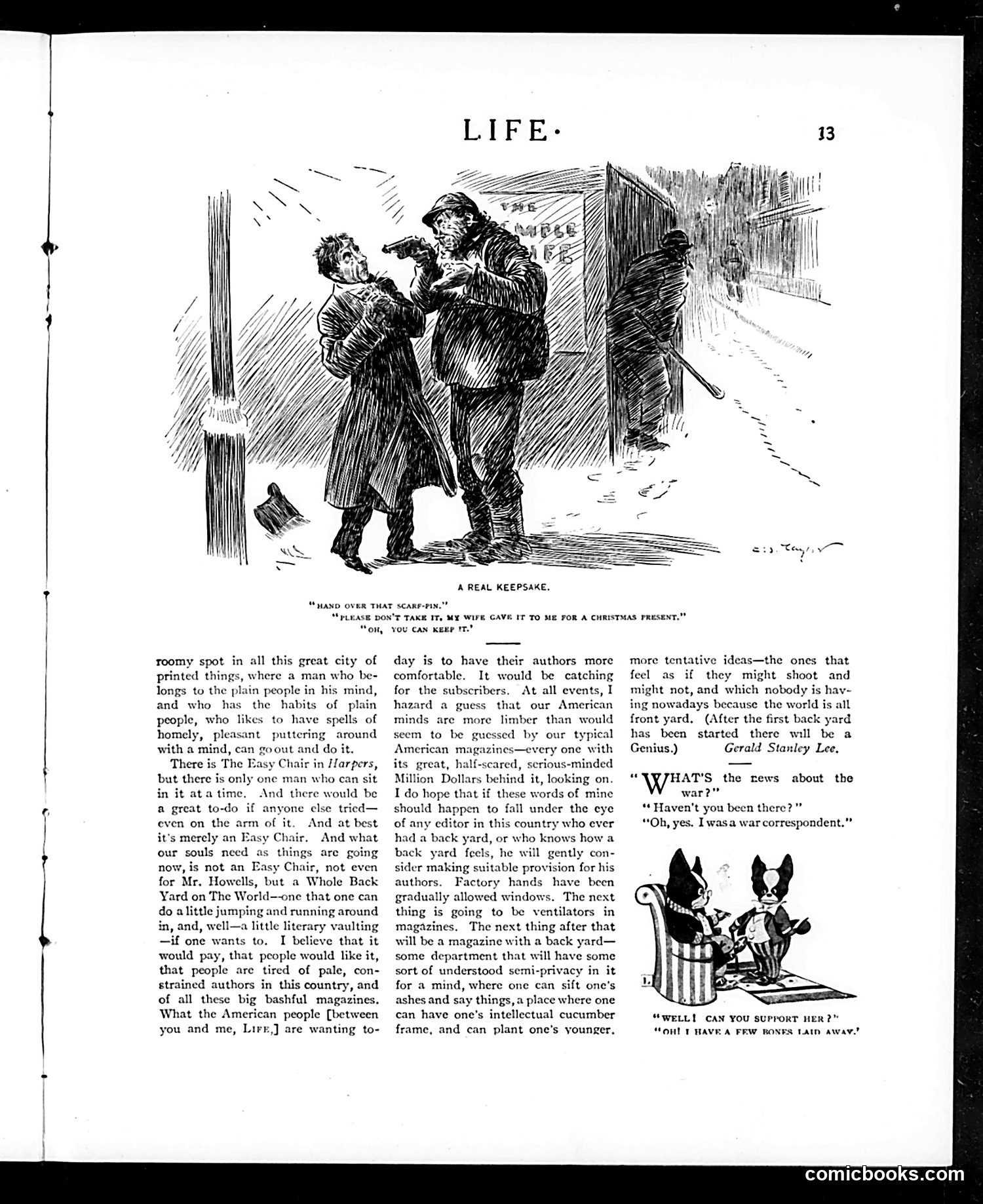
What you’re looking at
The top cartoon titled "A Real Keepsake" depicts a street robbery. A man is being accosted by a thief who demands a scarf-pin (a decorative pin worn on neckties). The victim protests that his wife gave it to him as a Christmas present, but the thief allows him to keep it anyway—a darkly humorous twist on the expected mugging. The accompanying article by Gerald Stanley Lee critiques American magazines as overly formal and constrained. He argues that magazine editors should provide authors with more creative freedom—metaphorically, a "back yard" where minds can roam freely rather than remaining confined to the "front yard" of respectable, cautious publication. The bottom cartoon shows a war correspondent being propositioned, apparently about supporting a woman. His reply—"I have a few bones laid away"—is a crude sexual joke about having savings or resources. Both pieces reflect early 20th-century attitudes about male independence, urban danger, and bohemian creative freedom.
📄 Transcribed text from this page (OCR, searchable)
Machine-transcribed from the original scan — historical spelling and the odd misread are preserved.
A REAL KEEPSAKE, “MAND OVER THAT SCARF-PIN."" “PLEASE DON'T TAKE IT, MY WIFE GAVE IT TO ME FOR A CHRISTMAS PRESENT.”* “on, You CAN Kexe 1.” Toomy spot in all this great city of printed things, where a man who be- longs to the plain people in his mind, and who has the habits of plain people, who likes to have spells of homely, pleasant puttering around with a mind, can goout and do it. There is The Easy Chair in Harpers, but there is only one man who can sit in it atatime. And there would be a great to-do if anyone else triced— even on the arm of it. And at best it's merely an Easy Chair. And what our souls need as things are going now, is not an E. r, not even for Mr. Howells, but a Whole Back Yard on The World—-one that one can do alittle jumpin; id running around in, and, well—a little literary vaulting —if one wants to. I believe that it would pay, that people would like it, that people are tired of pale, con- strained authors in this country, and of all these big bashful magazines. What the American people [between you and me, Lirr,] are wanting to- day is to have their authors more comfortable. It would be catching for the subscribers. At all events, I hazard a guess that our American minds are more limber than would seem to be guessed by our typical American magazines—every one with its great, half-scared, scrious-minded Million Dollars behind it, looking on. I do hope that if these words of mine should happen to fall under the eye of any editor in this country who ever had a back yard, or who knows how a back yard feels, he will gently con- sider making suitable provision for his authors. Factory hands have been gradually allowed windows. The next thing is going to be ventilators in magazines. The next thing after that will be a magazine with a back yard— some department that will have some sort of understood semi-privacy in it for a mind, where one can sift one’s ashes and say things, a place where one can have one’s intellectual cucumber frame, and can plant one’s younger, more tentative ideas—the ones that feel as if they might shoot and might not, and which nobody is hav- ing nowadays because the world is all front yard, (After the first back yard has been started there will be a Genius.) Gerald Stanley Lee, ce HAT’S the rews war?"* “Haven't you been there?” “Oh, yes. Iwasa war correspondent.” about the “WELLI CAN YOU SUPPORT HER?” “OH! T HAVE A FRW BONES LAID away comicbooks.com