
A complete issue · 64 pages · 1904
Life — December 1, 1904
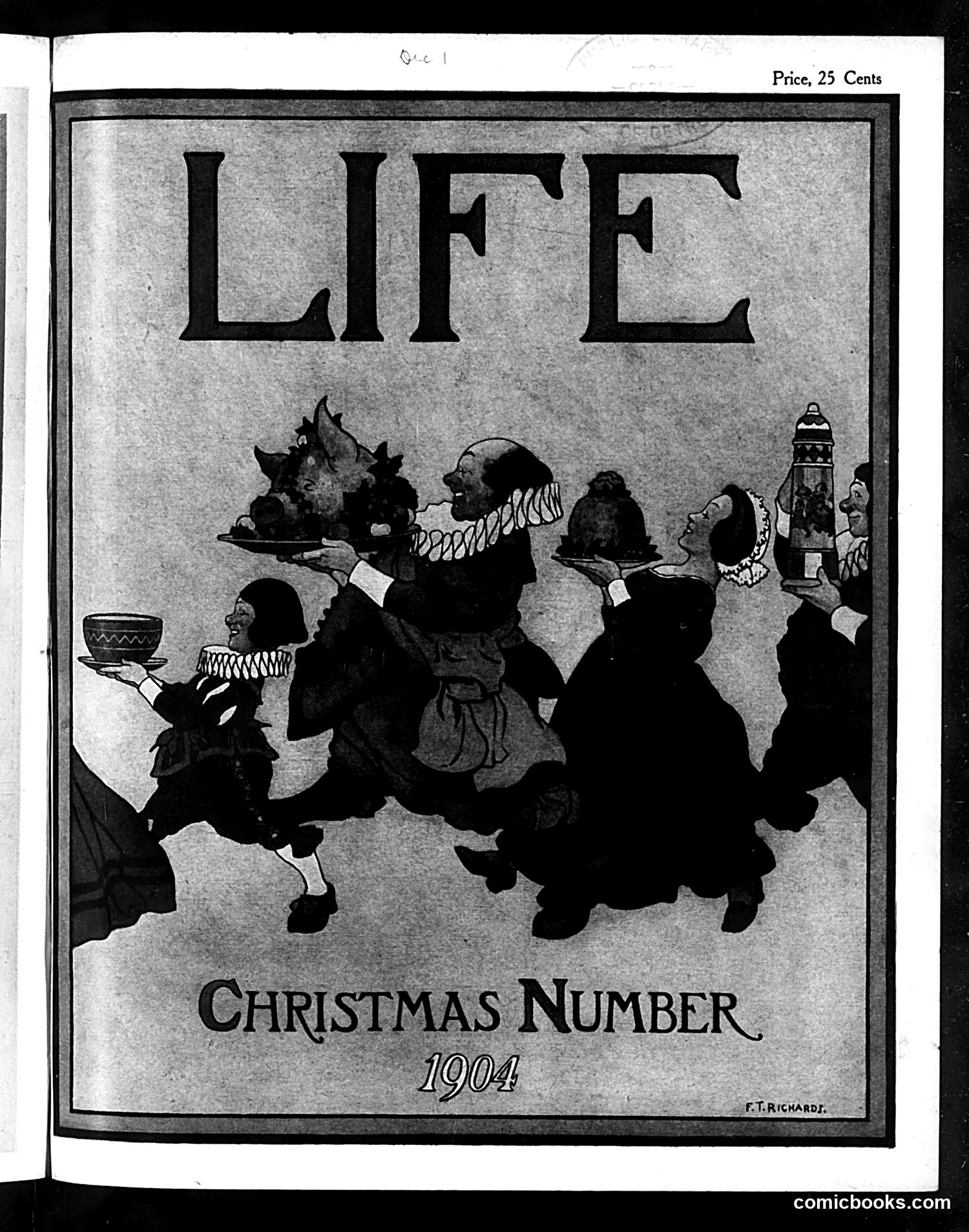
This is the cover of Life's 1904 Christmas issue, priced at 25 cents. The illustration by F.T. Richards depicts what appears to be a festive holiday scene with silhouetted figures in period dress (early 1900s) engaged in Christmas celebration. The figures wear distinctive collars and bonnets typical of the era, and appear to be caroling, feasting, or attending a holiday gathering. The caricatured faces and exaggerated features suggest satirical commentary, though the specific political or social targets are unclear without additional context. The image likely mocks contemporary holiday traditions, social pretensions, or current events of 1904, but the exact references aren't definitively identifiable from the visual alone.
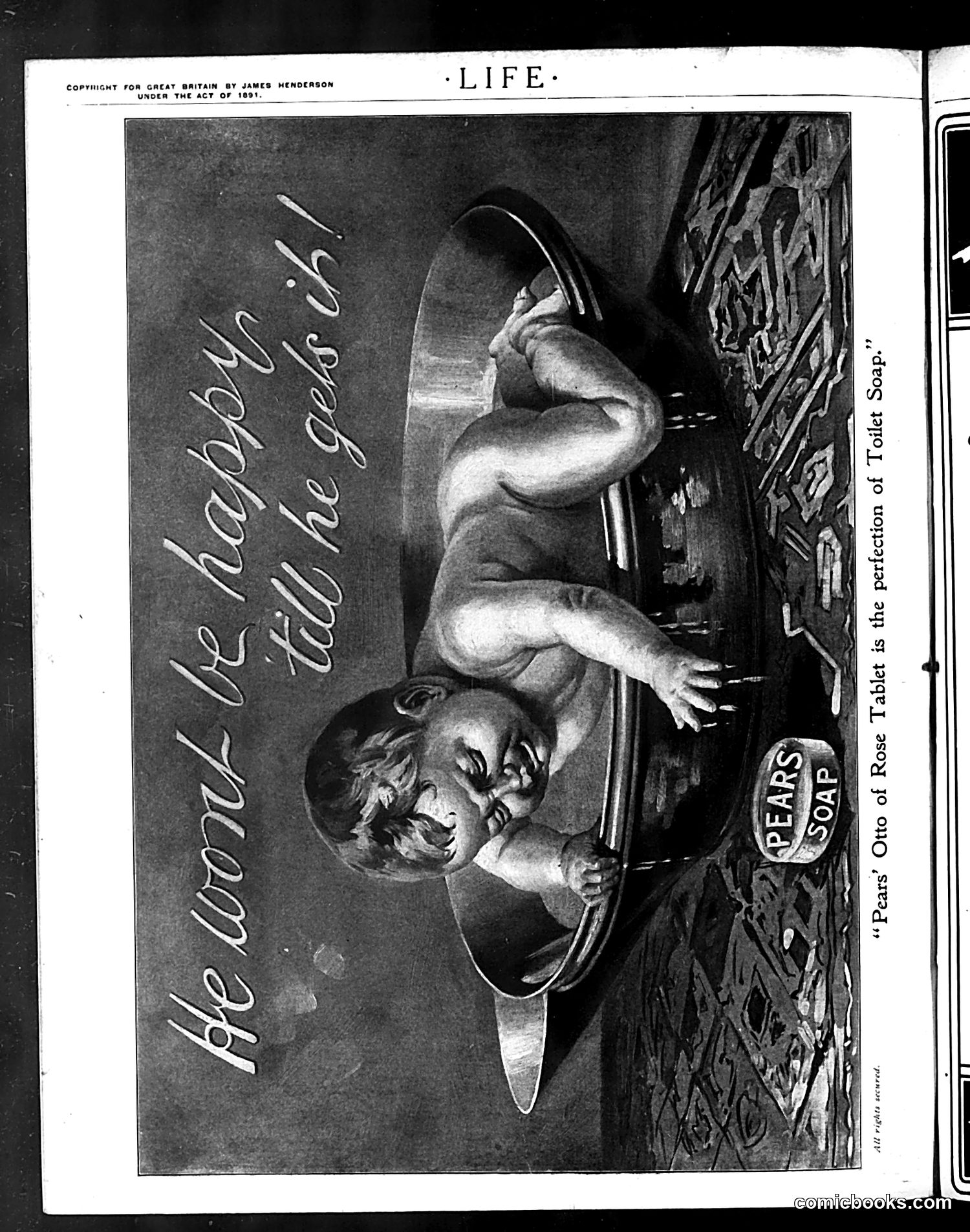
This is a **Pears' Soap advertisement** from Life magazine. The image shows a cherubic child in a bathtub with the text "He won't be happy till he gets it." The advertisement uses a common Victorian/Edwardian marketing strategy: associating soap with cleanliness, childhood innocence, and parental care. The implication is that children desire Pears' Soap specifically, and parents should purchase it to satisfy their offspring and maintain proper hygiene. This represents early consumer advertising that appeals to parental aspirations and child welfare. The cherub figure was a popular trope in advertising of this era, suggesting purity and wholesomeness. For modern readers, it's notable as an example of how brands used emotional appeals and childhood imagery for commercial purposes—a practice that continues today but is now more heavily scrutinized.
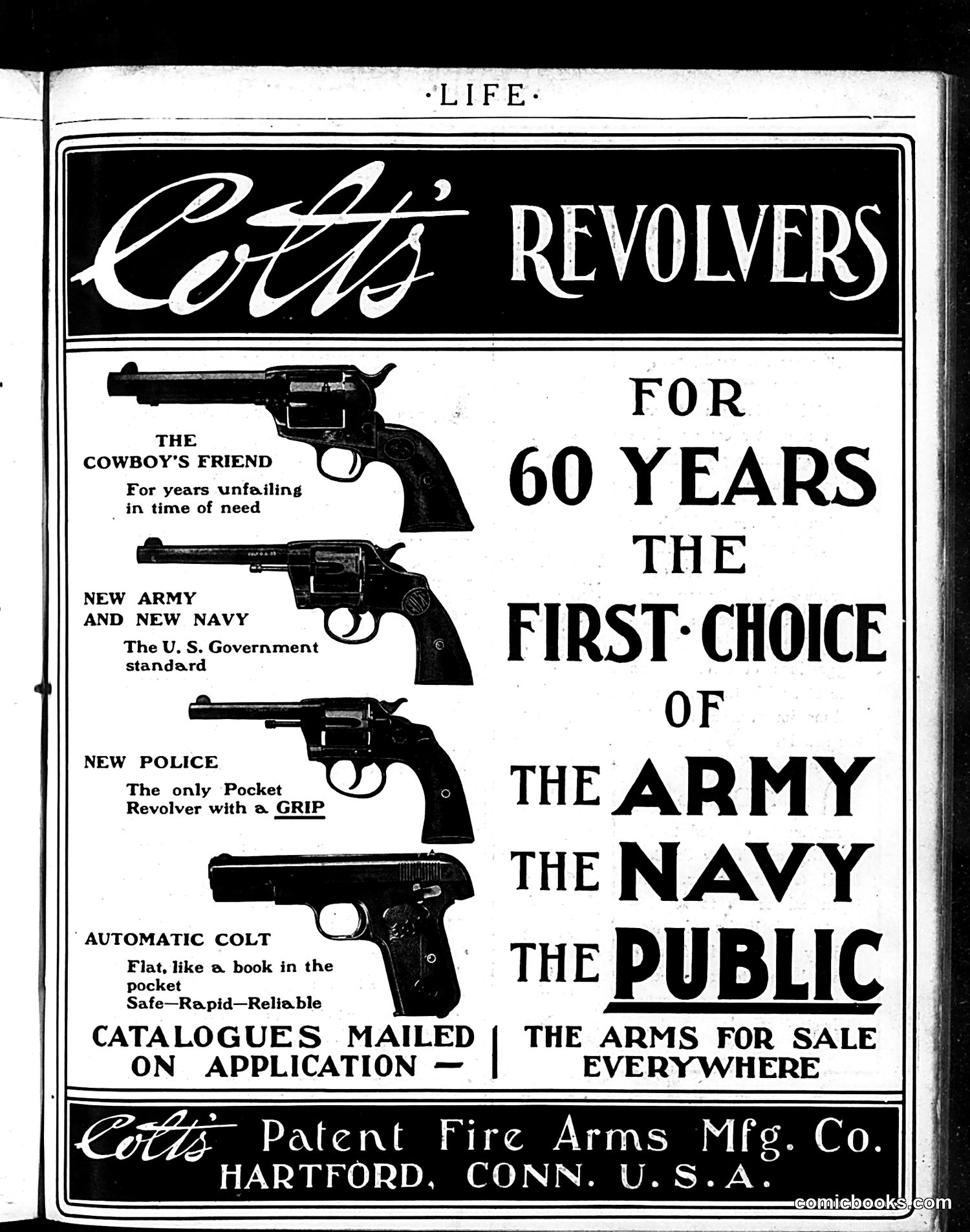
This is a **straightforward product advertisement**, not satire or political commentary. Colt's Patent Fire Arms Manufacturing Company of Hartford, Connecticut advertised their revolvers in *Life* magazine. The ad emphasizes Colt's market dominance by claiming 60 years as "the first choice" of the U.S. Army, Navy, and general public. It showcases four weapon models with marketing copy: the "Cowboy's Friend," the government-standard military revolver, a "New Police" pocket model, and an "Automatic Colt" pistol. The ad promises mail-order catalogs and notes weapons are "for sale everywhere"—reflecting an era when firearm mail-order and retail sales were completely unregulated, before 20th-century firearms restrictions.
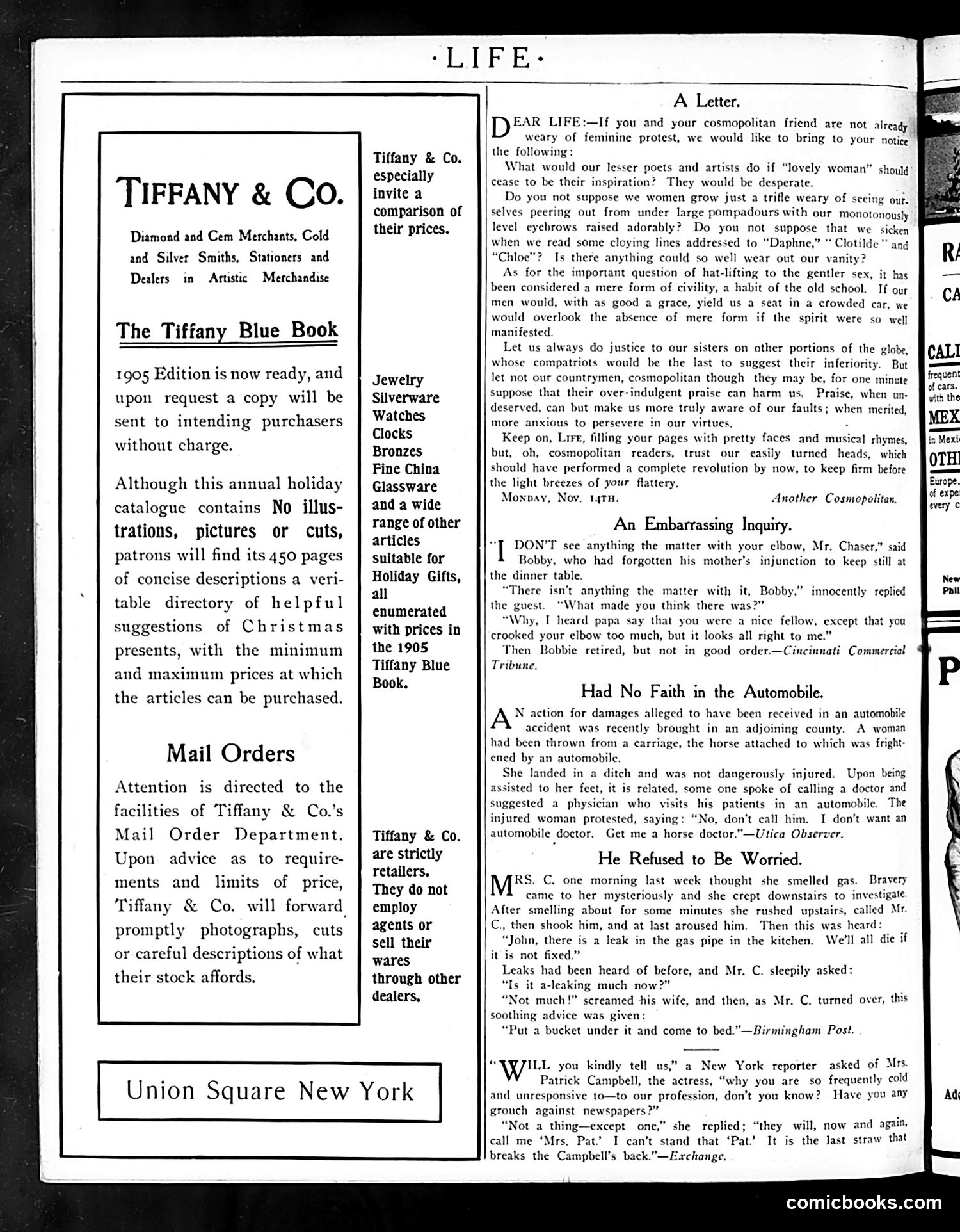
This page is primarily **advertising and miscellaneous content** rather than political cartoons. The left side features a Tiffany & Co. advertisement promoting their 1905 Blue Book catalog for holiday shopping, emphasizing their jewelry, silverware, and luxury goods. The right side contains three brief humorous anecdotes labeled "Another Cosmopolitan": 1. **"A Letter"** - A feminist satire mocking cosmopolitan women's complaints about societal double standards regarding appearance and behavior 2. **"An Embarrassing Inquiry"** - A dinner table joke about a boy's improper elbow etiquette 3. **"Had No Faith in the Automobile"** - A woman's skepticism about automobiles after a horse-related accident 4. **"He Refused to Be Worried"** - A domestic humor piece about a gas leak These are light, social-commentary sketches typical of Life's satirical humor, targeting contemporary manners and emerging technologies rather than serious politics.
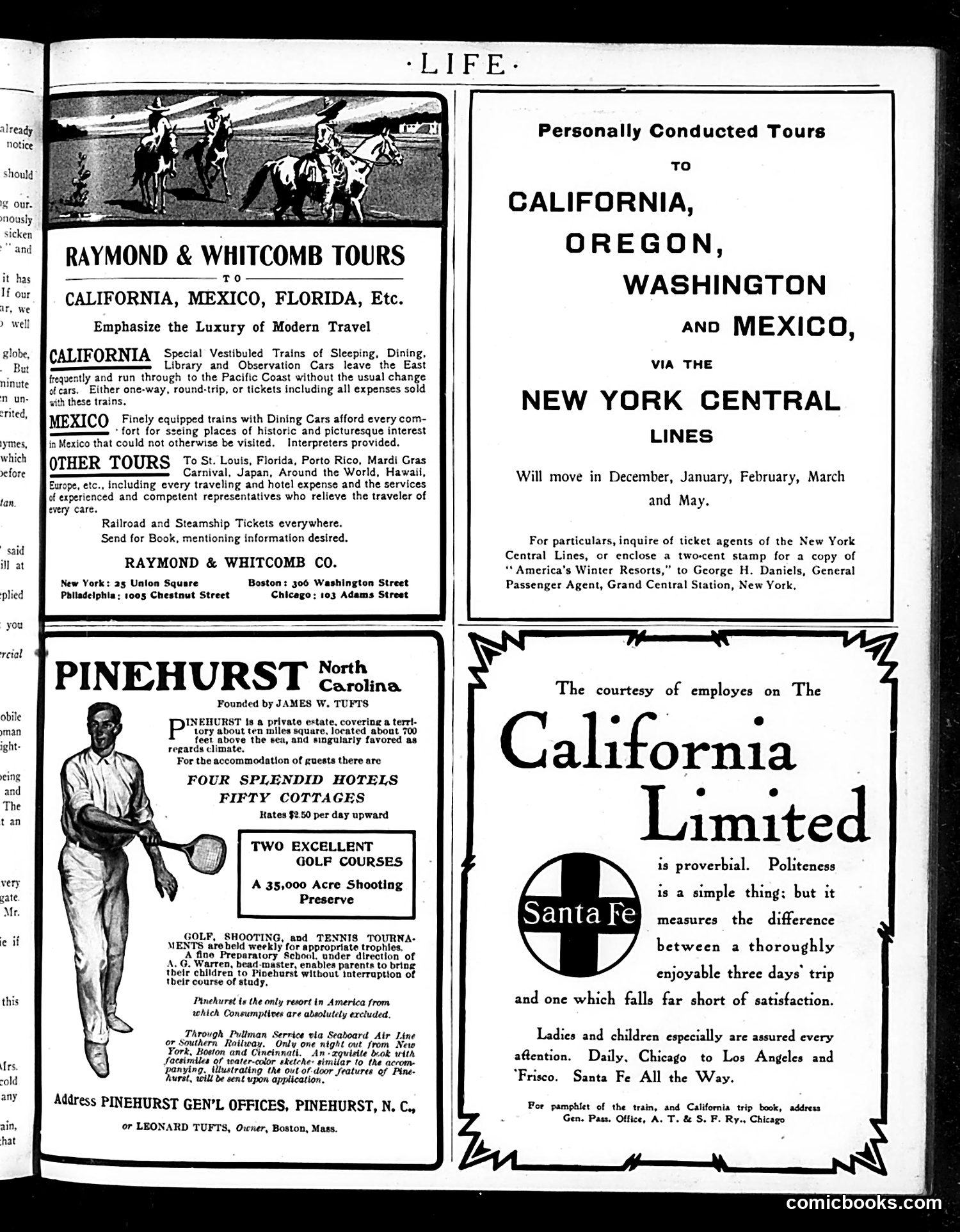
This page consists primarily of **advertisements** rather than editorial cartoons or satirical content. The ads promote: 1. **Raymond & Whitcomb Tours** - luxury travel to California, Mexico, Florida, and other destinations via special trains with sleeping cars 2. **Pinehurst, North Carolina** - a resort featuring golf, shooting, and tennis, with "fifty cottages" available 3. **Santa Fe Railway's California Limited** - a passenger train service emphasizing politeness and quality service to California The only figurative element is an illustration of a **golfer at Pinehurst** - a straightforward promotional image, not satire. There is **no political commentary or satire** visible on this page. It reflects early 20th-century American leisure travel marketing, targeting wealthy readers who could afford railroad excursions and resort stays.
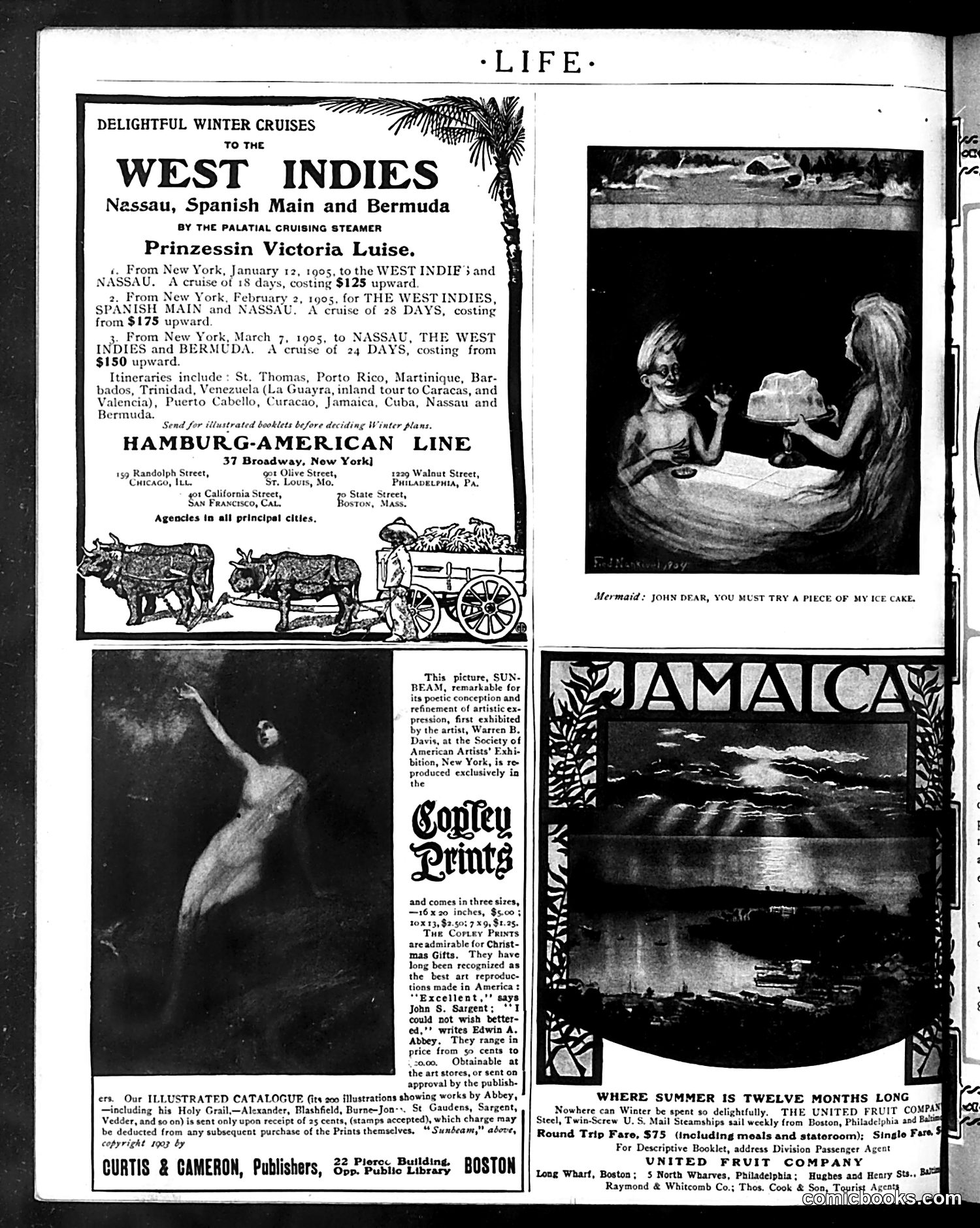
This page is primarily **advertising**, not satire or political commentary. The main content includes: 1. **Hamburg-American Line cruise advertisement** promoting winter Caribbean voyages from New York to the West Indies, Nassau, and Bermuda—typical leisure travel marketing for wealthy Americans. 2. **Corsey Prints advertisement** showcasing artistic nude prints available for purchase, marketed as "Christmas Gifts." 3. **United Fruit Company advertisement** for Jamaica tourism, emphasizing year-round summer weather. 4. **Curtis & Cameron Publishers** promoting illustrated art catalogs. The single illustration (top right) shows a "Mermaid" offering ice cake to "John Dear"—a simple, lighthearted visual pun rather than political satire. This appears to be a standard Life magazine page from the early 1900s focused on commercial ventures and leisure activities for affluent readers, rather than social commentary.
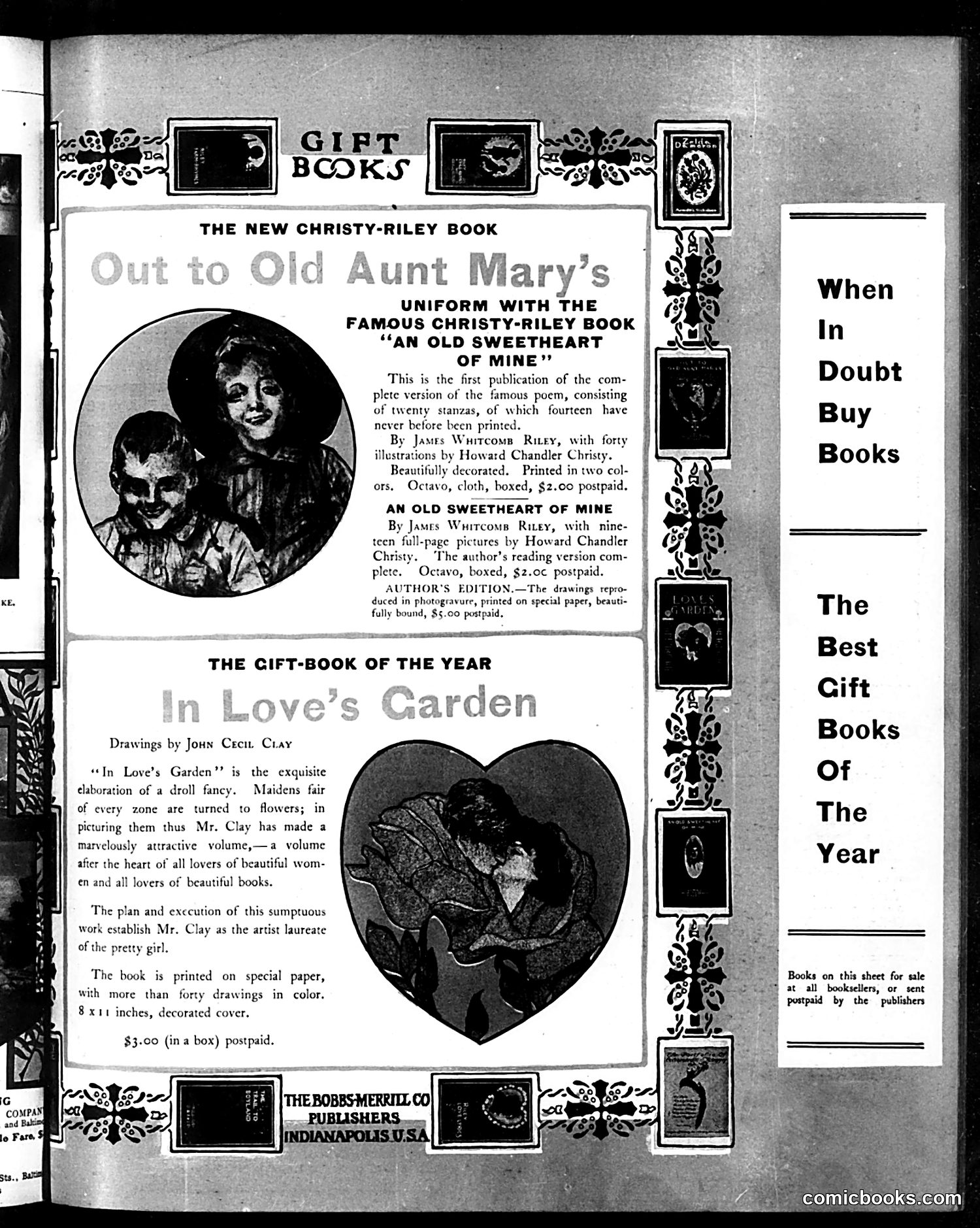
This page is primarily **advertising for gift books**, not satire or political commentary. It showcases three Christy-Riley publications offered by Bobbs-Merrill Publishers: 1. **"Out to Old Aunt Mary's"** — a illustrated poem by James Whitcomb Riley with forty drawings by Howard Chandler Christy, priced at $2.00 2. **"An Old Sweetheart of Mine"** — another Riley work with nineteen illustrations by Christy 3. **"In Love's Garden"** — described as "the gift-book of the year," featuring drawings by John Cecil Clay, priced at $3.00 The page emphasizes these as luxury gift items suitable for "lovers of beautiful books." The decorative borders and heart imagery reinforce the romantic, sentimental nature of these publications intended for holiday gift-giving. This reflects early 20th-century publishing and consumer culture around illustrated literature as premium gifts.
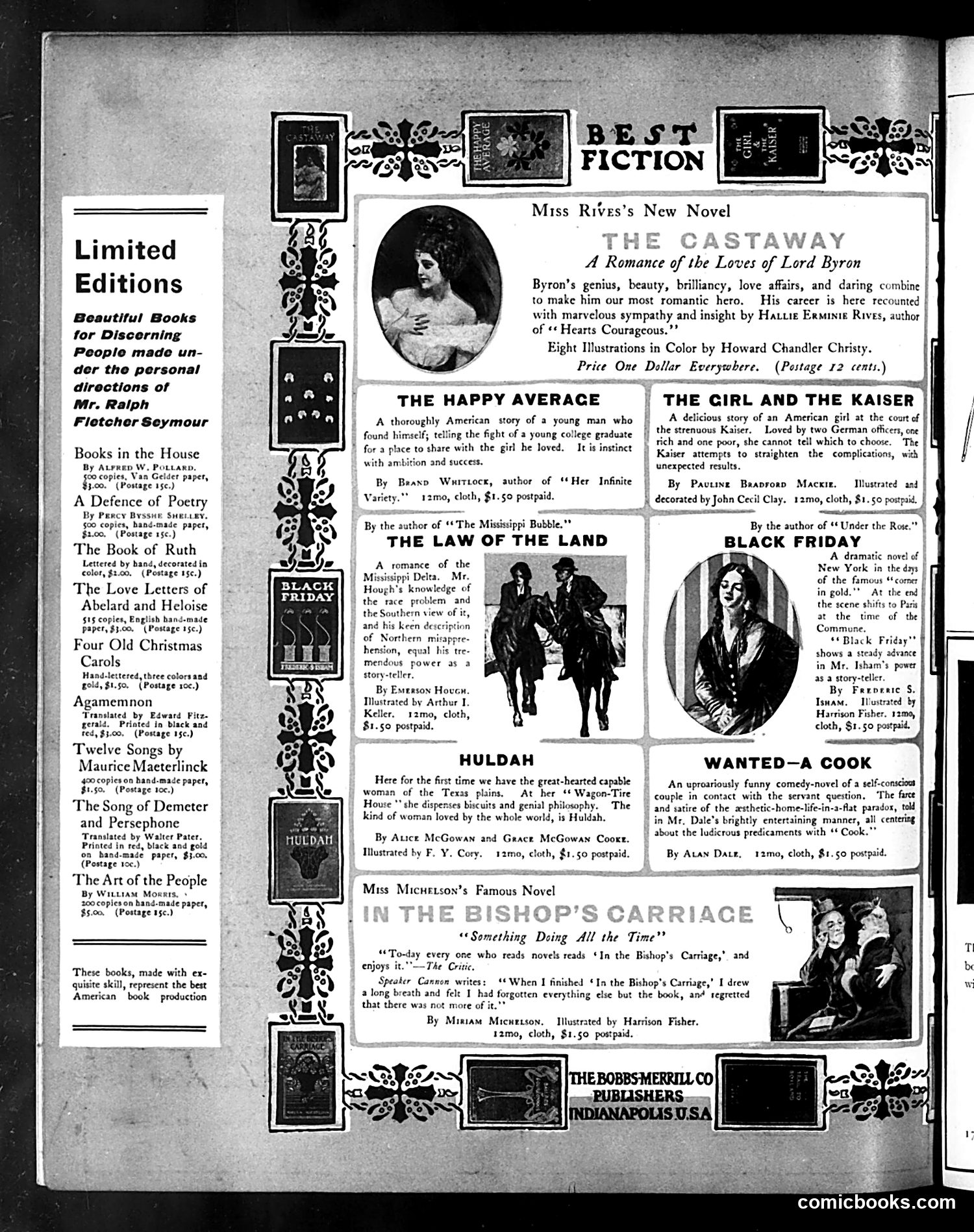
This page is primarily a **book advertisement section** for the Bobbs-Merrill Company Publishers, not a political cartoon. It showcases "Best Fiction" titles available through "Limited Editions" curated by Ralph Fletcher Seymour. The page features novels by popular authors of the era, including *The Castaway* (a romance about Lord Byron by Hallie Erminie Rives) and *In the Bishop's Carriage* by Miriam Michelson. Each listing includes illustrations, prices, and brief descriptions. The left sidebar lists additional "beautiful books for discerning people," emphasizing hand-crafted production values—typical of early 20th-century American publishing marketing that positioned books as luxury goods for educated readers. This is essentially a **catalog page**, not satirical content.
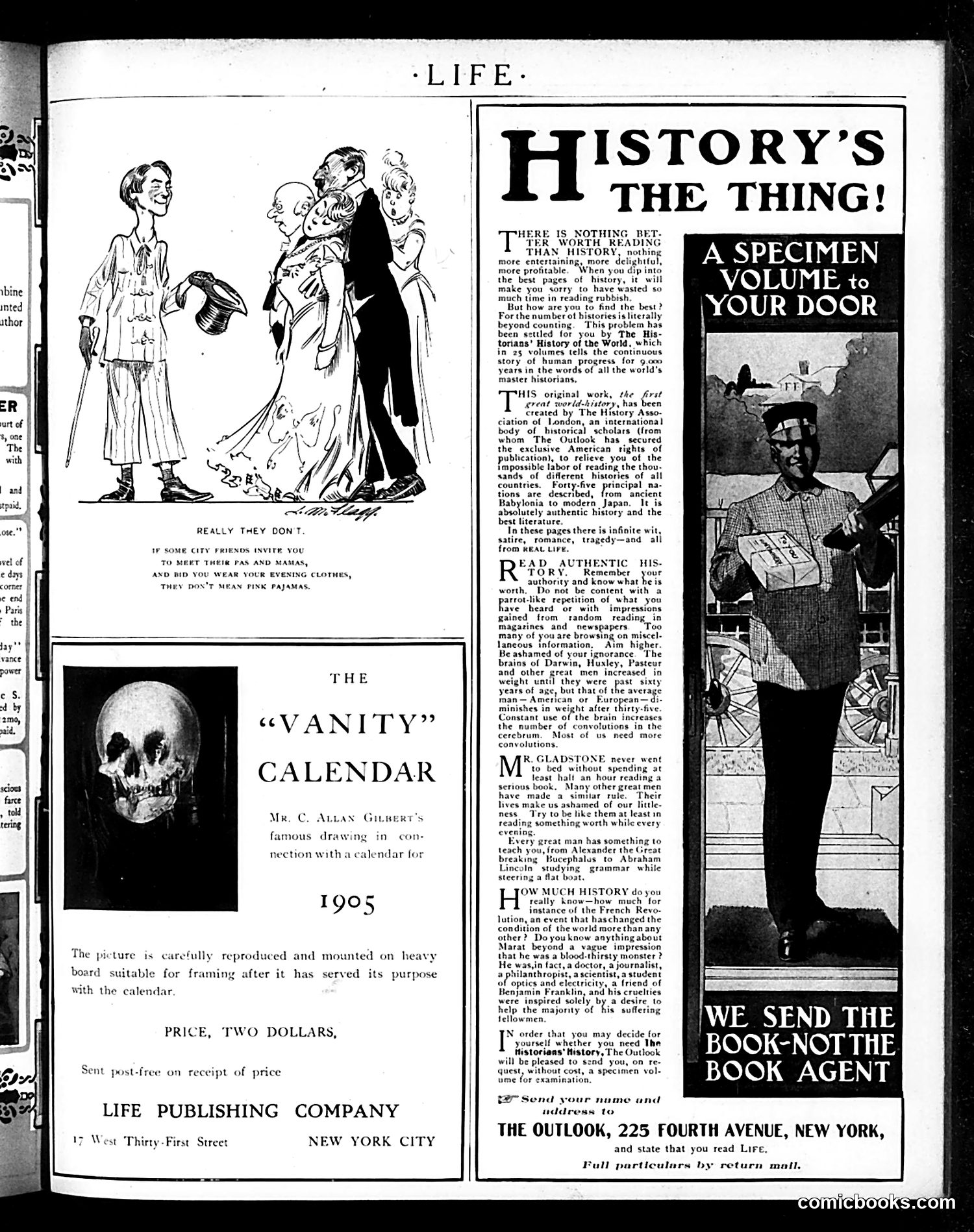
This page is primarily **advertising and editorial content** rather than political satire. The top cartoon captioned "REALLY THEY DON'T" depicts a social scenario about evening wear etiquette—likely mocking the pretensions of people claiming they don't need formal clothing for city social events, when in fact they do. The main content advertises a "Vanity Calendar" for 1905 featuring a skull image by C. Allan Gilbert. This appears to be a memento mori aesthetic popular in that era. The right page promotes "History's the Thing!"—a multi-volume historical encyclopedia—with testimonials about its educational value. The final advertisement ("WE SEND THE BOOK—NOT THE BOOK AGENT") emphasizes direct-mail sales, a modern convenience at the time. Overall, this is a **commercial page** reflecting early 1900s consumer culture and educational products.
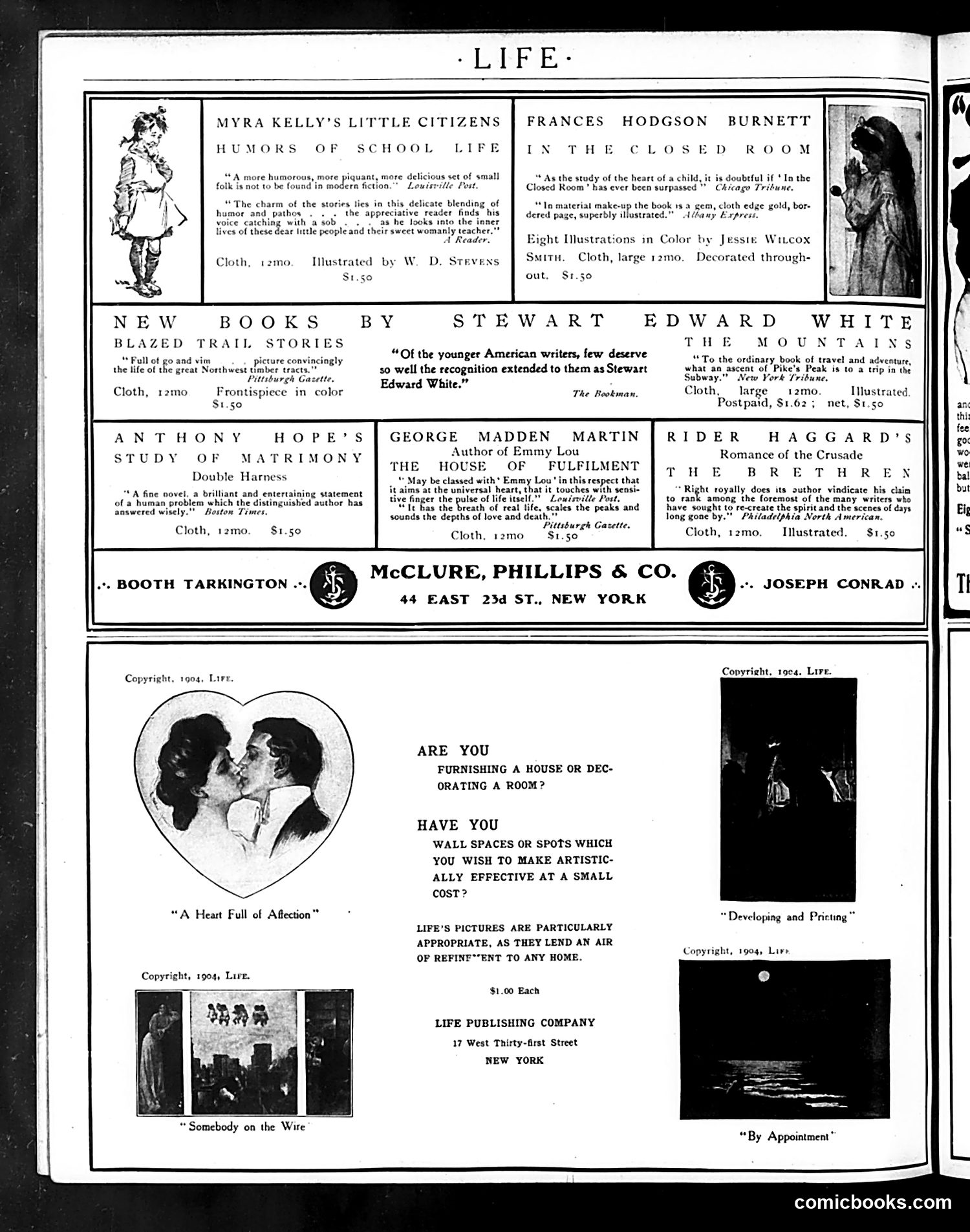
This page is primarily **advertising for books and pictures**, not political satire. The upper section promotes new publications by Stewart Edward White, Frances Hodgson Burnett, Anthony Hope, and others—typical literary offerings of 1904. The lower half advertises **Life Publishing Company's pictures** for home decoration. The heartfelt romantic illustration titled "A Heat Full of Affection" and photographs like "Somebody on the Wire" and "By Appointment" were marketed as affordable ($1 each) art prints to help readers furnish homes tastefully. There is **no political cartoon or satire** on this page. It represents Life magazine's business model: combining literary reviews with merchandise sales to middle-class readers seeking cultural refinement.
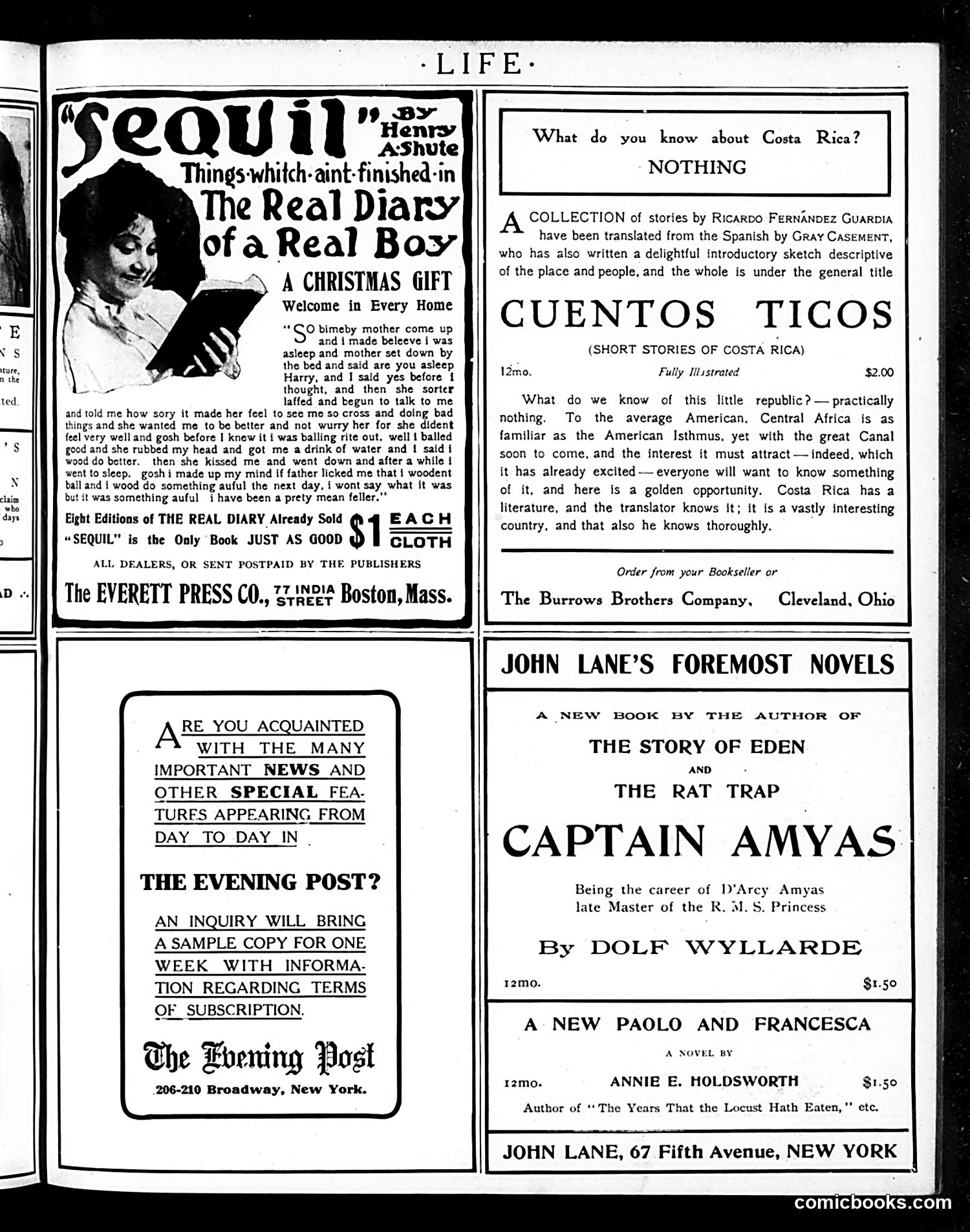
This page is primarily **advertising and book promotion**, not satire or political commentary. It contains: 1. **"Sequil" advertisement** (top left): Promotes a book sequel to *The Real Diary of a Real Boy*, marketed as a Christmas gift. The publisher emphasizes it's "the only book just as good" as the original, priced at $1 cloth. 2. **"Cuentos Ticos" advertisement** (top right): Promotes a collection of Costa Rican short stories translated from Spanish by Gray Casement, published by Burrows Brothers Company for $2.00. 3. **The Evening Post promotion** (bottom left): Solicits newspaper subscriptions. 4. **John Lane's novels** (bottom right): Advertises three books, including *Captain Amyas* by Dolf Wyllarde ($1.50). The page contains no identifiable political cartoons or satire—it's a standard magazine advertising section.
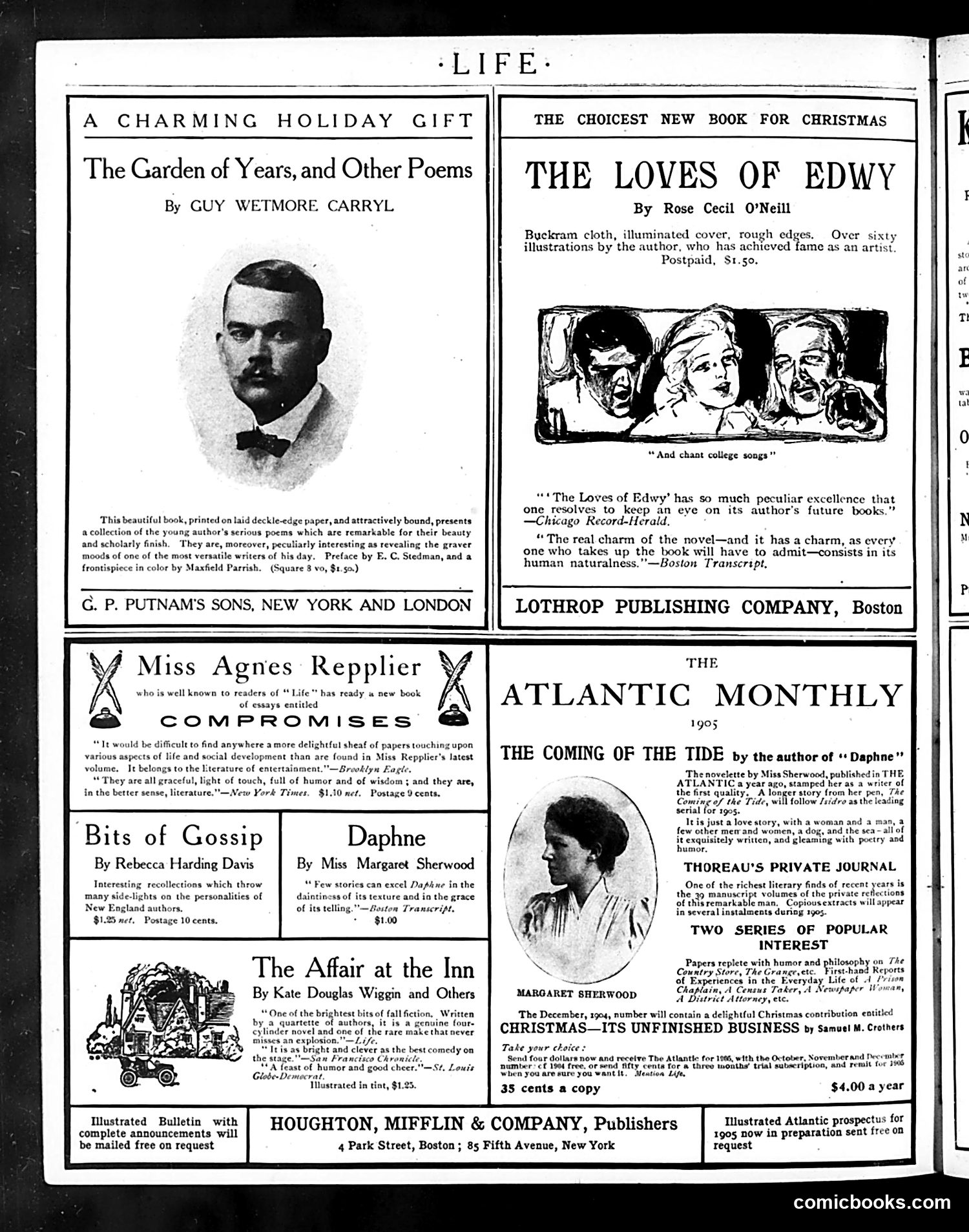
This is primarily a **book advertisement page** from Life magazine, not a political cartoon. It showcases Christmas gift recommendations for 1904-1905, featuring literary works. The main advertisements promote: - **"The Garden of Years, and Other Poems"** by Guy Wetmore Carryl - **"The Loves of Edwy"** by Rose Cecil O'Neill (illustrated) - **"Compromises"** by Miss Agnes Repplier (essays) - Works by Rebecca Harding Davis and Margaret Sherwood - **"The Affair at the Inn"** by Kate Douglas Wiggin - **The Atlantic Monthly** magazine The **Atlantic Monthly** section features "The Coming of the Tide" and mentions contributions including "Thoreau's Private Journal" and literary pieces emphasizing humor and philosophy—standard elite intellectual fare of the era. This reflects turn-of-the-century American publishing and gift-giving culture, showcasing popular authors considered suitable holiday presents for educated readers.
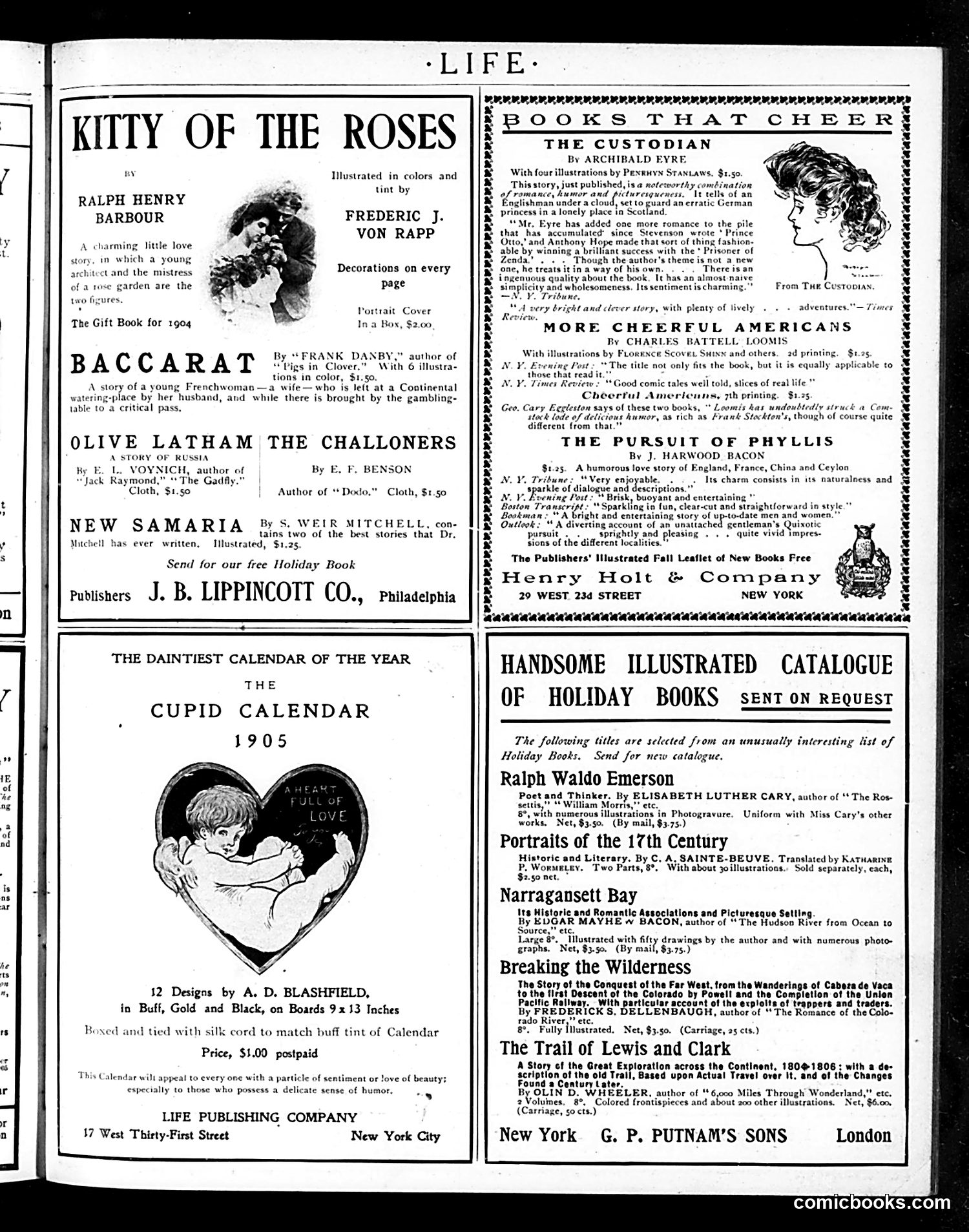
This page is **primarily advertising** for holiday gift books from 1904-1905, not a political cartoon. It showcases romantic novels and gift items popular during the Edwardian era. Notable content includes: **Books advertised:** Light romantic fiction ("Kitty of the Roses," "Baccarat," "The Pursuit of Phyllis") aimed at genteel audiences. These titles reflect early 1900s preferences for sentimental love stories and adventure tales set in exotic locations (Russia, France, Ceylon). **The Cupid Calendar** (center-left) features cherub imagery—typical Victorian/Edwardian sentimentality. At $1.00 postpaid, it targets readers "with a particle of sentiment or love of beauty." **Social context:** These advertisements reveal what educated, middle-to-upper-class American readers valued: romantic escapism, travel narratives, and refined humor. The emphasis on illustrated, boxed gift editions suggests these were luxury items for affluent gift-givers. No political satire is evident—this is straightforward commercial promotion within *Life* magazine's pages.
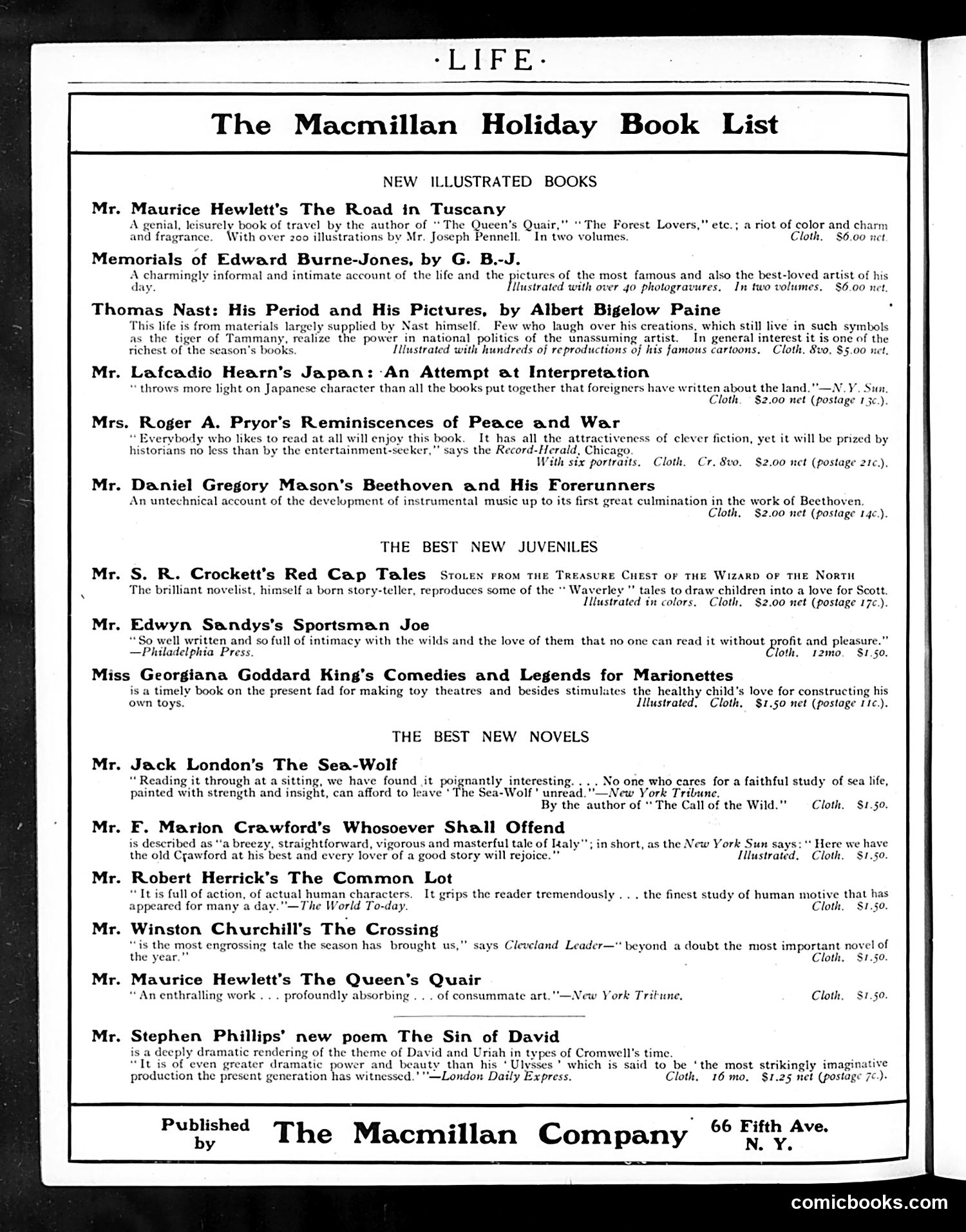
This page is primarily **advertising**, not political satire or commentary. It's a publisher's catalog promoting Macmillan Company books for the holiday season, organized into three categories: illustrated books, juvenile literature, and novels. The only historical figure explicitly referenced is **Thomas Nast**, the famous 19th-century political cartoonist. The advertisement notes his symbolic creations—particularly "the tiger of Tammany" (referring to Tammany Hall, NYC's corrupt Democratic machine)—demonstrating his significant influence on American politics, even though contemporaries underestimated his power. Other notable authors advertised include Jack London (*The Sea-Wolf*), Winston Churchill (the novelist, not the future Prime Minister), and F. Marion Crawford. The page reflects early 1900s literary tastes and publishing practices, with prices ranging from $1.50 to $6.00 and detailed postage costs. There is **no cartoon or satire present**—this is straightforward commercial advertising.
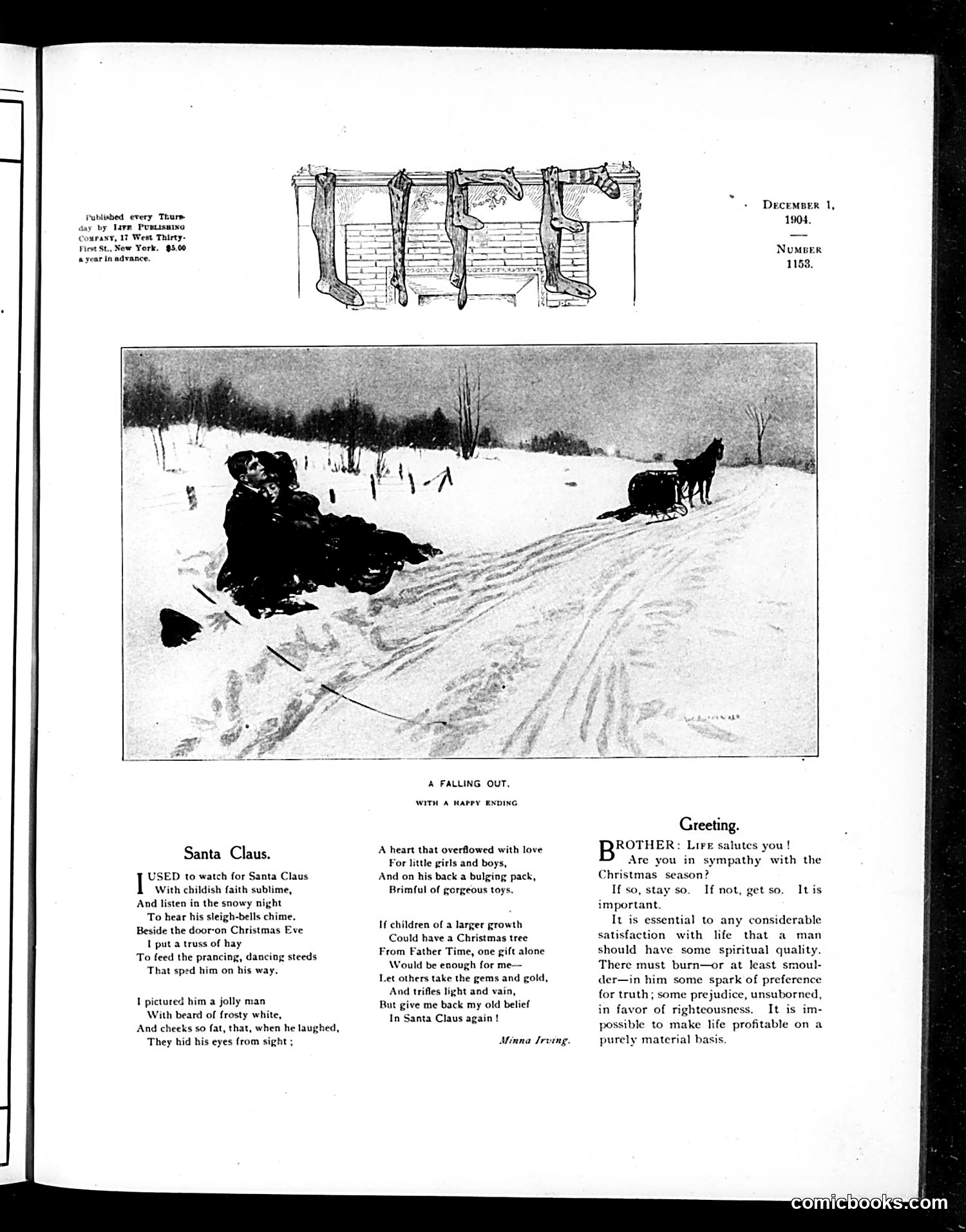
This page combines nostalgic Christmas sentiment with philosophical messaging. The central image shows a sledding accident in winter—a figure has fallen from a sleigh while another sled departs, captioned "A Falling Out with a Happy Ending." The poem "Santa Claus" by Minna Irving expresses adult longing to recapture childhood belief in Santa, requesting this as a Christmas gift from "Father Time." The "Greeting" section addresses readers directly, urging spiritual and moral values over materialism. It argues that meaningful life requires "some spark of preference for truth" and "prejudice in favor of righteousness"—essentially advocating moral conviction shouldn't be abandoned for purely financial gain. The sledding mishap likely symbolizes life's disappointments, while the "happy ending" caption suggests resilience or recovery. Together, the content promotes spiritual substance and nostalgic values during the materialistic Christmas season, a common Progressive-era critique of commercialism.
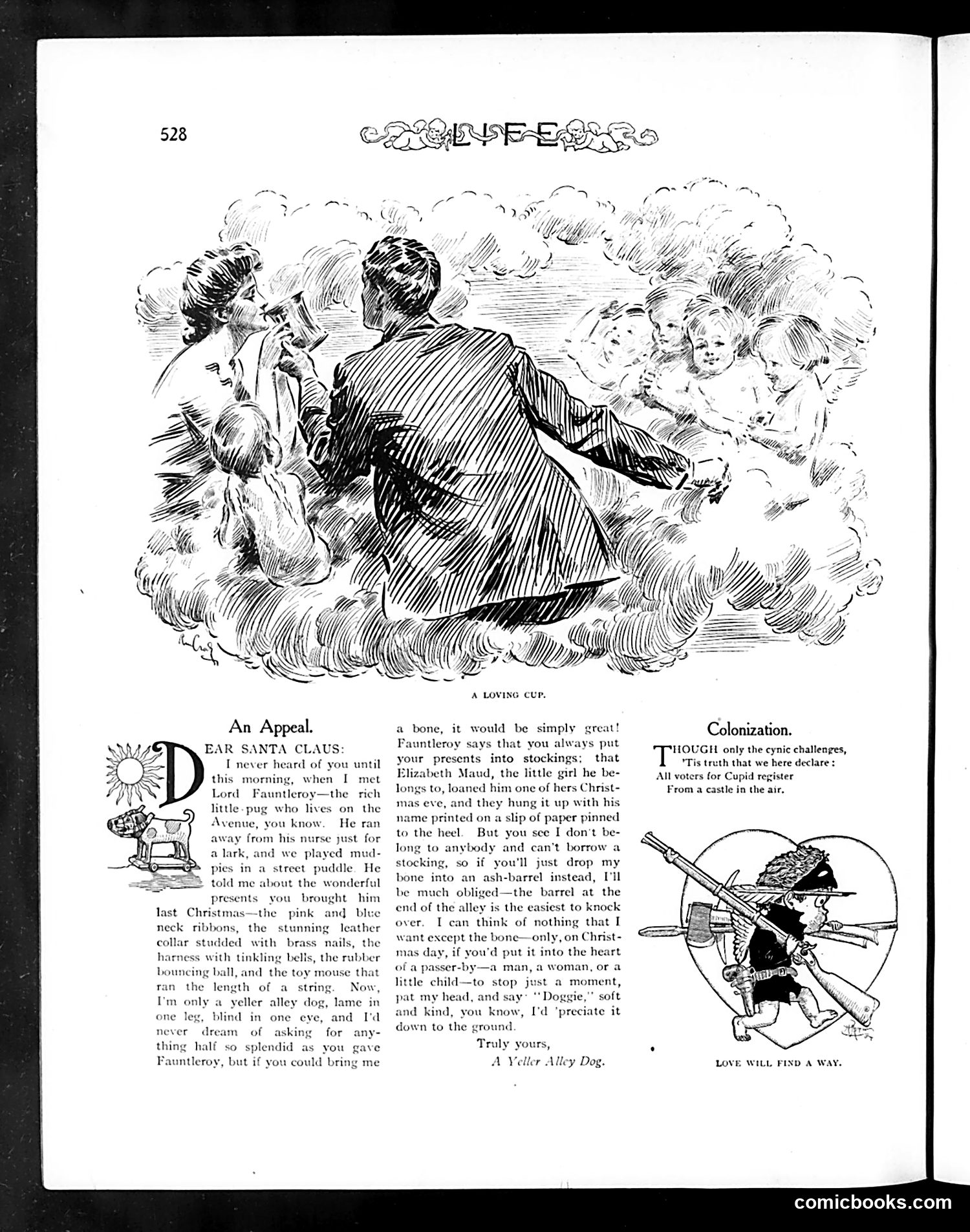
This page contains two distinct pieces of social commentary from *Life* magazine: **"An Appeal"** presents a letter from a street dog to Santa Claus contrasting class inequality. The "yeller alley dog"—poor, disabled, ownerless—begs for a simple bone, while "Lord Fauntleroy" (a reference to the pampered protagonist of a contemporary children's book) receives luxurious gifts: ribbons, studded collars, and toys. The satire critiques wealth disparity: the wealthy pet receives indulgences while the working-class dog asks only for basic sustenance. The dog's final wish—that someone show kindness by dropping a bone in an ash-barrel—poignantly illustrates how poverty strips dignity. **"Colonization"** is a brief verse mocking romantic idealism. It satirizes voters who support "Cupid" (romantic love as a governing principle) as believers in fantasies—castles in the air—rather than practical reality. This appears to critique sentimental or naive political positions. The accompanying illustrations emphasize these themes: cherubs surround the wealthy dog's narrative, while a cupid-themed drawing accompanies the colonization verse.
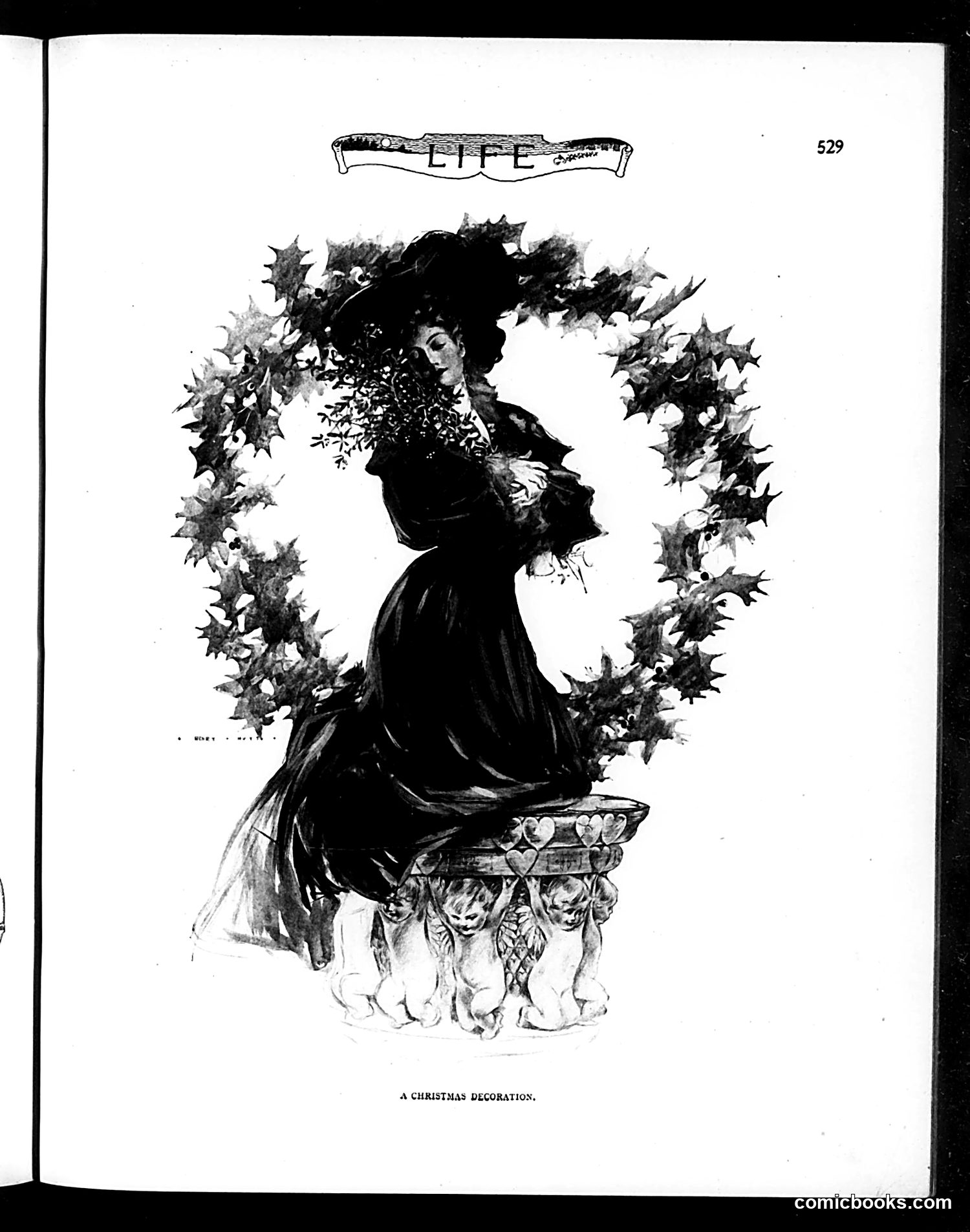
This page from *Life* magazine presents a single illustration titled "A Christmas Decoration." The image shows a fashionable woman in silhouette, seated on an ornate pedestal, adorned with an elaborate wreath of holly and other festive foliage forming a decorative frame around her figure. Her flowing dark dress and refined pose suggest she represents an idealized version of feminine elegance. The satire appears gentle rather than biting—this is likely social commentary on how women were themselves treated as decorative objects during the holiday season, or perhaps mockery of excessive Victorian-era Christmas ornamentation and the artificiality of seasonal displays. The woman becomes the "decoration" herself, a witty observation on aesthetics, class, and gender roles in turn-of-the-century society.
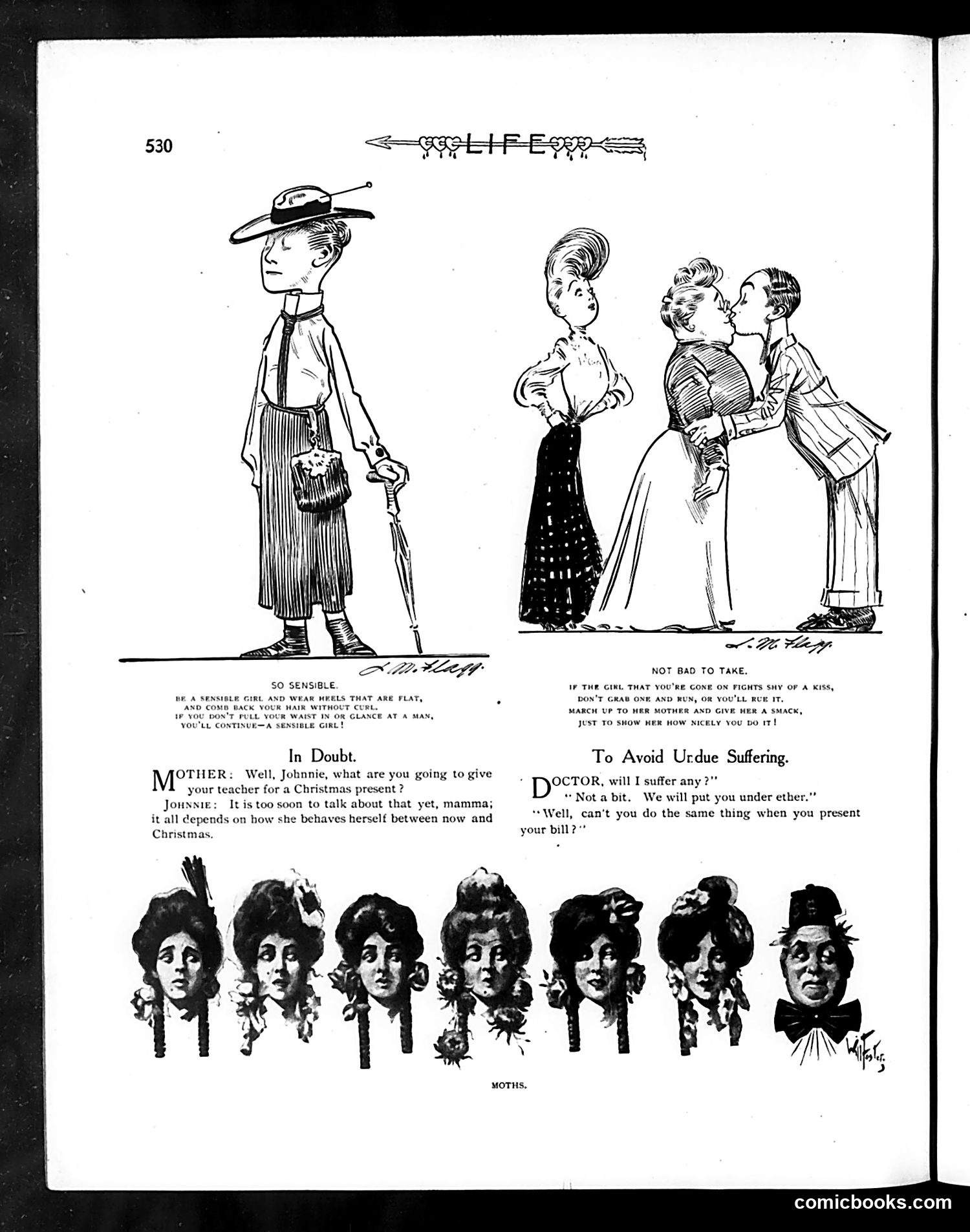
This page contains early-20th-century humor satirizing social conventions and gender roles: **"So Sensible"** mocks rigid Victorian propriety for women—flat heels, uncurled hair, constrained waists, avoiding male attention—presenting these restrictions as absurdly limiting. **"In Doubt"** is a child-humor joke: young Johnnie will decide what Christmas gift to give his teacher based on her behavior, inverting adult-child power dynamics for comic effect. **"Not Bad to Take"** appears to satirize inappropriate courtship advice, ironically suggesting kissing a girl's *mother* to demonstrate technique—absurd and offensive by modern standards, likely mocking actual period dating "wisdom." **"To Avoid Undue Suffering"** is a doctor joke: the patient quips that anesthesia during surgery would be helpful again when the doctor presents his bill—a commentary on medical costs. The bottom **"Moths"** illustration remains unclear without additional context. The overall tone reflects turn-of-the-century *Life* magazine's satirical approach to manners, courtship, and social propriety.
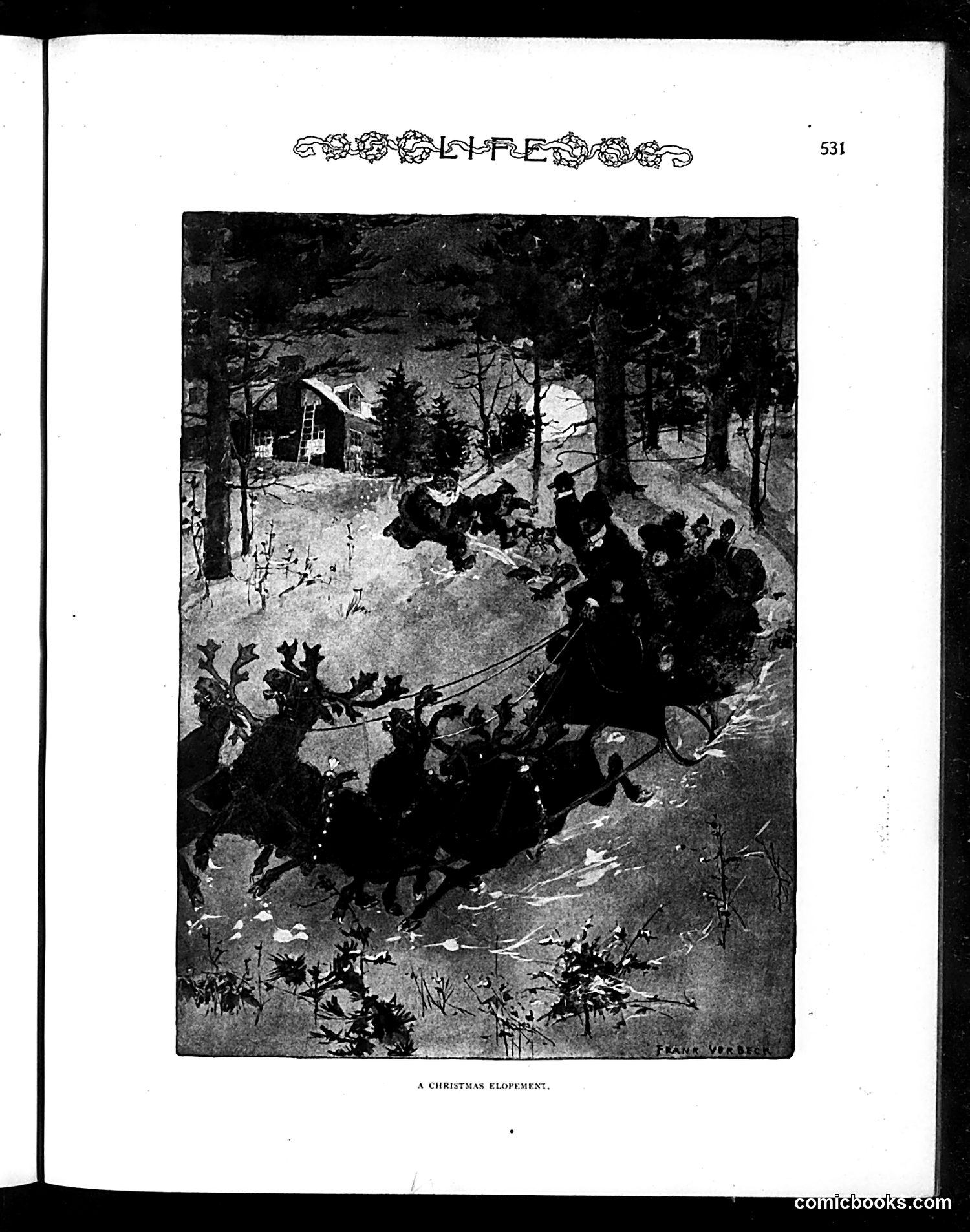
This illustration, credited to Frank Verbeck, depicts a winter woodland scene titled "A Christmas Elopement." The image shows a horse-drawn sleigh carrying multiple bundled figures moving rapidly through a snowy forest, with a cabin visible in the background. The composition suggests a dramatic escape or hurried journey—consistent with the "elopement" theme of the title. Without additional context from the magazine issue, the specific satirical target remains unclear. However, given Life's satirical nature, this likely comments on romantic scandal, hasty marriages, or social proprieties of the era. The winter setting and urgent movement emphasize the clandestine nature of the depicted elopement, making it humorous commentary on Gilded Age social conventions.
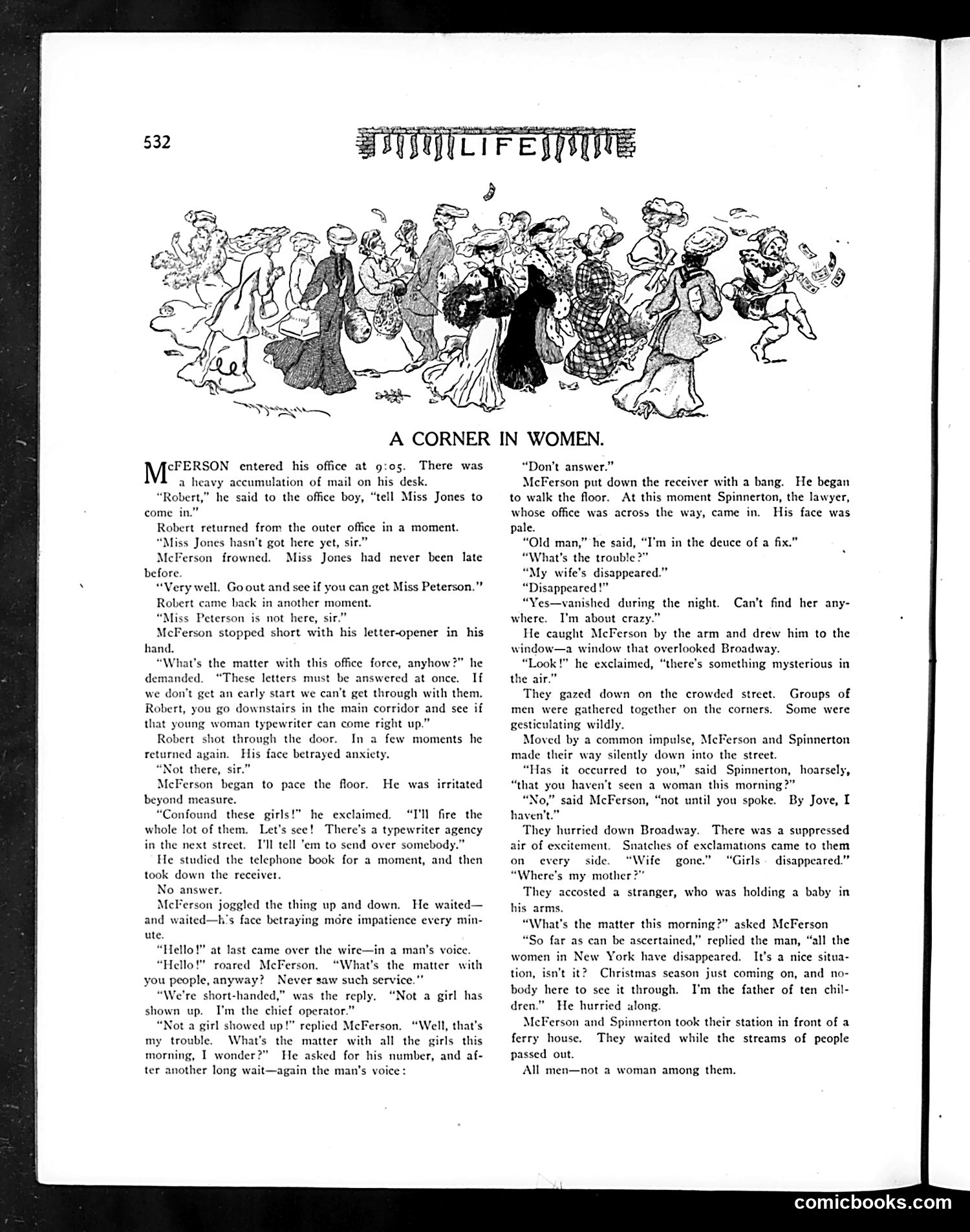
This satirical story depicts a fantasy scenario where all women in New York mysteriously vanish overnight. The narrative begins with McFerson's office chaos—female employees Miss Jones and Miss Peterson failing to appear—then escalates as he and his lawyer friend Spinnerton discover the phenomenon is citywide. The satire targets **early 20th-century workplace dependency on female labor**, particularly secretarial and typewriter-operator positions that were increasingly feminized. By showing the immediate collapse of business operations and social order when women disappear, the piece ironically highlights how essential women's work was, even as society largely undervalued it. The final image of crowds of helpless men searching Broadway adds dark comedy to the premise. This reflects contemporary anxiety about women's growing workforce participation and independence during this era.
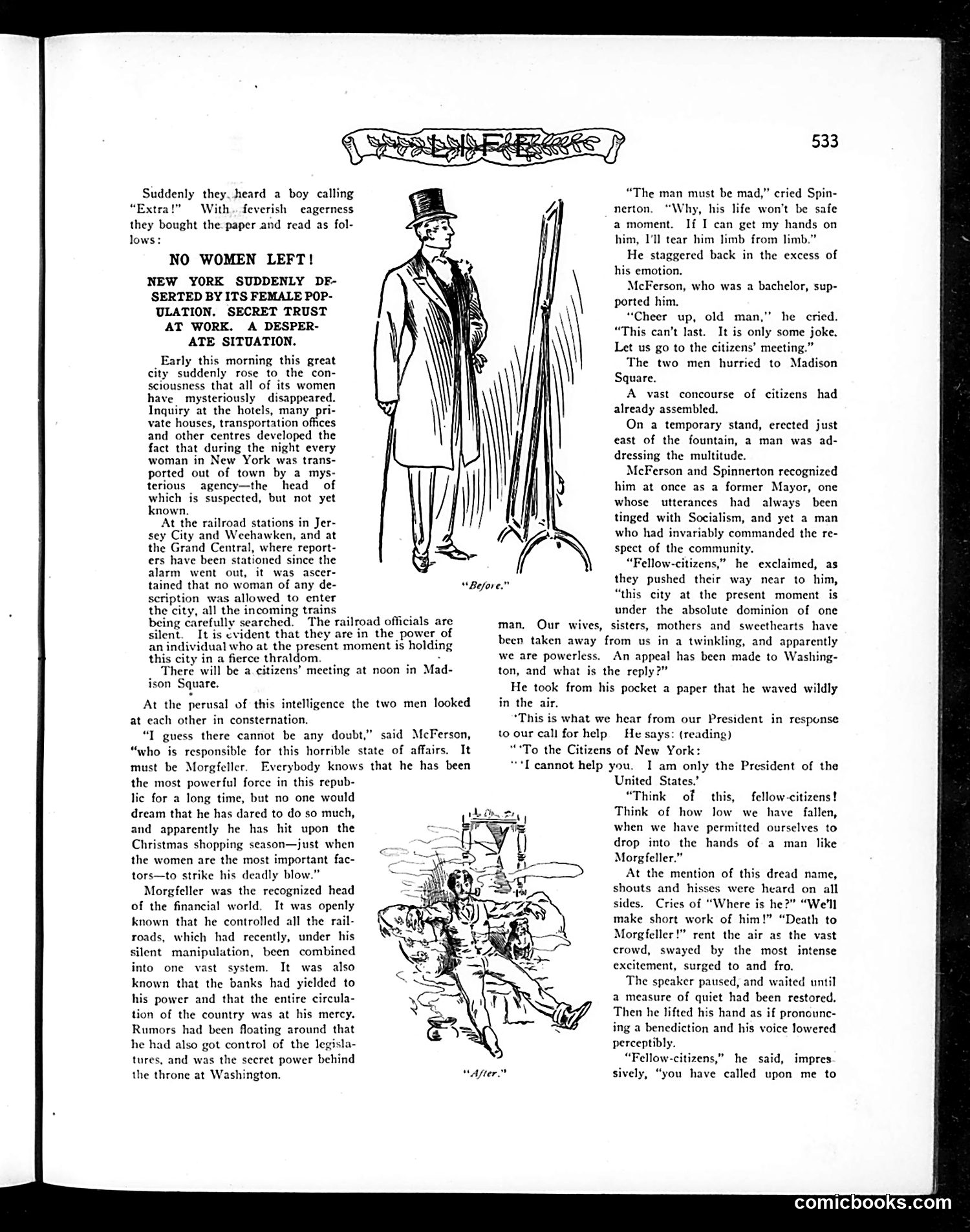
This early 20th-century satirical story mocks the era's fears about monopolistic power and governmental helplessness. The narrative describes all New York women mysteriously vanishing, orchestrated by "Morgfeller"—a transparent caricature of J.P. Morgan, the actual era's most powerful financier. The satire's point: Morgfeller controls railroads, banks, currency circulation, and secretly manipulates legislatures and Washington itself. When citizens appeal to the President for help, he responds that he's powerless—a scathing critique of corporate dominance over elected government. The two illustrations show a well-dressed figure "Before" and "After" the crisis, emphasizing how completely one man's financial power has disrupted society. This reflects genuine Progressive Era anxieties about unchecked monopolies and their political influence—concerns that would eventually fuel antitrust legislation.
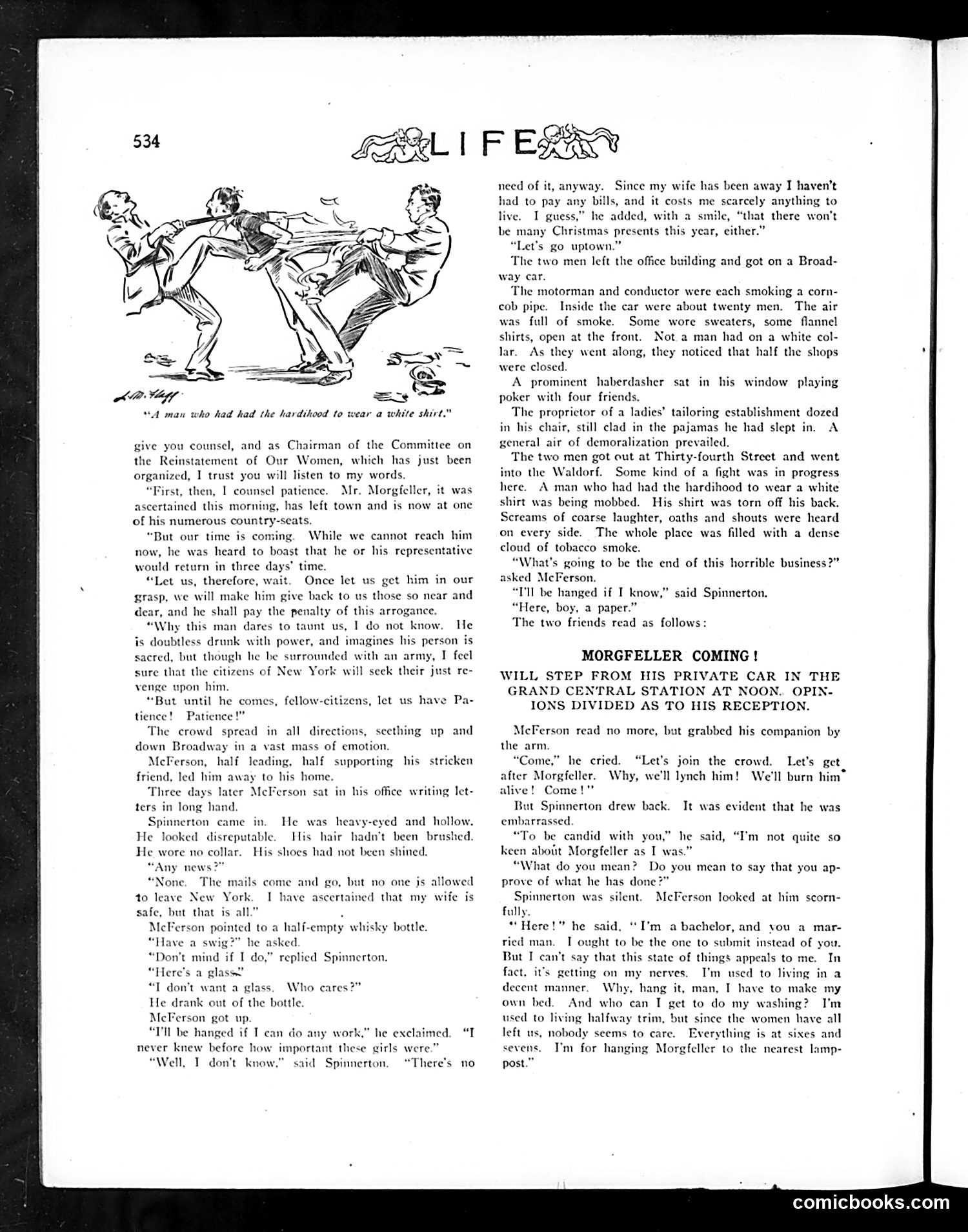
This satirical piece depicts social chaos resulting from women's absence—likely referencing the early suffrage movement or women's activism. The cartoon shows a man in a white shirt being mobbed, illustrating the story's absurdist premise: when women leave New York, society collapses into disorder. The satire works on multiple levels: shops close, men neglect grooming and work, they drink heavily, and civic infrastructure fails. A character named Morgfeller (apparently a wealthy industrialist who "dares to taunt" by leaving town) becomes the focus of public rage, with crowds demanding his return. The joke targets both the emerging women's movement and male anxiety about female independence. By depicting societal breakdown without women, the writer mocks both the idea that women are essential to civilization *and* the men who panic at their absence. The unmanned mobs and deteriorating standards of dress and behavior suggest masculine incompetence and dependency.
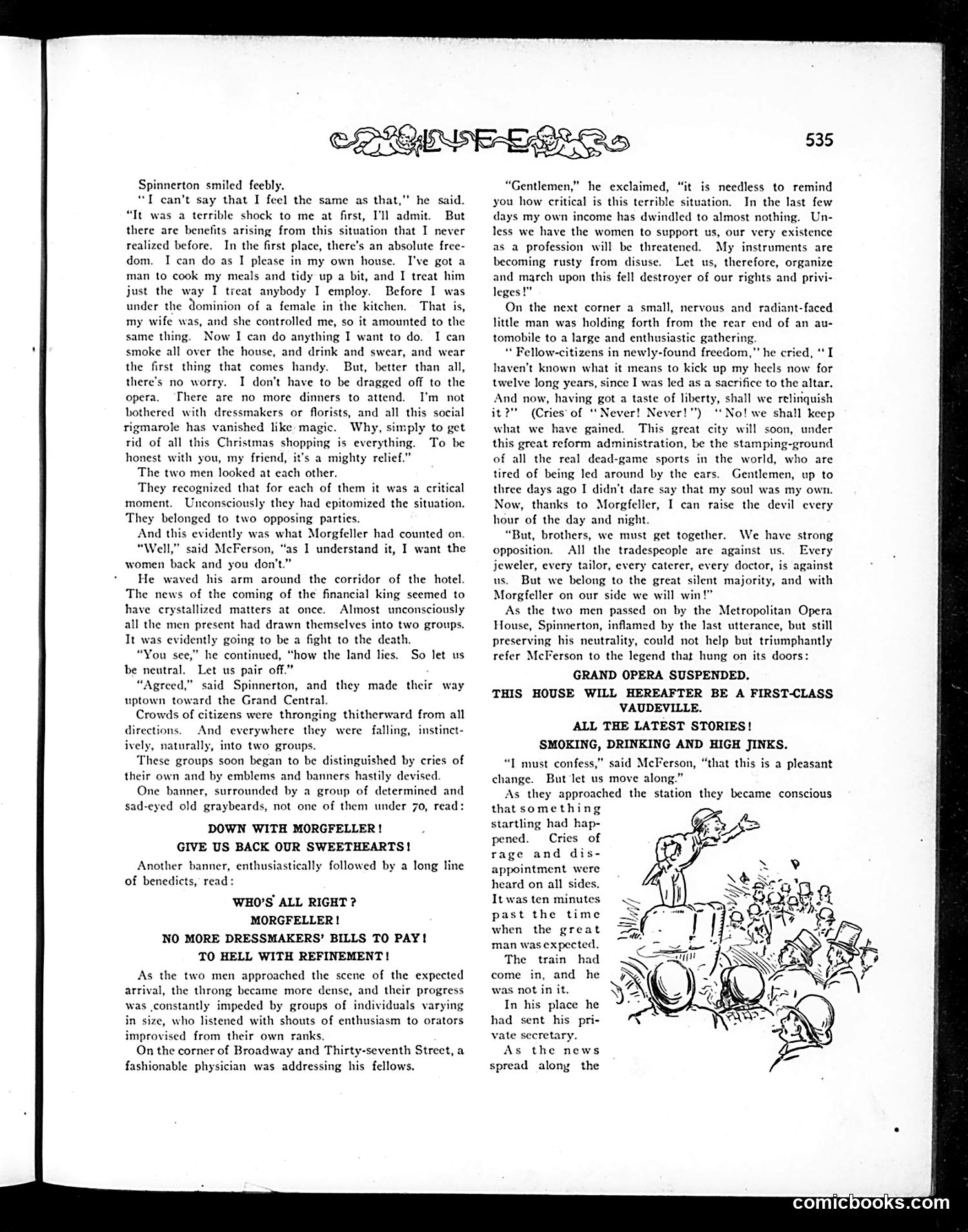
This page depicts a satirical narrative about men divided over whether women should return to traditional domestic roles. The story pivots on a mysterious "financial king" (Morgfeller) whose arrival crystallizes two opposing male factions: **The Pro-Women Faction** (older men): Led by elderly graybeards demanding "Give Us Back Our Sweethearts!" — they depend economically on women's unpaid domestic labor and the social spending it requires (dressmakers, opera tickets, florists). **The Anti-Women Faction** (younger men, "benedicts"): Celebrating newfound freedom from female control — no more enforced refinement, opera attendance, or dressmakers' bills. The satire mocks post-suffrage anxieties: men realizing they've benefited from women's unpaid work and social obligations, while also resenting female authority. Professionals (the physician) fear losing income from women's social lives. The cartoon ridicules both masculine posturing about "freedom" and the economic dependence masked by claims of superiority. The implicit joke: men can't actually survive without women's labor and presence, despite celebrating their absence.
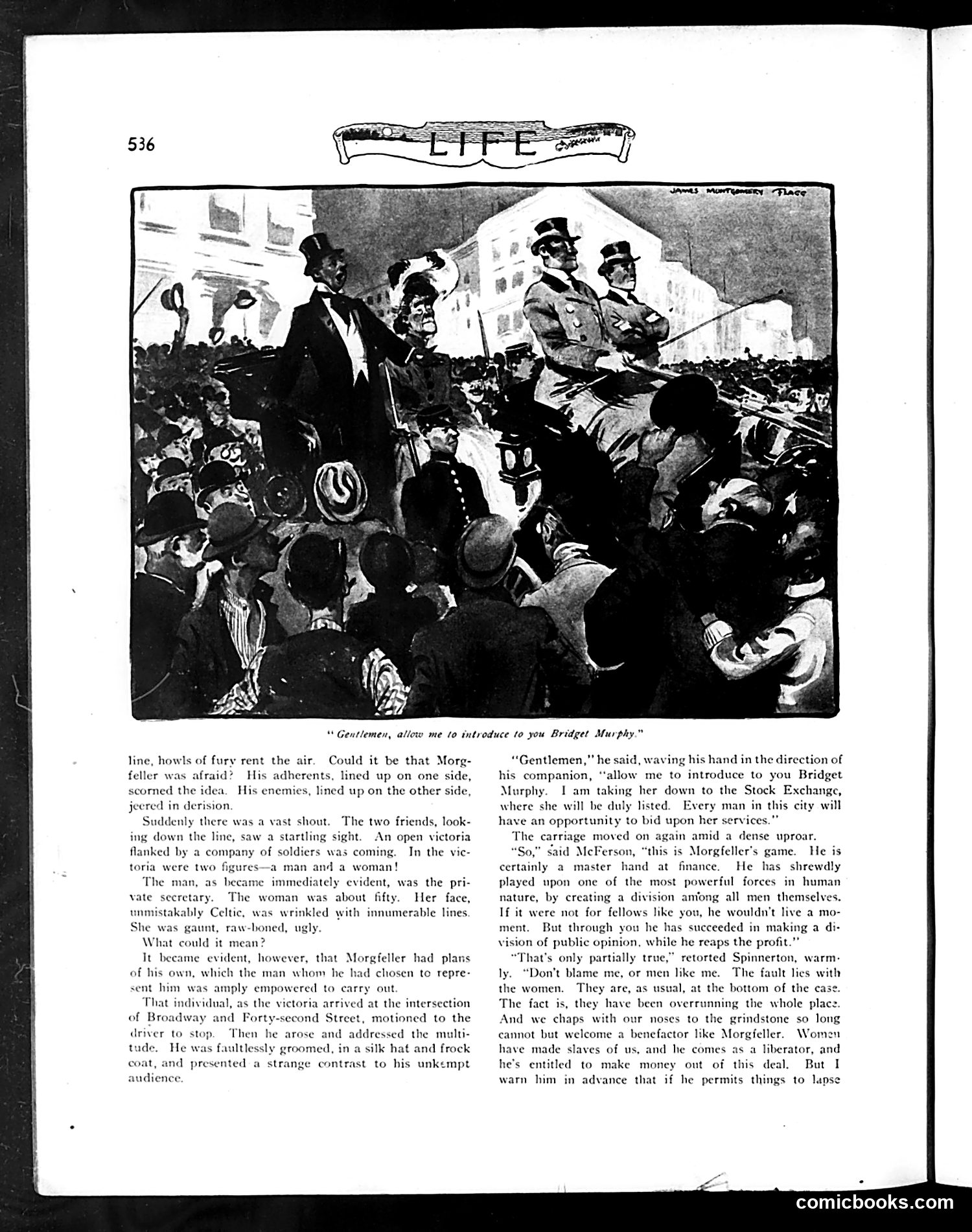
This page satirizes turn-of-the-century financial manipulation and anti-feminist sentiment. A wealthy financier named Morgfeller stages a public spectacle at Broadway and 42nd Street, introducing an Irish immigrant woman named Bridget Murphy to a crowd, announcing he'll "list" her at the Stock Exchange for men to bid on her services. The satire operates on multiple levels: Morgfeller exploits class divisions and xenophobia (the "Celtic" immigrant woman) to distract the public from his schemes. The male characters' dialogue reveals the era's misogyny—they blame women for "overrunning the whole place" and welcome Morgfeller as a "liberator" from female influence, despite recognizing his exploitation. The cartoon mocks both the financier's cynical manipulation of public opinion and the working men's willingness to embrace a scheme that degrades women, revealing how prejudice and economic anxiety made the public vulnerable to exploitation.
This satirical story mocks early-20th-century debates over women's roles and rights. A character named Morgfeller has apparently orchestrated the removal of women from society—which initially delights misogynists but creates economic chaos. He profits enormously by auctioning women back to the highest bidders. The satire's point: two male characters, McFerson and Spinnerton, who were ideologically opposed, discover their positions have *reversed*. McFerson, who wanted women removed, now praises Morgfeller for proving women's value. Spinnerton, who opposed the removal, now sees the profit motive. The final irony shows women returning en masse on Broadway, suggesting the experiment has failed—or perhaps that women's actual irreplaceability to society is undeniable. This reflects pre-suffrage anxieties about women's independence and economic power, using absurdist humor to satirize both feminist and anti-feminist positions.
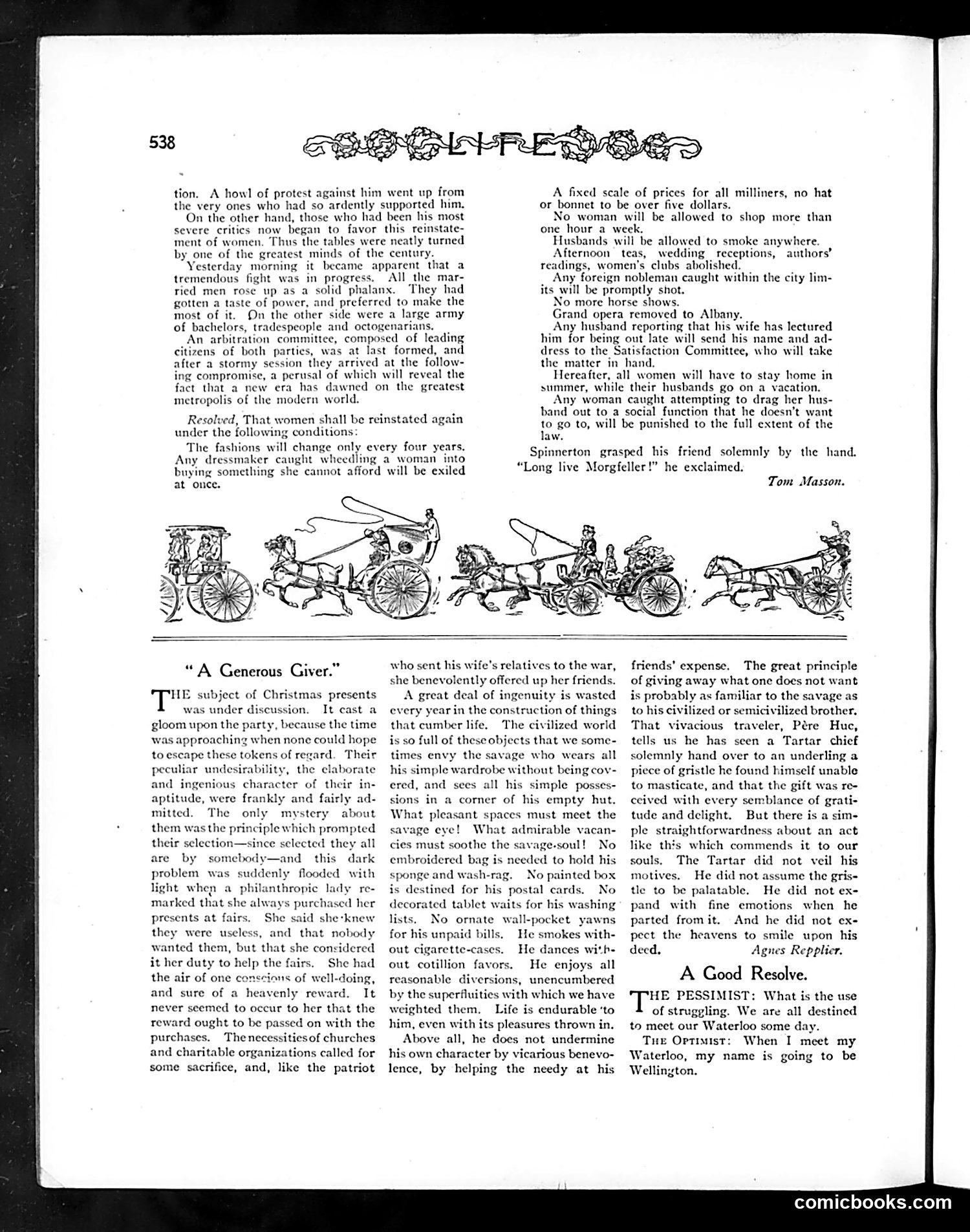
This page contains two distinct satirical pieces. The upper section mocks a hypothetical conflict where married men attempt to restrict women's freedoms (banning shopping, women's clubs, opera, etc.), ultimately compromising by allowing women limited rights under strict conditions. The satire targets both male chauvinism and women's social activism of the era. The lower article, "A Generous Giver," satirizes wealthy charitable donors who purchase useless items at charity fairs and gift them as Christmas presents—not from generosity but to support the fundraising organizations. The author critiques the donor's self-congratulation while acknowledging she's essentially pawning off unwanted goods on friends. It's a biting commentary on performative charity and the hypocrisy of "philanthropic" behavior masking self-interest. Both pieces exemplify *Life* magazine's satirical approach to American social pretensions.
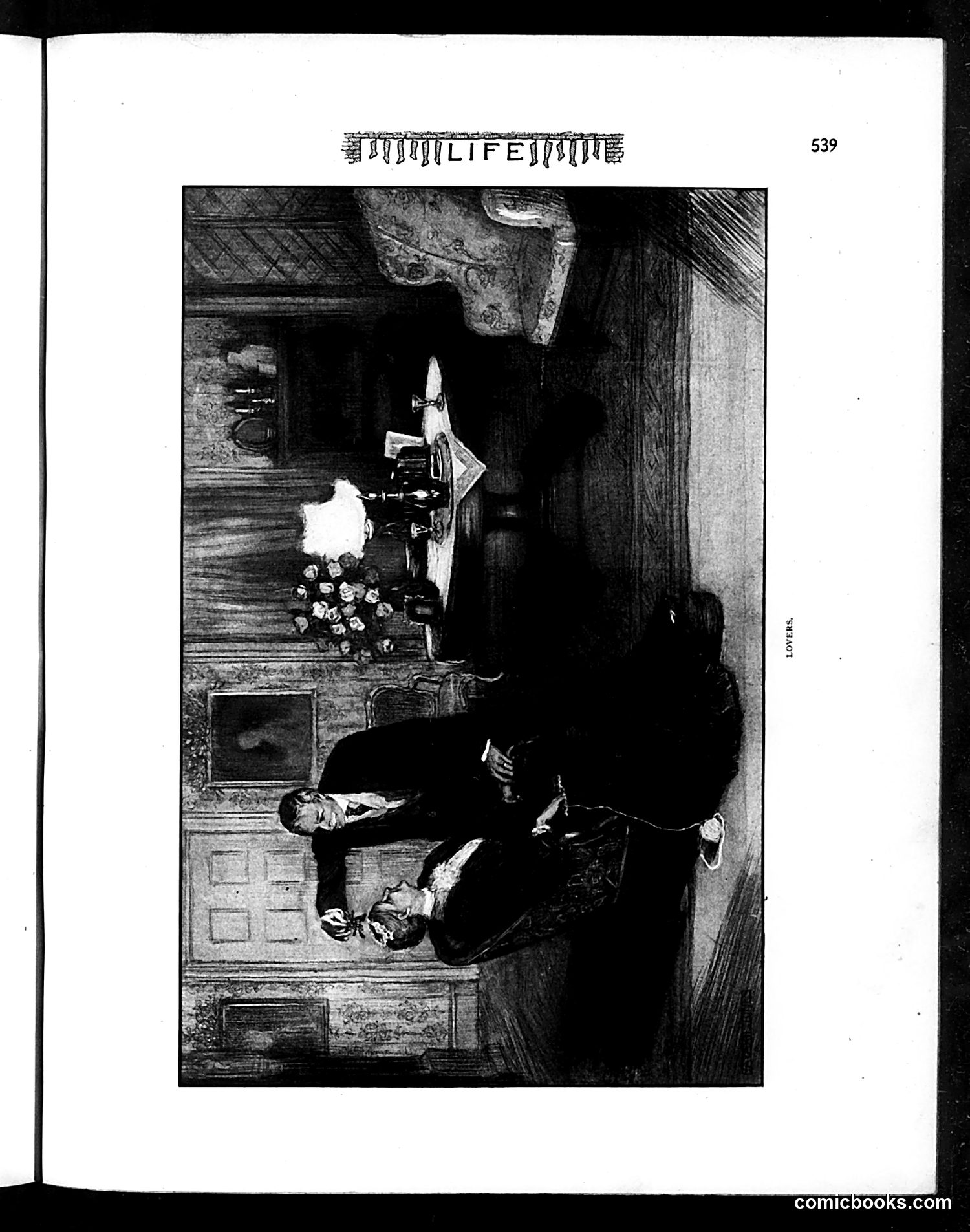
This page from *Life* magazine (page 539) shows a black and white photograph or illustration rotated 90 degrees, depicting what appears to be an interior domestic scene. The image shows figures in formal dress near furniture and a fireplace with flowers. However, without visible text labels, captions, or clear satirical elements identifying specific political figures or contemporary references, I cannot reliably determine what this cartoon satirizes or who it depicts. The formal setting and composition suggest social commentary about domestic life or manners, but the specific target of the satire remains unclear from the image alone. The OCR text provided ("SUIAOT") does not clarify the content's meaning. More contextual information would be needed for accurate interpretation.
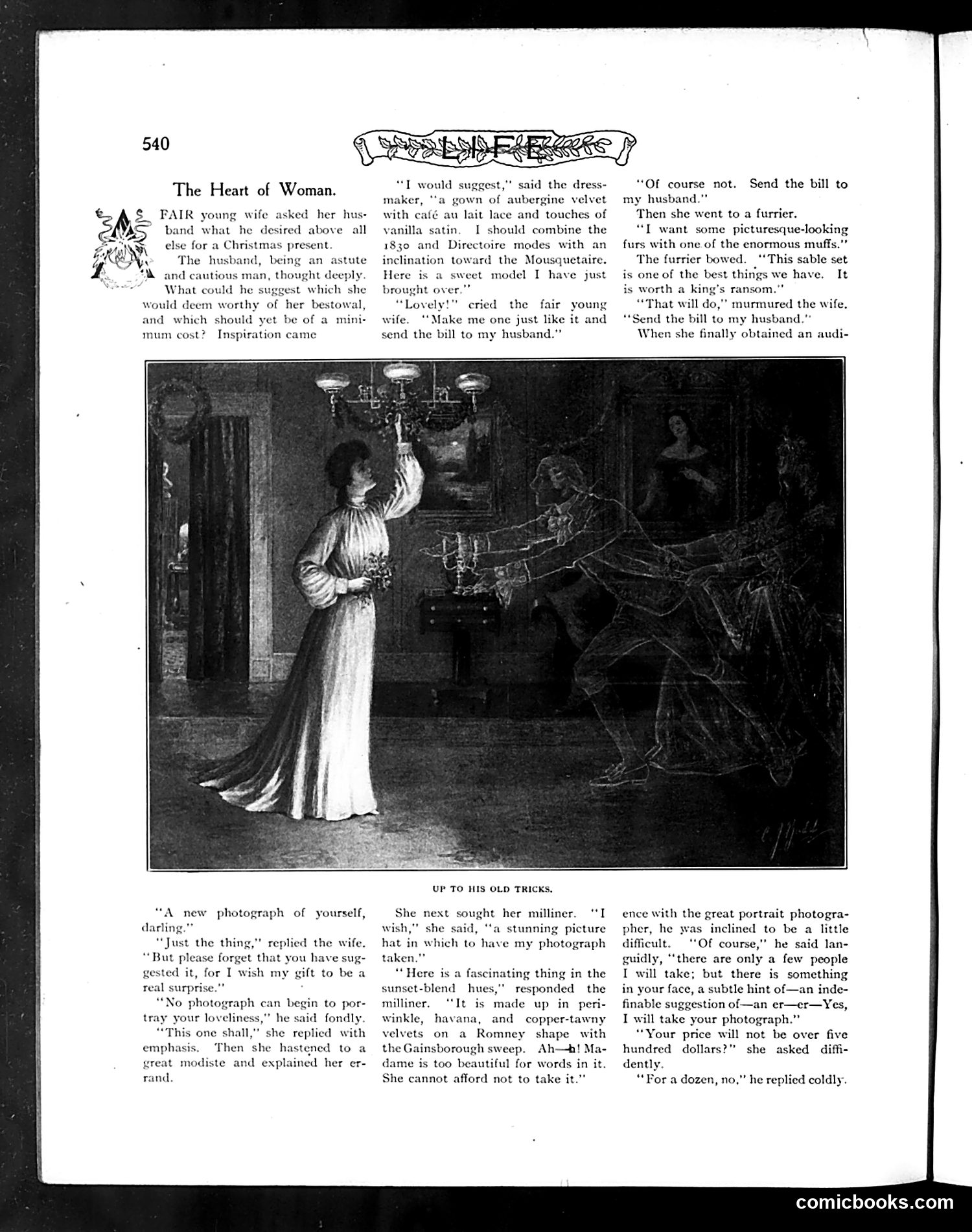
This story satirizes the stereotypical wife who exploits her husband's Christmas gift request to justify extravagant shopping. The "fair young wife" asks what he desires for Christmas, but rather than buy *him* a gift, she interprets his answer as permission to purchase expensive items for herself—a dress, furs, a hat, and a photograph—while instructing shopkeepers to "send the bill to my husband." The joke targets women's perceived materialism and manipulative spending habits. Each tradesperson (dressmaker, furrier, milliner, photographer) encourages increasingly costly selections, and the wife accepts them all. The final irony: the renowned portrait photographer charges $500 per dozen photographs, subverting her attempt at economy. The satire reflects early 20th-century anxieties about women's consumer power and marital finances, presenting the wife as clever but mercenary—turning a gift-giving occasion into a scheme for personal indulgence at her husband's expense.
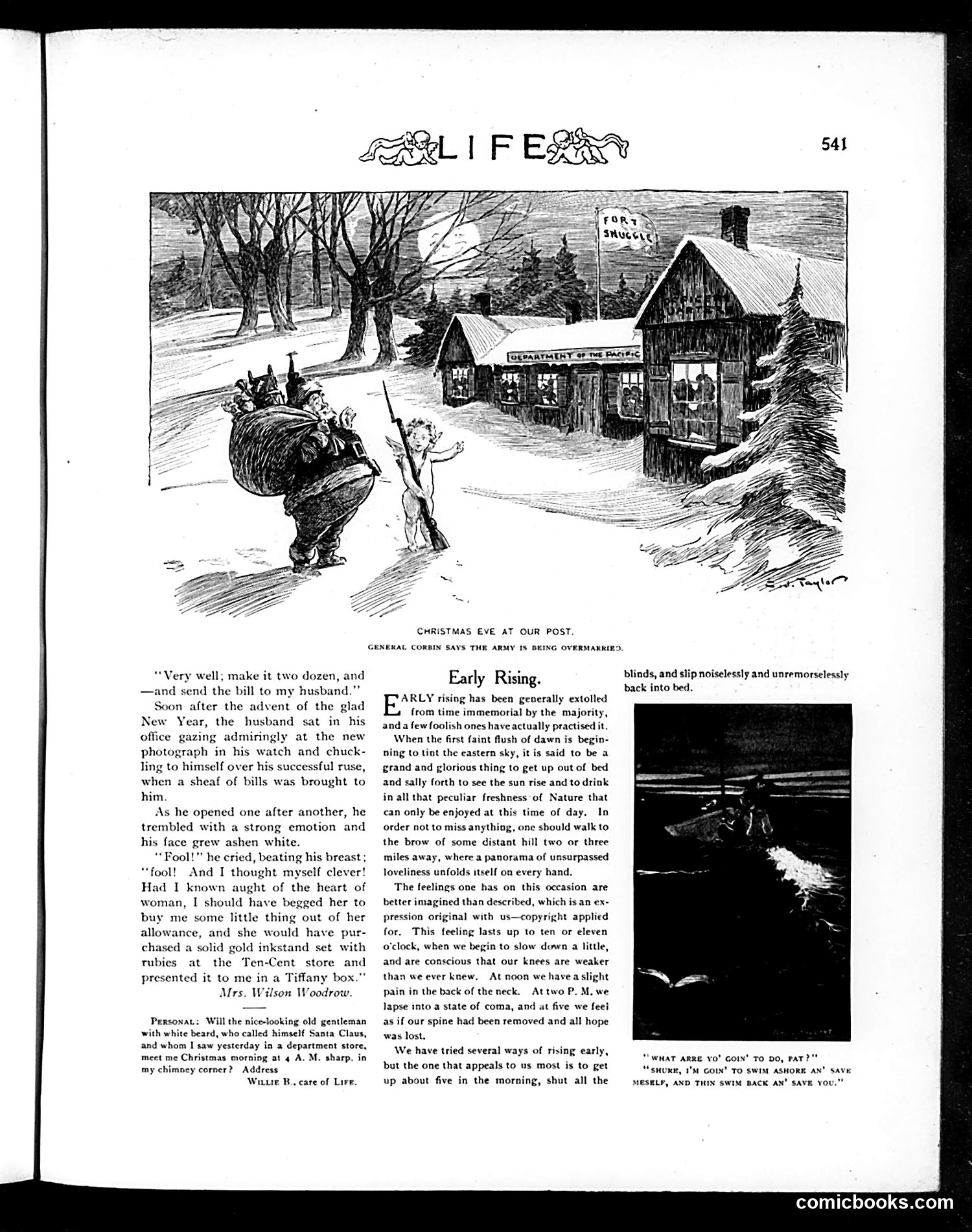
This page contains two satirical pieces typical of early 20th-century Life magazine humor: **Top cartoon ("Christmas Eve at Our Post"):** depicts a domestic comedy about gift-giving. A husband cleverly gives his wife a photograph as a Christmas gift, expecting minimal expense. However, the wife subsequently purchases expensive items (rubies, Tiffany boxes) and sends the bills to him—the joke being that his "ruse" backfired spectacularly. The satire targets both marital financial dynamics and wives' spending habits, a common theme in period humor. **"Early Rising" article:** satirizes the popular Victorian/Edwardian virtue of early morning activity. It mocks the romanticized notion that dawn walks yield spiritual refreshment, revealing instead physical exhaustion, aching knees, and eventual collapse—making the only rational solution a return to bed. The humor lies in deflating pretentious health advice through honest observation. **Sidebar personal ad:** a humorous "lost and found" where someone addresses "Santa Claus" as if real, maintaining the magazine's comedic tone throughout.
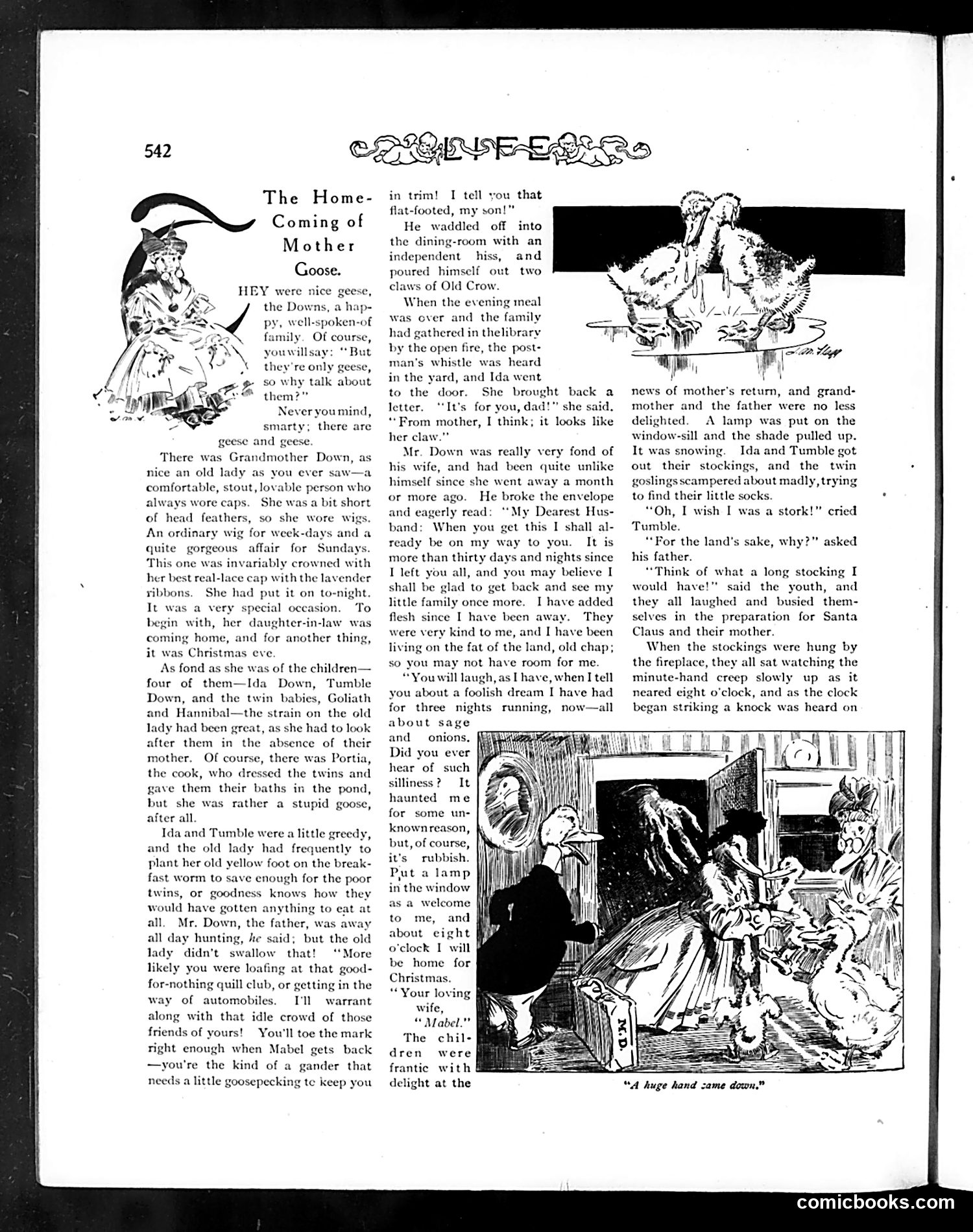
This is a humorous domestic narrative illustrated with animal characters—specifically geese—rather than a political cartoon. The story depicts a family of geese awaiting the return of "Mother" (Mabel) from a month-long absence. The satire is gentle and social rather than political: it gently mocks human domestic life by rendering it through anthropomorphic geese characters. The humor targets recognizable middle-class concerns—an absent breadwinner husband frequenting a "quill club," children's greediness, household management challenges, and Christmas preparations. The elderly Grandmother Down's characterization as a bossy matriarch who threatens to "goosepeck" the lazy father figure provides comic commentary on domestic authority. The "smarty" opening voice suggests the author is deflating readers who might dismiss the story as merely about geese, insisting instead on its relevance to human family dynamics. This appears to be light entertainment rather than social criticism.
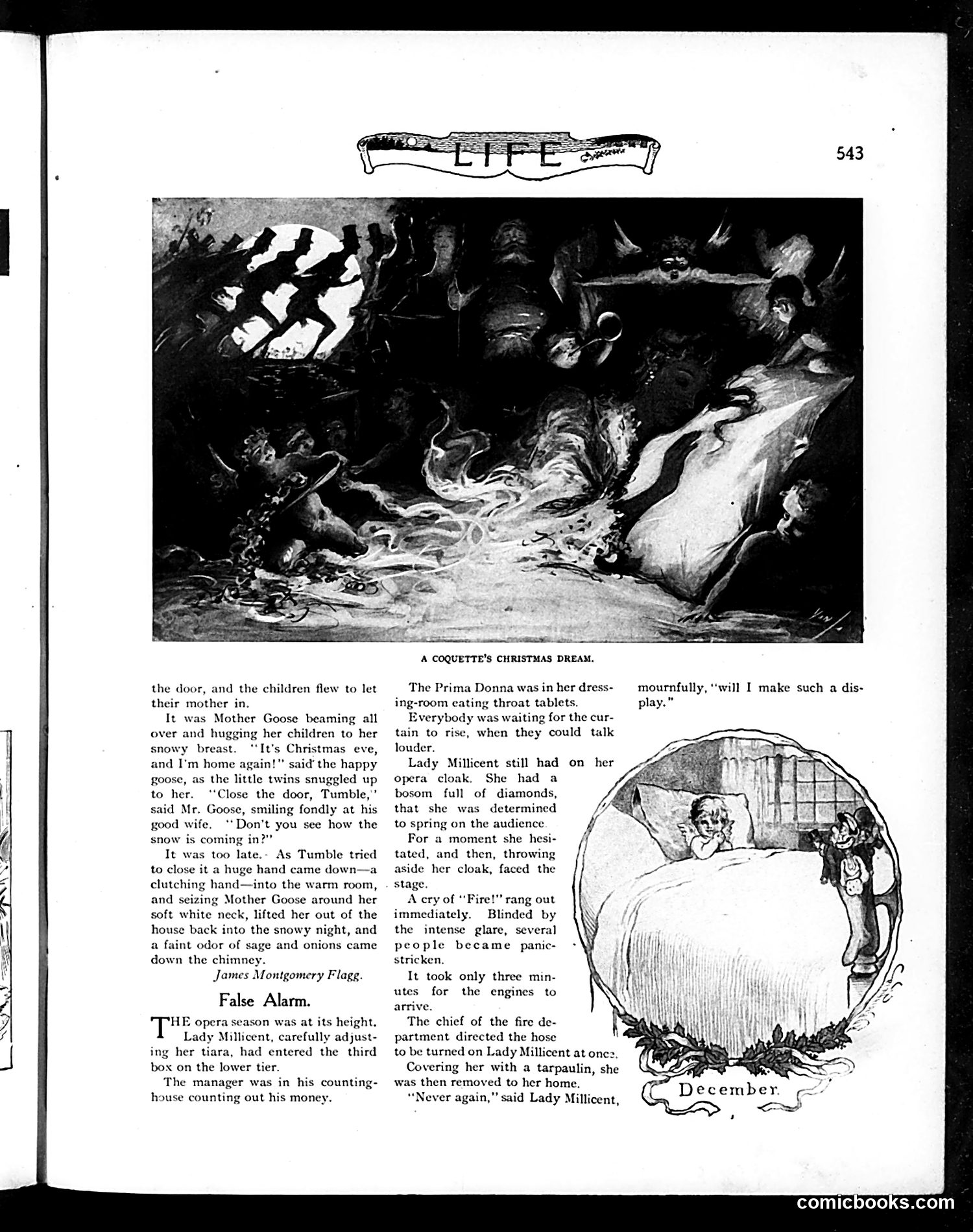
This page contains two satirical stories illustrated by James Montgomery Flagg: **"A Coquette's Christmas Dream"** (top): A dark fantasy where Mother Goose's cozy Christmas homecoming is interrupted when a giant hand seizes her from the house. The surreal horror suggests anxieties about domestic security or serves as cautionary Christmas tale. **"False Alarm"** (bottom): Social satire mocking wealthy vanity. Lady Millicent attends the opera wearing conspicuous diamonds. When she dramatically removes her cloak to display them, her glittering jewels cause someone to shout "Fire!" The resulting panic—firefighters hosing her down—humbles her pretension. The moral: ostentatious wealth display invites ridicule and misfortune. Both stories use exaggerated scenarios to mock human folly: supernatural intrusion on domesticity and the social consequences of vanity. The humor targets both supernatural superstition and upper-class pretension.
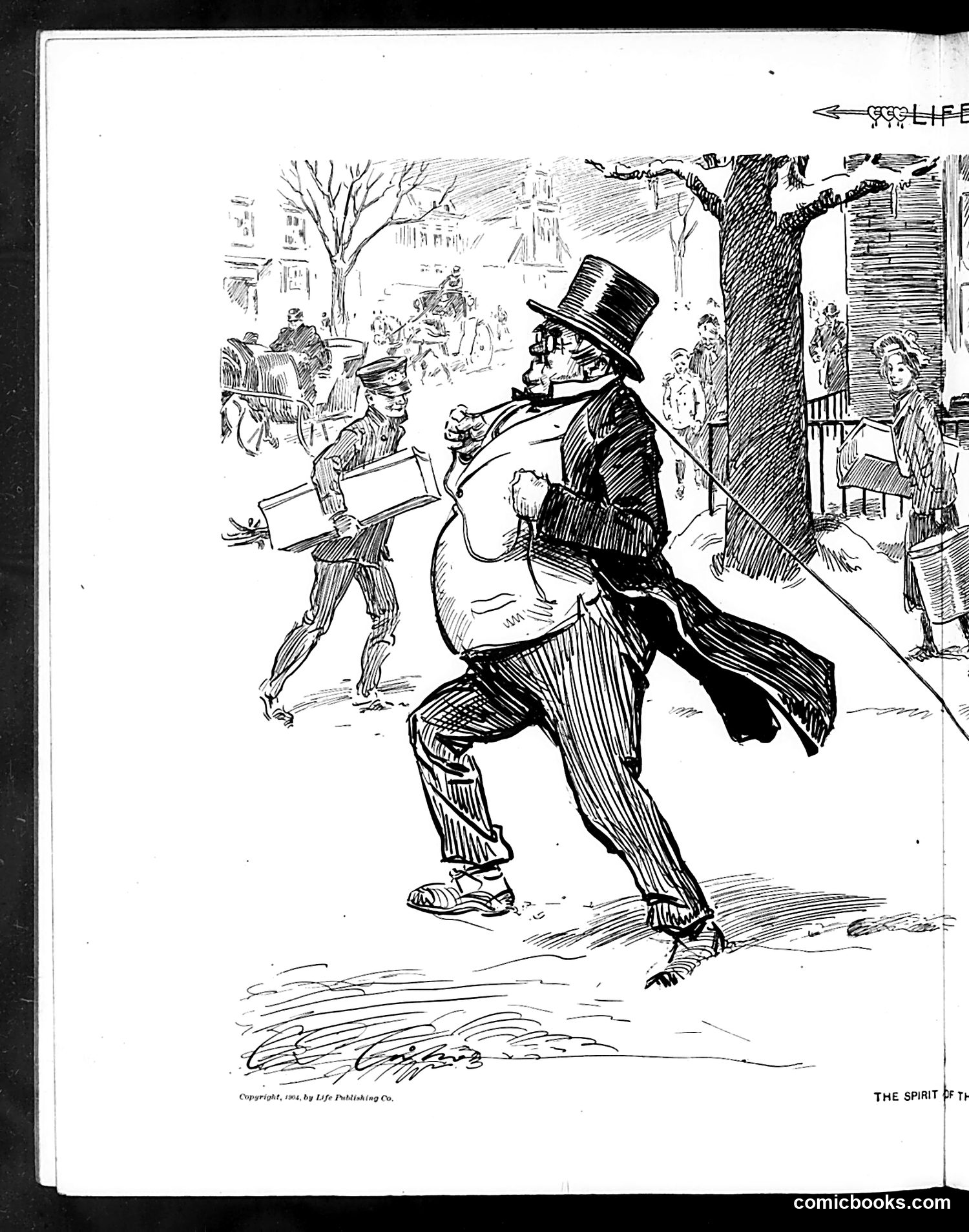
This satirical cartoon depicts a rotund, well-dressed gentleman in a top hat being chased or confronted by a thin man holding what appears to be a document or notice. The portly figure's exaggerated physique and formal attire suggest he represents wealth or privilege, while the pursuing figure appears to be serving him with legal papers or a bill. The cartoon's title, "The Spirit of [incomplete]," likely comments on a social or political issue of 1904. The scene captures a common satirical theme of the era: the tension between wealthy elites and creditors, legal authorities, or reform movements. The urban street setting with onlookers suggests public scandal or accountability. Without the complete title, the specific target remains unclear, but the image exemplifies Life magazine's tradition of mocking pretension and exposing consequences facing the privileged.
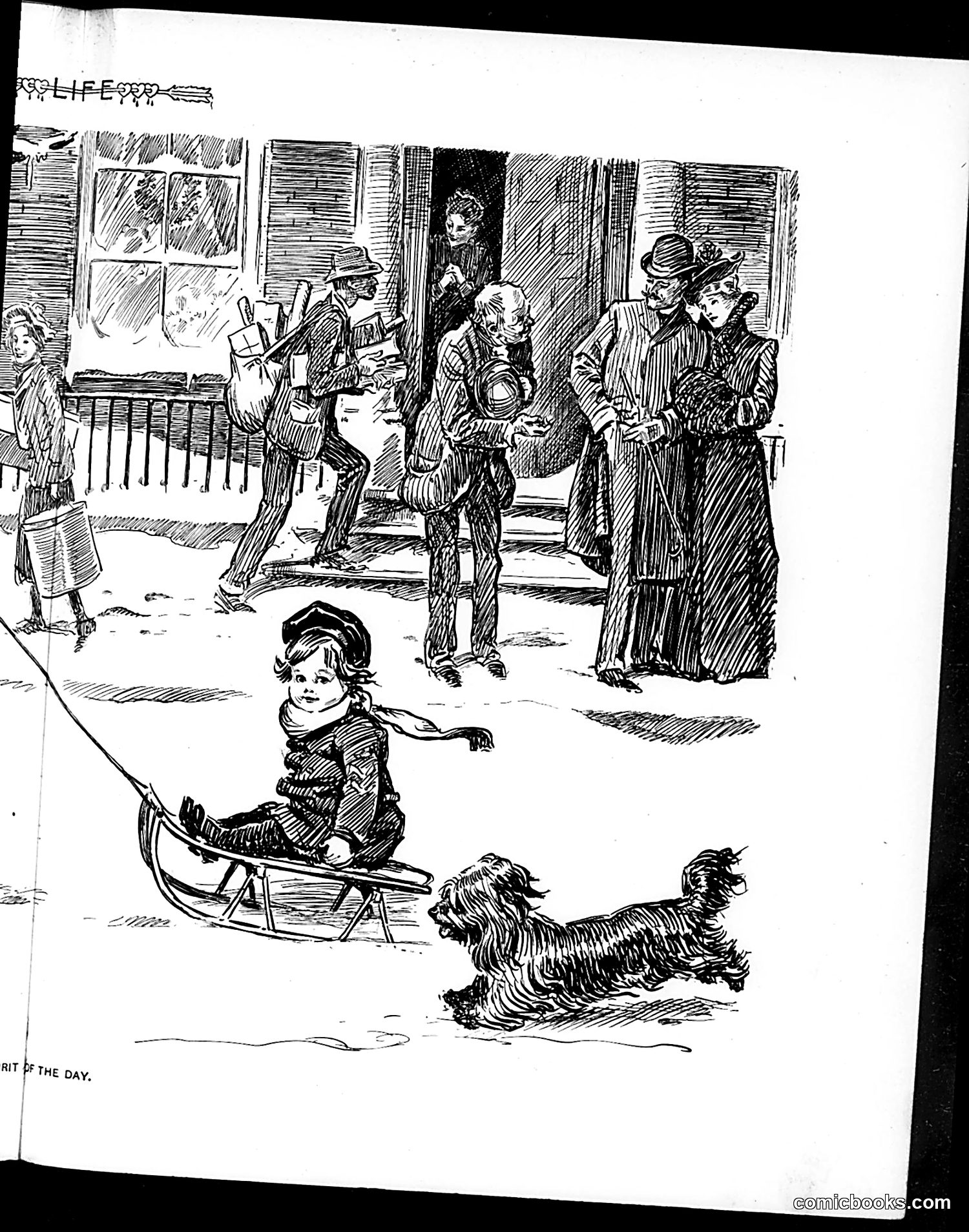
This ink sketch depicts a winter street scene with social class contrast. A well-dressed child sits on a sled being pulled by a long-haired dog, while well-to-do adults in coats and hats observe from a building entrance behind. A woman on the left watches from a window. The satire appears to comment on childhood leisure and class distinctions in Victorian or Edwardian-era urban life. The child's comfortable, playful situation—sledding with a pet—contrasts with the formal, stationary adults, suggesting how childhood freedom differs from adult social constraints and propriety. The caption "A Bit of the Day" likely refers to a brief moment of innocent winter pleasure, though the exact satirical target remains unclear without additional context about Life magazine's contemporary concerns.
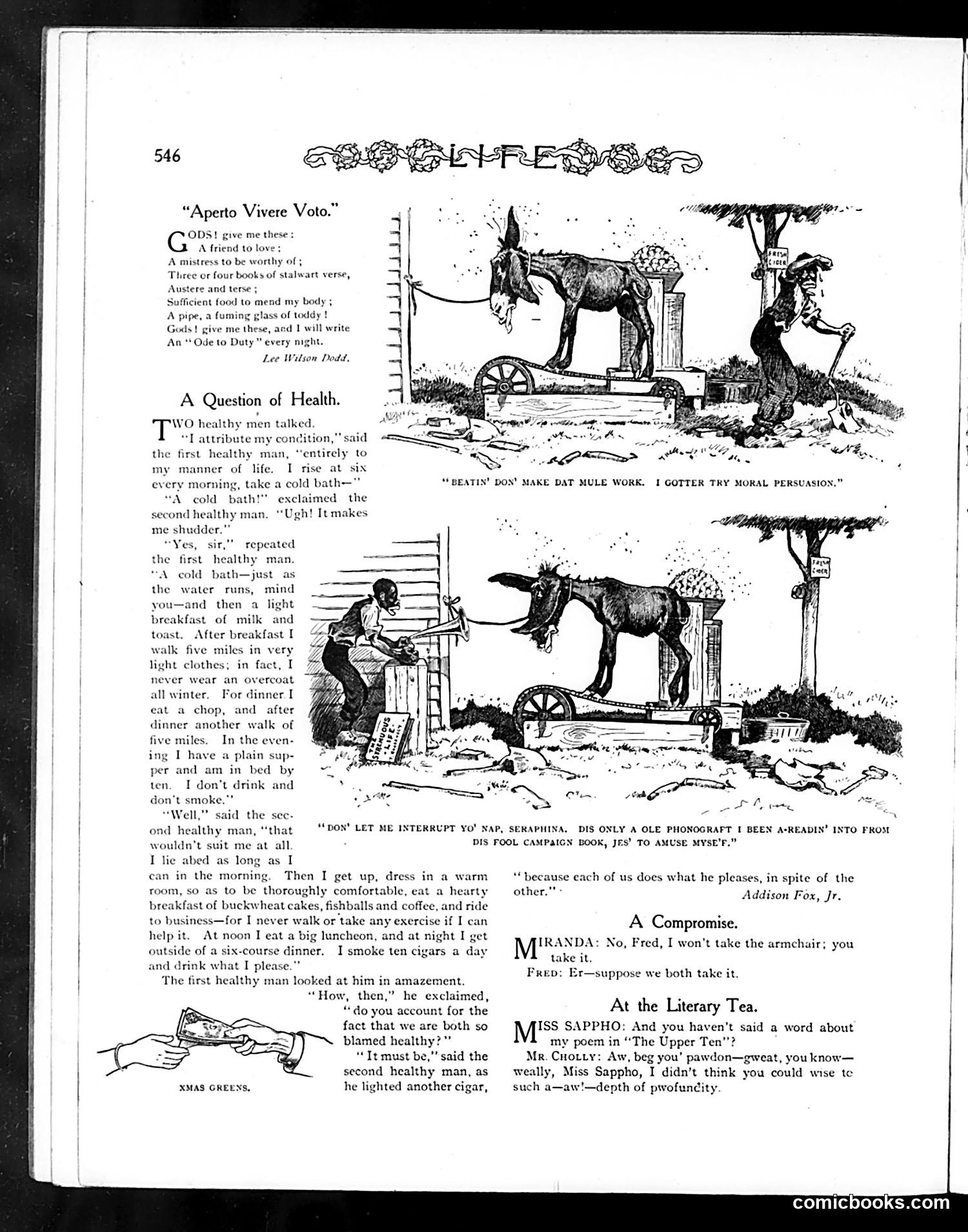
This *Life* magazine page contains three distinct humorous pieces: **"A Question of Health"**: Two men compare their health regimens—one rigid (cold baths, light meals, exercise, no drinking/smoking) versus one indulgent (sleeping late, hearty breakfasts, no exercise, heavy dinners, cigars, alcohol). The joke's punchline satirizes the absurdity that both remain equally healthy *because* each does what suits him individually. This mocks contemporary health fads and contradictory medical advice. **Two cartoon vignettes**: Rural/working-class scenes with dialect humor. One shows a mule refusing work; another depicts someone avoiding disturbing a napping woman to try "moral persuasion" instead. These employ stereotypical African American vernacular for comedic effect. **"A Compromise" and "At the Literary Tea"**: Brief dialogue sketches—one about two people both wanting furniture, resolved by sharing; another mocking pretentious literary circles, where a man uses affected speech ("pwofuncity") to flatter a poet without committing to actual critique. The page reflects early 20th-century American satire targeting health crazes, social conventions, and literary pretension.
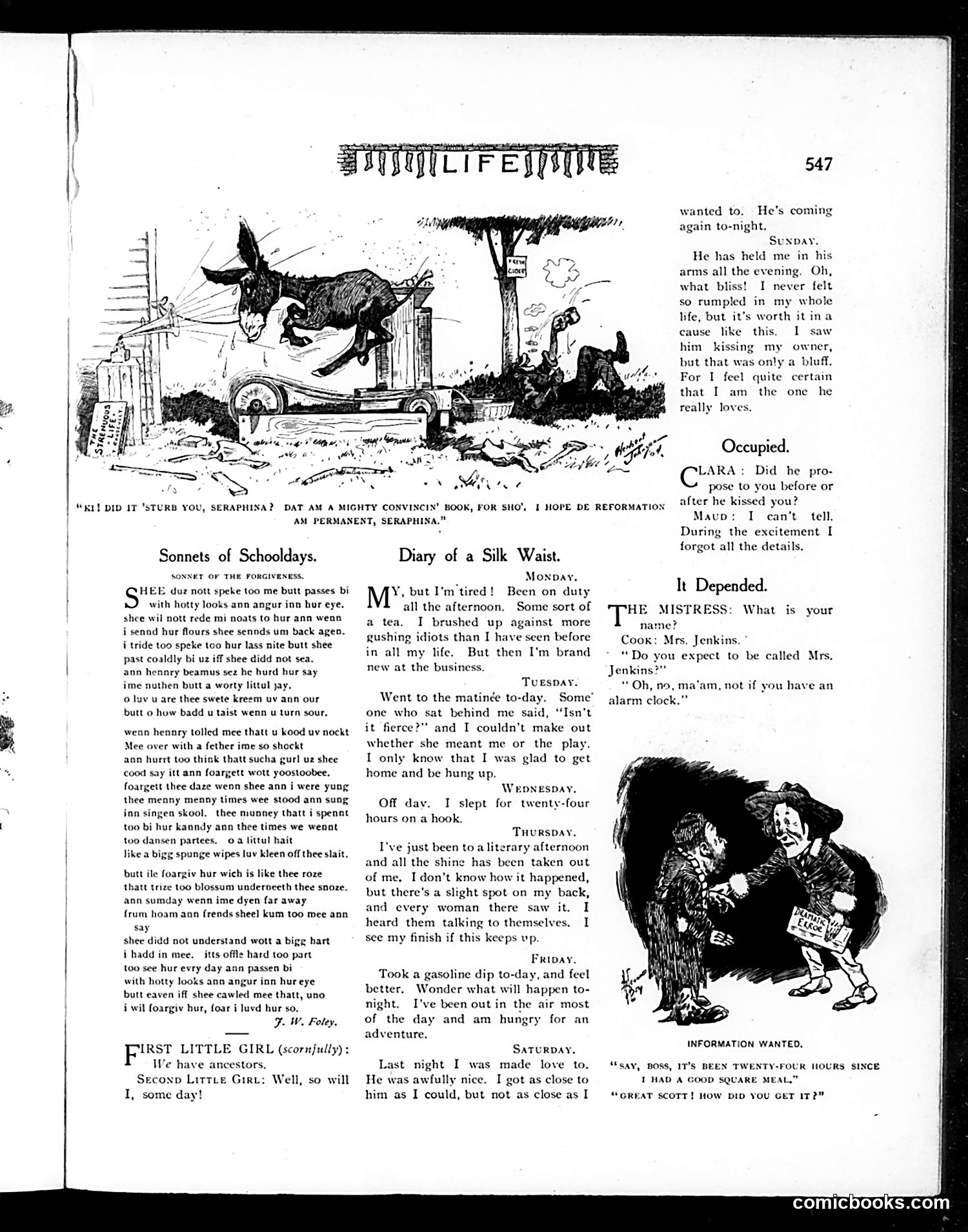
This page contains three distinct satirical pieces: **"Sonnets of Schooldays"** parodies overwrought Victorian poetry with deliberately misspelled dialect verse about forgiveness between young lovers—mocking both sentimental romance and affected literary pretension. **"Diary of a Silk Waist"** is a comedic monologue from a working woman's perspective, chronicling her week of romantic entanglement, exhaustion from her job, and social embarrassments (a visible stain at a literary event). The humor derives from her matter-of-fact tone about intimate encounters and the triviality of her concerns. **"Information Wanted"** (bottom cartoon) shows what appears to be a vagrant or laborer asking when he last ate—a joke about extreme poverty or homelessness, with the boss's sarcastic response implying the man's desperation is exaggerated or unbelievable. The page reflects early 1900s American humor: satirizing romantic conventions, poking fun at working-class women gaining social independence, and making light of economic hardship.
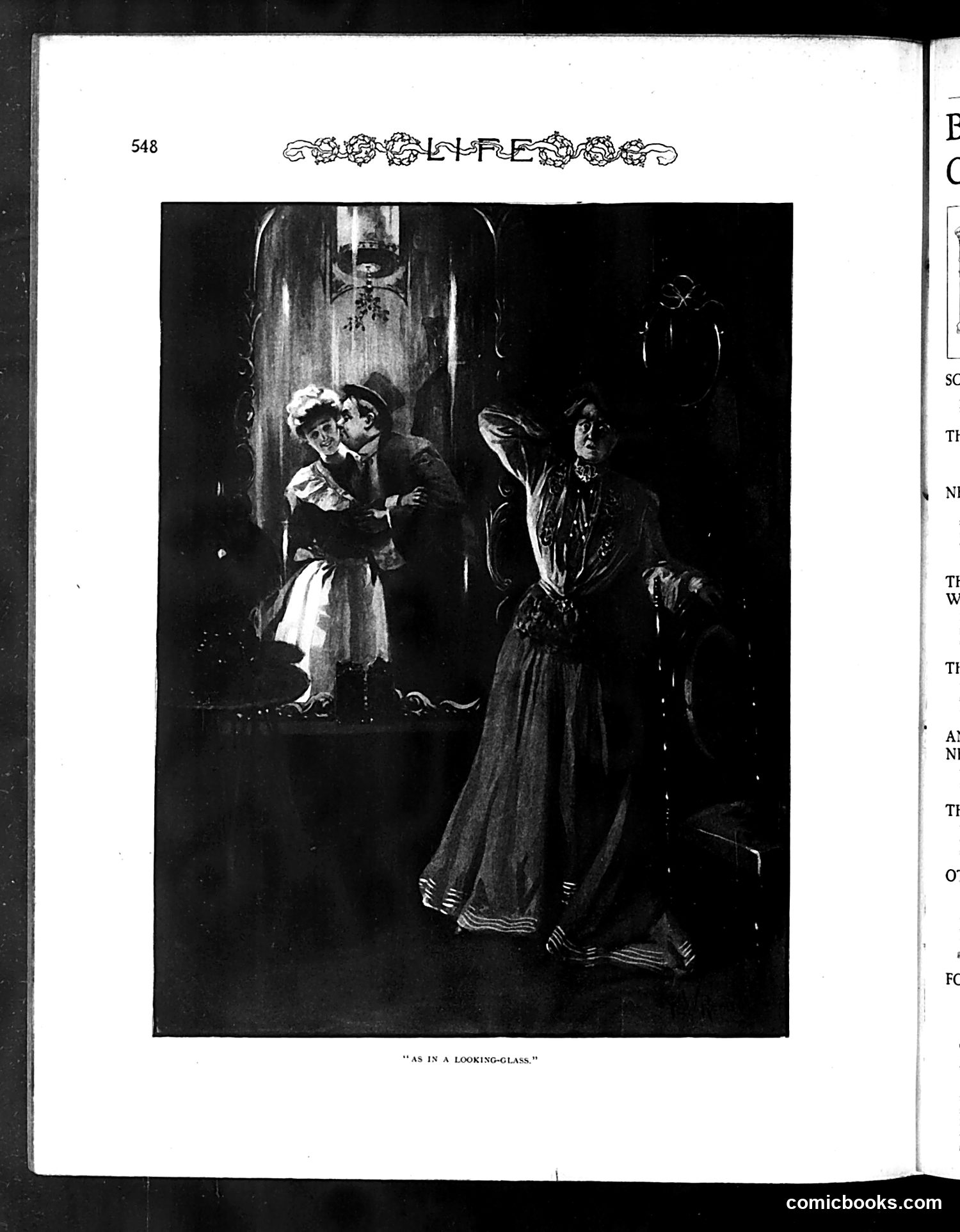
This appears to be an illustration from Life magazine showing a scene with four figures in period dress. The caption "As in a Looking-Glass" suggests a reference to Lewis Carroll's *Through the Looking-Glass*, implying reversed or distorted reality. The image depicts what seems to be a social or political encounter, with figures in Victorian-era clothing arranged in a doorway or corridor setting. Without clearer context about the surrounding text or publication date, the specific satirical target remains unclear. The theatrical lighting and composition suggest commentary on social pretense, deception, or the contrast between appearance and reality—themes consistent with both Carroll references and early 20th-century American satire. The exact political or social critique intended cannot be definitively determined from the image alone.
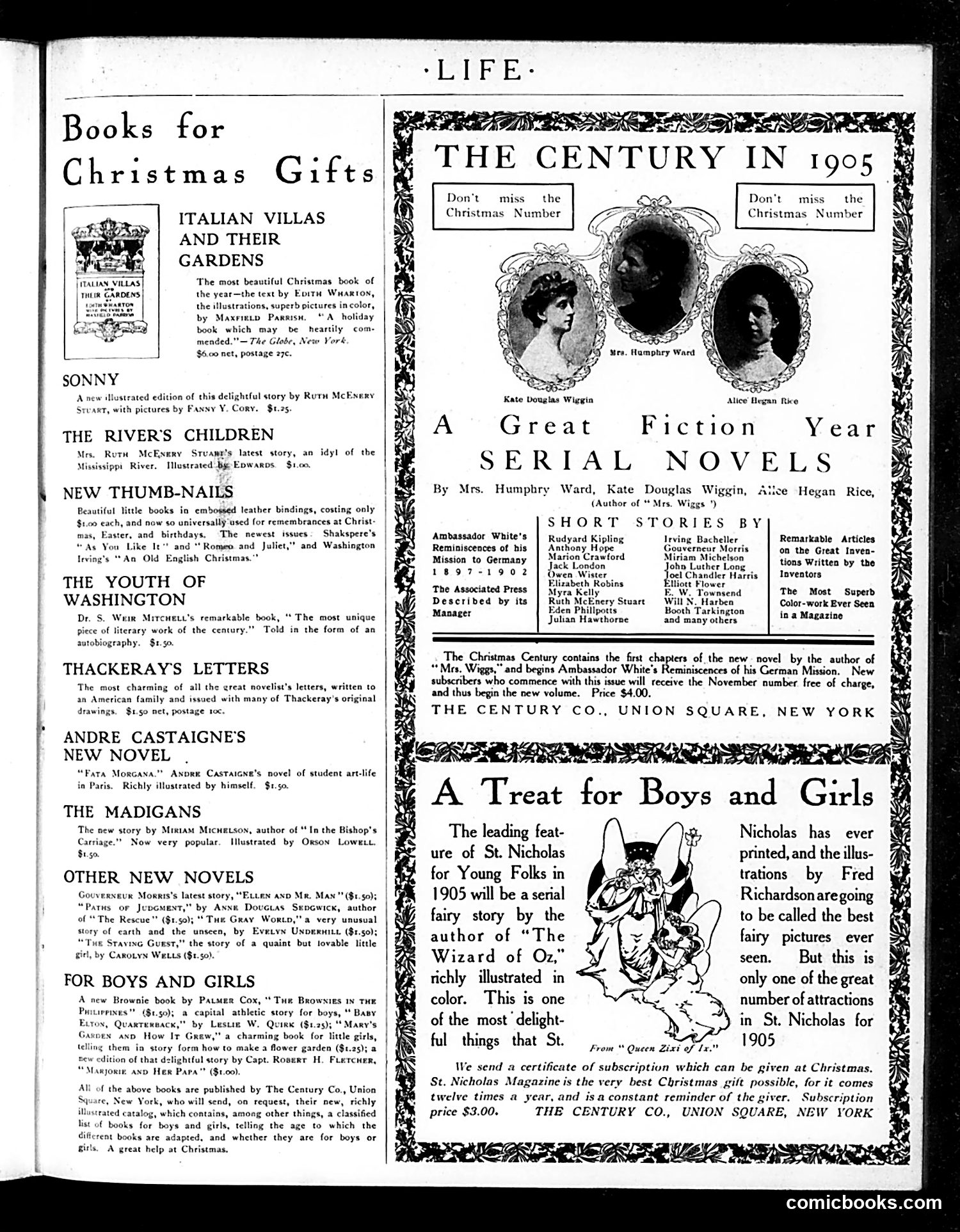
This page is primarily **advertising for Christmas gift books** rather than political satire or cartoons. The left column lists literary works by popular authors (Thackeray, André Castaigne, Marion Harland), while the right side advertises *The Century* magazine's December 1905 Christmas issue. The central advertisement highlights "A Great Fiction Year" featuring serial novels by prominent authors including Rudyard Kipling, Jack London, and Owen Wister. Below that, *St. Nicholas* magazine advertises an upcoming fairy tale serial by L. Frank Baum (author of *The Wizard of Oz*), illustrated by Fred Richardson. The small illustration shows a whimsical fairy character—likely promotional art for the Baum serialization. This is a **typical period magazine page** showcasing holiday publishing offerings to affluent American readers, with no apparent political commentary or satire.
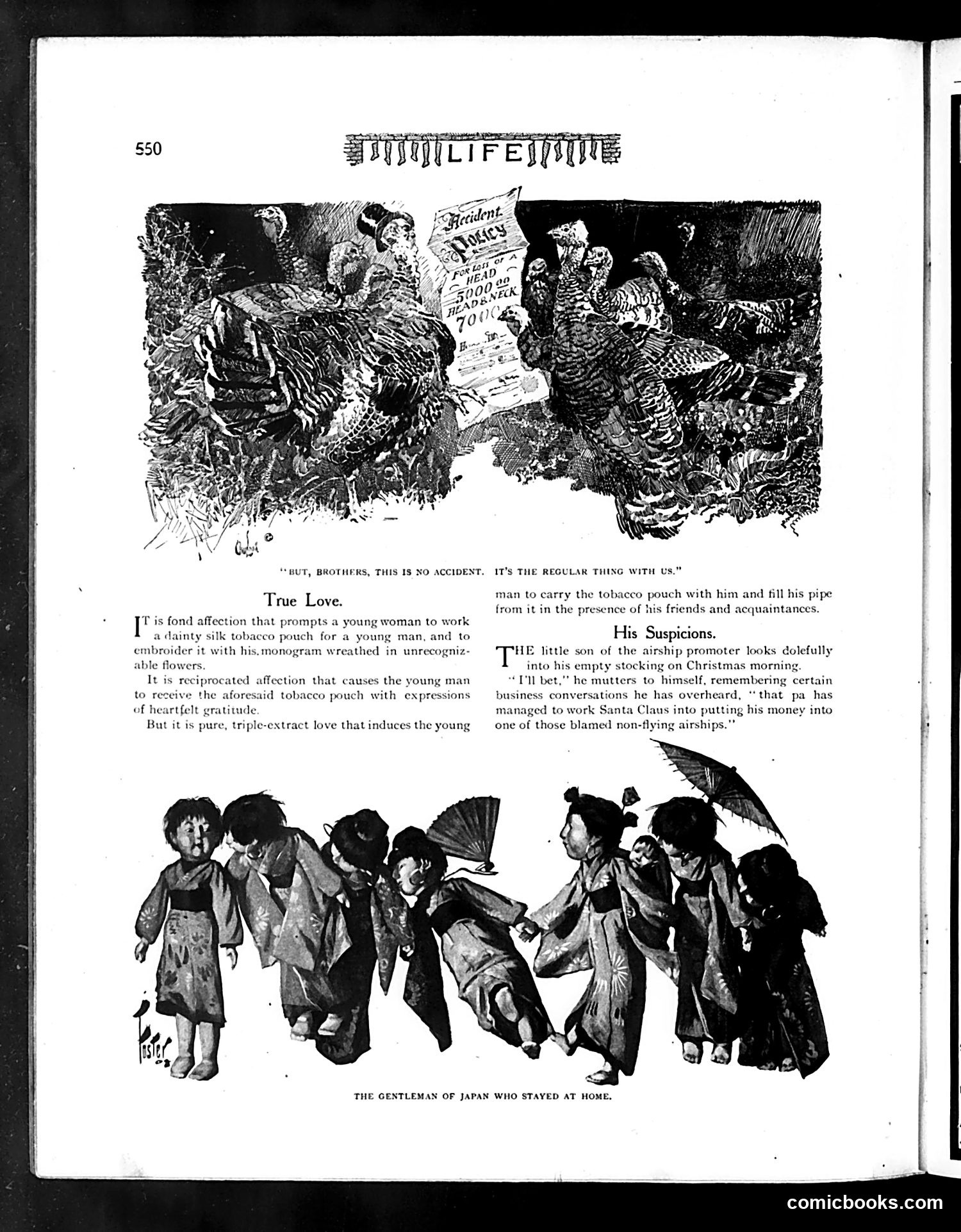
This page contains three separate satirical pieces: **"True Love"** (top cartoon): Mocks romantic gestures between young couples, particularly the custom of embroidering tobacco pouches with monograms as love tokens. The satire progresses from sentimental to cynical—the "pure, triple-extract love" is when the man actually *uses* the pouch publicly, suggesting true affection is proven through practical use rather than heartfelt sentiment. **"His Suspicions"** (middle text): A brief joke about a boy disappointed on Christmas morning. He suspects his father—an "airship promoter"—has convinced Santa Claus to invest the boy's gifts into a failed aviation venture, mocking both the father's dubious business schemes and the early-1900s airship industry's speculative nature. **"The Gentleman of Japan Who Stayed at Home"** (bottom illustration): Shows Japanese figures in traditional dress with umbrellas. The caption likely comments on Japanese isolation or cultural insularity, though the specific historical reference is unclear without additional context.
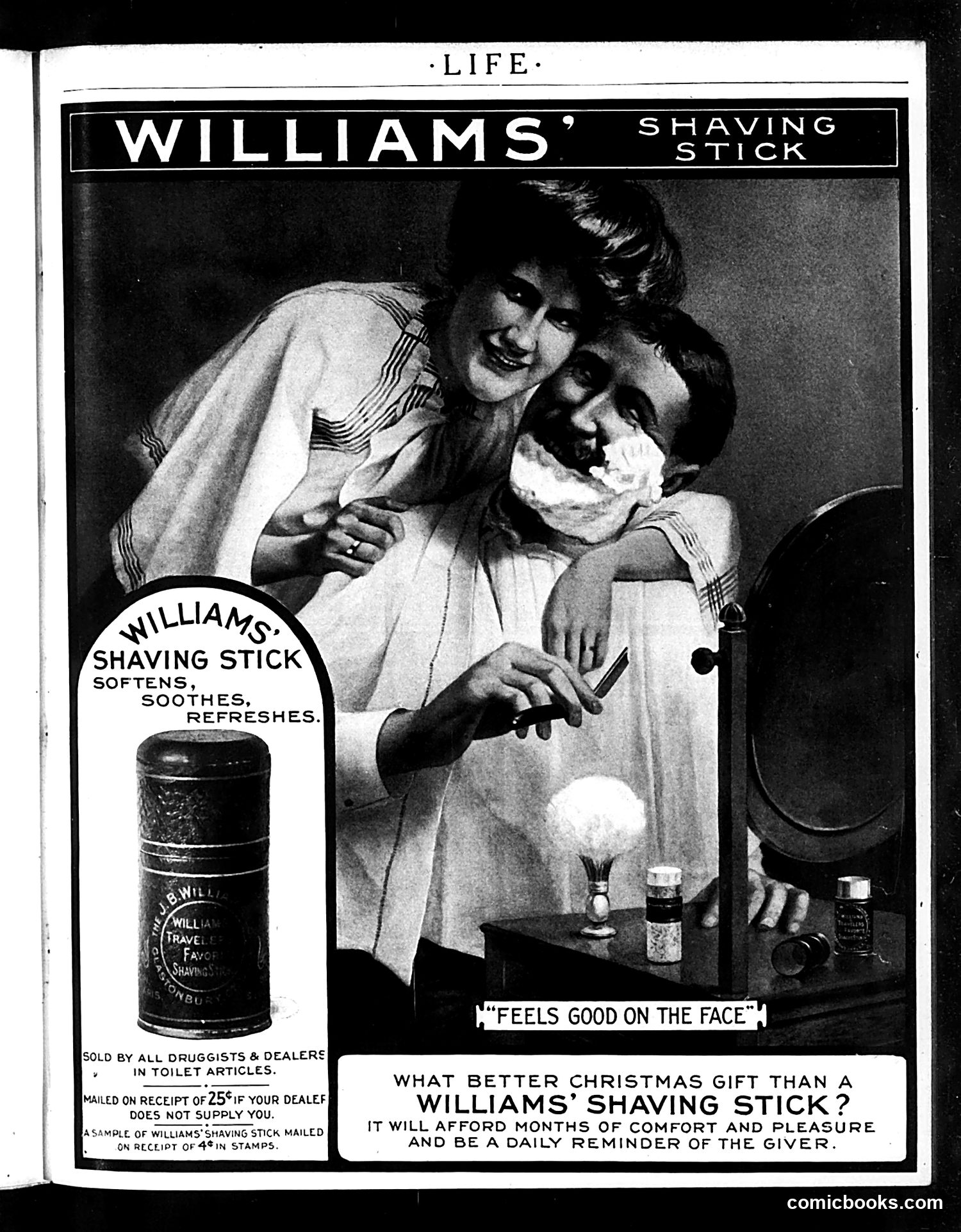
This is a straightforward product advertisement, not political satire. It promotes Williams' Shaving Stick as a Christmas gift, featuring a domestic scene where a woman applies shaving cream to a man's face while a child watches. The ad emphasizes the product's benefits—it "softens, soothes, refreshes"—and employs sentimental marketing by suggesting the gift will provide "months of comfort and pleasure" and serve as a "daily reminder of the giver." The pricing and mail-order details (25¢, samples for 4¢ in stamps) indicate this was a mass-market consumer product sold through druggists. The tagline "Feels Good on the Face" was the product's marketing slogan. This represents early 20th-century advertising's appeal to domestic comfort and gift-giving sentiment.
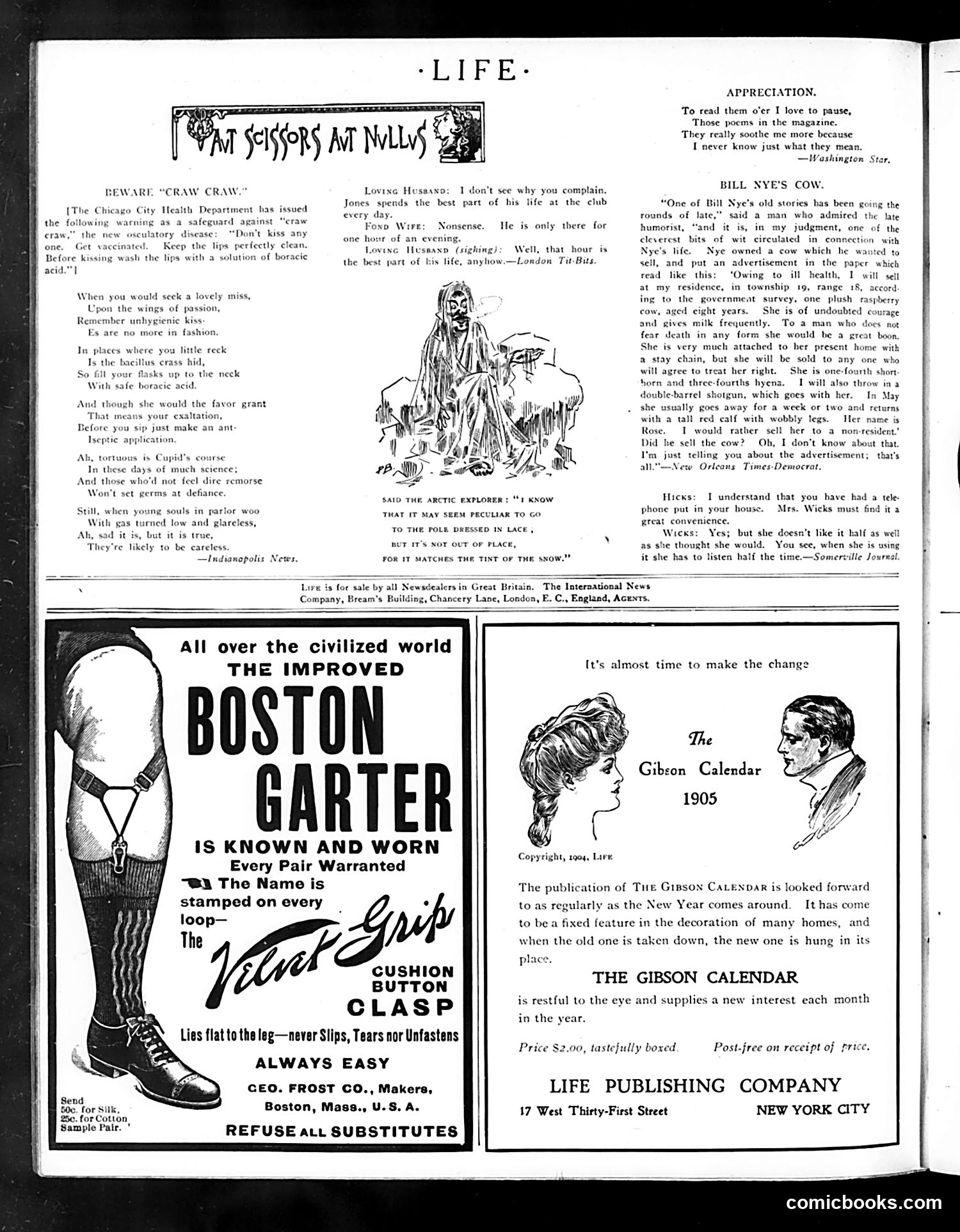
This page from Life magazine (circa 1904-1905) contains satirical content and period advertisements rather than a single unified political cartoon. **Main Content:** The page features several short humorous pieces mocking social customs and marital dynamics. "Beware 'Craw Craw'" satirizes a Chicago health department warning about unsanitary kissing practices during a supposed disease outbreak. A dialogue between a "Loving Husband" and "Fond Wife" jokes about marital dissatisfaction—the husband spends evenings at a club, which his wife sarcastically suggests is the best part of his life. "Bill Nye's Cow" reprints a tall tale from the deceased humorist Bill Nye about selling a difficult, temperamental cow through an absurdly honest advertisement. **Advertisements:** Include the Boston Garter (men's hosiery) and promotion for the Gibson Calendar, featuring Charles Dana Gibson's famous illustrations of idealized women. The content reflects turn-of-century American humor focusing on gender relations, health anxieties, and consumer culture.
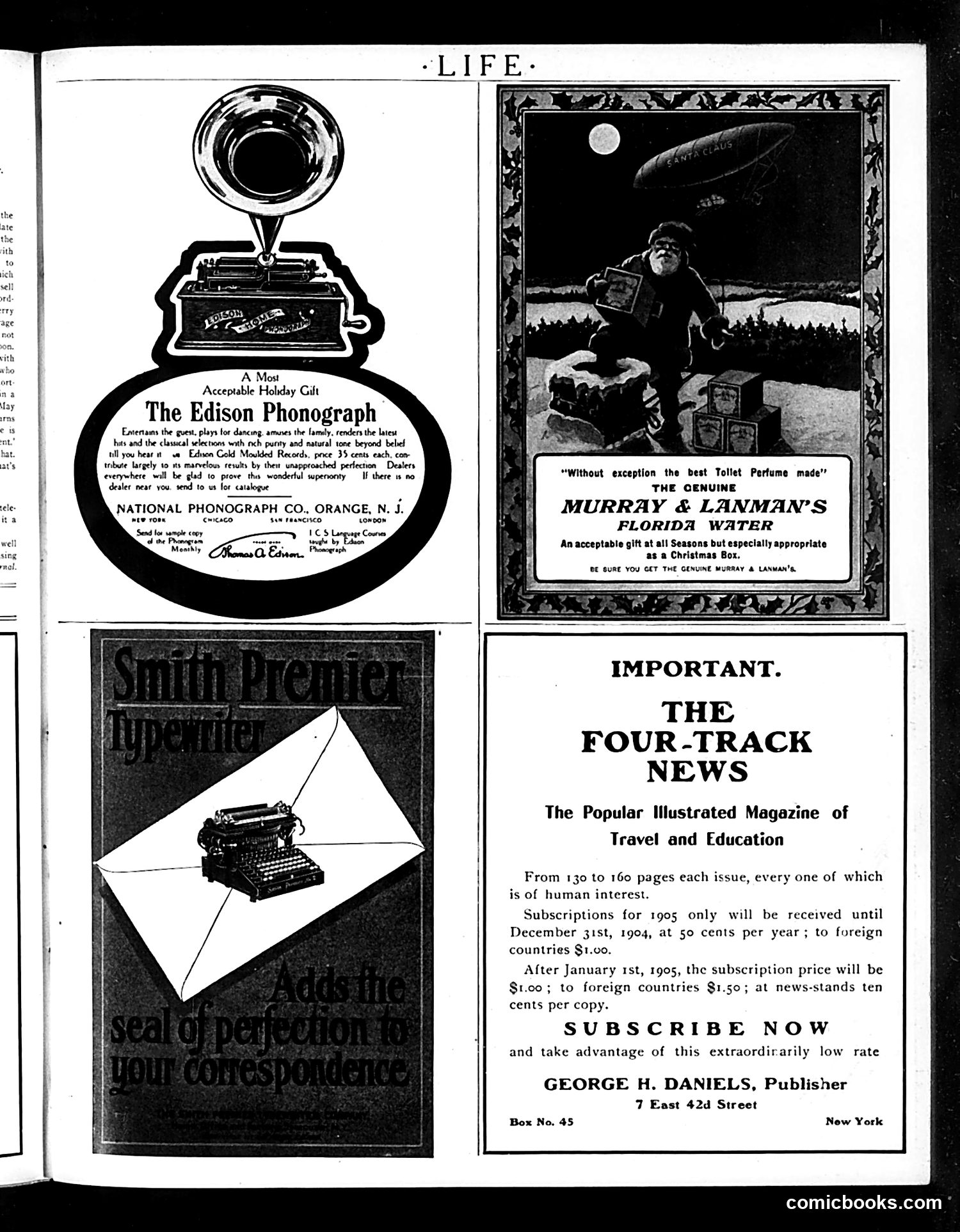
This is primarily a **product advertisement page** rather than political satire. It features three holiday gift promotions typical of early 1900s consumer marketing: 1. **Edison Phonograph** (top): Advertises the new technology as entertainment for guests, dancing, and family amusement, emphasizing its superior sound quality with Gold Moulded Records at 35 cents each. 2. **Murray & Lanman's Florida Water** (right): A perfume/toiletry product marketed as an appropriate Christmas gift. 3. **Smith Premier Typewriter** (bottom left): Promotes this writing machine, though text is partially obscured. 4. **The Four-Track News** (bottom right): A travel and education magazine subscription offer at 50 cents/year through December 1904, with price increasing to $1.00 thereafter. The page reflects **turn-of-the-century consumer culture**, showcasing emerging technologies (phonographs, typewriters) and luxury goods as desirable holiday presents for middle-class Americans. There is no political cartoon or satire present.
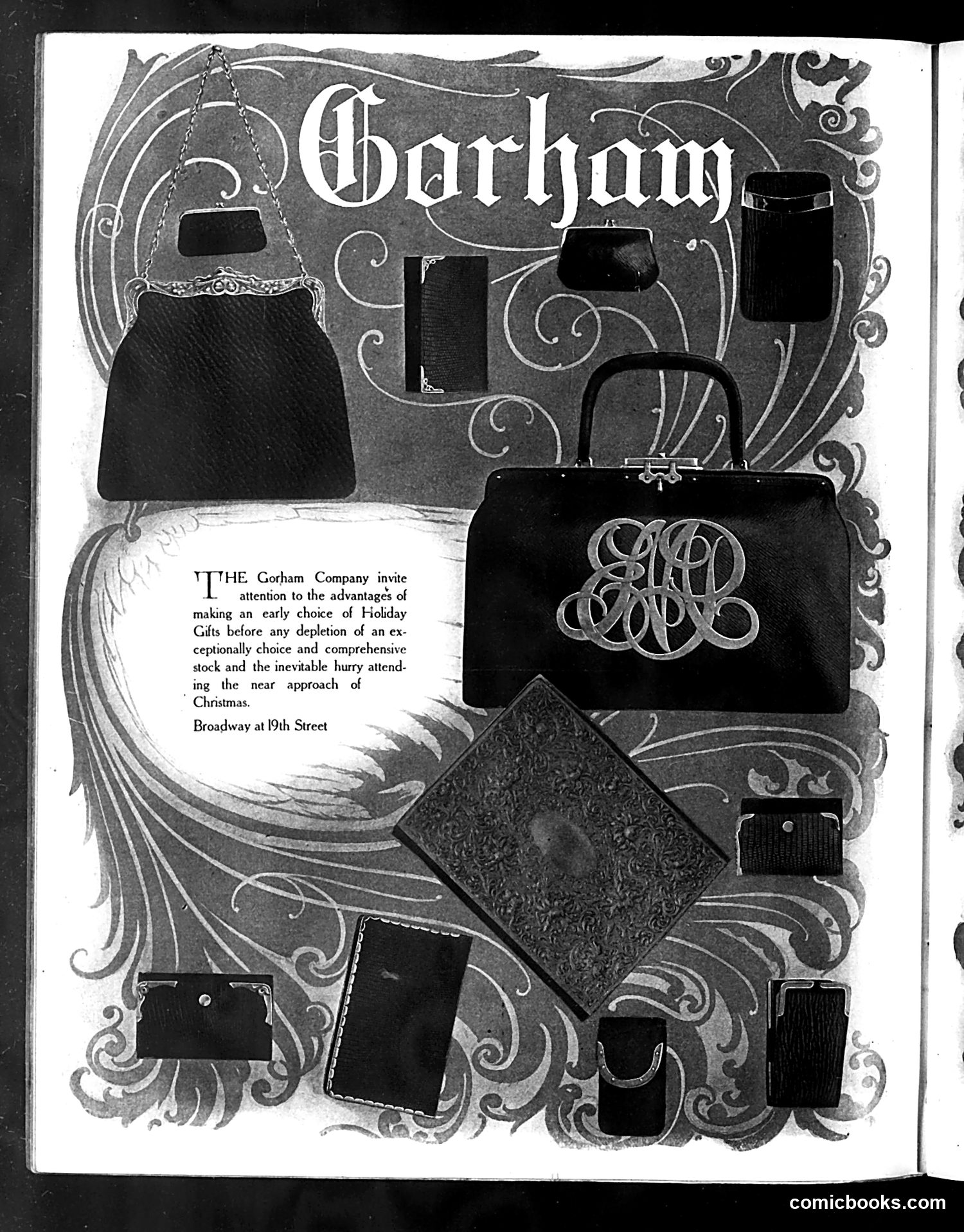
This is a Gorham Company advertisement, not a political cartoon. Gorham was a prominent American silverware and luxury goods manufacturer. The ad promotes early Christmas shopping to avoid last-minute rush and stock depletion. The decorative Art Nouveau border frames various luxury items—handbags, compacts, and other accessories—displayed as holiday gift options. The elaborate typography and ornamental design are characteristic of early 20th-century luxury advertising. The message is straightforward consumer advice: shop early for Christmas at their Broadway location at 19th Street to secure the best selection before inventory runs low during the holiday season.
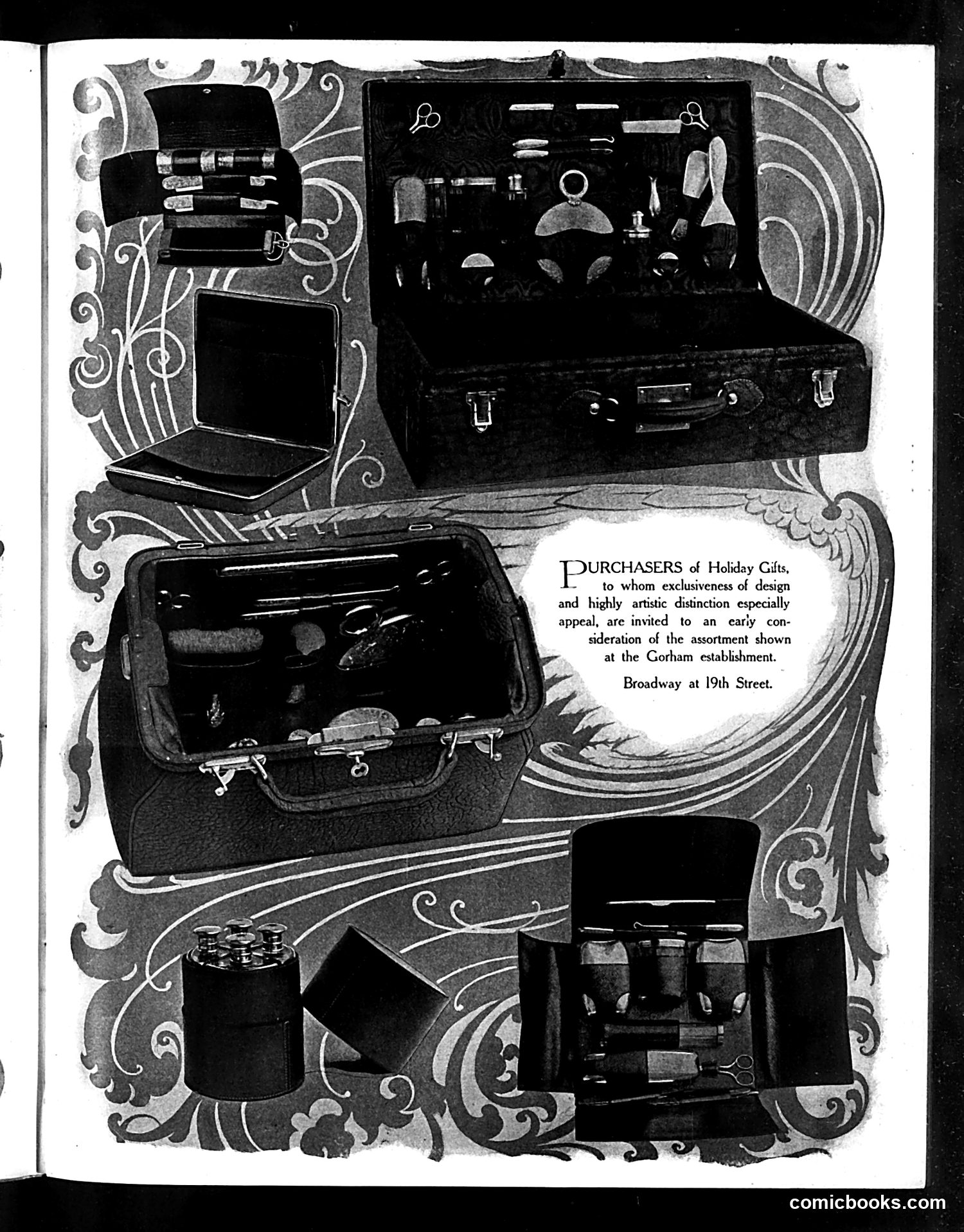
This is a full-page advertisement for Gorham, a luxury goods establishment located at Broadway and 19th Street in New York. Rather than satirical content, the page showcases elegant gift sets displayed in ornate decorative frames—including grooming kits, manicure sets, and toiletry cases arranged in leather carrying cases. The text invites affluent consumers seeking "exclusiveness of design and highly artistic distinction" to view their holiday gift assortment. This represents early-20th-century luxury marketing aimed at wealthy gift-buyers, emphasizing craftsmanship and refined taste rather than containing political satire or humor.
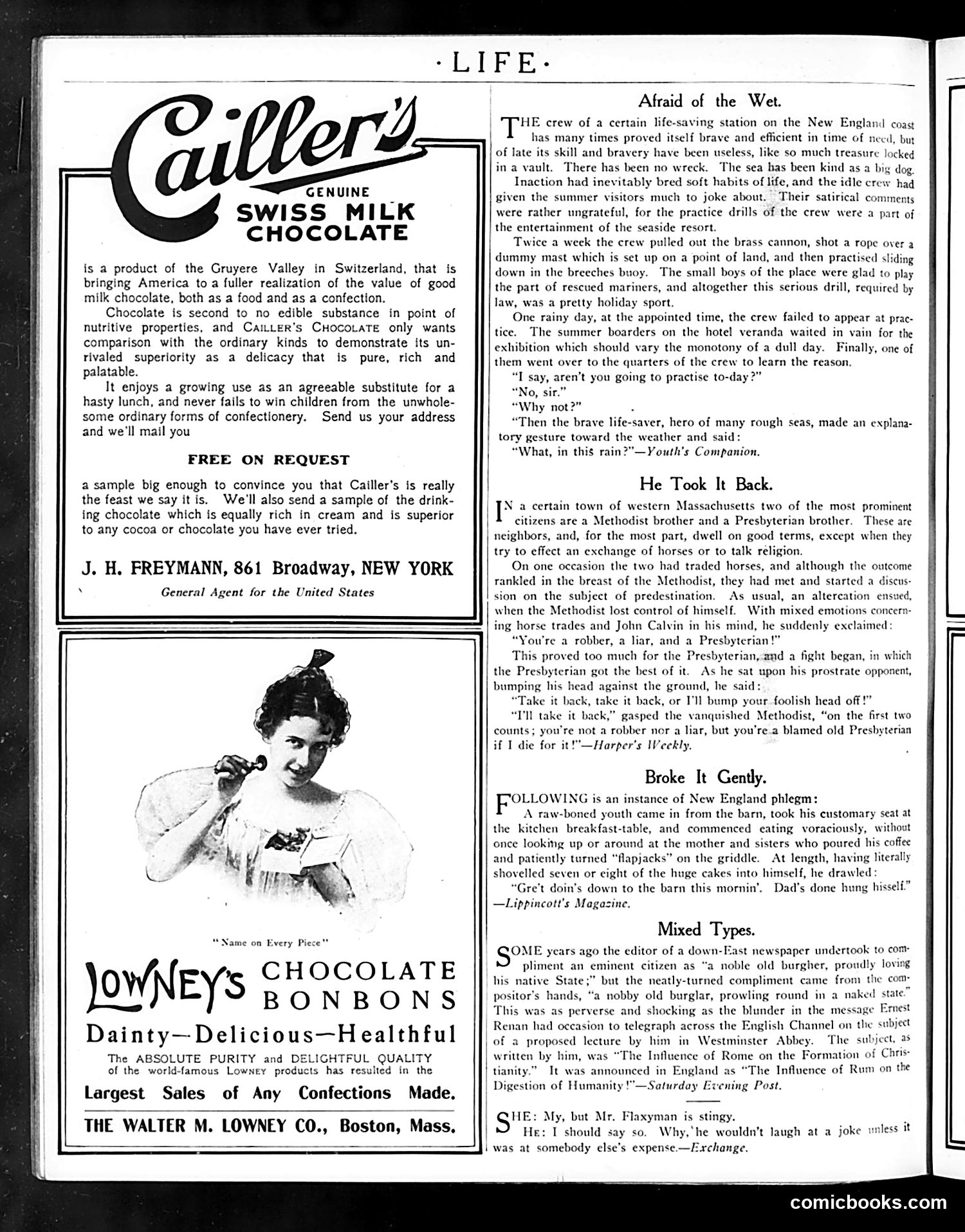
This page from *Life* magazine is primarily **advertisements** for chocolates (Cailler's Swiss Milk Chocolate and Lowney's Chocolate Bonbons), occupying roughly half the space. The remaining content consists of three brief humorous anecdotes: 1. **"Afraid of the Wet"** — A life-saving station crew avoids practice drills during rain, disappointing summer visitors expecting to see a rescue demonstration. The joke mocks the crew's reluctance to work in bad weather despite their profession requiring courage in dangerous conditions. 2. **"He Took It Back"** — A Methodist and Presbyterian neighbor argue over horse-trading and theology. The Methodist, losing the argument, insults his neighbor by calling him "a robber, a liar, and a Presbyterian"—grouping religious identity with dishonesty. This satirizes sectarian rivalry and suggests Protestants stereotyped each other as readily as they disputed doctrine. 3. **"Broke It Gently"** — A youth eats multiple flapjacks without acknowledgment, then casually mentions he's done the farm work (the text is cut off, but the humor likely derives from his indirect way of delivering bad news). These are gentle, domestic humor pieces typical of *Life*'s satirical approach.
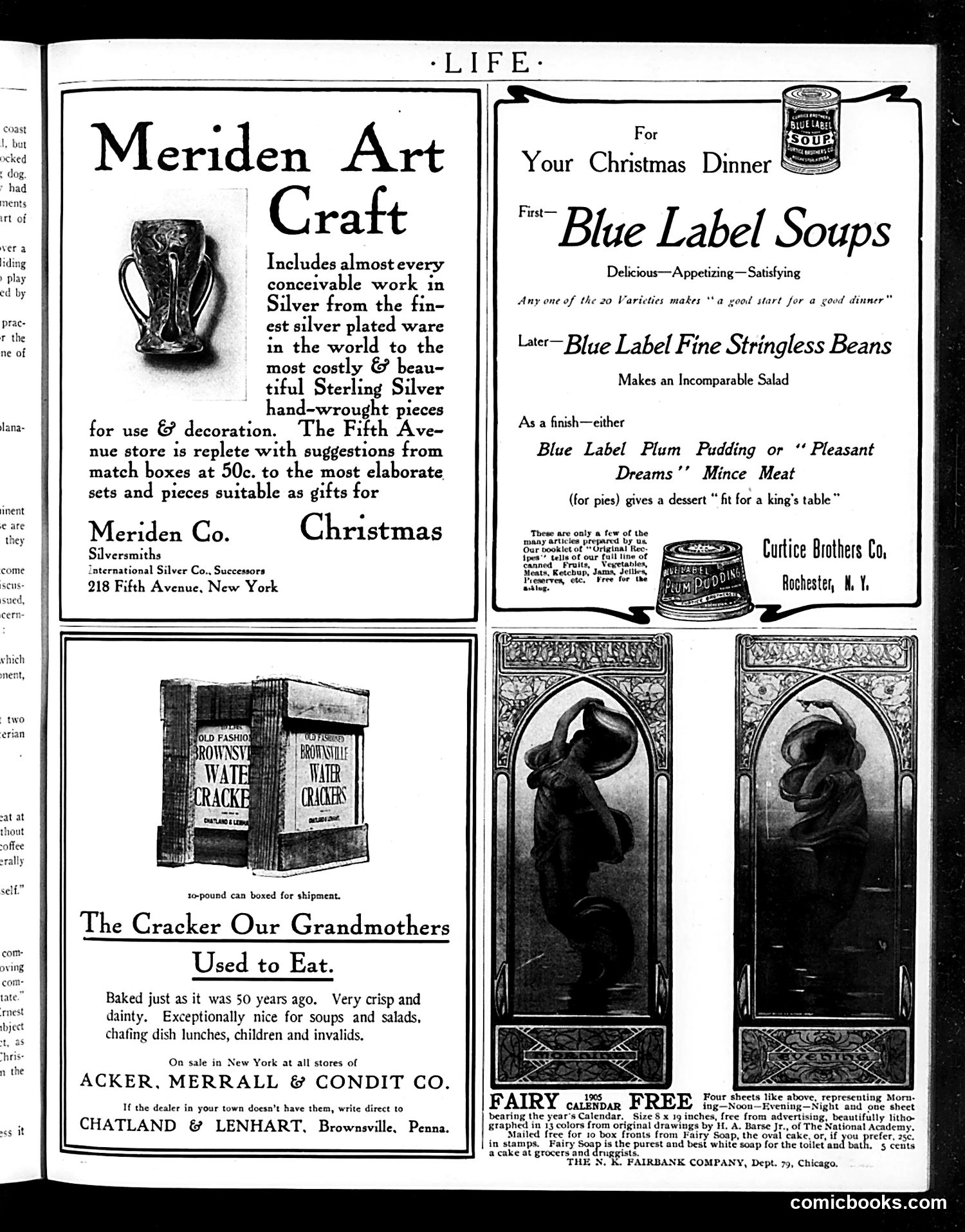
This page contains **no political cartoons or satire**—it is primarily **advertising**. The content includes four product advertisements typical of early 20th-century magazines: 1. **Meriden Art Craft** (silver goods for Christmas gifts) 2. **Blue Label Soups and canned foods** by Curtice Brothers Co. (Christmas dinner ingredients) 3. **Acker, Merrall & Condit Co. crackers** (positioned nostalgically as "the cracker our grandmothers used to eat") 4. **Fairy Soap calendar** (offering free lithographed calendars in 13 colors) The only notable historical detail is the **Fairy Soap advertisement**, which references the product's purity and offers decorative calendars as promotional incentives—a common marketing practice of the era. There is **no satire, caricature, or political commentary** on this page. It represents typical commercial content from Life's advertising sections.
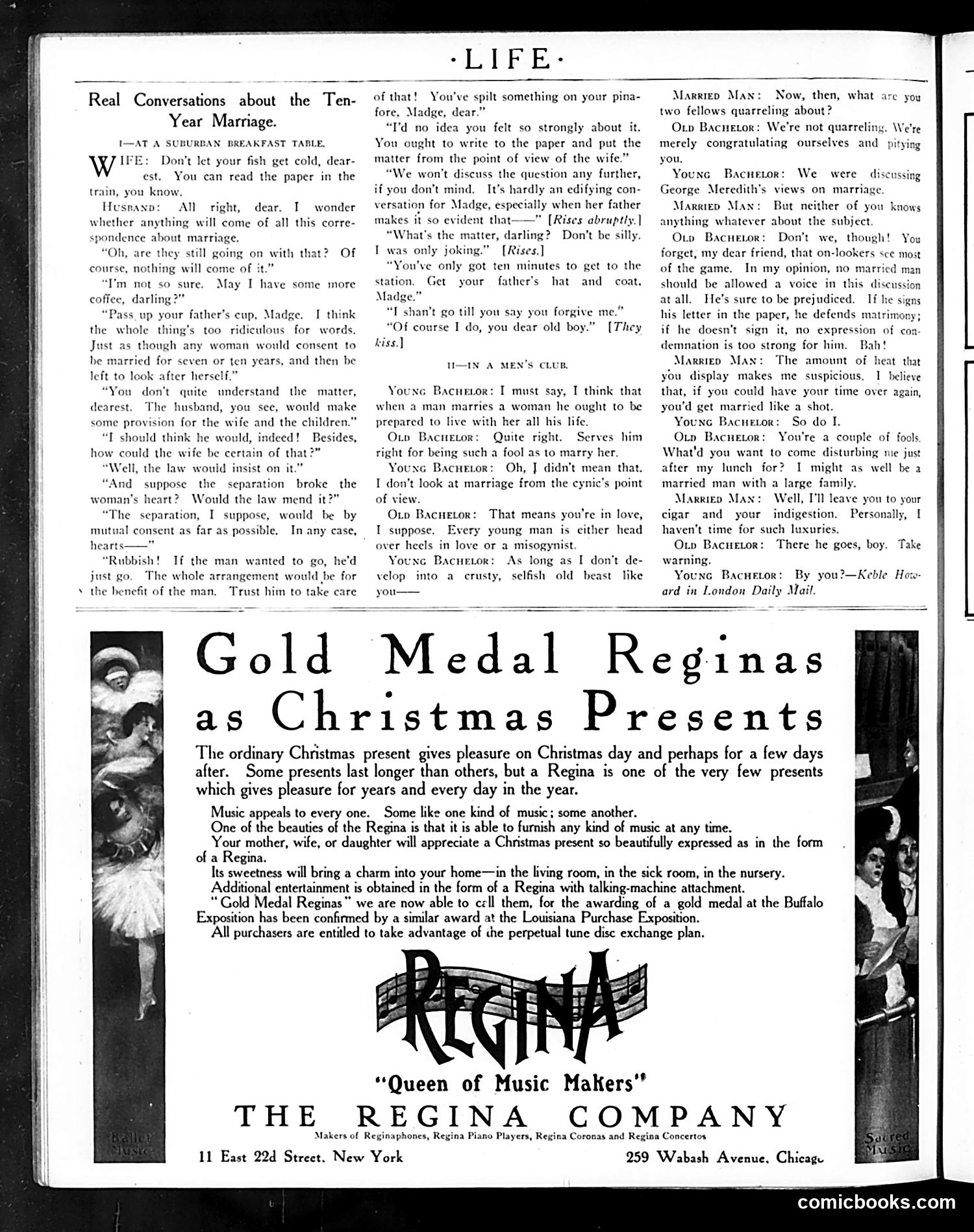
This page satirizes a contemporary debate about reforming marriage laws, likely referencing proposals for limited-term or terminable marriages circulating in early 20th-century Britain. The satire presents three conversations—between spouses, young bachelors, and a married man—to expose the hypocrisy surrounding marriage reform arguments. Each group claims moral authority while revealing self-interest: the wife resents her dependent status; young bachelors philosophize while secretly envying married life; the married man dismisses all commentary as irrelevant. The joke targets everyone: those advocating change ignore women's actual vulnerability; cynics mask romantic disappointment; married men demand silence from critics while remaining defensive. The simultaneous conversations suggest that *no one*—whether inside or outside marriage—can discuss the topic without contradiction or bias. The humor relies on readers recognizing the genuine anxiety about women's legal and economic dependence, while mocking the self-righteous posturing of all parties in the debate.
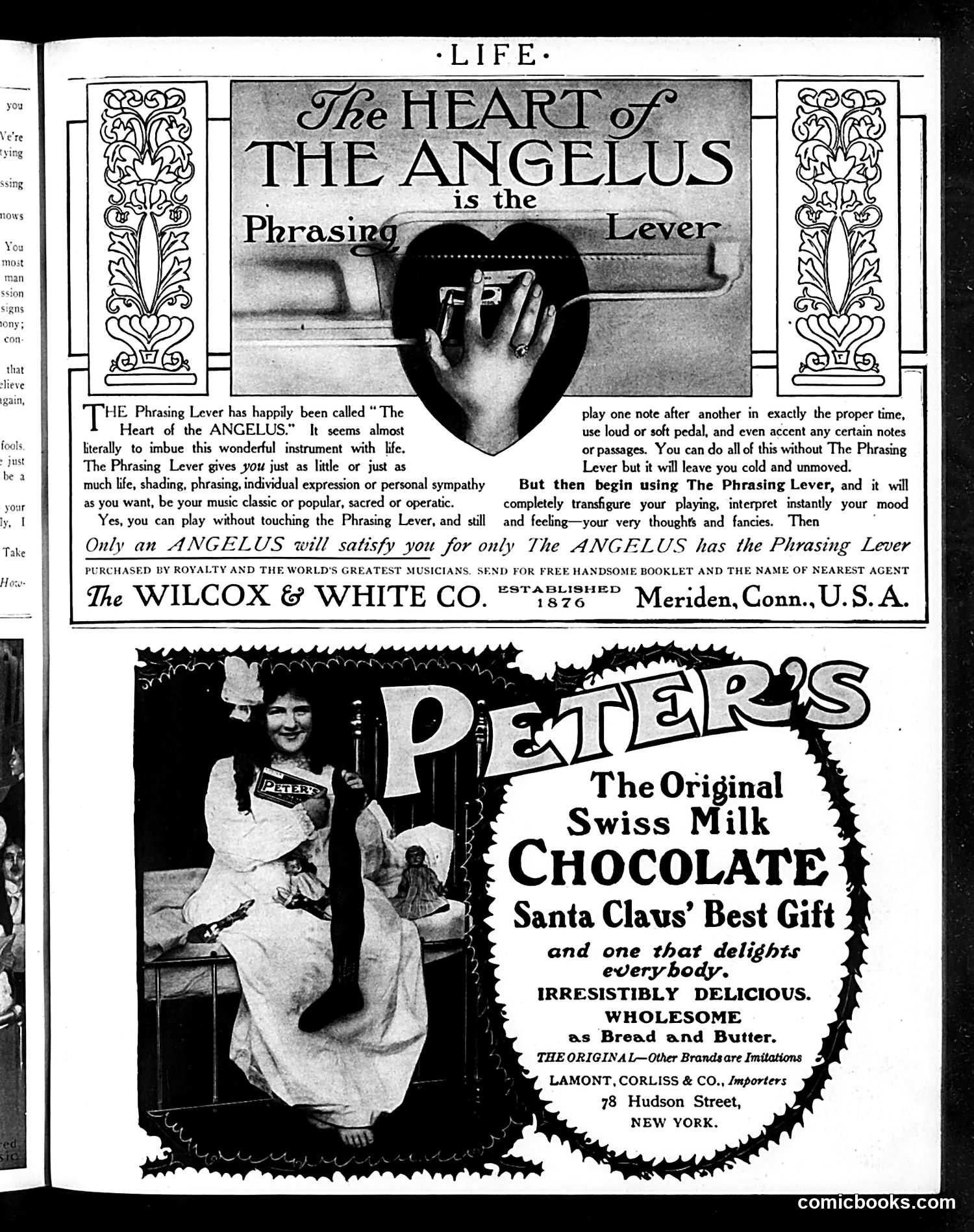
This is primarily a **product advertisement page**, not a political cartoon. It contains two distinct ads: **Top:** An Angelus player piano advertisement emphasizing the "Phrasing Lever" — a mechanical feature allowing emotional expression in automated musical performance. The ad markets to affluent consumers ("purchased by royalty and the world's greatest musicians"), claiming the lever transforms mechanical playing into artistically expressive performance. The heart imagery suggests the device adds "life" to otherwise lifeless mechanical music. **Bottom:** A Peter's Swiss Milk Chocolate advertisement positioning chocolate as an ideal Christmas gift. The illustration shows a woman (likely representing abundance or holiday spirit) with children, emphasizing wholesomeness and family appeal. Neither contains satire or political commentary. This represents typical *Life* magazine content from its early period — a mix of commercial advertising alongside editorial material, targeting middle-to-upper-class American readers interested in consumer goods and cultural products.
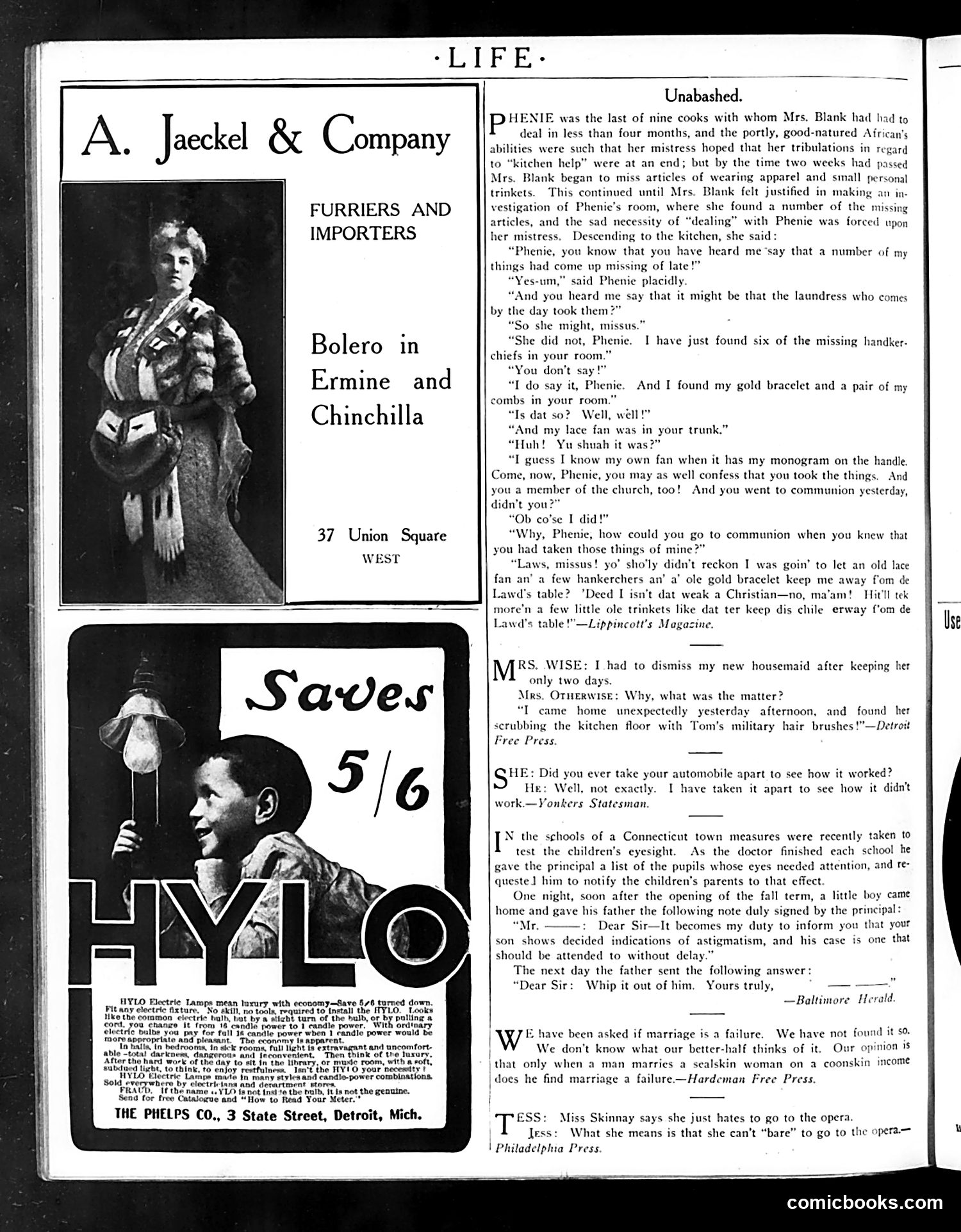
This page contains **advertisements** (Jaeckel & Company furs, HYLO electric lamps, Phelps Co.) and **humorous anecdotes** typical of *Life* magazine's satirical content. The main story, "Unabashed," presents a racist caricature of an African American cook named Phenie caught stealing from her white employer, Mrs. Blank. The "humor" relies on exaggerated dialect and a now-offensive stereotype: Phenie's response—that stolen trinkets won't keep her from communion—is presented as comically hypocritical religious devotion. By modern standards, this represents deeply racist attitudes normalized in early 20th-century media, mocking Black workers through demeaning language and portrayal. The other brief anecdotes mock women's incompetence (the housemaid misusing hair brushes) and male mechanical ignorance (taking apart a car), offering safer, contemporary social humor. The advertisements emphasize emerging consumer technologies (electric lighting) and luxury goods (furs), reflecting the magazine's affluent readership.
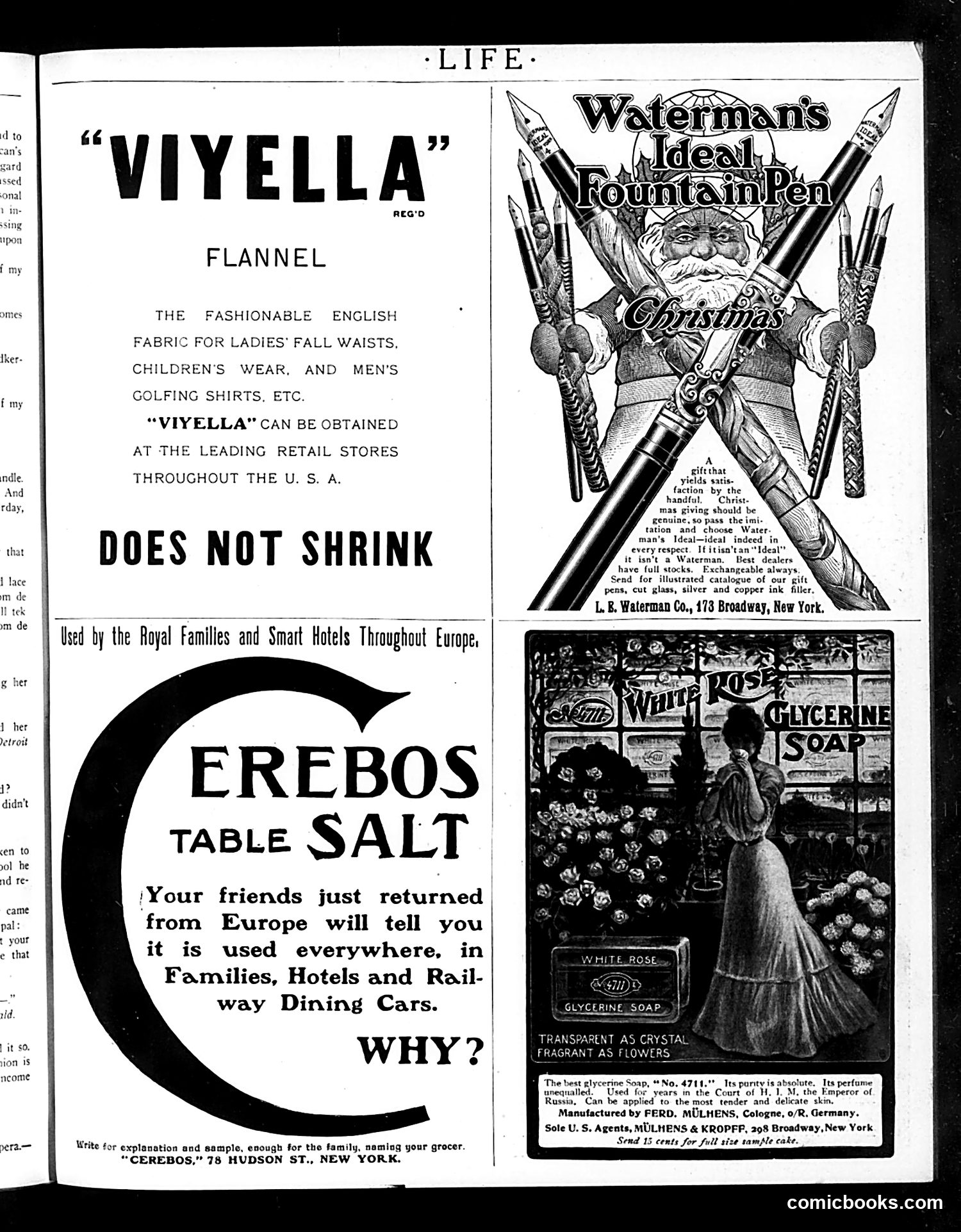
This page consists primarily of **advertisements rather than editorial cartoons**. The content reflects early 20th-century marketing strategies: **Left side:** Ads for Viyella flannel fabric and Cerebos table salt, both emphasizing European prestige and royal/upper-class usage to appeal to American consumers aspiring to sophistication. **Right side:** Two product advertisements—Waterman's Ideal fountain pens (marketed as Christmas gifts) and White Rose glycerine soap (labeled "transparent as crystal, fragrant as flowers"). **The appeal pattern:** These ads exploit American fascination with European refinement. Cerebos explicitly states "Your friends just returned from Europe will tell you" it's used in prestigious settings—a sales tactic leveraging post-war transatlantic travel and the notion that European standards equaled quality and taste. **No political satire is present.** This is a straightforward advertising page demonstrating how brands marketed products through claims of exclusivity, royal patronage, and cultural sophistication during the early 1900s.
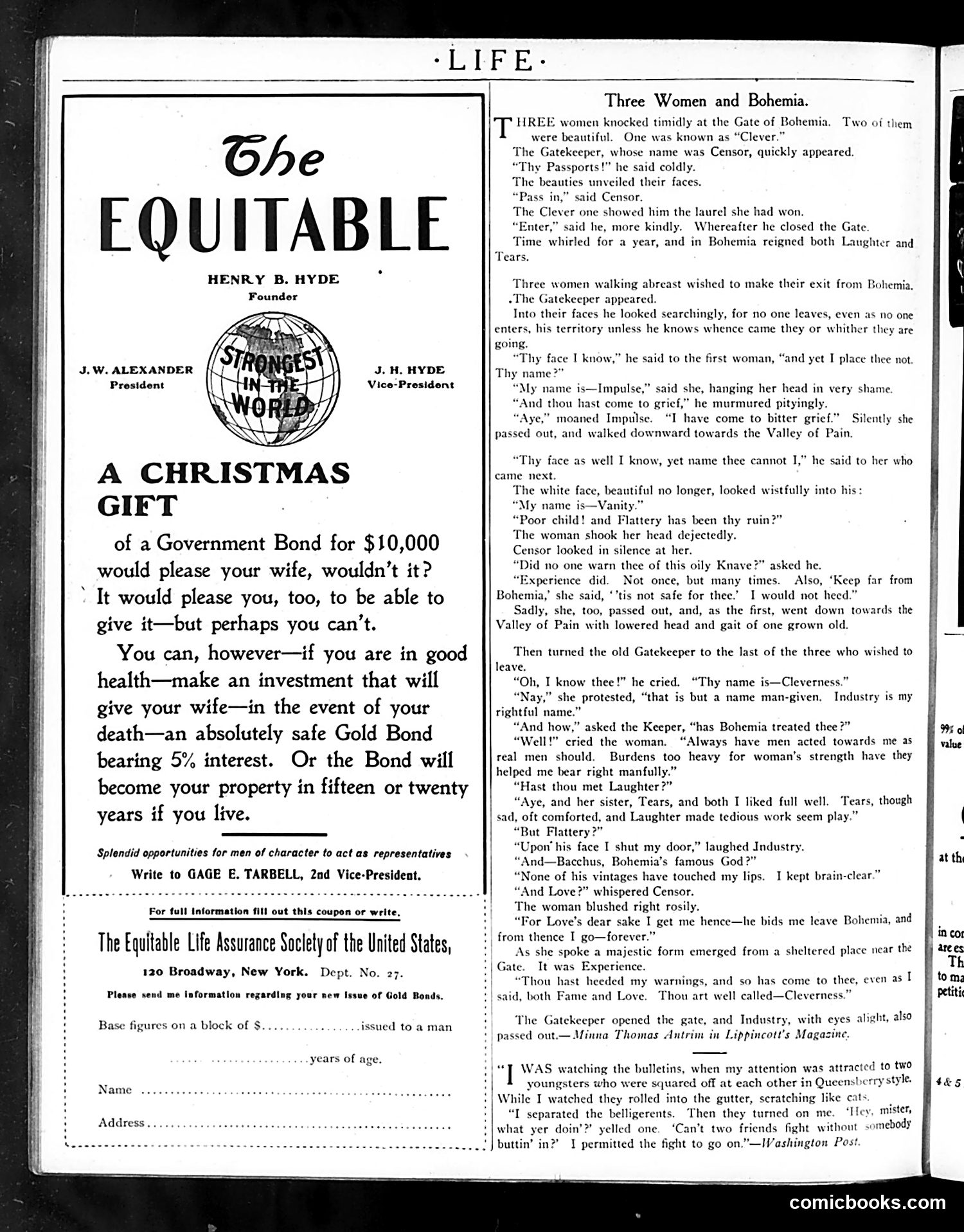
This page contains two distinct elements: an **insurance advertisement** and a **moral allegory**. ## The Advertisement The Equitable Life Assurance Society pitches life insurance as a Christmas gift—a practical alternative to the expensive $10,000 government bond most men cannot afford. It promises widows financial security through a "Gold Bond" at 5% interest. ## The Allegory: "Three Women and Bohemia" This morality tale uses "Bohemia" (a symbolic place of artistic freedom and bohemian lifestyle) as a testing ground for female virtue. Three women exit through a magical gate guarded by "Censor": - **Impulse**: Ruins herself through recklessness, exits to the "Valley of Pain" - **Vanity**: Corrupted by flattery despite warnings, also exits damaged - **Cleverness/Industry**: Resists temptation (flattery, alcohol, loose morals), maintains her strength, and leaves virtuous—departing only for respectable love The narrative moralizes that female success requires rejecting impulse, vanity, and vice while embracing industry and moral restraint. It reflects early-20th-century attitudes conflating women's worth with sexual purity and dutiful behavior.
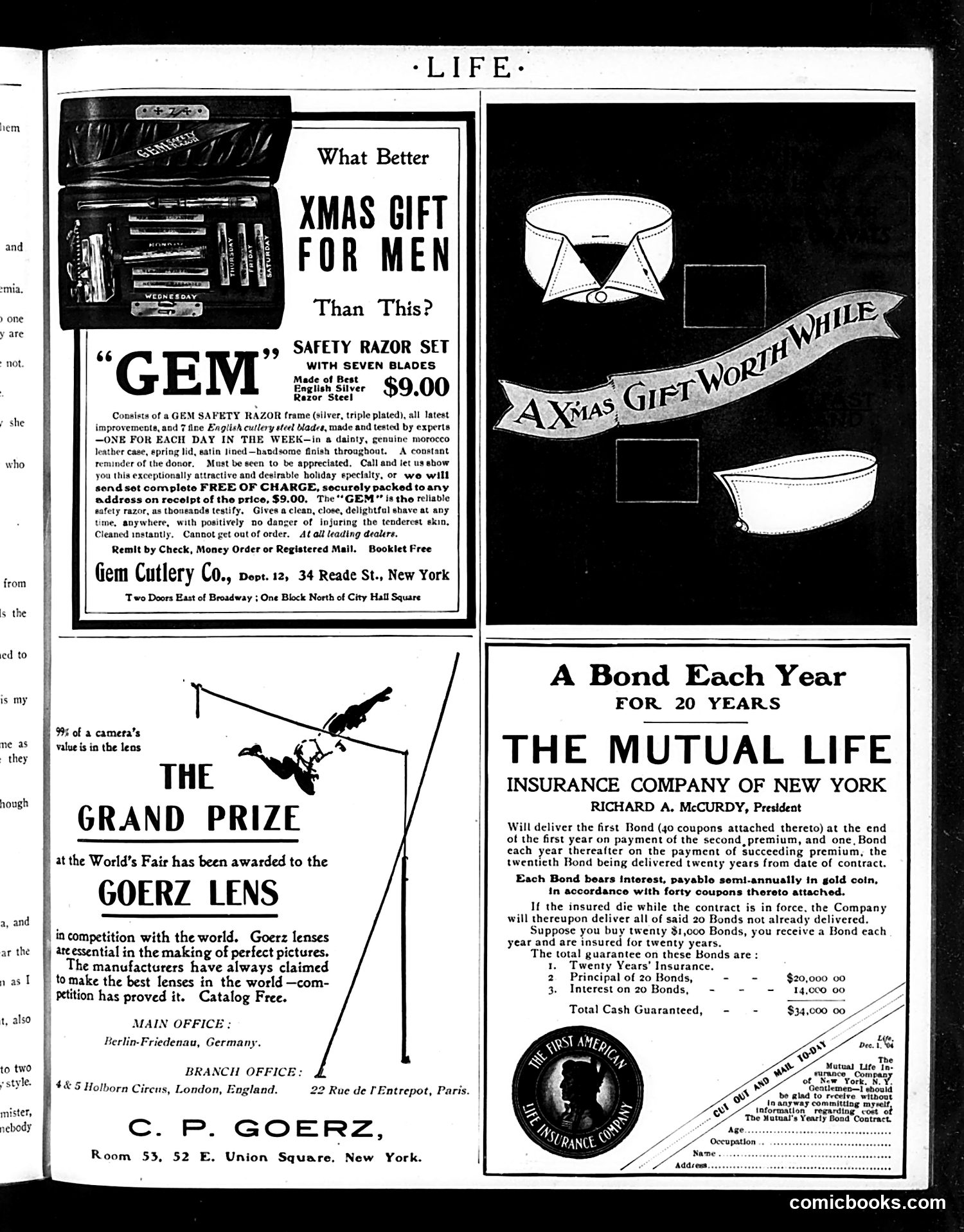
This page is primarily **advertising**, not satire or political commentary. It contains four commercial advertisements from the early 20th century: 1. **Gem Safety Razor Set** ($9.00) — marketed as an ideal Christmas gift for men, featuring seven blades (one for each weekday) in a morocco leather case. 2. **Goerz Lens** — promoting a camera lens that won "The Grand Prize" at the World's Fair, emphasizing superior quality in lens manufacturing. 3. **Mutual Life Insurance Company of New York** — advertising a 20-year bond scheme where customers receive annual bonds with guaranteed cash value up to $14,000. 4. **Xmas Gift Worth While** (top right) — partially visible advertisement, appears to feature gift packaging. These ads reflect early 1900s consumer culture and marketing strategies. There is no political satire or social commentary visible on this page—it represents straightforward product promotion typical of Life magazine's advertising sections.
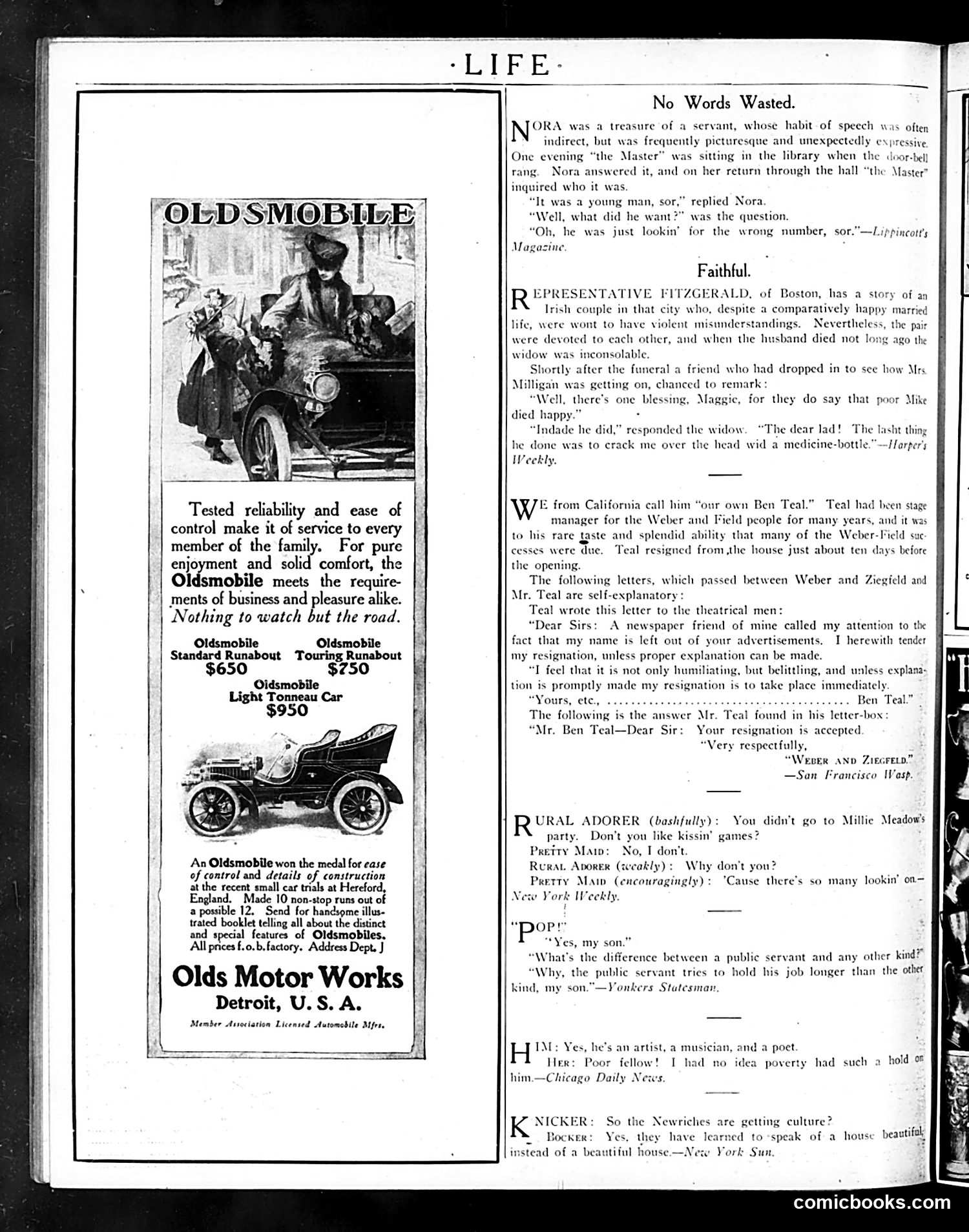
This page contains **primarily humorous anecdotes and jokes** rather than political cartoons, alongside an Oldsmobile automobile advertisement. The left side features a large Oldsmobile ad emphasizing reliability and ease of control—typical early 1900s automotive marketing. The right side presents several brief comedy pieces: - **"No Words Wasted"**: Irish servant Nora's indirect speech ("lookin' for the wrong number") - **"Faithful"**: Dark humor about an Irish widow whose abusive husband "died happy" after hitting her with a medicine bottle - **Ben Teal anecdote**: A theater stage manager's resignation letter over being omitted from advertisements, promptly accepted by Weber and Ziegfeld—satirizing theatrical egos and dismissal - **Rural/Pretty Maid dialogue**: Innocent flirtation joke about kissing games - **Public Servant joke**: Cynical observation that public servants prioritize job security - **Newriches**: Social satire about newly wealthy people adopting pretentious speech ("a house" vs. "beautiful house") The humor relies on Irish stereotypes, marital discord, theatrical drama, and class commentary typical of early 20th-century American magazines.
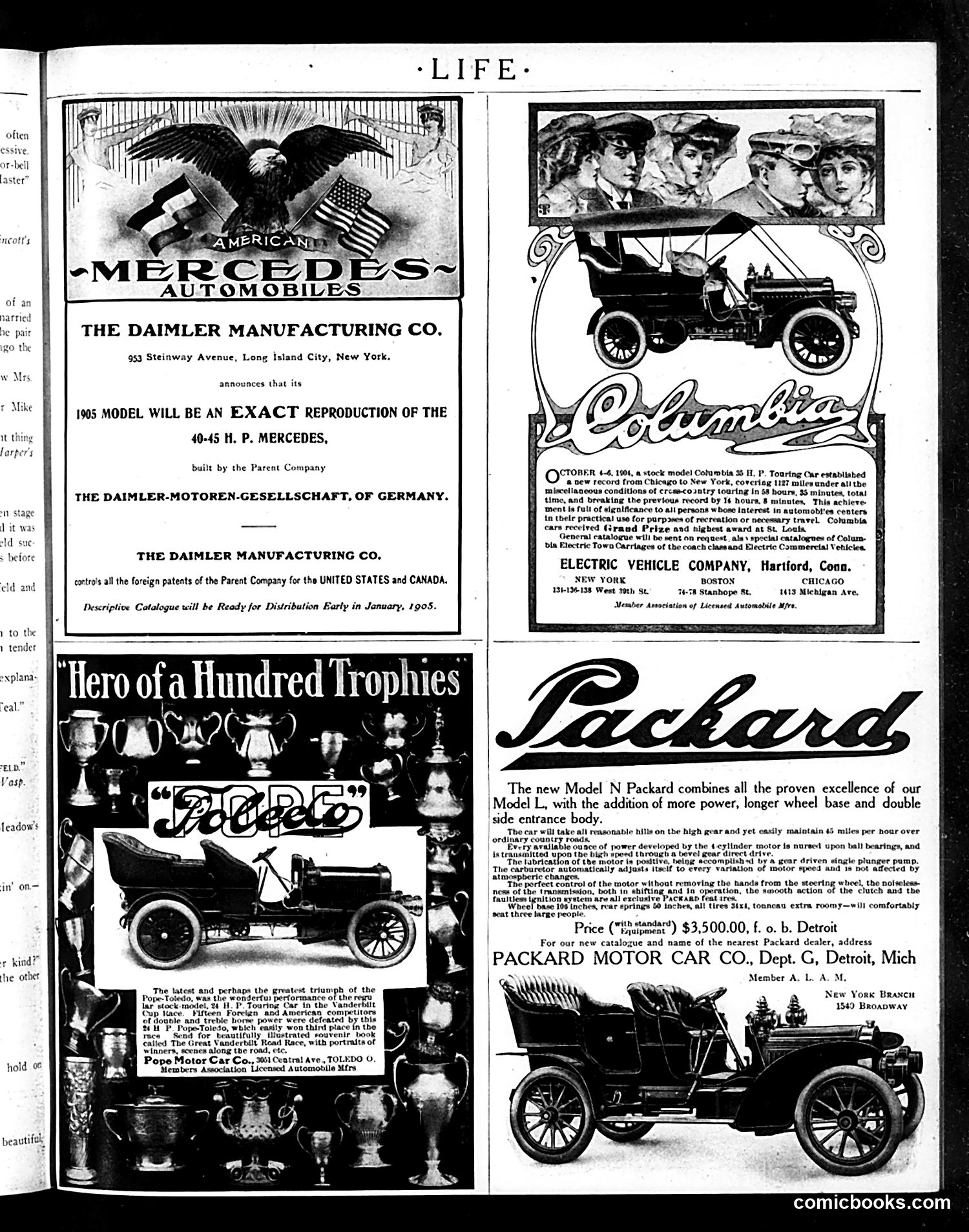
This page is primarily **automobile advertising**, not satire or political commentary. It features four luxury car manufacturers competing for wealthy American consumers in the early automotive era. The ads showcase: - **Mercedes** (German-made, distributed by Daimler Manufacturing in Long Island City) - **Columbia** (electric vehicle, noting a Chicago-to-New York speed record) - **Pope-Toledo** (emphasizing performance in the prestigious Vanderbilt Cup Race) - **Packard** (Model N, highlighting advanced engineering and luxury features) Each manufacturer uses patriotic imagery, racing achievements, and technical specifications to establish prestige. The competitive focus reflects the nascent automobile industry's race for dominance. Notably, German engineering (Mercedes) is presented alongside American innovations, suggesting the U.S. market was still adopting foreign designs while developing domestic expertise. There is no cartoon or satire visible—this is a straightforward commercial page aimed at affluent readers interested in purchasing high-end motorcars.
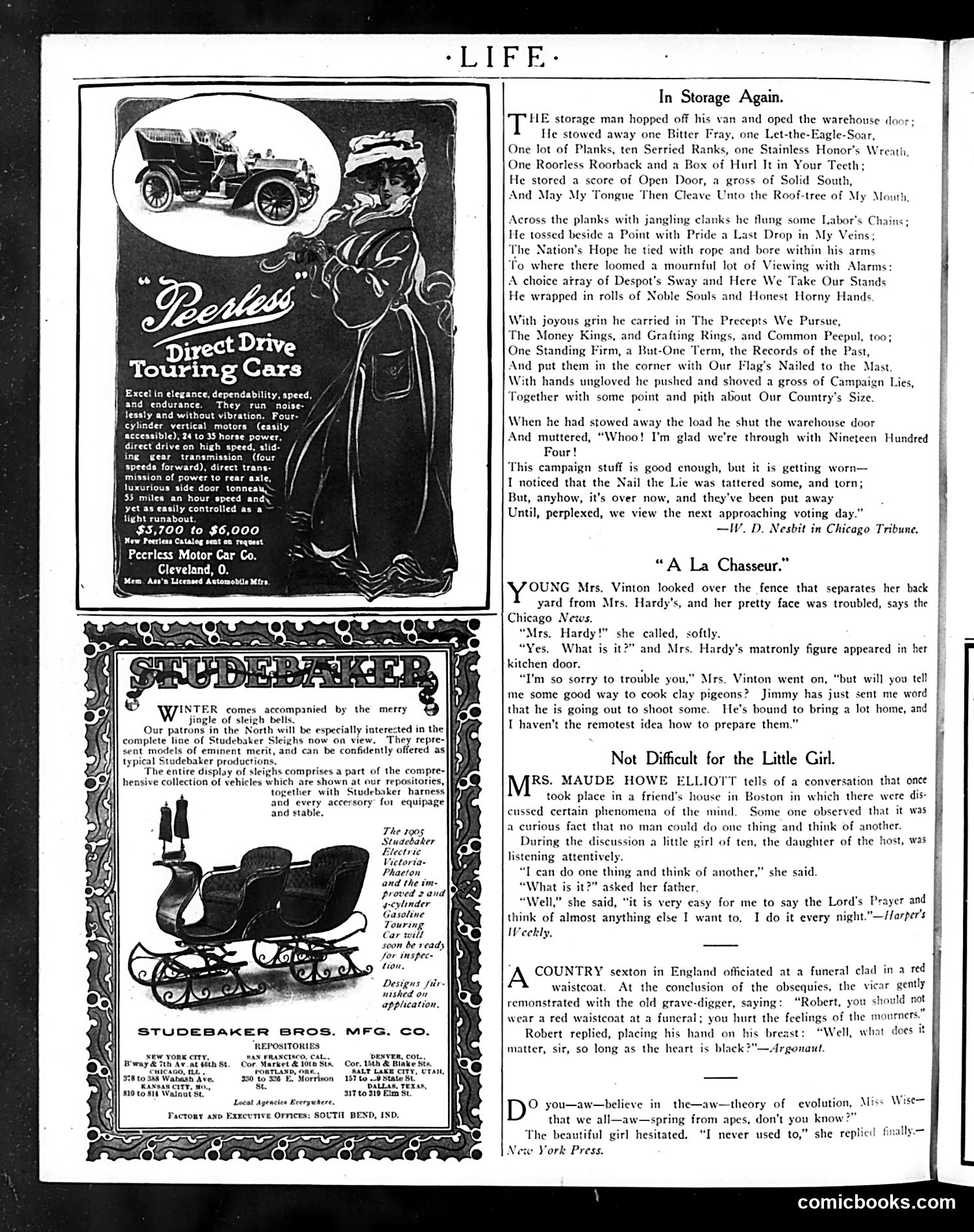
This page contains primarily **advertising** (Peerless automobiles, Studebaker sleighs and carriages) and humorous fictional sketches. The main satirical content is the poem **"In Storage Again"** by W.D. Nesbit. It's a post-election piece (referencing "Nineteen Hundred Four") using extended metaphor: a storage man warehouses political campaign rhetoric and slogans from the recent election. The poem catalogs worn-out political phrases and arguments—"Bitter Fray," "Roorless Roorback," "Campaign Lies," appeals to patriotism and labor—as though they're physical objects being packed away until the next election cycle. The joke targets the predictable, recycled nature of American political discourse: the same tired arguments, false claims, and emotional appeals resurface every four years. The remaining short fiction pieces ("A La Chasseur," "Not Difficult for the Little Girl") are unrelated social humor sketches—not political satire.
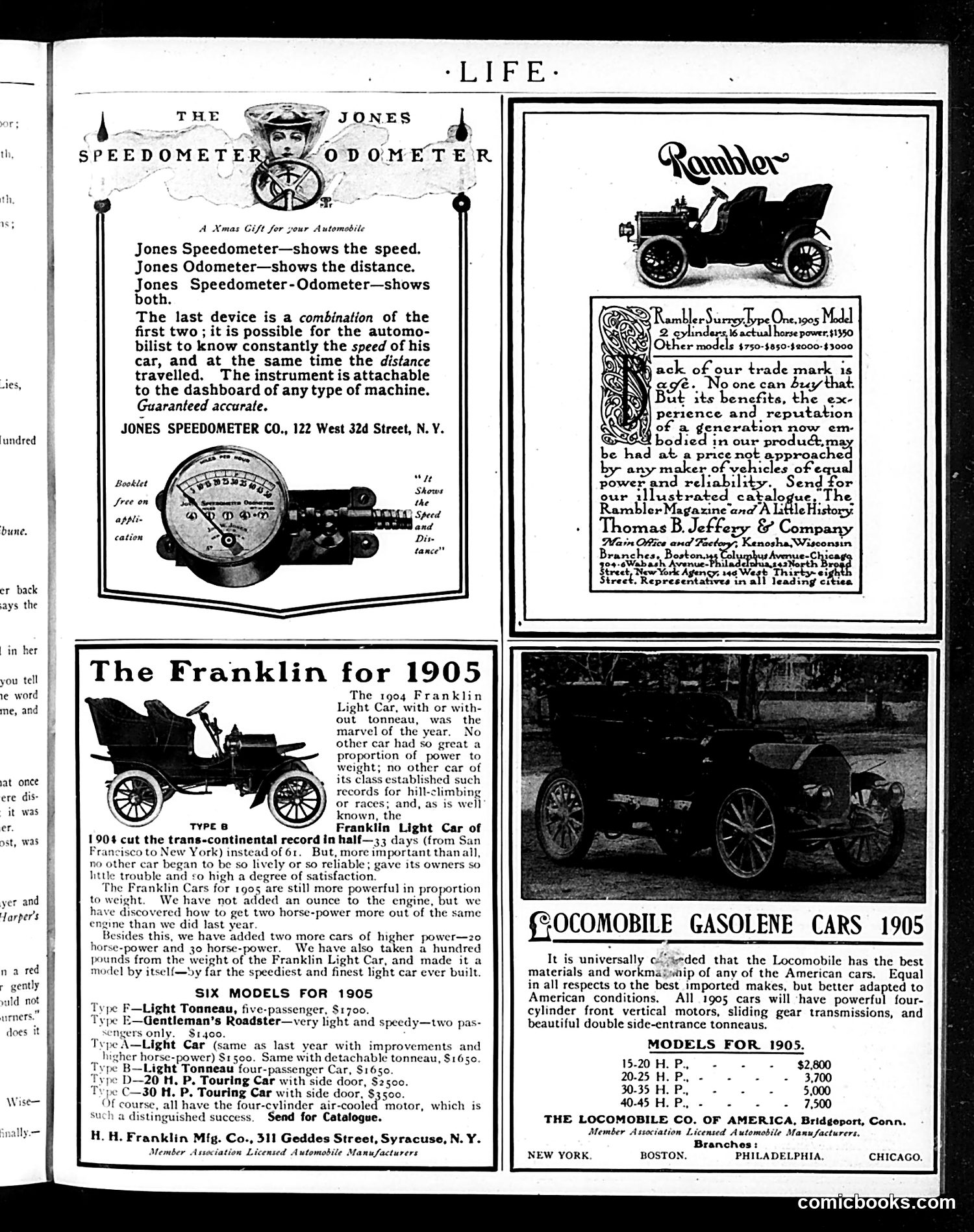
This is primarily an **advertising page** from Life magazine's 1905 issue, not a political cartoon or satirical piece. It features four automotive advertisements: the Jones Speedometer-Odometer device, the Rambler automobile, the Franklin automobile, and the Locomobile automobile. The content reflects early 1900s automobile marketing—emphasizing technical innovations (speedometers, air-cooled engines), performance capabilities (hill-climbing, transcontinental speed records), and manufacturing quality. References like the Franklin's 1904 trans-continental speed record (33 days) and the Locomobile's claim to use materials "equal in all respects to the best imported makes" highlight competitive positioning in a nascent automobile industry. There is **no satire or political commentary** visible on this page.
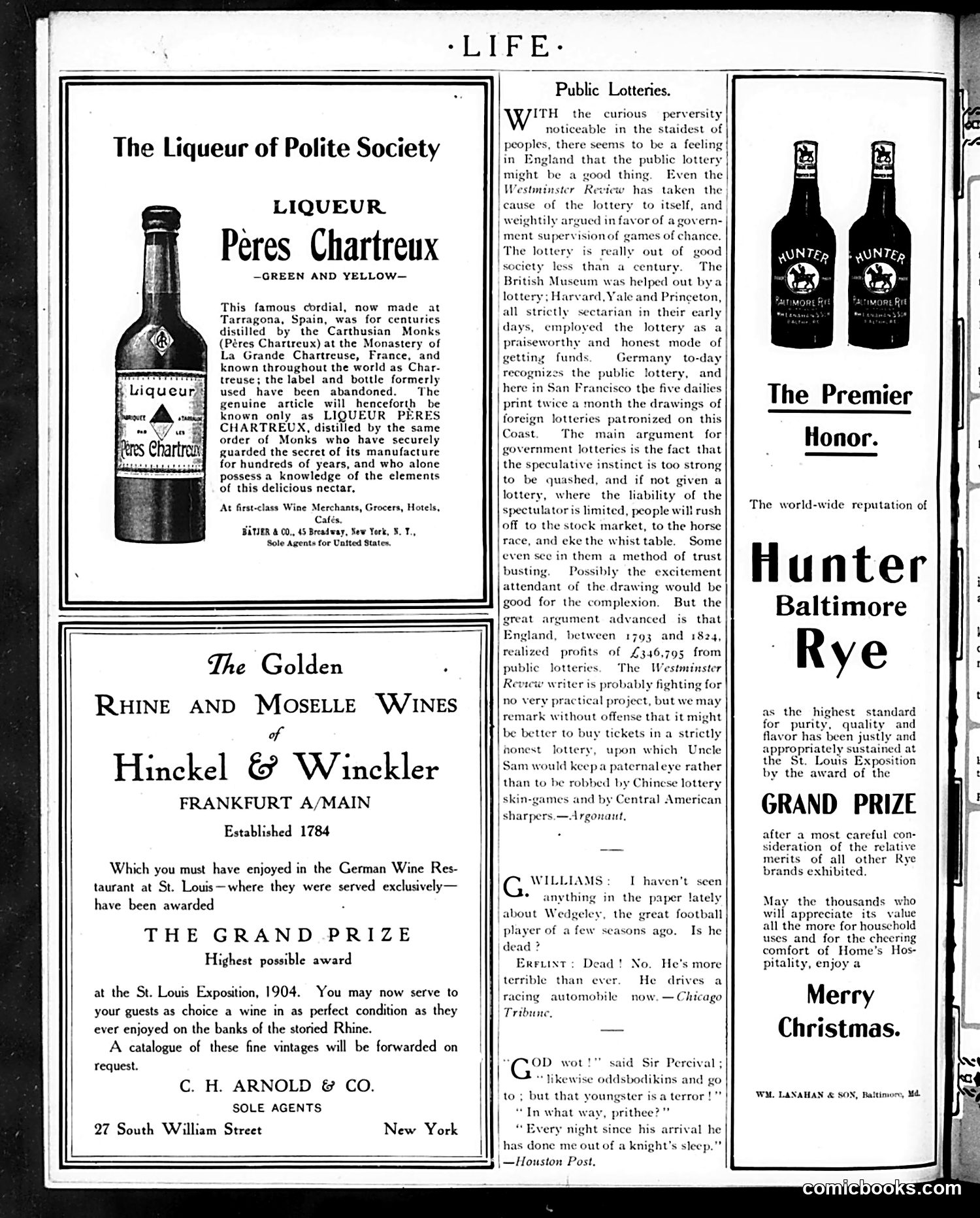
This page is primarily **advertisements** interspersed with brief satirical commentary and jokes. The **main content** discusses **public lotteries in England**—specifically debating whether government-supervised lotteries are preferable to unregulated gambling. The writer argues that since people will gamble anyway (at racetracks, stock markets, card games), a controlled lottery with state oversight is safer than allowing them to be "robbed by Chinese lottery skin-games and by Central American sharpers." The piece cites England's profits from lotteries between 1793-1824 as justification. The three **brief jokes** below concern unrelated topics: a deceased football player who actually drives recklessly; and a knight losing sleep to a young visitor. The **advertisements** promote luxury goods—French liqueur, German wines, and Baltimore whiskey—all marketed to wealthy, "polite society" consumers, positioning alcohol as a status symbol for the genteel classes. The page reflects early-1900s American attitudes toward gambling, class, and consumption.
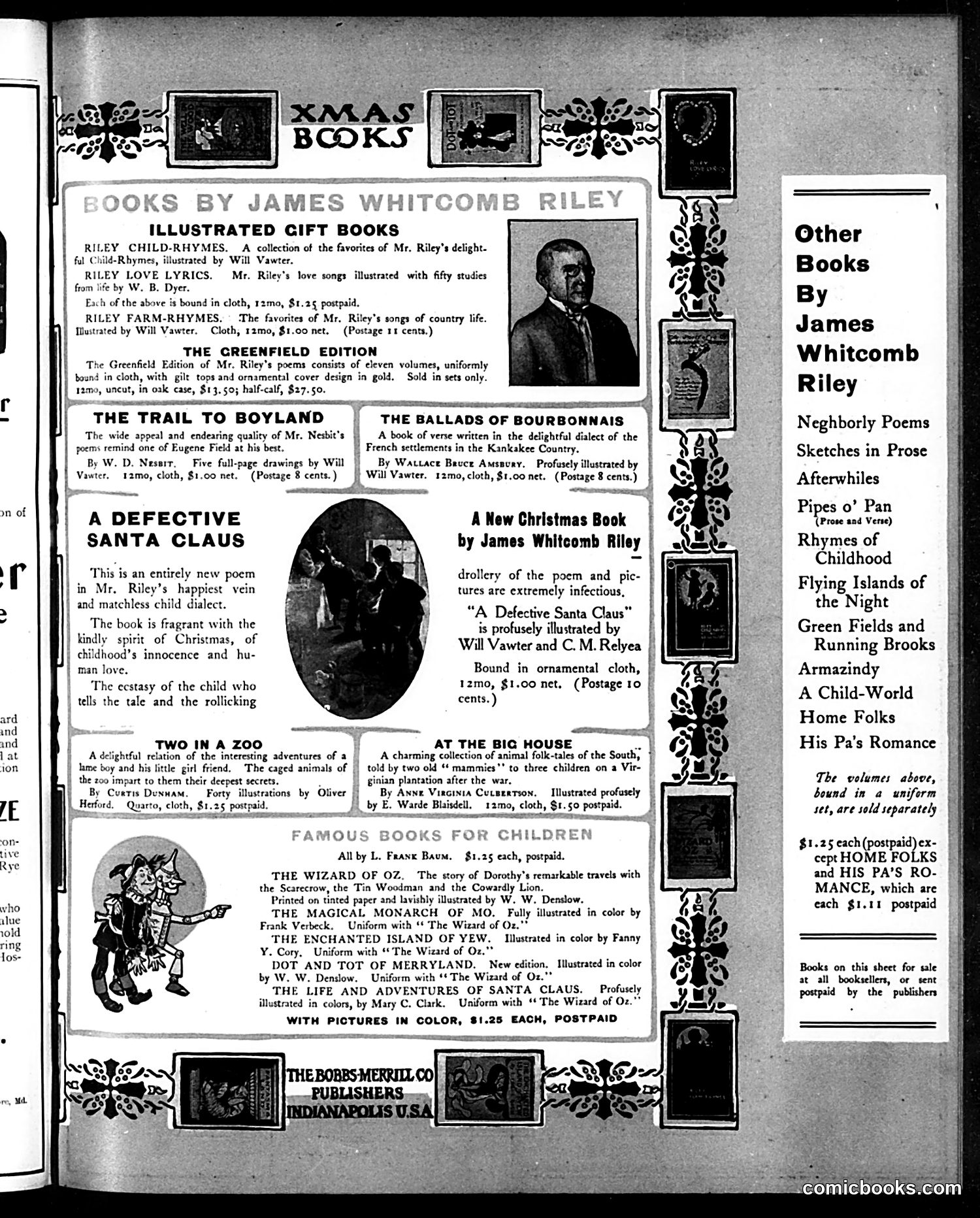
This is primarily a **publisher's advertisement page**, not satirical content. It promotes books by James Whitcomb Riley (a popular American poet of the era) and related children's literature, published by The Bobbs-Merrill Company. The page features Riley's illustrated gift books of poetry and dialect verse aimed at children and families—*Riley Child-Rhymes*, *Riley Farm-Rhymes*, and *A Defective Santa Claus*. It also advertises other children's classics like *The Wizard of Oz* by L. Frank Baum and *The Enchanted Island of Yew*. The decorative borders and illustrations (including what appears to be a wizard figure) reflect typical early 1900s book advertising design. There is **no political satire or social commentary** visible—this is straightforward commercial promotion of sentimental, family-oriented literature that was highly fashionable during this period.
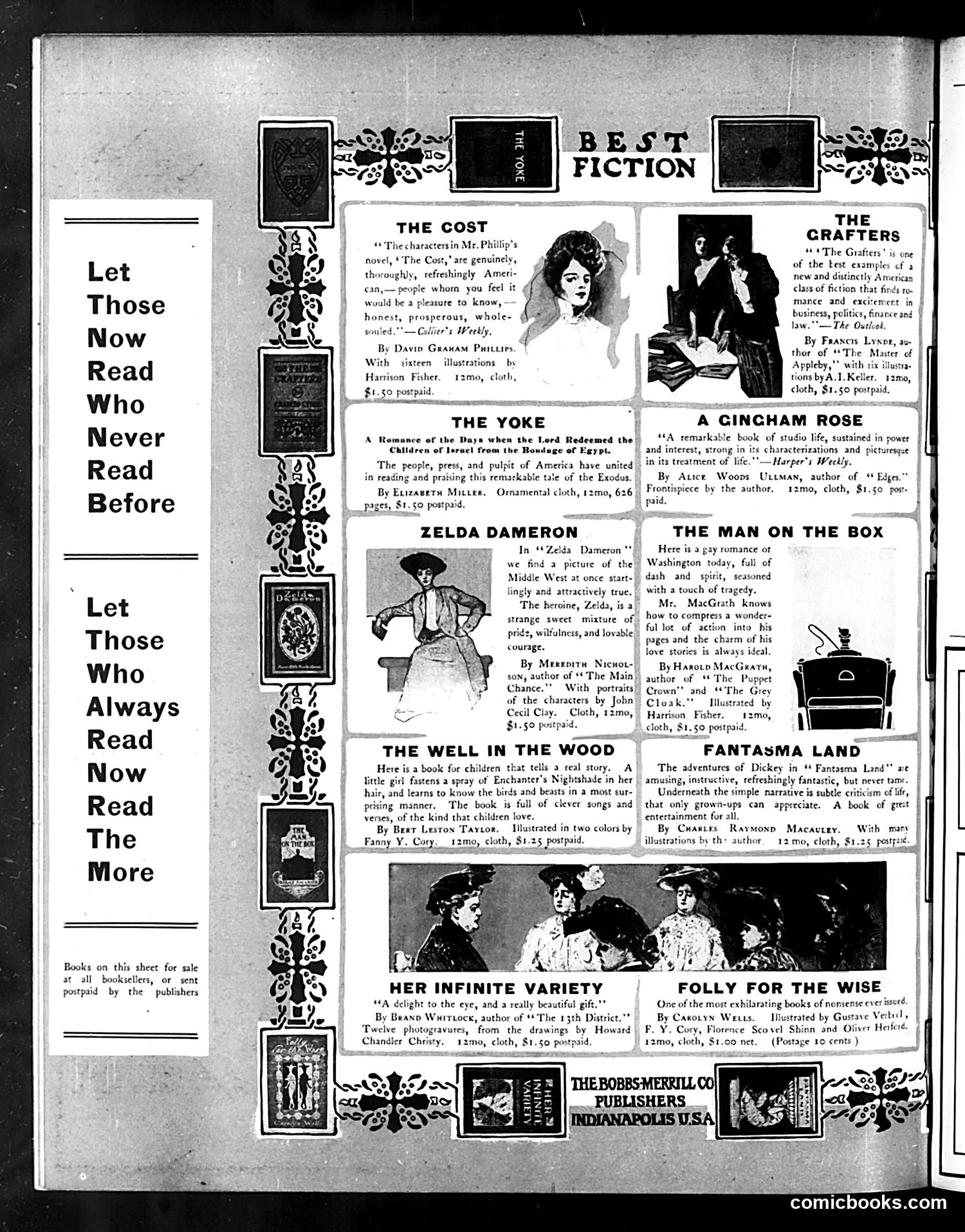
This is a **book advertisement page**, not a political cartoon. It showcases fiction titles from publisher Bobbs-Merrill Company, featuring novels like "The Cost," "The Yoke," and "The Man on the Box." The left sidebar contains **marketing copy** targeting readers—"Let Those Now Read Who Never Read Before" and "Let Those Who Always Read Now Read The More"—designed to appeal both to new and habitual readers. The books advertised are **contemporary commercial fiction** of the early 1900s, emphasizing American characters and settings ("refreshingly American"), romance, adventure, and moral wholesomeness. The decorative art-nouveau border and illustrated portraits of characters reflect the period's book design conventions. This represents **mass-market publishing** aimed at middle-class American readers—no political satire is present. The page functions purely as a sales vehicle for Bobbs-Merrill's catalog.
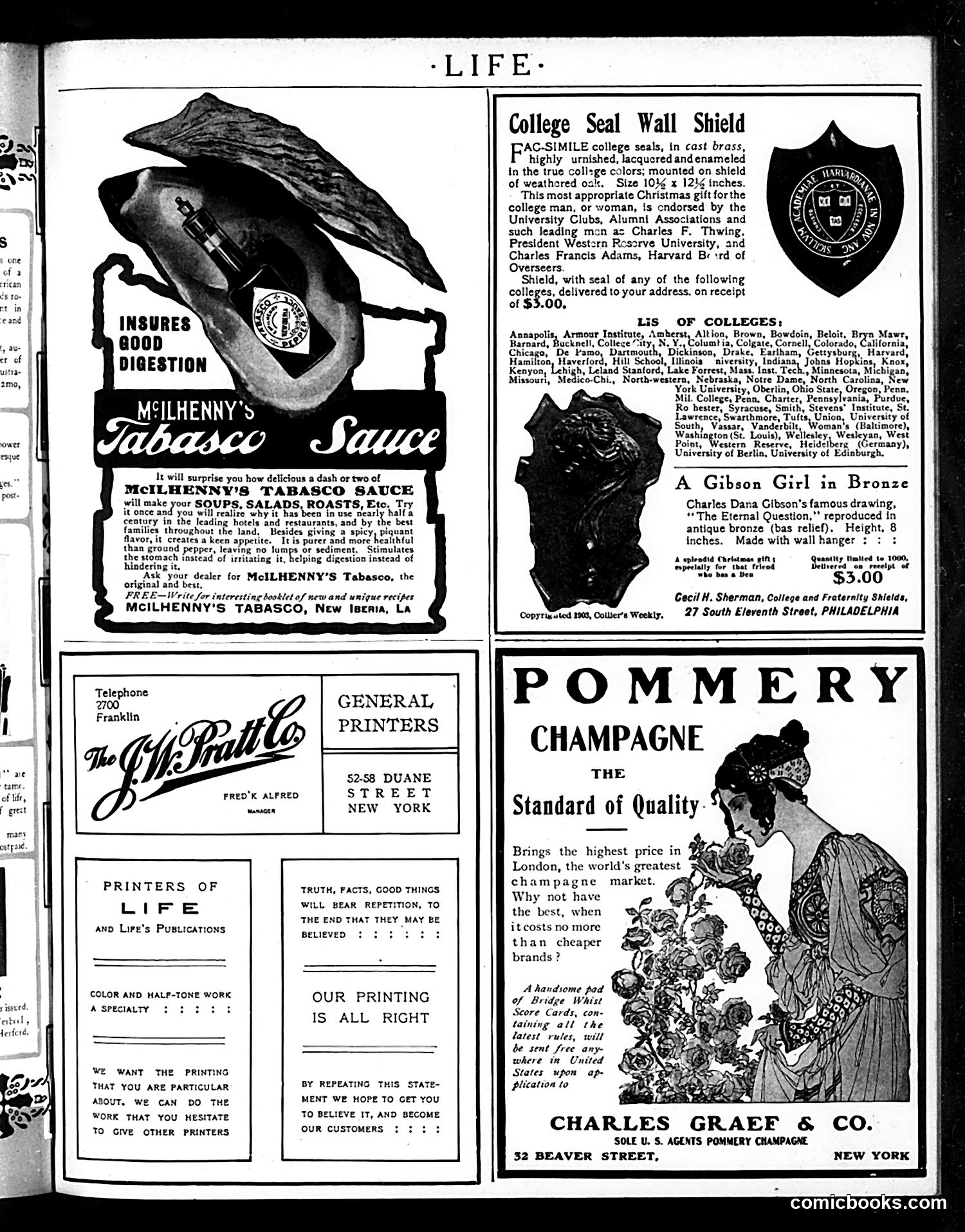
This page consists primarily of **advertisements rather than editorial cartoons or satire**. The content includes: 1. **McIlhenny's Tabasco Sauce ad**: Features an illustration of a bird (appears to be a raven or crow) with text claiming the sauce "insures good digestion." This is straightforward product advertising using an animal mascot. 2. **College Seal Wall Shields ad**: Offers facsimile college seals mounted on shields as Christmas gifts, endorsed by prominent educators. This is a merchandise advertisement targeting alumni. 3. **Gibson Girl bronze statue ad**: References Charles Dana Gibson's famous "Gibson Girl" illustration, offering a bronze reproduction titled "The Eternal Question" as a gift. 4. **Pommery Champagne ad**: Features an elegant illustration of a woman and promotes French champagne as "the Standard of Quality." The page also contains **printer advertisements** for Life's own printing services. Overall, this is an **advertising-heavy page with no identifiable political satire or social commentary**—typical of early 20th-century magazine layouts.
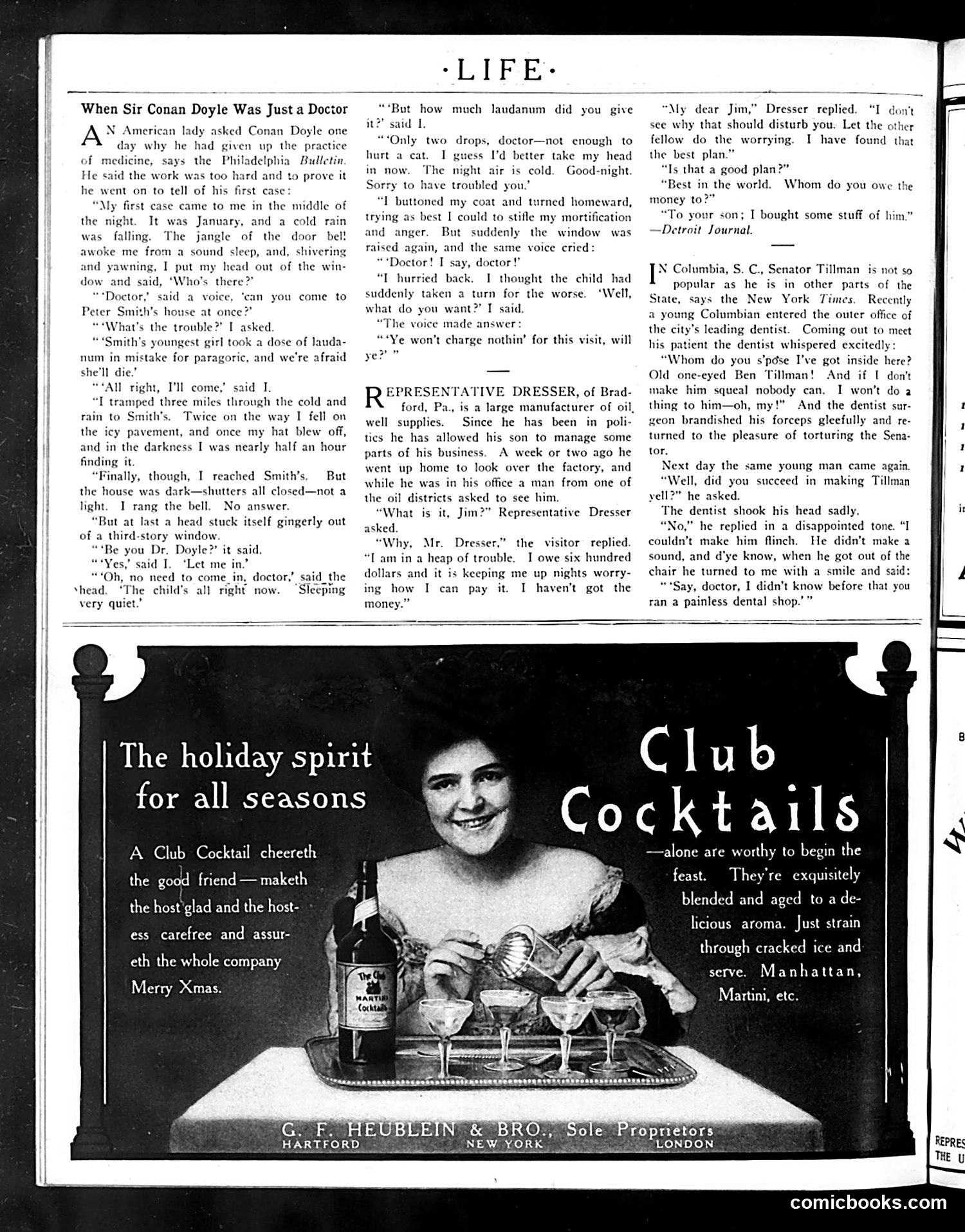
This page contains three humorous anecdotes typical of early 20th-century American humor magazines: 1. **"When Sir Conan Doyle Was Just a Doctor"**: A story about the famous author's early medical practice, depicting a frustrating house call where a patient's child recovers before his arrival, then refuses to pay—satirizing both medical practice difficulties and working-class penny-pinching. 2. **"Representative Dresser" anecdote**: A businessman advises someone in debt to stop worrying and let creditors worry instead. The joke: the debtor discovers this advice came from Dresser's son, the actual creditor—satirizing callous business ethics. 3. **"Senator Tillman" joke**: A dentist expects to make the notoriously tough South Carolina senator squeal in pain but fails. The humor relies on Tillman's reputation for toughness and the implied contrast between expectation and reality. The **Club Cocktails advertisement** below promotes holiday spirits with period-appropriate marketing imagery.
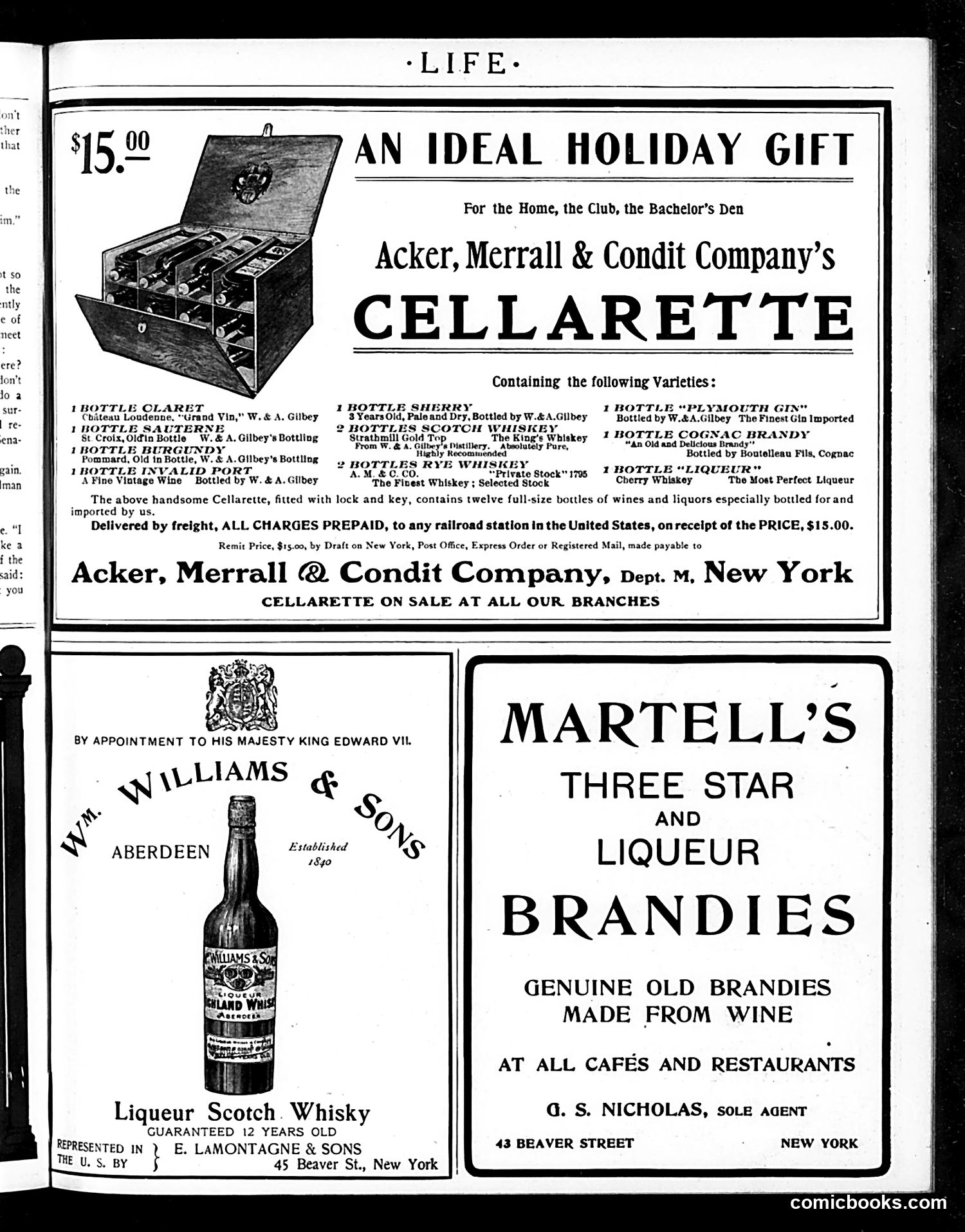
This page contains **no cartoons or satire**—it is purely **advertising** from an early 20th-century *Life* magazine. The ads promote luxury alcoholic beverages as holiday gifts, reflecting the pre-Prohibition era when such products were legal and marketed to affluent consumers. Key advertisements include: 1. **Acker, Merrall & Condit's "Cellarette"** ($15)—a decorative wooden case containing twelve bottles of assorted wines and liquors (claret, sherry, gin, whiskey, brandy), marketed for "the Home, the Club, the Bachelor's Den" 2. **W.M. Williams & Sons Scotch Whisky** from Aberdeen, holding a royal warrant from King Edward VII 3. **Martell's Brandies**, sold through cafés and restaurants The ads reflect Gilded Age consumer culture, emphasizing imported European spirits and gentlemanly leisure. The royal appointment language signaled prestige and quality to wealthy American buyers.
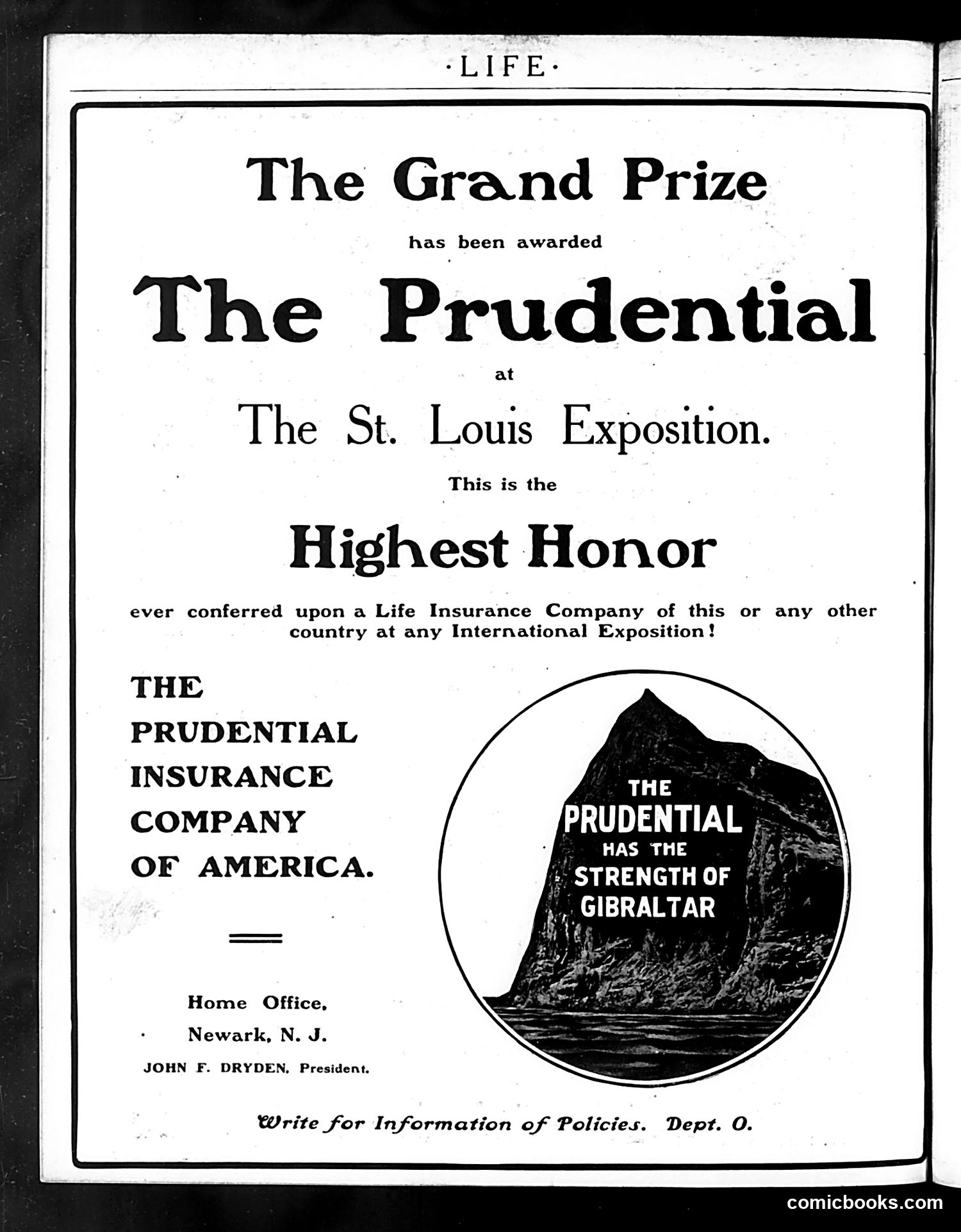
This is an advertisement rather than satire. It announces that The Prudential Insurance Company of America won the Grand Prize at the St. Louis Exposition (the 1904 World's Fair), claimed as "the Highest Honor ever conferred upon a Life Insurance Company" at any international exposition. The circular image shows Gibraltar's Rock with text reading "The Prudential Has the Strength of Gibraltar"—a metaphor equating the insurance company's stability and reliability with the famous, immovable fortress. This became Prudential's famous advertising slogan. The page promotes the company's Newark, New Jersey headquarters and President John F. Dryden, inviting readers to request policy information. It's straightforward corporate marketing designed to build consumer confidence through the prestige of an international award and the promise of fortress-like dependability.
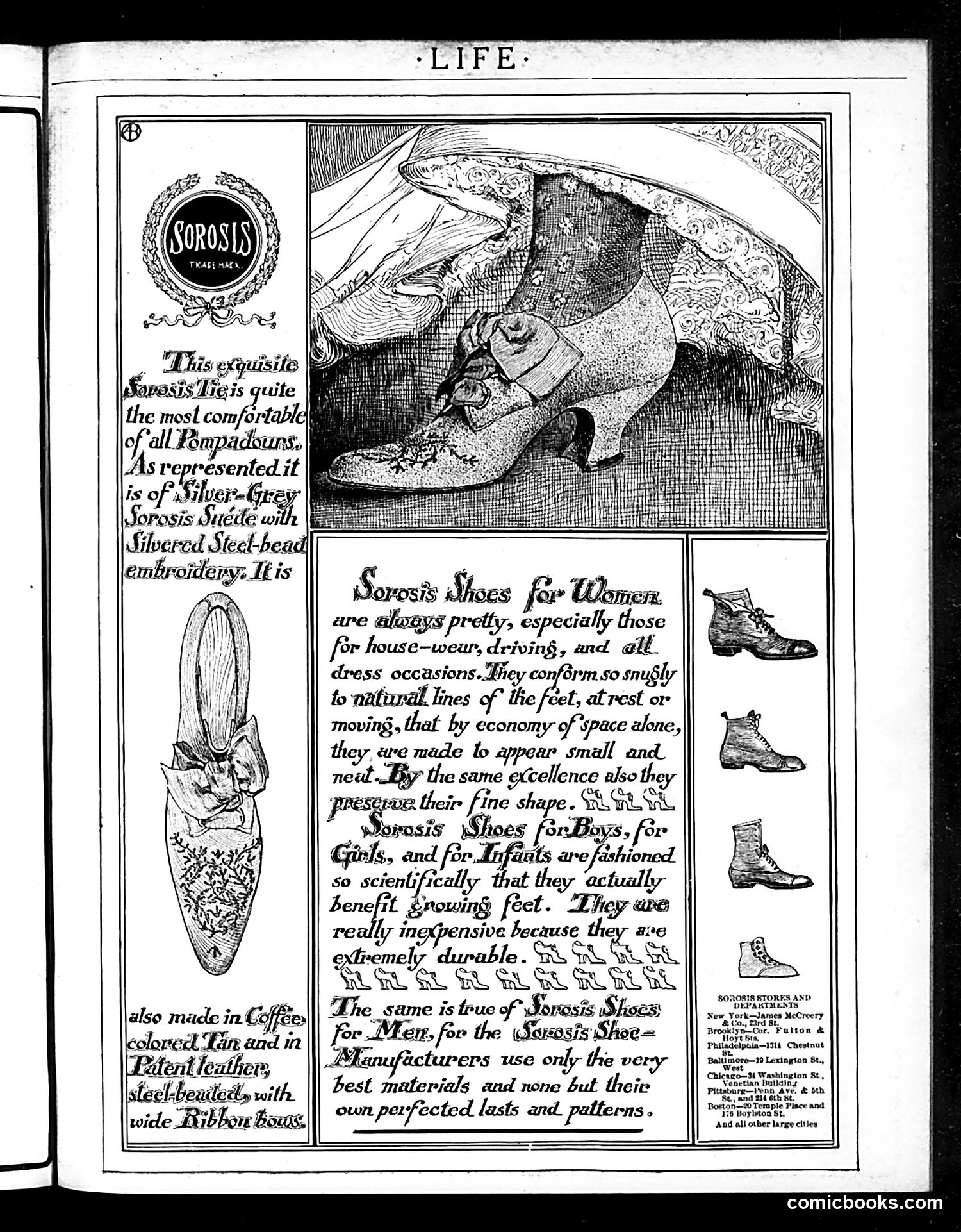
This is **not a political cartoon**—it's a **full-page advertisement** for Sorosis brand shoes, appearing in *Life* magazine. The page promotes Sorosis footwear across multiple demographics: women's shoes for "house-wear, driving, and dress occasions"; children's shoes designed to "actually benefit growing feet"; and men's shoes. The ad emphasizes that these shoes are scientifically constructed to flatter the foot's natural shape while remaining durable and relatively inexpensive. The imagery includes detailed etchings of a woman's shoe from multiple angles and a decorative beaded slipper. Text boxes highlight product features and list retail locations in major U.S. cities (New York, Boston, Philadelphia, Baltimore, Chicago, etc.). There is **no satire or political content** here—this is straightforward early 20th-century product advertising using the prestige of *Life* magazine's sophisticated readership to market premium footwear.
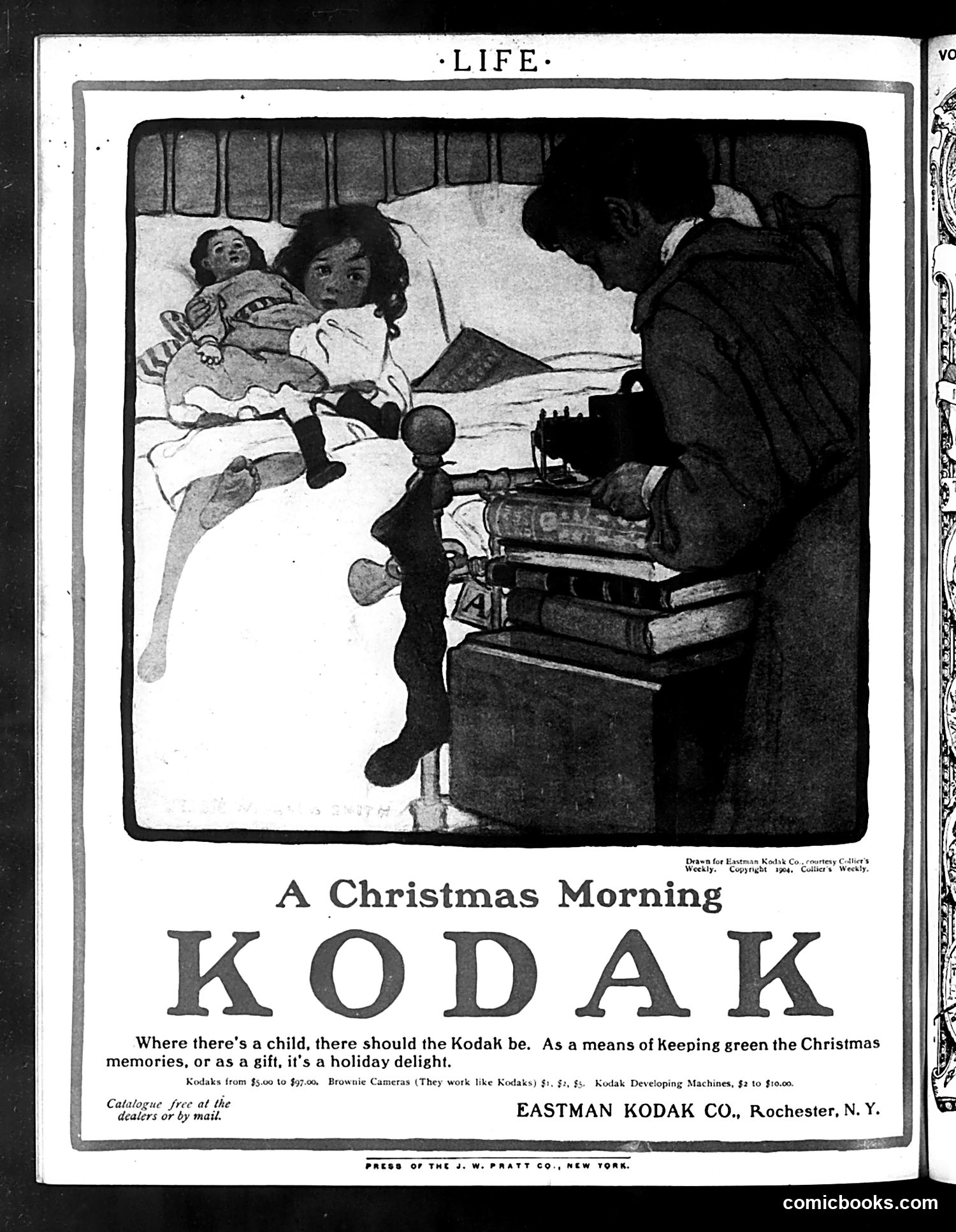
This is primarily a **Kodak camera advertisement**, not political satire. The image shows a domestic Christmas morning scene: a mother and child in bed while a father figure stands nearby examining books or materials, presumably Kodak products. The advertisement's message is straightforward: Kodak cameras are ideal Christmas gifts for capturing family memories with children. The tagline—"Where there's a child, there should the Kodak be"—positions photography as essential to preserving holiday moments. **Historical context**: This 1904 ad reflects early mass-market camera marketing, targeting middle-class families during photography's transition from specialist hobby to consumer product. The Brownie camera (mentioned in pricing) was specifically designed as an affordable, user-friendly option for amateur photographers. There is no political satire or caricature here—it's straightforward commercial messaging dressed in sentimental domestic imagery typical of early 20th-century advertising.