
Life, 1904-12-01 · page 26 of 64
Life — December 1, 1904 — page 26: what you’re looking at
What you’re looking at
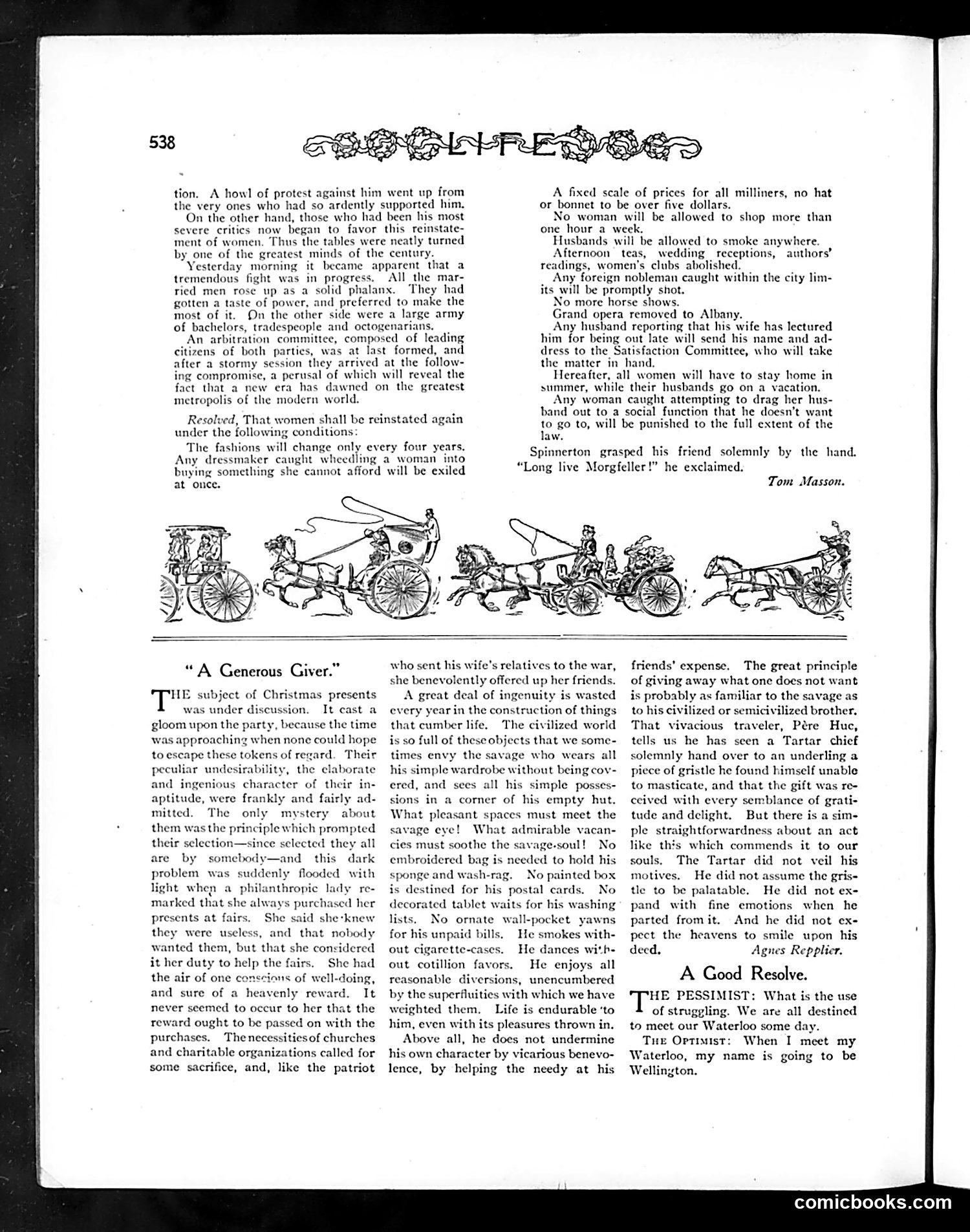
This page contains two distinct satirical pieces. The upper section mocks a hypothetical conflict where married men attempt to restrict women's freedoms (banning shopping, women's clubs, opera, etc.), ultimately compromising by allowing women limited rights under strict conditions. The satire targets both male chauvinism and women's social activism of the era. The lower article, "A Generous Giver," satirizes wealthy charitable donors who purchase useless items at charity fairs and gift them as Christmas presents—not from generosity but to support the fundraising organizations. The author critiques the donor's self-congratulation while acknowledging she's essentially pawning off unwanted goods on friends. It's a biting commentary on performative charity and the hypocrisy of "philanthropic" behavior masking self-interest. Both pieces exemplify *Life* magazine's satirical approach to American social pretensions.
📄 Transcribed text from this page (OCR, searchable)
Machine-transcribed from the original scan — historical spelling and the odd misread are preserved.
tion. A howl of protest against him went up from the very ones who had so ardently supported him. On the other hand, those who had been his most severe critics now began to favor this reinstate- ment of women. Thus the tables were neatly turned by one of the greatest minds of the century. Yesterday morning it became apparent that a tremendous fight was in progress. All the mar- ried men rose up as a solid phalanx. They had gotten a taste of power, and preferred to make the most of it. On the other side were a large army of bachelors, tradespeople and octogenarians. An arbitration committee, composed of leading citizens of both parties, was at last formed, and after a stormy session they arrived at the follow- ing compromise, a perusal of which will reveal the fact that a new era has dawned on the greatest metropolis of the modern world. A fixed scale of prices for all milliners, no hat or bonnet to be over five dollars. No woman will be allowed to shop more than one hour a we: Husbands will be allowed to smoke anywhere. Afternoon teas, wedding lings, women’s clubs abolished. receptions, authors’ ny foreign nobleman caught within the city lim- its will be promptly shot. No more horse show: Grand opera removed to Albany. Any husband reporting that his wife has lectured him for being out late will send his name and ad- dress to the Satisfaction Committee, who will take the matter in hand. Hereafter, all women will have to stay home in summer, while their husbands go on a vacation. Any woman caught attempting to drag her hus- — 4 band out to a social function that he doesn’t want Resolved, That women shall be reinstated again to go to, will be punished to the full extent of the under the following conditions: ine The fashions will change only every four years. Any dressmaker caught wheedling a woman into buying something she cannot afford will be exiled Spinnerton grasped his friend solemnly by the hand. “Long live Morgfeller!” he exclaimed. at once. Tom Masson. “A Generous Giver.” TH! subject of Christmas presents was under discussion. It cast a gloom upon the party, because the time pproaching when none could hope to escape these tokens of regard. Their peculiar undesirability, the elaborate and ingenious character of their in- aptitude, were frankly and fairly ad- mitted. The only mystery about them was the principle which prompted their selection—since selected thi 1 are by dark problem was suddenly flooded with light when a philanthropic lady re- marked that she always purchased her presents at fairs, She said she-knew they were useless, and that nobody wanted them, but that she considered it her duty to help the fairs. She had the air of one conscions of well-doing, and sure of a heavenly reward, It never seemed to occur to her that the reward ought to be passed on with the purchases. Thenecessitiesof churches and charitable organizations called for some sacrifice, and, like the patriot somebody—and_ this who sent his wife's relatives to the war, she benevolently offered up her friends. A great deal of ingenuity is wasted every year in the construction of things that cumber life. The civilized world is so full of these objects that we some- times envy the savage who wears all his simple wardrobe without being cov- ered, and sees all his simple posses sions in a corner of his empty hut. What pleasant spaces must meet the savage eye! What admirable vacan- cies must soothe the s ge-soul! No embroidered bag is needed to hold his sponge and wash-rag. No painted box is destined for his postal cards. No decorated tablet waits for his w lists. No ornate wall-pocket for his unpaid bills. He smokes with- out cigarette-cases. He dances with- out cotillion vors. He enjoys all reasonable diversions, unencumbered by the superfluities with which we have ighted them, Life is endurable ‘to him, even with its pleasures thrown in. Above all, he does not undermine his own character by vicarious benevo- lence, by helping the needy at his of giving away what one does not want is probably as familiar to the savage as to his civilized or semicivilized brother. That vivacious traveler, Pére Huc, tells us he has seen a Tartar chief solemnly hand over to an underling a piece of gristle he found himself unable to masticate, and that the gift was re- ceived with every semblance of grati- tude and delight. But there is a sim- ple straightforwardnes pout an act like this which commends it to our souls, The Tartar did not veil his motive He did not assume the gris- tle to be palatable. He did not ex- pand with fine emotions when he parted fromit. And he did not ex- pect the heavens to smile upon his deed. Agnes Repplier. A Good Resolve. 'HE PESSIMIST: What is the use of struggling. We are all destined to mect our Waterloo some day. Tue Optimist: When I meet my Waterloo, my name is going to be Wellington. comicbooks.com