
Life, 1904-12-01 · page 25 of 64
Life — December 1, 1904 — page 25: what you’re looking at
What you’re looking at
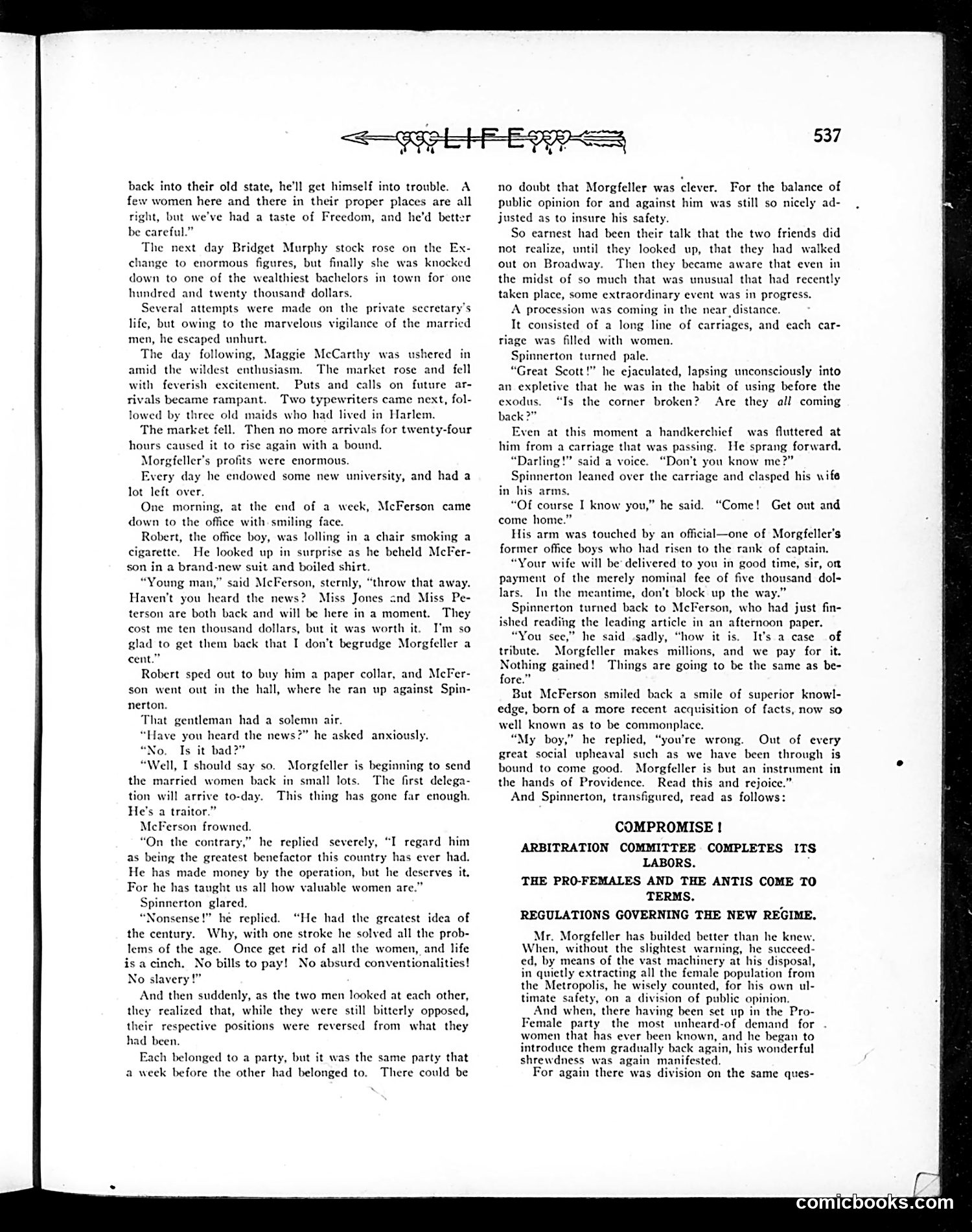
This satirical story mocks early-20th-century debates over women's roles and rights. A character named Morgfeller has apparently orchestrated the removal of women from society—which initially delights misogynists but creates economic chaos. He profits enormously by auctioning women back to the highest bidders. The satire's point: two male characters, McFerson and Spinnerton, who were ideologically opposed, discover their positions have *reversed*. McFerson, who wanted women removed, now praises Morgfeller for proving women's value. Spinnerton, who opposed the removal, now sees the profit motive. The final irony shows women returning en masse on Broadway, suggesting the experiment has failed—or perhaps that women's actual irreplaceability to society is undeniable. This reflects pre-suffrage anxieties about women's independence and economic power, using absurdist humor to satirize both feminist and anti-feminist positions.
📄 Transcribed text from this page (OCR, searchable)
Machine-transcribed from the original scan — historical spelling and the odd misread are preserved.
back into their old state, he'll get himself into trouble. A few women here and there in their proper places are all right, but we've had a taste of Freedom, and he'd better be careful.” The next day Bridget Murphy stock rose on the Ex- change to enormous figures, but finally she was knocked down to one of the wealthiest bachelors in town for one hundred and twenty thousand dollars. Several attempts were made on the private secretary's life, but owing to the marvelous vigilance of the married men, he escaped unhurt. The day following, Maggie McCarthy was ushered in amid the wildest enthusiasm. The market rose and fell with feverish excitement. Puts and calls on future ar- rivals became rampant. Two typewriters came next, fol- lowed by three old maids who had lived in Harlem. The market fell. Then no more arrivals for twenty-four hours sed it to rise again with a bound. Morgfeller’s profits were enormous. Every day he endowed some new university, and had a lot left over. One morning, at the end of a week, McFerson came down to the office with smiling face. Robert, the office boy, was lolling in a chair smoking a cigarette. He looked up in surprise as he beheld McFer- son in a brand-new suit and boiled shirt. “Young man,” said McFerson, sternly, “throw that away. Haven't you heard the news? Miss Jones and Miss Pe- terson are both back and will be here in a moment. They cost me ten thousand dollars, but it was worth it. I'm so glad to get them back that I don’t begrudge Morgfeller a cent.” Robert sped out to buy him a paper collar, and McFer- son went out in the hall, where he ran up against Spin- nerton. That gentleman had a solemn air. “Have you heard the news?” he asked anxiously. o. Is it bad?” Well, I should say so. Morgfeller is beginning to send the married women back in small lots. The first delega- tion will arrive to-day. This thing has gone far enough. He's a traitor.” McFerson frowned. “On the contrary,” he replied severely, “I regard him as being the greatest benefactor this country has ever had. He has made money by the operation, but he deserves it. For he has taught us all how valuable women are.” Spinnerton glared. “Nonsense!” he replied. “He had the greatest idea of the century. Why, with one stroke he solved all the prob- lems of the age. Once get rid of all the women, and life isacinch. No bills to pay! No absurd conventionalities! No slavery ! And then suddenly, as the two men looked at each other, they realized that, while they were still bitterly opposed, their respective positions were reversed from what they had been. Each belonged to a party, but it was the same party that a week before the other had belonged to. There could be 537 no doubt that Morgfeller was clever. For the balance of public opinion for and against him was still so nicely ad- justed as to insure his safety. So earnest had been their talk that the two friends did not realize, until they looked up, that they had walked out on Broadway. Then they became aware that even in the midst of so much that was unusual that had recently taken place, some extraordinary event was in progress. A procession was coming in the near distance. It consisted of a long line of carriages, and each car- riage was filled with women. Spinnerton turned pale. “Great Scott!” he ejaculated, lapsing unconsciously into an expletive that he was in the habit of using before the exodus. “Is the corner broken? Are they all coming back ?” Even at this moment a handkerchief was fluttered at him from a carriage that was passing. He sprang forward. Darling!” said a voice. “Don't you know me?” Spinnerton leaned over the carriage and clasped his wife in his arms. “Of course I know you,” he said. come home.” His arm was touched by an official—one of Morgfeller’s former office boys who had risen to the rank of captain, “Your wife will be’ delivered to you in good time, sir, om payment of the merely nominal fee of five thousand dol- lars. In the meantime, don’t block up the way.” Spinnerton turned back to McFerson, who had just fin- ished reading the leading article in an afternoon paper. “You see,” he said .sadly, “how it It's a case of tribute. Morgfeller makes millions, and we pay for it. Nothing gained! Things are going to be the same as be- fore.” But McFerson smiled back a smile of superior knowl- edge, born of a more recent acquisition of facts, now so well known as to be commonplace. “My boy,” he replied, “you're wrong. Out of every great social upheaval such as we have been through is bound to come good. Morgfeller is but an instrument in the hands of Providence. Read this and rejoice.” And Spinnerton, transfigured, read as follows: “Come! Get out and COMPROMISE ! ARBITRATION COMMITTEE COMPLETES ITS LABORS. THE PRO-FEMALES AND THE ANTIS COME TO TERMS. REGULATIONS GOVERNING THE NEW REGIME. Mr. Morgfeller has builded better than he knew. When, without the slightest warning, he succeed- ed, by means of the vast machinery at his disposal, in quietly extracting all the female population from the Metropolis, he wisely counted, for his own ul- timate safety, on a division of public opinion. And when, there having been set up in the Pro- Female party the most unheard-of demand for women that has ever been known, and he began to introduce them gradually back again, his wonderful shrewdness was again manifested. For again there was division on the same ques- comicbooks.com