
Life, 1904-12-01 · page 22 of 64
Life — December 1, 1904 — page 22: what you’re looking at
What you’re looking at
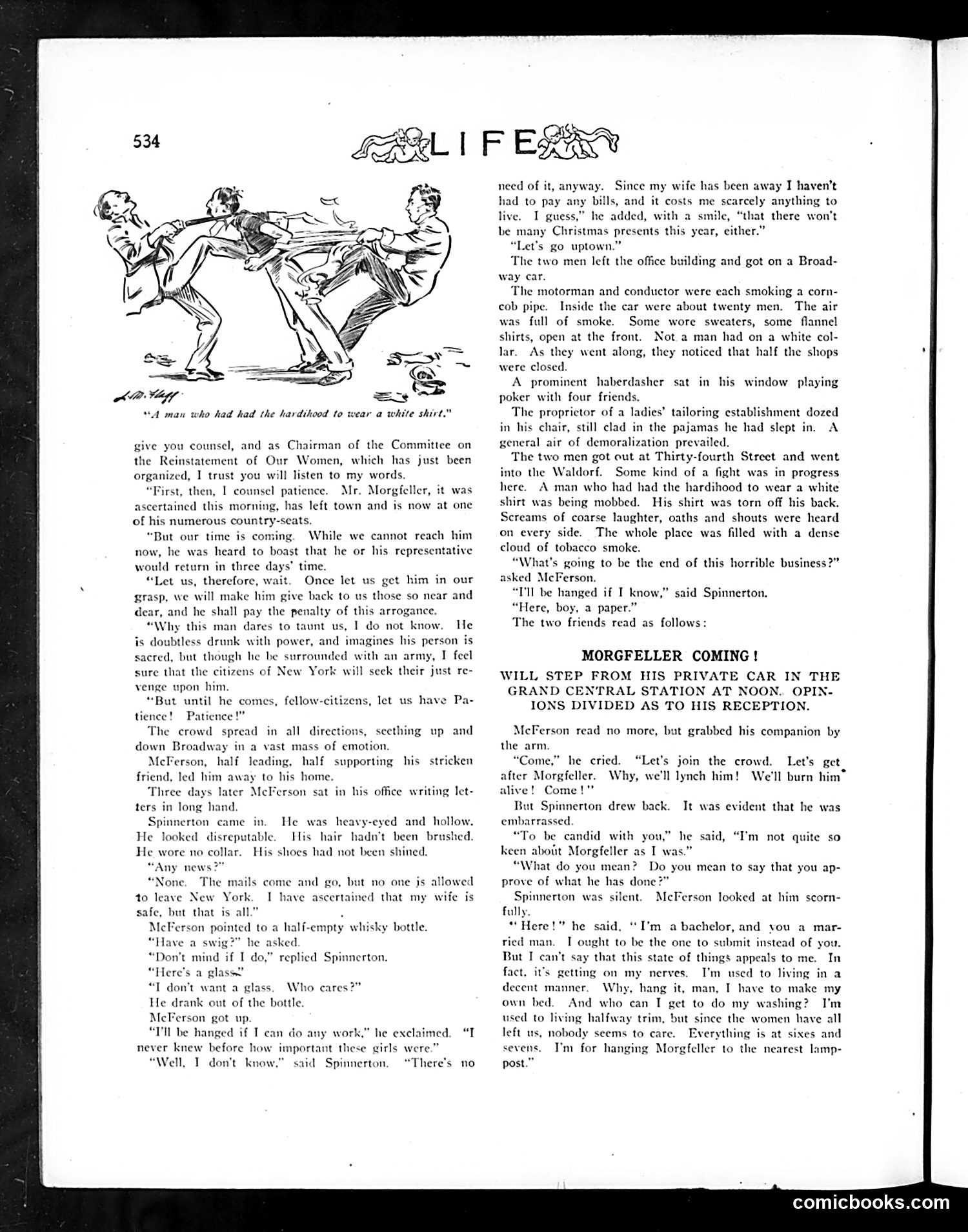
This satirical piece depicts social chaos resulting from women's absence—likely referencing the early suffrage movement or women's activism. The cartoon shows a man in a white shirt being mobbed, illustrating the story's absurdist premise: when women leave New York, society collapses into disorder. The satire works on multiple levels: shops close, men neglect grooming and work, they drink heavily, and civic infrastructure fails. A character named Morgfeller (apparently a wealthy industrialist who "dares to taunt" by leaving town) becomes the focus of public rage, with crowds demanding his return. The joke targets both the emerging women's movement and male anxiety about female independence. By depicting societal breakdown without women, the writer mocks both the idea that women are essential to civilization *and* the men who panic at their absence. The unmanned mobs and deteriorating standards of dress and behavior suggest masculine incompetence and dependency.
📄 Transcribed text from this page (OCR, searchable)
Machine-transcribed from the original scan — historical spelling and the odd misread are preserved.
LGR | F ELI a Ka vg “A man who had had the hardihood to wear a white shirt.” give you counsel, and as Chairman of the Committee on the Reinstatement of Our Women, which has just been organized, I trust you will listen to my words. rst, then, I counsel patience. Mr. Morgfeller, it was ascertained this morning, has left town and is now at one of his numerous country-seats. While we cannot reach him now, he was heard to boast that he or his representative would return in three days’ time. “Let us, therefore, wait. Once let us get him in our grasp, we will make him give back to us those so near and dear, and he shall pay the penalty of this arrogance. “Why this man dares to taunt us, I do not know. He is doubtless drunk with power, and imagines his person is sacred, but though he be surrounded with an army, I feel sure that the citizens of New York will seek their just re- venge upon him. “But until he comes, fellow-cit tience! Patience!” The crowd spread in all directions, seething up and down Broadway in a vast mass of emotion. McFerson, half leading, half supporting his stricken friend, led him away to his home. Three days later MeFerson sat in his office writing Iet- ters in long hand. Spinnerton came in. He was heavy-eyed and hollow. He looked disreputable. His hair hadn't been brushed He wore no collar. “But our time is coming. ns, let us have Pa- His shoes had not been shined. ny news? “None, The mails come and go, but no one js allowed to leave New York. [ have ascertained that my wife is safe, but that is all.” . McFerson pointed to a half-empty whisky bottle. “Have a sv e¢ asked. “Don't mind if I do,” replied Spinnerton. “Here's _ “T don't want a glass. Who cares?” He drank out of the bottle. McFerson got up. “TIL be hanged if T can do any work.” never knew before how important these girls were “Well, 1 don’t know.” said Spinnerton he exclaimed, “I “There's no need of it, anyway. Since my wife has been away I haven't had to pay any bills, and it costs me scarcely anything to live. I guess,” he added, with a smile, “that there won't be many Christmas presents this year, cither.” “Let's go uptown.” The two men left the office building and got on a Broad- way car. The motorman and conductor were each smoking a corn- cob pipe. Inside the car were about twenty men. The air was full of smoke. Some wore sweaters, some flannel shirts, open at the front. Not a man had on a white col- lar. As they went along, they noticed that half the shops were closed. A prominent haberdasher sat in his window playing poker with four friends. The proprictor of a ladies’ tailoring establishment dozed in his chair, still clad in the pajamas he had slept in. A general air of demoralization prevailed. The two men got out at Thirty-fourth Street and went into the Waldorf. Some kind of a fight was in progress here. A man who had had the hardihood to wear a white shirt was being mobbed. His shirt was torn off his back. Screams of coarse laughter, oaths and shouts were heard on every side. The whole place was filled with a dense cloud of tobacco smoke. “What's going to be the end of this horrible business?” asked McFerson. “T'll be hanged if I know,” said Spinnerton. “Here, boy, a paper.” The two friends read as follows: MORGFELLER COMING! WILL STEP FROM HIS PRIVATE CAR IN THE GRAND CENTRAL STATION AT NOON. OPIN- IONS DIVIDED AS TO HIS RECEPTION. McFerson read no more, but grabbed his companion by the arm. “Come,” he cried. after Morgfeller. aliv Come !"* But Spinnerton drew back. embarrassed “Let’s join the crowd. Let's get Why, we'll lynch him! We'll burn him” Tt was evident that he was “To be candid with you,” he said, “I’m not quite so keen abotit Morgfeller as I was.” “What do you mean? Do you mean to say that you ap- prove of what he has done?” Spinnerton was silent. fully. “Here!” he said, ‘I'm a bachelor, and you a mar- ried man. McFerson looked at him scorn- I ought to be the one to submit instead of you. But I can’t say that this state of things appeals to me. In fact, it’s getting on my nerves. decent: manner. own bed. I'm used to living in a Why, hang it, man, T have to make my And who can I get to do my washing? I'm used to living halfway trim, but since the women have all left us, nobody seems to care. Everything is at sixes and I'm for hanging Morgfeller to the nearest lamp- comicbooks.com