
A complete issue · 40 pages · 1904
Life — November 3, 1904
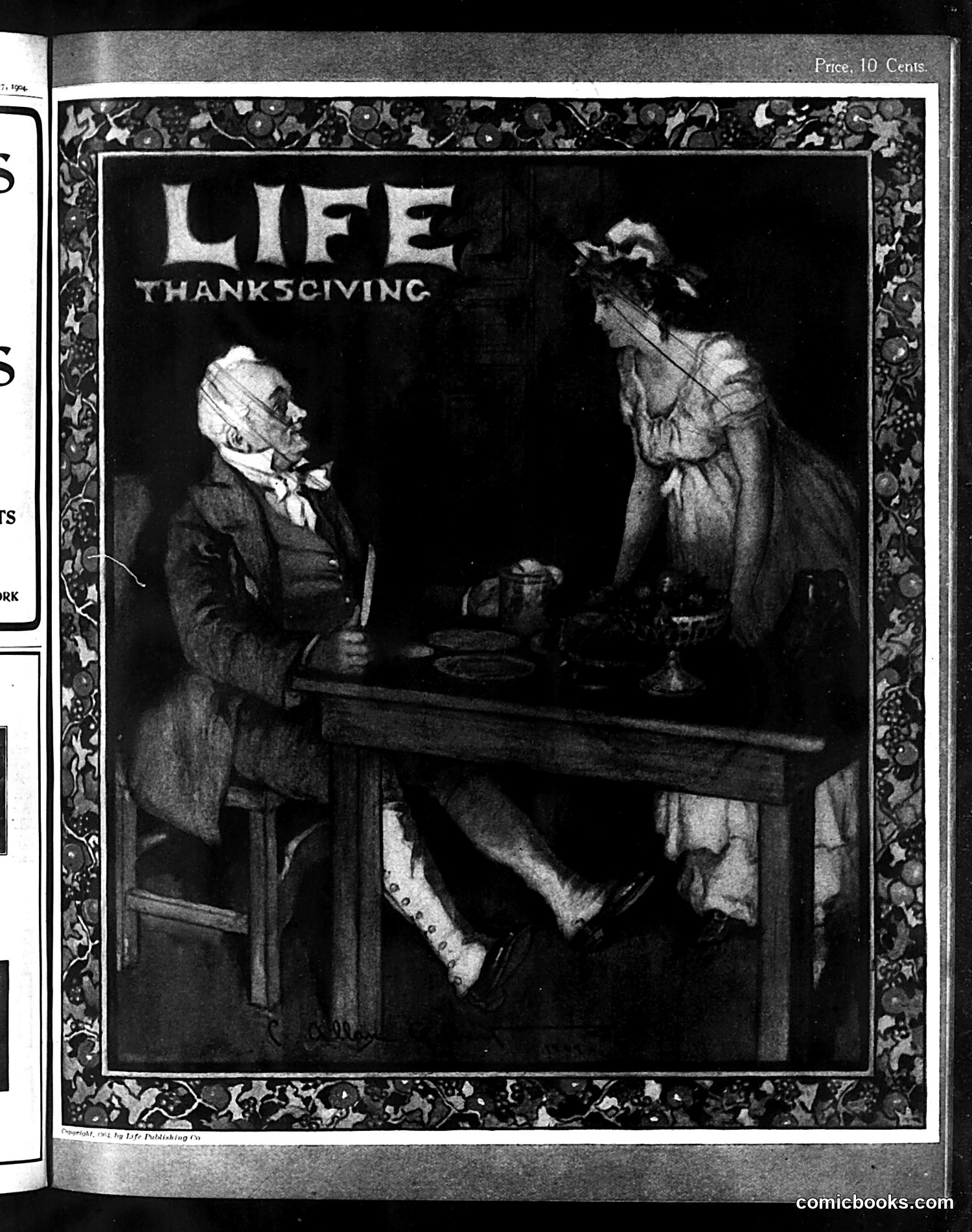
This is a satirical cartoon from Life magazine's Thanksgiving issue (priced at 10 cents). The image depicts two figures at a dining table in what appears to be a social commentary on holiday hypocrisy or class disparity during Thanksgiving. The figure on the left, dressed formally with bandaged head, appears to represent a wealthy or upper-class person, while the figure on the right holds what looks like a serving dish. The composition suggests irony about Thanksgiving's supposed ideals of gratitude and equality—contrasting celebration with underlying social divisions. Without clearer identification of the specific figures or additional context text, the precise political or social target remains uncertain, though the cartoon clearly critiques something about how Thanksgiving was observed or celebrated in early 20th-century America.
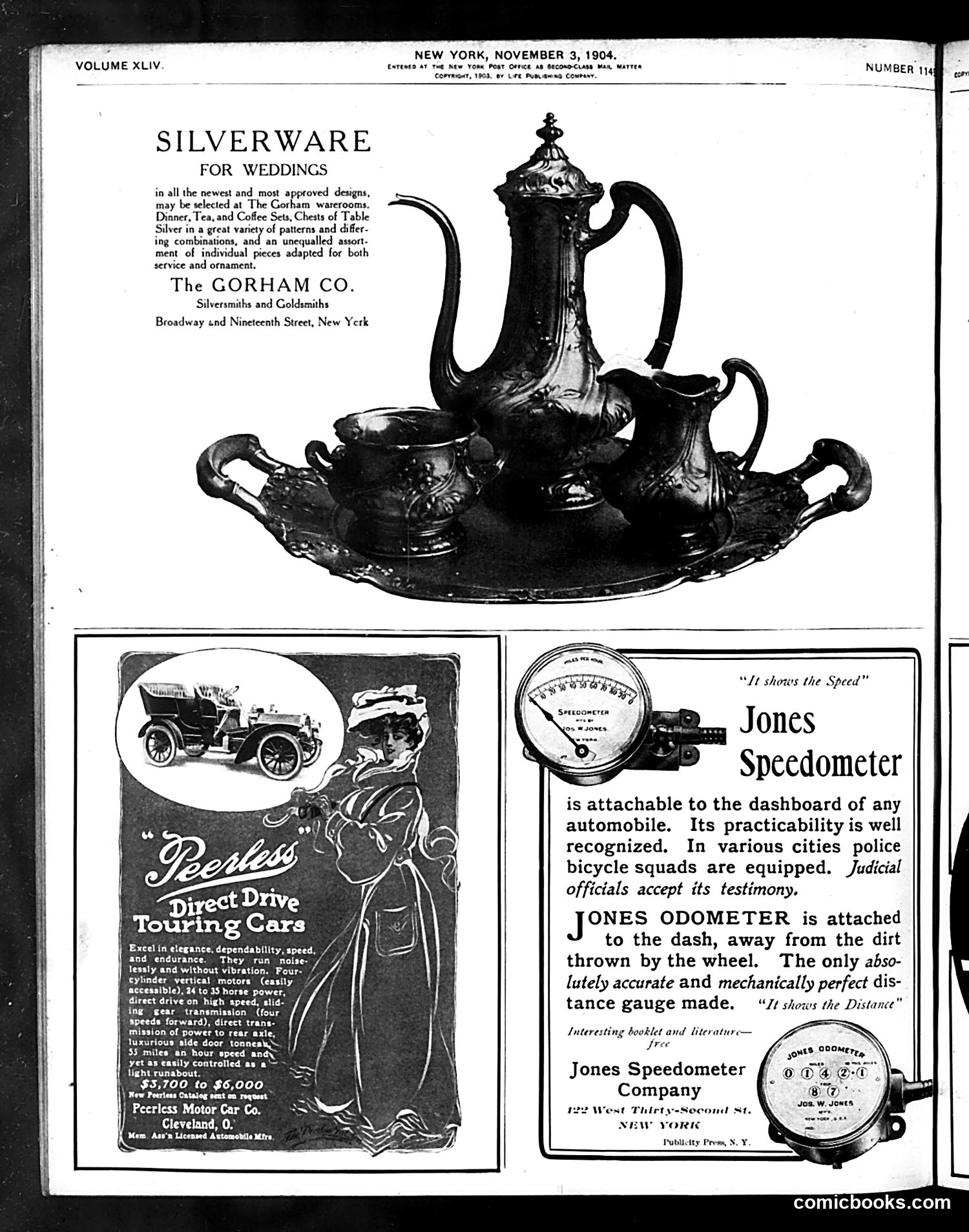
This page from *Life* magazine (November 3, 1904) is **primarily advertising**, not satire or political commentary. The top advertisement features **The Gorham Company**, a prestigious silversmith, promoting wedding silverware sets with an ornate teapot and service pieces. Below that are two separate advertisements: one for **Peerless Direct-Drive Touring Cars** (manufactured by Peerless Motor Car Co., Cleveland), and another for the **Jones Speedometer Company** in New York. The Peerless ad uses an illustration of a well-dressed woman driver alongside an early automobile, emphasizing the car's reliability and luxury features ("luxurious side door tonneau," "light runabout"). There is no political cartoon or satirical content on this page—it's a standard commercial advertising section typical of *Life* magazine's revenue model in the early 1900s.
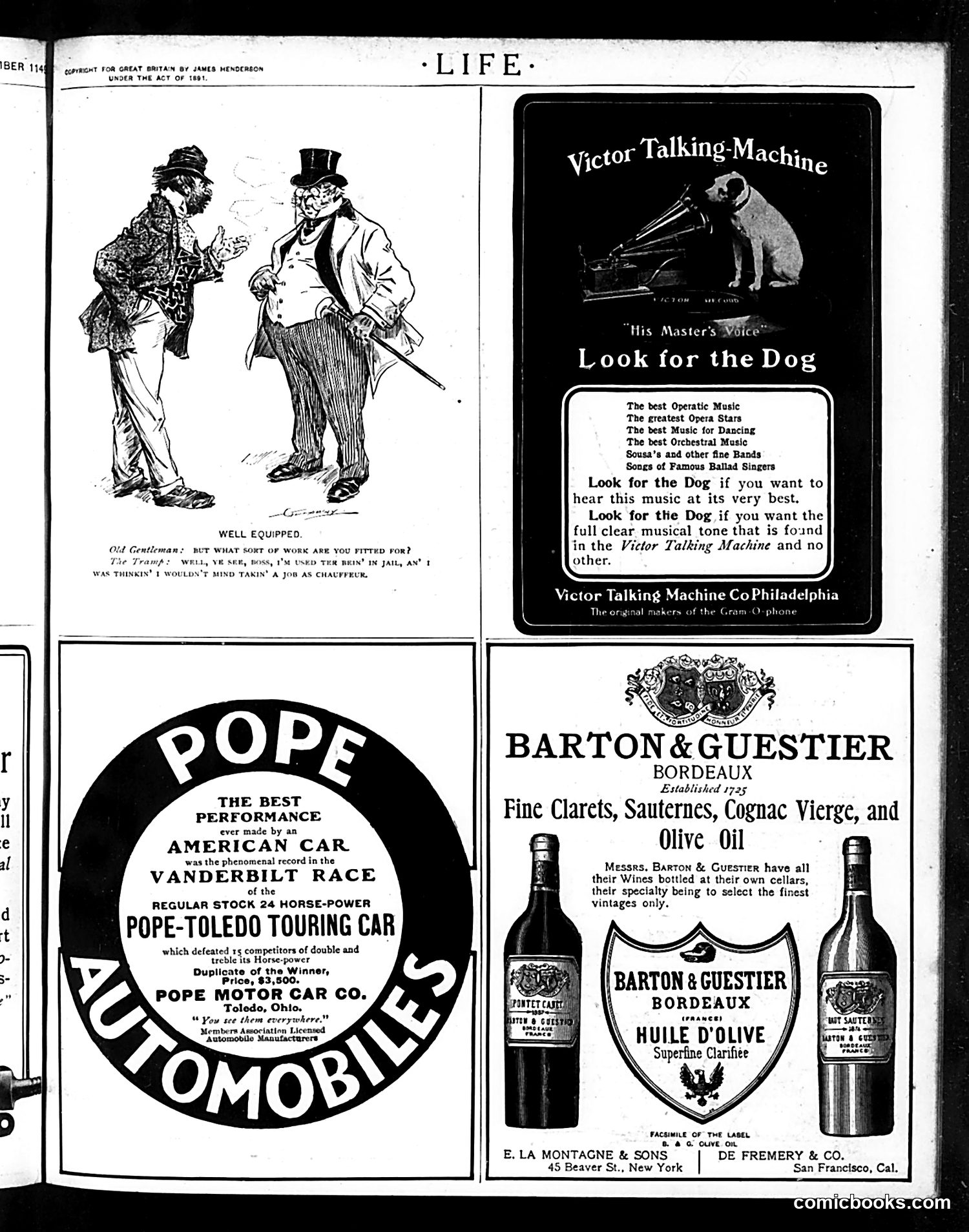
The top cartoon titled "Well Equipped" depicts two gentlemen in formal attire. The dialogue indicates one is poorly dressed for work—apparently having been in jail for vagrancy—while the other, a well-dressed man, seems to be critiquing his appearance or fitness for employment. The humor relies on class commentary: the shabby figure claims he wouldn't mind working as a chauffeur despite his rough circumstances. The page is otherwise dominated by **advertisements**: a Victor Talking Machine promotion, a Pope-Toledo automobile ad (emphasizing performance in the Vanderbilt Race), and Barton & Guestier wine/olive oil products. These ads represent luxury goods marketed to Life's affluent readership circa the early 1900s. The cartoon's class-based humor contrasts with the surrounding advertisements for expensive consumer goods.
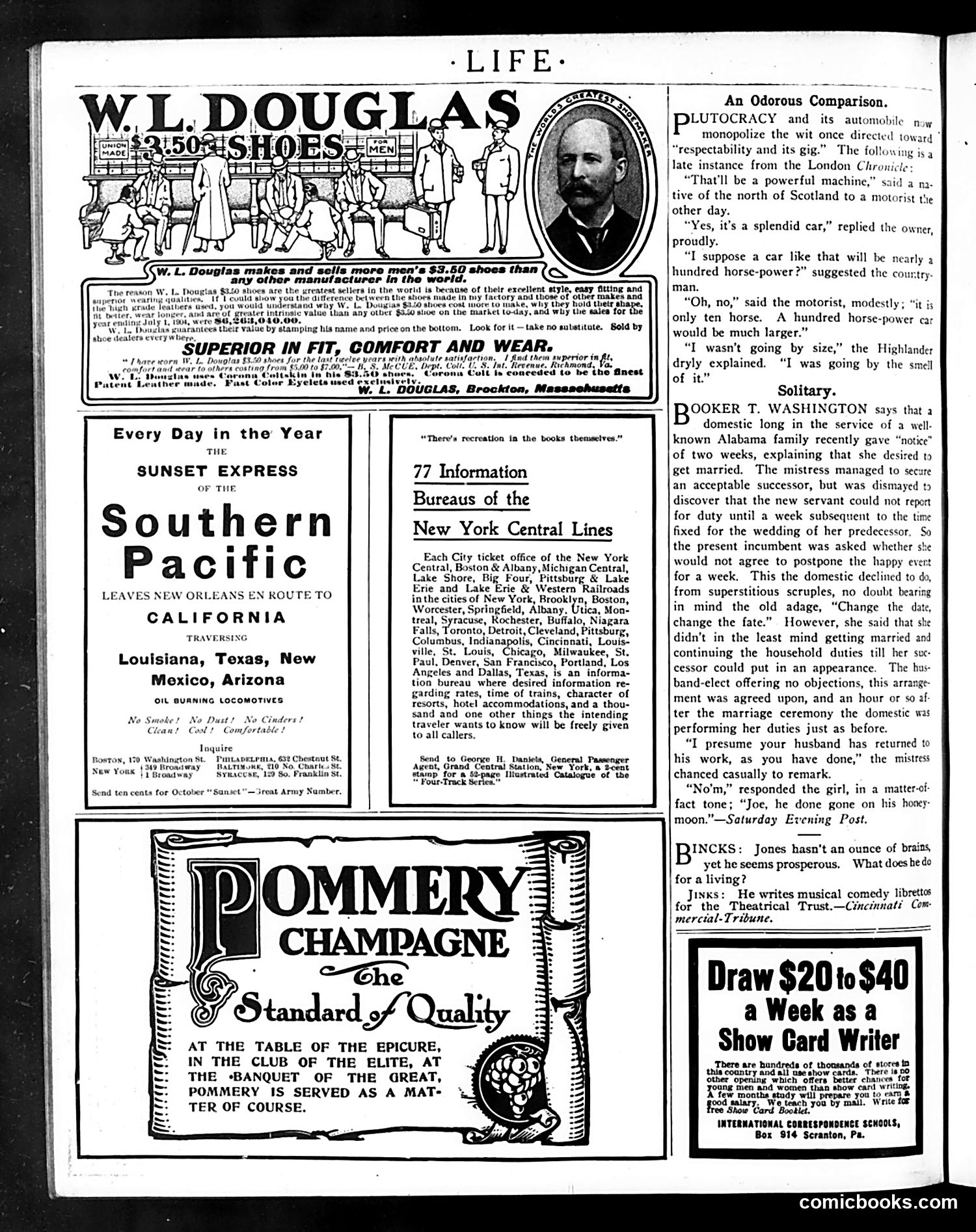
This page is **primarily advertising** rather than political satire. The main content includes: 1. **W.L. Douglas Shoes ad** - Claims Douglas makes more $3.50 men's shoes than competitors, emphasizing "superior in fit, comfort and wear." 2. **Southern Pacific Railway ad** - Promotes the "Sunset Express" train route from New Orleans to California. 3. **Pommery Champagne ad** - Positions the product as a luxury item served at elite gatherings. 4. **Small humor items** ("Solitary," "Odorous Comparison," "Bincks") - Brief anecdotes poking fun at domestic situations and character quirks, typical of Life's filler content. The page reflects early 20th-century consumer advertising and light social humor rather than substantive political commentary.
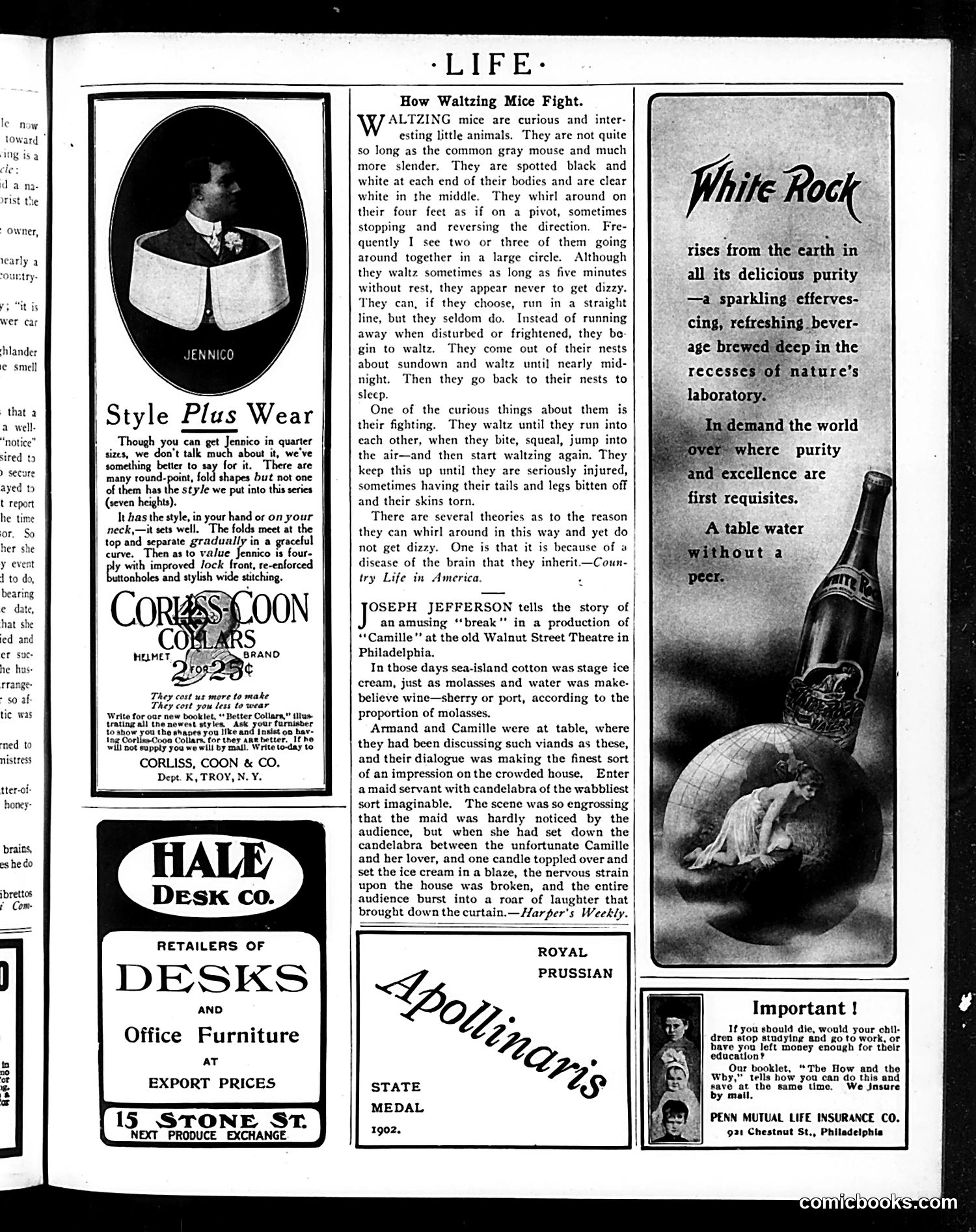
This page is primarily **advertising and light entertainment content** rather than political satire. The main articles include: 1. **"How Waltzing Mice Fight"** — a humorous natural history piece describing mice that dance in circles and occasionally fight, with theories about inherited brain disease. 2. **Joseph Jefferson anecdote** — a brief story about a theater production of "Camille" where stage ice cream caught fire during a performance, causing audience laughter. The advertisements include fashion (Corless Coon Collars), furniture (Hale Desk Co.), and beverages (White Rock water, Apollinaris). An insurance company ad appears at bottom right. There is **no political cartoon or satire** on this page—it reflects Life's mixed content of light humor, product advertising, and entertaining anecdotes typical of early 1900s magazines.
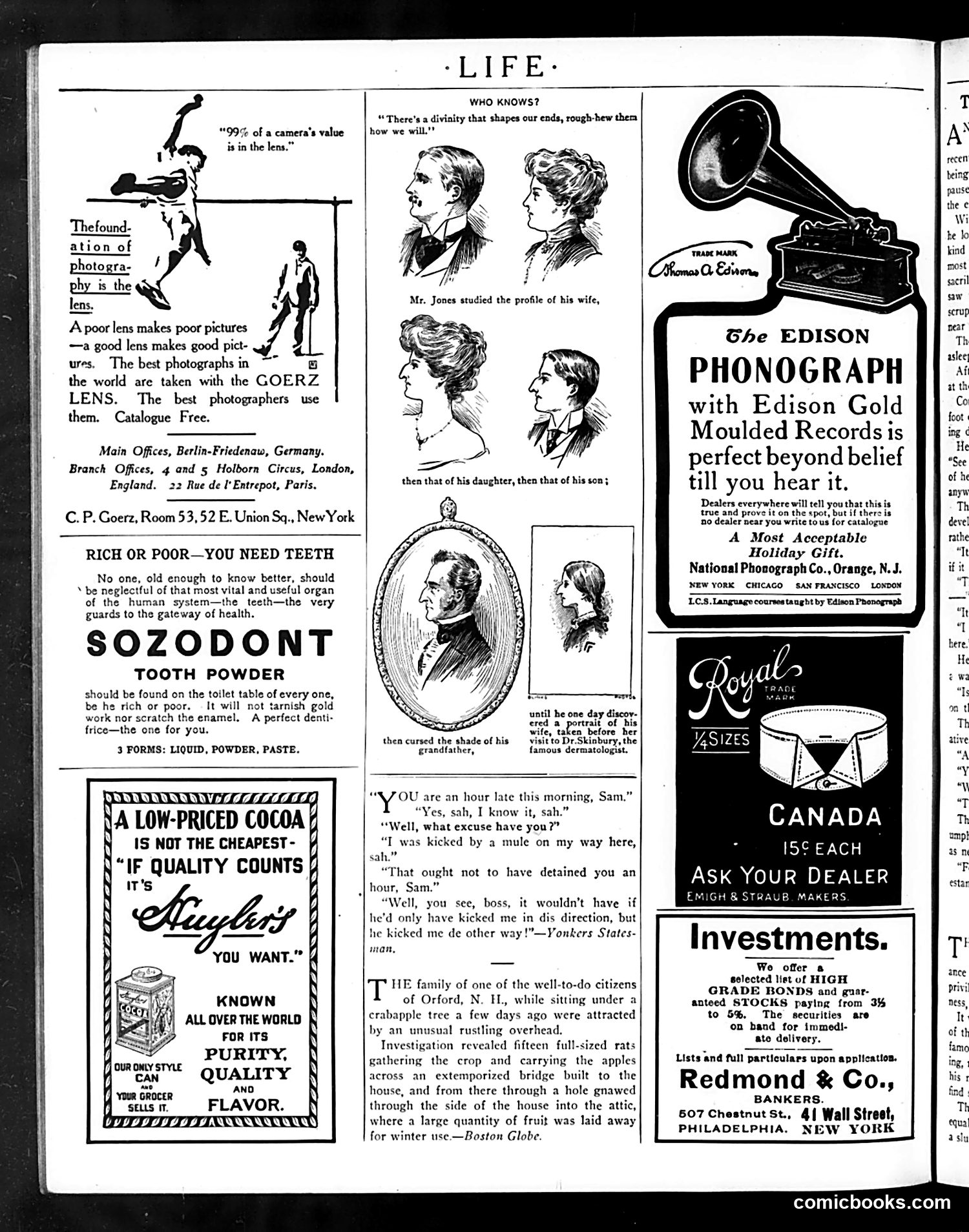
This page is **primarily advertising** with one brief satirical cartoon. The main content includes ads for Goerz camera lenses, Sozodont tooth powder, Stuyler's cocoa, Edison phonographs, Royal Canada corsets, and investment services. The central cartoon, titled "WHO KNOWS?", depicts a man studying profile sketches of his wife, daughter, and son. The joke satirizes **phrenology**—the pseudoscientific belief that facial features reveal character traits. The caption suggests the man is trying to predict his descendants' personalities or fates from their profiles. Below is an unrelated anecdote about rats in a New Hampshire home. The page reflects early 1900s consumer culture and contemporary fascination with now-discredited "scientific" theories about human nature.
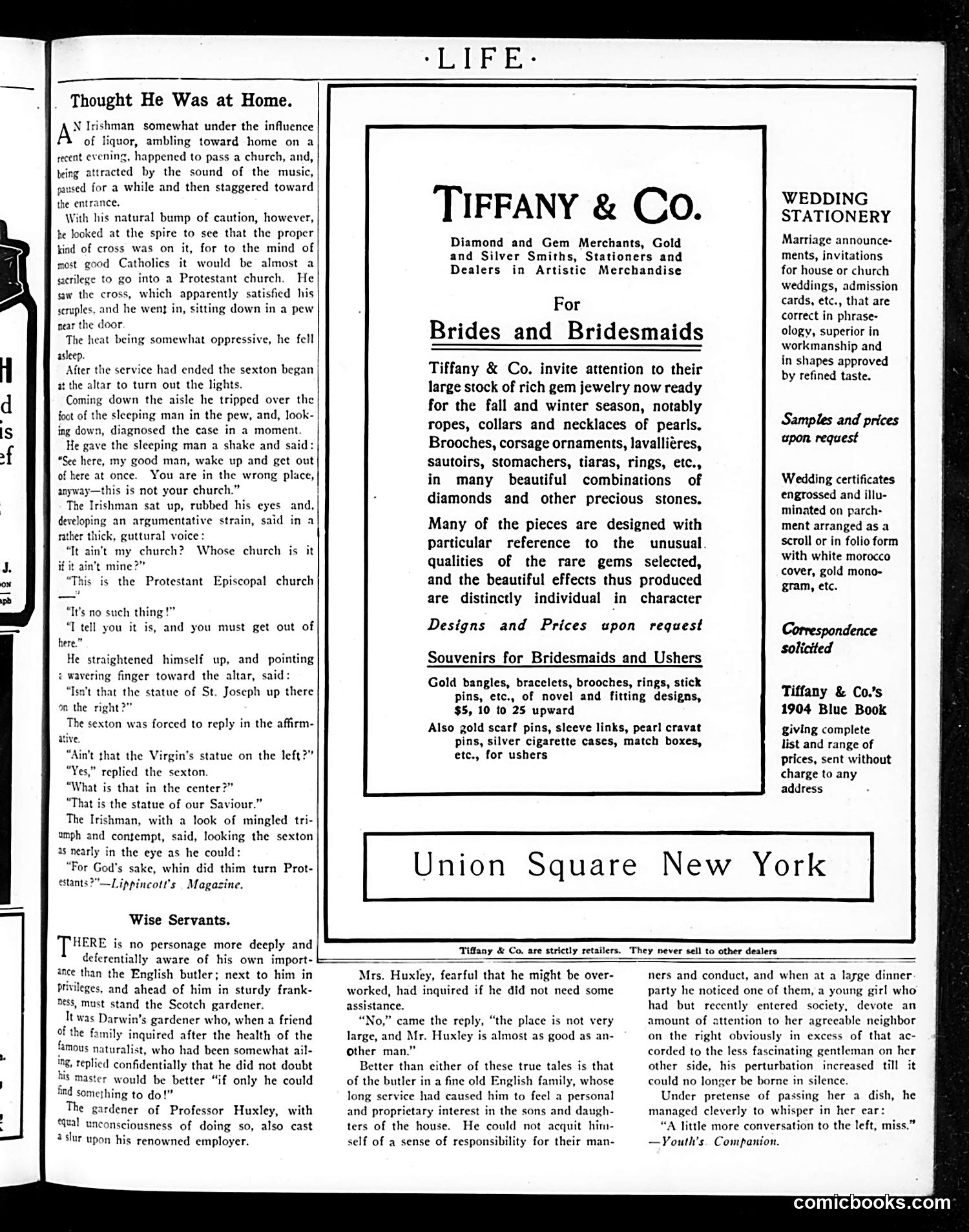
This page contains two distinct elements: **Left side:** A satirical short story titled "Thought He Was at Home" about an intoxicated Irishman who enters a Protestant Episcopal church by mistake, thinking it's his Catholic church. The humor derives from his confusion and his drunken commentary on the church's statuary and layout—a common ethnic stereotype of the era associating Irish immigrants with alcoholism and religious differences. **Right side:** Primarily advertising for Tiffany & Co., the luxury jeweler, promoting wedding merchandise for "Brides and Bridesmaids," including jewelry, pearls, and accessories. The advertisement occupies most of the page's right half. The juxtaposition is typical of *Life* magazine's format—mixing satirical fiction with commercial advertisements. The Irish immigrant humor reflects early 1900s American attitudes toward Irish Catholic newcomers.
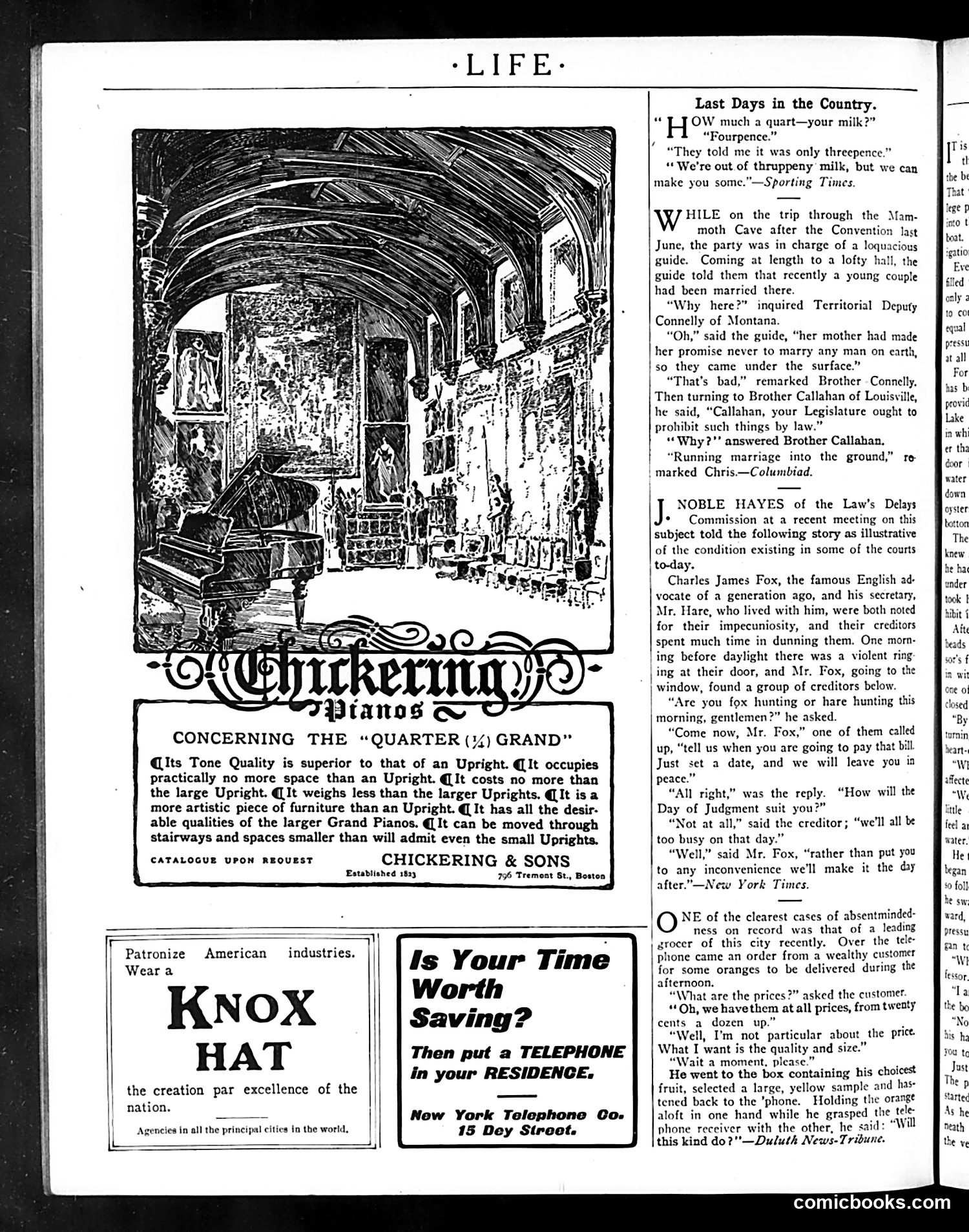
This page from *Life* magazine contains primarily **advertising and anecdotes** rather than political cartoons. The main illustration shows an interior cave scene (likely Mammoth Cave, referenced in the text), but serves as decoration for a piano advertisement rather than satire. The text includes humorous anecdotes: one about a rural couple's marriage ceremony occurring underground in the cave, and another about Charles James Fox (an 18th-century English politician) avoiding creditors by claiming to be "fox hunting or hare hunting." A third story describes a grocer's telephone customer requesting colored oranges, with comedic miscommunication about pricing. The advertisements promote Knox Hats and New York Telephone service. **No political satire or caricature appears on this page.** It's a typical example of *Life*'s mix of light humor, advertisements, and lifestyle content.
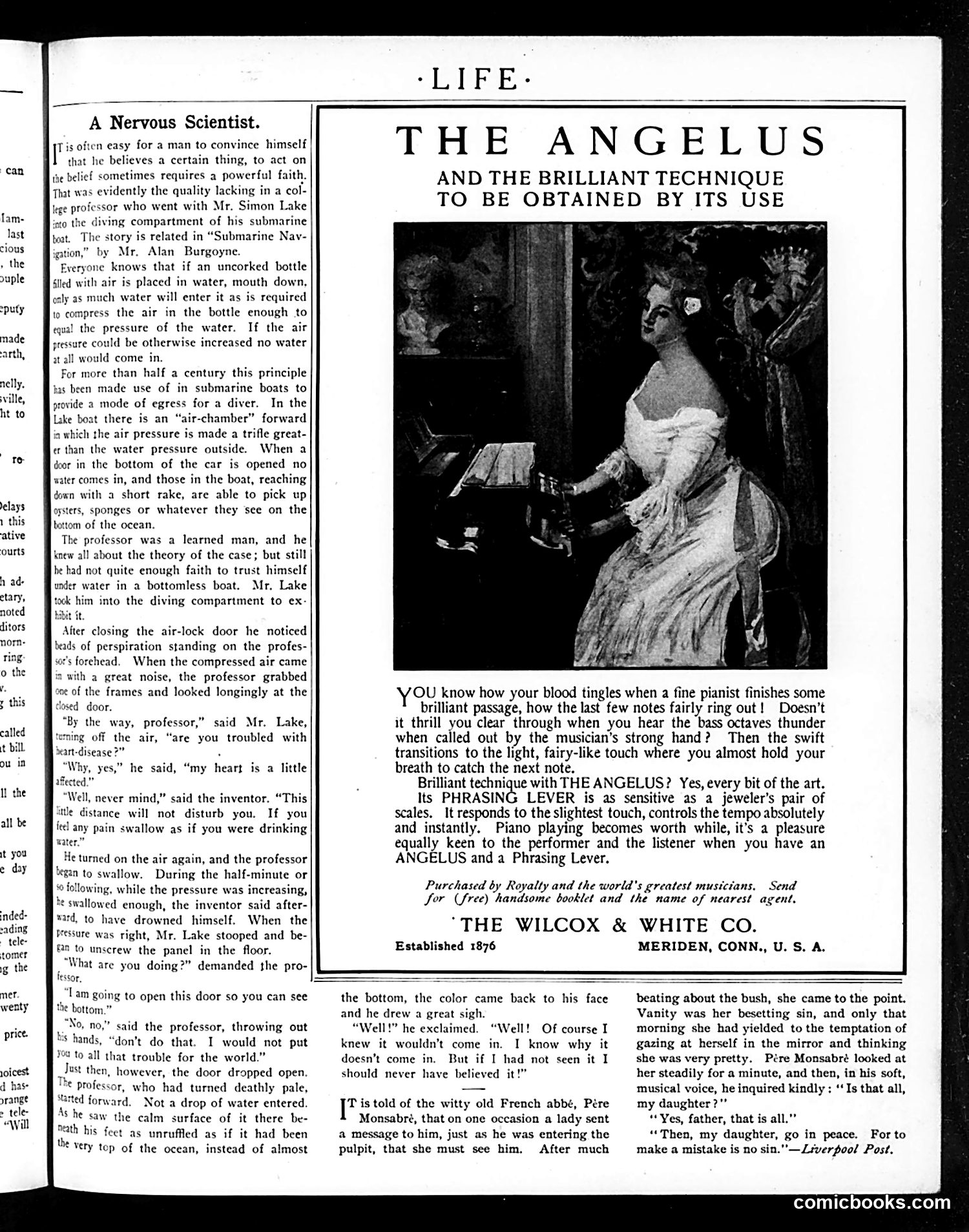
This page contains two distinct items: **Left side:** "A Nervous Scientist" - a humorous short story about a timid professor who doubts his own submarine diving invention. The narrative satirizes academic anxiety: despite understanding the theory, he lacks confidence to test it himself and nearly panics underwater. The joke targets intellectuals who are theoretically sound but practically fearful. **Right side:** An advertisement for "The Angelus" piano by Wilcox & White Co. (established 1876). The ad uses romantic imagery of an elegant woman playing piano and poetic language about musical sensitivity and "brilliant technique." It's a standard period advertisement targeting wealthy consumers, positioning the piano as an instrument for refined, artistic people. Neither section appears to be overtly political satire.
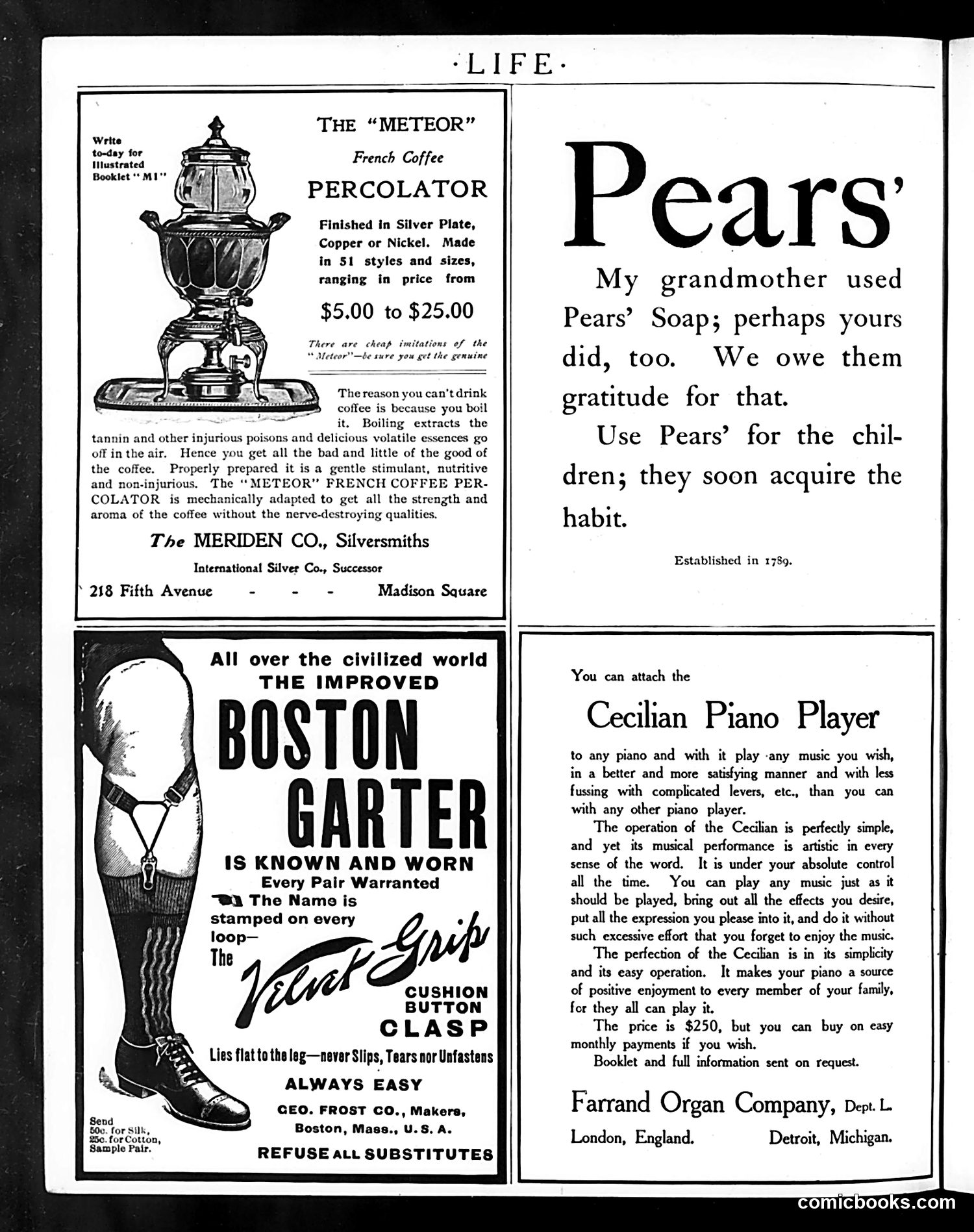
This page contains **advertisements rather than political cartoons**. There are four product ads: 1. **The "Meteor" French Coffee Percolator** — touting proper coffee preparation that avoids boiling (which allegedly destroys coffee's benefits and releases "tannin and other injurious poisons") 2. **Pears' Soap** — a nostalgic appeal claiming the product's long history and suggesting mothers used it, positioning it as safe for children 3. **Boston Garter** — emphasizing comfort features (cushion button, velvet grip) with a leg illustration; marketed as superior to substitutes 4. **Cecilian Piano Player** — a mechanical piano attachment promising easy music-making for families without musical skill The page reflects early 20th-century consumer culture, emphasizing product superiority, health/safety claims, and aspirational family values. No satire or political commentary is present.
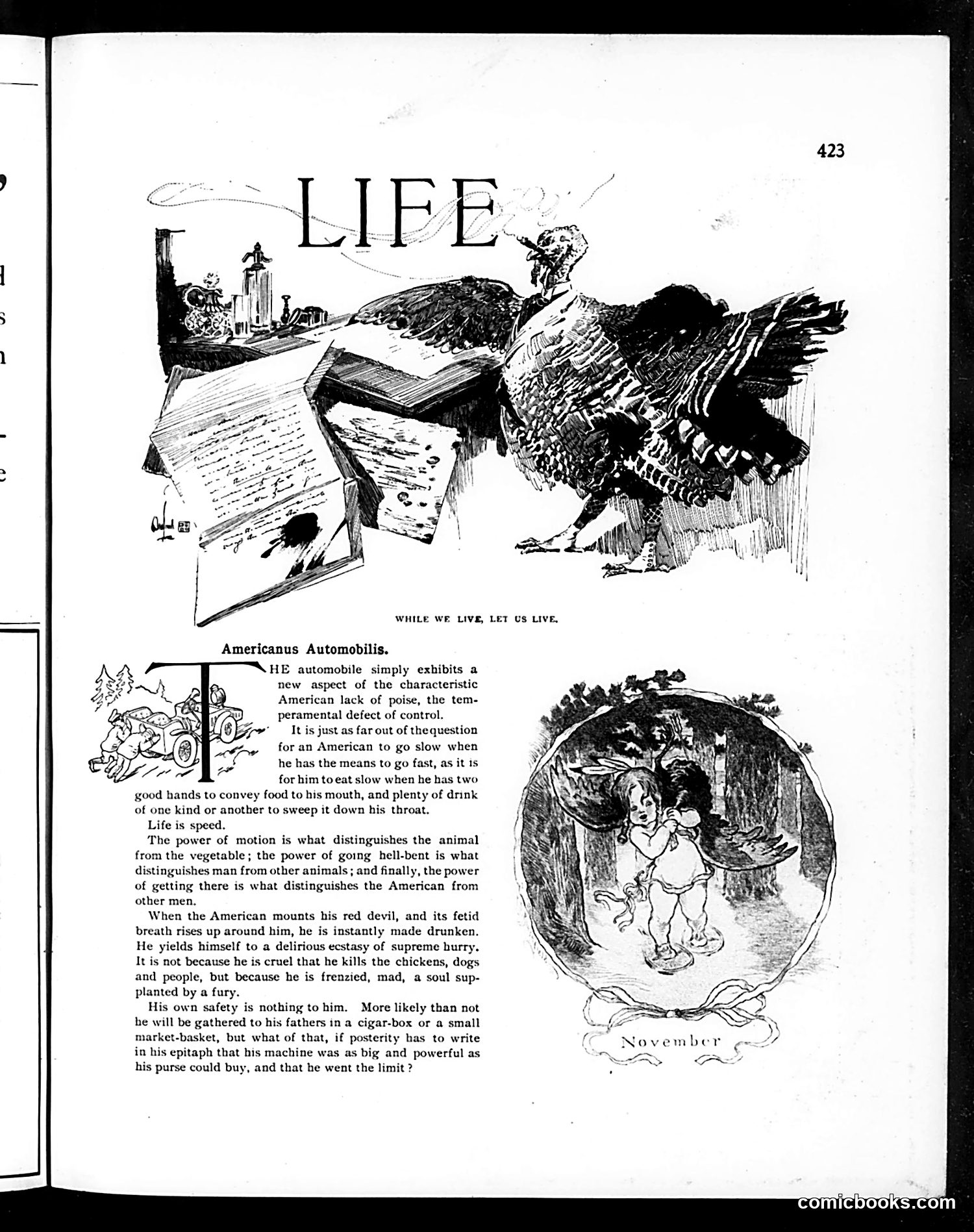
**Top Illustration:** An allegorical figure representing "Life" sits amid scattered papers and books, overlooking a cityscape. The artwork illustrates the magazine's motto: "While We Live Let Us Live." **Main Article: "Americanus Automobilis"** This satirical piece mocks American car culture and reckless driving habits. The text ridicules the American tendency toward speed and excess—comparing the automobile driver's behavior to intoxication and madness. It critiques wealthy Americans who drive dangerously despite having means for safety, suggesting their vehicles are monuments to their own poor judgment rather than accomplishment. The article uses colorful language about the driver being "instantly made drunken" by his machine, implying automobiles encourage destructive impulses. **"November" illustration** (bottom right): A seasonal vignette, likely decorative.
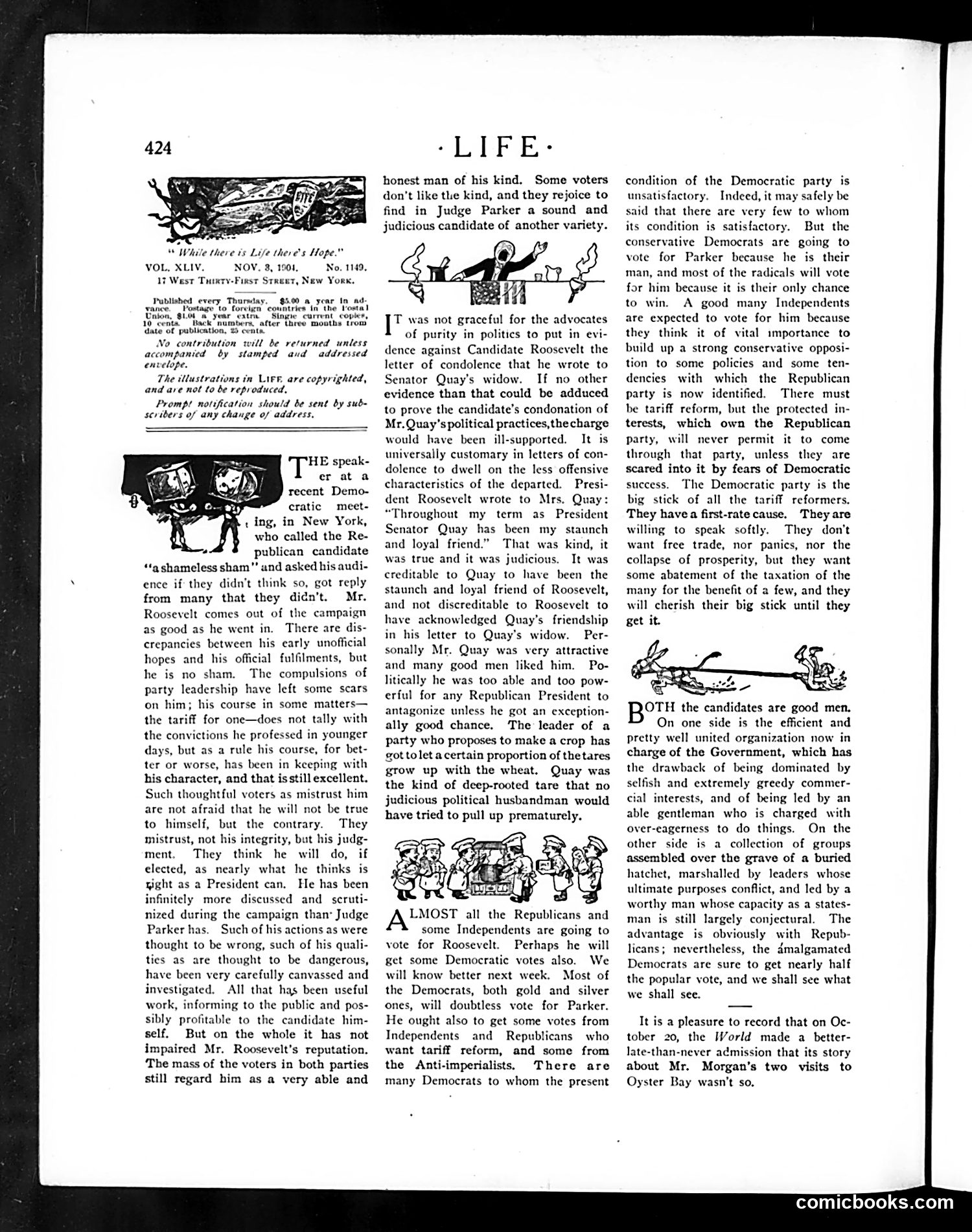
This Life magazine page discusses the upcoming presidential race between Democrat Alton B. Parker and Republican Theodore Roosevelt. The text analyzes Parker as "an honest man of his kind" but questions whether he can unite fractious Democratic factions—reformers, protectionists, and anti-imperialists who lack consensus. The cartoons (specific figures unclear from image quality) appear to satirize party divisions and candidate appeal. The commentary suggests both candidates are "good men," but Roosevelt's Republicans have organizational advantage, while Democrats are an "amalgamated" coalition held together primarily by opposing Republicans rather than shared principles. The piece reflects genuine anxiety about Democratic party coherence in 1904.
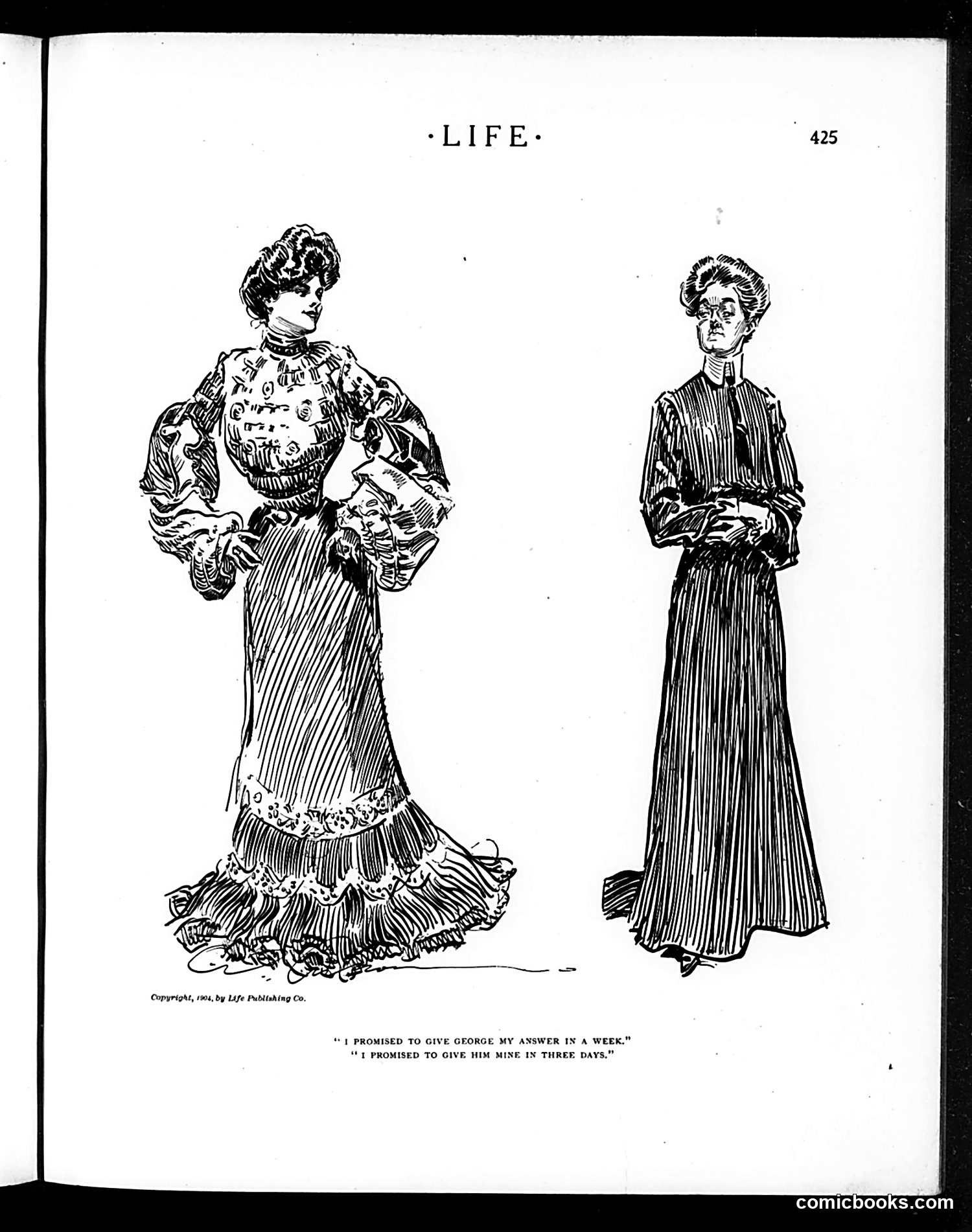
This page shows two women in early 1900s dress with the caption: "I PROMISED TO GIVE GEORGE MY ANSWER IN A WEEK" / "I PROMISED TO GIVE HIM MINE IN THREE DAYS." The cartoon satirizes women's courtship behavior and indecision about marriage proposals. The joke contrasts two women's different timelines for responding to marriage proposals from men named George—one woman takes a week to decide, the other only three days. The humor likely mocks either women's tendency to delay romantic decisions or, conversely, suggests the woman answering in three days is overeager or impulsive. This reflects early 1900s social norms where women were expected to play coy during courtship and marriage negotiations. The satire targets the ritualized games of Victorian-era romance, where timing and apparent reluctance were part of courtship conventions.
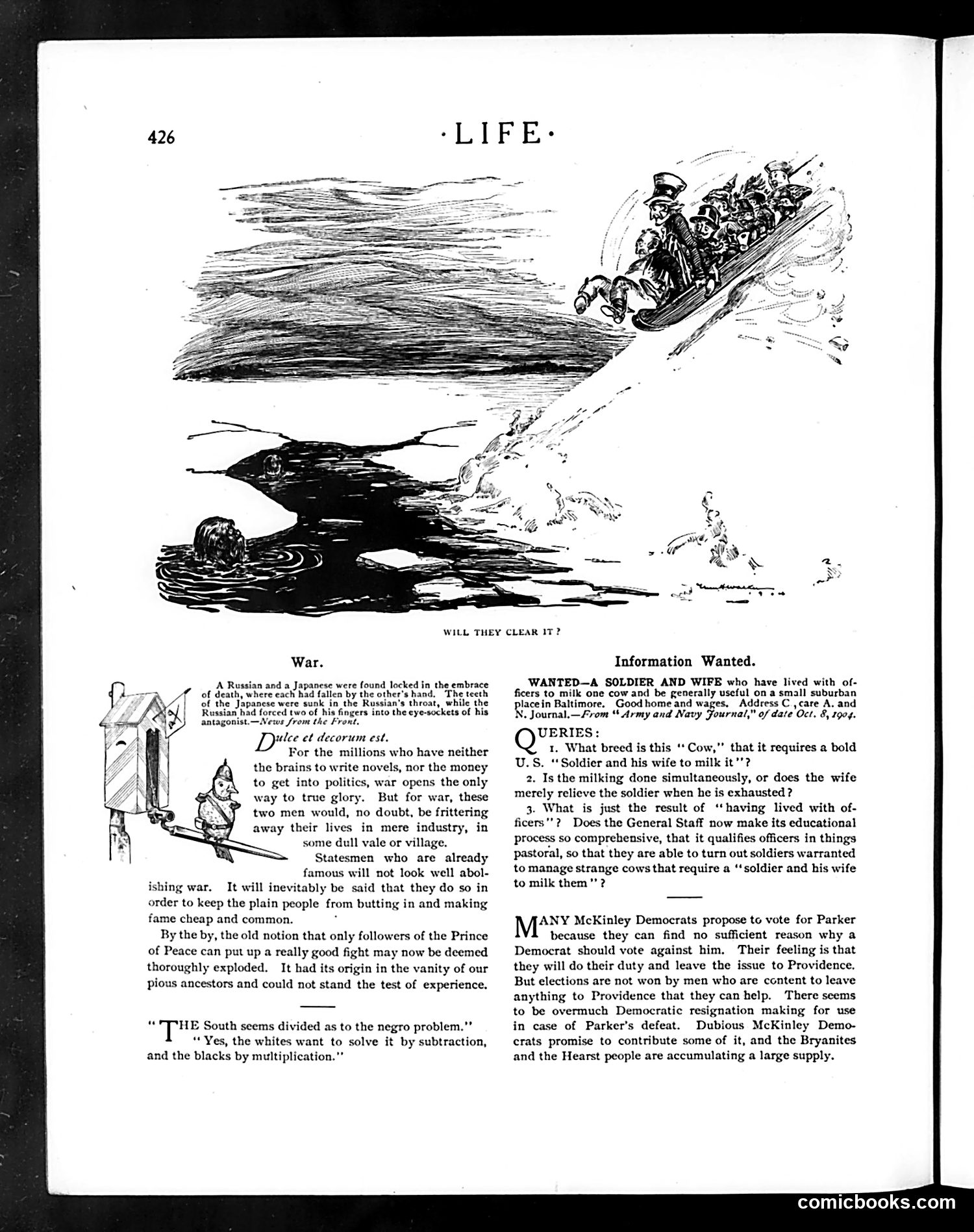
The main cartoon depicts the Russo-Japanese War (1904-1905), showing two soldiers locked in brutal combat with the caption "Will They Clear It?" The accompanying text sarcastically praises war as providing "true glory" for common people who lack talent for writing or politics—a biting critique of romanticizing warfare. The satire attacks the hypocrisy of statesmen who won't abolish war because it would make "fame cheap and common," and mocks the notion that religious principle is necessary for good fighting. Below, a faux job listing satirizes military incompetence: it requests a soldier and his wife to milk a cow, with queries questioning what military training possibly qualifies officers for pastoral labor. The final section discusses McKinley Democrats considering voting for Parker (likely Parker in the 1904 election), criticized for passive resignation rather than engaged political action—another target of Life's satire.
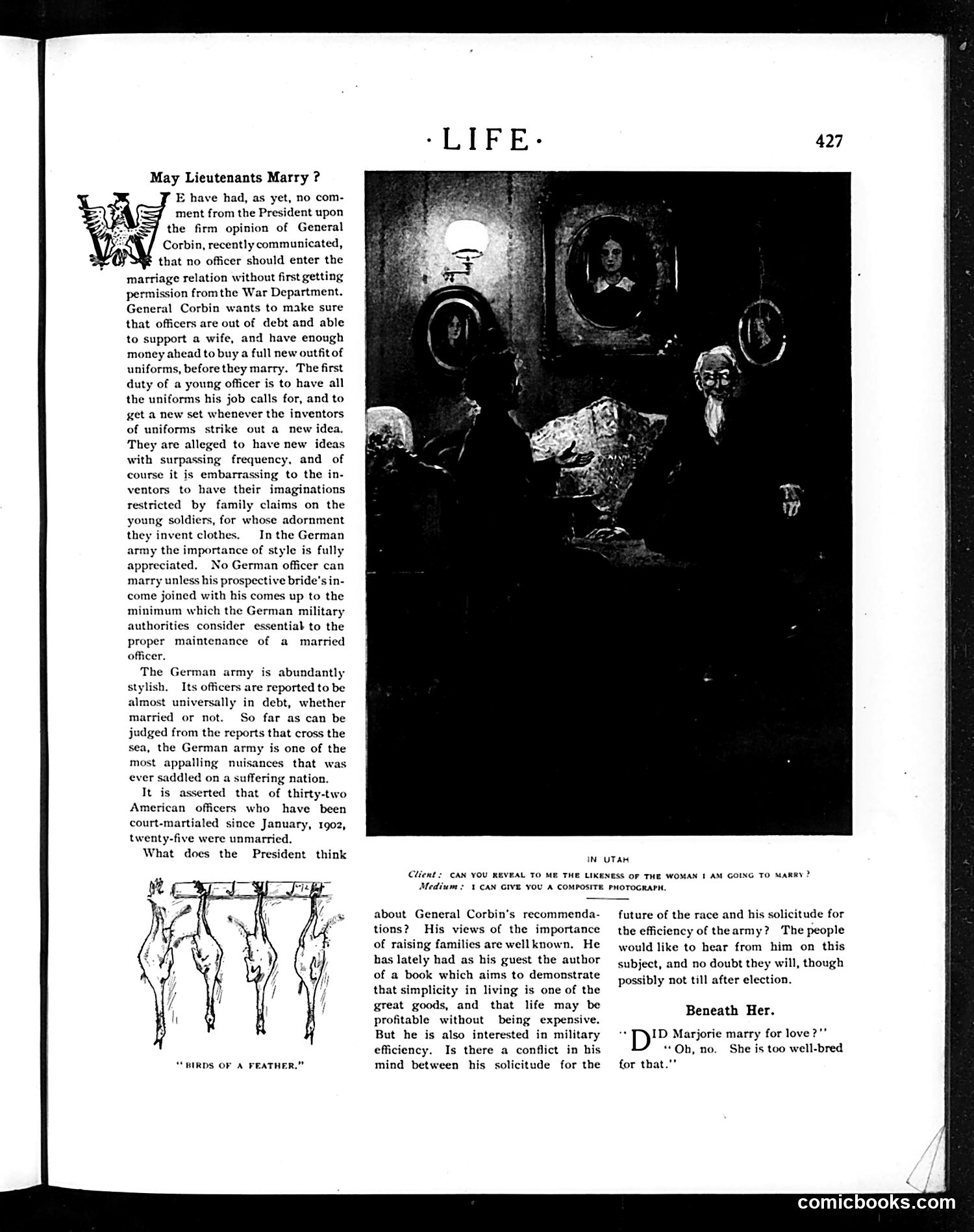
This page satirizes **General Corbin's military policy requiring officers to seek War Department permission before marriage** and mandating financial readiness and new uniforms. The main article mocks the regulation's absurdity by noting that uniform inventors profit from frequent style changes, making officers perpetually indebted. Life highlights the hypocrisy by comparing the German army—which enforces similar rules—yet remains notoriously inefficient and indebted, contradicting the efficiency argument. The cartoon **"Birds of a Feather"** (lower left) depicts hanged figures, likely satirizing the policy's severity. The **"In Utah" illustration** shows a spiritualist medium offering a "composite photograph" of a client's future bride—a joke about spiritualism's fraudulence, perhaps suggesting Corbin's marriage rules are equally baseless prediction. The final joke, "Beneath Her," mocks upper-class women who avoid marrying for love, viewing it as undignified—contrasting sharply with military concerns about officer marriages and efficiency.
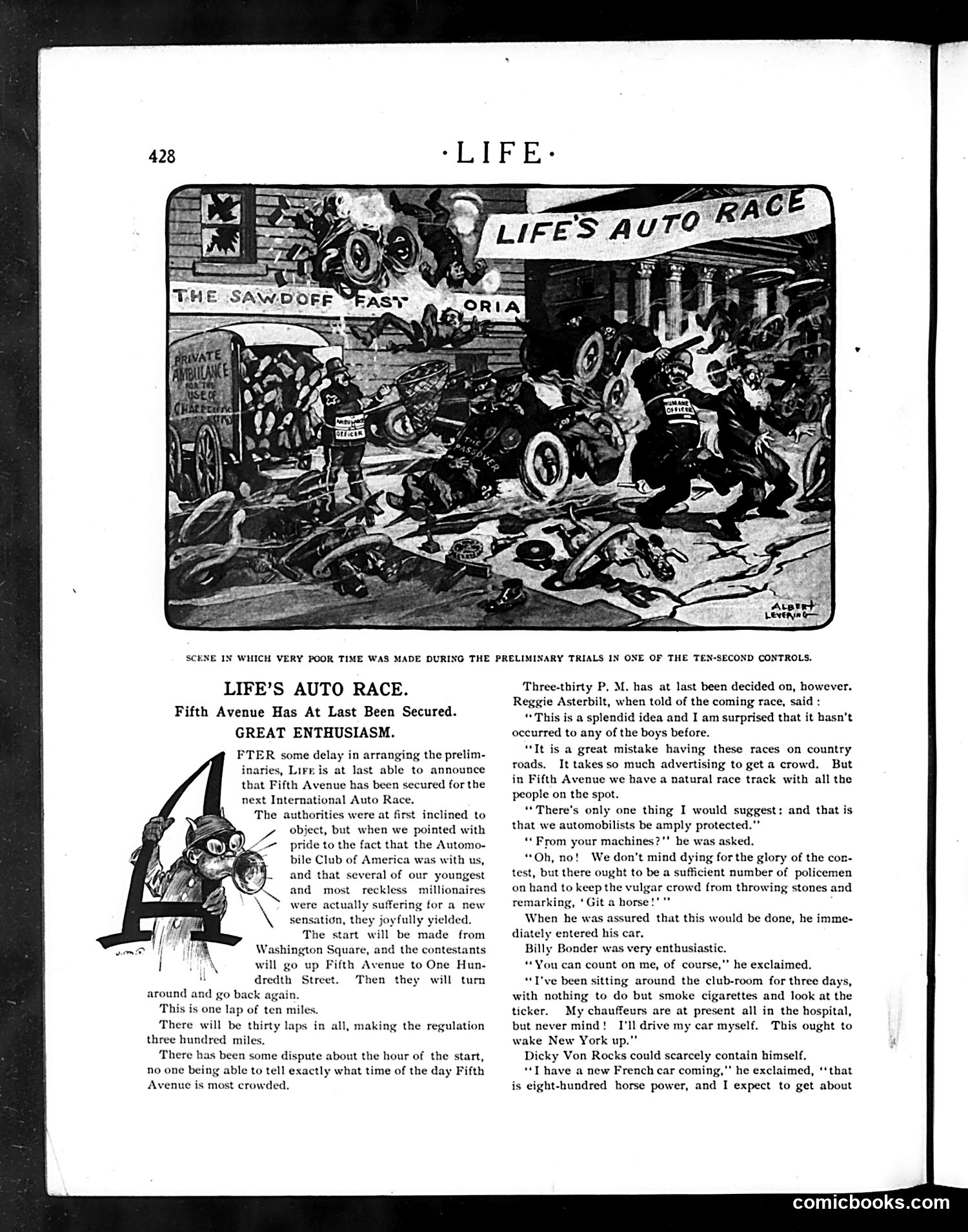
This is satirical commentary on wealthy industrialists and their reckless enthusiasm for automobile racing. The piece mocks the idea of holding a high-speed auto race down Fifth Avenue in Manhattan—a densely populated urban street. The satire targets millionaires like "Reggie Asterbilt" (a play on the Vanderbilt family name), "Billy Bonder," and "Dicky Von Rocks"—fictional wealthy men portrayed as bored thrill-seekers who care more about spectacle and personal glory than public safety. Their dialogue reveals their arrogance: they want police protection "from the vulgar crowd" throwing stones and shouting "Git a horse!" The image shows a chaotic crash scene with damaged vehicles and wreckage, illustrating the inevitable danger such a race would pose to pedestrians and drivers alike. Life's joke: these millionaires are so disconnected from reality and public welfare that they genuinely believe racing expensive automobiles through crowded city streets is a reasonable entertainment idea, requiring only crowd control and police protection—from ordinary people's disapproval, not from actual danger.
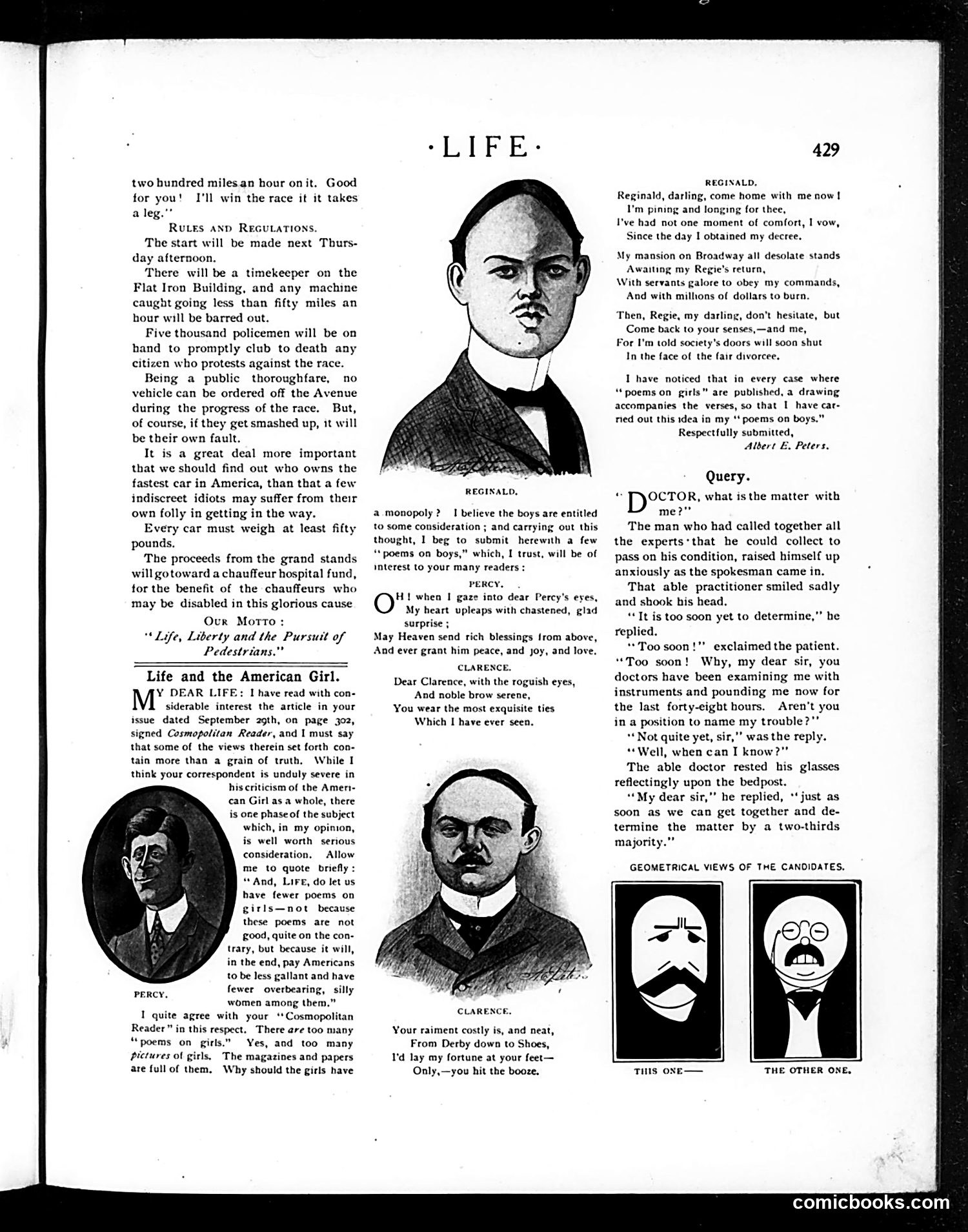
This page satirizes early 1900s American obsessions and social conventions through multiple pieces: **The Auto Race Mock-Rules**: The headline "Life, Liberty and the Pursuit of Pedestrians" mocks a dangerous proposed automobile race down Broadway. The absurd "regulations"—casually accepting pedestrian deaths, requiring only 50-pound minimum car weight—satirize how recklessly cities prioritized automotive spectacle over citizen safety. The five thousand police deployed to "club to death" protesters exposes the era's prioritization of corporate/wealthy interests over public welfare. **"Poems on Boys"**: This section parodies sentimental Victorian verse. Reader "Percy" submits flowery romantic poems about men (mirroring typical "poems on girls"), with accompanying portraits. The joke: these poems expose how ridiculous such saccharine sentiment becomes when applied to men—one subject is a drunk ("you hit the booze"), another's lover wants him back for her mansion and millions, mocking superficiality dressed as romance. The overall theme critiques both automotive recklessness and gender-based sentimentality in popular magazines.
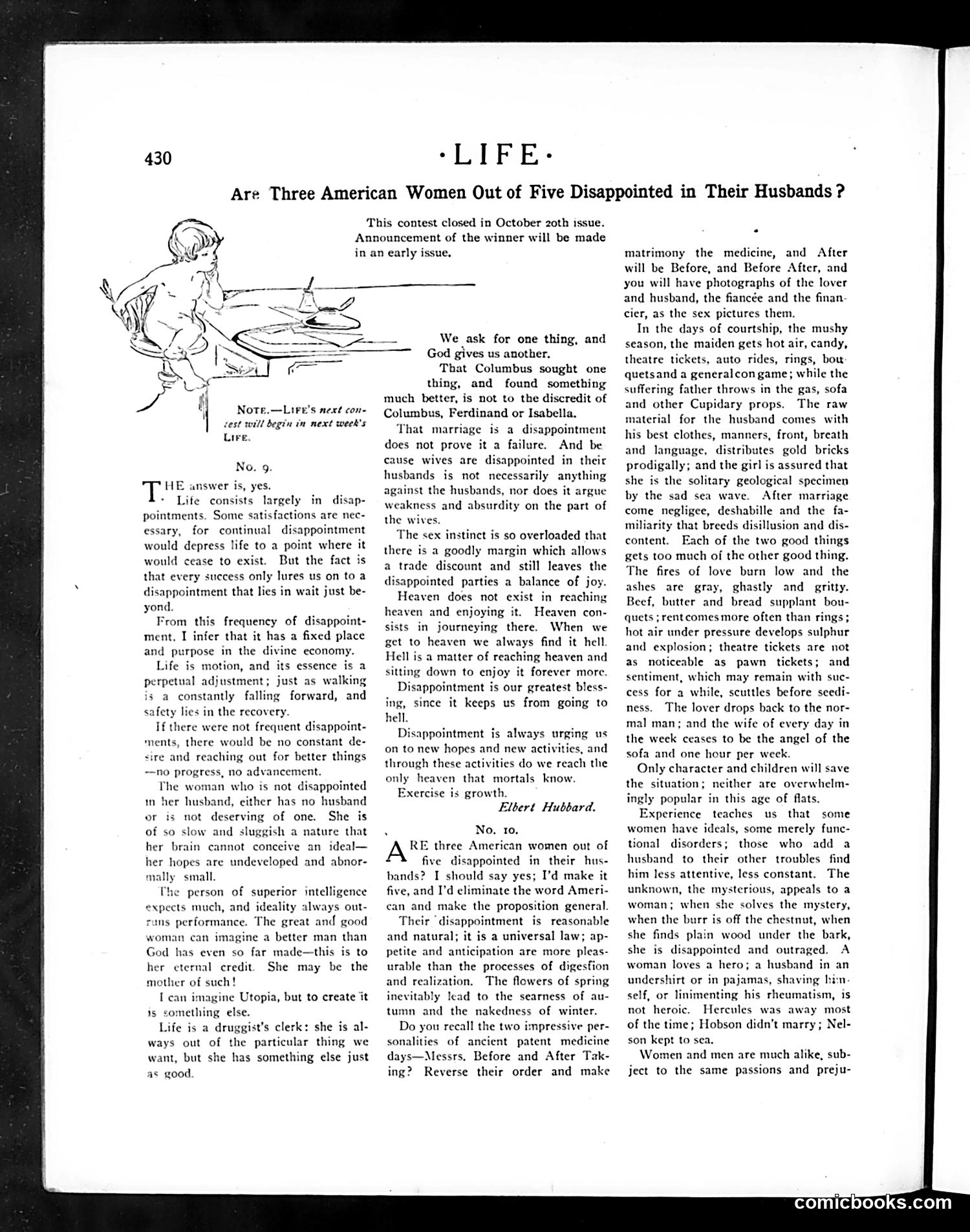
This page presents a contest about marital disappointment, featuring commentary by Elbert Hubbard (a prominent turn-of-the-century essayist). The small illustration shows a woman at a table, apparently contemplating relationship dissatisfaction. **The Satire's Point:** The contest asks whether three of five American women are disappointed in their husbands. Hubbard argues the answer is "yes"—and that this disappointment is actually *beneficial*. He frames marital letdown as philosophically necessary: disappointment drives progress and prevents complacency. **Social Context:** This reflects early 1900s gender attitudes. Rather than critiquing marriages as genuinely problematic, Hubbard suggests disappointed wives lack sufficient imagination or intellect. He uses the "Before and After" patent-medicine metaphor to suggest courtship promises are naturally unrealistic compared to married life. **The Satire:** Life magazine's editors appear to mock Hubbard's attempts to reframe women's legitimate disappointment as character development—turning marital dissatisfaction into philosophical virtue.
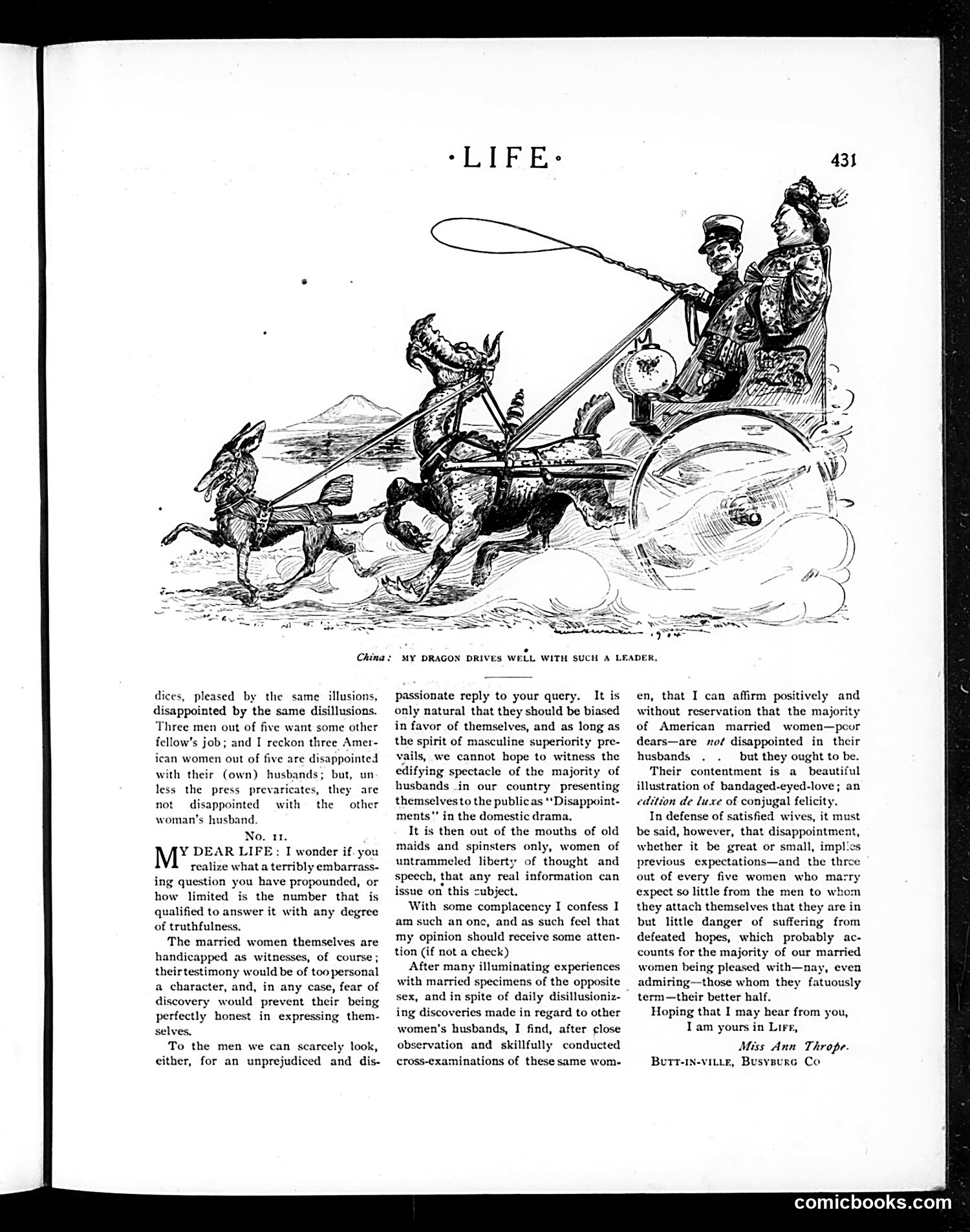
This page combines a satirical illustration with a letter-to-the-editor commentary on American marriage and marital satisfaction. **The Cartoon:** Shows an ornately dressed Chinese figure (likely a mandarin or emperor) in an elaborate carriage pulled by a dragon, being whipped along by attendants. The caption reads "MY DRAGON DRIVES WELL WITH SUCH A LEADER"—a joke about control and dominance. **The Letter's Argument:** A spinster named "Miss Ann Thrope" (a pun on "misanthrope") responds to Life magazine's question about whether American wives are disappointed in their husbands. She argues that most married women *should* be disappointed but aren't—because they have such low expectations of men that they're easily satisfied by minimal effort. She claims wives are blinded by "bandaged-eyed-love" and simply admire their husbands out of resignation. **The Satire's Point:** This critiques both masculine superiority (husbands viewed as natural "leaders") and female acceptance of subordination in marriage. The dragon imagery suggests wives are beasts of burden, driven by domineering husbands—presented here as inevitable rather than problematic.
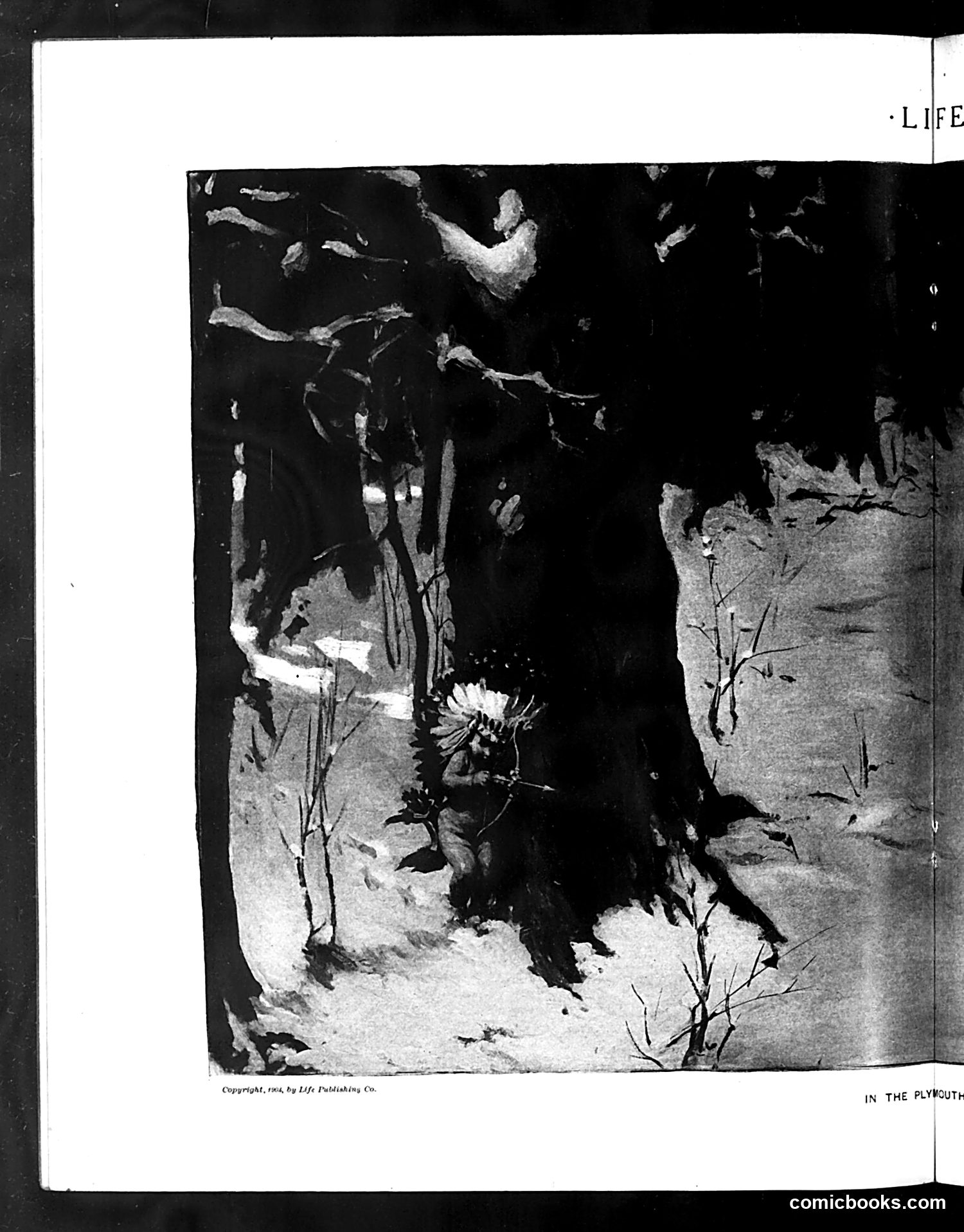
This appears to be a black and white photograph or illustration from Life magazine (copyright 1904, per visible text). The image shows an underwater or aquatic scene with what looks like fish swimming above sandy/rocky bottom, along with some aquatic plants or sea vegetation. The caption reads "IN THE PLYMOUTH," suggesting this depicts Plymouth Harbor or a similar location. However, the OCR text is too corrupted to provide meaningful context about any satirical intent or political commentary. Without legible text explaining the image's purpose, I cannot reliably identify what social or political point this page was making for its 1904 audience. It may be a nature illustration, environmental commentary, or satirical piece, but the evidence needed to explain its meaning to modern readers is not clearly visible here.
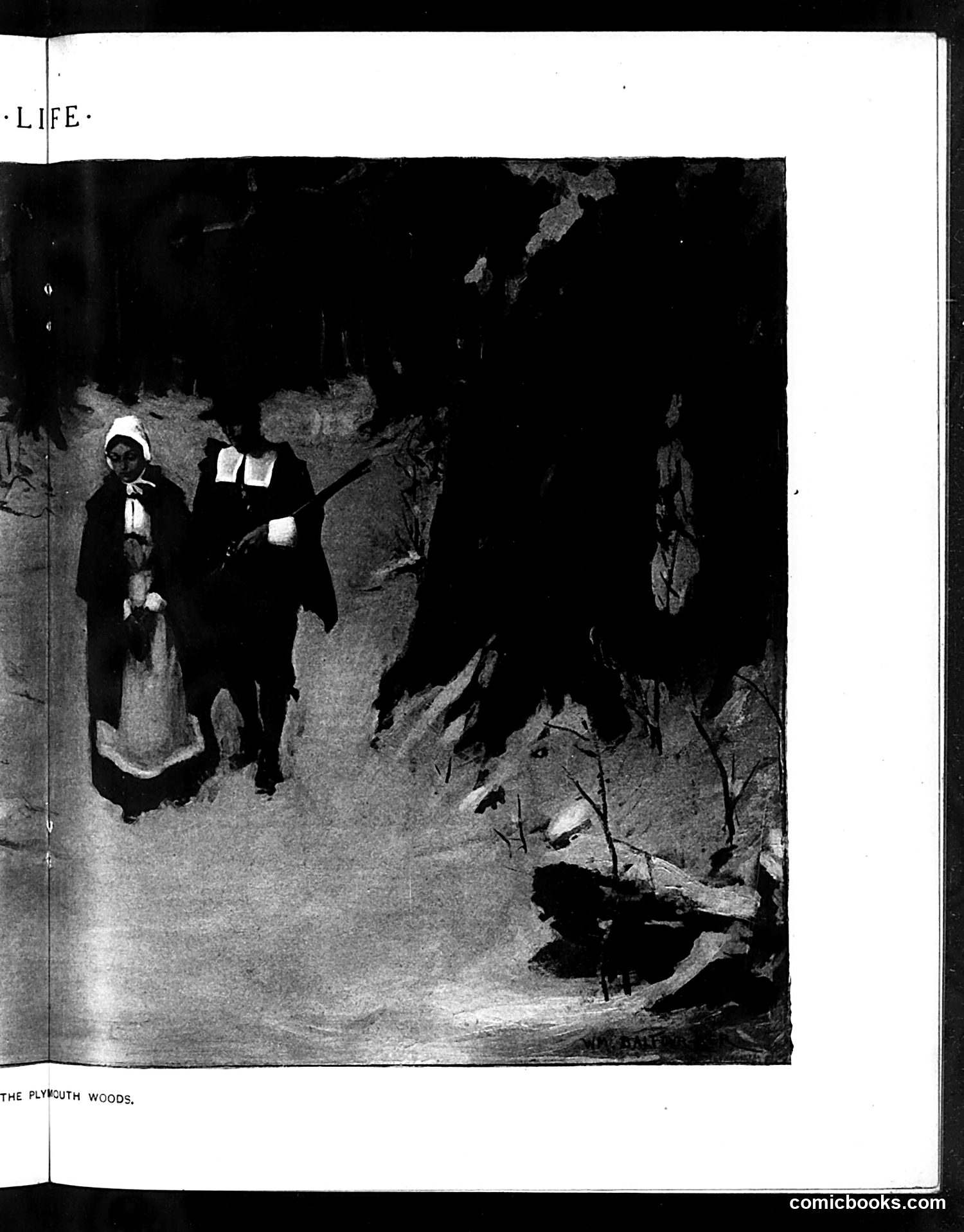
This appears to be an illustration titled "The Plymouth Woods" from *Life* magazine. The image shows two figures in dark Victorian-era clothing standing in a wooded area at night or dusk. One figure wears a white bonnet; the other wears formal dress with a distinctive white collar detail. The reference to "Plymouth Woods" likely alludes to the Pilgrims and early American colonial history, though the specific satirical point is unclear from the image alone. The formal dress and period styling suggest this may be a historical commentary or social satire, but without additional context or visible text explaining the joke, the exact target of the satire cannot be definitively determined.
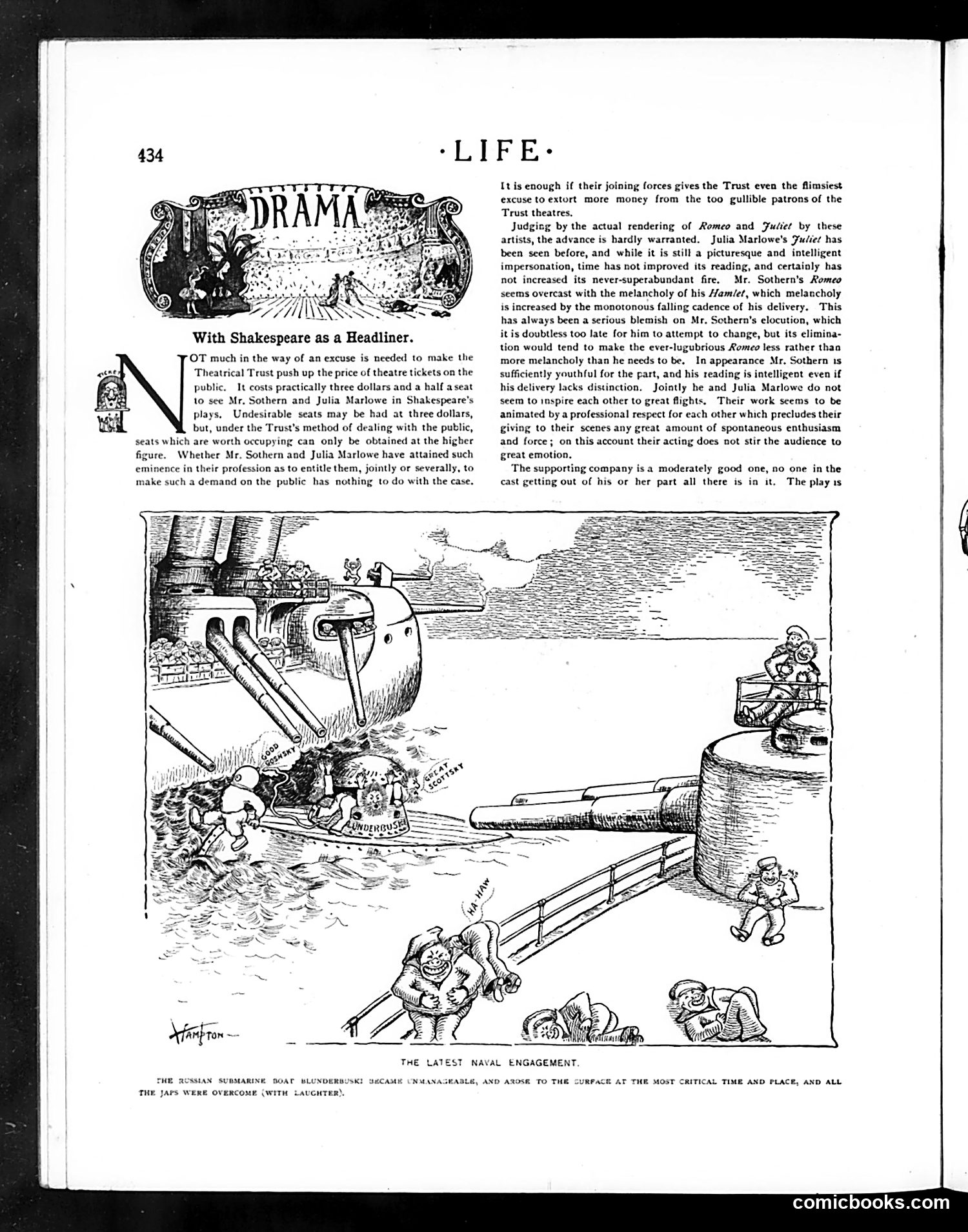
This page contains two distinct pieces. The main article critiques the "Theatrical Trust"—a monopolistic theater organization accused of price-gouging by using famous actors as cover. Specifically, it attacks a Shakespeare production starring Edward Sothern and Julia Marlowe, charging exorbitant ticket prices ($3.50) while claiming the actors' performances don't justify the cost. The writer faults Sothern's monotonous delivery and both actors' lack of spontaneous chemistry. Below is an unrelated political cartoon titled "The Latest Naval Engagement," depicting a Russian submarine (the "Blunderuski") comically malfunctioning and surfacing during a critical naval moment, allowing Japanese forces to overcome it "with laughter." This likely satirizes Russian naval incompetence during the Russo-Japanese War (1904-1905), a contemporary conflict when this was published.
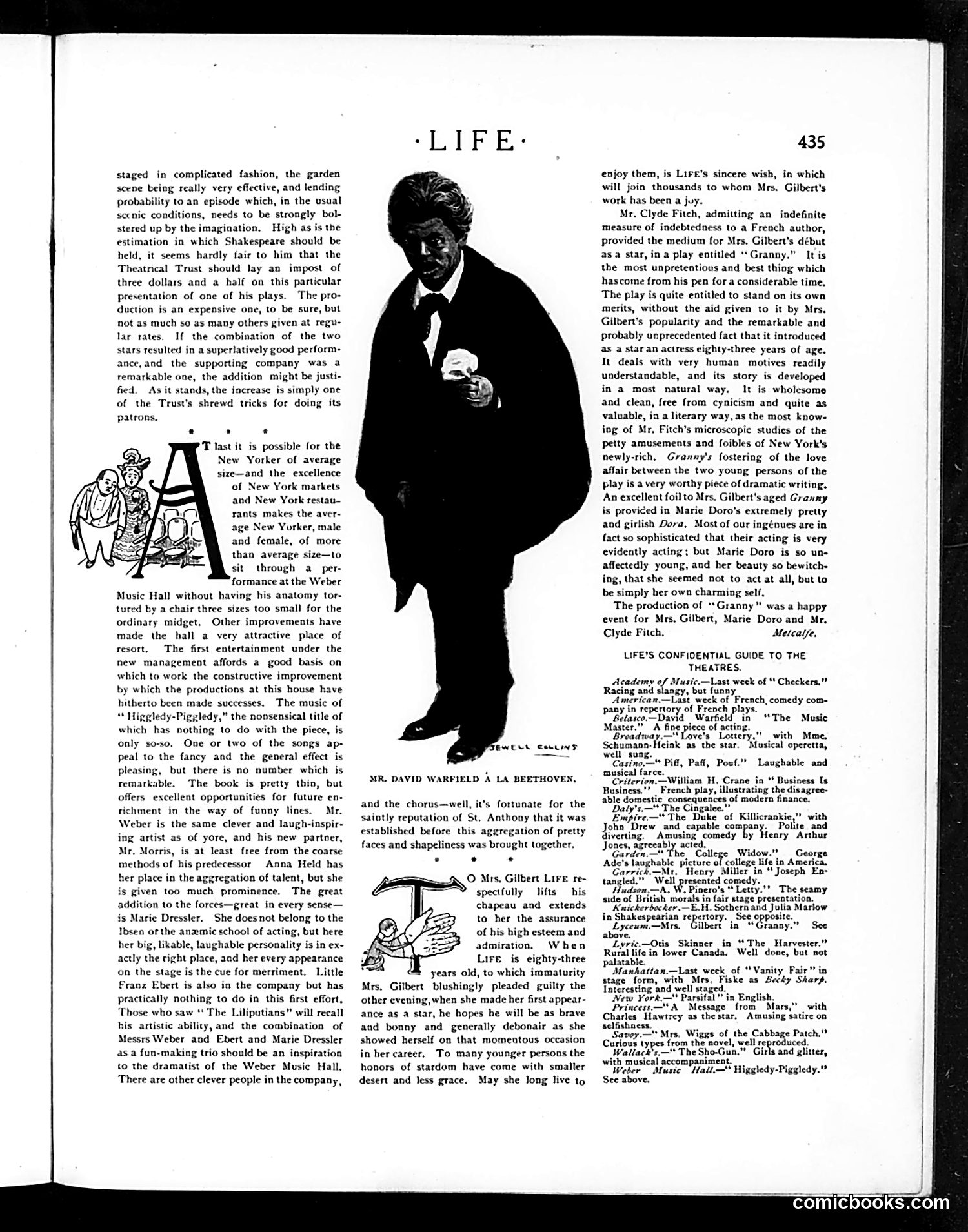
This page contains theatrical reviews from an American satirical magazine, likely from the early 1900s. The key content includes: **The Cartoon**: A portrait labeled "MR. DAVID WARFIELD À LA BEETHOVEN" shows actor David Warfield posed to resemble the famous composer—a visual joke comparing the actor's dramatic demeanor to classical music's gravitas. **The Reviews**: The text critiques several Broadway productions: - Shakespeare production criticized for inflated pricing ($3.50 surcharge) by the "Theatrical Trust"—a reference to the monopolistic theater booking organization that controlled American theater - "Higgledy-Piggledy" at Weber Music Hall, praised for Marie Dressler's comedic talent - A play featuring Mrs. Gilbert, an 83-year-old actress making her starring debut, whom the reviewer warmly congratulates **The Satire**: The "Beethoven" joke mocks theatrical pretension. The Trust criticism reflects Progressive-era skepticism toward monopolies. The warmth toward elderly Mrs. Gilbert's success suggests democratic ideals about opportunity.
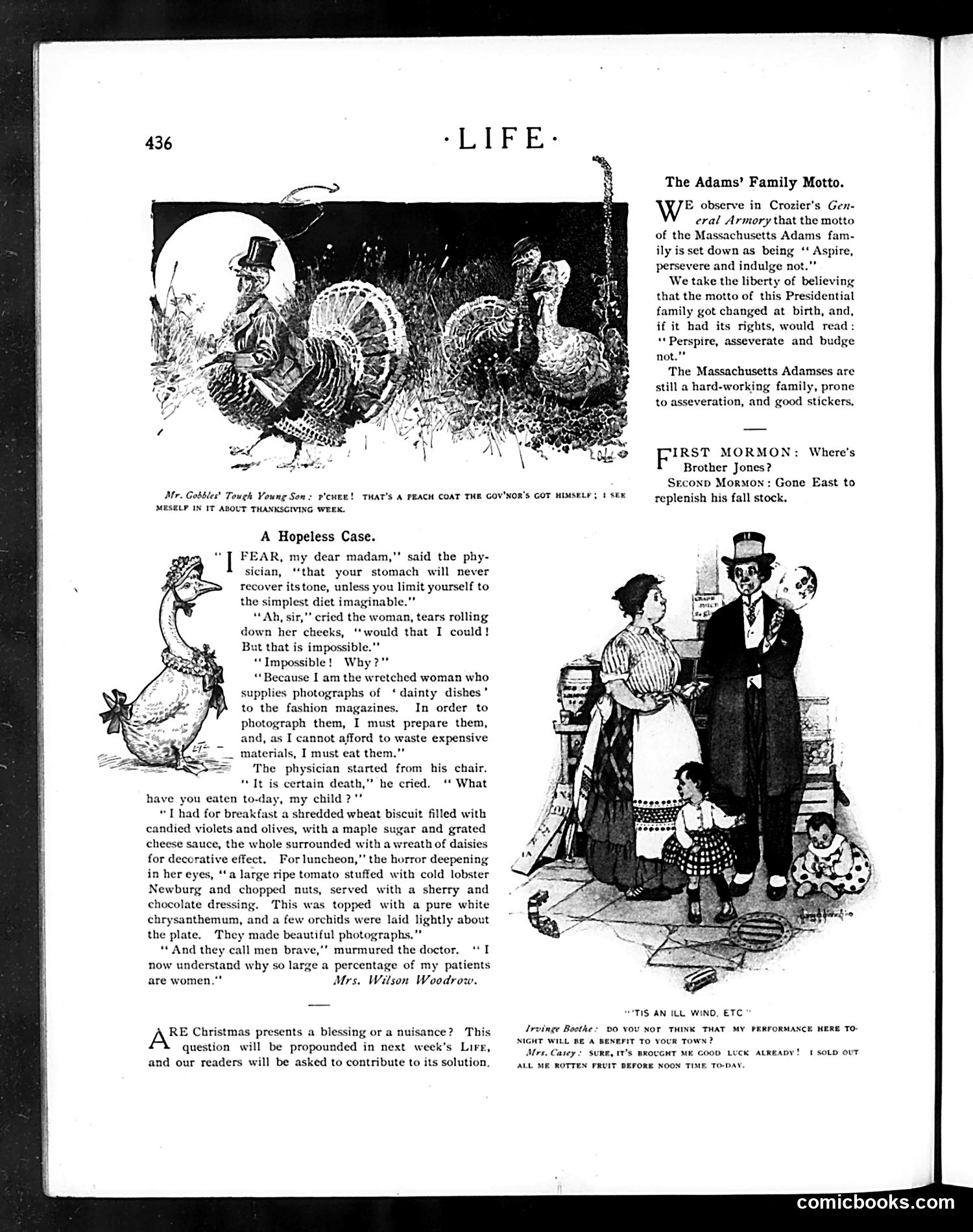
This page contains three satirical pieces typical of early 20th-century American humor: **"A Hopeless Case"** mocks the artificial food photography industry. A woman who styles elaborate dishes for magazine photos must eat her own creations—combining expensive ingredients with inedible decorations (flowers, orchids)—to avoid waste. The joke: her profession literally kills her through absurd overconsumption, yet she's trapped by economic necessity. **"The Adams' Family Motto"** is political satire about President John Adams's Massachusetts family. Their official motto is "Aspire, persevere and indulge not," but the writer suggests it should be "Perspire, asseverate and budge not"—mocking them as sweaty, talkative workaholics who won't yield. **"'Tis an Ill Wind, Etc"** jokes about an actor (Irving Boothe) asking if his performance benefits the town. A woman replies she's already profited by selling her "rotten fruit"—implying his performance is so bad, locals prefer buying spoiled goods to watching him. All three pieces satirize modern life's absurdities and hypocrisy through exaggeration.
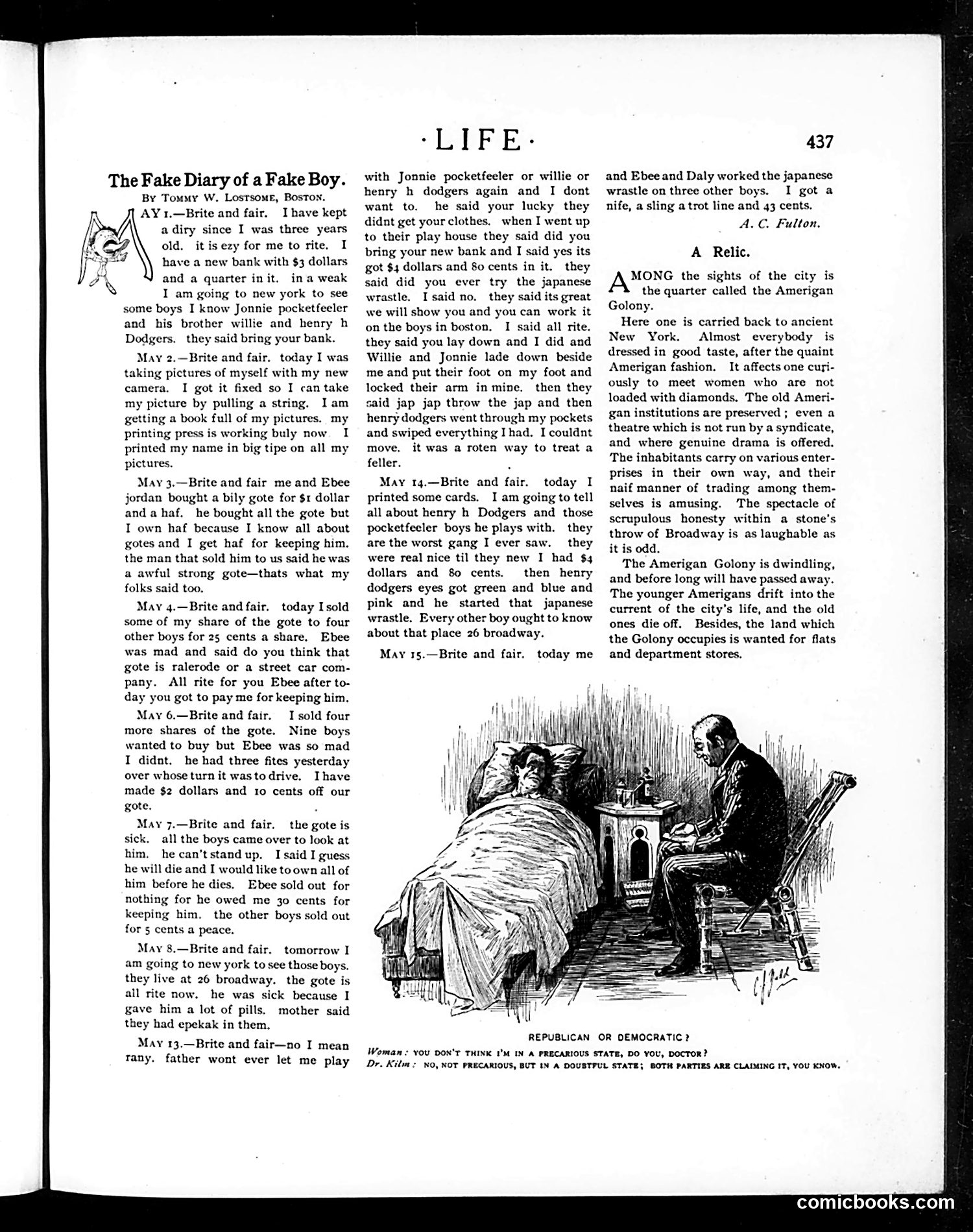
This satirical piece mocks American capitalism and entrepreneurship through a boy's diary entries. The humor targets: **The get-rich-quick scheme**: Young Tommy and his friend Ebee repeatedly subdivide ownership of a goat, selling shares to multiple boys—a transparent parody of stock speculation and corporate fraud common in Gilded Age America. **Predatory business**: The narrative exposes how boys exploit each other's inexperience, with Tommy initially profiting but later becoming victim to the "Japanese wrestle" con—a setup theft by older boys (Jonnie pocketfeeler, Henry Dodgers, Willie) who befriend him specifically to rob him. **Naive optimism**: Tommy's misspellings and matter-of-fact reporting ("it was a roten way to treat a feller") underscore his innocence as he describes being swindled. The second section, "A Relic," briefly comments on the American Colony neighborhood in New York, noting its old-fashioned simplicity—women without diamonds—as a curiosity in modern America. Together, these pieces satirize American greed and dishonesty through childish mimicry.
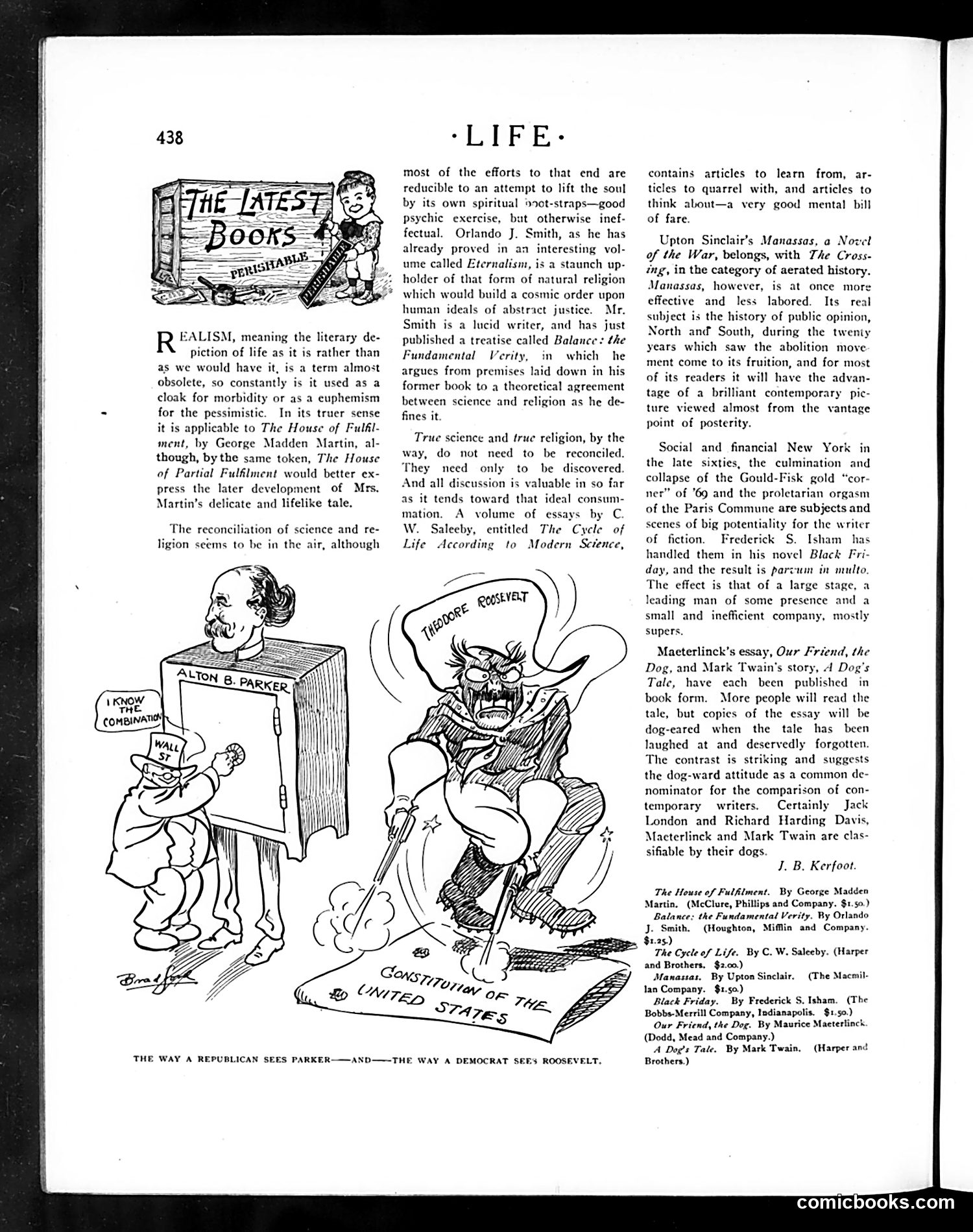
The bottom cartoon compares how Republicans and Democrats view their respective presidential candidates (likely from the 1904 election). On the left, a Republican sees **Alton B. Parker** (Democratic candidate) as a small, ineffectual figure saying "I know nothing," dwarfed by the towering presence of Parker's namesake bust. On the right, a Democrat depicts **Theodore Roosevelt** as a monstrous, destructive force labeled "Theodore Roosevelt" riding roughshod over the "Constitution of the United States," suggesting Republicans' view of Roosevelt as powerful versus Democrats' view of him as a constitutional threat. The satirical point: each party's caricature of the opposing candidate reflects their opposing political interests—one portraying weakness and ignorance, the other depicting dangerous overreach. The contrasting depictions highlight partisan disagreement about fitness for office.
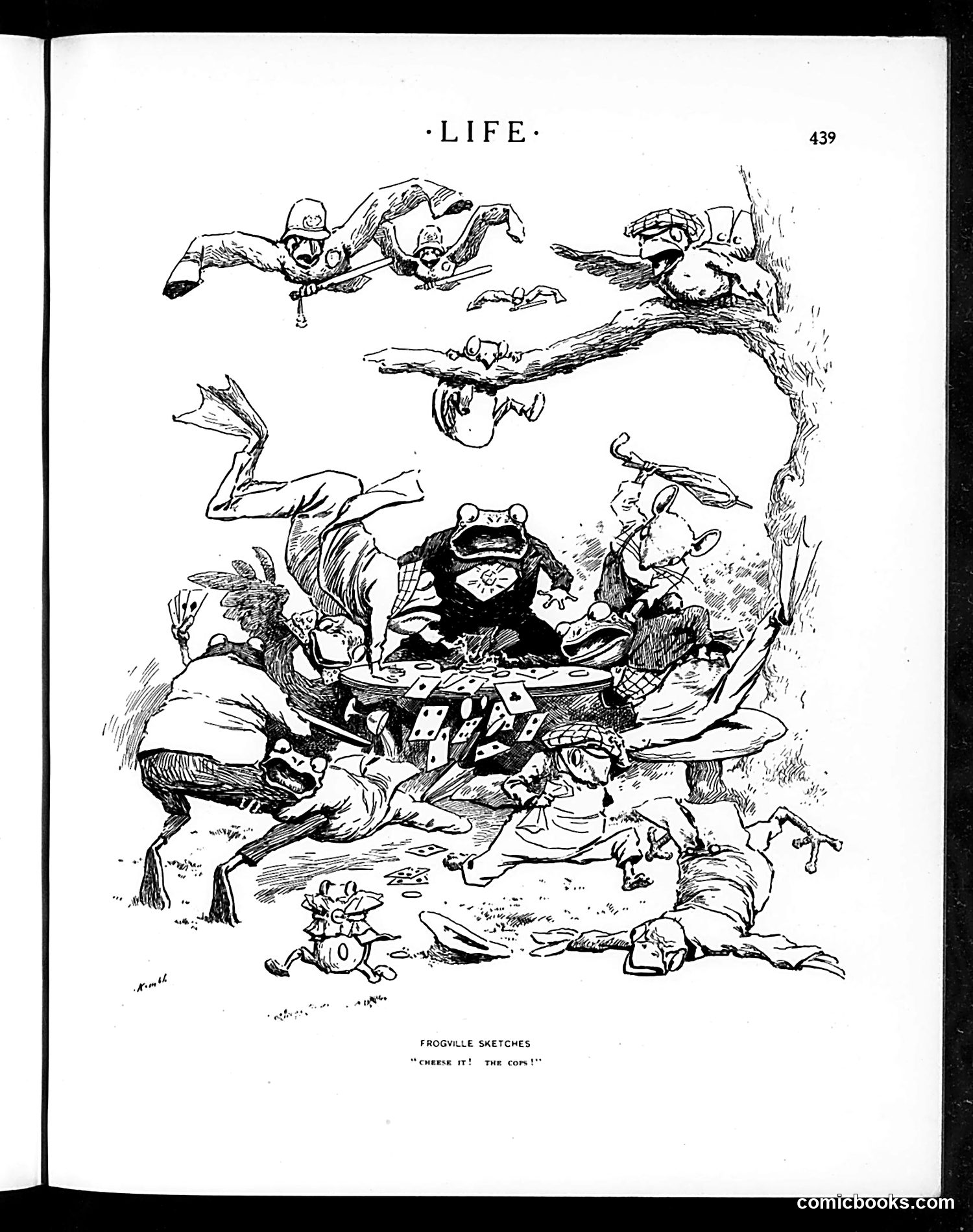
This is a humorous cartoon depicting an anthropomorphic frog community in what appears to be a gambling or illicit activity scene. The title "Cheese it! The Cops!" is period slang meaning "Watch out! Police are coming!" The scene shows frogs engaged in what looks like a clandestine card game or gambling operation, with various figures fleeing in panic—some diving, others scrambling away. The setting and composition suggest this is satirizing human criminal or underground activity by representing it through animal characters. The cartoon's humor relies on the contrast between the innocent-seeming frog characters and the decidedly criminal behavior depicted. This appears to be whimsical social satire typical of *Life* magazine's editorial style, rather than commentary on a specific event.
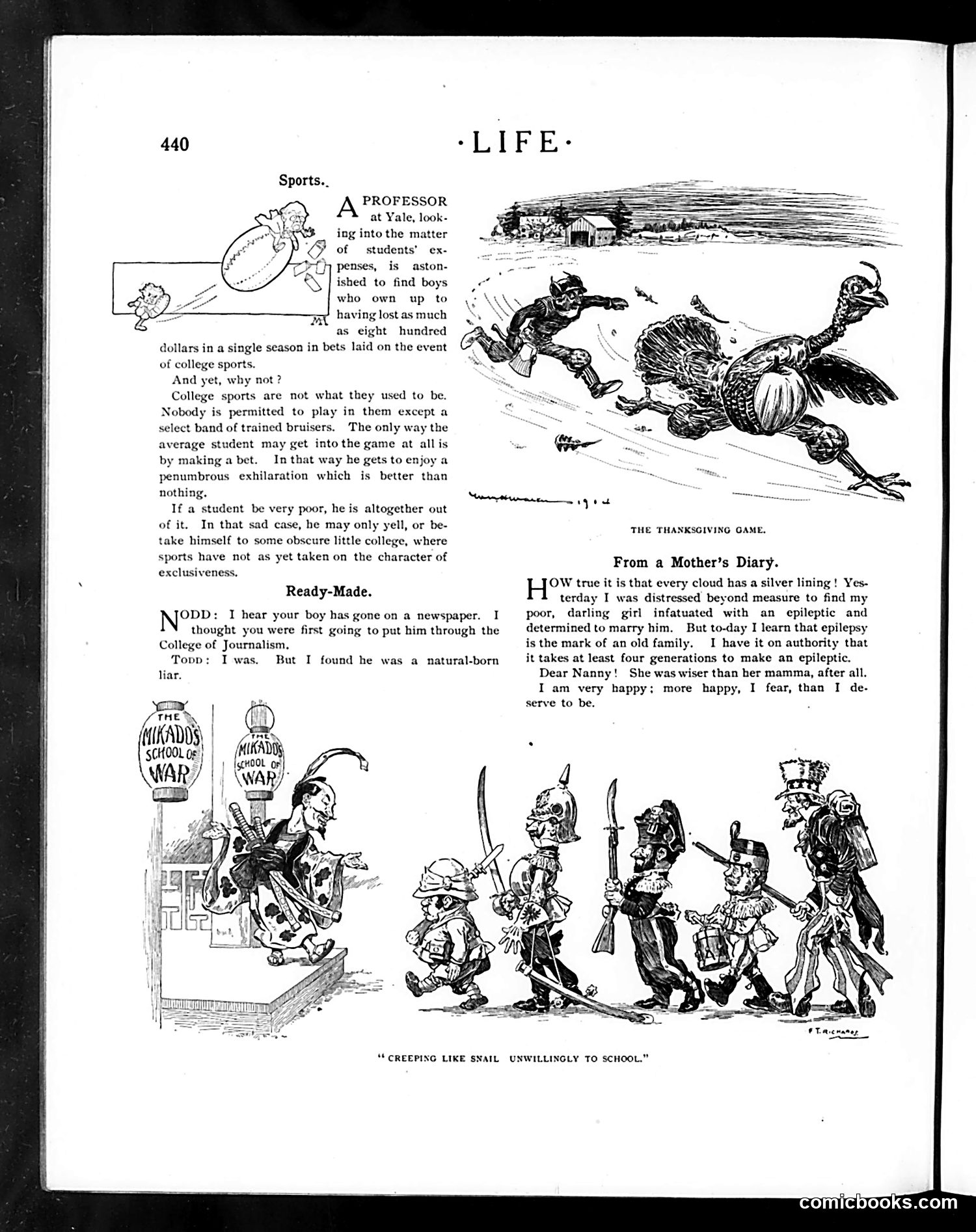
This page satirizes three aspects of early 20th-century American society: **Top cartoon ("Sports"):** A Yale professor discovers college students are gambling heavily on sports events—losing hundreds of dollars per season. The satire targets the professionalization and exclusivity of college athletics. Only "trained bruisers" (professional athletes) can play; ordinary students can only participate through betting, which becomes their primary engagement with sports. **Middle cartoon ("Ready-Made"):** A joke about a journalist's son. The father says he originally planned to send his boy to journalism school, but discovered "he was a natural-born liar"—so newspaper work is his natural fit. This satirizes journalism's reputation for dishonesty. **Bottom cartoon ("From a Mother's Diary"):** A mother celebrates her daughter's engagement to an epileptic man, consoling herself that epilepsy indicates "old family" status (requiring four generations to develop). The satire mocks aristocratic pretension—using a serious neurological condition as a status symbol. The final illustration shows children reluctant to attend school, referencing Shakespeare's *As You Like It*.
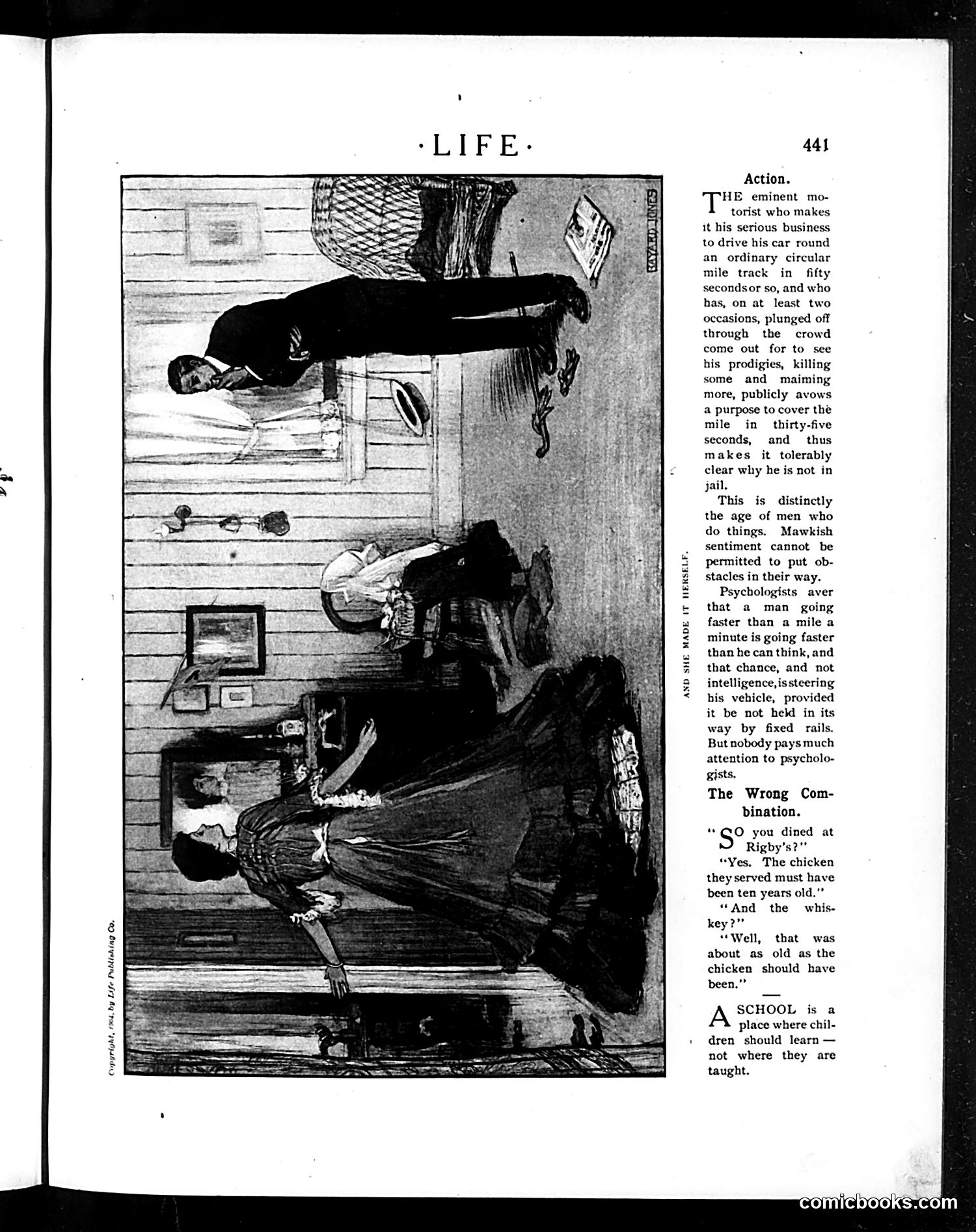
This page contains two distinct satirical pieces: **"Action"** mocks the reckless motorist craze of the early 1900s. A wealthy "eminent motorist" drives dangerously fast around a circular track—killing and maiming spectators—yet publicly boasts of going even faster. The satire targets both the driver's callous disregard for human life and society's fascination with speed for its own sake. The piece sardonically notes that psychologists prove drivers going over a mile per minute cannot think—they're merely gambling with chance—yet "nobody pays much attention to psychologists." The satirist implies the age glorifies reckless action over safety or reason. **"The Wrong Combination"** is a brief joke about dining at "Rigby's" restaurant, where both the ten-year-old chicken and equally-aged whiskey are served together—creating an absurd pairing where neither ingredient should actually be that old. It's humor about bad restaurant quality.
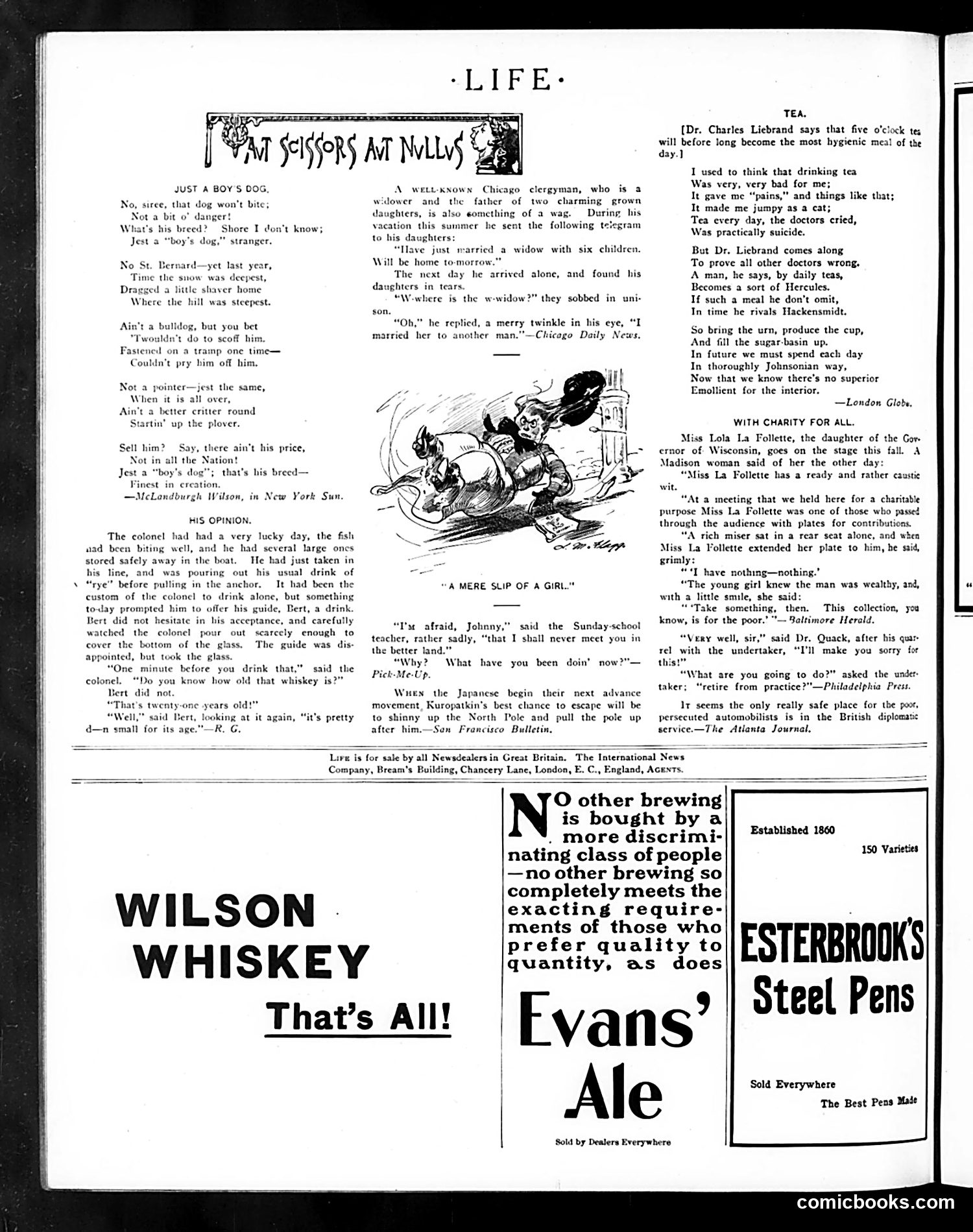
This Life magazine page contains several humorous pieces typical of early 1900s American satire: **"Just a Boy's Dog"** is a sentimental poem celebrating a loyal mutt—a common nostalgic theme about unconditional animal devotion. **The Chicago clergyman anecdote** is a joke about a widower's prank: he telegrams his daughters that he's married a widow with six children, causing distress until he reveals he married *her* to someone else—pure misdirection humor. **Tea advocacy** satirizes Dr. Liebrand's claims that five-o'clock tea promotes health and strength (referencing wrestler Hackensmidt), mocking pseudo-scientific health crazes. **"Miss La Follette" anecdote** portrays a wealthy miser's hypocrisy—he claims poverty while refusing to donate to charity, until the witty young woman's clever retort ("This collection is for the poor") shames him into contributing. The page is predominantly **satirical commentary on contemporary social issues**: medical fads, class pretension, and charitable giving. The advertisements (Wilson Whiskey, Evans' Ale, Esterbrook Pens) are period-appropriate lower-class marketing.
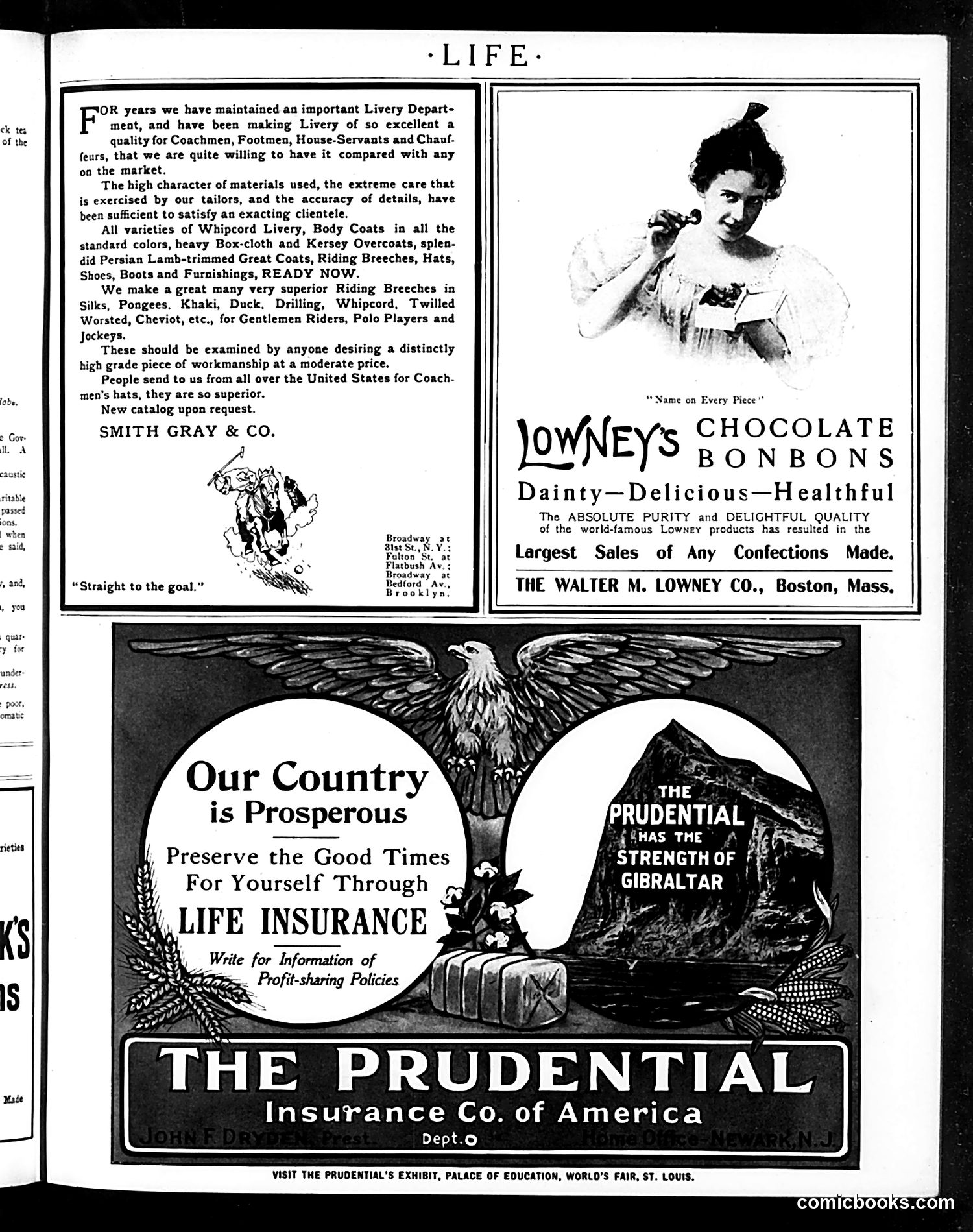
This is primarily an **advertising page**, not satirical content. It features three distinct ads: 1. **Smith Gray & Co.** (top left): Tailors advertising livery uniforms for servants, coachmen, and gentlemen riders—reflecting the era's rigid class hierarchy and servant culture. 2. **Lowney's Chocolate Bonbons** (top right): Features a woman in period dress, emphasizing "purity" and "delicious" quality—typical early 1900s confectionery marketing using feminine imagery. 3. **The Prudential Insurance** (bottom, largest): Uses patriotic imagery (eagle, Gibraltar) and prosperity rhetoric ("Our Country is Prosperous") to sell life insurance policies. The reference to a World's Fair exhibit in St. Louis dates this to around 1904. The page reflects turn-of-the-century American consumer culture: luxury goods marketed to the wealthy, nationalist optimism, and insurance as a modern financial product. There is no political satire visible—these are straightforward commercial advertisements.
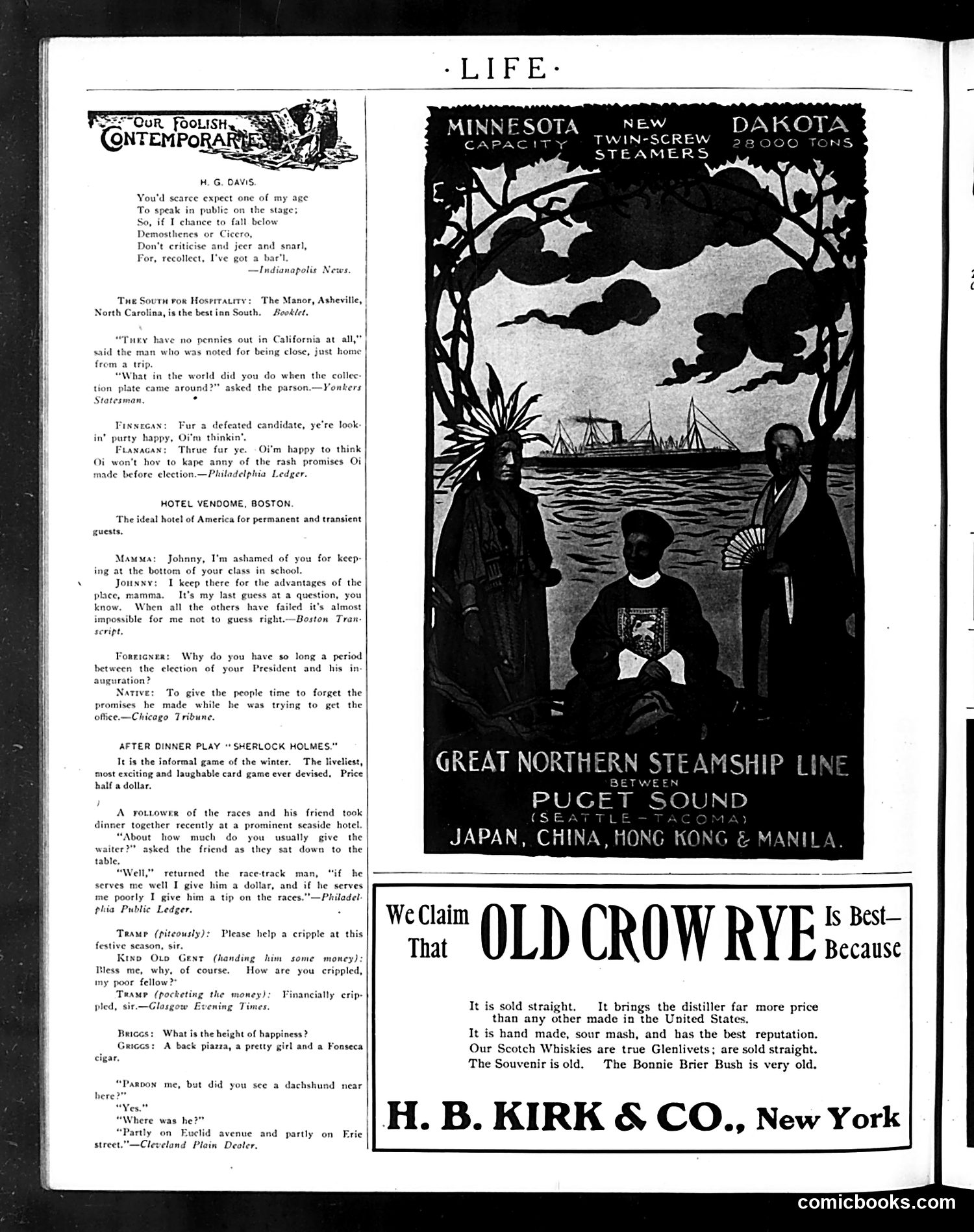
This page mixes humor columns with advertisements. The left side contains brief satirical jokes on American social and political topics: **Key satirical pieces:** - H.G. Davis poem: A reference to the 1904 vice-presidential candidate apologizing for speaking publicly despite his age - A joke about California lacking pennies (economic commentary) - Politicians forgetting campaign promises after election (cynicism about electoral politics) - A mother-son exchange about ranking last in school (educational satire) - Waiter tip joke from a racetrack gambler (class/labor commentary) **The right side** features two advertisements: a steamship line to Asia and Old Crow Rye whiskey, typical of period Life magazine content. The overall tone reflects turn-of-the-century American skepticism toward politicians, wealth inequality, and social pretense. No specific political figures are named—the satire targets universal types and behaviors rather than individuals.
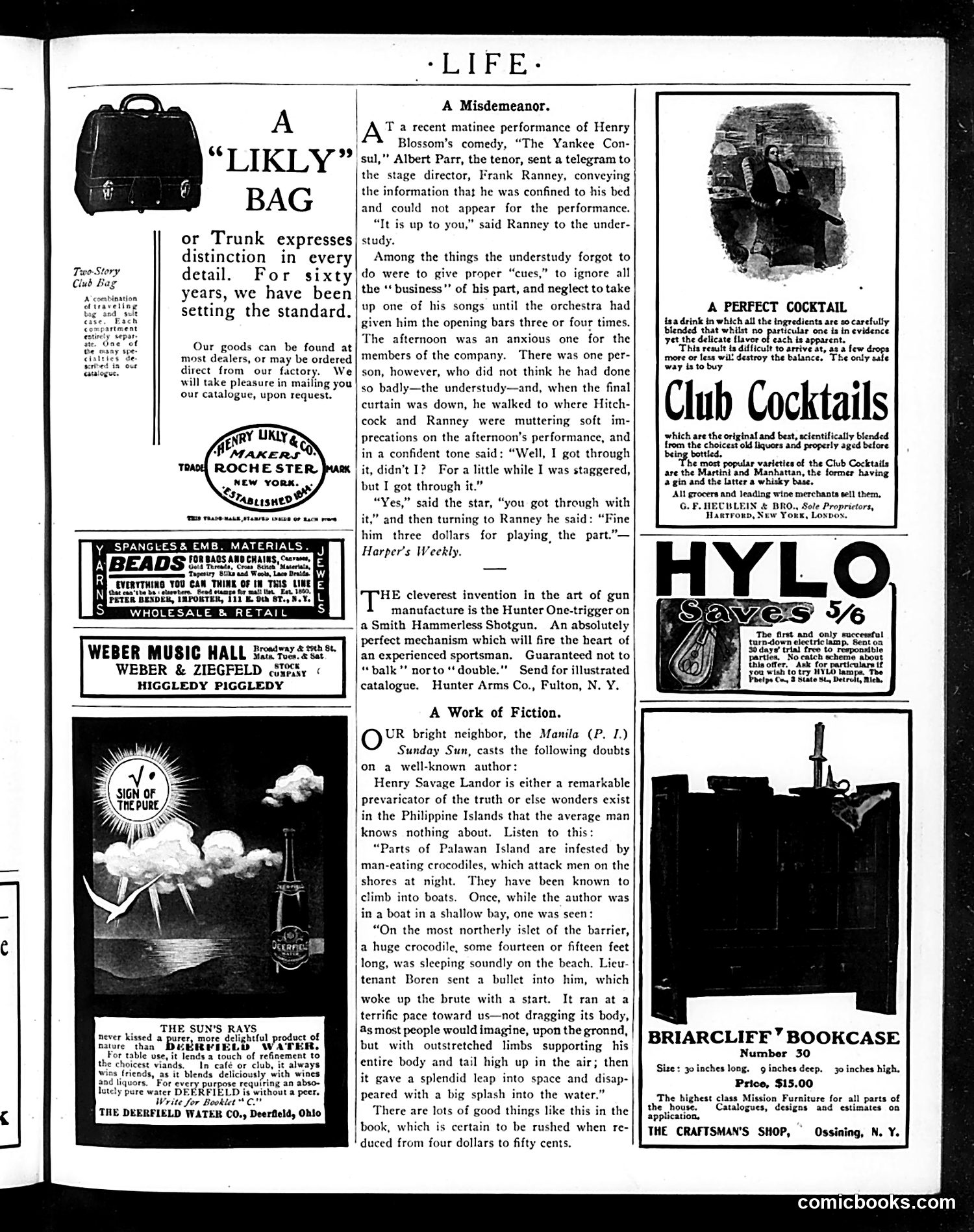
This page is primarily **advertising with two satirical articles**. **"A Misdemeanor"** (top right) is a humorous anecdote about an understudy tenor in Henry Blossom's play "The Yankee Consul" who performs poorly—forgetting cues, ignoring stage business, and delaying songs. Despite his obvious failures, the understudy confidently tells the director he "got through it." The star sarcastically rewards him three dollars "for playing the part," mocking his obliviousness. **"A Work of Fiction"** (bottom) satirizes author Henry Savage Landor's tall tales about the Philippines. The Manila Sunday Sun quotes his implausible crocodile story—a 14-15 foot crocodile allegedly running toward them on outstretched limbs with its tail "high up in the air" before leaping into water. The piece suggests Landor either fabricates wildly or encountered impossible phenomena. Both pieces use humor to mock incompetence and exaggeration respectively. The remainder comprises product advertisements for luggage, beads, music hall performances, cocktails, water, and furniture.
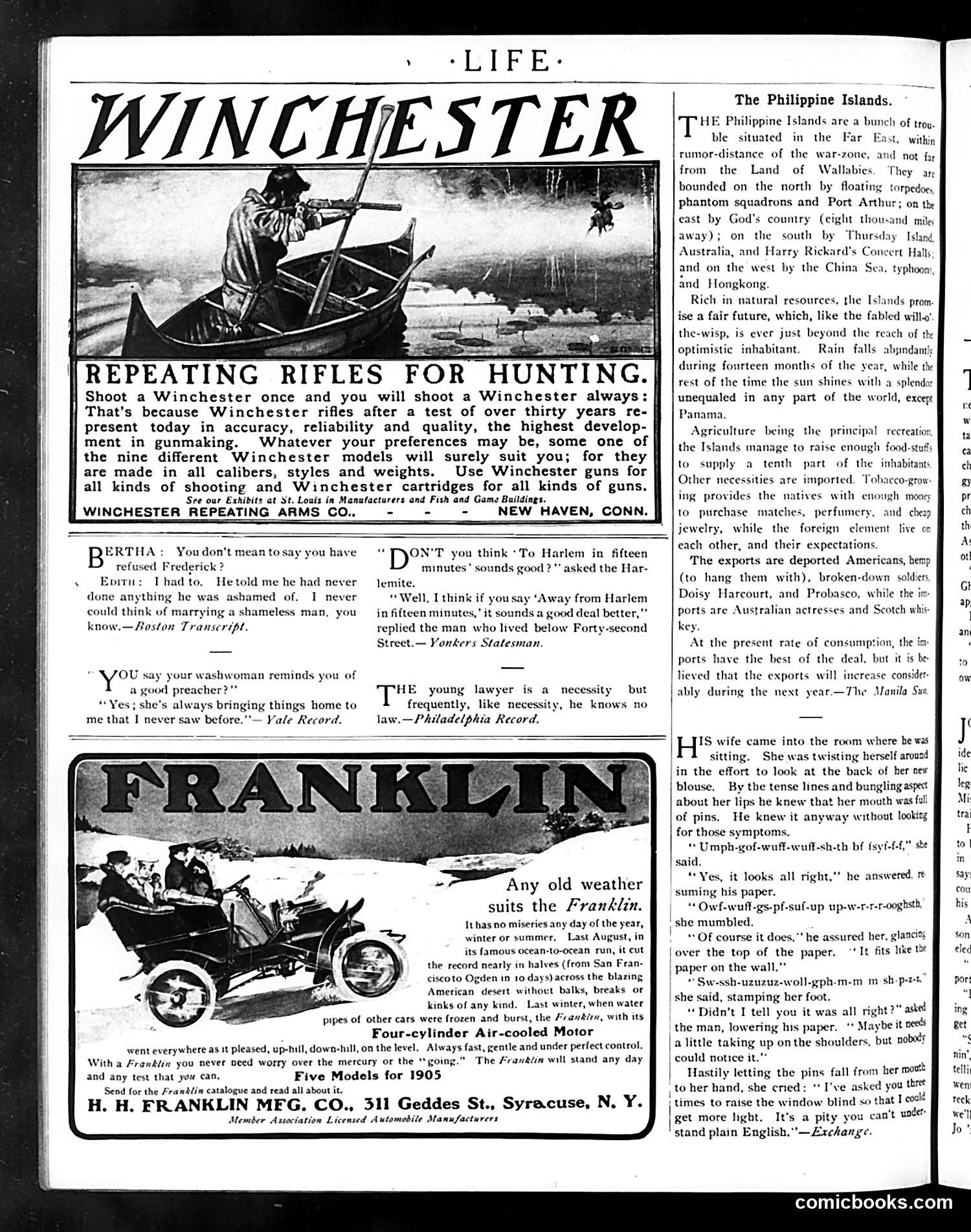
This page contains **advertisements and humor pieces** typical of *Life* magazine's satirical format. **The Cartoons/Jokes:** The short comic dialogues mock social pretension and urban attitudes: - A woman rejects a suitor because he's never been ashamed of anything (implying shamelessness is required for marriage) - A washwoman is compared to a preacher because she "brings things home" - New Yorkers prefer "Away from Harlem in fifteen minutes" to "To Harlem"—expressing contempt for the neighborhood **The Philippine Islands Piece:** This is satirical commentary on American imperialism (the U.S. had annexed the Philippines in 1898). The "geography" mockingly describes the islands as trouble-prone, surrounded by military dangers, and economically dependent on imported goods and American exploitation—implying the colonial venture was poorly conceived and extractive. **The Advertisements:** Winchester rifles, Franklin automobiles, and other products use period advertising language emphasizing reliability and performance. The page reflects early-1900s urban American attitudes: class anxiety, ethnic prejudice, and skepticism toward U.S. imperial ambitions.
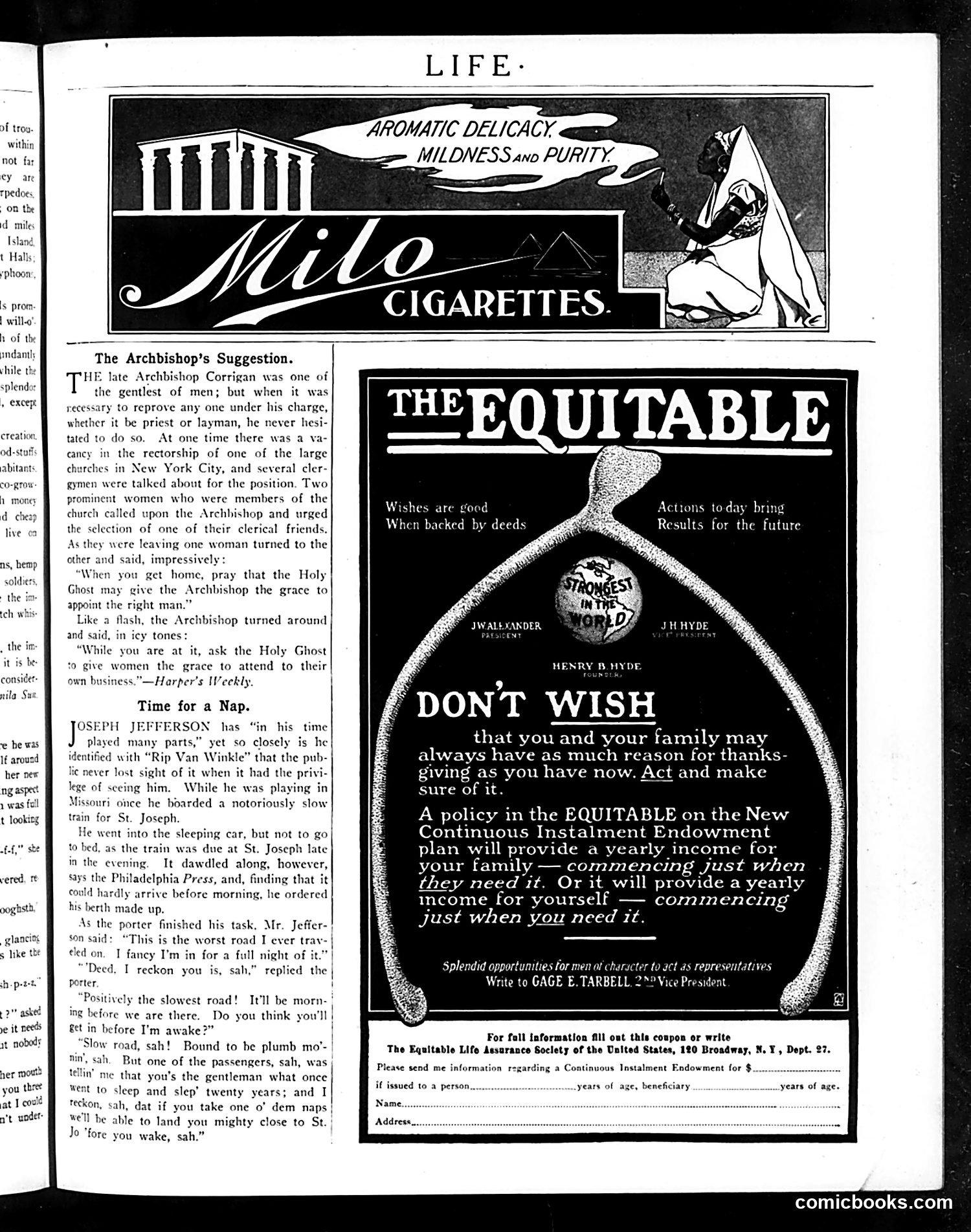
This page contains two unrelated items: humorous anecdotes and advertisements. **The Anecdotes:** The top section presents two brief satirical stories from *Harper's Weekly*. "The Archbishop's Suggestion" mocks women's charitable activism by depicting two parishioners pestering Archbishop Corrigan about clergy appointments, only to be sharply rebuked for overstepping their proper domestic sphere. The joke reflects contemporary attitudes dismissing women's public involvement as meddlesome. "Time for a Nap" is a light joke about actor Joseph Jefferson, famous for playing Rip Van Winkle (a man who sleeps 20 years). A porter on a slow train, recognizing Jefferson, jokes that one of his famous naps would get him there faster than the train itself. **The Advertisements:** The page features ads for Milo Cigarettes (emphasizing "aromatic delicacy") and The Equitable Life Assurance Society, promoting their endowment insurance plans promising family financial security. These are straightforward period insurance and tobacco marketing. The page reflects early-20th-century attitudes: dismissive humor about women's activism, celebrity anecdotes, and life insurance pitched as essential family planning.
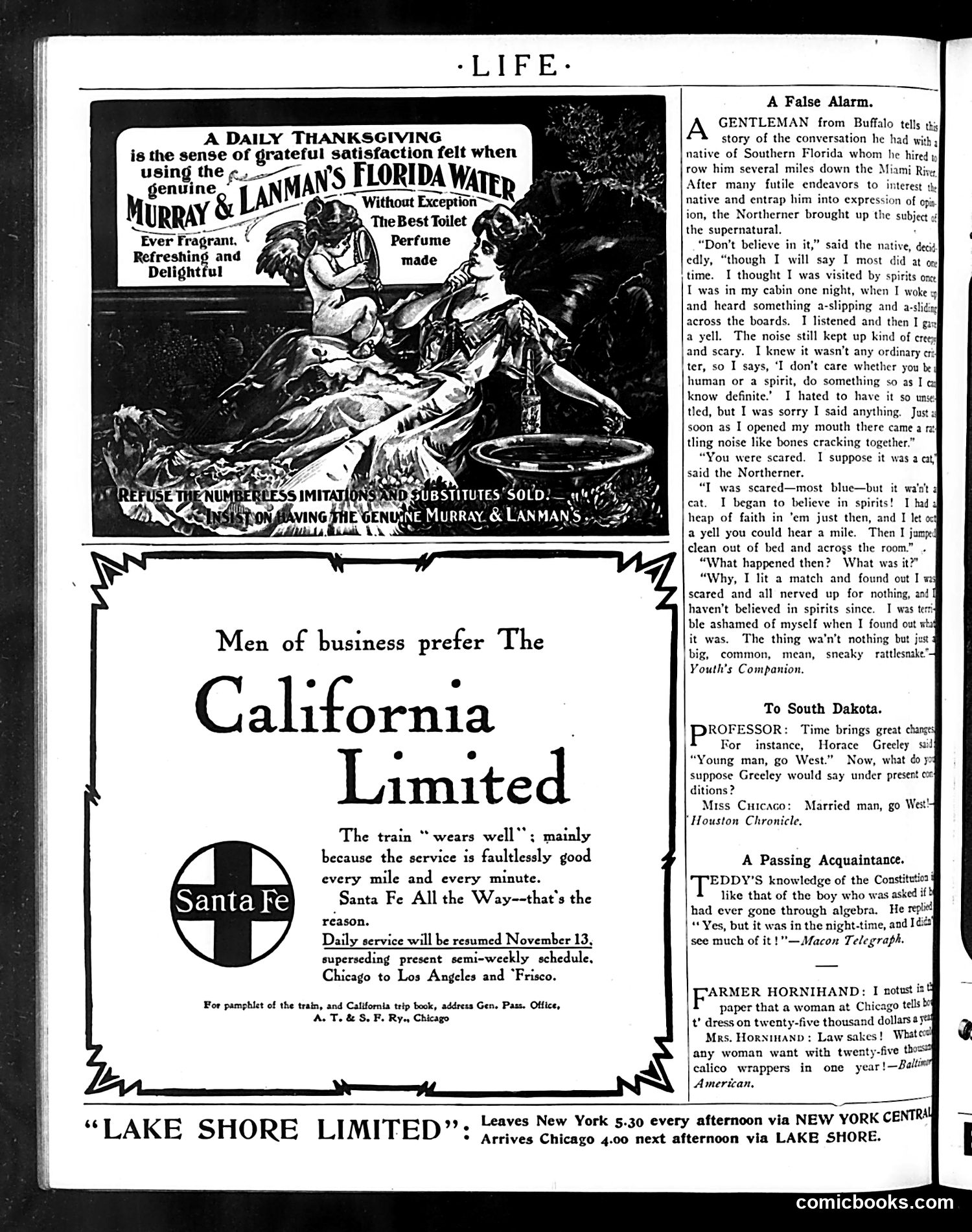
This page consists primarily of **advertisements** for railroad services (Santa Fe, Lake Shore Limited) and toiletries (Murray & Lanman's Florida Water), interspersed with brief humorous anecdotes. The satirical content is minimal. The small jokes in the right column appear to mock: 1. **"A False Alarm"**: A Florida native's superstitious fear that turns out to be a harmless rattlesnake—poking fun at rural credulity and overreaction. 2. **"To South Dakota"**: A play on Horace Greeley's famous "Go West" advice, updated to suggest married men should go west to escape their wives—a common domestic-relations joke of the era. 3. **"A Passing Acquaintance"** and **"Farmer Hornihand"**: Brief wordplay jokes about constitutional ignorance and women's extravagant spending. The page's primary purpose is **commercial**, advertising rail travel and consumer goods to upper-middle-class readers. The humor serves as filler between ads rather than as serious satire.
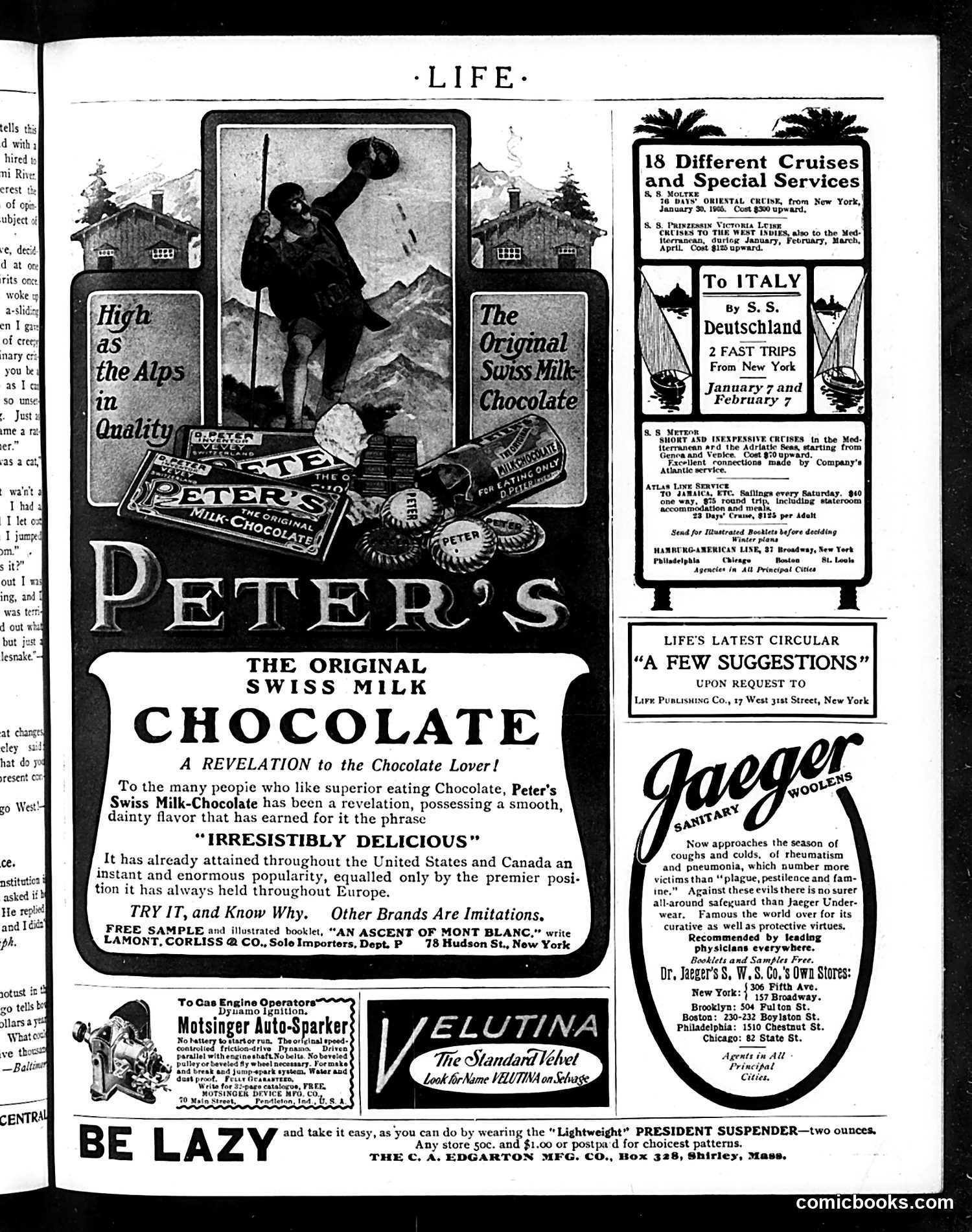
This is primarily an **advertising page** from an early 20th-century issue of Life magazine, containing no political cartoons or satire requiring historical context. The dominant advertisement features **Peter's Swiss Milk Chocolate**, emphasizing its European origin and "irresistibly delicious" quality—a marketing appeal to American consumers' preference for imported goods. The illustration shows a figure ascending a snowy mountain, reinforcing Swiss Alpine authenticity. Surrounding ads promote: - Cruise lines (Hamburg-American, S.S. Deutschland) offering exotic travel to the Orient and Caribbean - Dr. Jaeger's wool undergarments, marketed with health claims common to the era - Various industrial products and services The page reflects **turn-of-the-century consumer culture**: emphasis on European sophistication, aspirational leisure travel, and products promoted through pseudo-scientific health claims. No satirical commentary or caricature is present—this is straightforward commercial advertising typical of Life's revenue model.
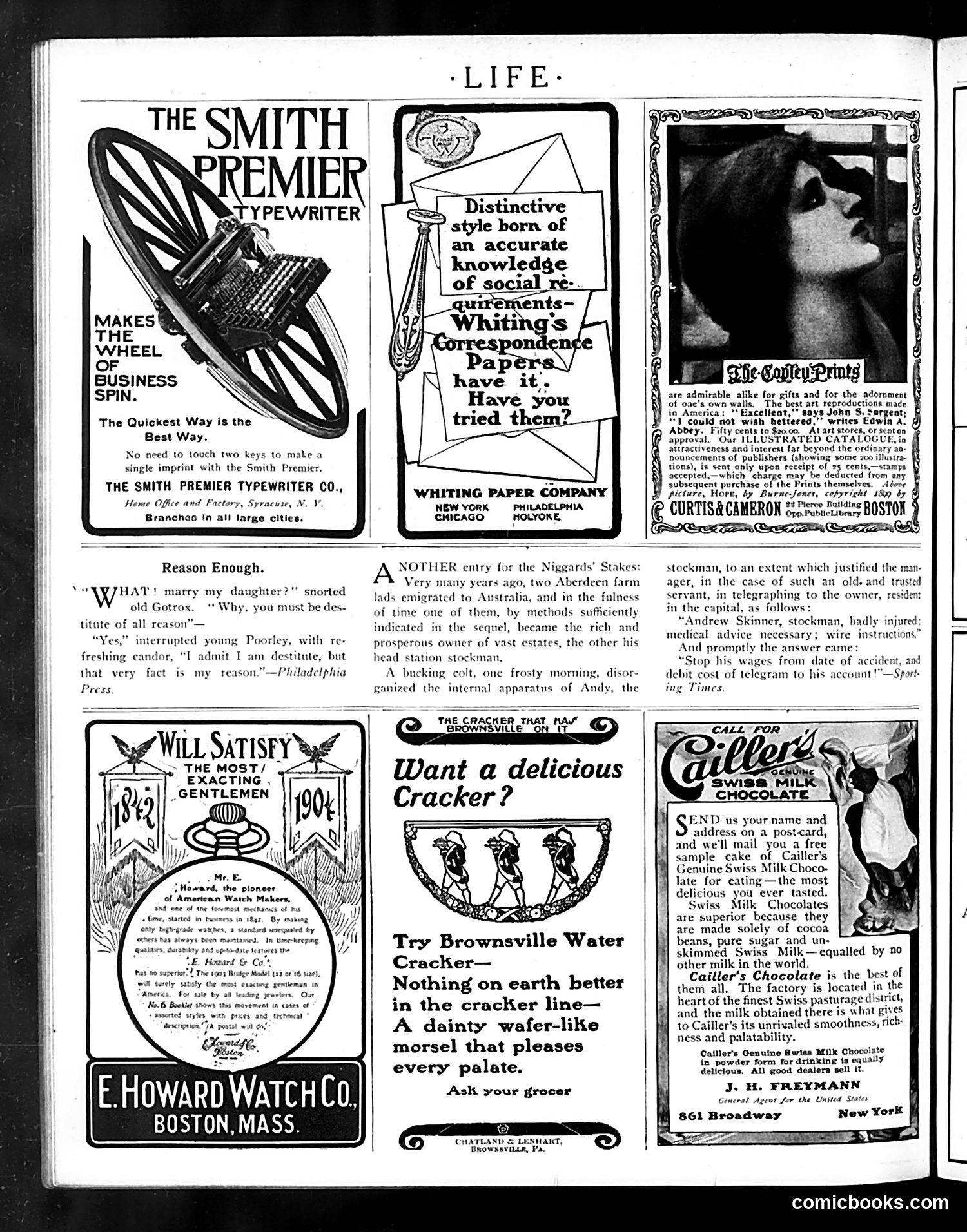
This page is primarily **advertisements** interspersed with brief humorous anecdotes typical of Life's satirical format. The main content includes ads for typewriters, watch-making, crackers, and Swiss chocolate—standard early-1900s consumer goods. The humor piece "Reason Enough" presents a brief social satire: a poor suitor justifies marrying above his station by claiming his very destitution is logical—a paradoxical argument poking fun at fortune-hunters' rationalizations. A second anecdote, "A Nother entry for the Niggards' Stakes," satirizes stinginess through an Australian pastoral scenario where a wealthy station owner, after his stockman is injured, responds to a medical-necessity telegram by *billing the man for the telegram cost itself*—an extreme characterization of miserliness. The page reflects Life's typical early-1900s mix of consumer culture and gentle social mockery targeting character flaws (greed, pretension) rather than political issues.
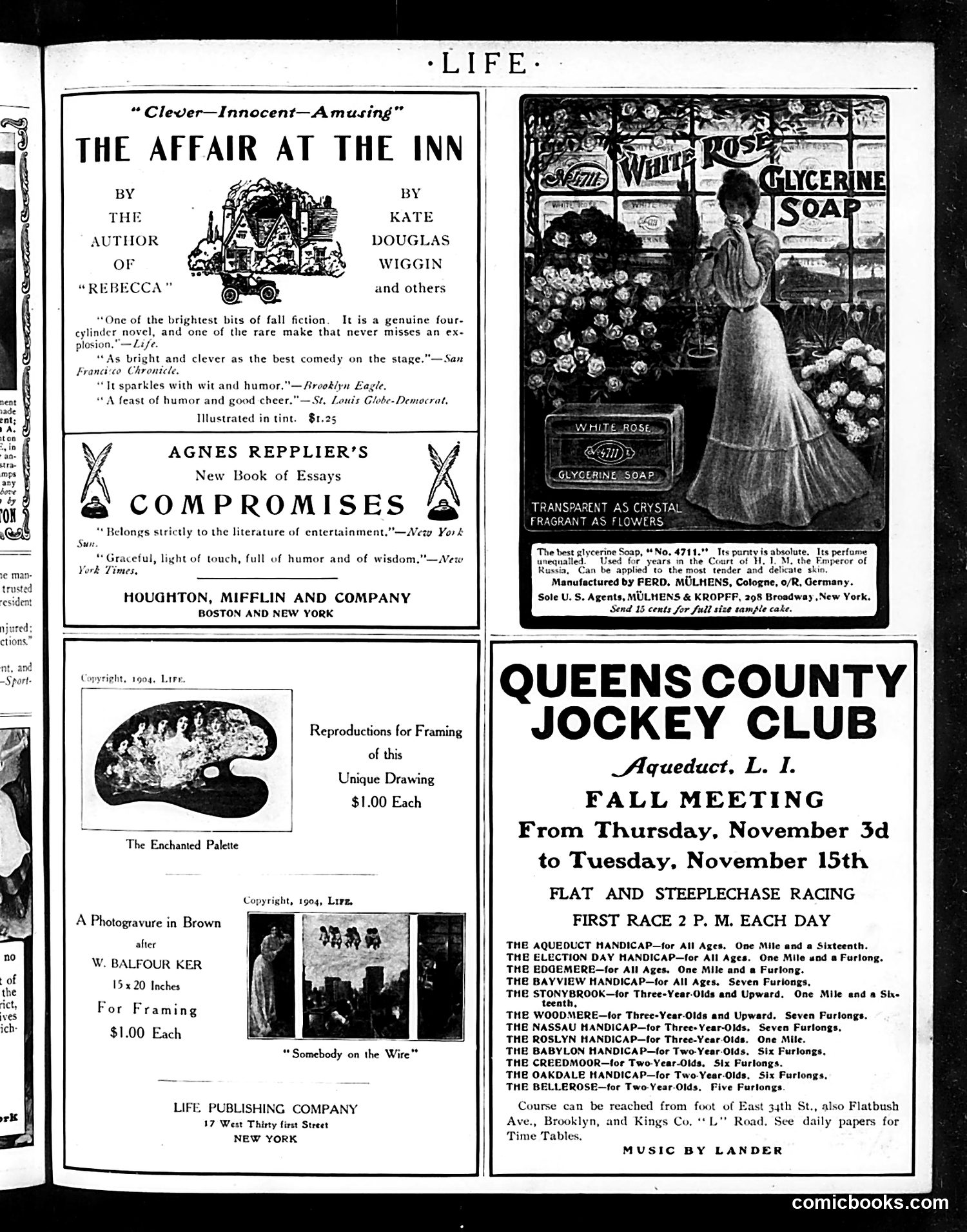
This page is primarily **advertising and book promotion**, not political satire. The main content includes: **Left side:** Book advertisements for *The Affair at the Inn* (by the author of *Rebecca*) and Agnes Repplier's essay collection *Compromises*—both marketed as witty, humorous entertainment. Publishers Houghton Mifflin quote positive reviews emphasizing clever humor and entertainment value. **Center:** Art reproductions for framing—prints by W. Balfour Ker, priced at $1 each, marketed to readers wanting affordable home decoration. **Right side:** A soap advertisement (White Rose Glycerine Soap) featuring an elegant woman, and the Queens County Jockey Club fall racing schedule from Aqueduct, Long Island. **The satire element:** Life magazine itself was satirical, but this particular page shows how *Life* supported itself through advertising while maintaining its literary cachet by advertising "clever" books and refined products to its educated, upper-middle-class readership.
This is a **full-page advertisement**, not a cartoon or satirical content. It promotes "Viyella," a British flannel fabric brand, published in *Life* magazine on November 3, 1904. The ad emphasizes that Viyella is an "ideal English flannel for Fall, 1904," available at American retailers for 75 cents per yard. It highlights the fabric's range of patterns (solids, stripes, plaids, prints) and its key selling point: **it does not shrink**—a significant advantage when wool fabrics commonly shrank during laundering. The warning "Avoid imitations! Refuse substitutes!" reflects early 20th-century competitive markets where counterfeit or inferior imitation fabrics were common problems. The emphasis on the product's English origin suggests quality cachet—British textiles were considered superior during this era. No satire or political content is present; this is straightforward period advertising.