
Life, 1904-11-03 · page 23 of 40
Life — November 3, 1904 — page 23: what you’re looking at
What you’re looking at
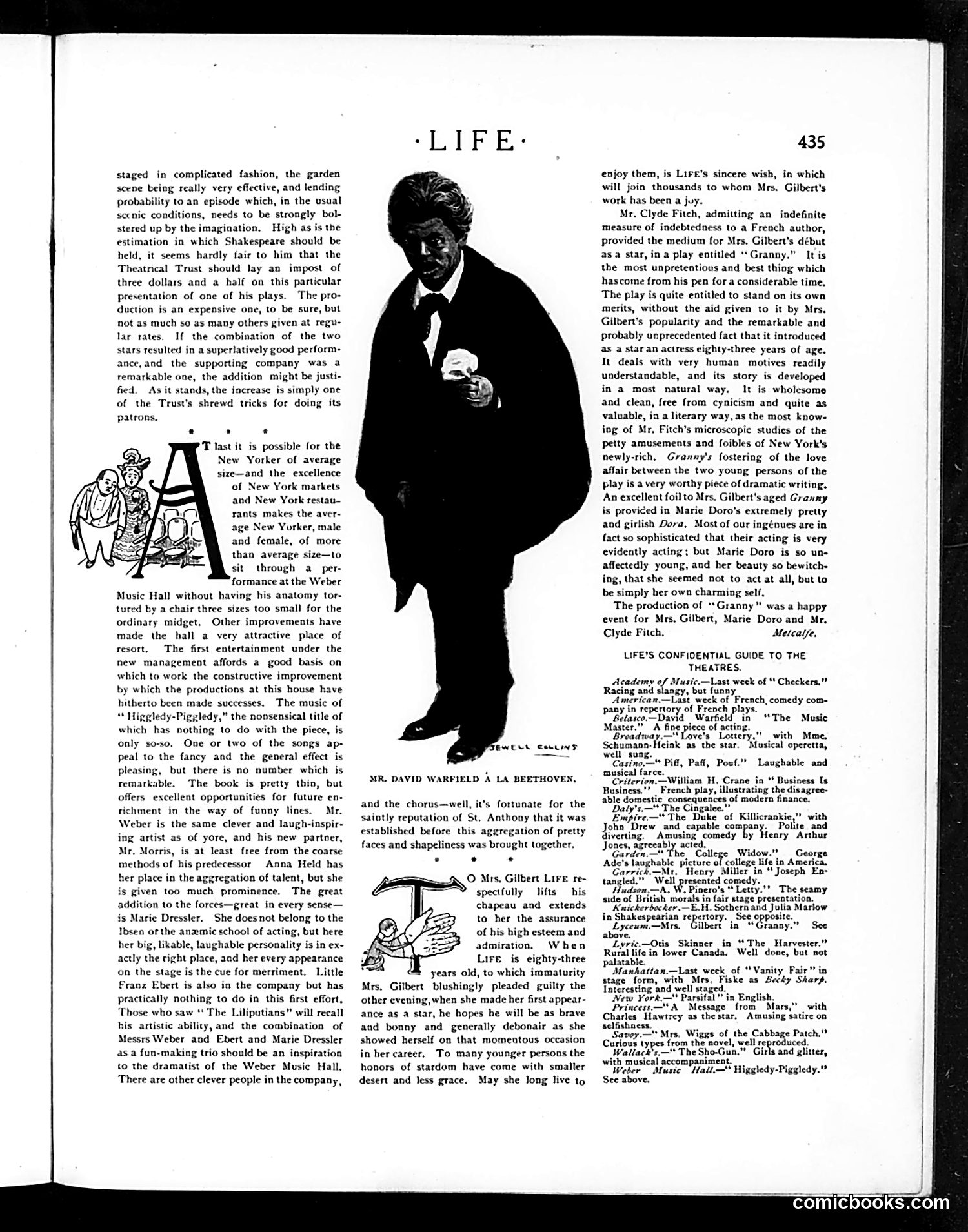
This page contains theatrical reviews from an American satirical magazine, likely from the early 1900s. The key content includes: **The Cartoon**: A portrait labeled "MR. DAVID WARFIELD À LA BEETHOVEN" shows actor David Warfield posed to resemble the famous composer—a visual joke comparing the actor's dramatic demeanor to classical music's gravitas. **The Reviews**: The text critiques several Broadway productions: - Shakespeare production criticized for inflated pricing ($3.50 surcharge) by the "Theatrical Trust"—a reference to the monopolistic theater booking organization that controlled American theater - "Higgledy-Piggledy" at Weber Music Hall, praised for Marie Dressler's comedic talent - A play featuring Mrs. Gilbert, an 83-year-old actress making her starring debut, whom the reviewer warmly congratulates **The Satire**: The "Beethoven" joke mocks theatrical pretension. The Trust criticism reflects Progressive-era skepticism toward monopolies. The warmth toward elderly Mrs. Gilbert's success suggests democratic ideals about opportunity.
📄 Transcribed text from this page (OCR, searchable)
Machine-transcribed from the original scan — historical spelling and the odd misread are preserved.
staged in complicated fashion, the garden scene being really very effective, and lending probability to an episode which, in the usual scenic conditions, needs to be strongly bol- stered up by the imagination. High as is the estimation in which Shakespeare should be held, it seems hardly fair to him that the Theatrical Trust should lay an impost of three dollars and a half on this particular presentation of one of his plays. The pro- duction is an expensive one, to be sure, but not as much so as many others given at regu- lar rates, If the combination of the two stars resulted in a superlatively good perform- ance,and the supporting company was a remarkable one, the addition might be justi- fied, As it stands, the increase is simply one of the Trust’s shrewd tricks for doing its patrons, * . . T last it is possible for the New Yorker of average size—and the excellence of New York markets and New York restau- rants makes the aver- age New Yorker, male and female, of more than average size—to sit’ through a per- formance at the Weber Music Hall without having his anatomy tor- tured by a chair three sizes too small for the ordinary midget. Other improvements have made the hall a very attractive place of resort, The first entertainment under the new management affords a good basis on which to work the constructive improvement by which the productions at this house have hitherto been made successes. The music of “ Higgledy-Piggledy,” the nonsensical title of which has nothing to do with the piece, is only so-so. One or two of the songs ap- peal to the fancy and the general effect is pleasing, but there is no number which is remarkable. The book is pretty thin, but offers excellent opportunities for future en- richment in the way of funny lines, Mr. Weber is the same clever and laugh-inspir- ing artist as of yore, and his new partner, Mr. Morris, is at least {ree from the coarse methods of his predecessor Anna Held has her place in the aggregation of talent, but she is given too much prominence. The great addition to the forces—great in every sense— is Marie Dressler. She does not belong to the Ibsen of the anaemic school of acting, but here her big, likable, laughable personality is in ex- actly the right place, and her every appearance on the stage is the cue for merriment. Little Franz Ebert is also in the company but has practically nothing to do in this first effort, Those who saw “ The Liliputians” will recall his artistic ability, and the combination of Messrs Weber and Ebert and Marie Dressler as a fun-making trio should be an inspiration to the dramatist of the Weber Music Hall, There are other clever people in the company, MR. DAVID WARFIELD A LA BEETHOVED and the chorus—well, it’s fortunate for the saintly reputation of St. Anthony that it was established before this aggregation of pretty faces and shapeliness was brought together. . . . O Mrs, Gilbert Lire re- spectfully lifts his chapeau and extends to her the assurance of his high esteem and admiration. When Lire. is eighty-three years old, to which immaturity Mrs, Gilbert blushingly pleaded guilty the other evening,when she made her first appear- ance as a star, he hopes he will be as brave and bonny and generally debonair as she showed herself on that momentous occasion in her career, To many younger persons the honors of stardom have come with smaller desert and less grace. May she long live to 435 enjoy them, is Lire’s sincere wish, in which will join thousands to whom Mrs. Gilbert's work has been a juy. Mr. Clyde Fitch, admitting an indefinite measure of indebtedness to a French author, provided the medium for Mrs, Gilbert's début asa star, ina play entitled “Granny.” It is the most unpretentious and best thing which hascome from his pen fora considerable time. The play is quite entitled to stand on its own merits, without the aid given to it by Mrs. Gilbert’s popularity and the remarkable and probably unprecedented fact that it introduced as a staran actress cighty-three years of age. It deals with very human motives readily understandable, and its story is developed in a most natural way. It is wholesome and clean, free from cynicism and quite as valuable, ia a literary way, as the most know- ing of Mr, Fitch's microscopic studies of the | petty amusements and foibles of New York's newly-rich. Granny's fostering of the love affair between the two young persons of the play is avery worthy piece of dramatic writing. An excellent foil to Mrs. Gilbert's aged Granny is proviced in Marie Doro’s extremely pretty and girlish Dora, Most of our ingénues are in fact so sophisticated that their acting is very evidently acting; but Marie Doro is so un- affectedly young, and her beauty so bewitch- ing, that she seemed not to act at all, but to be simply her own charming self, The production of **Granny” was a happy | event for Mrs. Gilbert, Marie Doro and Mr, j Clyde Fitch, Metcalfe. LIFE’S CONFIDENTIAL GUIDE TO THE THEATRES. Academy of Music.—Last week of Checkers.” Racing and slangy, but funny ‘American.—Last week of French, comedy com- | pany in repertory of French plays. Belasco.—David_ Warfield in “The Music Master.” A fine piece of acting. Breadway.—" Love's Lottery,” with Mme. Schumann-Heink as the star. Musical operetta, Pif, Paff, Pouf.” Laughable and musical farce. —William H. Crane in “ Business Is Business."? | French play, illustrating the disagree- able domestic consequences of modern finance, Daly's.—"*The Cingalee.” Empire—* The Duke of Killicrankie,” with Joha Drew and capable company: Polite and diverting. Amusing comedy by Henry Arthur Jones, agreeably acted. Garden —“ The College Widow." George Ade’s laughable picture of college life in America. Henry Miller in “Joseph En- | I presented comedy. Pinero’s * Letty.'? The seamy side of British morals in fair stage presentatio: Knickerbocker.—E.H. Sothern and Julia Marlow: in Shakespearian repertory. , See opposit. Lyccum—Mrs. Gilbert’ in Crann above. Lyric. —Otis Skinner in “The Harvester.” Rural life in lower Canada. Well done, but not palatable. aie eae Manhattan.—Last week of “Vanity Fair” in stage form, with Mrs, Fiske as Secky Sharp. Interesting and well staged. Parsifal’” in English, | ‘A Message from Mars," with Charles Hawtrey as thestar, Amusing satire on sero Mra, Wiggs of the Cabbage Patch Savey.—* Mrs. ‘iggs of the Cabbage Patch.’* | Curious types from the novel, well reproduced. | Wallack's—" The Sho-Gun.” Girls and glitter, with musical accompanimen: % Weber Music Hall.— Higgledy-Piggledy.”” See above. | comicbooks.com