
Life, 1904-11-03 · page 26 of 40
Life — November 3, 1904 — page 26: what you’re looking at
What you’re looking at
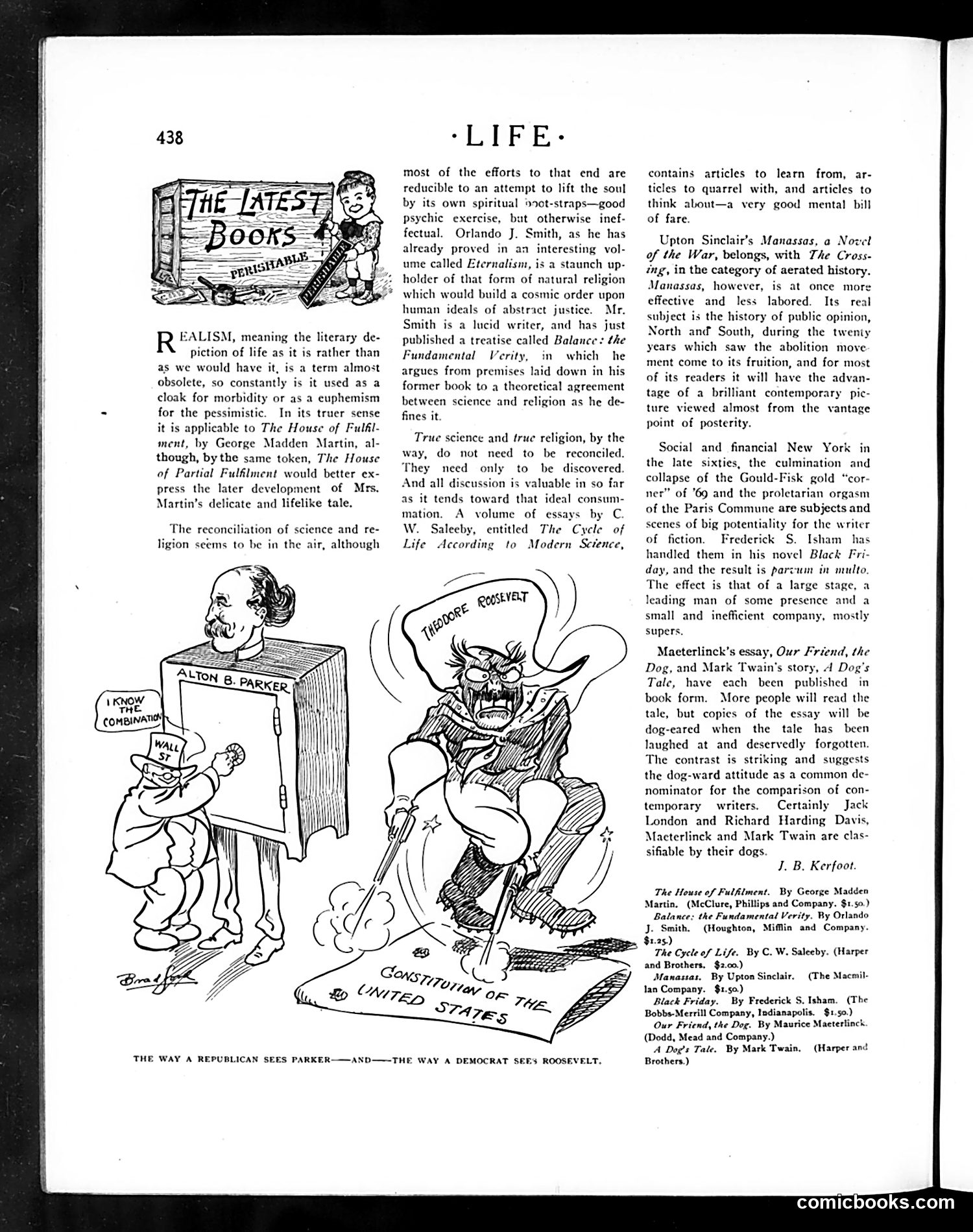
The bottom cartoon compares how Republicans and Democrats view their respective presidential candidates (likely from the 1904 election). On the left, a Republican sees **Alton B. Parker** (Democratic candidate) as a small, ineffectual figure saying "I know nothing," dwarfed by the towering presence of Parker's namesake bust. On the right, a Democrat depicts **Theodore Roosevelt** as a monstrous, destructive force labeled "Theodore Roosevelt" riding roughshod over the "Constitution of the United States," suggesting Republicans' view of Roosevelt as powerful versus Democrats' view of him as a constitutional threat. The satirical point: each party's caricature of the opposing candidate reflects their opposing political interests—one portraying weakness and ignorance, the other depicting dangerous overreach. The contrasting depictions highlight partisan disagreement about fitness for office.
📄 Transcribed text from this page (OCR, searchable)
Machine-transcribed from the original scan — historical spelling and the odd misread are preserved.
R EALISM, meaning the literary de- Piction of life as it is rather than as we would have it, is a term almost obsolete, so constantly is it used as a cloak for morbidity or as a euphemism for the pessimistic. In its truer sense it is applicable to The House of Fulfil- ment, by George Madden Martin, al- though, by the same token, The House of Partial Fulfilment would better ex- press the later development of Mrs. Martin’s delicate and lifelike tale. The reconciliation of science and re- ligion seems to be in the air, although *LIFE- most of the efforts to that end are reducible to an attempt to lift the soul by its own spiritual »9ot-straps—good psychic exercise, but otherwise inef- fectual. Orlando J. Smith, as he has already proved in an interesting vol- ume called Eternalism, is a staunch up- holder of that form of natural religion which would build a cosmic order upon human ideals of abstract justice. Mr. Smith is a lucid writer, and has just published a treatise called Balance: the Fundamental Verity, in which he argues from premises laid down in his former book to a theoretical agreement between science and religion as he de- fines it. True science and true religion, by the way, do not need to be reconciled. They need only to be discovered. And all discussion is valuable in so far as it tends toward that ideal consum- mation. A volume of essays by C. W. Saleeby, entitled The Cycle of Life According to Modern Sctence, THE WAY A REPUBLICAN SEES PARKER——AND——THE WAY A DEMOCRAT SER% ROOSEVELT, contains articles to learn from, ar- ticles to quarrel with, and articles to think about—a very good mental bill of fare. Upton Sinclair’s Manassas, a Novel of the War, belongs, with The Cross- ing, in the category of aerated history. Manassas, however, is at once more effective and less labored. Its real subject is the history of public opinion, North and South, during the twenty years which saw the abolition move ment come to its fruition, and for most of its readers it will have the advan- tage of a brilliant contemporary pic- ture viewed almost from the vantage point of posterity. Social and financial New York in the late sixties, the culmination and collapse of the Gould-Fisk gold “cor- ner” of '69 and the proletarian orgasm of the Paris Commune are subjects and scenes of big potentiality for the writer of fiction. Frederick S$. Isham has handled them in his novel Black Fri- day, and the result is parvtwin in muito. The effect is that of a large stage, a leading man of some presence and a small and inefficient company, mostly supers. Maeterlinck’s essay, Our Friend, the Dog, and Mark Twain's story, d Dog's Tale, have each been published in book form. More people will read the tale, but copies of the essay will be dog-eared when the tale has been laughed at and deservedly forgotten. The contrast is striking and suggests the dog-ward attitude as a common de- nominator for the comparison of con- temporary writers. Certainly Jack London and Richard Harding Davis, Macterlinck and Mark Twain are clas- sifiable by their dogs. J. B. Kerfoot. The House of Fulfilment. By George Madden Martin. (McClure, Phillips and Company. $1.50.) Balance: the Fundamental Verity. By Orlando J. Smith, (Houghton, Mifflin and Company. $1.25) The Cycle of Life. By C. W. Saleeby. (Harper and Brothers. $2.00.) Manassas, By Upton Sinclair. lan Company. $1.50) Black Friday. By Frederick S. Isham. (The Bobbs-Merrill Company, Indianapolis. $1.50.) Our Friend, the Dog. By Maurice Mactertinck. (Dodd, Mead and Company.) A Dog's Tale. By Mark Twain, Brothers.) (The Macmil- (Harper and comicbooks.com