
Life, 1904-11-03 · page 16 of 40
Life — November 3, 1904 — page 16: what you’re looking at
What you’re looking at
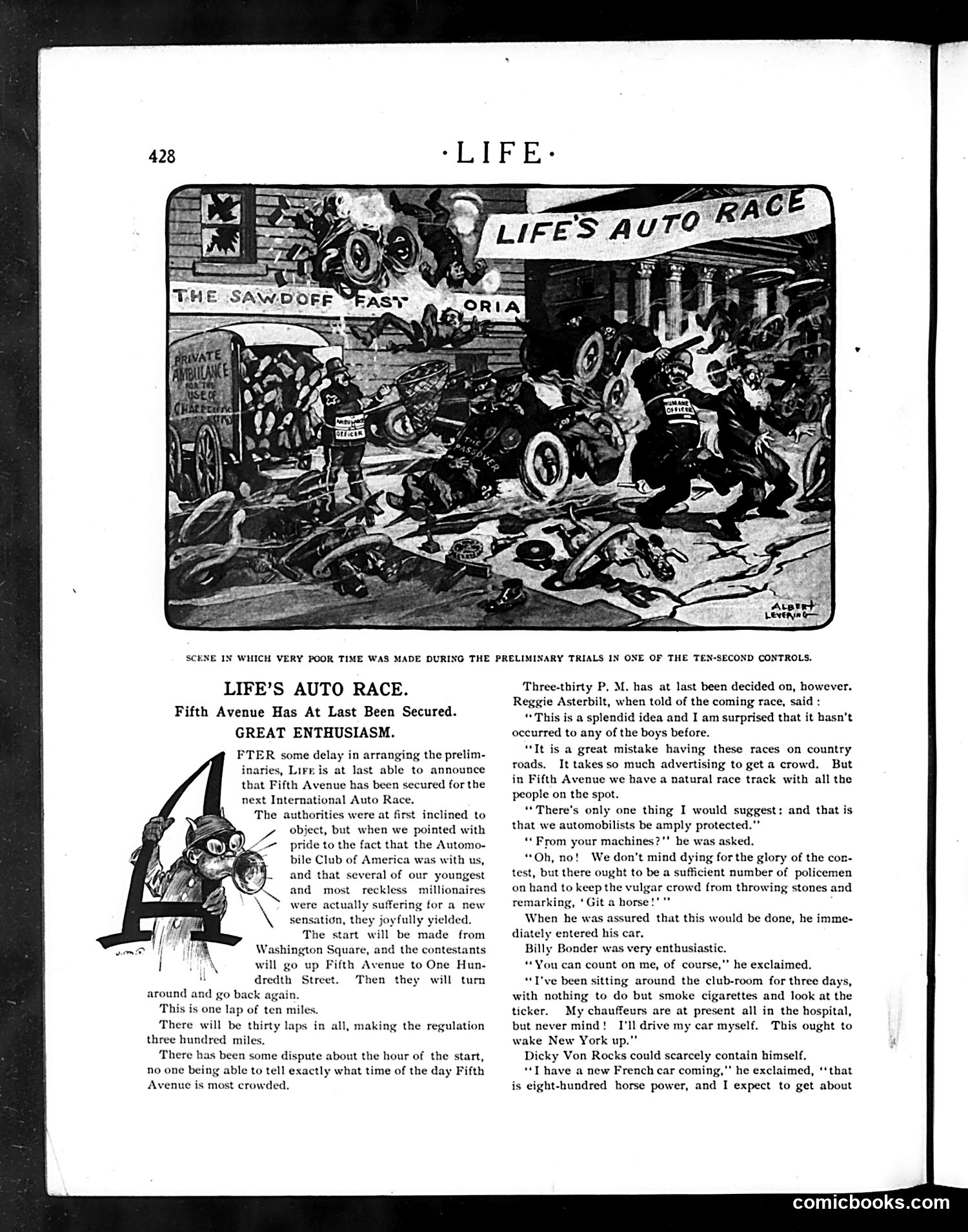
This is satirical commentary on wealthy industrialists and their reckless enthusiasm for automobile racing. The piece mocks the idea of holding a high-speed auto race down Fifth Avenue in Manhattan—a densely populated urban street. The satire targets millionaires like "Reggie Asterbilt" (a play on the Vanderbilt family name), "Billy Bonder," and "Dicky Von Rocks"—fictional wealthy men portrayed as bored thrill-seekers who care more about spectacle and personal glory than public safety. Their dialogue reveals their arrogance: they want police protection "from the vulgar crowd" throwing stones and shouting "Git a horse!" The image shows a chaotic crash scene with damaged vehicles and wreckage, illustrating the inevitable danger such a race would pose to pedestrians and drivers alike. Life's joke: these millionaires are so disconnected from reality and public welfare that they genuinely believe racing expensive automobiles through crowded city streets is a reasonable entertainment idea, requiring only crowd control and police protection—from ordinary people's disapproval, not from actual danger.
📄 Transcribed text from this page (OCR, searchable)
Machine-transcribed from the original scan — historical spelling and the odd misread are preserved.
SCENE IN WHICH VERY POOR TIME WAS MADE DURING THE PRELIMINARY TRIALS IN ONE OF THE TEN-SECOND CONTROLS. LIFE’S AUTO RACE. Fifth Avenue Has At Last Been Secured. GREAT ENTHUSIASM. FTER some delay in arranging the prelim- inaries, Lirris at last able to announce that Fifth Avenue has been secured for the next International Auto Race. The authorities were at first inclined to object, but when we pointed with pride to the fact that the Automo- bile Club of America was with us, and that several of our youngest and most reckless millionaires were actually suffering for a new sensation, they joyfully yielded. The start will be made from Washington Square, and the contestants will go up Fifth Avenue to One Hun- " dredth Street. Then they will turn around and go back again. This is one lap of ten miles. There will be thirty laps in all, making the regulation three hundred miles. ‘There has been some dispute about the hour of the start, no one being able to tell exactly what time of the day Fifth Avenue is most crowded. Three-thirty P. M. has at last been decided on, however. Reggie Asterbilt, when told of the coming race, said : “This is a splendid idea and I am surprised that it hasn’t occurred to any of the boys before. “It is a great mistake having these races on country roads. It takes so much advertising to get a crowd. But in Fifth Avenue we have a natural race track with all the people on the spot. “There's only one thing I would suggest: and that is that we automobilists be amply protected."” “From your machines?" he was asked. “Oh, no! We don’t mind dying for the glory of the con- test, but there ought to be a sufficient number of policemen on hand to keep the vulgar crowd from throwing stones and remarking, ‘Git a horse!’"” When he was assured that this would be done, he imme- diately entered his car, Billy Bonder was very enthusiastic. “You can count on me, of course,"’ he exclaimed. “T've been sitting around the club-room for three days, with nothing to do but smoke cigarettes and look at the ticker. My chauffeurs are at present all in the hospital, but never mind! I'll drive my car myself. This ought to wake New York up.” Dicky Von Rocks could scarcely contain himself, ‘*T have a new French car coming,” he exclaimed, ‘‘that is eight-hundred horse power, and I expect to get about comicbooks.com