
Life, 1904-11-03 · page 18 of 40
Life — November 3, 1904 — page 18: what you’re looking at
What you’re looking at
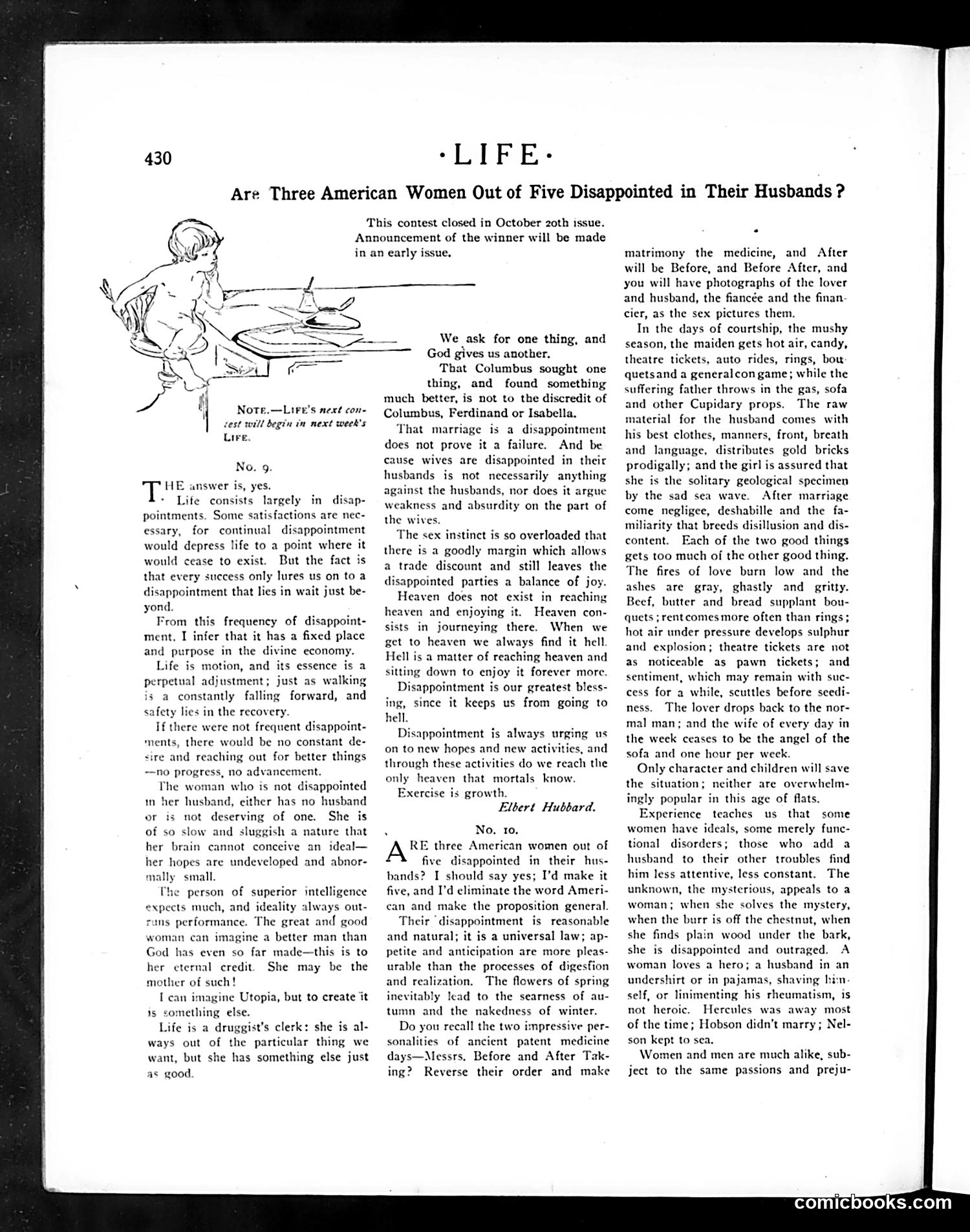
This page presents a contest about marital disappointment, featuring commentary by Elbert Hubbard (a prominent turn-of-the-century essayist). The small illustration shows a woman at a table, apparently contemplating relationship dissatisfaction. **The Satire's Point:** The contest asks whether three of five American women are disappointed in their husbands. Hubbard argues the answer is "yes"—and that this disappointment is actually *beneficial*. He frames marital letdown as philosophically necessary: disappointment drives progress and prevents complacency. **Social Context:** This reflects early 1900s gender attitudes. Rather than critiquing marriages as genuinely problematic, Hubbard suggests disappointed wives lack sufficient imagination or intellect. He uses the "Before and After" patent-medicine metaphor to suggest courtship promises are naturally unrealistic compared to married life. **The Satire:** Life magazine's editors appear to mock Hubbard's attempts to reframe women's legitimate disappointment as character development—turning marital dissatisfaction into philosophical virtue.
📄 Transcribed text from this page (OCR, searchable)
Machine-transcribed from the original scan — historical spelling and the odd misread are preserved.
*LDP Es Three American Women Out of Five Disappointed in Their Husbands ? This contest closed in October 2oth issue. Announcement of the winner will be made in an early issue. Note.—Lire’s next con- zest will begin in mext week's Lire. No. 9. answer is, yes. Lite consists largely in disap- pointments. Some satisfactions are nec- essary, for continual disappointment would depress life to a point where it would cease to exist. But the fact is that every success only lures us on to a disappointment that lies in wait just be- yond. ‘om this frequency of disappoint- ment, I infer that it has a fixed place and purpose in the divine economy. Life is motion, and its essence is a perpetual adjustment; just as walking is a constantly falling forward, and safety lies in the recovery. If there were not frequent disappoint- ments, there would be no constant de- sire and reaching out for better things no progress, no advancement. The woman who is not disappointed in her husband, either has no husband or is not deserving of one. She is of so slow and sluggish a nature that her brain cannot conceive an ideal— her hopes are undeveloped and abnor- mally small. Che person of superior intelligence expects much, and ideality always out- runs performance. The great and good woman can imagine a better man than God has even so far made—this is to her eternal credit. She may be the mother of such! agine Utopia, but to create it is something else. Life is a dru: clerk: she is al- ways out of the particular thing we want, but she has something else just as good. Tecan We ask for one thing, and God gives us another. That Columbus sought one thing, and found something much better, is not to the discredit of Columbus, Ferdinand or Isabella. That marriage is a disappointment does not prove it a failure. And be cause wives are disappointed in their husbands is not necessarily anything against the husbands, nor does it argue weakness and absurdity on the part of the wives. The sex instinct is so overloaded that there is a goodly margin which allows a trade discount and still leaves the disappointed parties a balance of jo: Heaven does not exist in reaching heaven and enjoying it. Heaven con- sists in journeying there. When we get to heaven we always find it hell Hell is a matter of reaching heaven and sitting down to enjoy it forever morc. Disappointment is our greatest bless- ing, since it keeps us from going to hell. Disappointment is always urging us on to new hopes and new activities, and through these activities do we reach the only heaven that mortals know. Exercise is growth. Elbert Hubbard. No, 10, RE three American women out of five disappointed in their hus- bands? I should say yes; I’d make it five, and I'd eliminate the word Ameri- can and make the proposition general. Their “disappointment is reasonable and natural; it is a universal law; ap- petite and anticipation are more pleas- urable than the processes of digesfion and realization. The flowers of spring inevitably lead to the searness of au- tumn and the nakedness of winter. Do you recall the two impressive per- sonalities of ancient patent medicine days—Messrs, Before and After Tak- ing? Reverse their order and make matrimony the medicine, and After will be Before, and Before After, and you will have photographs of the lover and husband, the fiancée and the finan. cier, as the sex pictures them. In the days of courtship, the mushy season, the maiden gets hot air, candy, theatre tickets, auto rides, rings, bow quetsand a generalcon game; while the suffering father throws in the gas, sofa and other Cupidary props. The raw material for the husband comes with his best clothes, manners, front, breath and language, distributes gold bricks prodigally; and the girl is assured that she is the solitary geological specimen by the sad sea wave. After marriage come negligee, deshabille and the fa- miliarity that breeds disillusion and dis- content. Each of the two good things gets too much of the other good thing. The fires of love burn low and the ashes are gray, ghastly and_ gritty. Beef, butter and bread supplant bou- quets ; rentcomes more often than rings; hot air under pressure develops sulphur and explosion; theatre tickets are not as noticeable as pawn tickets; and sentiment, which may remain with suc- cess for a while, scuttles before scedi- ness. The lover drops back to the nor- mal man; and the wife of every day in the week ceases to be the angel of the sofa and one hour per week. Only character and children will save the situation; neither are overwhelm- ingly popular in this age of flats. Experience that some women have ideals, some merely fune- tional disorders; those who add a husband to their other troubles find him less attentive, less constant. The unknown, the mysterious, appeals to a woman; when she solves the mystery, when the burr is off the chestnut, when she finds plain wood under the bark, she is disappointed and outraged. A woman loves a hero; a husband in an undershirt or in pajamas, shaving hin- self, or linimenting his rheumatism, is not heroic. Hercules was away most of the time; Hobson didn’t marry; Nel- son kept to sea, Women and men are much alike, sub- ject to the same passions and preju- teaches us comicbooks.com