
Life, 1904-11-03 · page 12 of 40
Life — November 3, 1904 — page 12: what you’re looking at
What you’re looking at
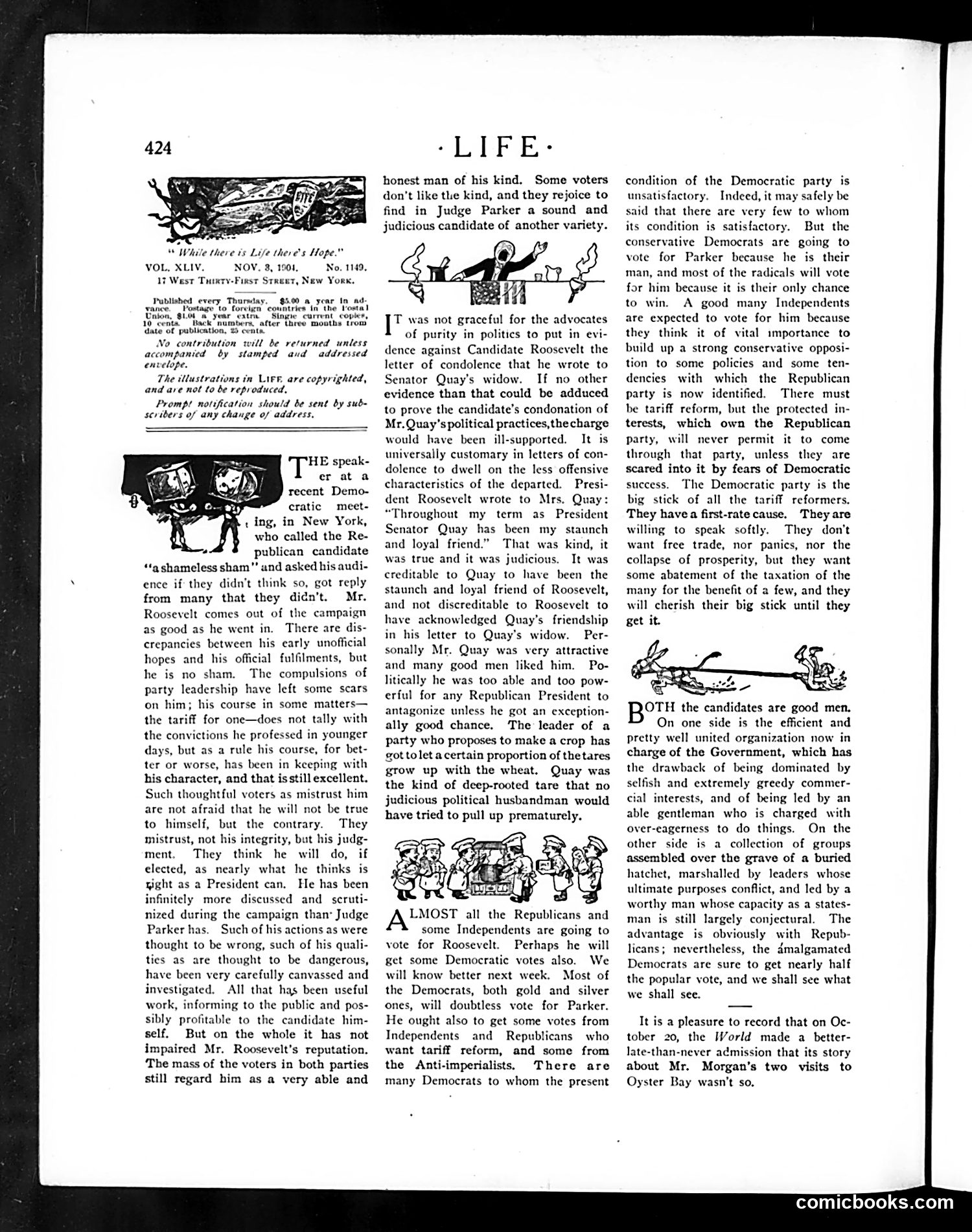
This Life magazine page discusses the upcoming presidential race between Democrat Alton B. Parker and Republican Theodore Roosevelt. The text analyzes Parker as "an honest man of his kind" but questions whether he can unite fractious Democratic factions—reformers, protectionists, and anti-imperialists who lack consensus. The cartoons (specific figures unclear from image quality) appear to satirize party divisions and candidate appeal. The commentary suggests both candidates are "good men," but Roosevelt's Republicans have organizational advantage, while Democrats are an "amalgamated" coalition held together primarily by opposing Republicans rather than shared principles. The piece reflects genuine anxiety about Democratic party coherence in 1904.
📄 Transcribed text from this page (OCR, searchable)
Machine-transcribed from the original scan — historical spelling and the odd misread are preserved.
While there ts Life there's Hope.” VOL, XLIV. NOV. 8, 1901, No. 1149, 17 West Tatxtv-Fixst Street, New Yorx. Published every Thurwlay. $400 a scar In ad vance. - Postage to forcin countries tn the Tosa] Union, $100 a year extra. Singie current. copier, 10 conta Hack numbers after three mouths {row date of publication, 23 conte No contribution twill be returned unless accompanied by stamped aud addressed envelope. The illustrations in LAFF, are copyrighted, and are not to be reproduced, Prompt notification should be sent by sub- scribers of any change of address. HE speak- er ata recent Demo- cratic meet- ting, in New York, who called the Re- publican candidate “‘ashameless sham" und asked his audi- ence if they didn’t think so, got reply from many that they didn’t. Mr. Roosevelt comes out of the campaign as good as he went in. There are dis- crepancies between his early unofficial hopes and his official fulfilments, but he is no sham. The compulsions of party leadership have left some scars on him; his course in some matters— the tariff for one—does not tally with the convictions he professed in younger days, but as a rule his course, for bet- ter or worse, has been in keeping with his character, and that is still excellent. Such thoughtful voters as mistrust him are not afraid that he will not be true to himself, but the contrary. They mistrust, not his integrity, but his judg- ment. They think he will do, if elected, as nearly what he thinks is right as a President can. He has been infinitely more discussed and scruti- nized during the campaign than’ Judge Parker has. Such of his actions as were thought to be wrong, such of his quali- ties as are thought to be dangerous, have been very carefully canvassed and investigated. All that has been useful work, informing to the public and pos- sibly profitable to the candidate him- self. But on the whole it has not impaired Mr. Roosevelt's reputation. The mass of the voters in both parties still regard him as a very able and -LIFE- honest man of his kind. Some voters don’t like the kind, and they rejoice to find in Judge Parker a sound and judicious candidate of another variety. T was not graceful for the advocates of purity in politics to put in evi- dence against Candidate Roosevelt the letter of condolence that he wrote to Senator Quay’s widow. If no other evidence than that could be adduced to prove the candidate’s condonation of Mr. Quay’s political practices,thecharge would have been ill-supported. It is universally customary in letters of con- dolence to dwell on the less offensive characteristics of the departed. Presi- dent Roosevelt wrote to Mrs. Quay: “Throughout my term as President Senator Quay has been my staunch and loyal friend.” That was kind, it was true and it was judicious. It was creditable to Quay to have been the staunch and loyal friend of Roosevelt, and not discreditable to Roosevelt to have acknowledged Quay’s friendship in his letter to Quay’s widow. Per- sonally Mr. Quay was very attractive and many good men liked him. Po- litically he was too able and too pow- erful for any Republican President to antagonize unless he got an exception- ally good chance, The leader of a party who proposes to make a crop has gotto let acertain proportion of thetares grow up with the wheat. Quay was the kind of deep-rooted tare that no judicious political husbandman would have tried to pull up prematurely, icans and some Independents are going to vote for Roosevelt. Perhaps he will get some Democratic votes also. We will know better next week. Most of the Democrats, both gold and silver ones, will doubtless vote for Parker. He ought also to get some votes from Independents and Republicans who want tariff reform, and some from the Anti-imperialists. There are many Democrats to whom the present condition of the Democratic party is unsatisfactory. Indeed, it may safely be said that there are very few to whom its condition is satisfactory. But the conservative Democrats are going to vote for Parker because he is their man, and most of the radicals will vote for him because it is their only chance to win. A good many Independents are expected to vote for him because they think it of vital importance to build up a strong conservative opposi- tion to some policies and some ten- dencies with which the Republican party is now identified. There must be tariff reform, but the protected in- terests, which own the Republican party, will never permit it to come through that party, unless they are scared into it by fears of Democratic success. The Democratic party is the big stick of all the tariff reformers. They havea first-rate cause, They are willing to speak softly. They don't want free trade, nor panics, nor the collapse of prosperity, but they want some abatement of the taxation of the many for the benefit of a few, and they will cherish their big stick until they OTH the candidates are good men. On one side is the efficient and pretty well united organization now in charge of the Government, which has the drawback of being dominated by selfish and extremely greedy commer- cial interests, and of being led by an able gentleman who is charged with over-eagerness to do things. On the other side is a collection of groups assembled over the grave of a buried hatchet, marshalled by leaders whose ultimate purposes conflict, and led by a worthy man whose capacity as a states- man is still largely conjectural. The advantage is obviously with Repub- licans; nevertheless, the dmalgamated Democrats are sure to get nearly half the popular vote, and we shall see what we shall see. It is a pleasure to record that on Oc- tober 20, the World made a better- late-than-never admission that its story about Mr. Morgan's two visits to Oyster Bay wasn't so. comicbooks.com