
A complete issue · 40 pages · 1904
Life — July 7, 1904
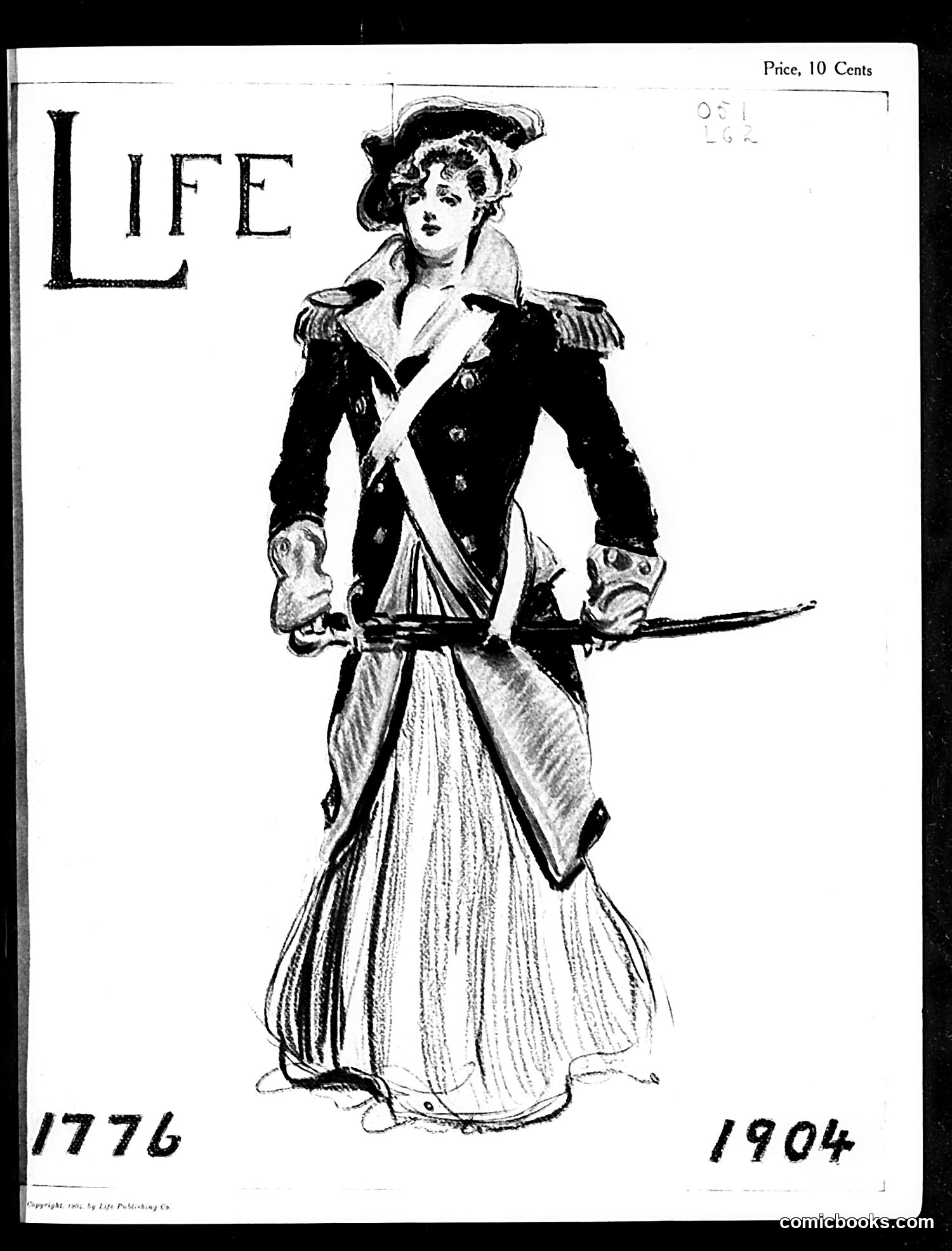
This cover illustrates the evolution of American women's fashion and social roles across 128 years. The figure combines military and civilian dress: a dark officer's coat with epaulettes and buttons paired with a full, pleated skirt. The sword suggests martial authority. The dates "1776" and "1904" frame a commentary on women's changing status—from the Revolutionary era to the early 20th century. By 1904, women were increasingly asserting public roles, entering professions, and demanding political rights (suffrage movements were gaining momentum). The satire appears to mock this transition by presenting a woman in masculine military garb, suggesting the incongruity or controversy many perceived in expanding women's social and political participation during this era.
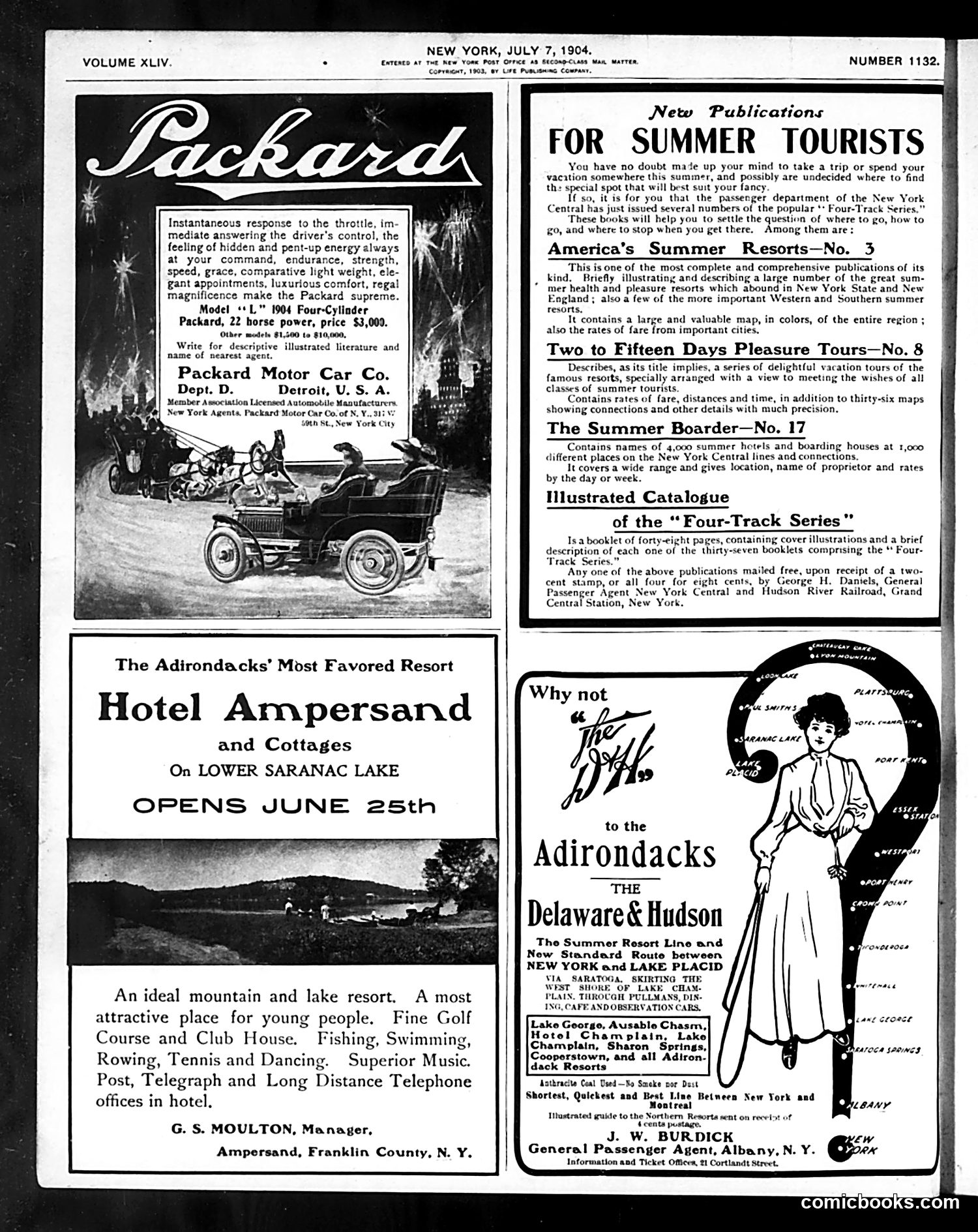
This page is **primarily advertising** rather than satire or political commentary. It contains: 1. **Packard Motor Car advertisement** (top left): Promotes a 1904 four-cylinder automobile, emphasizing luxury features like throttle control and comfort—typical early automotive marketing. 2. **Travel/tourism advertisements** (right side): Multiple ads for Adirondack Mountain resorts, including Hotel Ampersand and Delaware & Hudson Railroad services. These target wealthy summer vacationers. 3. **Illustration style**: The Packard ad includes period illustrations of the automobile; the Adirondacks ad features a stylized woman in Edwardian dress with a map, appealing to leisure travelers. The page reflects **Gilded Age consumer culture**—promoting automobiles, resort vacations, and railroad travel to affluent readers. No political satire or cartoon humor is apparent.
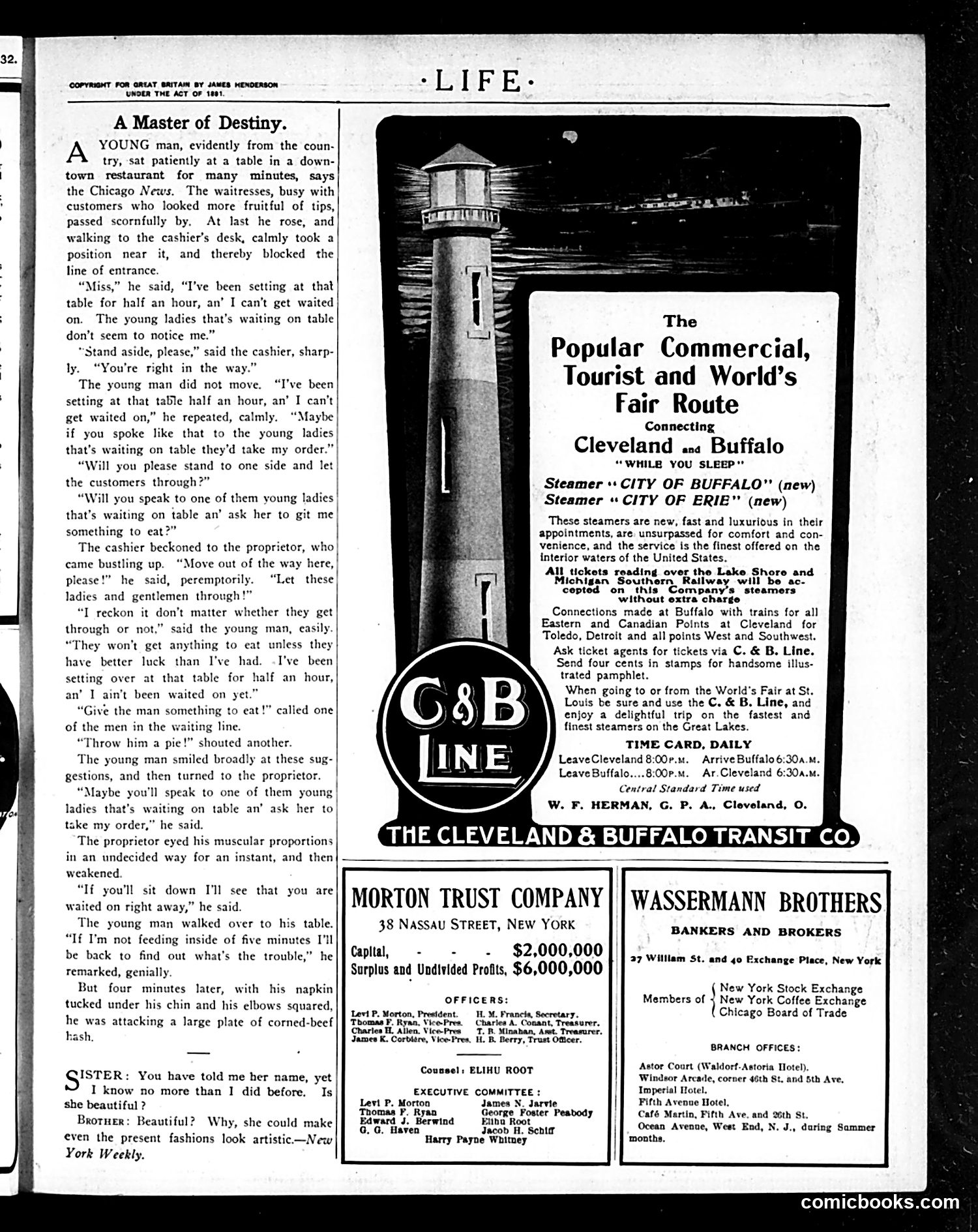
This page is primarily **advertising with a framing story**. The main content is a short satirical narrative titled "A Master of Destiny" about a young man dining alone at a restaurant who, frustrated by slow service, manipulates the waitstaff through reverse psychology—suggesting they ignore him and serve other customers instead. The proprietor eventually seats him, realizing the man's cunning approach. The satire targets **social maneuvering and manipulation** rather than any specific political figure. It's a humorous commentary on how clever psychology can achieve results in everyday situations. The page features advertisements for the C&B Line steamship service (Cleveland-Buffalo route) and financial firms (Morton Trust Company, Wassermann Brothers). This reflects typical Life magazine content mixing satirical stories with commercial advertising.
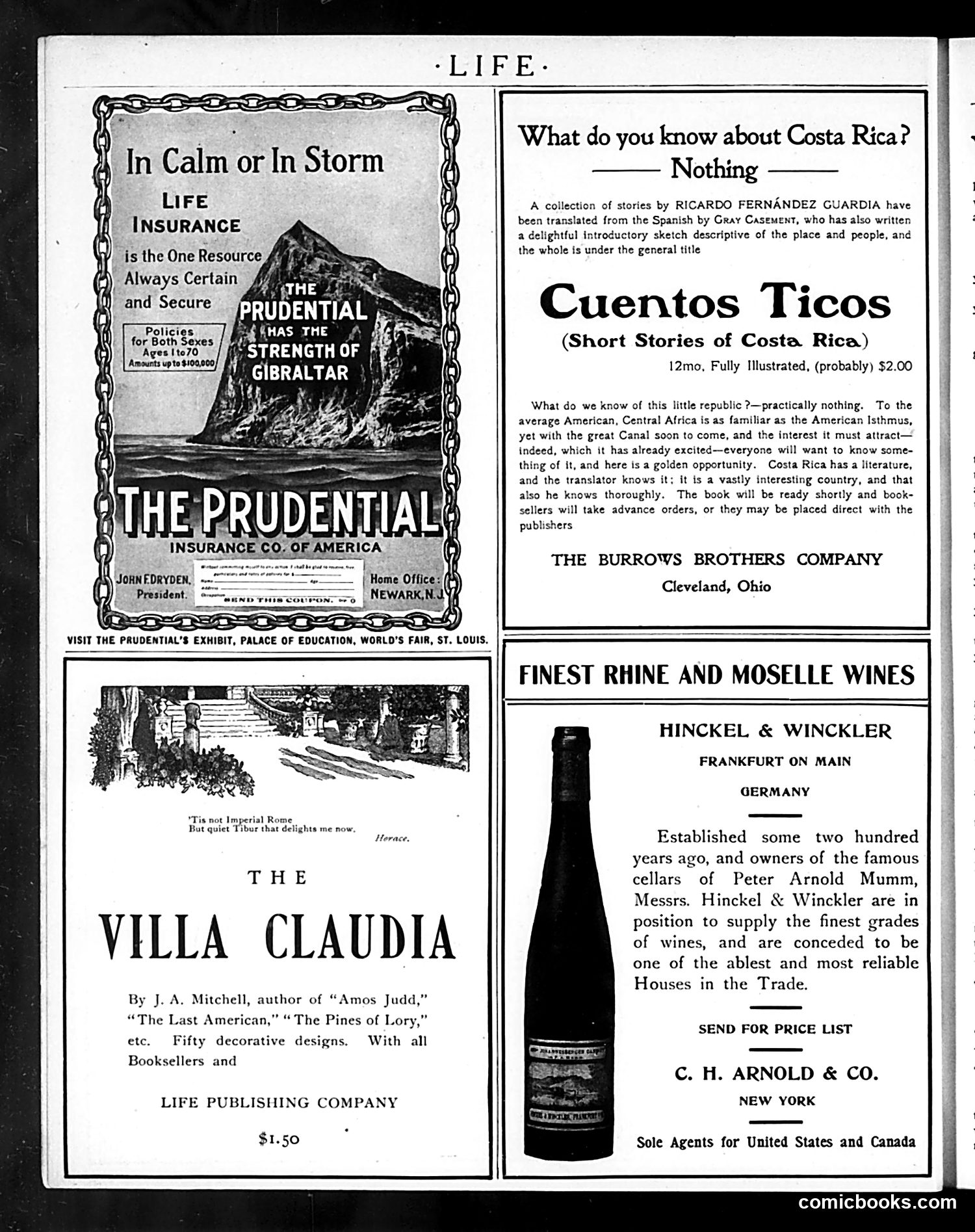
This page is primarily **advertising**, not satire or political commentary. It contains four distinct advertisements: 1. **The Prudential Insurance Co.** — A life insurance ad featuring Gibraltar's famous Rock, emphasizing stability ("strength of Gibraltar") and security for policyholders. 2. **"Cuentos Ticos"** — A book announcement for short stories about Costa Rica by Ricardo Fernández Guardia, marketed to American readers unfamiliar with Central America. 3. **"The Villa Claudia"** — A book by J.A. Mitchell, published by Life Publishing Company. 4. **Hinckel & Winckler Wines** — German Rhine and Moselle wines, with C.H. Arnold & Co. as U.S. agents. The page reflects early 20th-century advertising conventions: formal typography, institutional endorsements, and appeals to educated, affluent readers. There is no discernible satire or political content.
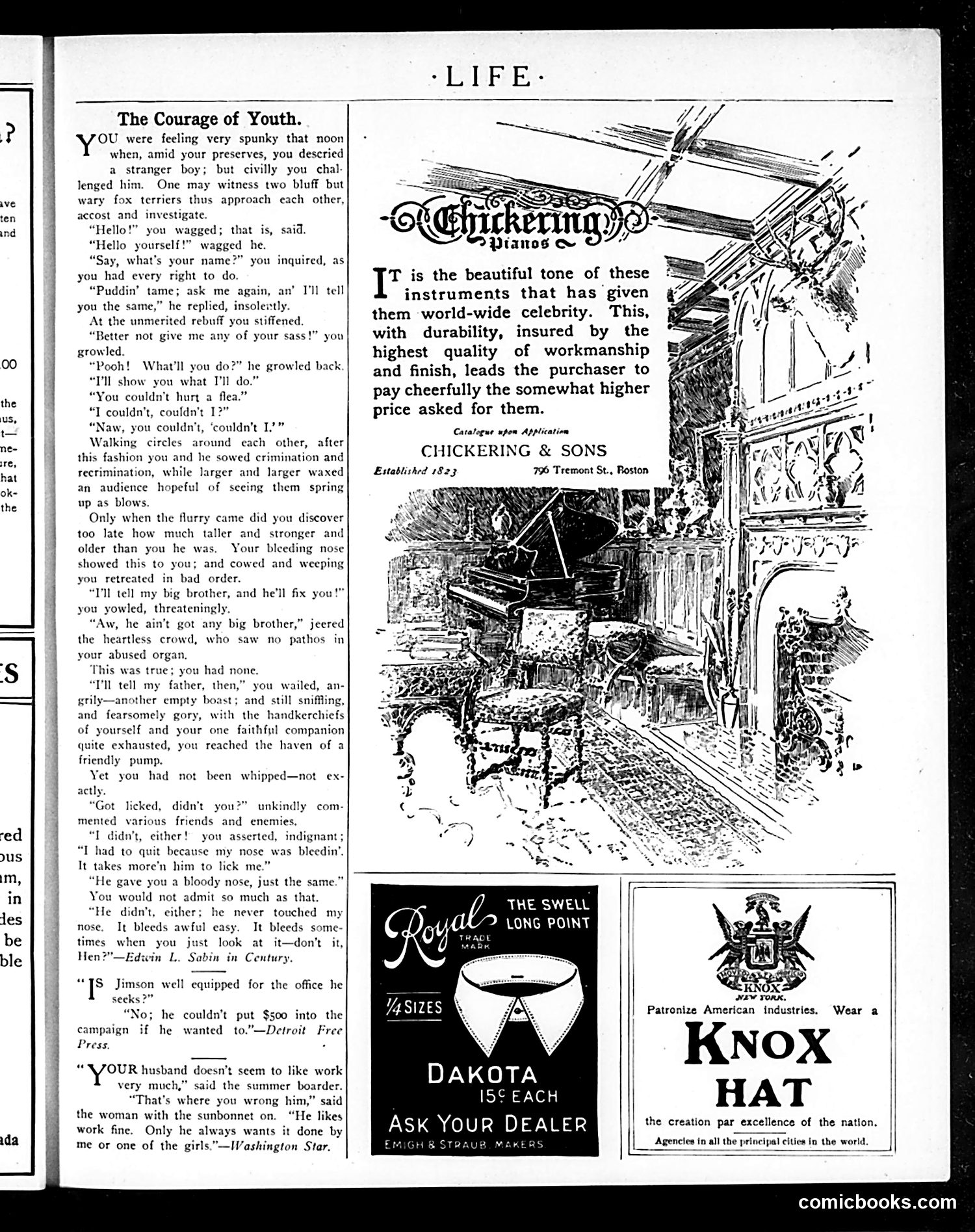
This page is primarily **advertising with one short story**. The story "The Courage of Youth" depicts a confrontation between two boys—a stranger and the narrator—who engage in verbal sparring rather than physical fighting. The narrator lacks a "big brother" to back him up, so he relies on wit and insults instead of fists. The piece appears to celebrate *cleverness over physical strength* in settling disputes among youth. The advertisements (Chickering pianos, Dakota collars, Knox hats) occupy most space, reflecting Life's commercial focus. The story's gentle mockery of childhood bravado and bluffing was typical of Life's lighthearted social commentary on American behavior and class dynamics during this era.
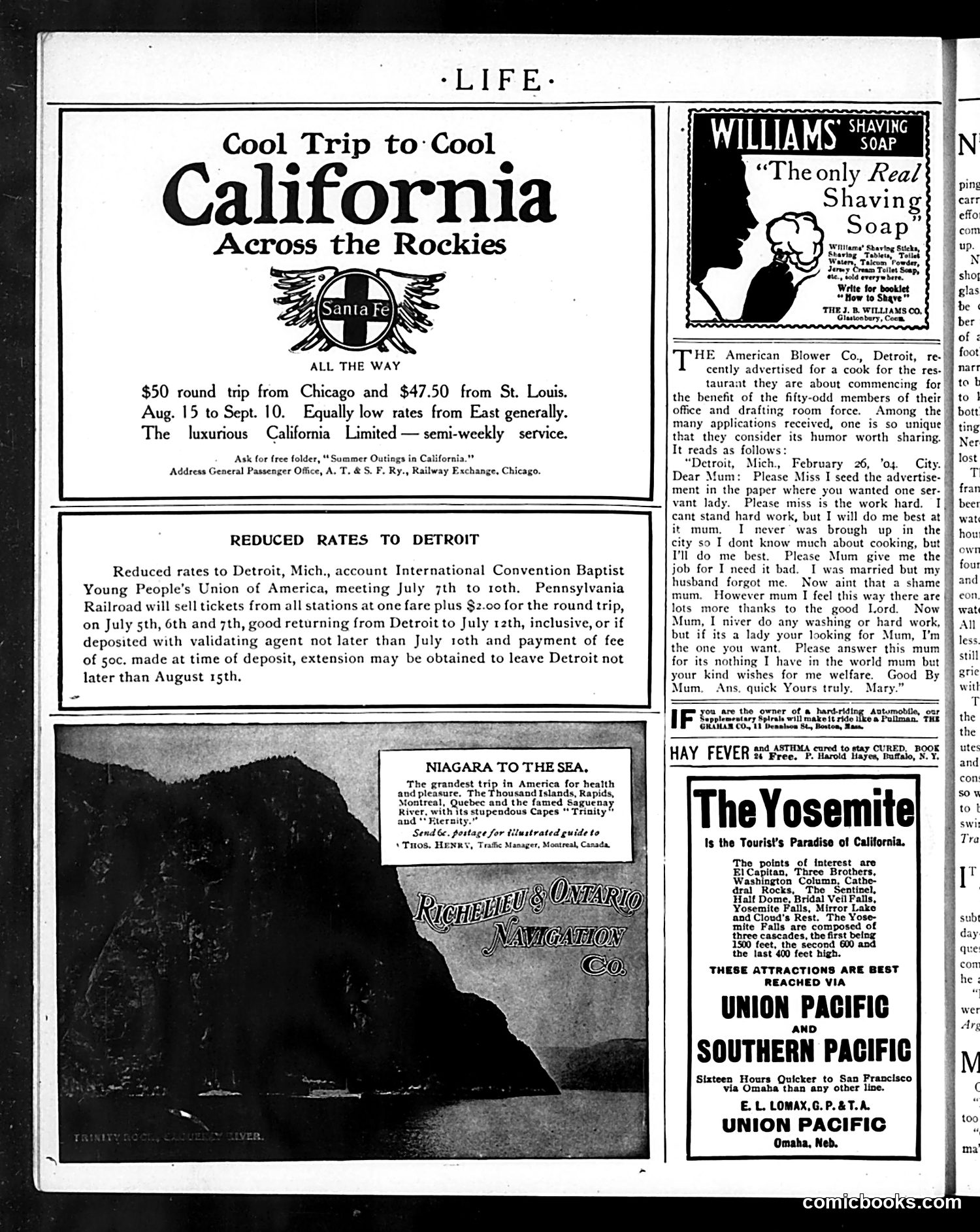
This page is **primarily advertising**, not satirical content. It contains several travel and product advertisements from the early 20th century: 1. **Santa Fe Railway ad** promoting California travel ($50 round trip from Chicago) 2. **Williams' Shaving Soap** advertisement 3. **American Blower Co.** humorous office anecdote about a cook 4. **Niagara to the Sea** tourism promotion with landscape photography 5. **Yosemite tourism ads** for Union Pacific and Southern Pacific railroads The only mildly satirical element is the American Blower Co. piece—a brief, lighthearted letter from a domestic worker seeking employment, likely meant as gentle office humor rather than pointed satire. The page reflects early 1900s consumer culture and America's emerging tourism industry. There are no political cartoons or significant social commentary present.
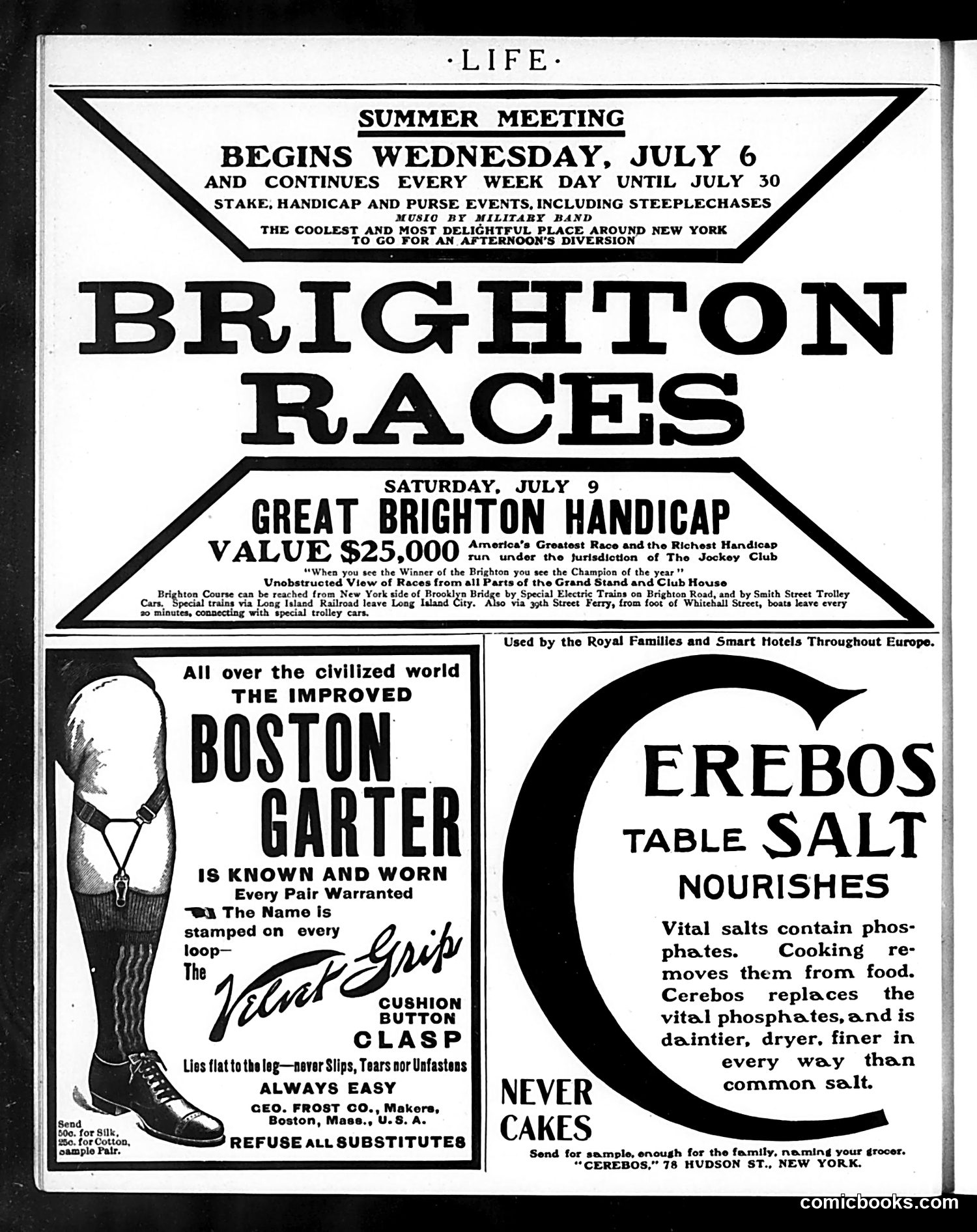
This page is primarily **advertising**, not political satire or cartooning. The top section announces Brighton Races—a horse racing venue near New York accessible by electric train and trolley. The featured race is the "Great Brighton Handicap" on Saturday, July 9, valued at $25,000, described as "America's Greatest Race." Below are two product advertisements: 1. **Boston Garter** (left): An illustrated sock garter with "Velvet Grip" cushion button clasp, marketed as reliable and preventing slips or tears. Made by Geo. Frost Co., Boston. 2. **Cerebos Table Salt** (right): A salt product claiming to contain vital phosphates that cooking removes from food, positioning itself as superior to common salt. There is no political cartoon or satire present on this page.
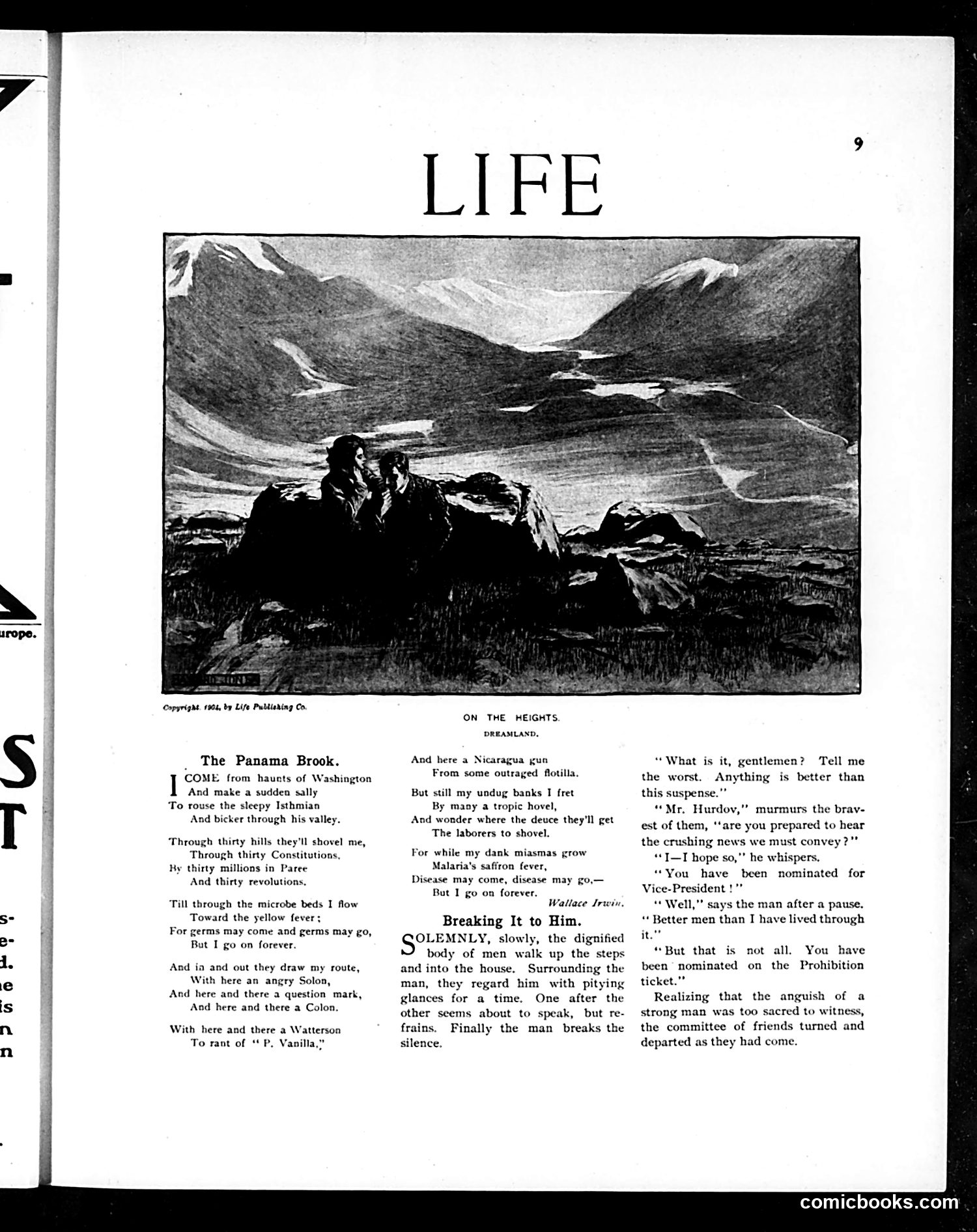
This page from *Life* magazine contains literary content rather than political satire. The header image titled "On the Heights, Dreamland" depicts two figures observing a mountainous landscape—likely illustrative rather than satirical. The page features three poems: "The Panama Brook" by Wallace Irwin, and "Breaking It to Him" (author unclear). The dialogue piece "Breaking It to Him" appears to be a brief satirical sketch about a man being informed of his nomination for Vice-President, with his concerned response suggesting reluctance or discomfort with the position. The specific historical context—which Vice-Presidential nomination this references—remains unclear without the magazine's date, but the humor derives from the subject's apparent dismay at receiving high political office.
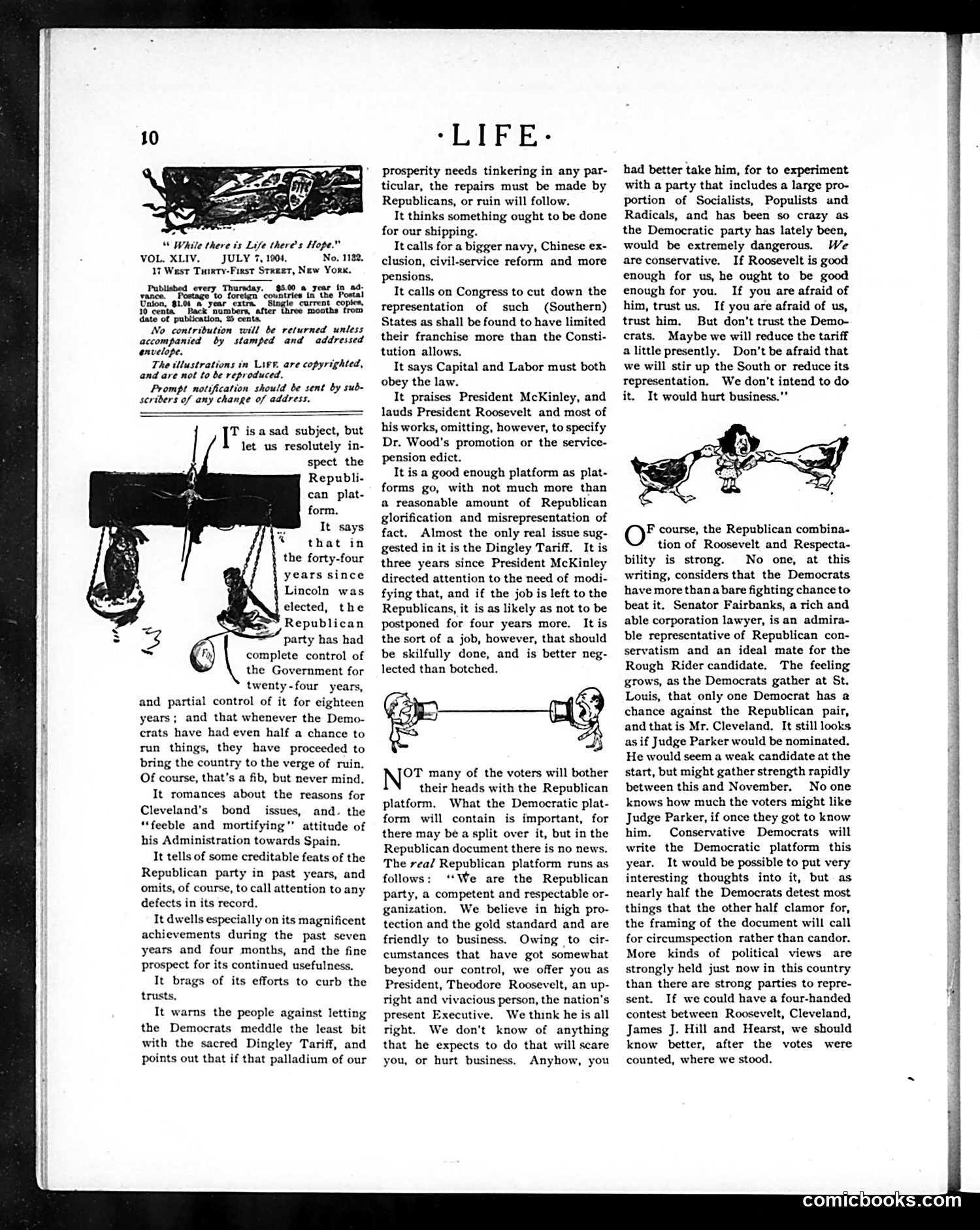
This page contains political commentary on the 1904 presidential election. The main cartoon (left side) depicts a figure hanging by a noose labeled with Democratic and Republican concerns—illustrating the precarious state of American politics. The text discusses the Republican platform's bland approach and defends Roosevelt's administration. It mocks Democratic chances, suggesting only Cleveland could compete against the Republican ticket. The piece criticizes both parties' platforms as inadequate. A small cartoon (right side) shows figures in relaxed poses, likely satirizing political complacency or the casual approach to serious governance issues. The overall message: American politics in 1904 faced genuine crises (Dinley Tariff, labor disputes) that neither party adequately addressed, leaving the nation in dangerous straits.
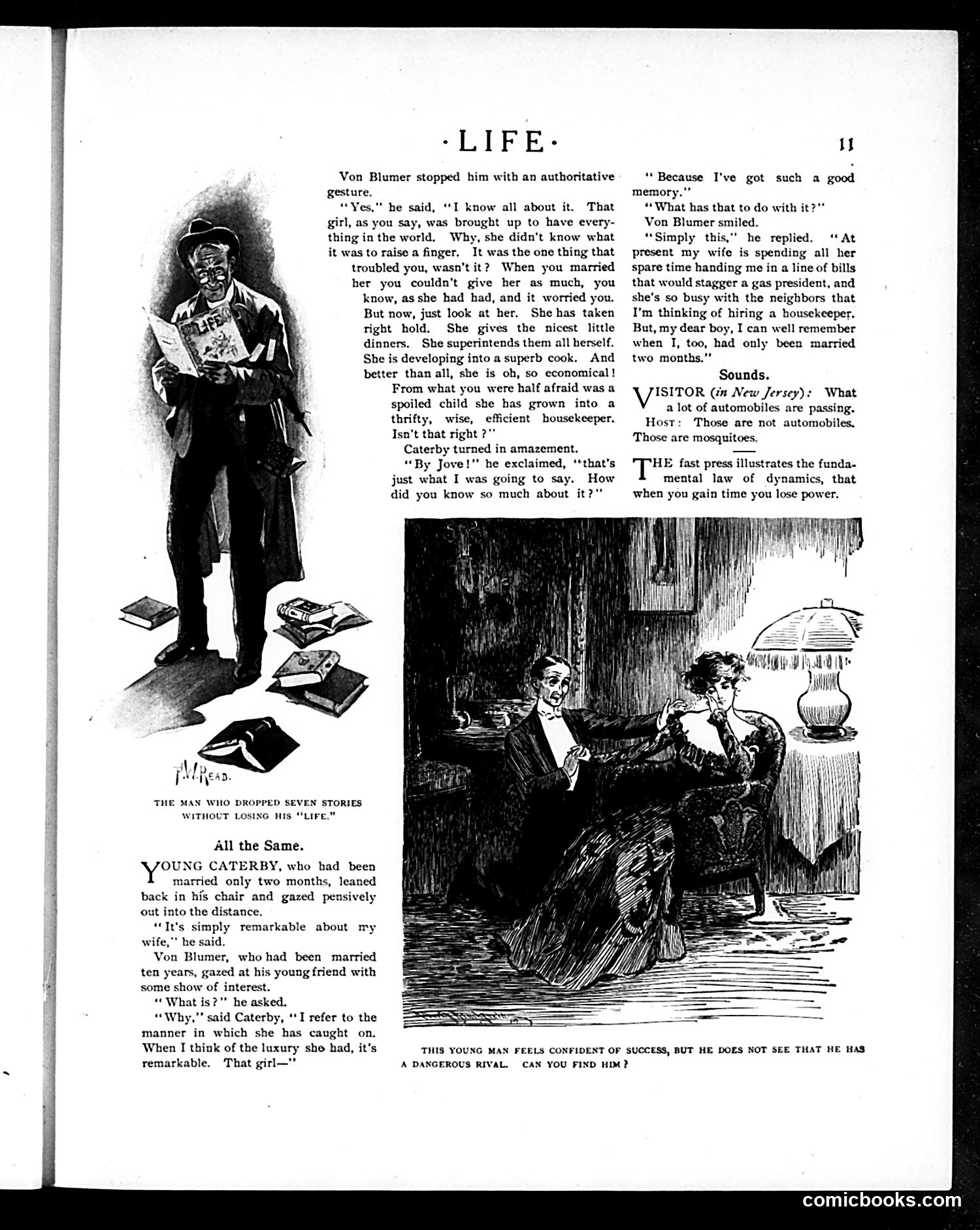
This page contains two satirical pieces from *Life* magazine: **Left cartoon**: "The Man Who Dropped Seven Stories Without Losing His 'Life'" depicts a figure dropping manuscript pages, suggesting a writer who survives professional rejection repeatedly. **Right section**: A dialogue between "Young Caterby" and "Von Blumer" discusses marriage and household management. Caterby expresses amazement at his wife's domestic competence—her cooking, economical management, and efficiency as a housekeeper. Von Blumer, married ten years, responds that such qualities are "all the same," implying they're unremarkable. The satire targets early 20th-century gender expectations: Caterby's wonder at basic wifely competence reflects the era's limited expectations for women's roles, while the older Von Blumer's jaded response mocks romantic idealization of domestic life. The bottom illustration shows a competitive domestic scene, reinforcing marriage as a performance arena.
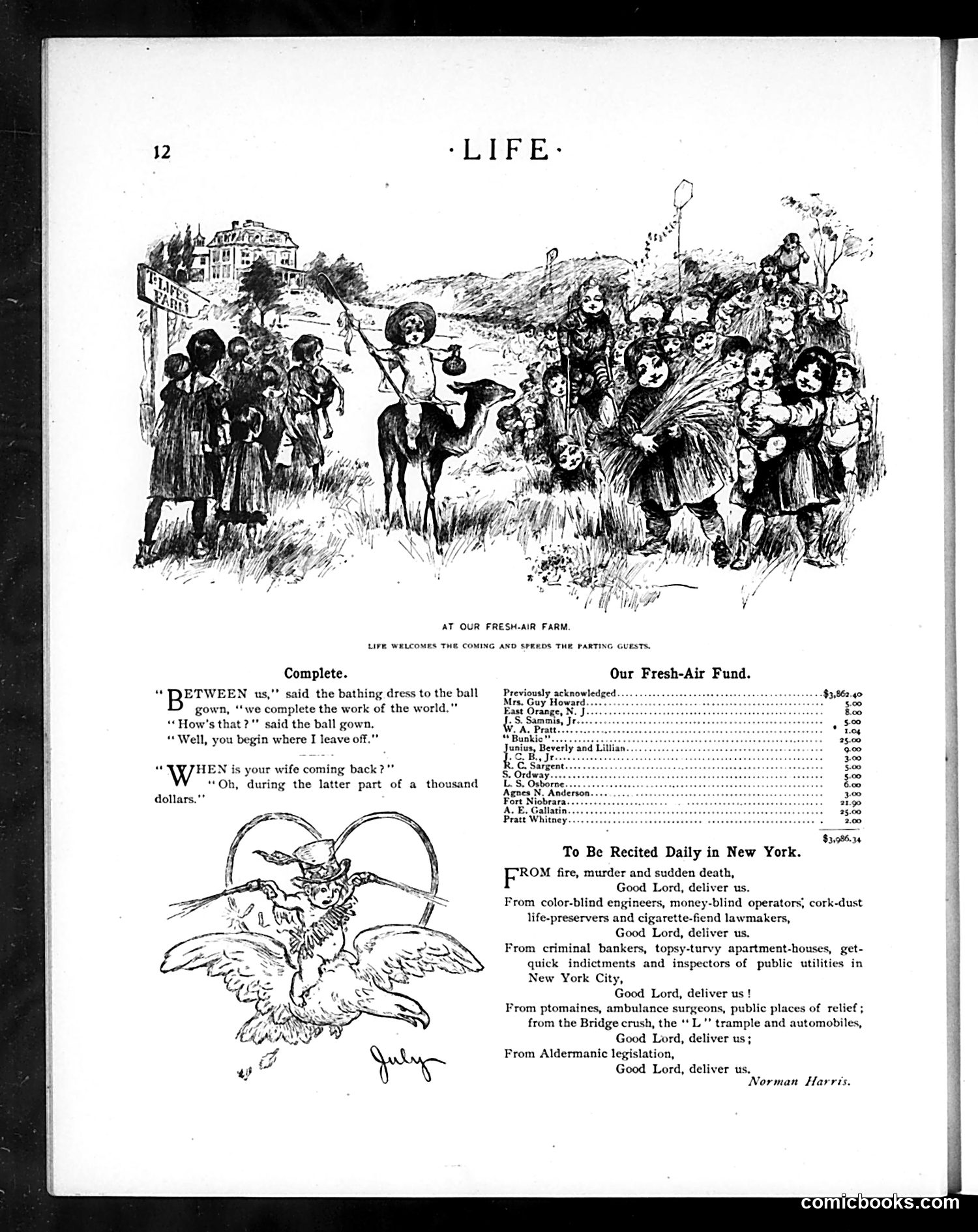
This page contains satirical humor and social commentary typical of early Life magazine. The top illustration depicts a "Fresh-Air Farm" scene—an urban charity program that brought city children to the countryside. The caption notes "Life welcomes the coming and speeds the parting guests," suggesting satire about these charitable endeavors. Below are two brief comedic dialogues mocking marital discord and domestic expectations, followed by a winged devil/imp illustration. The right side lists donors to the "Fresh-Air Fund" and includes "To Be Recited Daily in New York," a prayer-parody by Norman Harris listing urban hazards (fires, corrupt officials, dangerous transit) residents should fear—satirizing contemporary New York City's chaotic conditions and dangers. This mock-prayer format was common satirical commentary on industrial-era American urban life.
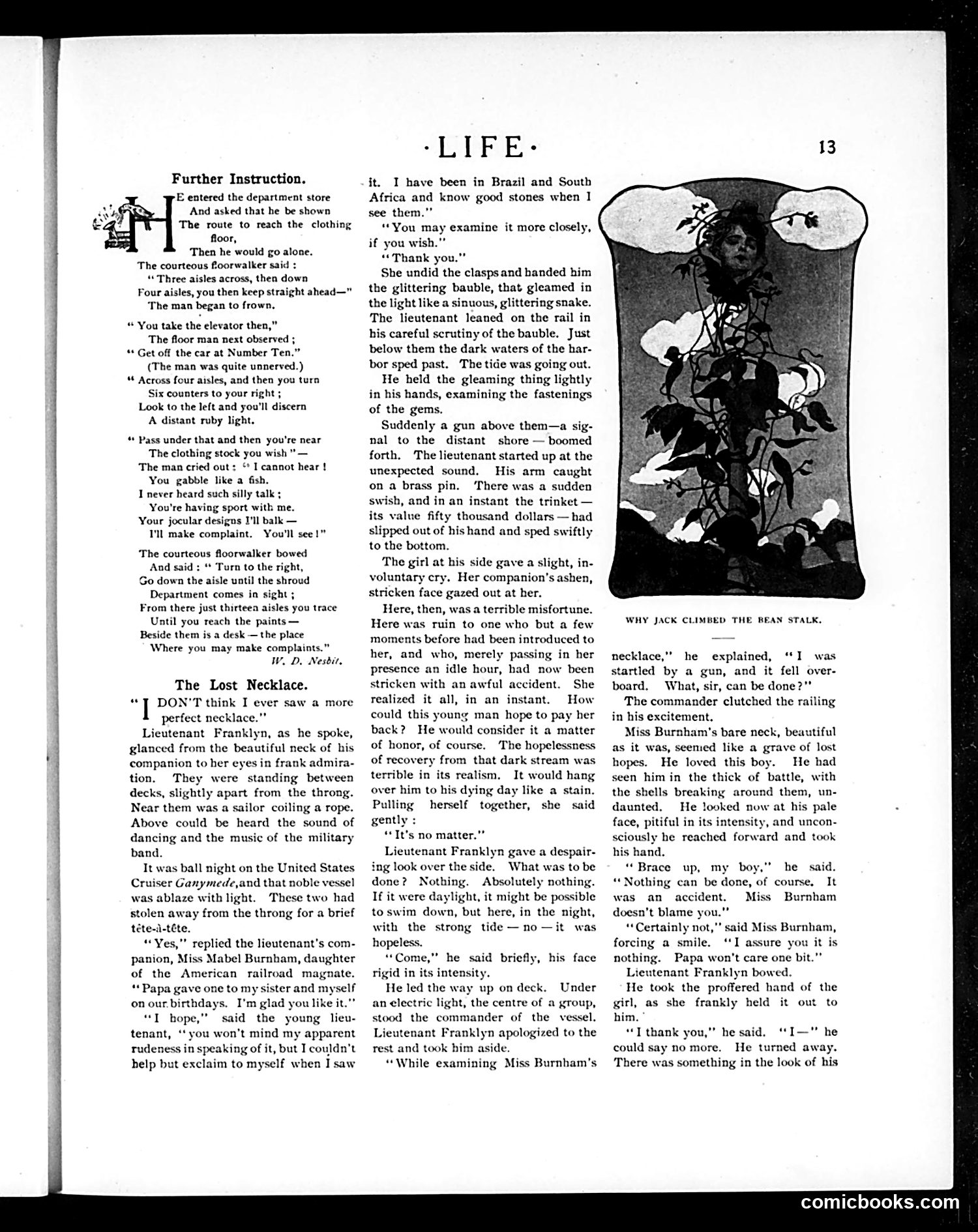
This page contains two pieces: a humorous poem about department store navigation (top left) and the beginning of a serialized romantic story (right). **The main illustrated story** depicts a dramatic moment aboard the USS *Ganymede*, a naval cruiser. Lieutenant Franklyn, examining a $50,000 diamond necklace belonging to Miss Mabel Burnham (daughter of a railroad magnate), is startled by a cannon signal. His arm jerks, the necklace slips overboard into the harbor. **The social context**: This appears to be early 20th-century melodrama—a common *Life* magazine feature. The setup contrasts a naval officer of modest means with a wealthy heiress, using the lost necklace as a plot device to create tension about honor and financial ruin. The illustration shows the moment of disaster with period-appropriate naval aesthetics. Modern readers would recognize this as serialized fiction entertainment—the precursor to soap operas—designed to keep readers returning to the magazine for the next installment's resolution.
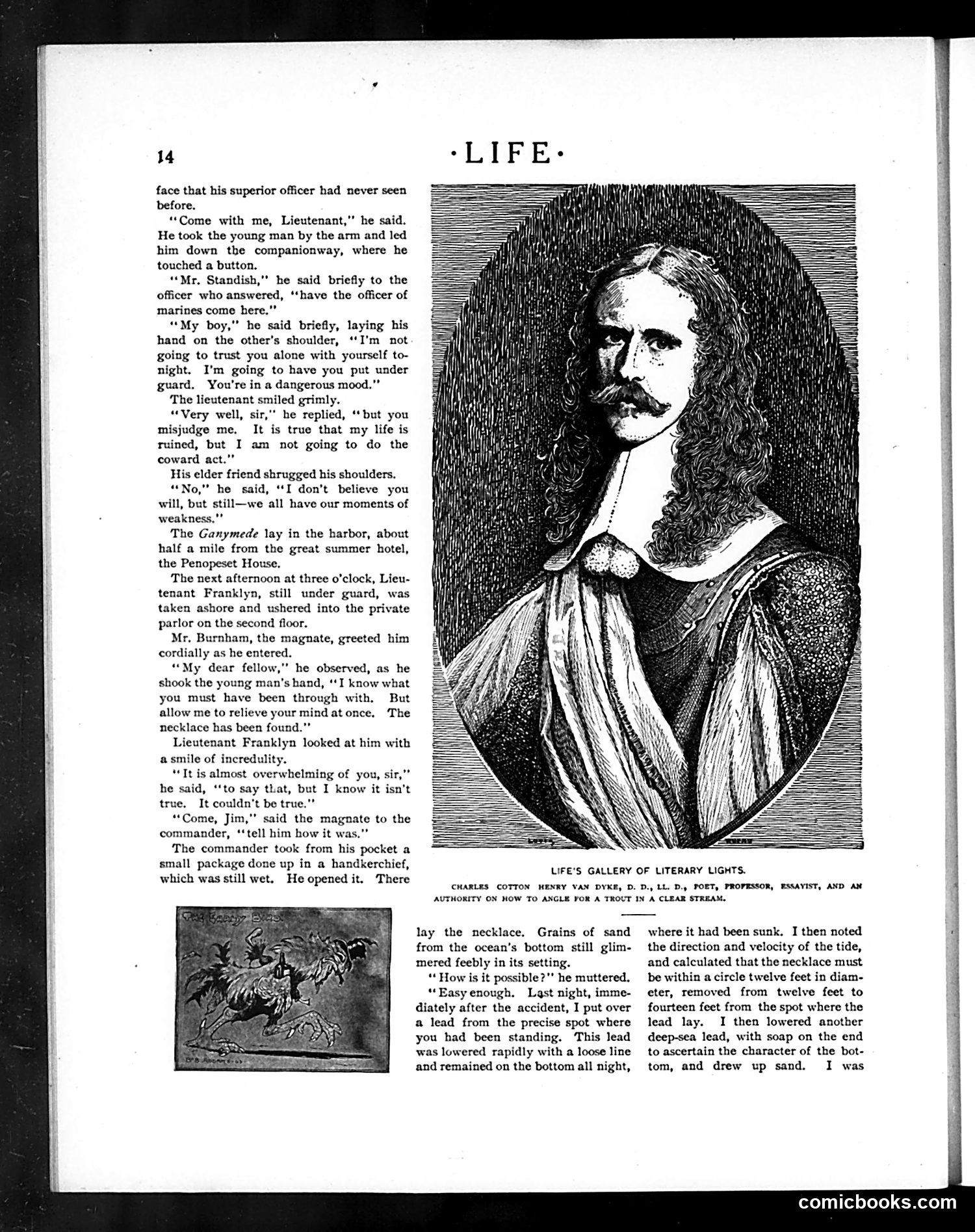
This page presents a serialized fiction narrative about a naval officer (Lieutenant Franklyn) whose reputation has been damaged by a lost necklace. The dramatic tension involves whether he'll commit suicide while under guard. The main illustration shows a portrait labeled "Life's Gallery of Literary Lights"—featuring Charles Cotton, Henry Van Dyke, and others, presented as authorities on leisure pursuits like trout fishing. This is satirical: the page contrasts high-minded literary figures with the melodramatic naval romance narrative below. The story's resolution appears anticlimactic: a commander recovers the necklace through mundane scientific method (using weighted leads and tide calculations to locate it on the ocean floor). The satire likely mocks both the overwrought emotional drama of the narrative and the gap between literary pretension and practical reality—the "literary lights" heading undercuts the sentimental story below it.
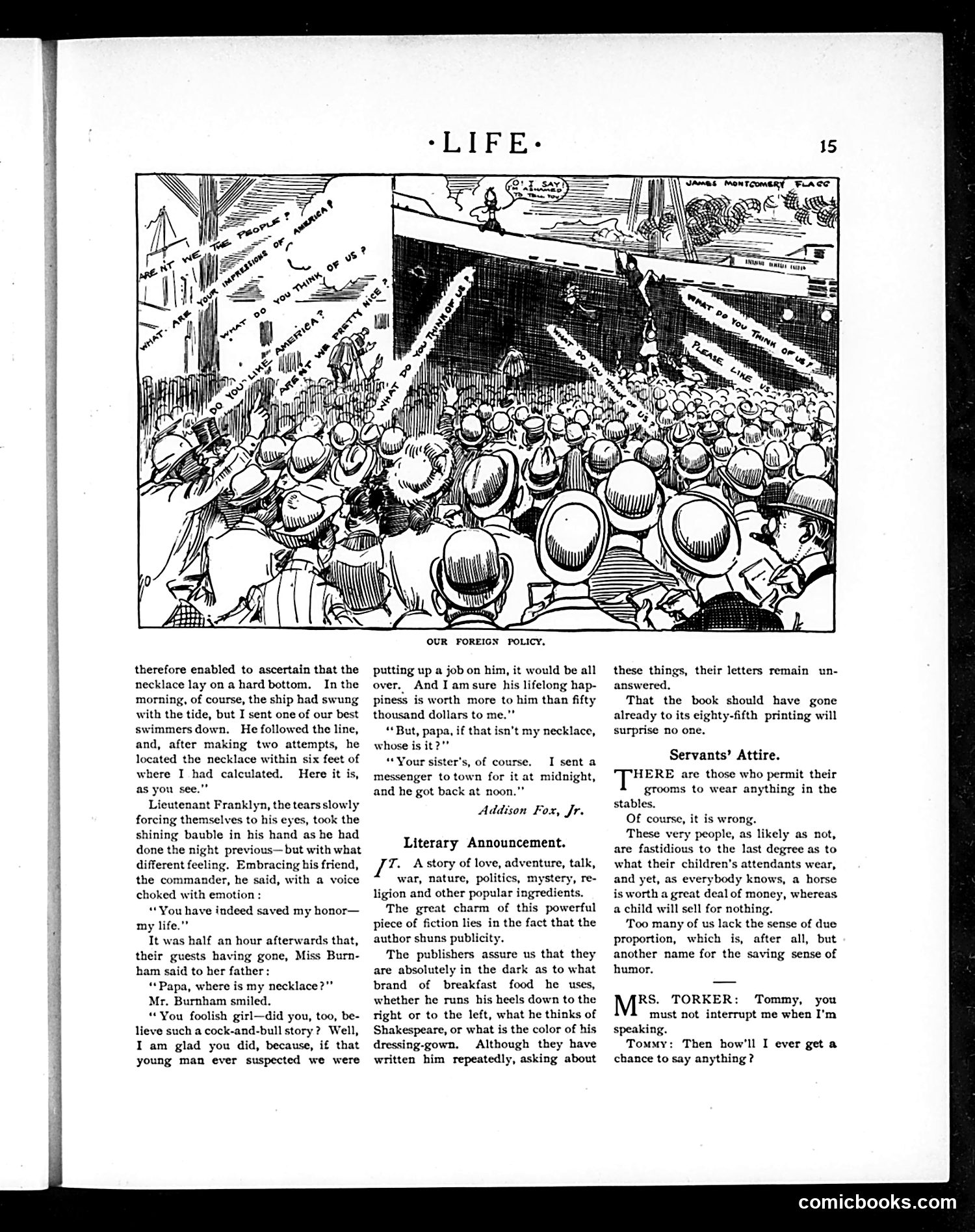
The political cartoon depicts a massive crowd of men wearing bowler hats gathered around ships and harbor infrastructure, with various speech bubbles containing phrases about "foreign policy." The image satirizes American foreign policy interventionism—likely from the early 20th century based on the style. The cartoon suggests that U.S. foreign policy is driven by commercial interests and military posturing rather than genuine diplomatic principles. The crowded, chaotic scene of businessmen and officials suggests that American involvement abroad serves primarily economic purposes. The titled caption "Our Foreign Policy" indicates this depicts how America conducts international relations. The accompanying text contains an unrelated short story about a recovered necklace, making this a typical Life magazine page mixing satirical cartoons with fiction.
This page contains two satirical pieces from Life magazine. **"The Cat"** is a humorous poem praising cats' independence and dignity compared to dogs' servile nature. It celebrates feline self-sufficiency—cats hunt for themselves rather than performing tricks for humans, they don't debase themselves seeking approval, and they resist domestication. The satire mocks human attempts to control animals and admires the cat's refusal to participate in man-pleasing activities. **"Some Future Society Nuptials"** satirizes wealthy Manhattan wedding culture through absurdist scenarios: speculators scalping wedding tickets, false alarms requiring police response, and—most pointedly—the ushers are named after famous contemporary boxers (Jeffries, Fitzsimmons, Sharkey, Corbett, Ruhlín, McCoy), who will "weigh in" like prizefighters. This mocks the commodification and spectacle of high-society weddings, treating them as entertainment events comparable to boxing matches rather than intimate ceremonies.
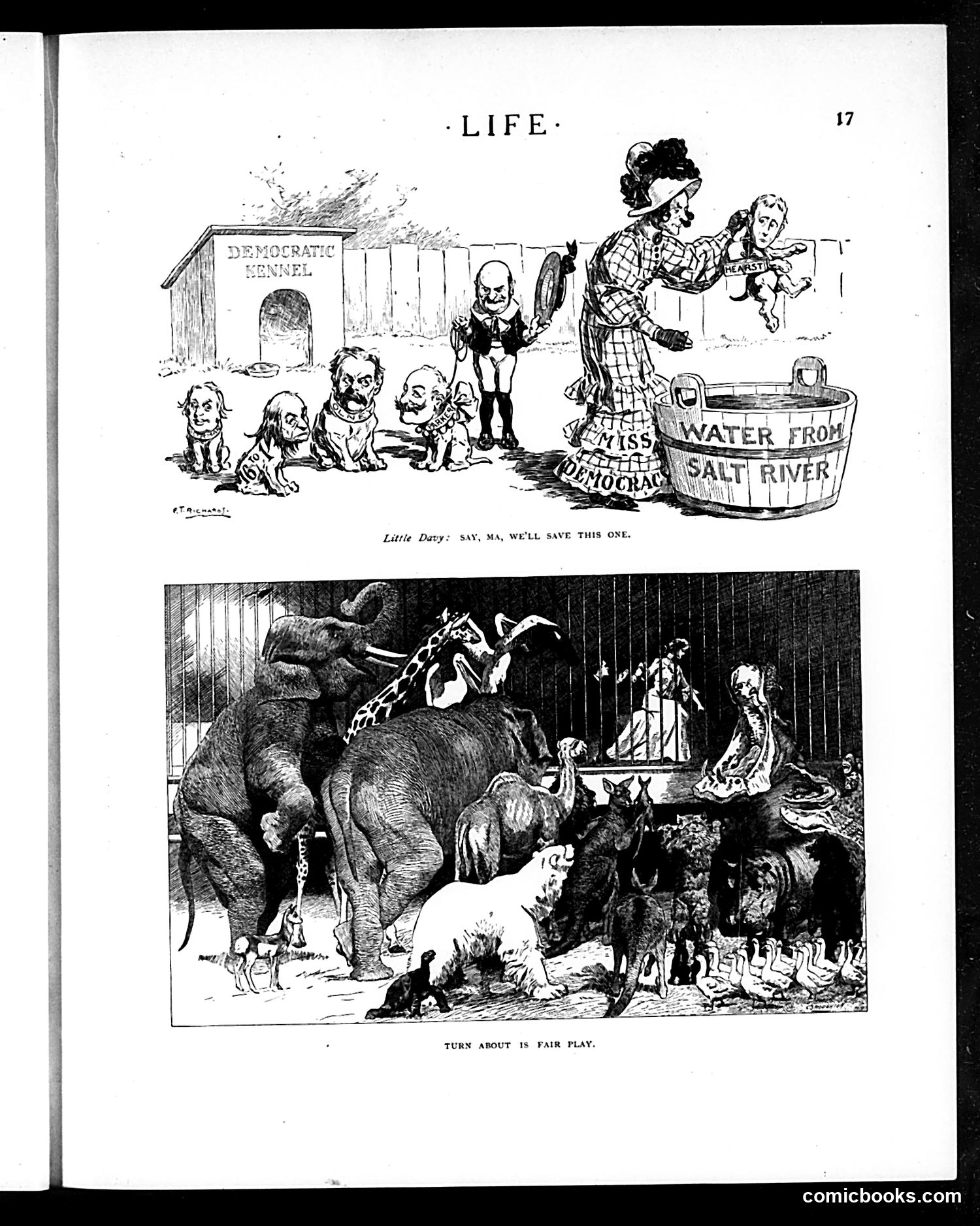
This page contains two political cartoons satirizing Democratic Party dysfunction and leadership crises. The **top cartoon** depicts the Democratic Party as a dilapidated building with party leadership shown as incompetent figures struggling to manage a brood of misbehaving "puppies" (representing party factions). A woman draws "water from salt river"—a period phrase meaning political defeat or ruin. The caption "we'll save this one" suggests futile attempts to salvage the party. The **bottom cartoon**, titled "Turn About is Fair Play," shows animals at what appears to be a circus or performance, likely satirizing political "performances" and the idea that Democrats are receiving their own treatment in return. Both cartoons mock Democratic Party instability, poor leadership, and internal conflicts during what appears to be the late 19th or early 20th century—though the specific political moment remains unclear without a date.
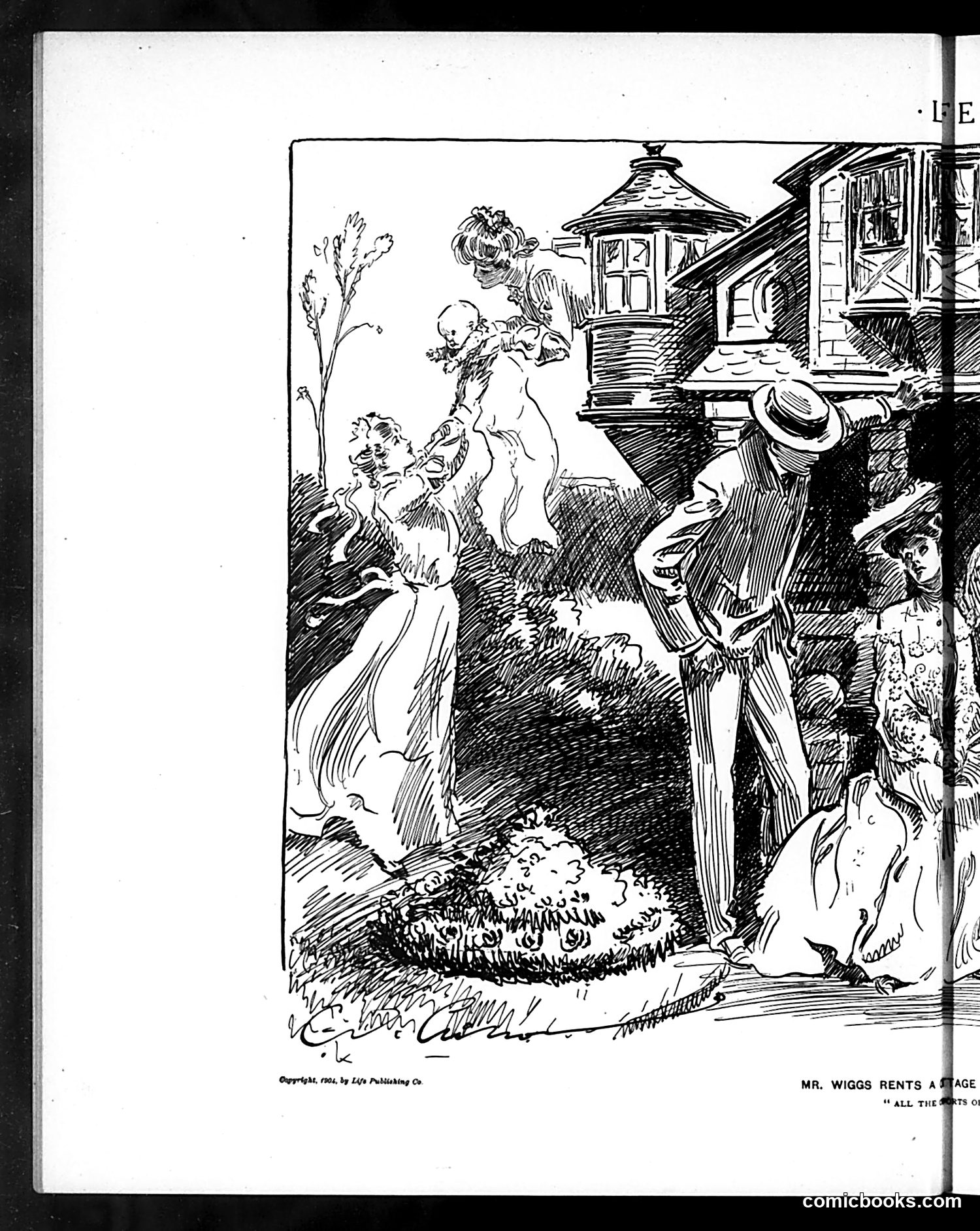
This appears to be an illustration from Life magazine (1904) titled "Mr. Wiggs Rents a Stage." The image shows what seems to be a theatrical or domestic scene with multiple figures in early 1900s dress. A man in a straw hat and suit appears central to the action, interacting with several other characters near a house with a distinctive turret. However, the OCR text is incomplete and fragmentary ("ALL THE" cuts off mid-phrase), making the full satirical point unclear. Without the complete caption or article text, I cannot definitively identify who "Mr. Wiggs" is or what specific social/political commentary this cartoon makes. It may reference a contemporary character or situation from 1904, but the specific reference is not evident from the visible material alone.
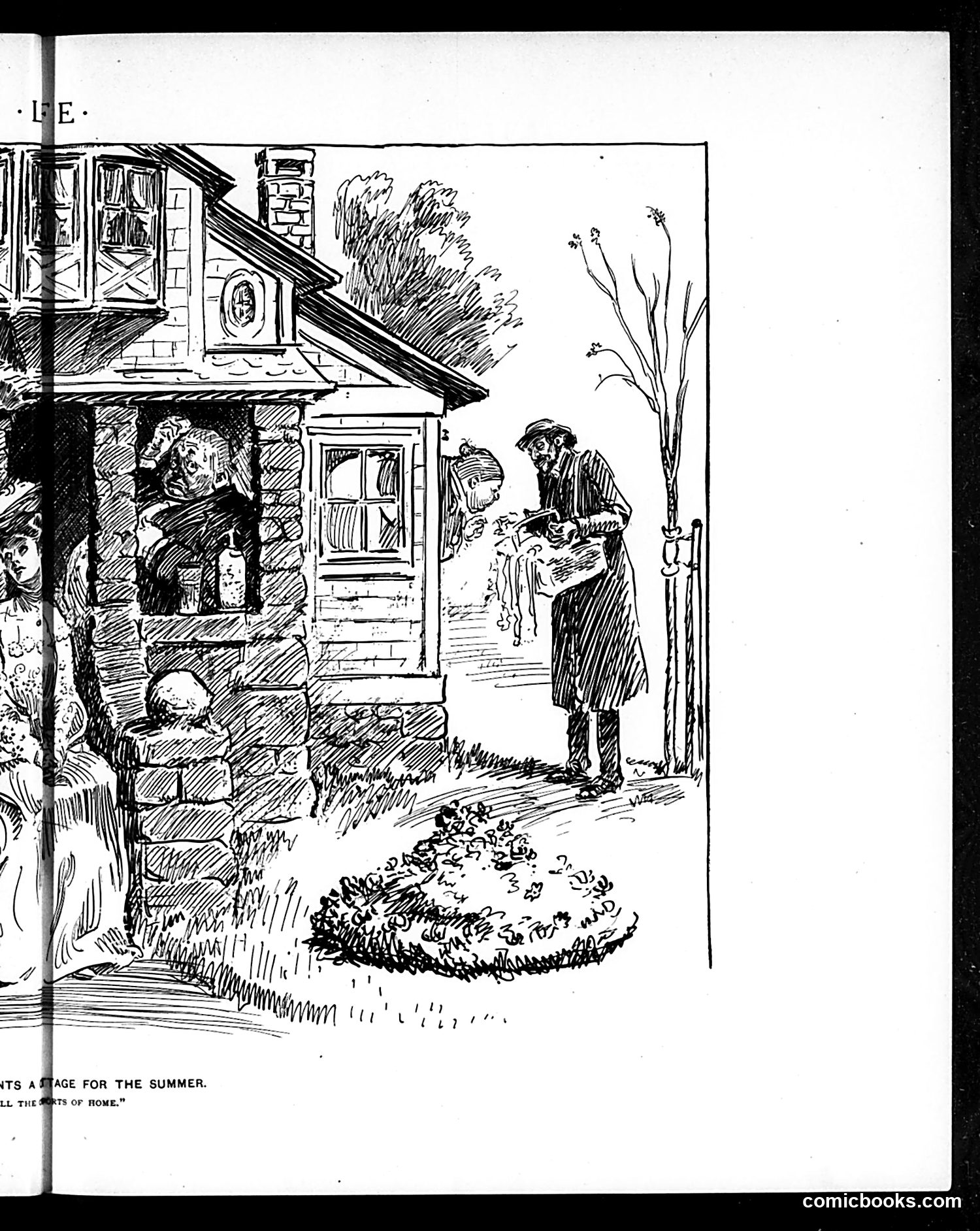
This appears to be a **Life magazine illustration** depicting a domestic scene outside a cottage. The visible text fragment references "a page for the summer" and "all the [comforts] of home." The sketch shows two figures outside a modest house with a tall plant—likely satirizing **summer cottage life or vacation aspirations**. The style and setting suggest early-to-mid 20th century American domestic life. However, the OCR text is too fragmentary to determine the specific satirical point. Without the complete caption or article text, I cannot identify whether this mocks: - Urban families attempting rural retreats - Real estate marketing - Architectural pretension - Or another social theme entirely **The visual joke requires the full accompanying text to interpret accurately.**
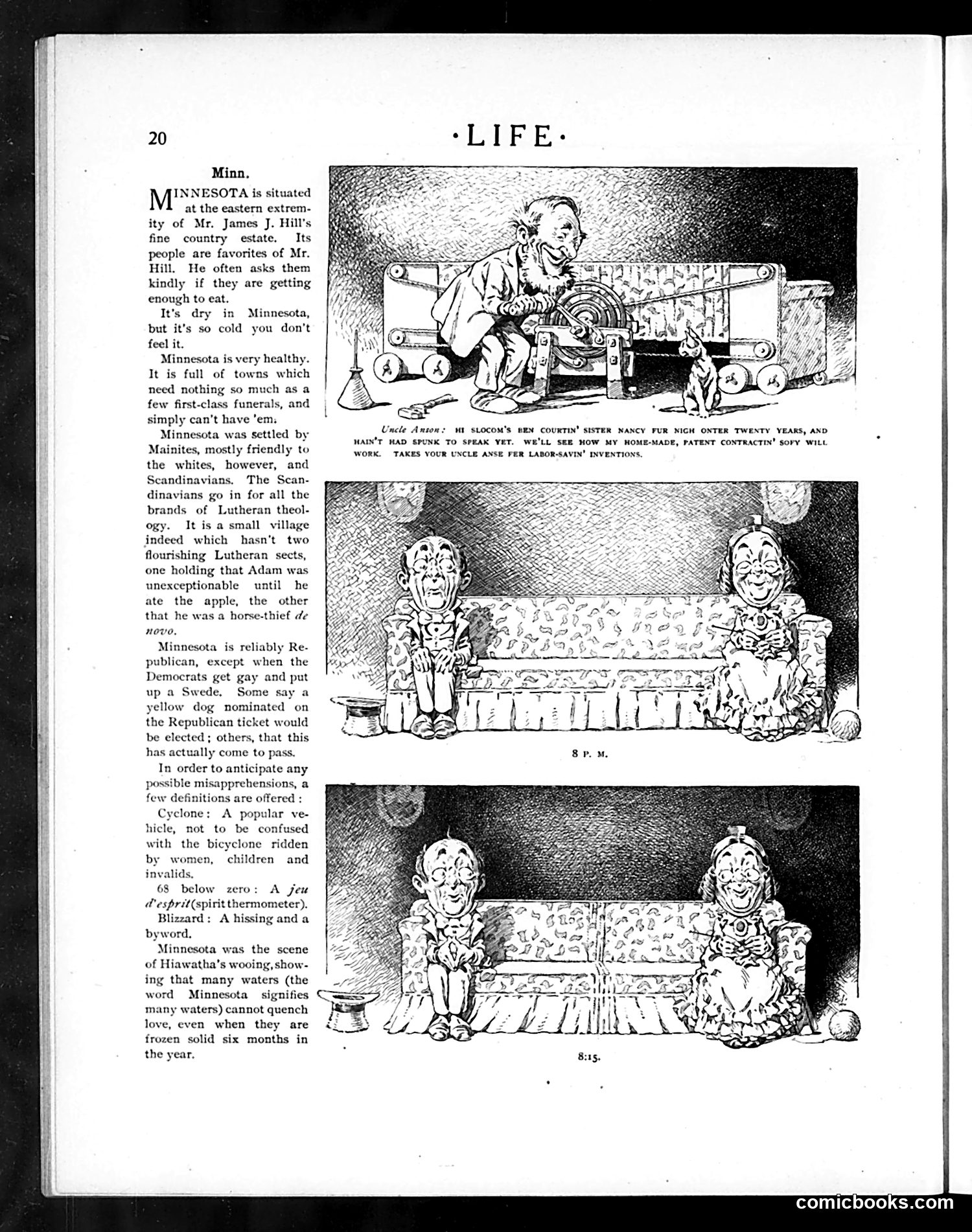
This page from *Life* magazine satirizes Minnesota through humorous commentary and three cartoon panels. The text mocks the state's harsh climate, religious divisions among Scandinavian settlers, and its reliably Republican politics—except when Democrats "put up a Swede." The opening establishes that Minnesota is located on railroad magnate James J. Hill's "country estate," sarcastically suggesting his economic dominance over the region. The cartoons below depict "Uncle Anson," an inventor character, attempting to patent a "labor-savin' invention"—a sofa designed to facilitate courtship between two reluctant people (his sister Nancy and "Mi Slocom"). The joke relies on frontier humor about backwardness and the inventor-charlatan type common to *Life*'s comedy. The satire targets both regional provincialism and patent-scheme absurdity.
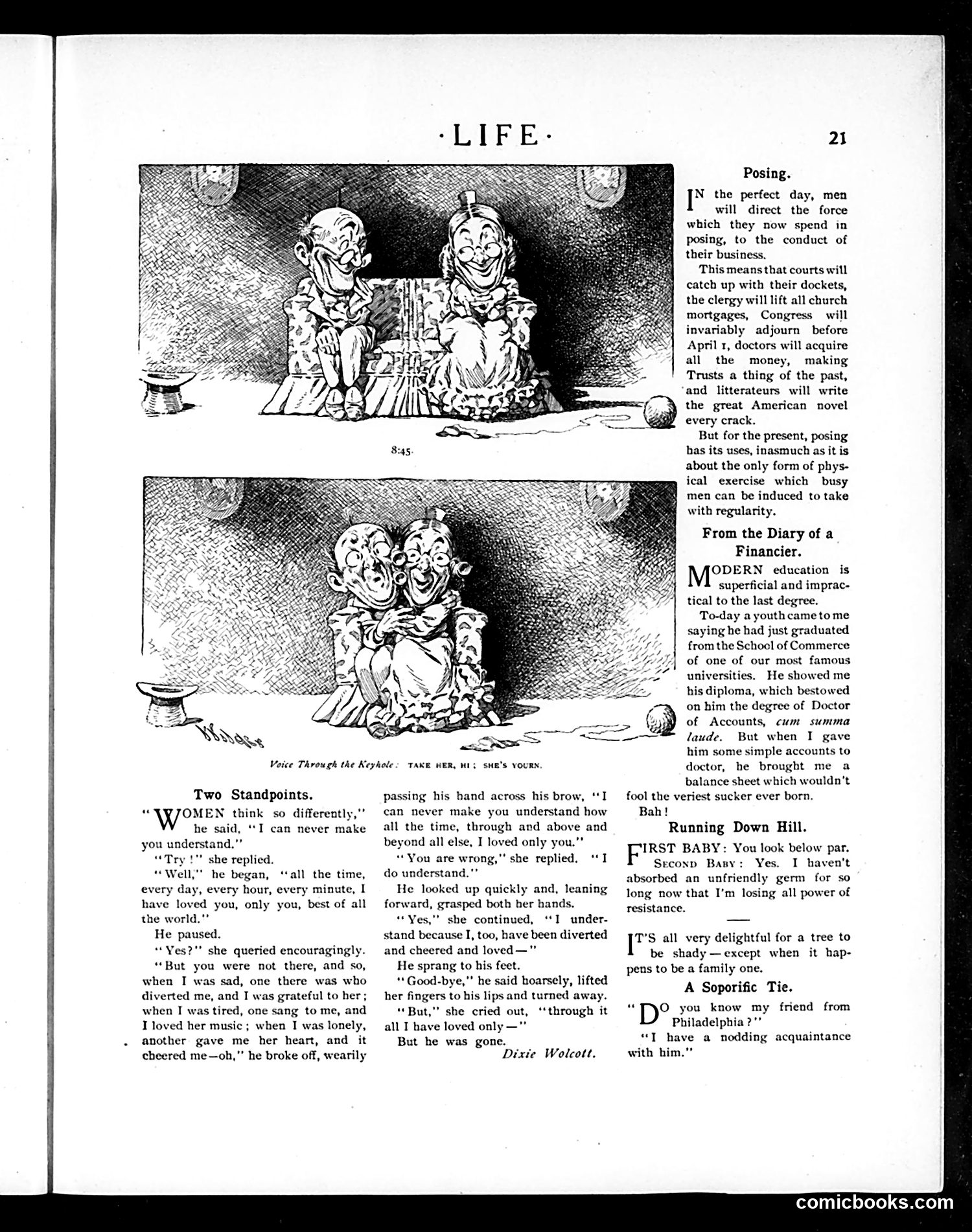
This page contains several short satirical pieces typical of early 20th-century *Life* magazine humor: **"Two Standpoints"** (main cartoon): A man confesses he loved only his wife despite being "diverted" by other women when sad, tired, or lonely. When she claims to understand because she too was "diverted and cheered and loved," he immediately leaves. The satire exposes male hypocrisy: men expect forgiveness for infidelity justified by continued "true love," but cannot accept the same logic from women—revealing the double standard in contemporary marriage expectations. **Other brief pieces** mock modern pretensions: "Posing" satirizes busy men's vanity; "From the Diary of a Financier" ridicules universities awarding inflated degrees to graduates unprepared for real work; "A Soporific Tie" makes a pun about boring acquaintances. The humor targets established institutions and social hypocrisy rather than specific political figures or events.
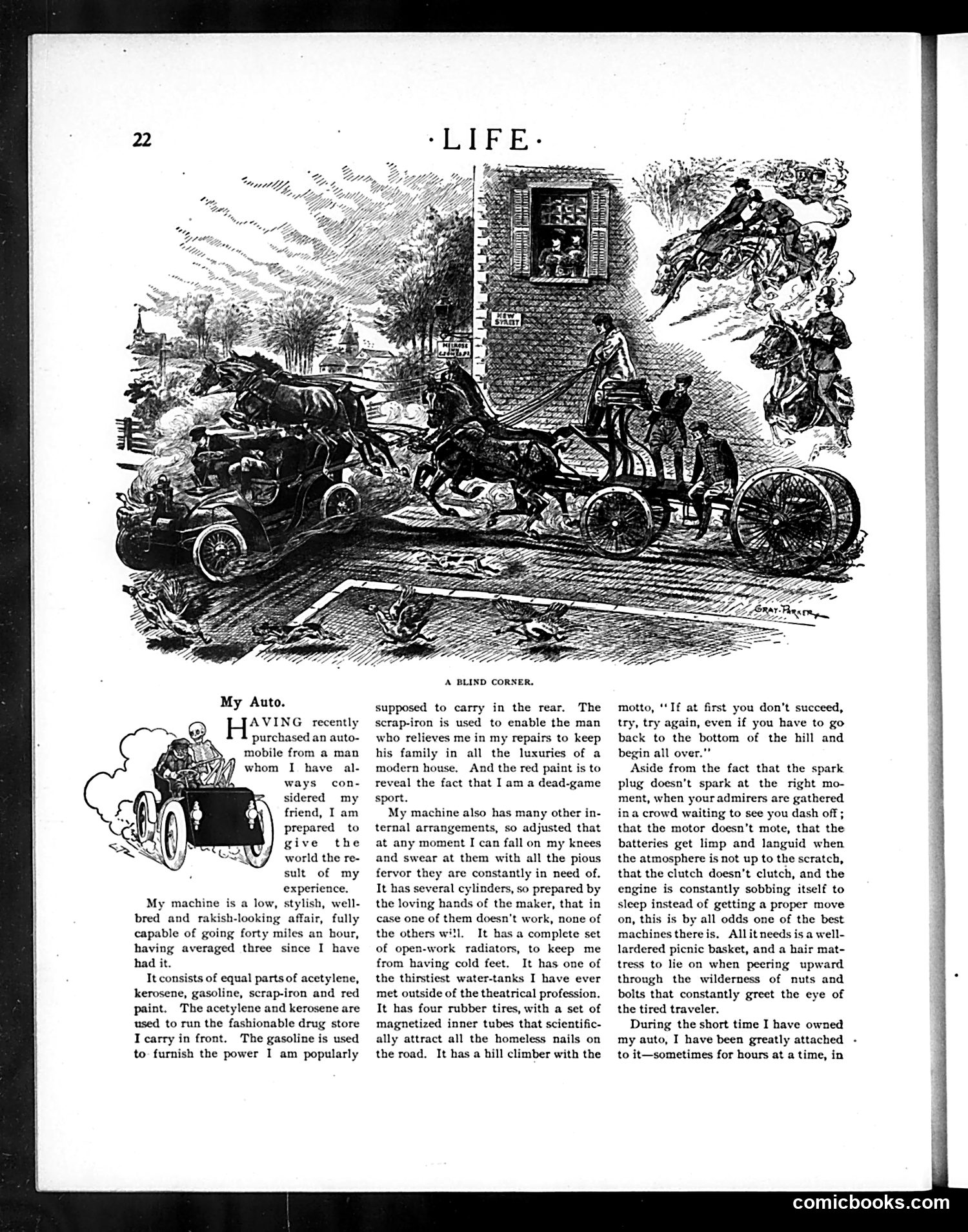
This page presents a humorous first-person account mocking the early automobile. The elaborate illustration titled "A Blind Corner" depicts a chaotic street scene with early cars colliding or careening dangerously, establishing the comedic tone. The text is a sarcastic complaint from an auto owner describing his vehicle as a barely-functional contraption assembled from "acetylene, kerosene, gasoline, scrap-iron and red paint." He sardonically catalogs its failures: engines that won't start, radiators that overheat, spark plugs that misfire, clutches that don't engage, and magnetized wheel rims that attract nails. The satire targets early automobiles as unreliable, dangerous, and expensive nuisances—a sharp contrast to their promotion as modern marvels. The owner's mock-heroic tone ("dead-game sport," constant prayer and swearing) emphasizes the frustration and humiliation of owning such problematic machines. This reflects genuine public skepticism about automobiles in the early 1900s, before they became reliable or affordable for average Americans.
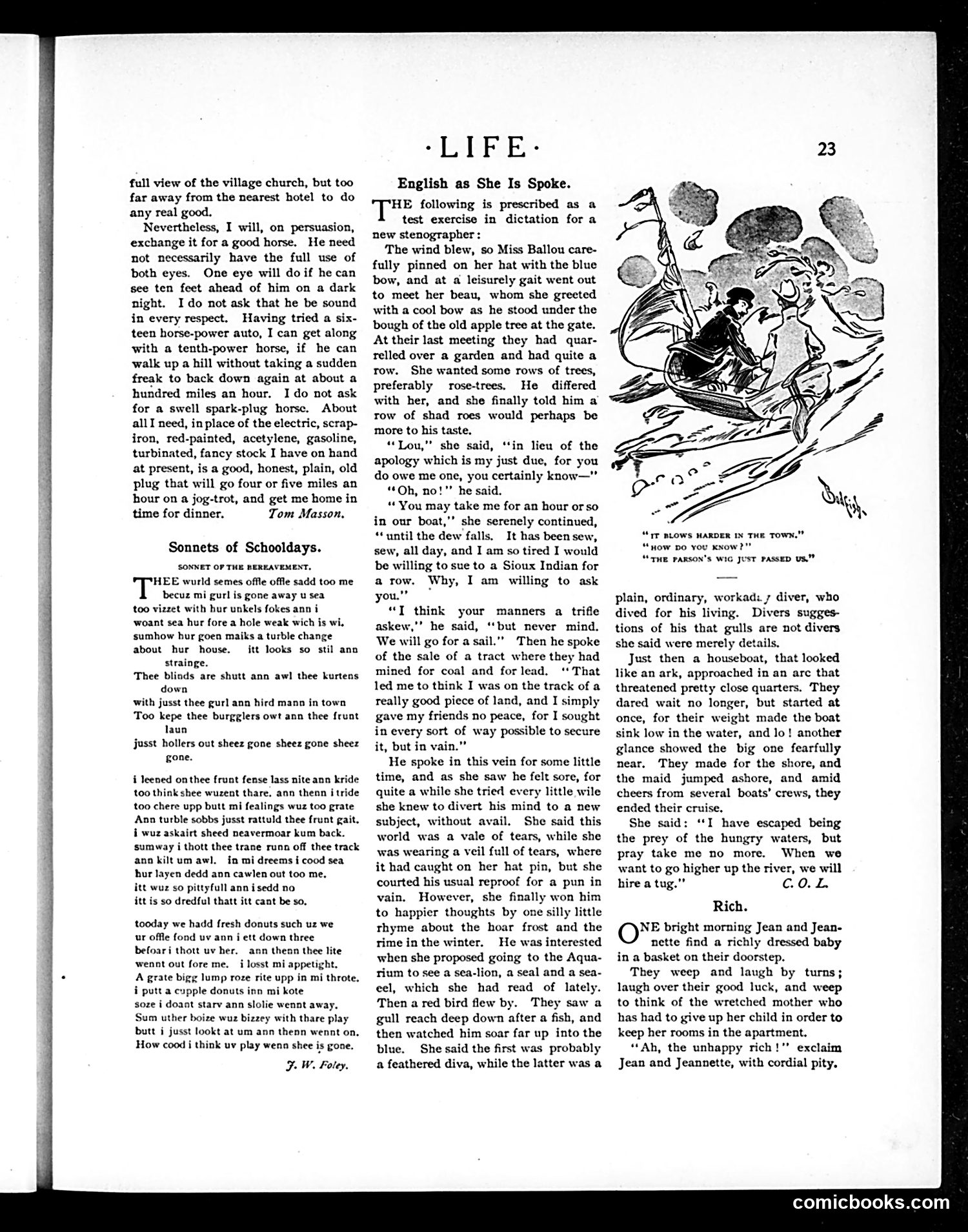
This page contains three separate pieces of satirical humor typical of Life magazine's style: 1. **"Tom Masson" piece**: A humorous complaint about trading an automobile for a horse—mocking early 1900s automotive unreliability by sarcastically listing all the car's broken systems (spark plugs, acetylene lights, turbines) while settling for a barely-functional horse that only needs to see ten feet ahead and not bolt downhill. 2. **"Sonnets of Schooldays"**: Intentional misspelling and phonetic dialect humor—a lovesick boy's poorly-written poem about missing his girlfriend, using extreme phonetic spelling ("wurld," "becuz," "donuts"). This mocks both adolescent sentimentality and poor literacy/spelling. 3. **"English as She Is Spoke"**: A dictation exercise exploiting homophones and near-homophones (sew/so, rows/roes, sue/sew, sale/sail, mined/mind) to create confusion. The humor lies in the difficulty these similar-sounding words would pose for stenographers attempting to transcribe by ear. All three pieces satirize contemporary inconveniences and confusions of the era.
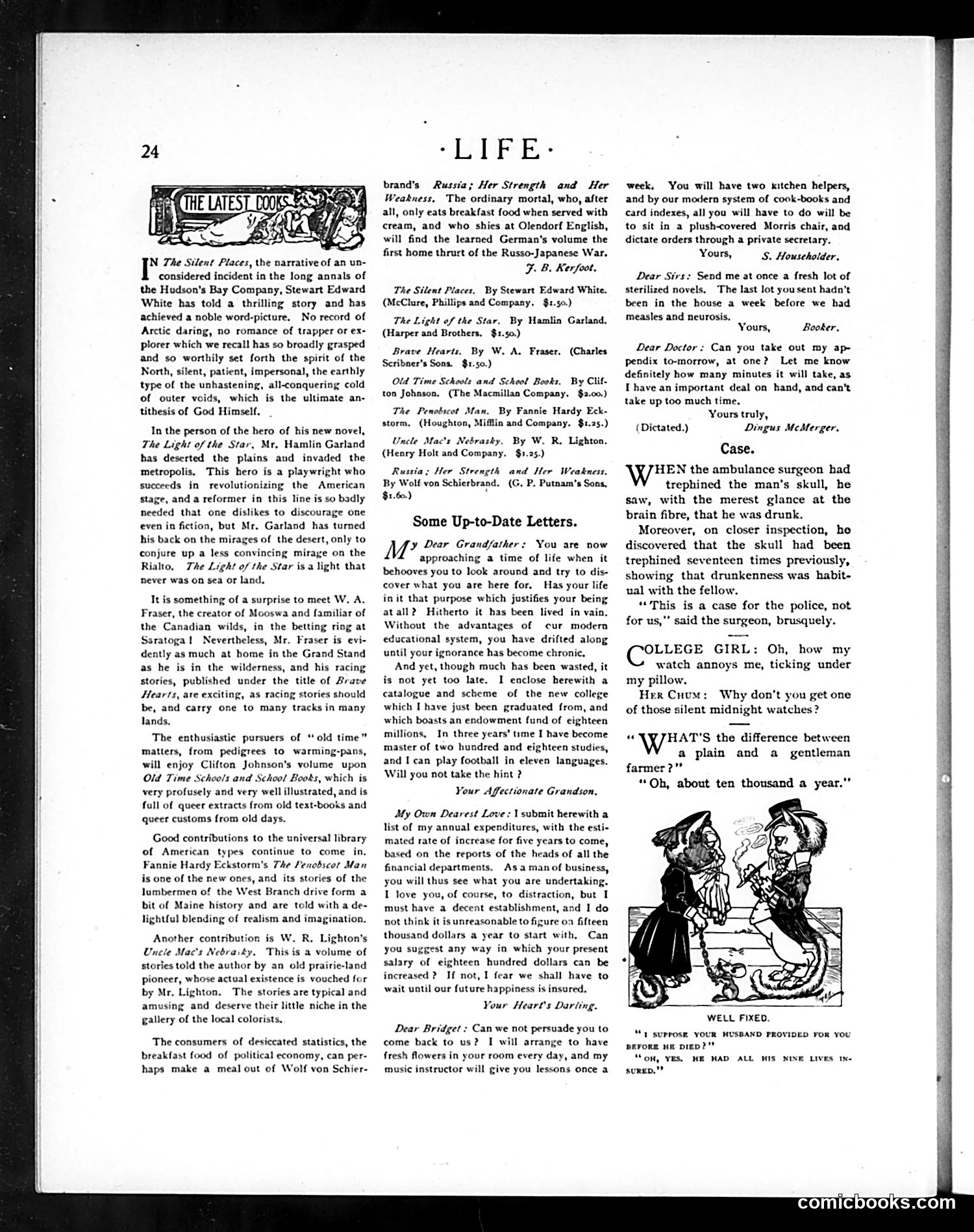
This page from *Life* magazine contains book reviews and advice-column letters. The cartoon at bottom right depicts a wealthy woman and what appears to be a working-class man in conversation, captioned "WELL FIXED," with dialogue about a husband's financial security. The satire targets **class distinctions and economic anxiety**. The joke plays on the phrase "well fixed" (meaning financially secure), contrasting the woman's refined appearance and circumstances with the man's rougher presentation. The caption—"'I WISH YOUR HUSBAND PROVIDED FOR YOU BEFORE HE DIED!' 'OH YES, HE HAD ALL HIS NINE LIVES INSURED'"—uses dark humor about insurance and mortality, likely mocking both working-class financial desperation and the emerging insurance industry's aggressive marketing. The broader page reviews recent literature emphasizing "local color" writers depicting American frontier and regional types—reflecting early 1900s fascination with authentic American narratives and disappearing ways of life.
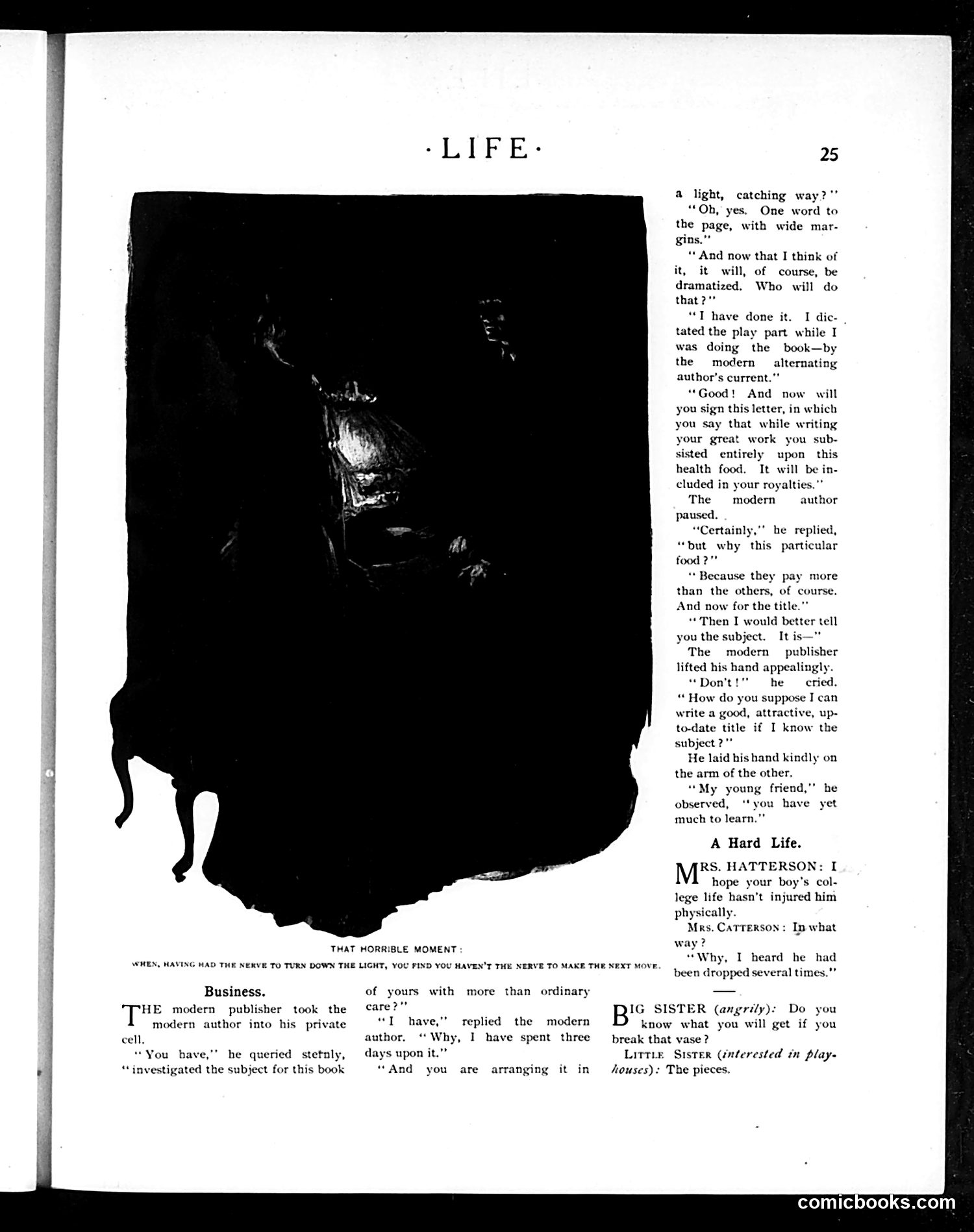
This page contains satirical commentary on early 20th-century publishing and authorship. The central cartoon, "That Horrible Moment," depicts a silhouetted couple in an awkward romantic situation—a visual gag about dating etiquette. The main text section, titled "Business," satirizes the relationship between modern publishers and authors. A cynical publisher guides an author through commercializing his work: writing it while simultaneously dictating a play adaptation, signing endorsement letters for health food products (without even knowing the subject), and crucially, the publisher *refuses to learn the book's subject* before writing its title—suggesting titles are marketing gimmicks disconnected from actual content. The satire targets commercial publishing's priorities: profit over substance, manufactured endorsements, and the inversion of artistic process where marketing drives creation rather than following it. The brief exchanges at page's bottom ("A Hard Life," "Big Sister") appear to be separate short comedic vignettes about college mishaps and household accidents—typical filler humor for the era.
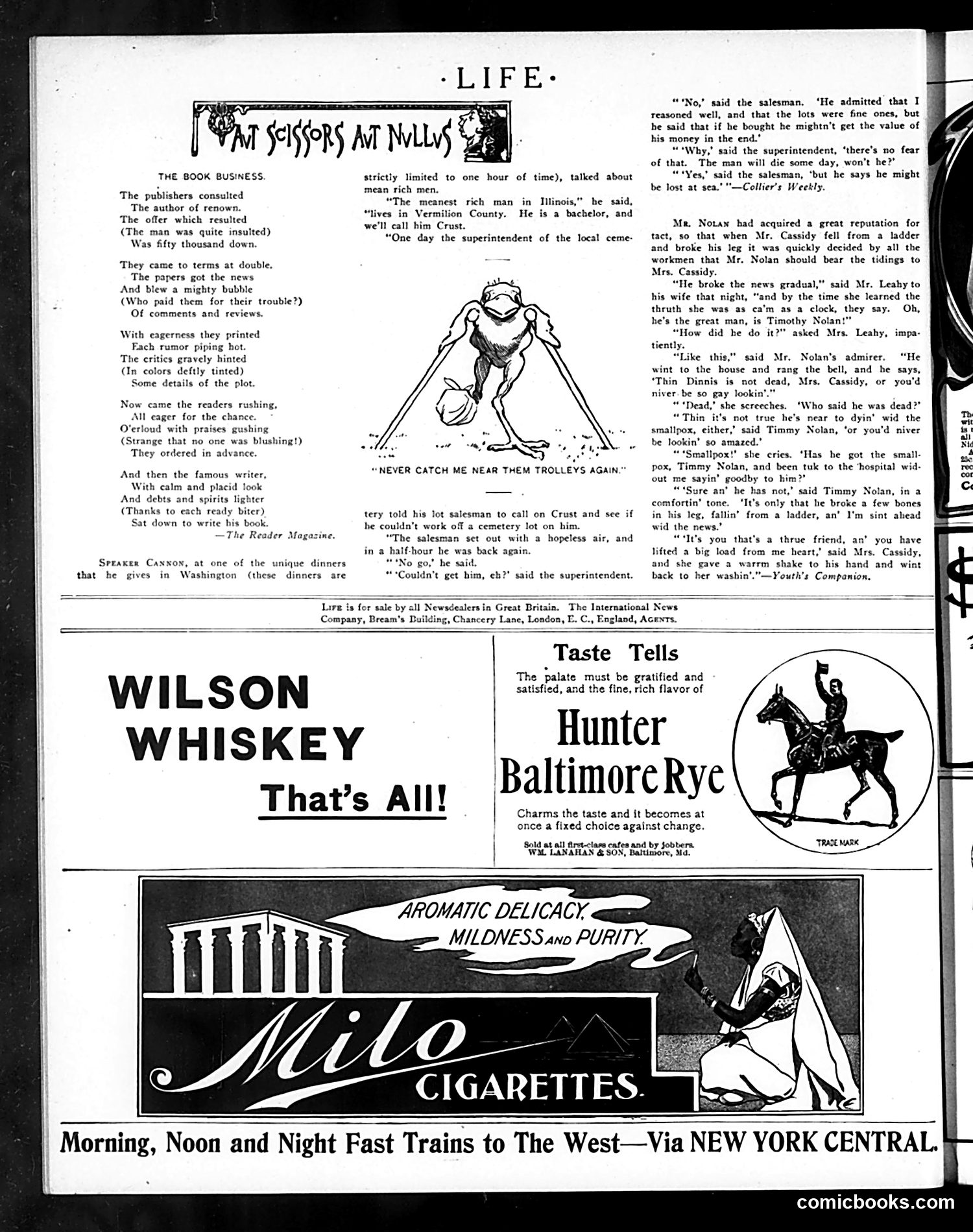
This page contains three humorous anecdotes satirizing human nature and greed: **"The Book Business"** mocks the publishing industry's hype machine. Publishers consult authors, offer advances, newspapers manufacture buzz (paid by publicists), critics hint at salacious details, readers pre-order excitedly—and only *then* does the author actually write the book. The satire: the entire apparatus exists to sell a product that doesn't yet exist. **"Mean Rich Men"** features a story about a miserly Illinois bachelor named Crust who refuses to buy a cemetery plot, reasoning he might "lose value" dying at sea. The joke: penny-pinching taken to absurd extremes. **"Timothy Nolan's Tact"** describes an Irishman delivering bad news gradually. He tells Mrs. Cassidy her husband isn't dead, doesn't have smallpox, merely broke some bones falling from a ladder. The humor: comic understatement and the Irish brogue dialect ("Dinnis," "wid," "thrue"). The page is primarily **advertising** (Wilson Whiskey, Hunter Baltimore Rye, Milo Cigarettes, New York Central trains), typical of early 20th-century magazines.
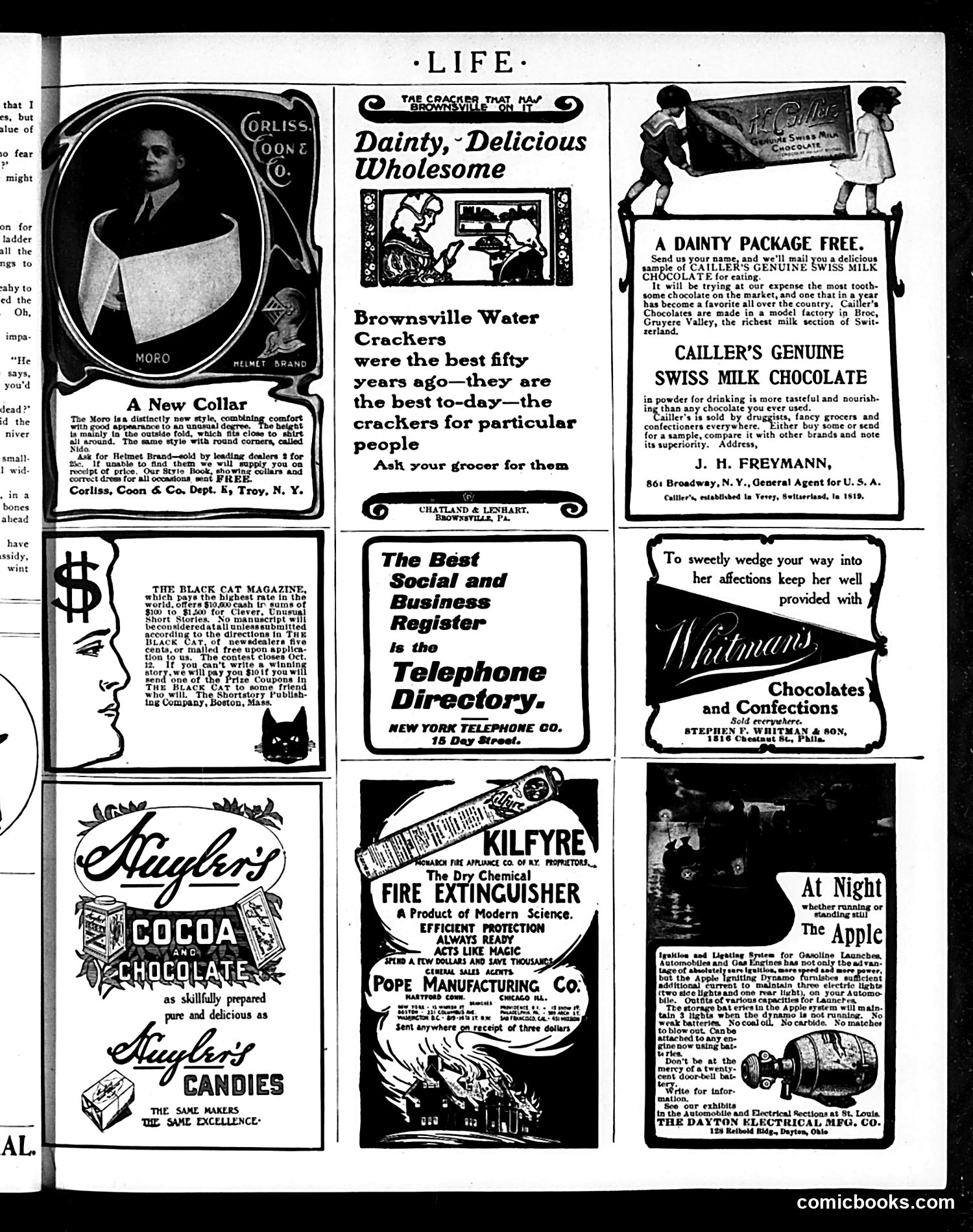
This page is primarily **advertising content** from an early 20th-century American magazine, not satirical cartoons. The ads promote various consumer products typical of the era: **Products advertised include:** - Corliss collar brands (men's formal wear) - Brownsville Water Crackers - Cailler's Swiss Milk Chocolate (with a free sample offer) - The Telephone Directory (positioned as a "social register") - Whitman's Chocolates and Confections - Stuyler's Cocoa and Candies - Kilfyre Fire Extinguisher - Dayton Electrical Manufacturing Co.'s ignition systems for automobiles **Notable elements:** One ad features a profile illustration with a dollar sign, likely representing commercial/business interests. The Telephone Directory ad humorously suggests the phone book is a "social register"—a joke about its importance to business and social life. The page reflects early-1900s consumer culture, emphasizing imported luxury goods (Swiss chocolate), new technology (automobiles, electrical systems), and emerging middle-class status markers.
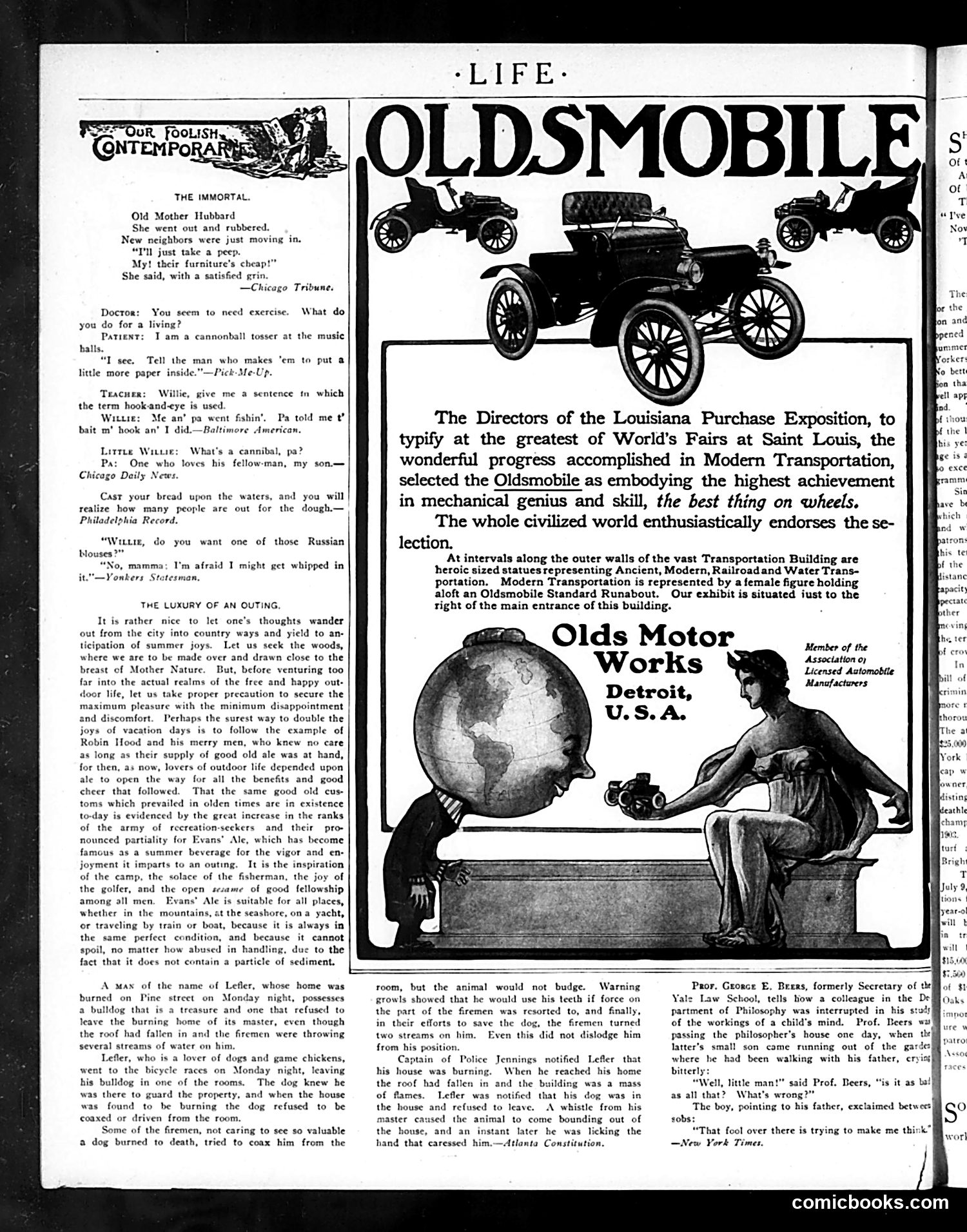
This page combines satirical humor with automobile advertising, typical of early 1900s magazines. **The Cartoons/Humor:** The left side features short jokes mocking contemporary life—gossipy neighbors ("Old Mother Hubbard"), working-class occupations (cannonball tosser), and social observations. These are mild satire on everyday behavior and speech patterns. **The Advertisement:** The dominant content is an Oldsmobile advertisement celebrating the vehicle's selection by the Louisiana Purchase Exposition (a 1904 World's Fair in St. Louis) as representing modern transportation progress. The ad claims the "civilized world enthusiastically endorses" the Oldsmobile as "the best thing on wheels." **The Point:** This reflects early automotive enthusiasm—before cars were commonplace, they were presented as marvels of mechanical achievement worthy of World's Fair recognition. The juxtaposition of working-class humor with luxury advertising shows Life's mixed audience: satirizing ordinary people while promoting aspirational consumer goods to the same readers.
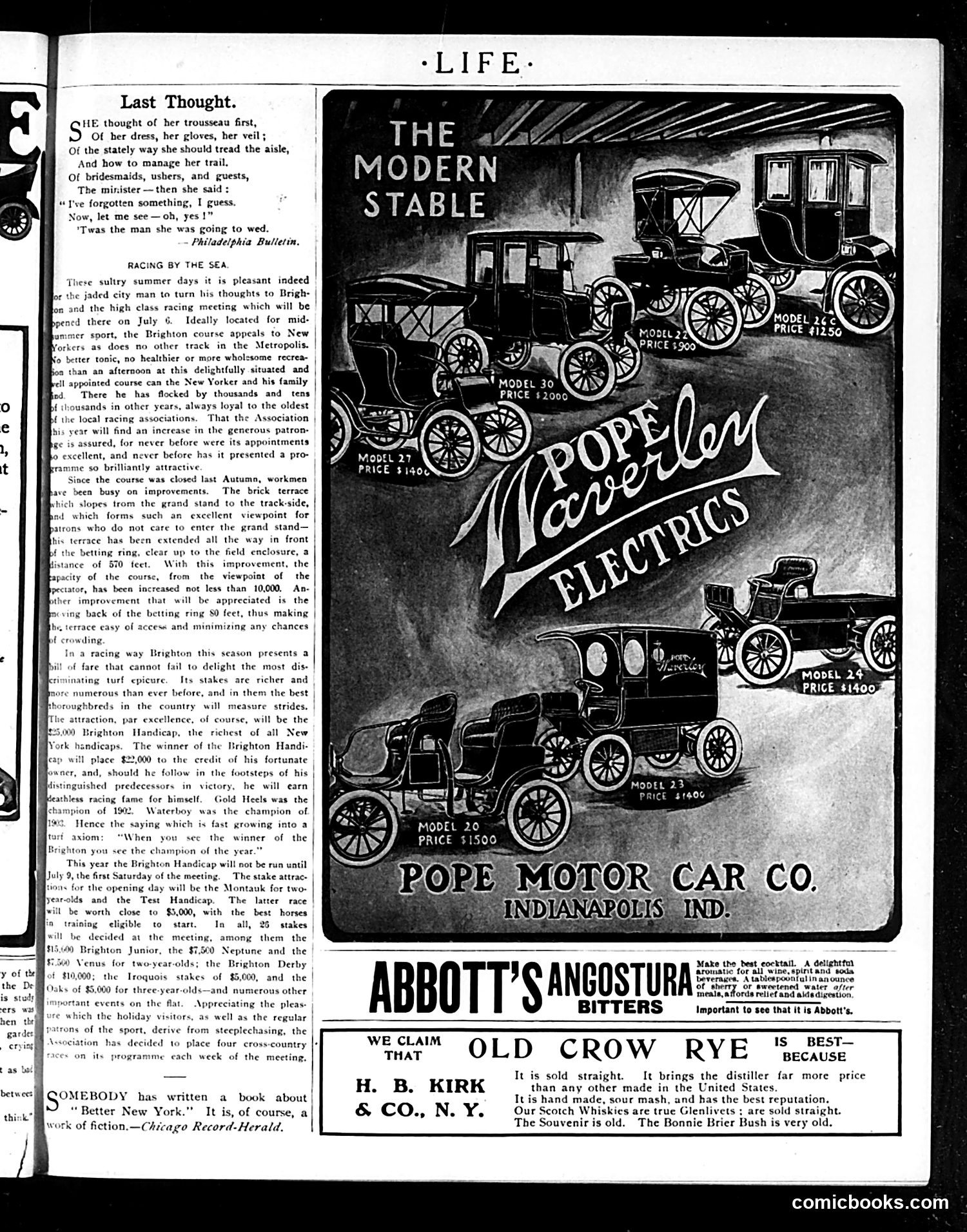
This page is primarily **advertising and feature content**, not political satire. The main content includes: **"Last Thought"** — A brief humorous poem (credited to Philadelphia Bulletin) about a bride-to-be obsessing over wedding details—dress, veil, bridesmaids—only to realize she's forgotten the groom himself. This is a light joke about female absent-mindedness regarding weddings. **"Racing by the Sea"** — A substantial article promoting the Brighton Beach racing course and its upcoming July 6 horse-racing meeting, detailing track improvements and valuable stakes races. **Advertisements** dominate the lower half: Pope Motor Car Company showcases electric automobiles with model numbers and prices; Abbott's Angostura Bitters, H.B. Kirk whiskey, and Old Crow Rye are also advertised. The page contains **no political cartoons or satire**—it's a mix of light humor and promotional content typical of early 1900s *Life* magazine.
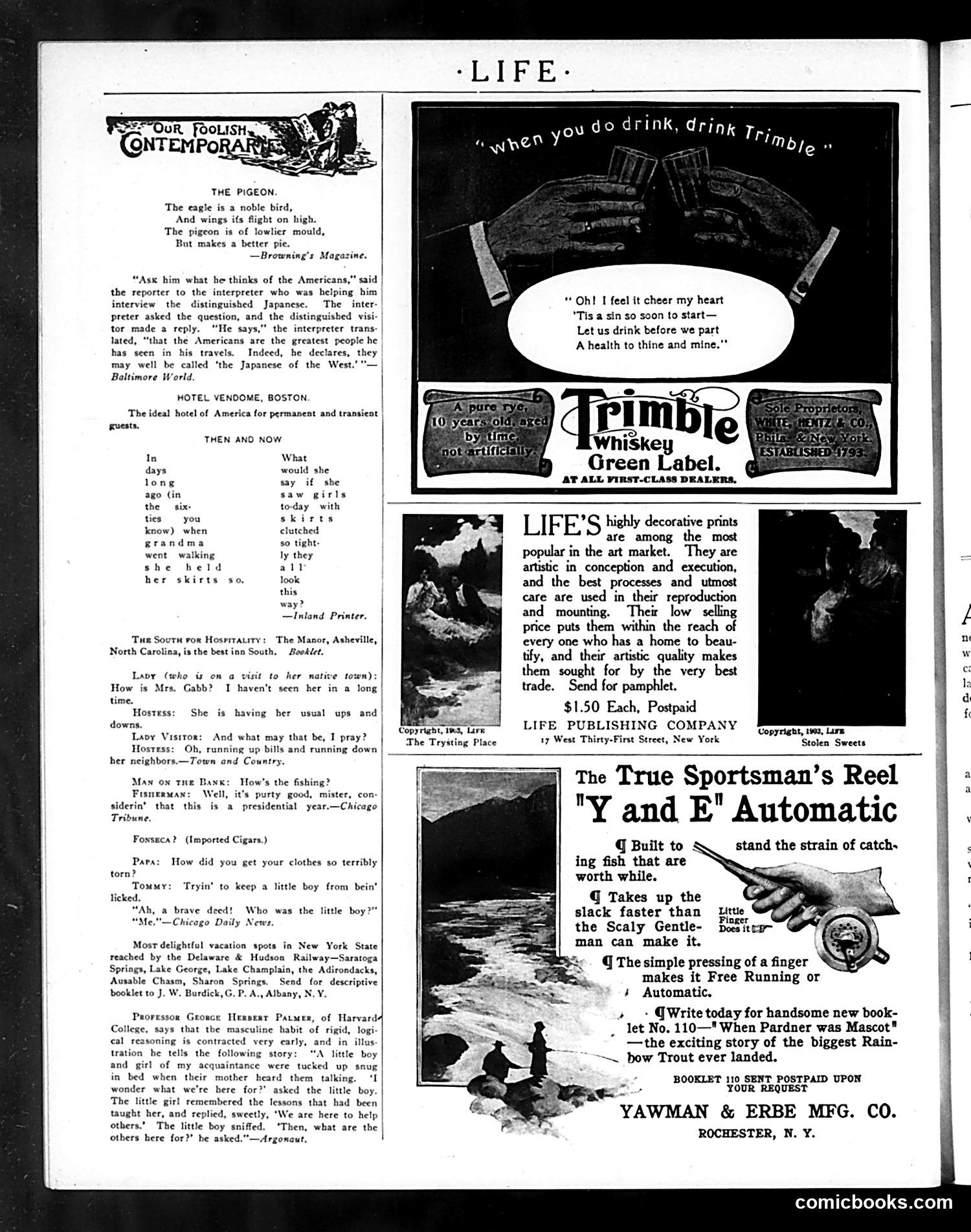
This page from the satirical magazine *Life* contains several short humorous pieces typical of early 20th-century American humor: **"Our Foolish Contemporaries"** section includes jokes mocking: - A Japanese visitor's flattery of Americans as "the Japanese of the West" - Women's fashion changes (comparing grandmothers' modest skirts to modern women's tighter styles) - A woman who runs up bills while gossiping about neighbors - Political corruption ("purty good fishing...considering that this is a presidential year") - A child's logical reasoning about human purpose **Advertisements** dominate the right side, including Trimble Whiskey and a fishing reel, typical of period publications. The humor relies on social observation—criticizing hypocrisy, vanity, and changing morals—rather than political satire. The overall tone is genteel and conservative, poking fun at social pretension and modern behavior while implicitly defending traditional values.
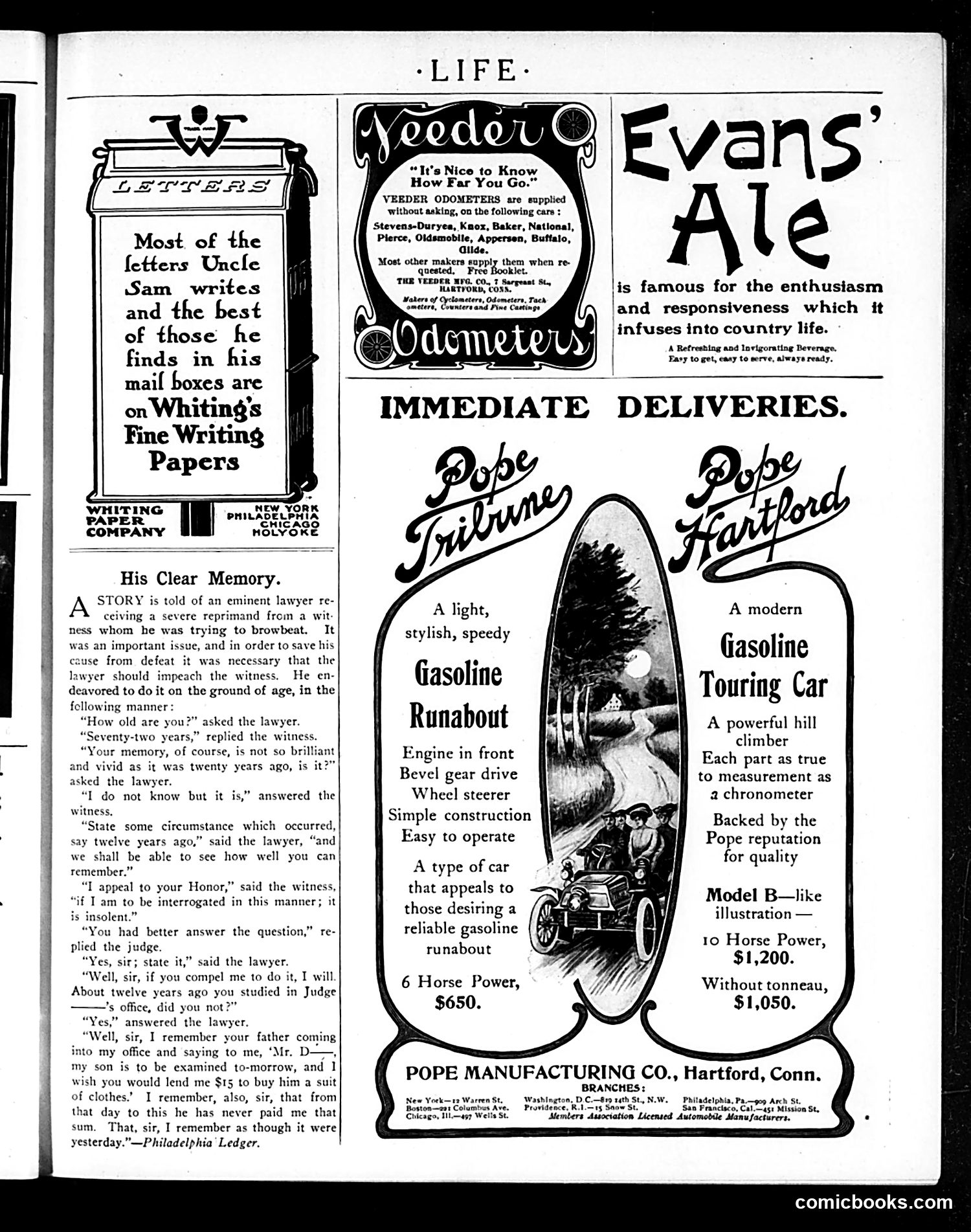
This Life magazine page contains primarily **advertisements** interspersed with a humorous anecdote. The main text is "His Clear Memory," a satirical story from the Philadelphia Ledger about a lawyer attempting to discredit a 72-year-old witness by questioning his memory. The witness cleverly turns the tables, recalling—with perfect clarity—that the lawyer's father borrowed $15 from him twelve years ago to buy his son a suit of clothes, which was never repaid. The joke undercuts the lawyer's assumption that age impairs memory; the witness remembers this embarrassing debt perfectly. The advertisements promote writing paper (Whiting's), car odometers (Veeder), Evans' Ale, and Pope Manufacturing automobiles (the Tribune and Hartford models). These reflect early 1900s consumer goods and the emerging automobile industry. The satire is gentle—the anecdote mocks pretentious legal tactics rather than addressing political or social movements.
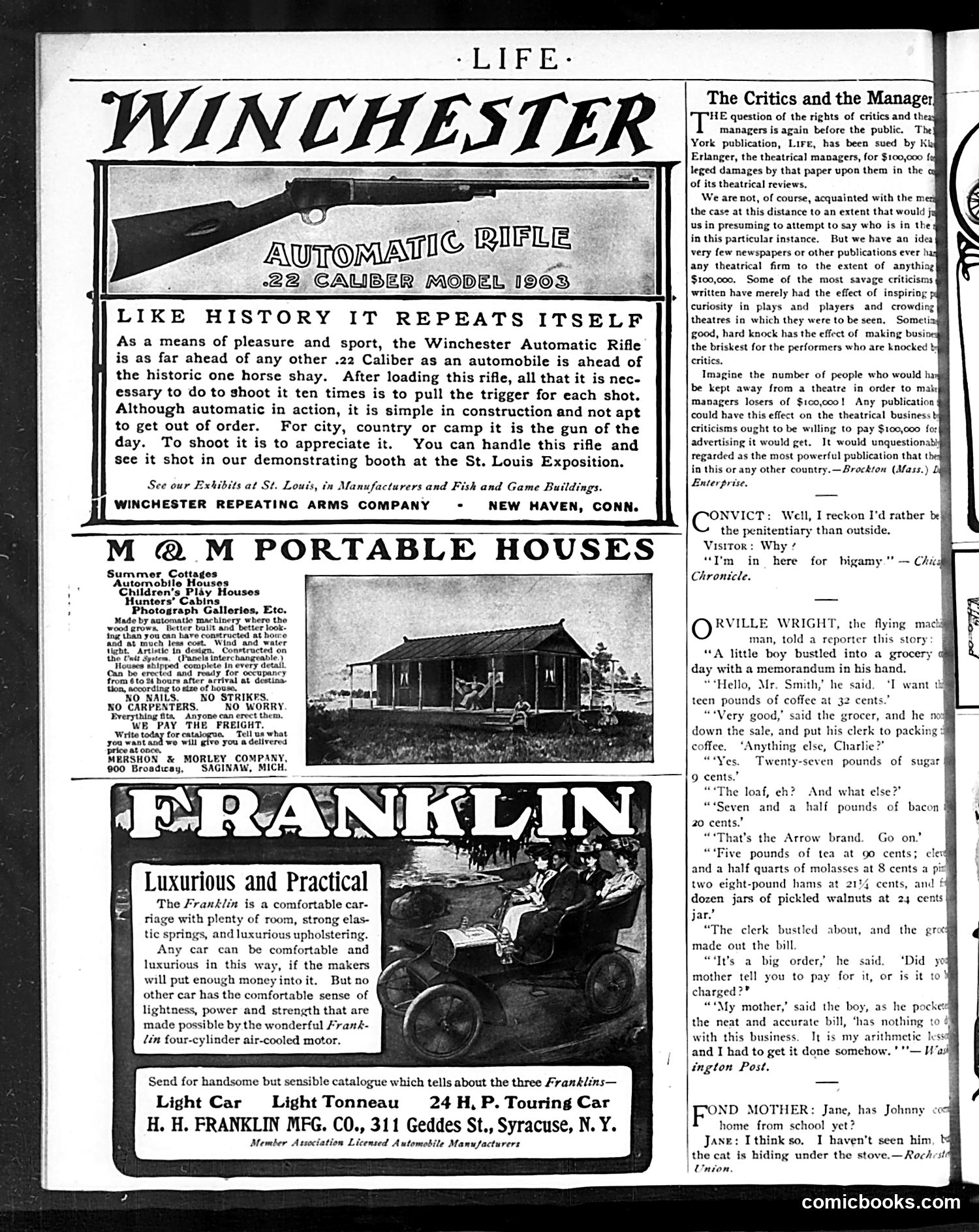
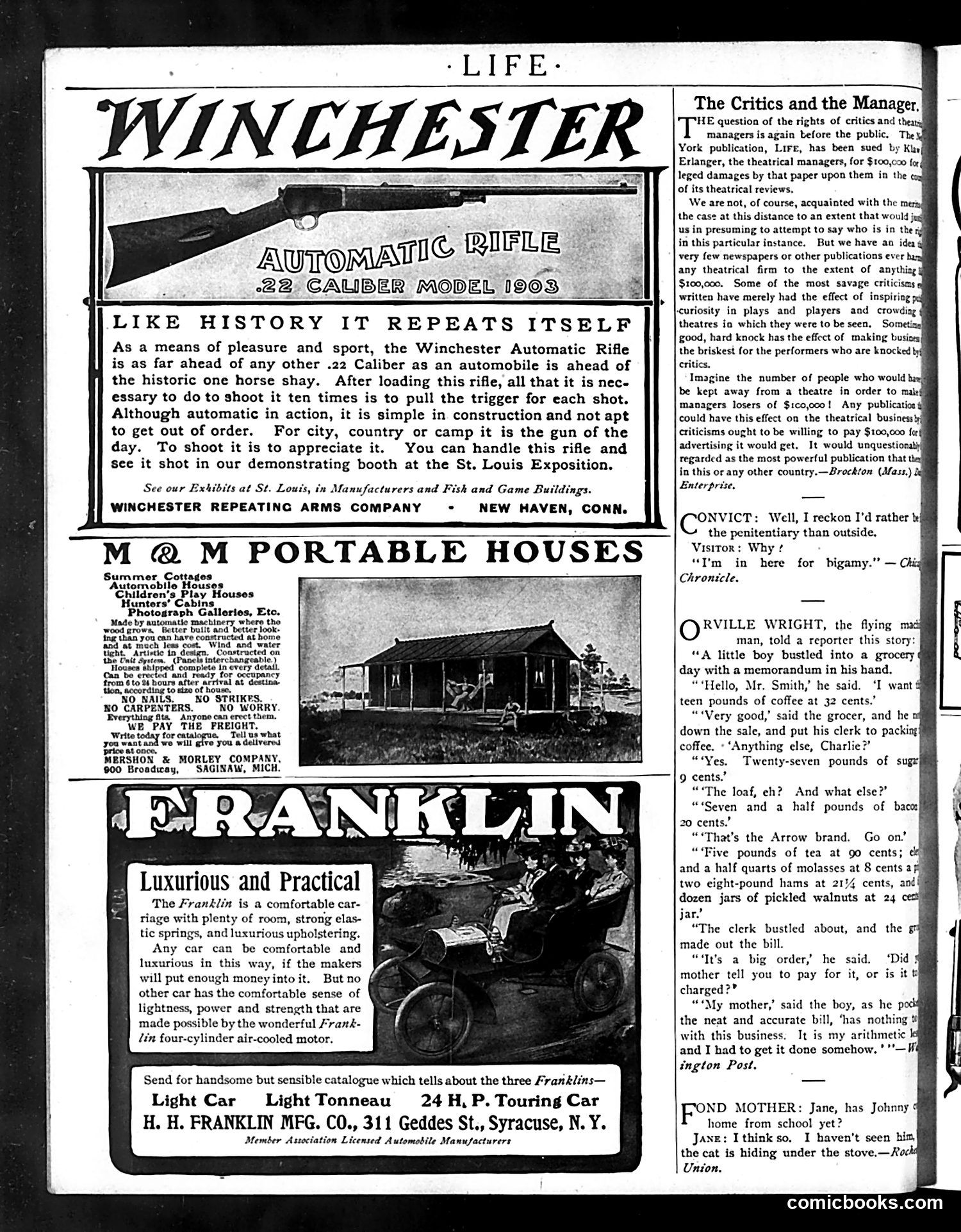
This page is primarily **advertising**, with several product advertisements dominating the layout: Winchester rifles, M&M portable houses, and Franklin automobiles. At the bottom right is a brief **editorial column** ("The Critics and the Manager") addressing a lawsuit where theatrical manager David Belasco sued *Life* magazine for $100,000 over negative theatrical reviews. The writer argues that critics rarely harm business that severely—in fact, harsh reviews often *increase* attendance, making such massive damages unlikely. Below that are two short **humorous anecdotes** unrelated to the main content: one about an Orville Wright grocery-store incident, and another prison joke about bigamy. The page reflects early 1900s concerns about press freedom and the theatrical industry's attempts to control critical coverage.
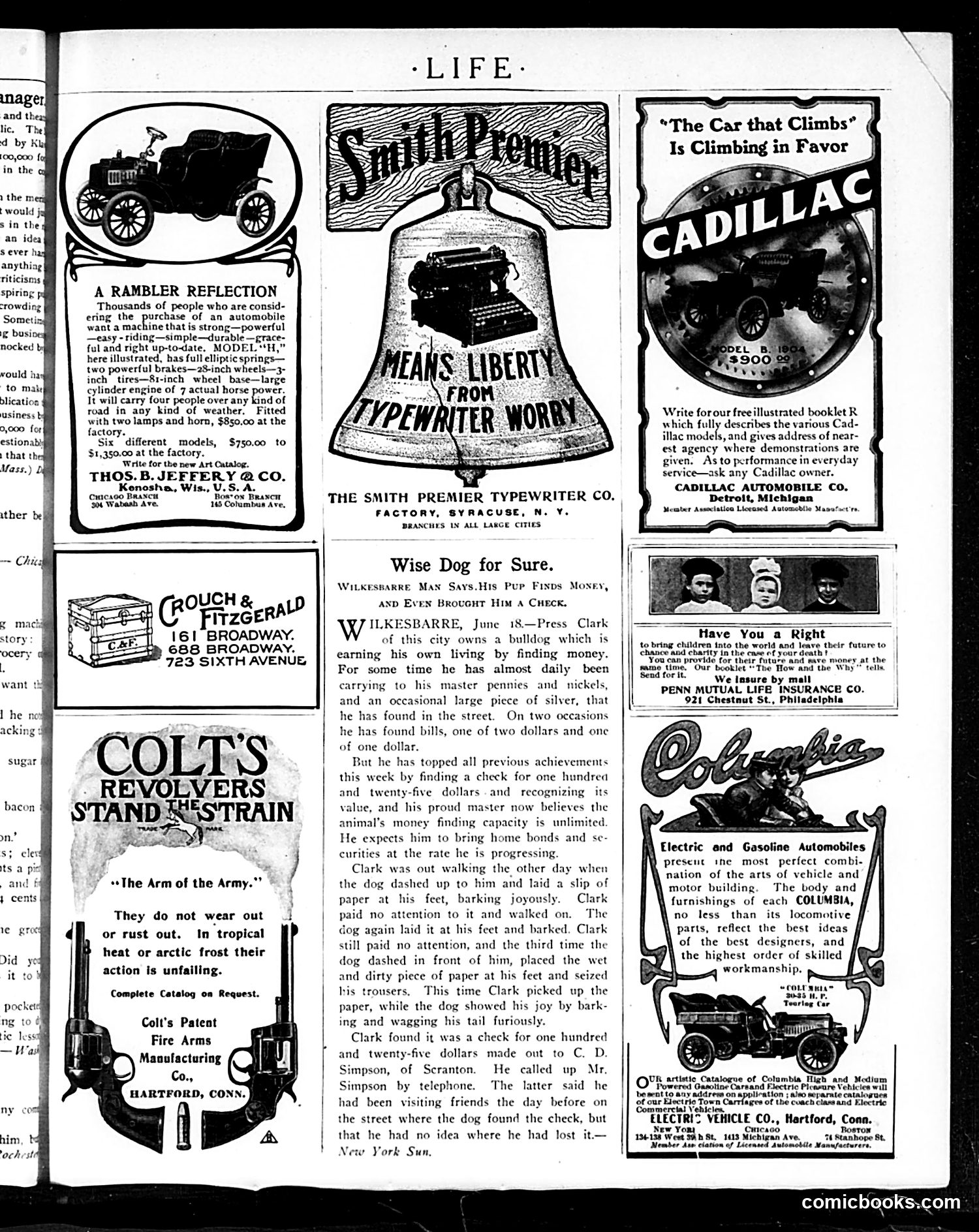
This page is primarily **advertisements** interspersed with one brief news item. The ads showcase early 1900s automobiles (Rambler, Cadillac, Columbia), firearms (Colt's Revolvers), and typewriters—products targeting affluent consumers. The sole editorial content is "Wise Dog for Sure," a humorous anecdote from the *New York Sun* about a bulldog in Wilkes-Barre, Pennsylvania that finds money in the street. The joke escalates absurdly: the dog finds coins, then bills, then—most ridiculously—a $125 check, which the dog supposedly recognizes as valuable and insists his owner retrieve. The satire mocks the era's tendency toward sentimental, implausible "human interest" stories in newspapers. The punchline suggests the dog now expects to bring home bonds and securities—an obvious exaggeration poking fun at credulous readers who believed such tales. The page reflects Life's dual nature: serious product advertising for the wealthy alongside lighthearted mockery of popular journalism conventions.
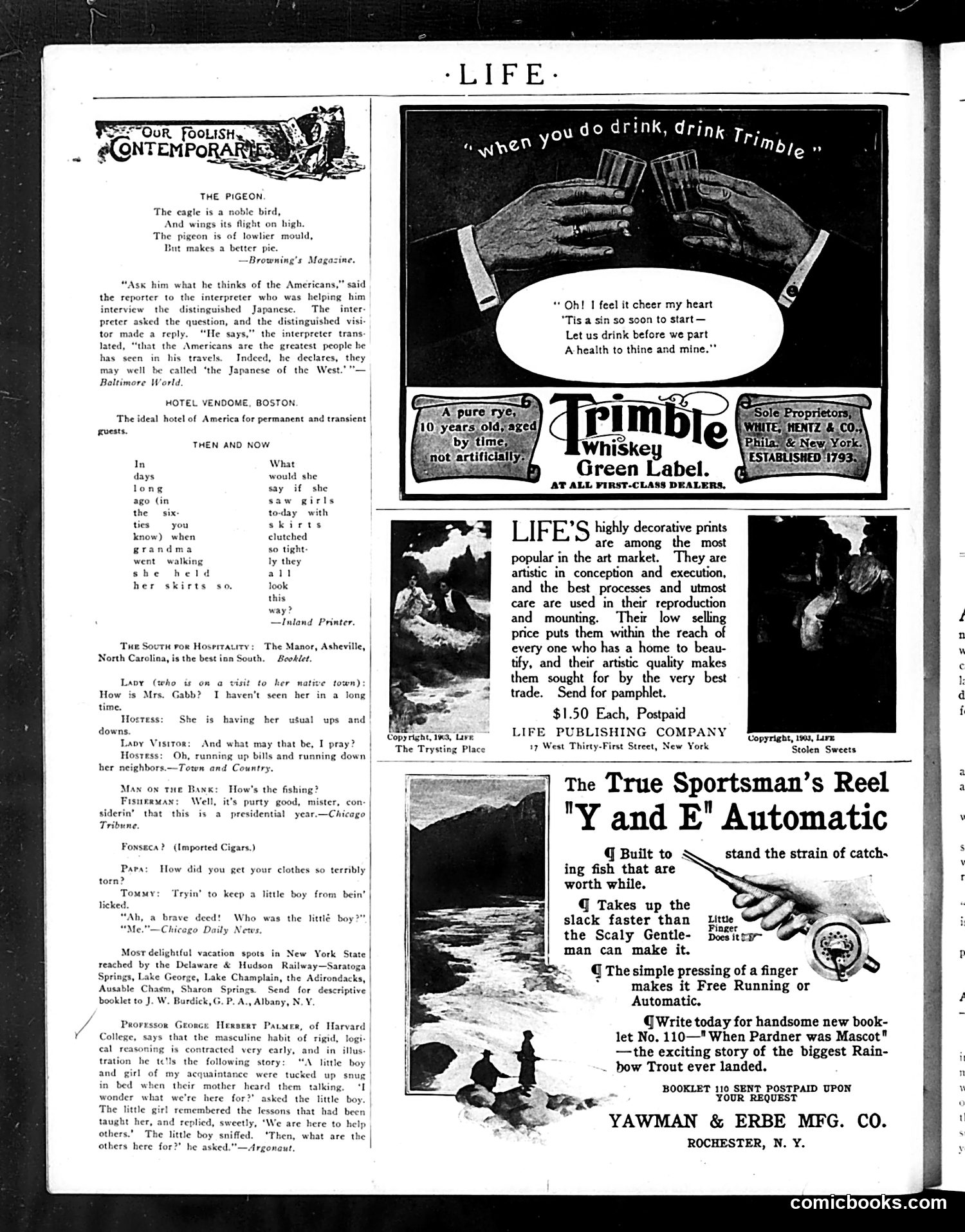
This page from early 1900s *Life* magazine combines humor columns with period advertisements. The satirical content includes: **"Then and Now"**: A commentary on changing women's fashion, contrasting Victorian-era propriety (grandmother holding skirts while walking) with contemporary styles where women's skirts are "clutched so tight" they appear scandalous—social satire about the relaxing of dress codes. **Miscellaneous humor pieces**: Jokes about diplomatic flattery (a Japanese visitor calling Americans "the Japanese of the West"), domestic life, and child logic. **Advertisements**: The page heavily features ads for Trimble Whiskey, Life's decorative prints, and a fishing reel ("Y and E" Automatic), typical of the era's product placement. The overall tone reflects *Life*'s satirical approach to American society, fashion, manners, and consumer culture in the Progressive Era, with mild social commentary embedded in brief comedic sketches and bon mots.
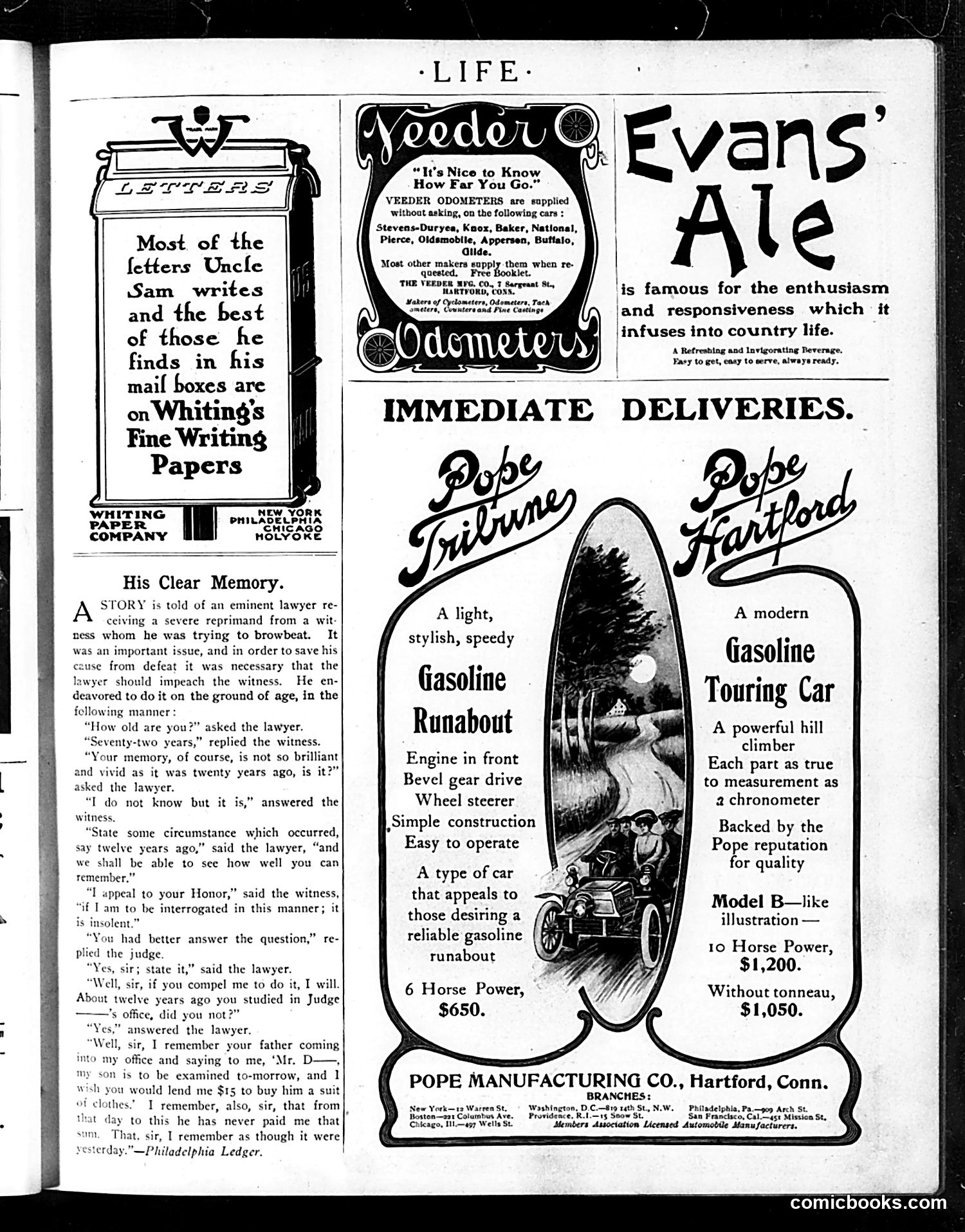
This page is primarily **advertising**, with one humorous anecdote. The main content is "His Clear Memory," a courtroom joke from the *Philadelphia Ledger*. A lawyer attempts to discredit a witness by questioning his memory over time, asking him to recall events from twelve years prior. The witness brilliantly turns the tables: he vividly remembers the lawyer's father borrowing $15 for the lawyer's suit—a debt apparently never repaid. The joke satirizes **legal tactics of intimidation** and exposes the lawyer's own questionable character, suggesting that sharp memory cuts both ways. The remainder consists of vintage automobile and product advertisements: Veeder odometers, Evans' Ale, Pope Manufacturing Company's Dobe automobiles, and Whiting Fine Writing Papers. These ads are typical of the era's consumer goods marketing, emphasizing reliability, quality, and modern convenience. The page contains no political cartoons or caricatures—it's a mix of humor and period advertising.
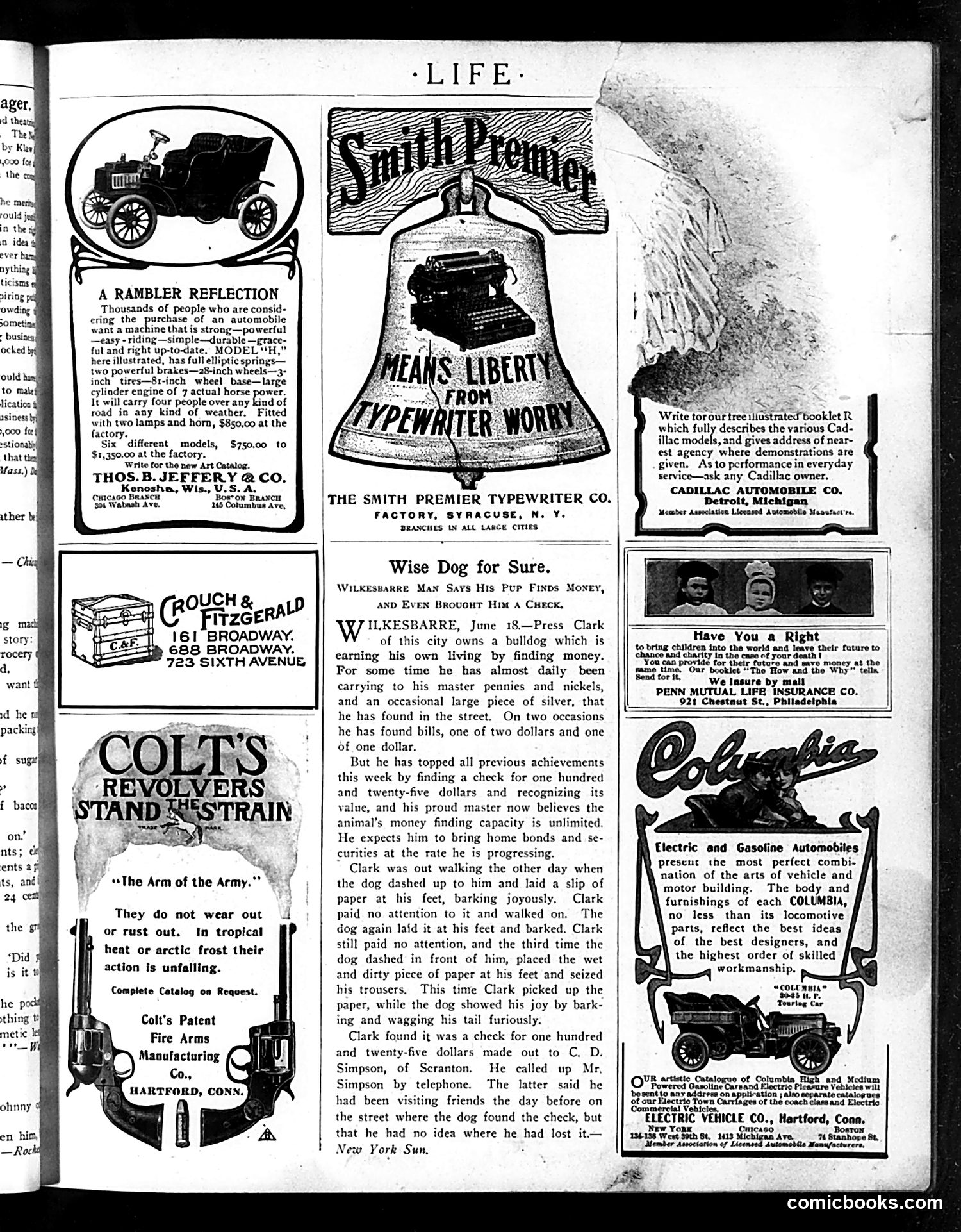
This page is primarily **advertising**, typical of early 1900s Life magazine. The main content is a humorous news story titled "Wise Dog for Sure" about a bulldog in Wilkes-Barre, Pennsylvania that finds money on the street—culminating in his discovery of a $125 check made out to a Scranton resident. The satire is gentle: the story plays on the dog's apparent intelligence and business acumen, with the owner jokingly suggesting the animal will soon bring home "bonds and securities." It's anthropomorphizing humor—treating the dog as if it understands monetary value. The surrounding advertisements showcase period products: Rambler automobiles, Smith Premier typewriters, Cadillac cars, Colt's revolvers, trunks, and Columbia automobiles. These ads reveal consumer interests of the era: early automobiles were luxury items, and life insurance was being actively marketed to middle-class readers concerned about family welfare. No political commentary appears; this page reflects the commercial culture and lighthearted domestic humor typical of Life's editorial approach during the Progressive Era.
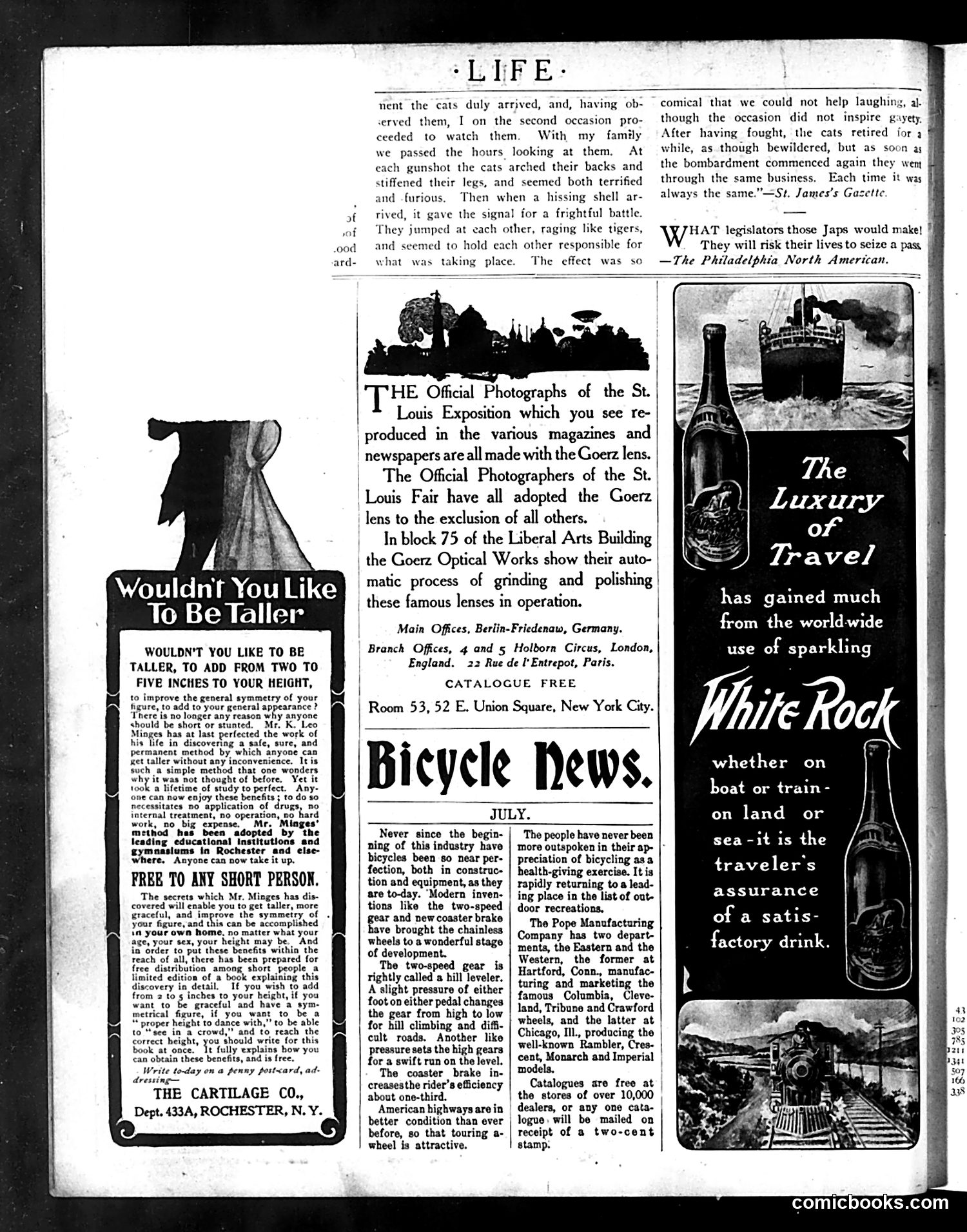
This advertisement satirizes pseudoscientific self-improvement schemes popular in early 1900s America. "Mr. K. Leo Minges" claims to have perfected a secret method to add 2-5 inches to anyone's height through mysterious means—no drugs, surgery, or hard work required. The pitch exploits common insecurities (being too short to dance with, see in crowds, or reach things) while promising free information to lure customers. The satire lies in the absurdity: no legitimate height-increasing method existed then. The vague language about a "discovery" requiring "a lifetime of study" masks that nothing real is being offered. This mocks the era's rampant mail-order scams and dubious "health institutes" that preyed on people's vanity and desperation—a common target of *Life* magazine's satirical advertising section.
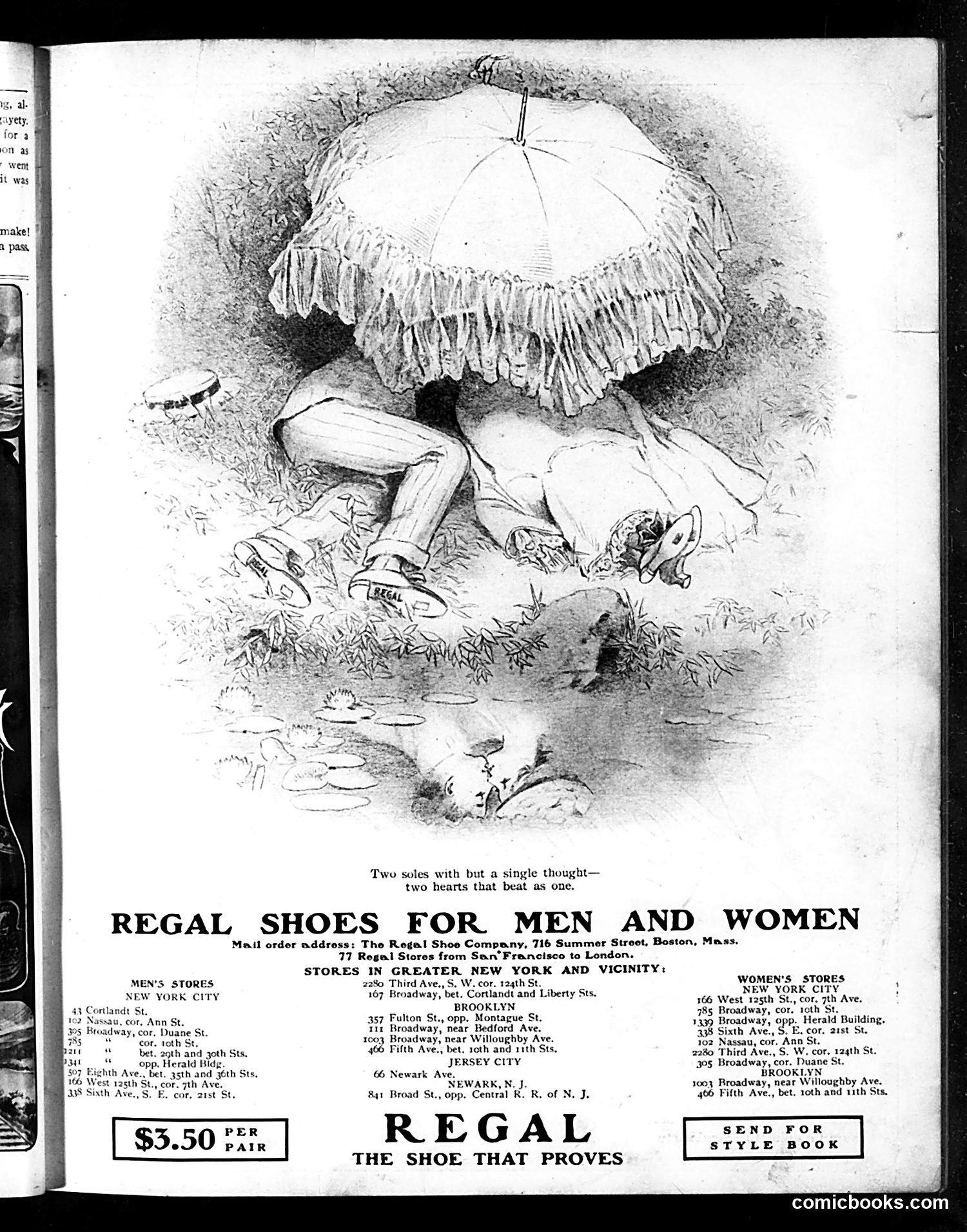
This page is primarily a **shoe advertisement** for Regal Shoes, not a political cartoon. The small illustration at the top depicts a couple resting together under an umbrella in pastoral settings—a man and woman whose legs are visible, positioned intimately close. The accompanying tagline reads: "Two soles with but a single thought— two hearts that beat as one." This is a **visual pun**: "soles" (shoe soles) and "souls" (spiritual essence) are homophonic, allowing the ad to play on romantic sentiment while advertising footwear. The imagery suggests companionship and romance to appeal to both male and female customers. The bulk of the page lists retail store locations across New York, Brooklyn, and New Jersey, and advertises the shoe's price ($3.50 per pair) and an available style book—standard advertising copy typical of early 20th-century Life magazine advertisements.
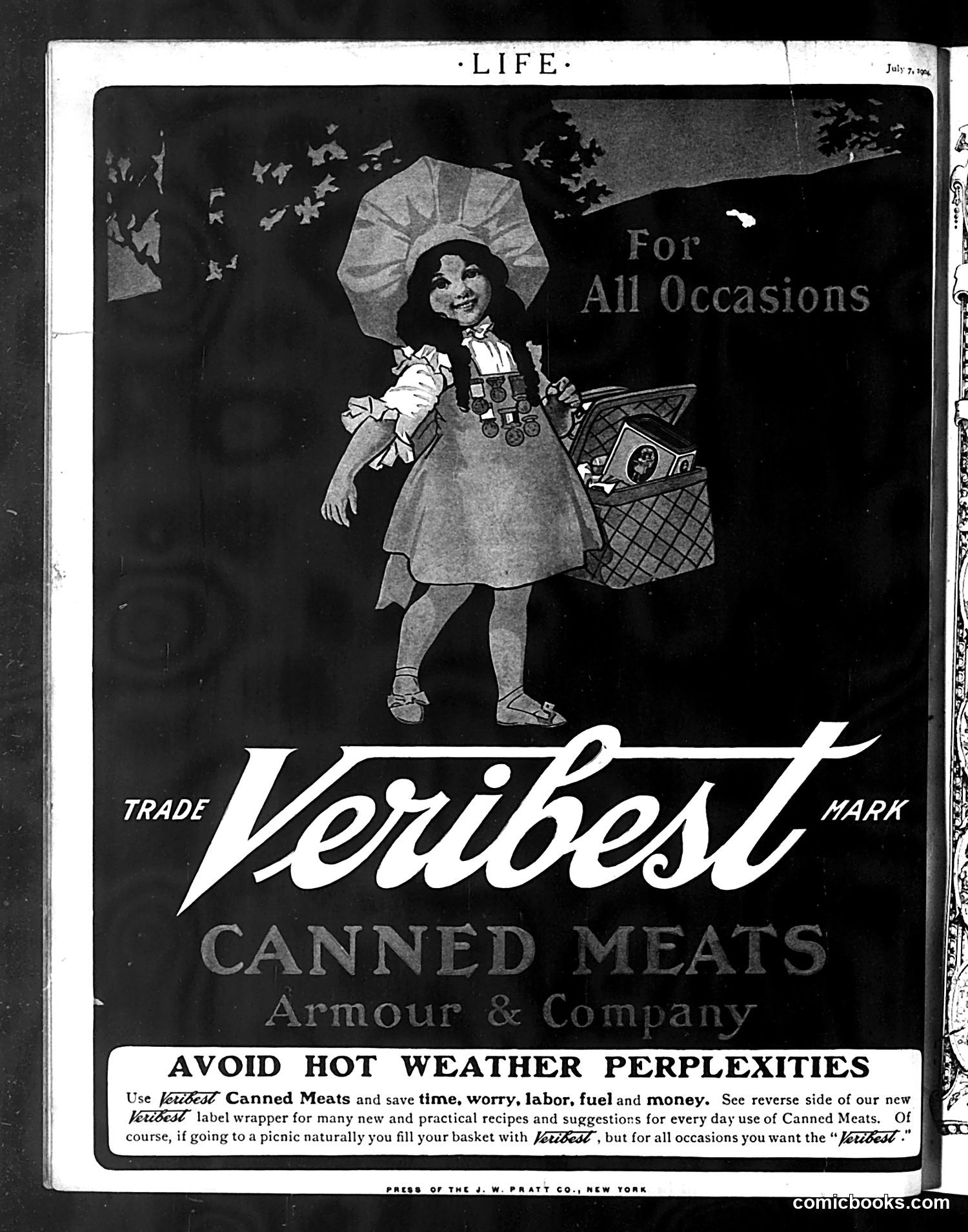
This is primarily a **product advertisement**, not political satire. It promotes Veribest brand canned meats by Armour & Company, published in Life magazine (July 7, 1924, per the header). The illustration shows a cheerful young woman holding a parasol and picnic basket, marketed as embodying convenience and style. The tagline "For All Occasions" emphasizes the product's versatility beyond picnics. The advertisement's pitch centers on practical benefits: canned meats save "time, worry, labor, fuel and money" during hot weather when cooking is burdensome. The copy suggests recipes are available on the label wrapper. This reflects early-20th-century consumer marketing targeting domestic homemakers, positioning convenience foods as modern solutions to summer household management. There is no political commentary or satire present—it's straightforward commercial promotion typical of Life magazine's advertising content during this era.