
Life, 1904-07-07 · page 13 of 40
Life — July 7, 1904 — page 13: what you’re looking at
What you’re looking at
This page contains two pieces: a humorous poem about department store navigation (top left) and the beginning of a serialized romantic story (right). **The main illustrated story** depicts a dramatic moment aboard the USS *Ganymede*, a naval cruiser. Lieutenant Franklyn, examining a $50,000 diamond necklace belonging to Miss Mabel Burnham (daughter of a railroad magnate), is startled by a cannon signal. His arm jerks, the necklace slips overboard into the harbor. **The social context**: This appears to be early 20th-century melodrama—a common *Life* magazine feature. The setup contrasts a naval officer of modest means with a wealthy heiress, using the lost necklace as a plot device to create tension about honor and financial ruin. The illustration shows the moment of disaster with period-appropriate naval aesthetics. Modern readers would recognize this as serialized fiction entertainment—the precursor to soap operas—designed to keep readers returning to the magazine for the next installment's resolution.
📄 Transcribed text from this page (OCR, searchable)
Machine-transcribed from the original scan — historical spelling and the odd misread are preserved.
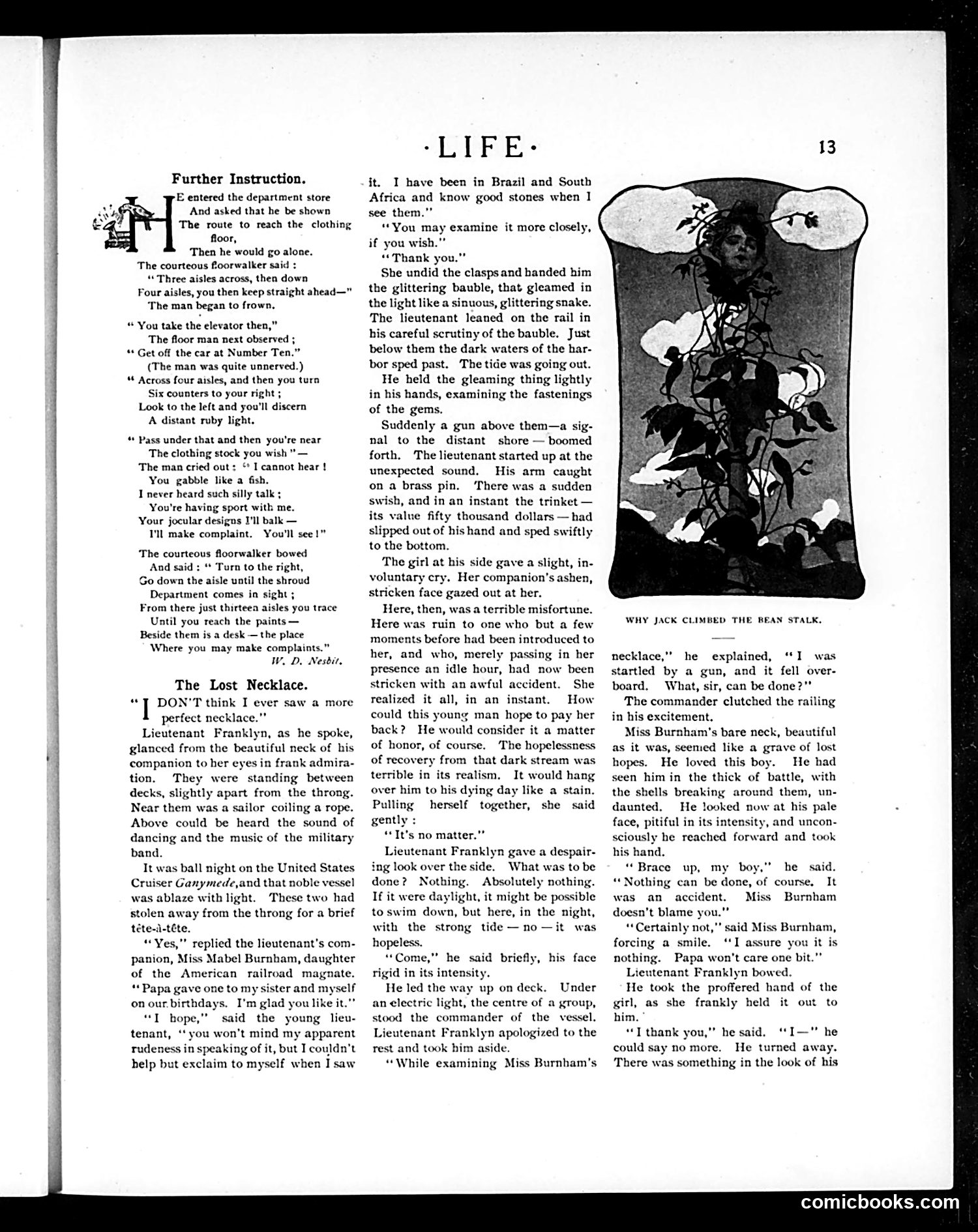
] ] | | Further Instruction. E entered the department store And asked that he be shown The route to reach the clothing floor, ‘Then he would go alone. The courteous foorwalker said : “Three aisles across, then down Four aisles, you then keep straight ahead—" ‘The man began to frown, “ You take the elevator then,” The floor man next observe “* Get off the car at Number Te: (The man was quite unnerved.) “ Across four aisles, and then you turn Six counters to your right ; Look to the left and you'll discern A distant ruby light. “ Pass under that and then you're near The clothing stock you wish "— ‘The man cried out: I cannot hear ! You gabble like a fish. I never heard such silly talk ; You're having sport with me. Your jocular designs I'll balk — Til make complaint. You'll see!” ‘The courteous floorwalker bowed And said : Turn to the right, Go down the aisle until the shroud Department comes in sight ; From there just thirteea aisles you trace Until you reach the paints — Beside them is a desk — the place Where you may make complaints.” W, D, Nesbit. The Lost Necklace. “T DON’T think I ever saw a more perfect necklace." Lieutenant Franklyn, as he spoke, glanced from the beautiful neck of his companion to her eyes in frank admira- tion, They were standing between decks, slightly apart from the throng. Near them was a sailor coiling a rope. Above could be heard the sound of dancing and the music of the military band. It was ball night on the United States Cruiser Ganymede,and that noble vessel was ablaze with light. These two had stolen away from the throng for a brief téte-J-tlte. “Yes,”’ replied the lieutenant’s com- panion, Miss Mabel Burnham, daughter of the American railroad magnate. “Papa gave one to my sister and myself on our birthdays. I'm glad you like it.” “IT hope,” said the young lieu. tenant, ‘you won't mind my apparent rudeness in speaking of it, but I couldn't help but exclaim to myself when I saw 1 PRUE it. I have been in Brazil and South Africa and know good stones when 1 see them." ‘You may examine it more closely, if you wish.” “Thank yo She undid the clasps and handed him the glittering bauble, that gleamed in the light like a sinuous, glittering snake. The lieutenant leaned on the rail in his careful scrutiny of the bauble. Just below them the dark waters of the har- bor sped past. ‘The tide was going out. He held the gleaming thing lightly in his hands, examining the fastenings of the gems, Suddenly a gun above them—a sig- nal to the distant shore — boomed forth. The lieutenant started up at the unexpected sound. His arm caught on a brass pin. ‘There was a sudden swish, and in an instant the trinket — its value fifty thousand dollars — had slipped out of his hand and sped swiftly to the bottom. ‘The girl at his side gave a slight, in- voluntary cry, Her companion’s ashen, stricken face gazed out at her. Here, then, was a terrible misfortune. Here was ruin to one who but a few moments before had been introduced to her, and who, merely passing in her presence an idle hour, had now been stricken with an awful accident. She realized it all, in an instant. How could this young man hope to pay her back? He would consider it a matter of honor, of course. The hopelessness of recovery from that dark stream was terrible in its realism, It would hang over him to his dying day like a stain. Pulling herself together, she said gently : “It's no matte: Lieutenant Franklyn gave a despair- ing look over the side. What was to be done? Nothing. Absolutely nothing. If it were daylight, it might be possible toswim down, but here, in the night, with the strong tide — no —it was hopeless. “Come,” he said briefly, his face rigid in its intensity, He led the way up on deck. Under an electric light, the centre of a group, stood the commander of the vessel, Lieutenant Franklyn apologized to the rest and took him aside. “While examining Miss Burnham's WHY JACK CLIMBED THE BEAN STALK, necklace," he explained, “I was startled by a gun, and it fell over- board, What, sir, can be done?" The commander clutched the railing in his excitement. Miss Burnham's bare neck, beautiful as it was, seemed like a grave of lost hopes. He loved this boy. He had seen him in the thick of battle, with the shells breaking around them, un- daunted. He looked now at his pale face, pitiful in its intensity, and uncon- sciously he reached forward and took his hand. “Brace up, my boy,” he said. “Nothing can be done, of course. It was an accident. Miss Burnham doesn’t blame you." “Certainly not," said Miss Burnham, forcing a smile. ‘I assure you it is nothing. Papa won't care one bit."” Lieutenant Franklyn bowed, He took the proffered hand of the girl, as she frankly held it out to him. “I thank you,” he said, “I—" he could say no more. He turned away. There was something in the look of his comicbooks.com