
Life, 1904-07-07 · page 10 of 40
Life — July 7, 1904 — page 10: what you’re looking at
What you’re looking at
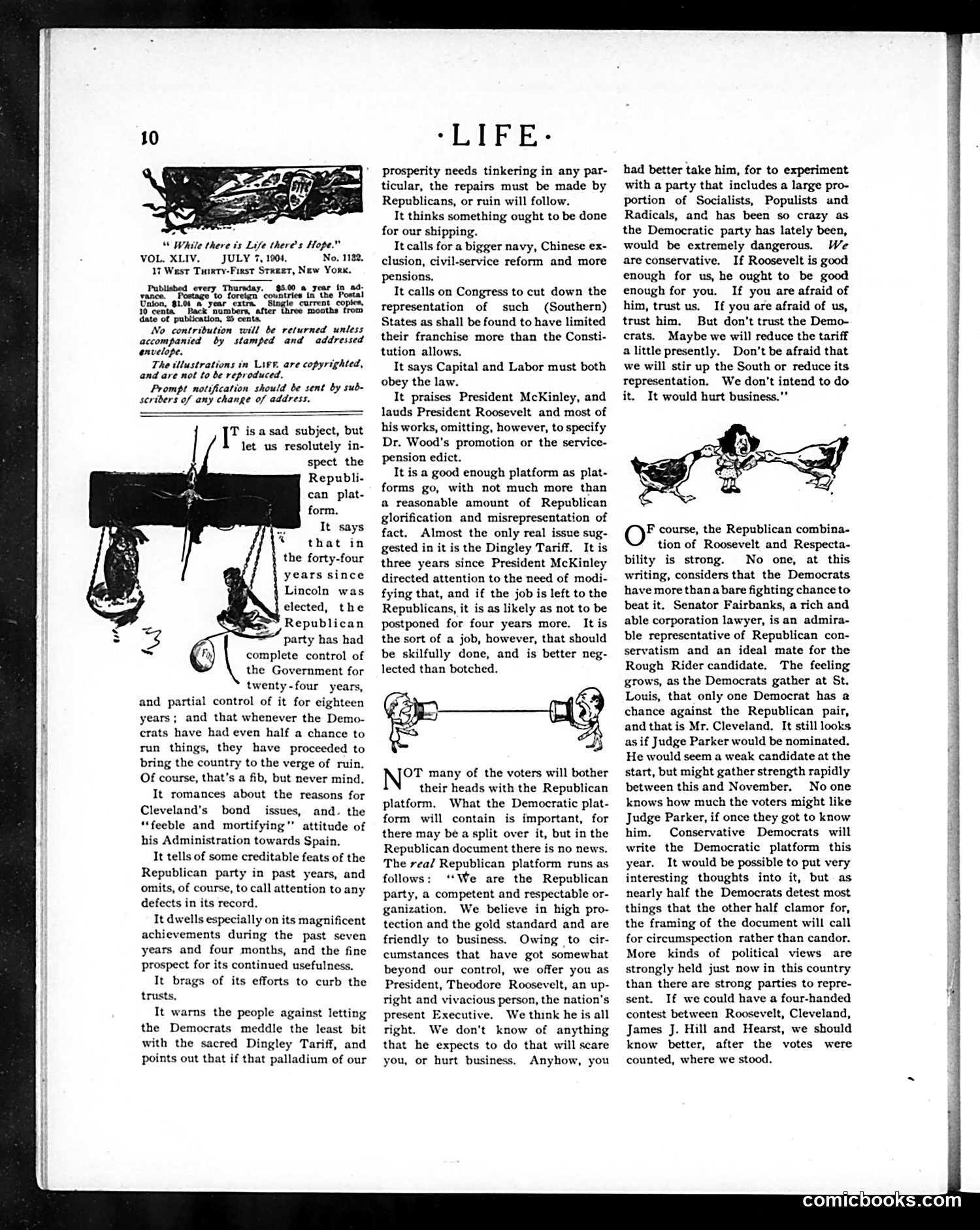
This page contains political commentary on the 1904 presidential election. The main cartoon (left side) depicts a figure hanging by a noose labeled with Democratic and Republican concerns—illustrating the precarious state of American politics. The text discusses the Republican platform's bland approach and defends Roosevelt's administration. It mocks Democratic chances, suggesting only Cleveland could compete against the Republican ticket. The piece criticizes both parties' platforms as inadequate. A small cartoon (right side) shows figures in relaxed poses, likely satirizing political complacency or the casual approach to serious governance issues. The overall message: American politics in 1904 faced genuine crises (Dinley Tariff, labor disputes) that neither party adequately addressed, leaving the nation in dangerous straits.
📄 Transcribed text from this page (OCR, searchable)
Machine-transcribed from the original scan — historical spelling and the odd misread are preserved.
“* While there is Life there's Hope.” VOL. XLIV. JULY 7, 1904, No, 1182, 17 West Tuuety-First Srezet, New York. lisbed yureday. tn ad ene ae ee eet oe i ni Geet a Sega at hrs ahs Bes date of publication, 2 cent. No contribution will be returned unless accompanied by stamped and addressed envelope. The illustrations in Lite. are copyrighted, and are not to be reproduced, Prompt notification should be sent by sub- scribers of any change of address. .° is asad subject, but let us resolutely in- spect the Republi- can plat- form. It says that in } the forty-four years since Lincoln was elected, the Republican party has had complete control of the Government for twenty-four years, and partial control of it for eighteen years; and that whenever the Demo- crats have had even half a chance to run things, they have proceeded to bring the country to the verge of ruin. Of course, that’s a fib, but never mind, It romances about the reasons for Cleveland's bond issues, and- the “feeble and mortifying” attitude of his Administration towards Spain. It tells of some creditable feats of the Republican party in past years, and omits, of course, to call attention to any defects in its record. It dwells especially on its magnificent achievements during the past seven years and four months, and the fine prospect for its continued usefulness. It brags of its efforts to curb the trusts, It warns the people against letting the Democrats meddle the least bit with the sacred Dingley Tariff, and points out that if that palladium of our SEE: Prosperity needs tinkering in any par- ticular, the repairs must be made by Republicans, or ruin will follow. It thinks something ought to be done for our shipping. It calls for a bigger navy, Chinese ex- clusion, civil-service reform and more pensions, It calls on Congress to cut down the representation of such (Southern) States as shall be found to have limited their franchise more than the Consti- tution allows. It says Capital and Labor must both obey the law. It praises President McKinley, and lauds President Roosevelt and most of his works, omitting, however, to specify Dr. Wood's promotion or the service- pension edict. It is a good enough platform as plat- forms go, with not much more than a reasonable amount of Republican glorification and misrepresentation of fact. Almost the only real issue sug- gested in it is the Dingley Tariff. It is three years since President McKinley directed attention to the need of modi- fying that, and if the job is left to the Republicans, it is as likely as not to be postponed for four years more. It is the sort of a job, however, that should be skilfully done, and is better neg- lected than botched. & OT many of the voters will bother their heads with the Republican platform. What the Democratic plat- form will contain is important, for there may be a split over it, but in the Republican document there is no news. The rea/ Republican platform runs as follows: ‘We are the Republican party, a competent and respectable or- ganization, We believe in high pro- tection and the gold standard and are friendly to business. Owing to cir- cumstances that have got somewhat beyond our control, we offer you as President, Theodore Roosevelt, an up- right and vivacious person, the nation’s present Executive. We think he is all right. We don't know of anything that he expects to do that will scare you, or hurt business. Anyhow, you 3 had better take him, for to experiment with a party that includes a large pro- portion of Socialists, Populists and Radicals, and has been so crazy as the Democratic party has lately been, would be extremely dangerous. We are conservative. If Roosevelt is good enough for us, he ought to be good enough for you. If you are afraid of him, trust us. If you are afraid of us, trust him. But don’t trust the Demo- crats. Maybe we will reduce the tariff a little presently. Don’t be afraid that we will stir up the South or reduce its representation. We don't intend to do it. It would hurt business."’ F course, the Republican combina- tion of Roosevelt and Respecta- bility is strong. No one, at this writing, considers that the Democrats have more thana bare fighting chance to beat it. Senator Fairbanks, a rich and able corporation lawyer, is an admira- ble representative of Republican con- servatism and an ideal mate for the Rough Rider candidate. The fecling grows, as the Democrats gather at St. Louis, that only one Democrat has a chance against the Republican pair, and that is Mr. Cleveland, It still looks asif Judge Parker would be nominated. He would seem a weak candidate at the start, but might gather strength rapidly between this and November. No one knows how much the voters might like Judge Parker, if once they got to know him. Conservative Democrats will write the Democratic platform this year. It would be possible to put very interesting thoughts into it, but as nearly half the Democrats detest most things that the other half clamor for, the framing of the document will call for circumspection rather than candor. More kinds of political views are strongly held just now in this country than there are strong parties to repre- sent. If we could have a four-handed contest between Roosevelt, Cleveland, James J. Hill and Hearst, we should know better, after the votes were counted, where we stood.