
A complete issue · 50 pages · 1904
Life — June 2, 1904
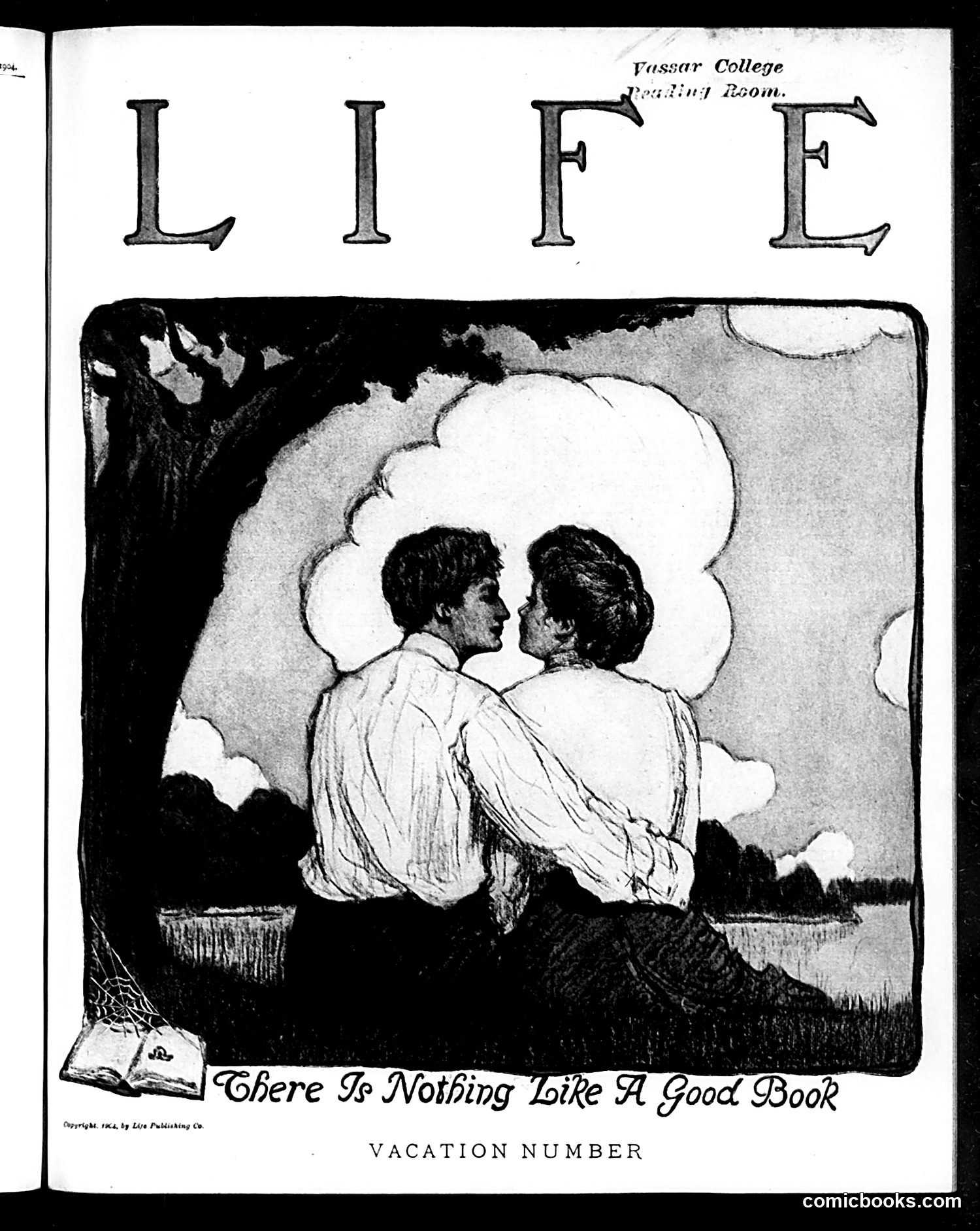
This is a "Vacation Number" cover from *Life* magazine featuring the headline "There Is Nothing Like A Good Book." The illustration depicts two young men in white shirts sitting back-to-back outdoors against clouds, apparently reading or relaxing together. The image appears to be promoting leisurely summer activities rather than delivering political satire. The romantic composition and intimate positioning of the figures suggests the cover celebrates vacation reading as a form of romantic or companionable relaxation. Without additional context about the specific publication date, it's unclear whether this references particular social attitudes of its era, though the aesthetic and artistic style suggests early-to-mid 20th century production. The message is straightforwardly promotional about vacation literature rather than satirical commentary.
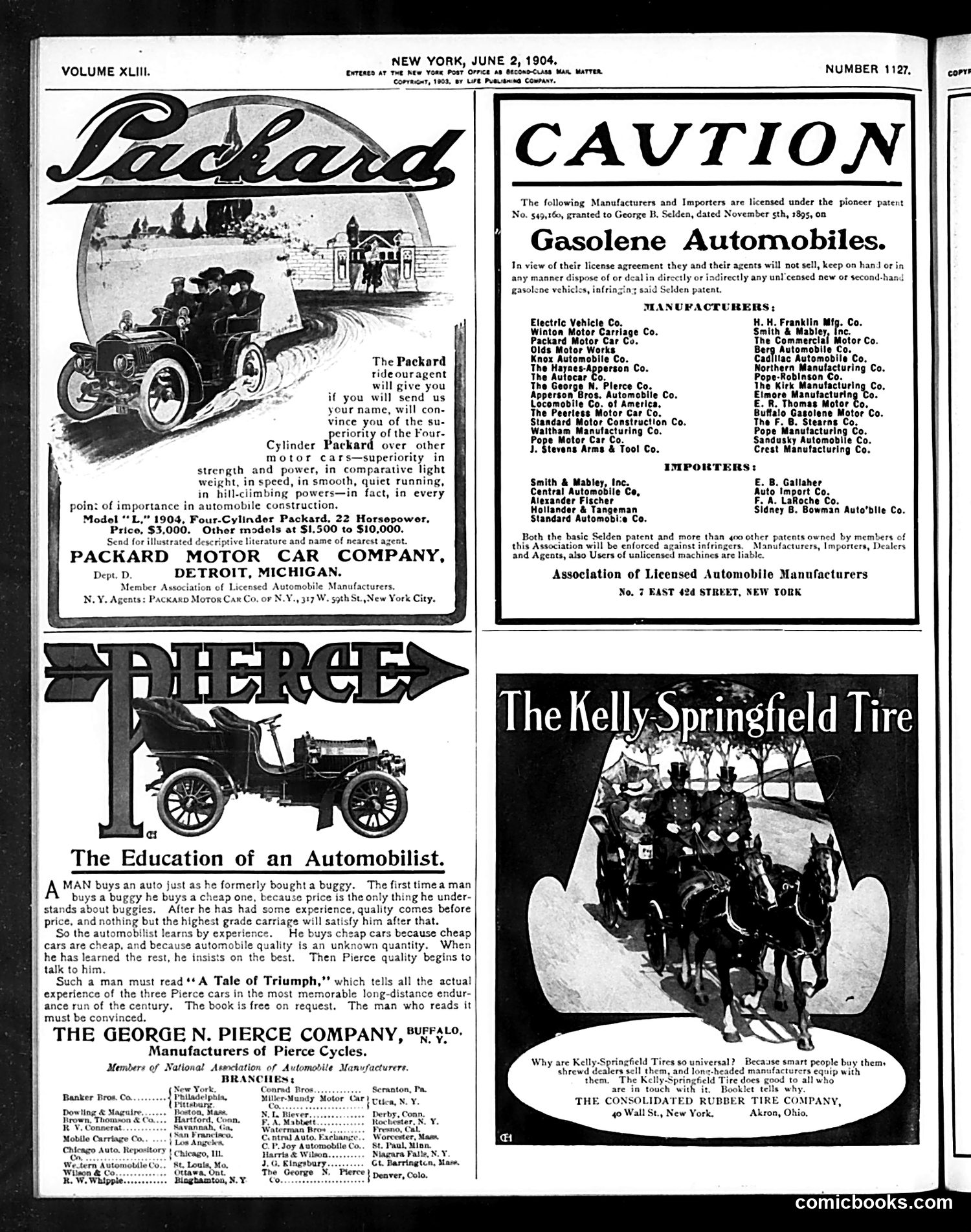
This page is primarily **advertising, not editorial content or satire**. It contains four automobile advertisements from June 2, 1904: 1. **Packard Motor Car Company** - promoting their "Model L" with 22 horsepower 2. A **caution notice** from the Association of Licensed Automobile Manufacturers listing authorized manufacturers and importers 3. **Pierce automobiles** - with an article titled "The Education of an Automobilist" explaining how car buyers learn quality through experience 4. **Kelly-Springfield Tire Company** - showing their product There are no political cartoons or satirical commentary here. The page reflects the early automotive industry's concerns: patent disputes (the caution notice), brand differentiation, and consumer education about vehicle quality during the nascent automobile era.

This page consists entirely of **advertisements**, not editorial cartoons or satire. The left half advertises the **Canadian Pacific Railway**, promoting its new transcontinental service between Montreal, Toronto, and Vancouver starting June 13, 1904. It lists three named trains: The Imperial Limited, The Pacific Express, and The Atlantic Express. The right half contains three separate ads: the **Watres Power Horn and Tire Filler** (a motorcar accessory), **Tomfoolery** (a humor book by James Montgomery Flagg with cartoonish illustrations of exaggerated facial features), and **Life Publishing Company** promoting their magazine. The page represents typical early-1900s advertising content—no political commentary or satire is present. The illustrated faces in the Tomfoolery ad are humorous caricatures meant to sell the book itself.
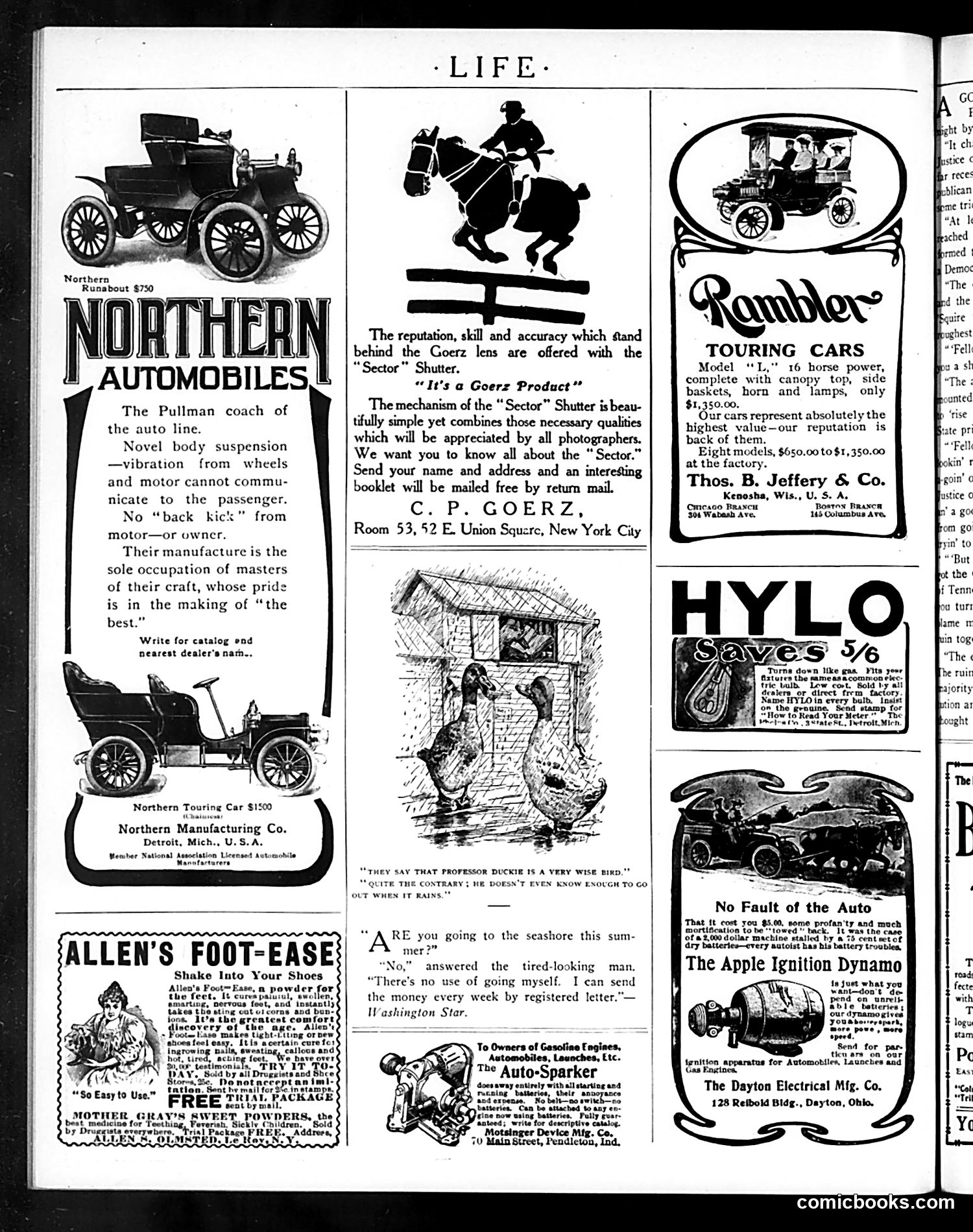
This page is primarily **automobile advertisements** from the early 1900s, interspersed with a single cartoon joke. The cartoon depicts two figures (a man and woman) at a well during rain, with the caption discussing Professor Ducks being "very wise" about not knowing "enough to go out when it rains." This appears to be a gentle, non-political humor piece playing on the proverb that ducks have natural sense. The advertisements showcase early motorcar manufacturers (Northern Automobiles, Rambler, Hylo) and automotive accessories (Allen's Foot-Ease shoe powder, Auto-Sparker ignition devices). These ads reflect the era when automobiles were novel luxury items requiring explanatory marketing. The page contains **no political satire or caricature**—it's straightforward commercial content typical of Life magazine's revenue model during this period.
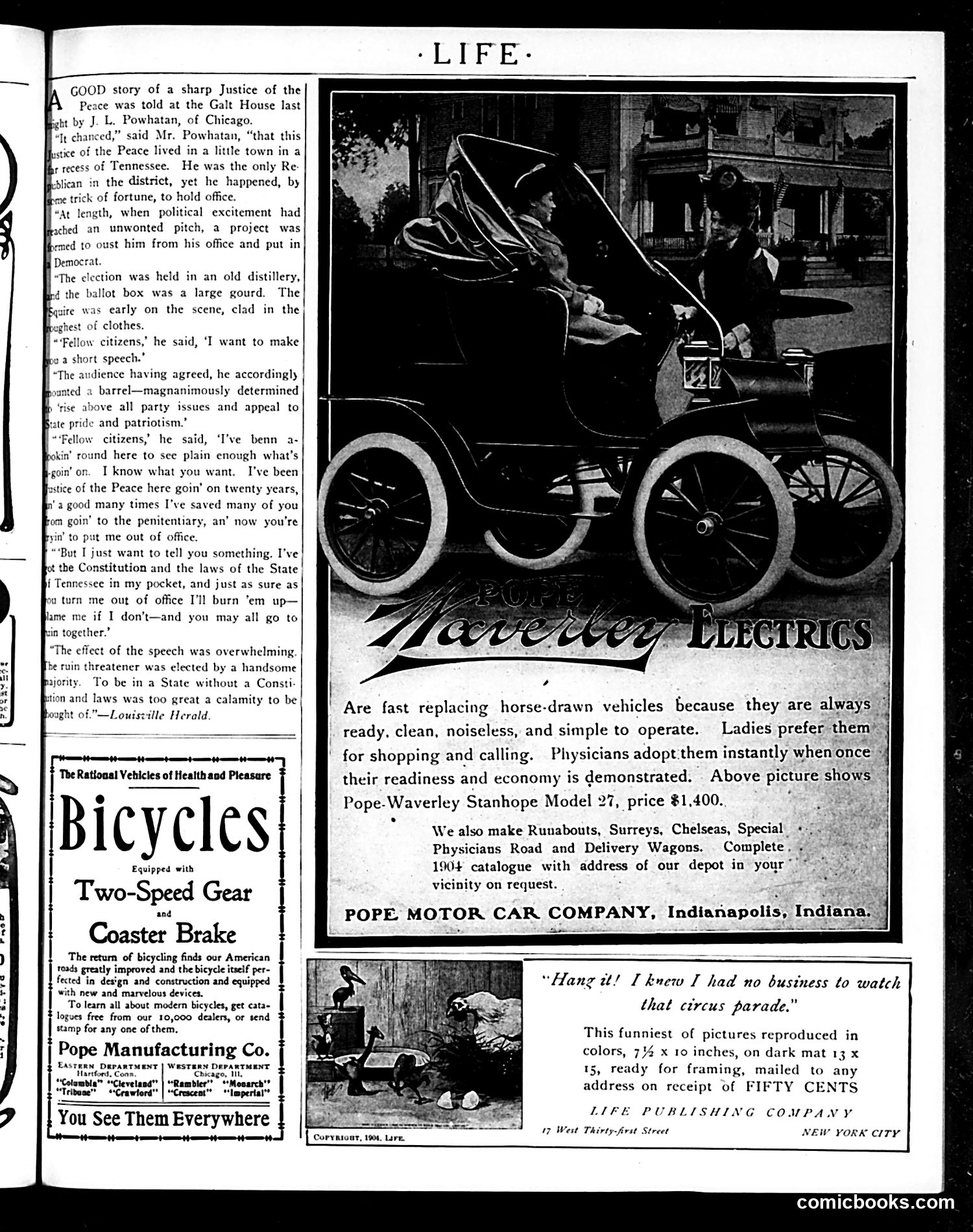
This page is primarily **advertising**, not political satire. The main content features two advertisements: 1. **Pope-Waverley Electrics** (large ad): Promotes early electric vehicles as superior to horse-drawn carriages—clean, quiet, and simple to operate. The image shows a woman in an electric car, appealing to female consumers and professionals (physicians). This reflects genuine technological competition in early 1900s transportation. 2. **Pope Manufacturing Co. Bicycles** (left column): Advertises bicycles with two-speed gear and coaster brakes, emphasizing American engineering improvements. The text story at top left appears unrelated—a humorous anecdote about a Justice of the Peace. The bottom comic about a circus parade is a separate humorous illustration, likely unconnected to the advertisements.
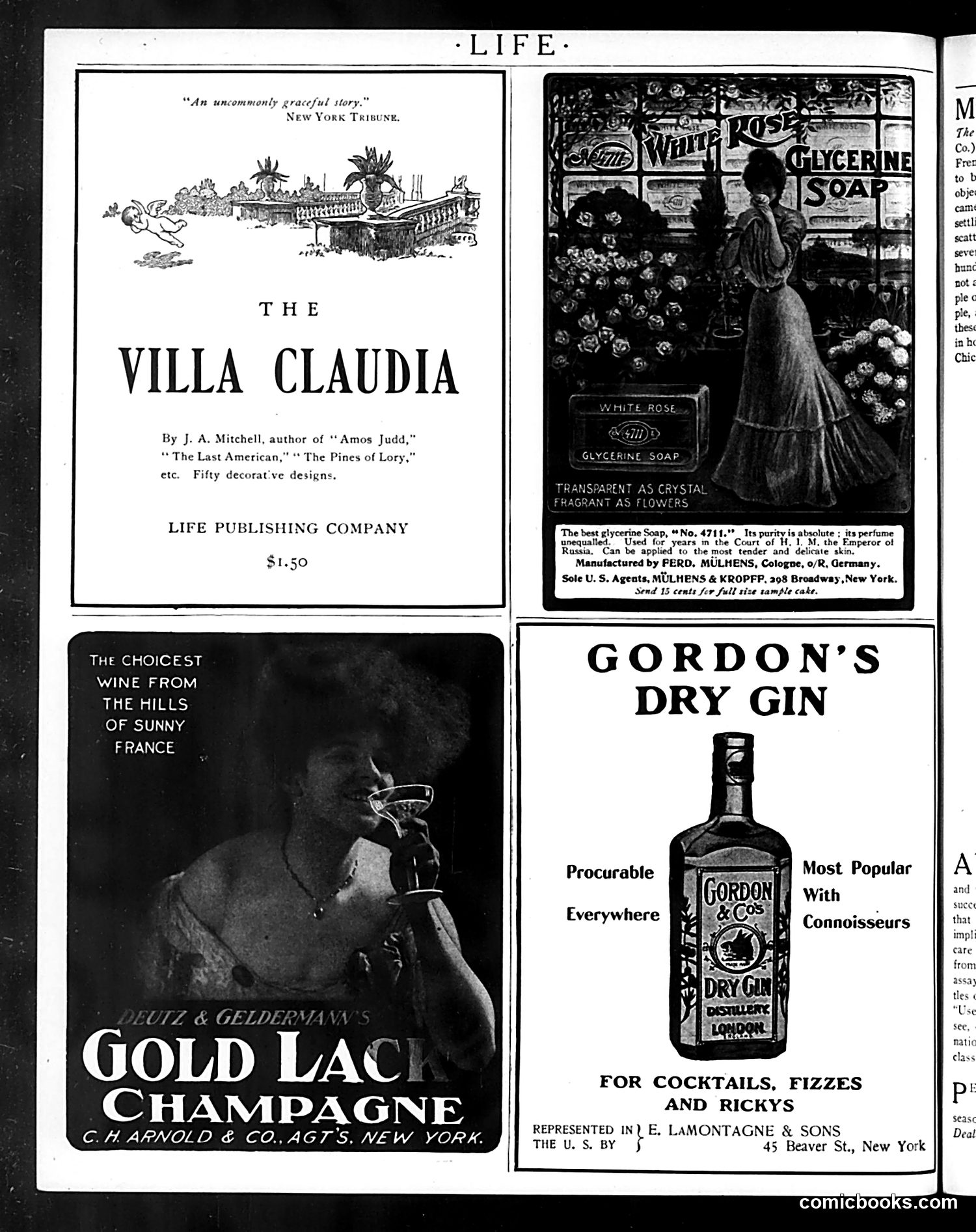
This page is primarily **advertising**, not political satire or editorial content. It contains four advertisements: 1. **Top left**: Book advertisement for "The Villa Claudia" by J.A. Mitchell, published by Life Publishing Company ($1.50) 2. **Top right**: White Rose Glycerine Soap ad, showing a woman viewing a shop window display 3. **Bottom left**: Gold Lack Champagne by Deutz & Geldermann, advertised as "the choicest wine from the hills of sunny France" 4. **Bottom right**: Gordon's Dry Gin advertisement, noting it's "procurable everywhere" and "most popular with connoisseurs" The page reflects early 20th-century advertising conventions, featuring luxury consumer goods (alcoholic beverages, soap, books) with elegant typography and imagery typical of the era. There is no political cartoon or satire present on this page.
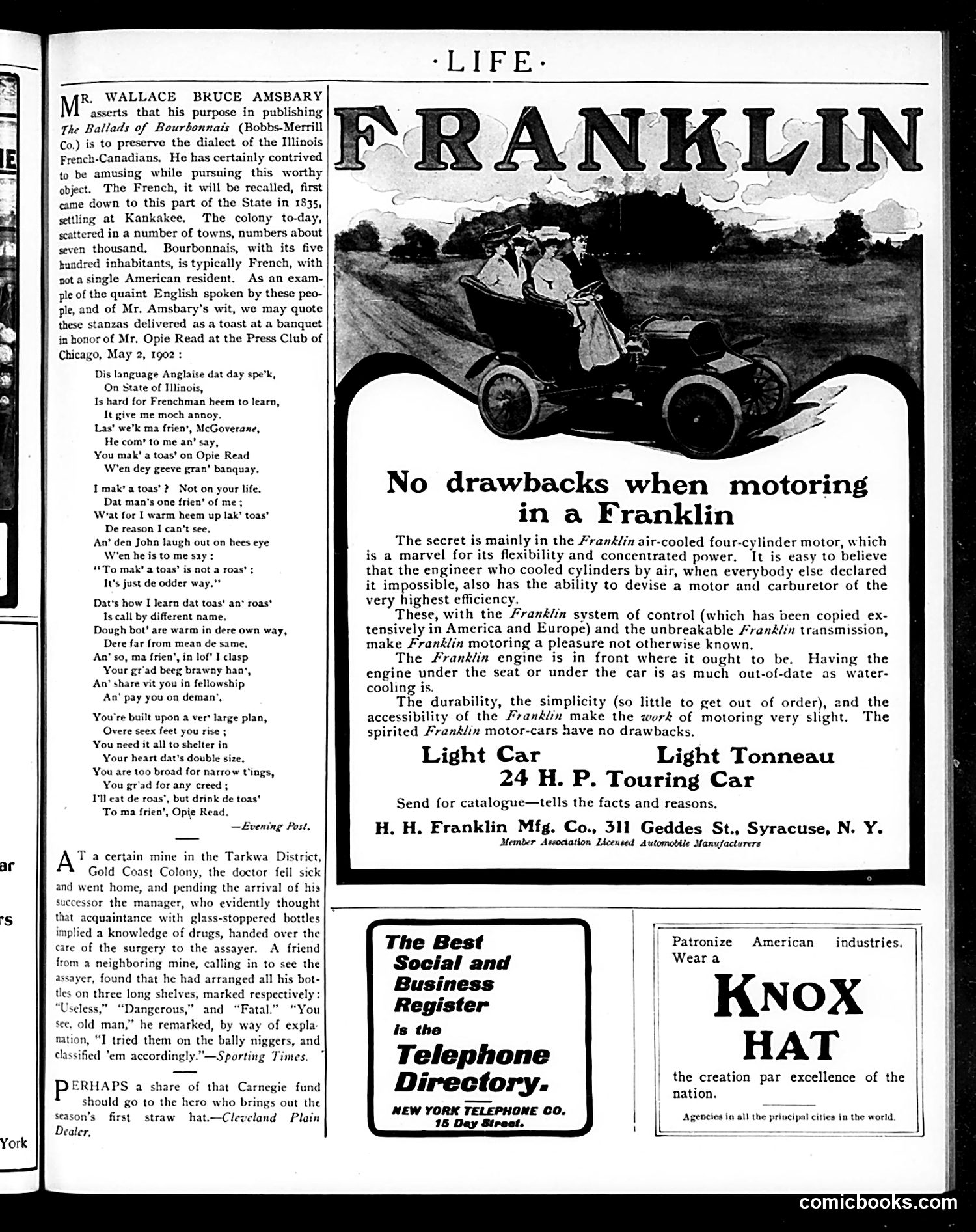
This page is primarily **advertising content**, not satire. The dominant feature is a large Franklin automobile advertisement featuring an early motorcar and the headline "No drawbacks when motoring in a Franklin." The advertisement emphasizes the Franklin's air-cooled four-cylinder engine, control system, and reliability—selling points for early 1900s automobiles when mechanical failures were common ("drawbacks"). The left side contains a poem by "Evening Post" about French-Canadian dialect spoken in Illinois, unrelated to the car ad. Below are two smaller ads: one for the New York Telephone Directory and another for Knox hats, promoting "American industries." **This is a standard magazine page mixing editorial content with period advertising—not political satire or social commentary requiring historical context for modern readers.**
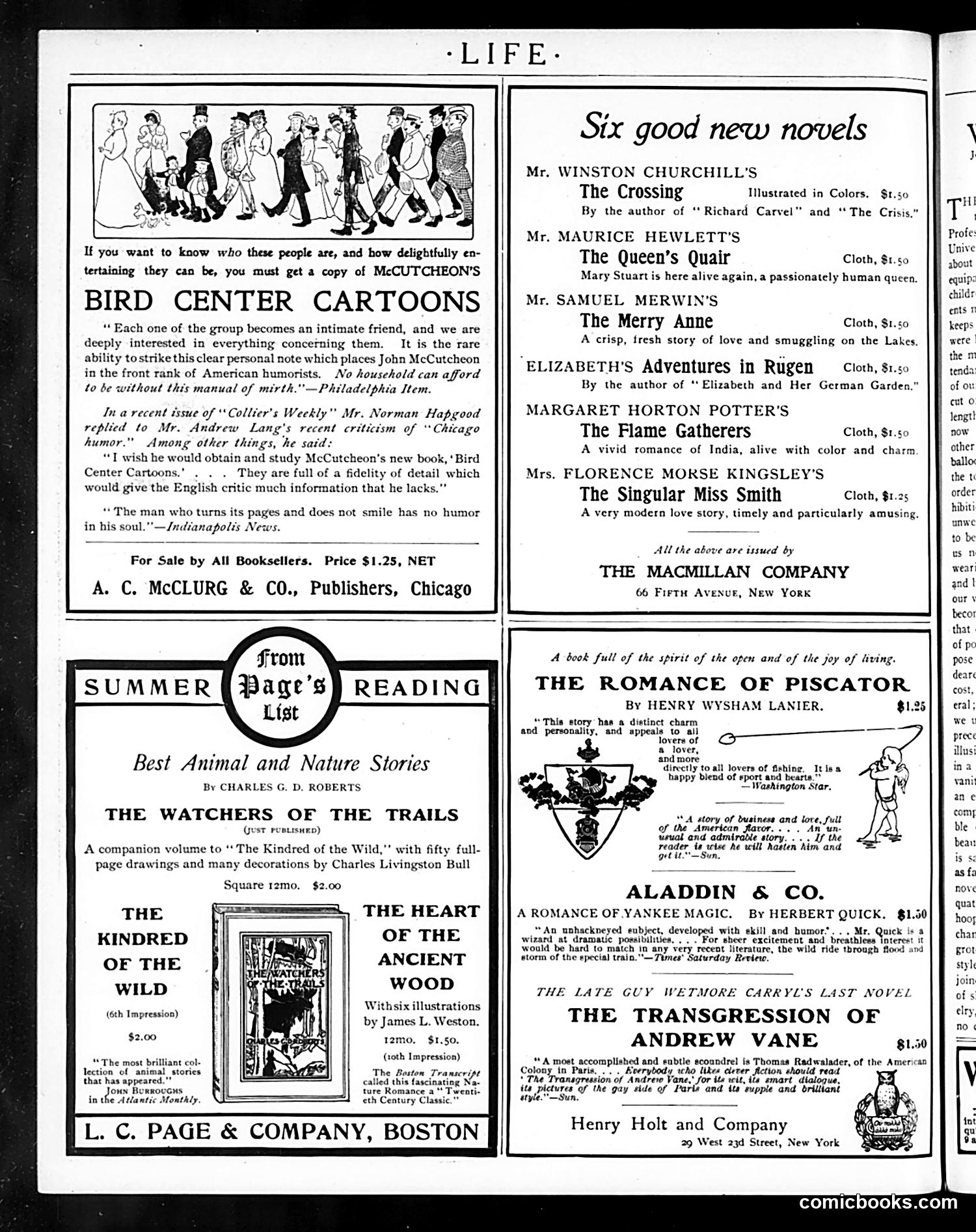
This page is primarily **book advertisements** from early 20th-century publishers, not political satire or cartoons requiring historical context. The left side advertises **"Bird Center Cartoons"** by A.C. McClung & Co., emphasizing that the cartoons feature recognizable characters readers care about—a selling point for what appears to be a popular comic series. The ad quotes praise from *Collier's Weekly* and *Indianapolis News*. Below that, **L.C. Page & Company** advertises nature and animal stories, including works by Charles G.D. Roberts. The right side lists **six new novels** from Macmillan Company and other publishers, plus advertisements for books like "The Romance of Piscator" and "Aladdin & Co." The page functions as a **book catalog**, not satirical commentary. No political figures or social critique are visible.
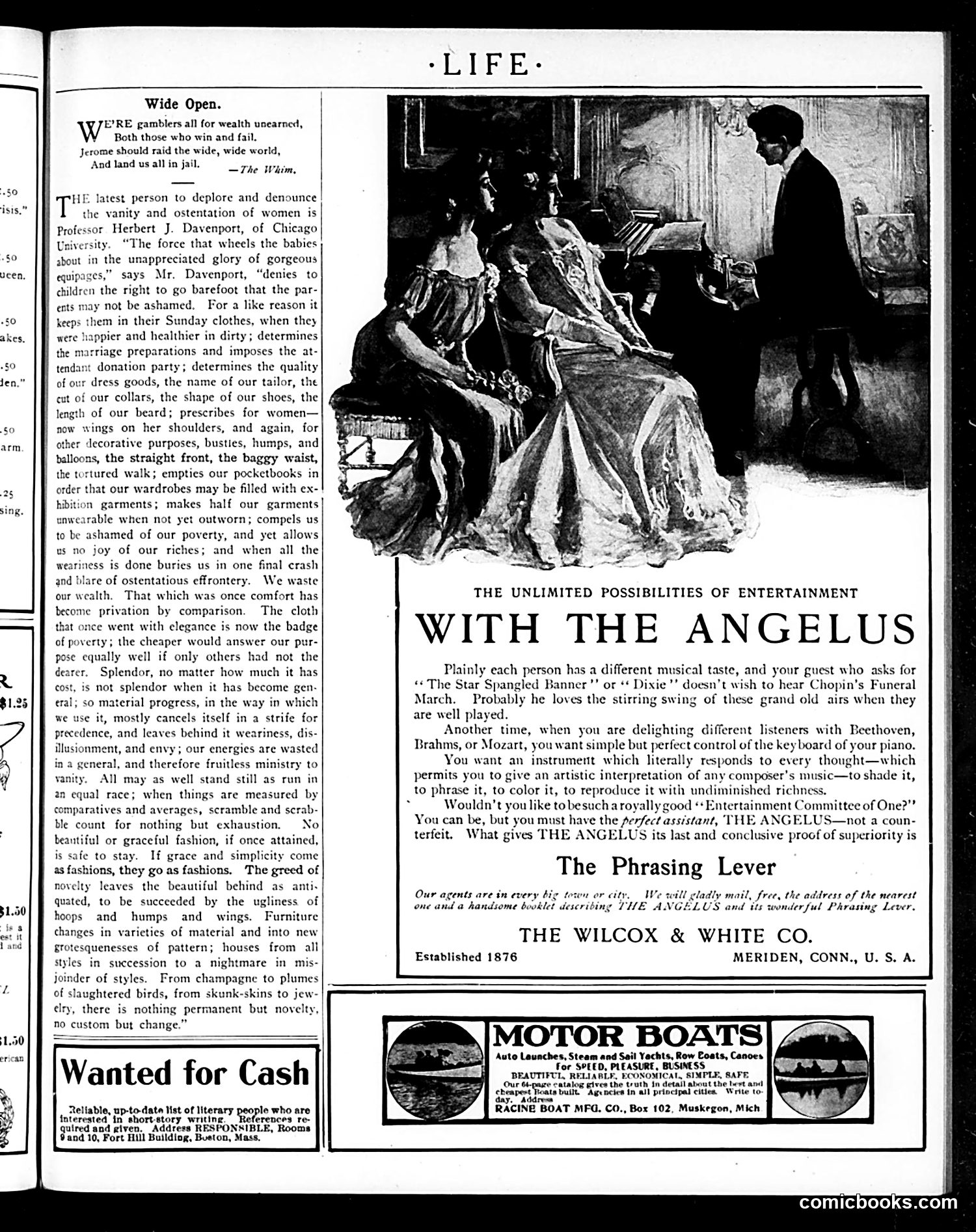
This page is primarily **advertising and editorial content rather than political satire**. The left column contains an essay titled "Wide Open" critiquing vanity and materialism in women's fashion and social ostentation, quoting Whitman. It attacks frivolous spending on clothing, jewelry, and decorative items. The right side advertises **The Angelus**, a musical instrument (appears to be a player piano or similar device), emphasizing its ability to reproduce any composer's work with "unlimited possibilities of entertainment." Below that is an ad for **The Wilcox & White Co.** (established 1876, Meriden, Connecticut), selling "The Phrasing Lever" musical device. At the bottom is an advertisement for **motor boats** from Racine Boat Manufacturing Company. The photograph shows what appears to be a social gathering or entertainment scene, likely illustrating the entertainment theme.
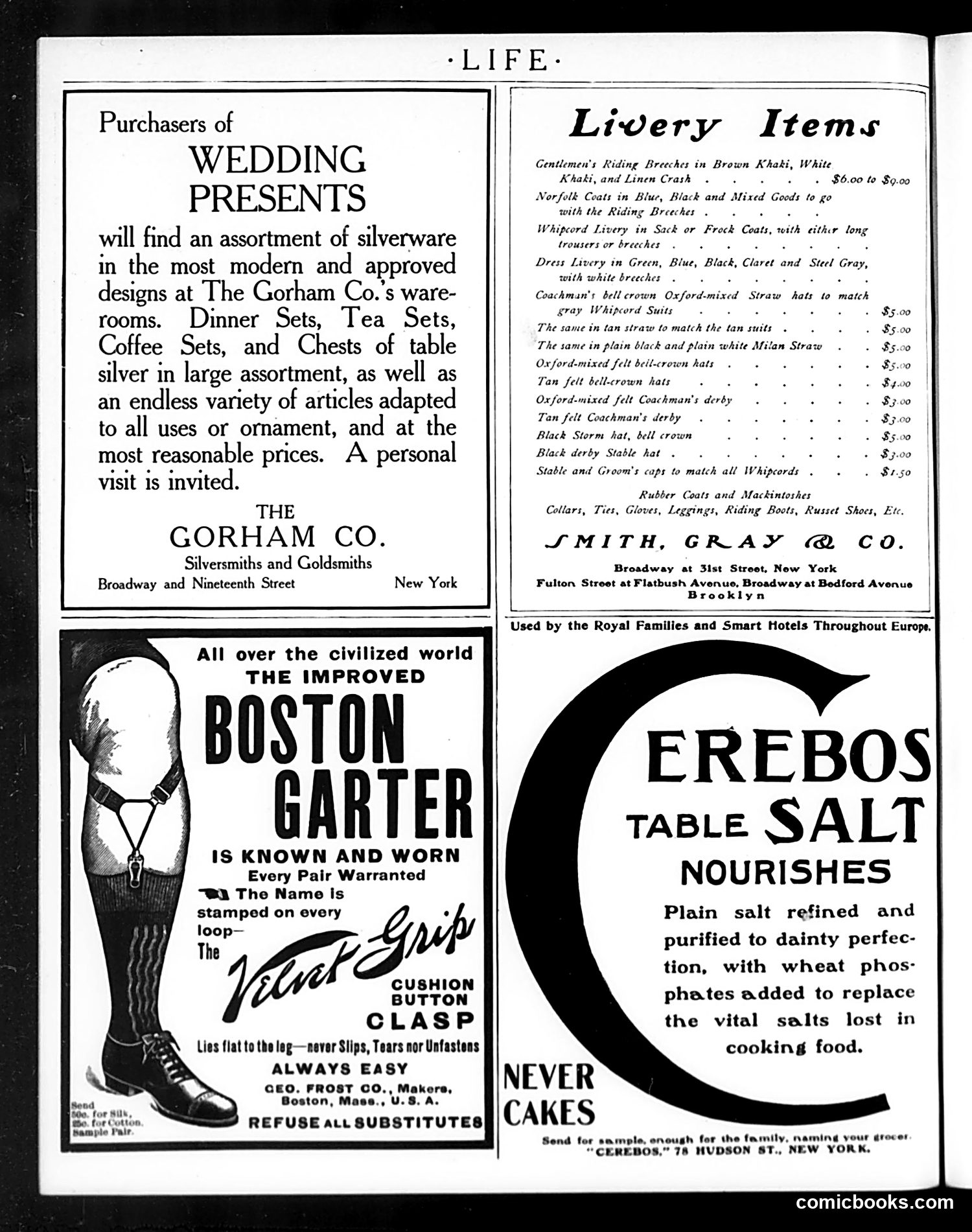
This page is primarily **advertising content**, not satirical cartoons. It contains four distinct ads: 1. **The Gorham Co.** — silverware for wedding gifts 2. **Smith, Gray & Co.** — livery items (riding clothes, hats, coats) 3. **Boston Garter** — an illustrated ad for men's garters with a "Velvet Grip Cushion Clasp," emphasizing durability ("never Slips, Tears nor Unfastens") 4. **Cerebos Table Salt** — salt refined with wheat phosphates The Boston Garter ad is the only image with visual content—showing a man's leg in a shoe and sock to demonstrate the garter product. The ads reflect early 20th-century consumer goods aimed at affluent readers. There is **no political satire** on this page; it's a straightforward advertising section from *Life* magazine.
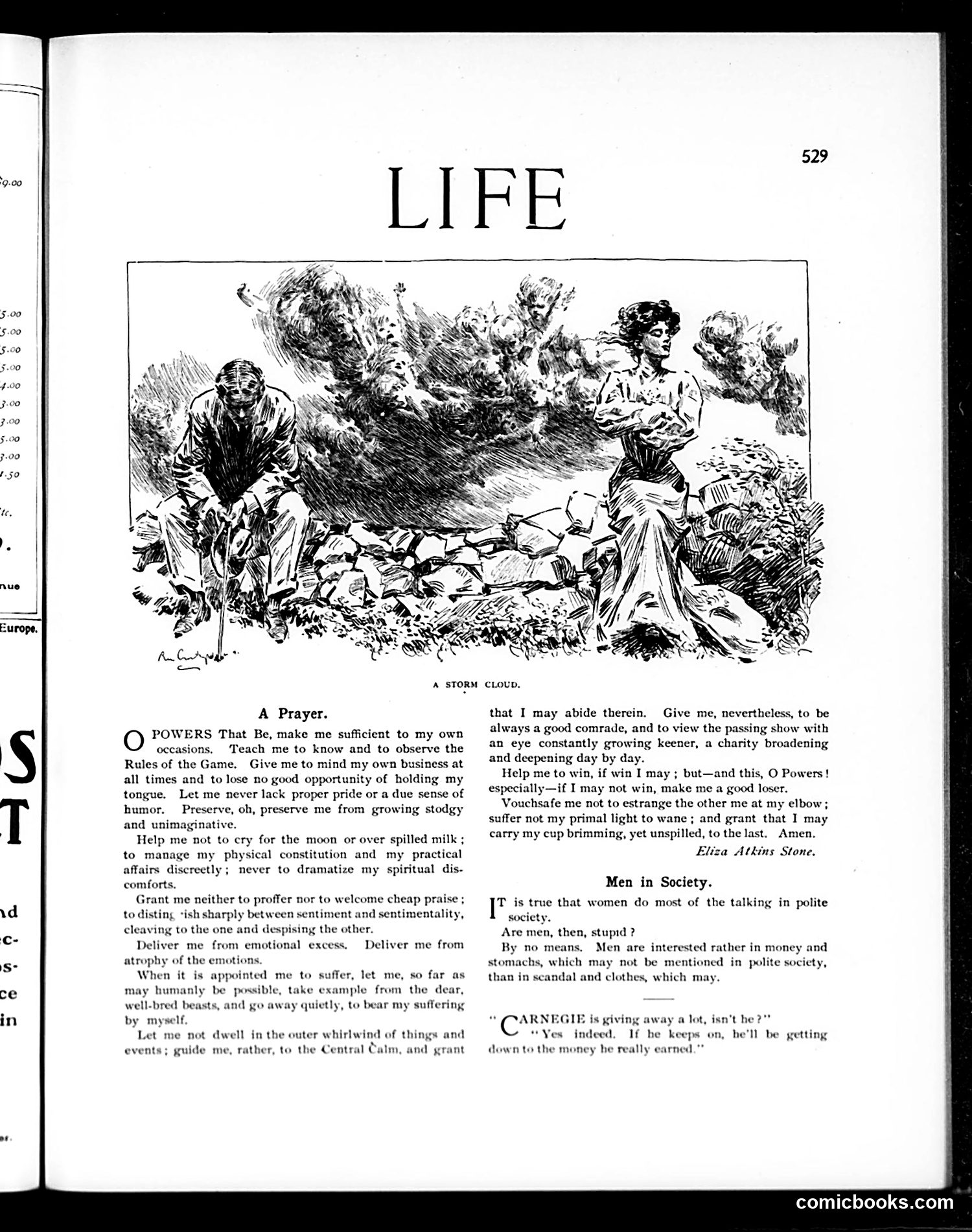
The page contains two distinct pieces: **"A Storm Cloud" illustration** shows a man and woman sitting outdoors during approaching bad weather—a visual metaphor for life's troubles. **"A Prayer"** by Eliza Atkins Stone is a poem requesting resilience and good humor during hardship. It asks for sufficiency, practical sense, and the ability to "bear my suffering" quietly without dramatizing spiritual discontent. The prayer emphasizes dignity in misfortune and acceptance of fate. **"Men in Society"** is a brief satirical piece mocking men's actual interests despite polite social conventions. It suggests men care about money and physical appetites more than the refined topics women discuss in "polite society"—a commentary on gender hypocrisy and the gap between public pretense and private reality.
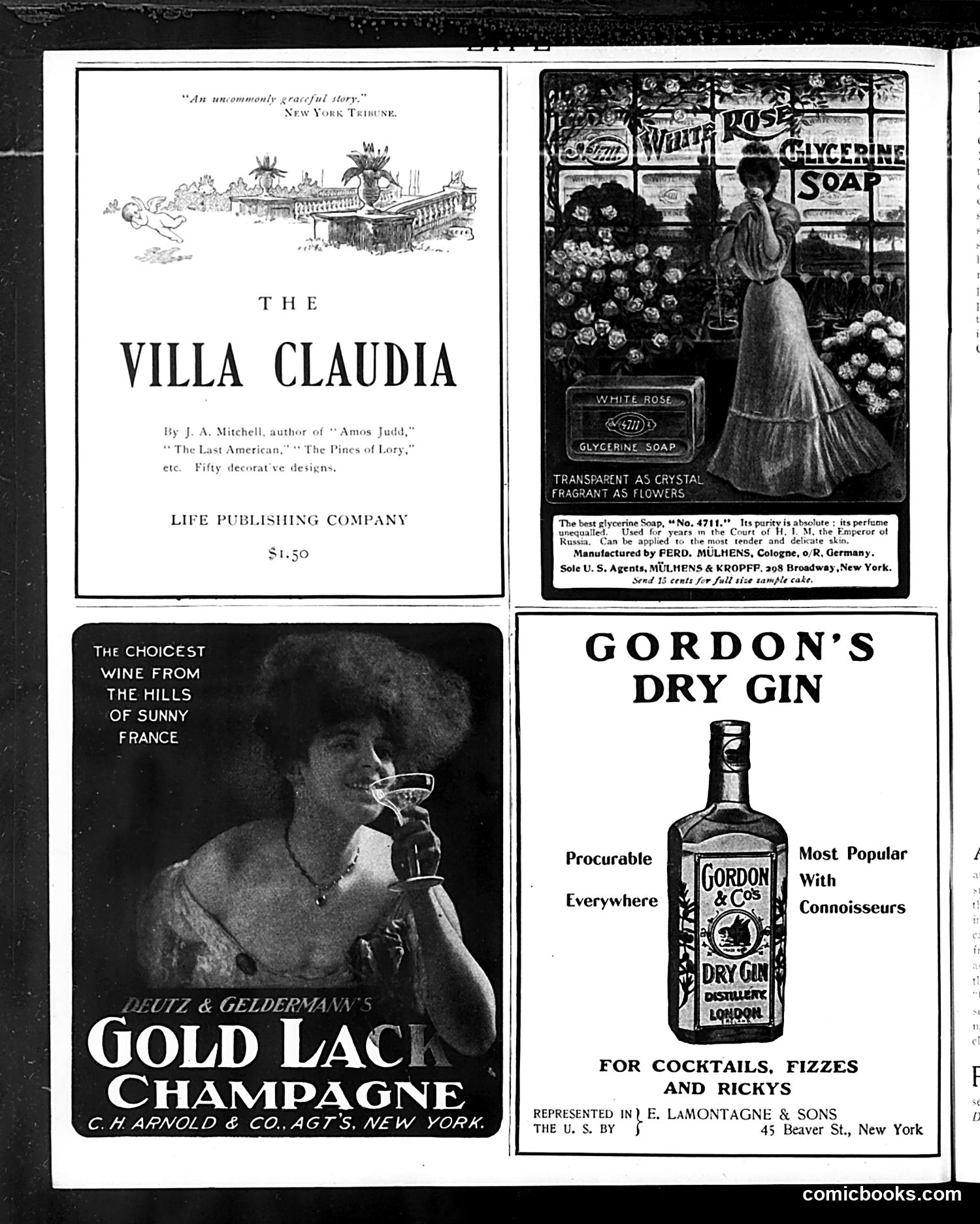
This page is primarily **advertising**, not editorial satire. It contains four advertisements: 1. **Book advertisement** (top left): "The Villa Claudia" by J.A. Mitchell, published by Life Publishing Company, $1.50 2. **White Rose Glycerine Soap** (top right): Shows a woman admiring flowers, marketing the soap as "transparent as crystal, fragrant as flowers" 3. **Gold Lace Champagne** (bottom left): Advertisement for Deutz & Geldermann's champagne, described as "the choicest wine from the hills of sunny France" 4. **Gordon's Dry Gin** (bottom right): Marketed as "procurable everywhere" and "most popular with connoisseurs," suitable for cocktails and mixed drinks The advertisements reflect early 20th-century consumer goods targeting upper and middle-class readers.
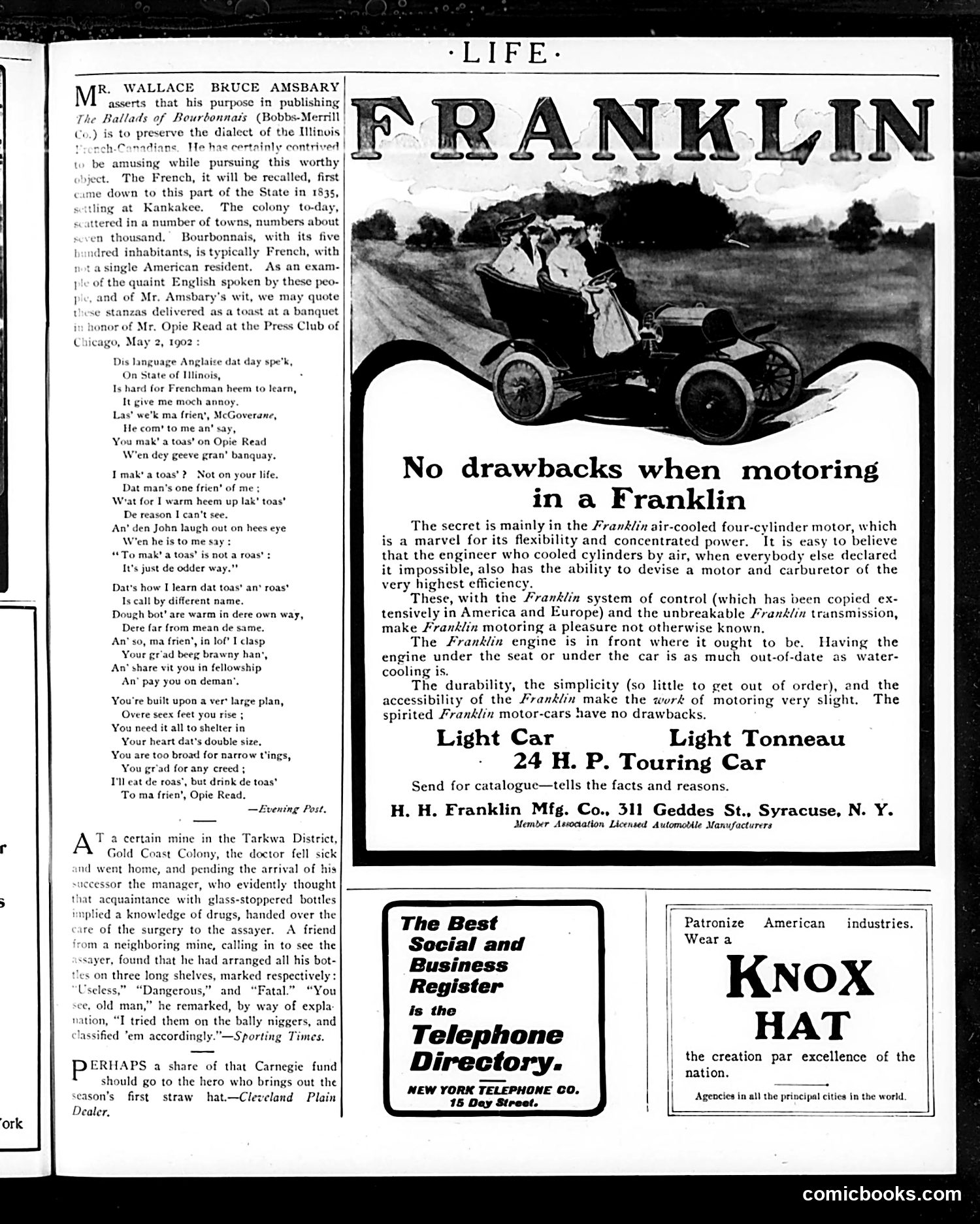
This page is primarily **advertising and literary content** rather than political satire. The main content features: 1. **"The Ballads of Bourbonnais"** — A literary piece by Wallace Bruce Amsbary celebrating French-Canadian dialect spoken in Illinois. The dialect poetry humorously reproduces the accented English of French colonists (e.g., "Dis language Anglaise"). This reflects turn-of-the-century American interest in regional vernacular literature. 2. **Franklin automobile advertisement** — A full-page ad promoting the Franklin motor car's air-cooled engine as superior technology, emphasizing reliability and ease of use. 3. **Minor anecdotes** — A brief story mocking a colonial-era doctor's assistant who tested medicines on unnamed subjects (using offensive period language), and a quip about straw hats. The page reflects early 1900s sensibilities: pride in regional American dialects, emerging automobile culture, and unfortunately, casual dehumanizing attitudes toward non-white populations. There is no coherent political cartoon or unified satirical theme.
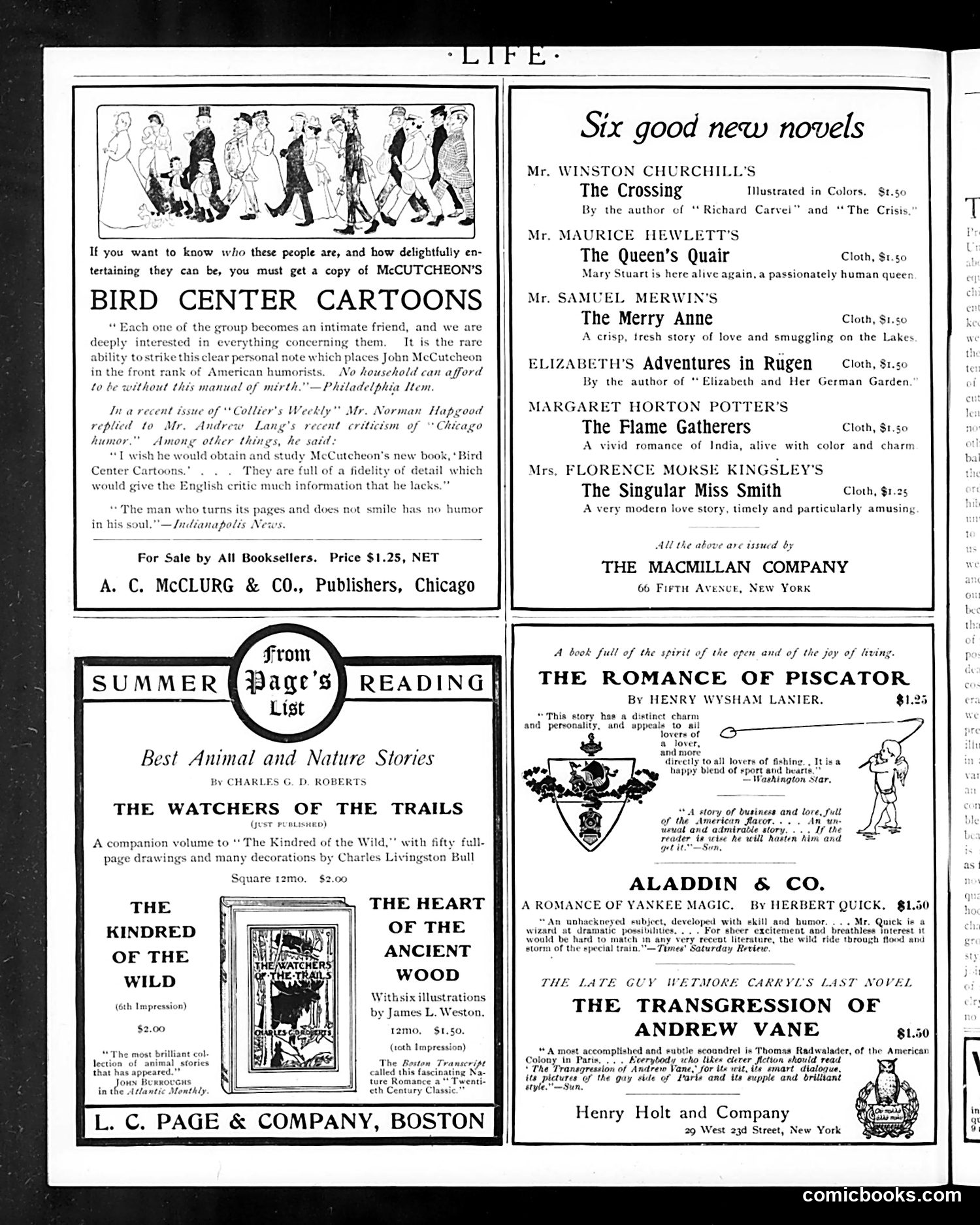
This page is primarily **advertising**, featuring book promotions rather than satirical content. The main advertisement promotes John McCutcheon's "Bird Center Cartoons," a collection of humorous drawings. McCutcheon was a prominent American cartoonist whose work appeared in major publications. The ads quote praise from notable figures: Norman Hapgood (editor of *Collier's Weekly*) endorses the book, and the *Philadelphia Item* calls it essential reading. The humor derives from the cartoons' ability to make "an intimate friend" of each character depicted—suggesting McCutcheon's skill at character development through visual comedy. The remainder of the page advertises six novels from major publishers (Macmillan, Henry Holt) and nature stories from L.C. Page & Company, typical of early 1900s literary marketing. No political satire or caricature is present; this is a straightforward publishing advertisement page.
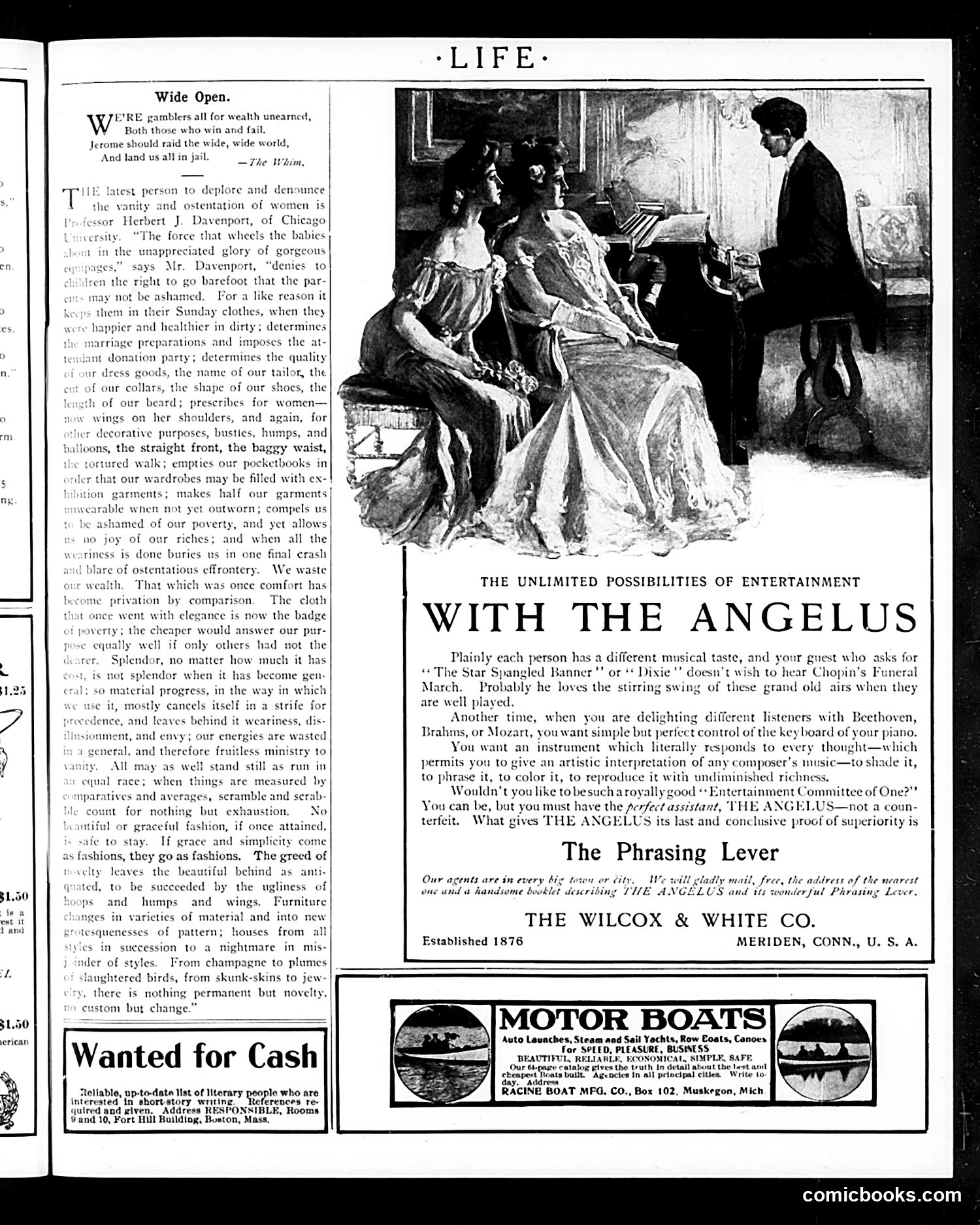
This page is primarily **advertising and editorial content** rather than political satire. The main feature is "Wide Open," a lengthy essay by Professor Herbert J. Davenport criticizing women's vanity and conspicuous consumption. Davenport argues that fashion dictates—corsets, bustles, elaborate dress codes—are wasteful, financially ruinous, and reduce women to poverty-stricken shame despite wealth. The piece attacks how "novelty" drives spending cycles, with fashions constantly changing, leaving previous purchases obsolete and shameful. The illustration shows a formal social gathering, likely depicting the women's fashions Davenport critiques. The remainder of the page contains **commercial advertisements**: the Angelus piano (emphasizing its "phrasing lever" for musical expression), a "Wanted for Cash" literary notice, and motor boats. This represents typical Life magazine content mixing social commentary with advertising—no specific political cartoon or identifiable caricatures appear on this page.
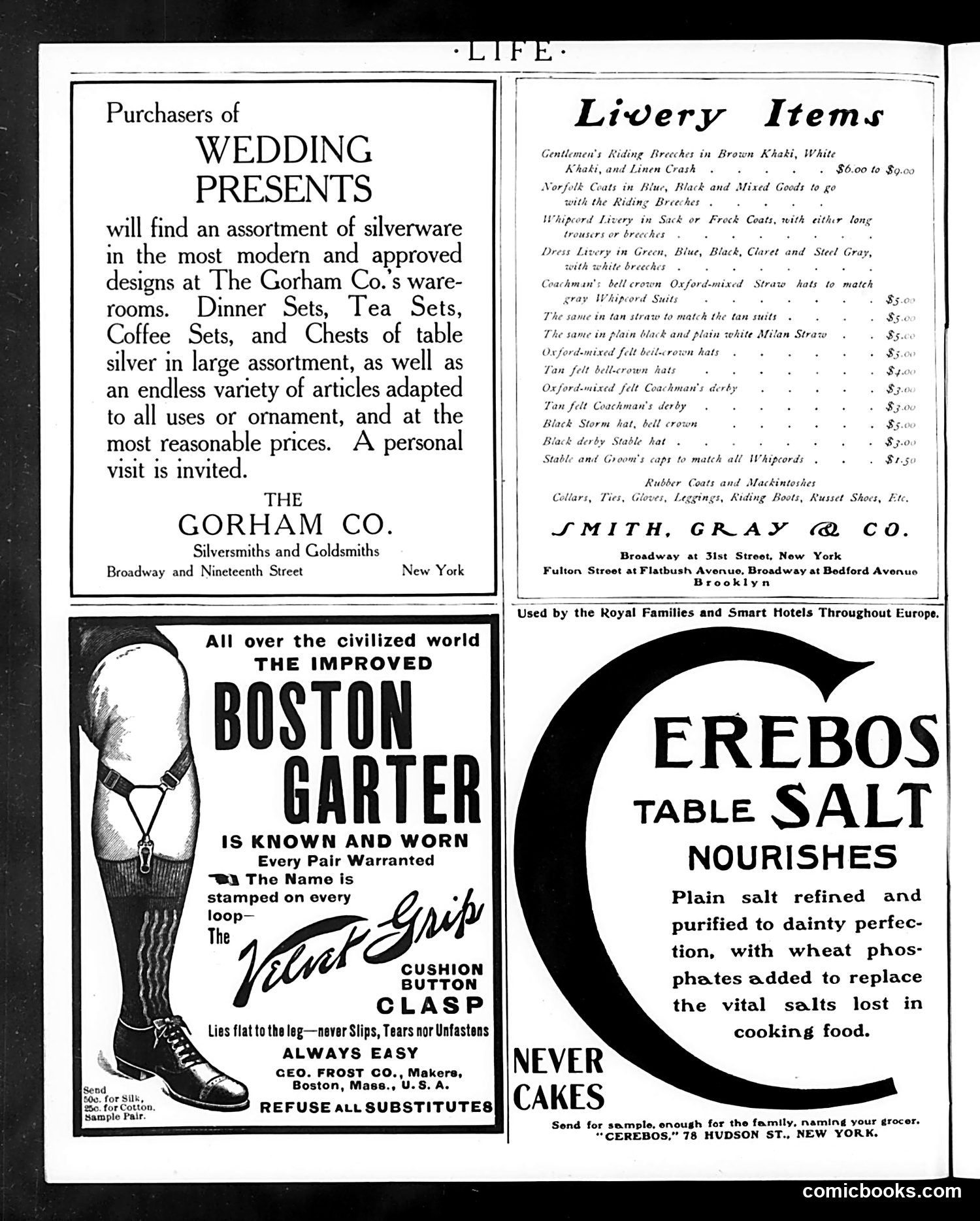
This is primarily a **advertisements page**, not satirical content. It contains four commercial ads typical of early 20th-century Life magazine: 1. **The Gorham Co.** (top left): Silver goods for weddings 2. **Smith, Gray & Co.** (top right): Livery clothing and accessories for servants/coachmen 3. **Boston Garter** (bottom left): Men's garters with cushioned clasps 4. **Erebos Table Salt** (bottom right): Salt fortified with wheat phosphates **Notable context for modern readers**: The livery items ad reveals the page's era—when wealthy households employed servants in formal dress. The Boston Garter ad reflects that men wore garters to keep socks up. The salt fortification claim reflects early 20th-century nutritional awareness. There is **no cartoon or satire** on this page—it's straightforward period advertising aimed at affluent readers.
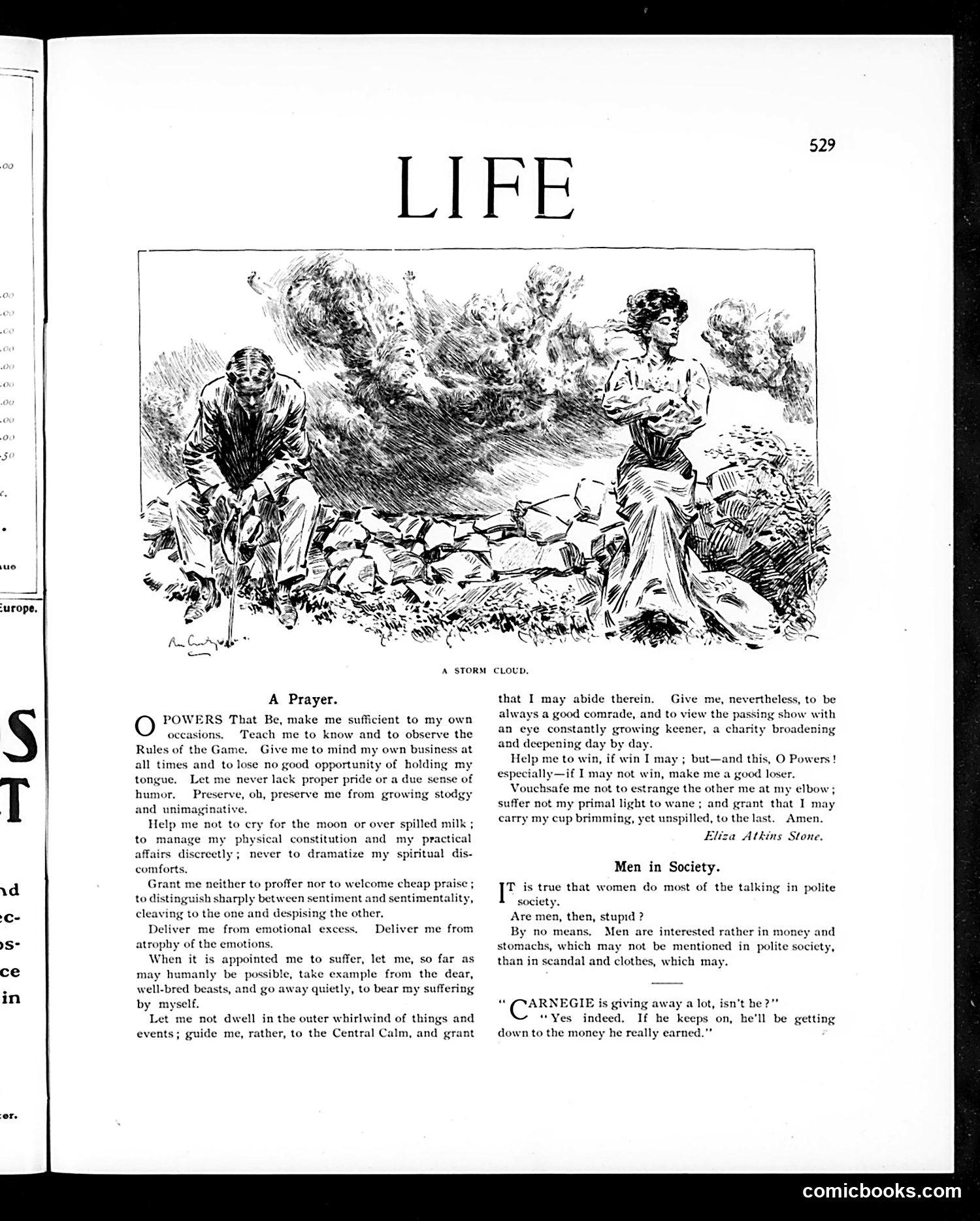
This *Life* magazine page contains satirical content about social manners and wealth. The top illustration, titled "A Storm Cloud," depicts a man and woman in an outdoor setting—likely commenting on social interactions or romantic dynamics. Below is a prayer-like essay mocking genteel Victorian/Edwardian social pretensions, advising readers to maintain composure, avoid dramatics, and accept life's disappointments with dignity. The final section, "Men in Society," uses light satire to suggest that men actually dominate social conversation despite appearances, being more interested in money and business than the trivial gossip (scandal and clothes) attributed to women. The closing joke about Andrew Carnegie mocks the wealthy industrialist's philanthropy as relatively modest compared to his total fortune—implying he's giving away only a fraction of his vast wealth while keeping the bulk he "really earned," a sharp jab at Gilded Age wealth inequality and selective generosity.
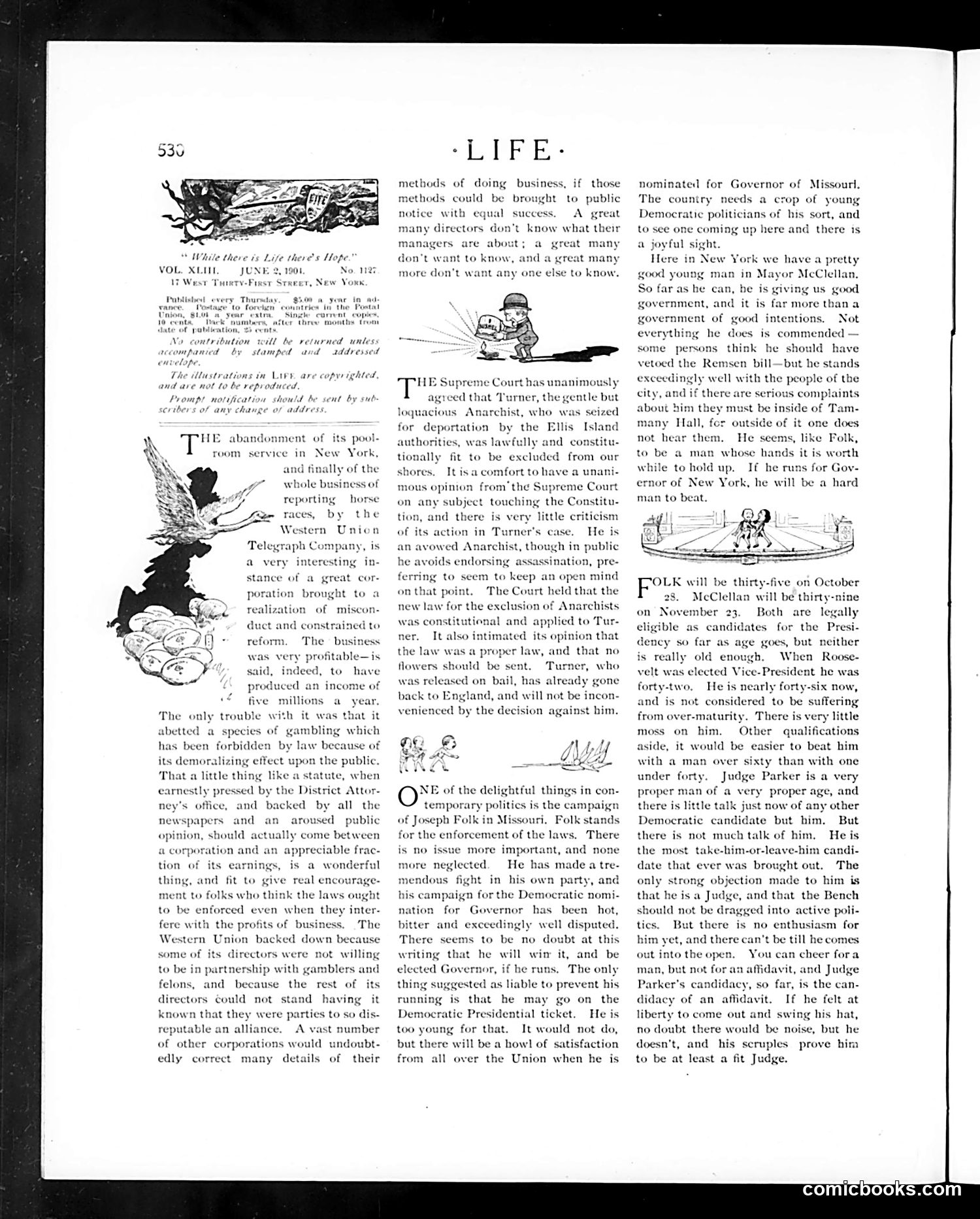
This page contains three separate political commentaries: **Western Union Telegraph Company**: The text celebrates the company's decision to stop profiting from horse-race gambling after public pressure and district attorney action. The point is that corporations will reform unethical practices when forced by law enforcement and public opinion—a call for greater corporate accountability. **Turner the Anarchist**: The Supreme Court unanimously upheld the deportation of Turner, described as an "avowed Anarchist." The commentary notes approvingly that excluding Anarchists from entry is constitutional, though Turner "avoids endorsing assassination." This reflects early-20th-century anxiety about radical political movements. **Joseph Folk for Missouri Governor**: Folk, running a campaign emphasizing law enforcement, is praised as a young Democratic candidate. The text suggests he'd be an excellent governor choice for Missouri, though notes speculation he might instead run for President. This is favorable political commentary on a reform-minded politician. The page reflects Progressive Era concerns: corporate reform, anarchist exclusion, and support for anti-corruption candidates.
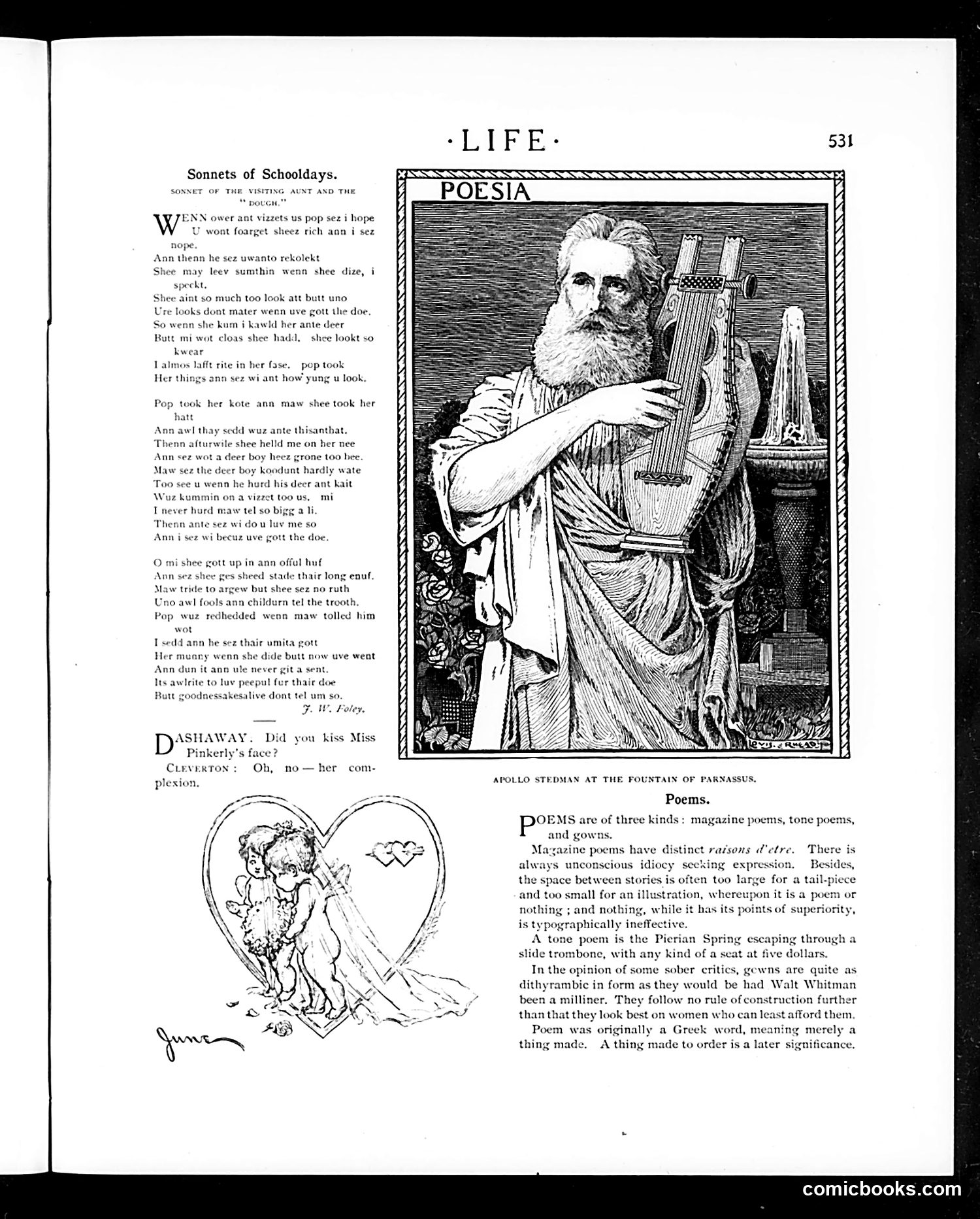
This page contains three distinct elements: **"Sonnets of Schooldays"** (top left): A humorous poem in deliberately misspelled dialect about a visiting aunt. The joke is mercenary: the narrator's family hopes the aunt will leave them money ("she may leev sumthin wenn shee dize"), so they flatter her excessively. The satire mocks both family greed and insincere hospitality toward wealthy relatives. **Cartoon (bottom left)**: A brief exchange where "Ashaway" asks if "Cieverton" kissed Miss Pinkerly's face, and he responds he kissed "her complexion" instead. This is gentle mockery of awkward courtship etiquette and perhaps her poor skin. **"Poems" essay (right)**: A satirical definition of three types of poems. The piece mocks "magazine poems" as filler content that's too long for illustrations but too short to be stories, and jokes that women's fashion ("gowns") are as poetic as Walt Whitman, suggesting they're pretentious nonsense. The overall tone is light satirical commentary on social conventions and literary pretension.
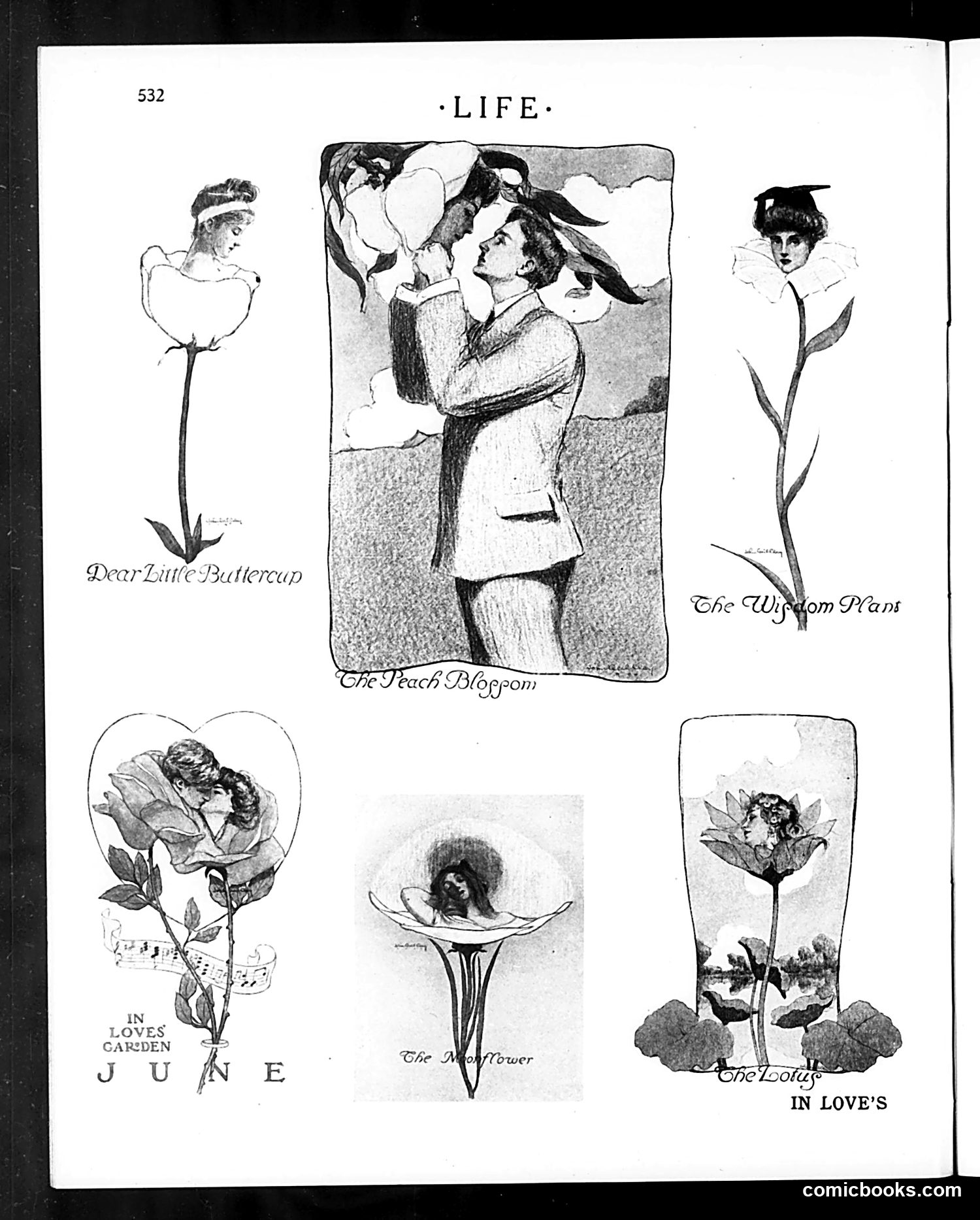
This appears to be a decorative page from *Life* magazine featuring floral illustrations paired with romantic or sentimental themes. The page presents five flowers—buttercup, peach blossom, wisdom plant(?), a rose labeled "In Love's Garden June," a moonflower, and a lotus—each illustrated with a human figure integrated into or emerging from the bloom. The titles suggest Victorian-era sentimentality where flowers carried symbolic meanings in courtship and romance. The central image shows a man gazing at a woman's face formed within peach blossoms, exemplifying the romantic tone. Rather than political satire, this appears to be aesthetic content celebrating the symbolic language of flowers popular in early 20th-century romantic culture. The page likely served decorative or aspirational purposes for *Life*'s readers interested in sentimental imagery.
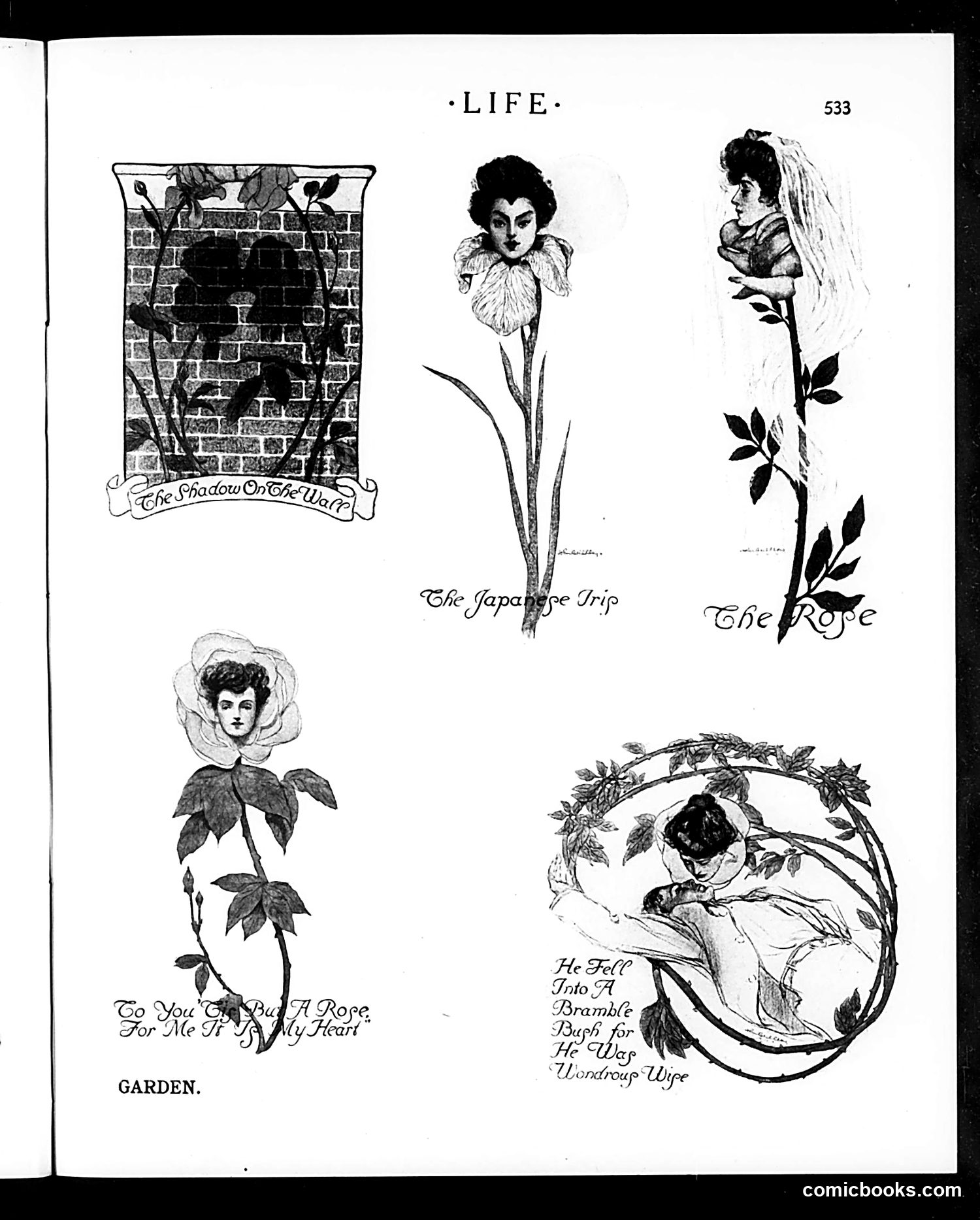
This page features decorative illustrations combining human faces with botanical forms—a common Art Nouveau style popular in early 20th-century American magazines. Each illustration pairs a woman's face with plant imagery: - "The Shadow On The Wall" shows a brick wall backdrop - "The Japanese Iris" depicts a woman's head as flower petals - "The Rose" presents a woman emerging from rose vines - "To You O Put A Rose For Me If My Heart" shows a rose with feminine features - "He Fell Into A Bramble Bush As He Was Wondrous Wipe" depicts a figure in thorny branches The "GARDEN" heading and romantic captions suggest these are sentimental, allegorical designs rather than political satire. They appear to be decorative art celebrating feminine beauty through nature metaphors—typical content for Life's lighter sections during this era.
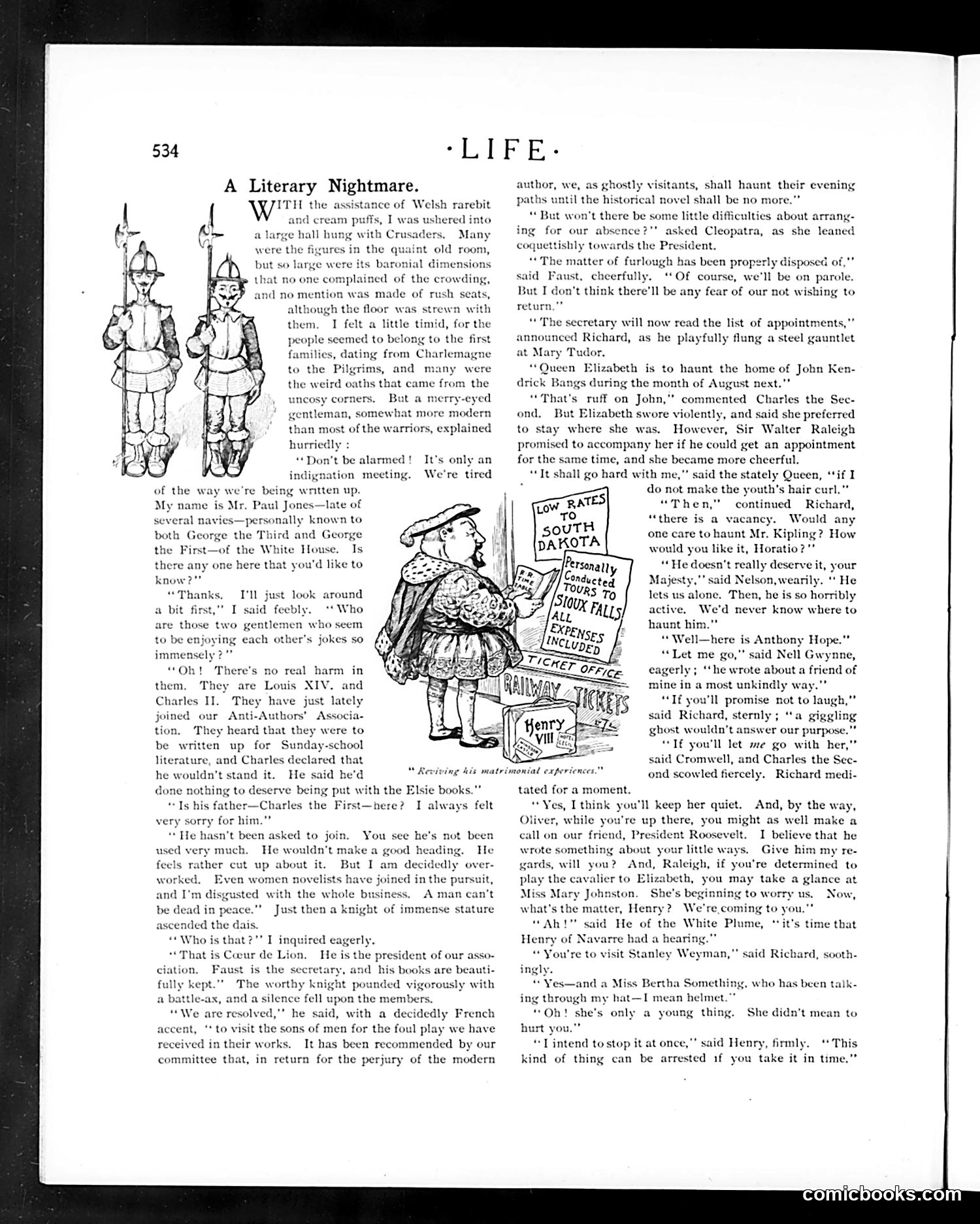
This satirical story mocks authors who exploit historical figures in their writing. The cartoon depicts historical and literary characters—Louis XIV, Charles II, Coeur de Lion (Richard the Lionheart), Cleopatra, Mary Tudor, Elizabeth I, Nelson, and others—meeting as ghosts to form an "Anti-Authors' Association." Their complaint: they're tired of being "written up" in novels, particularly Sunday-school literature and popular fiction. The satire targets authors (especially novelists of the era) for profiting from and distorting the realities of famous people's lives. Characters like Charles II refuse to be associated with "Elsie books" (wholesome children's literature), finding it demeaning. The resolution shows the ghosts planning to haunt authors' "evening paths" until "the historical novel shall be no more"—exaggerating writers' invasive use of real historical figures for commercial fiction. This reflects contemporary anxiety about biographical novels and literary appropriation.
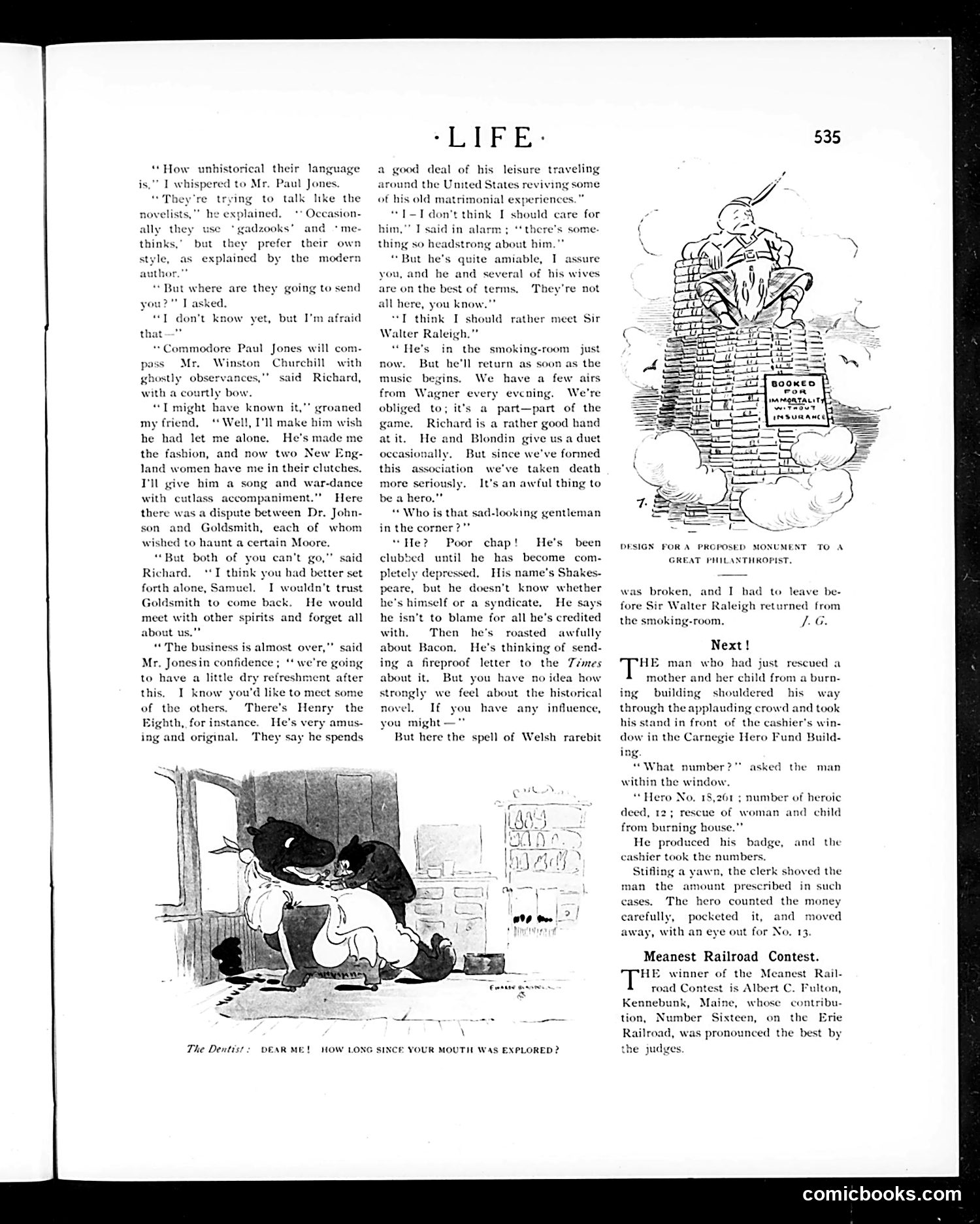
This page contains two satirical pieces typical of Life's humor: **Upper cartoon ("The Dentist"):** Shows a dentist asking a patient, "Dear me! How long since your mouth was explored?" The joke plays on double meaning—dentists exploring mouths professionally, but the patient's expression suggests embarrassment about personal hygiene or neglect. **Main text narrative:** A dialogue about summoning historical spirits (Paul Jones, Shakespeare, Henry VIII, Sir Walter Raleigh) to participate in a "historical novel" enterprise. The satire mocks the era's obsession with historical fiction and "unhistorical" dramatizations. Shakespeare is depicted as depressed and confused about authorship disputes (the "Bacon controversy"—contemporary debates over who actually wrote Shakespeare's works). The piece ridicules both historical inaccuracy in popular entertainment and pseudointellectual pretension. **Lower section ("Meanest Railroad Contest"):** A man rescues a mother and child from fire, then visits the Carnegie Hero Fund building to claim his monetary reward with bureaucratic indifference—satirizing the mechanization of heroism and charity. The overall tone critiques American culture's commercialization and theatrical treatment of history, heroism, and public virtue.
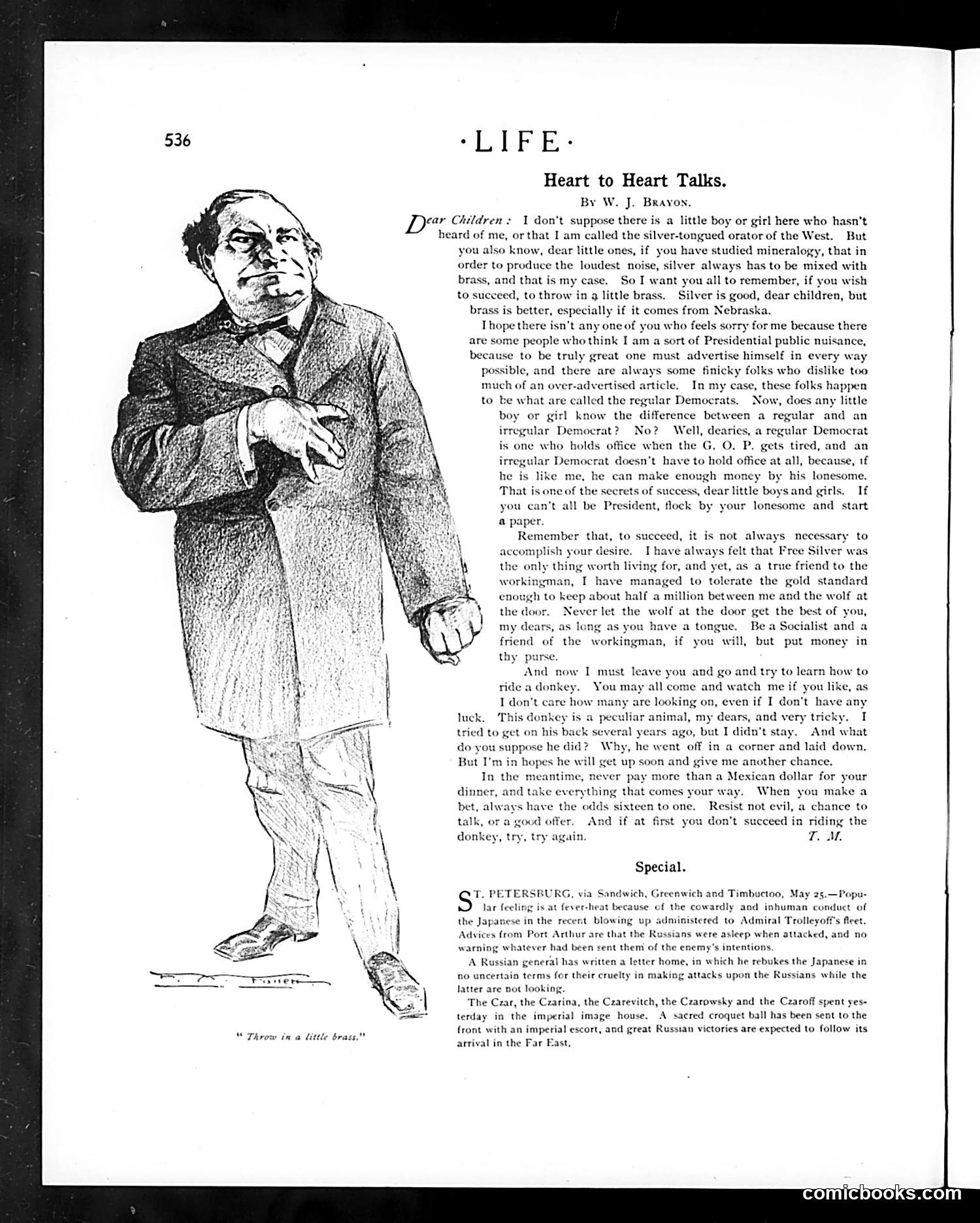
This page satirizes **William Jennings Bryan**, the "silver-tongued orator of the West" and three-time presidential candidate. The illustration shows Bryan as a self-aggrandizing figure, and his "Heart to Heart Talks" column mocks his political hypocrisy and shameless self-promotion. The satire targets Bryan's contradiction: he championed "Free Silver" and workers' rights while accumulating personal wealth. The phrase "throw in a little brass" (mixing silver with base metal) suggests his rhetoric—impressive-sounding but ultimately inferior. He's ridiculed for claiming to help workingmen while enriching himself, and for his inability to succeed politically despite constant self-advertisement. The "Special" section at bottom mocks Russian military incompetence during the Russo-Japanese War (1904-05), sardonically reporting that Russians were "asleep" during attacks and criticizing Japanese "cruelty" for attacking when enemies weren't ready.
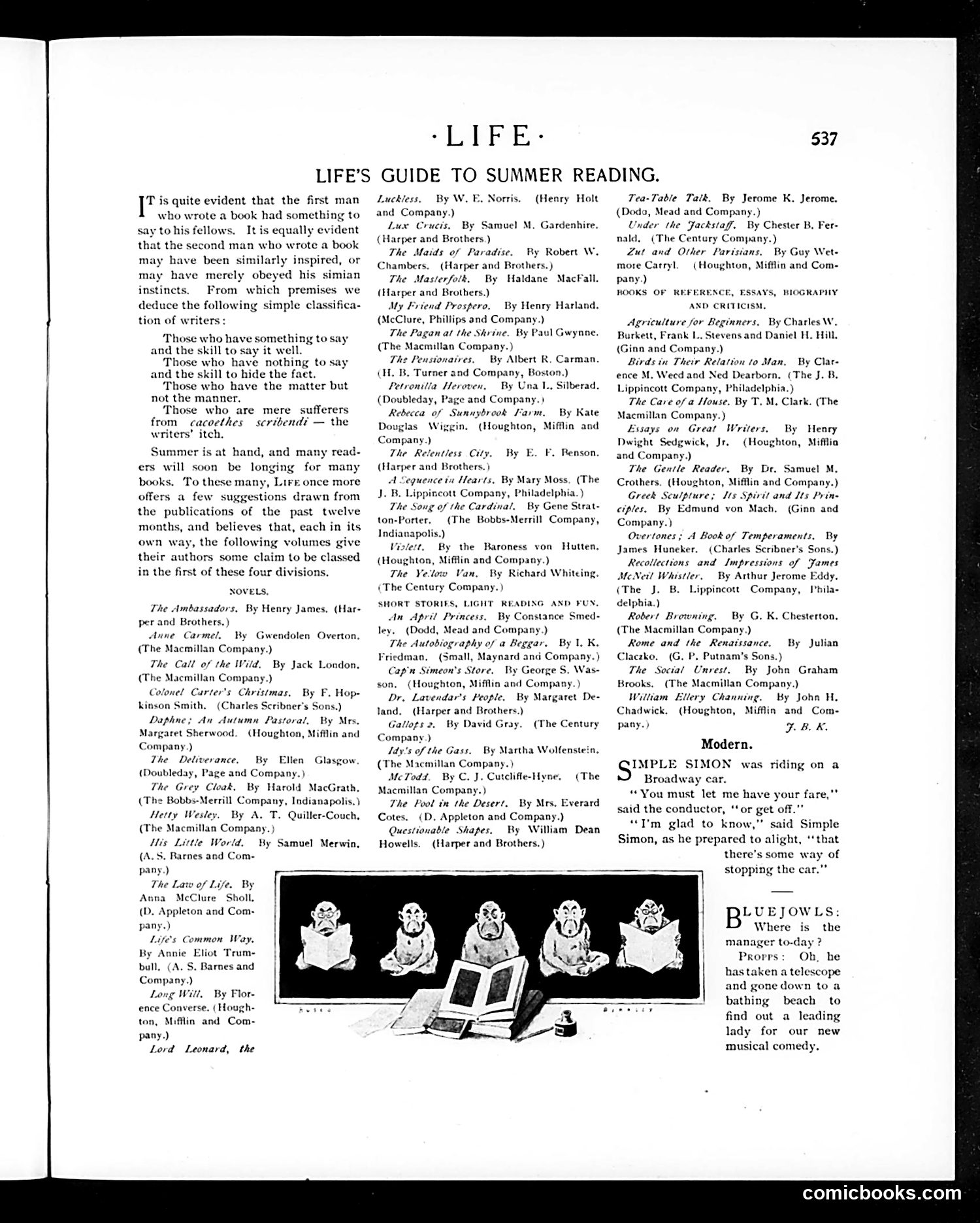
This page from *Life* magazine offers a curated summer reading list organized by category: novels, short stories, and reference works. The accompanying cartoon (showing five cherubic figures reading books) humorously illustrates the editorial's opening philosophy about writers. The text classifies all writers into four types: those with something meaningful to say and skill to say it; those with nothing to say but skill to hide that fact; those with substance but poor style; and those suffering from "cacoethes scribendi" (the obsessive writer's itch). The list itself attempts to place recommended 1902-1903 publications in the first category—authors with genuine merit. The small "Modern" sketch below about "Simple Simon" and the "Bluejowls" dialogue is unrelated filler humor, typical of *Life's* satirical format. The overall page functions as both practical guide and gentle critique of contemporary literature's quality.
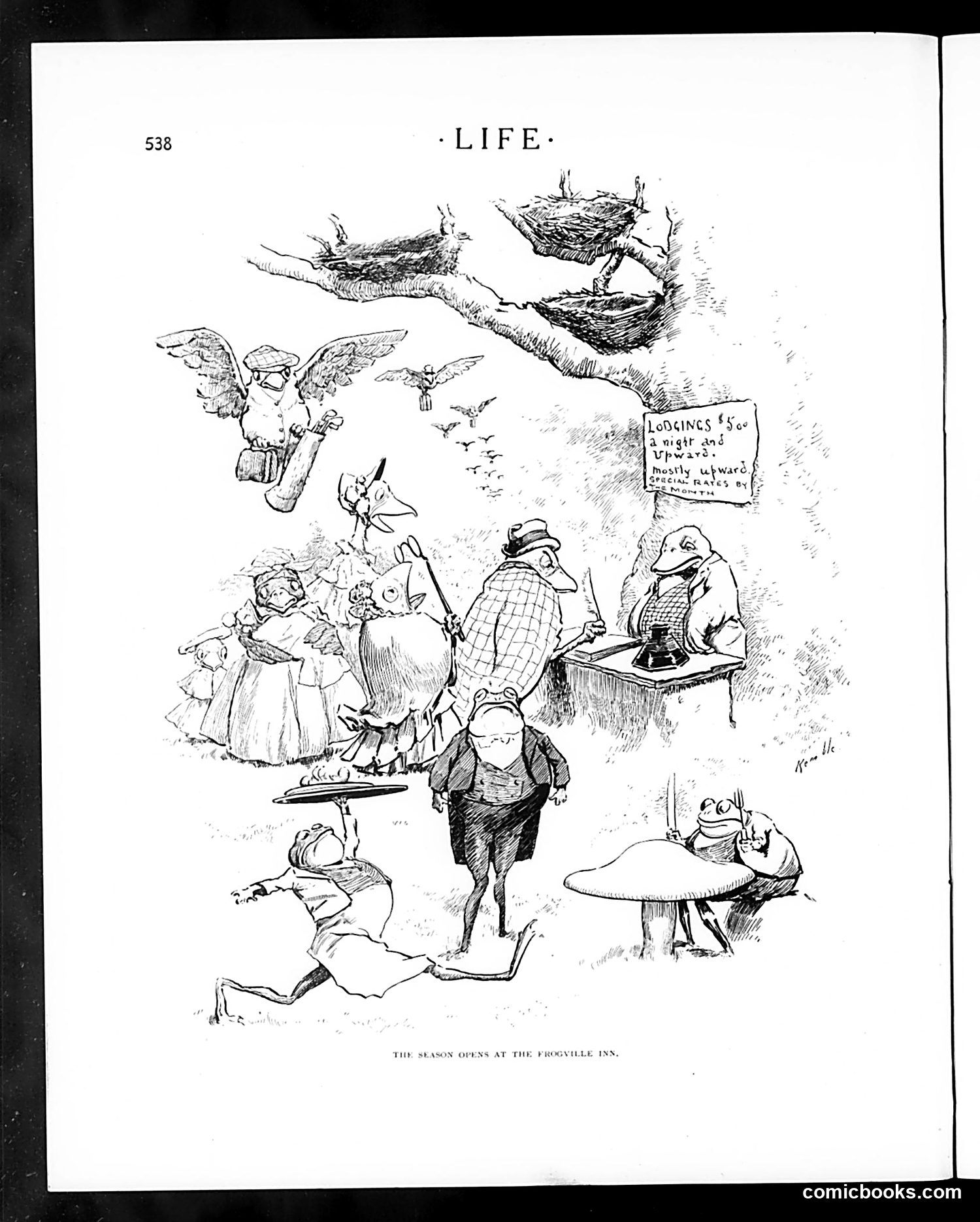
This is a satirical cartoon depicting the opening of a seasonal establishment called "The Frogville Inn." The illustration features various anthropomorphic frogs and other characters engaged in typical inn activities—dining, socializing, and lodging. A sign advertises "Lodgings $5.00 a night and Upwards (mostly upward)," suggesting the inn inflates prices opportunistically during peak season. The parenthetical "(mostly upward)" is the joke—implying that rates only go up, never down. The cartoon satirizes seasonal hospitality businesses and their price-gouging practices. The "Frogville" setting appears whimsical, but the critique targets real commercial exploitation of travelers during busy periods. The illustration's playful tone masks commentary on unfair business practices common in the hospitality industry.
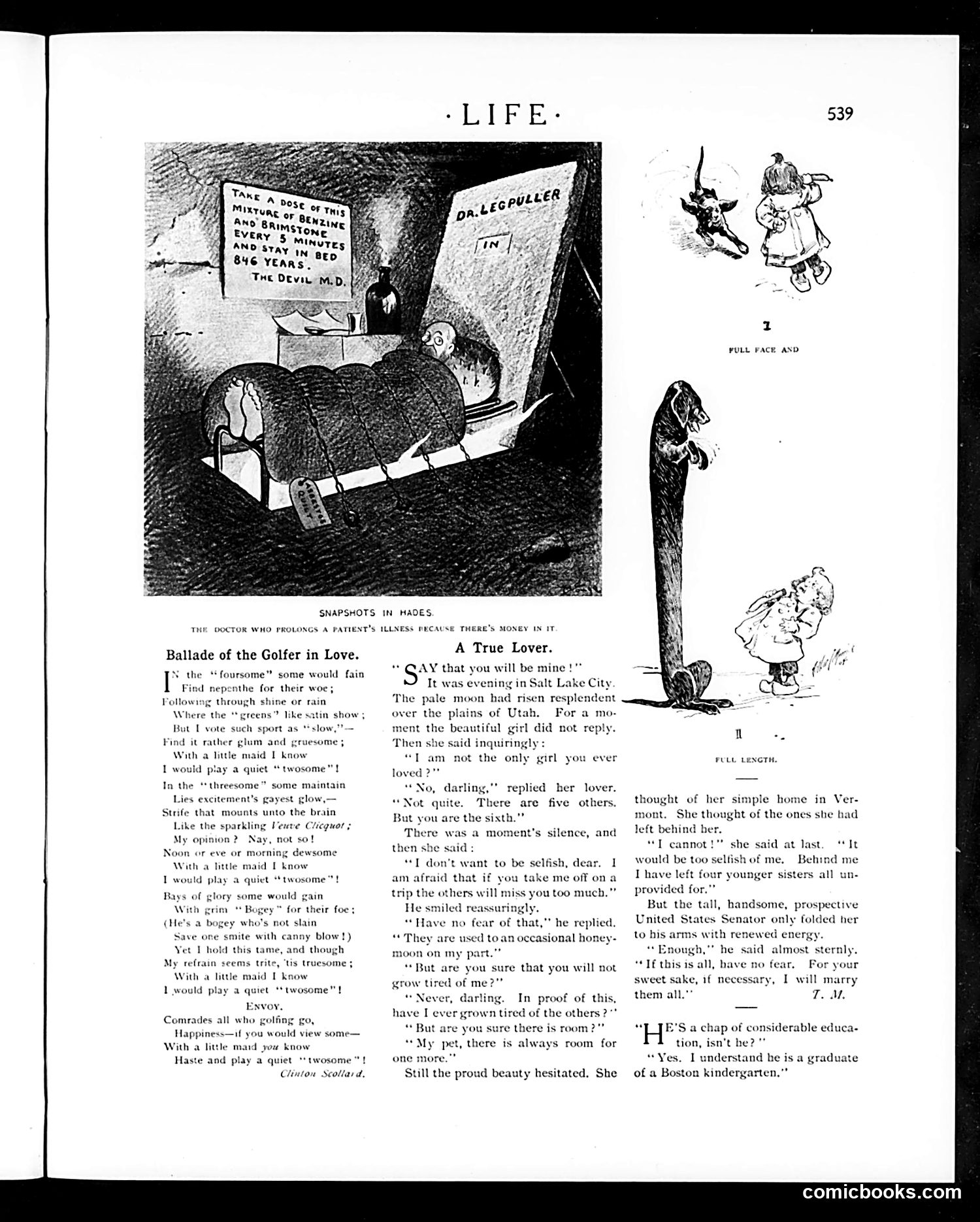
**Top Cartoon ("Snapshots in Hades"):** A satirical jab at unscrupulous doctors. The image shows a physician prolonging a patient's illness to extract payment. The caption explicitly states the doctor's scheme: "The doctor who prolongs a patient's illness because there's money in it." This reflects early-20th-century concerns about medical ethics and financial incentives corrupting healthcare. **"Ballad of the Golfer in Love":** A light verse poem celebrating golf as a romantic activity—the speaker prefers golfing as a couple ("twosome") over other leisure pursuits. It's genteel, whimsical humor typical of Life's lighter content. **"A True Lover":** A comedic short story about a duplicitous suitor in Salt Lake City who's already married five times and proposes to a sixth woman. The joke involves her concern that his other wives will miss him, and his casual willingness to marry *all* her sisters to keep her. The final gag mocks the suitor's education credentials, sarcastically noting he graduated from "kindergarten." The small illustrations on the right appear to be unrelated humorous vignettes.
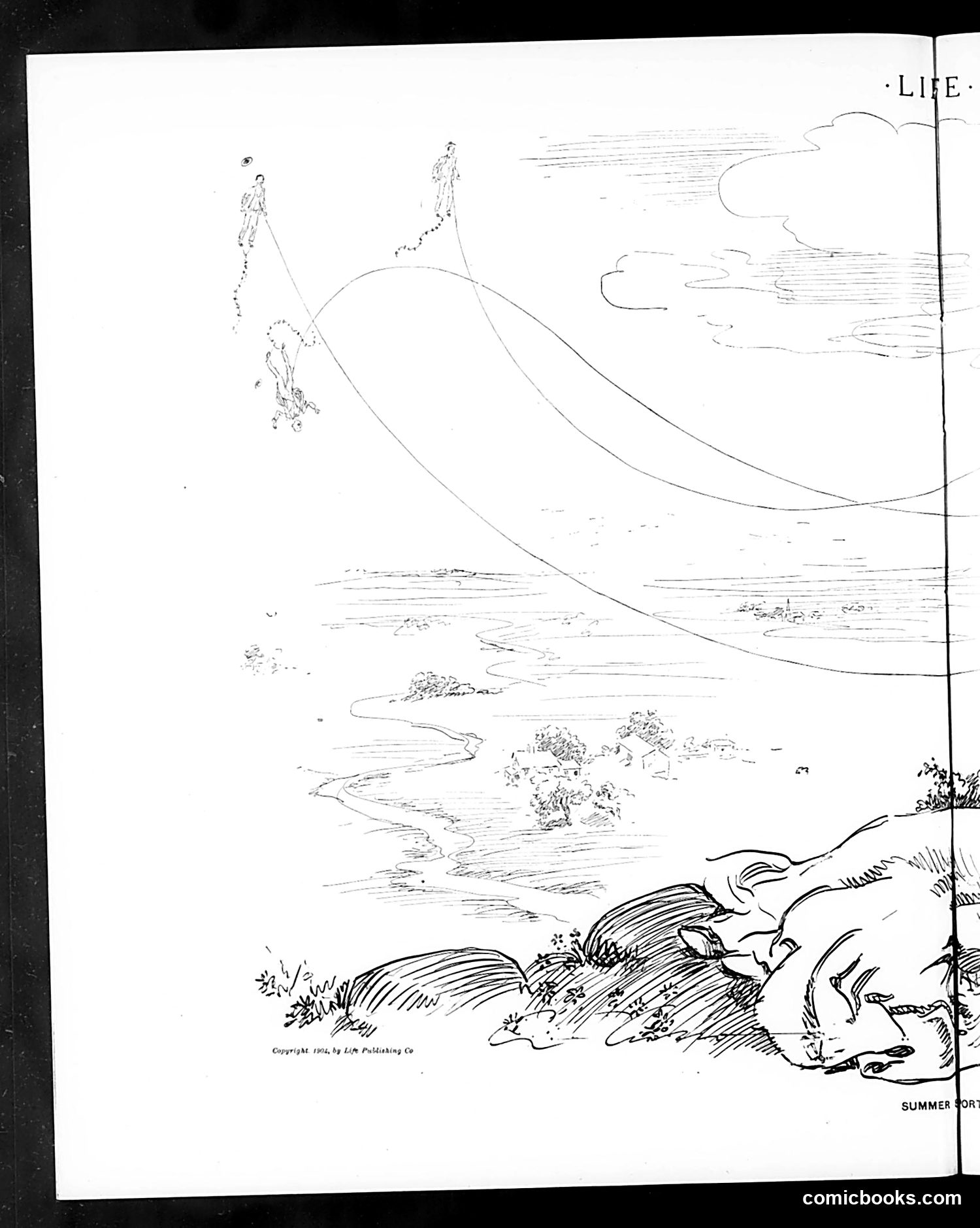
This appears to be a satirical illustration from *Life* magazine showing figures suspended by ropes over a landscape with a winding river and hills. The title "SUMMER SORT" suggests commentary on summer activities or leisure. The figures suspended in air likely represent people engaged in some form of recreation—possibly skydiving, parachuting, or a similar activity that was novel or noteworthy when this was published. The elaborate landscape below suggests an idealized vacation setting. Without clearer text or additional context, I cannot definitively identify specific political figures or events being satirized. The copyright attribution to "Life Publishing Co" is visible. The cartoon's exact satirical target—whether mocking summer tourism, athletic pursuits, or social trends—remains unclear from the image alone.
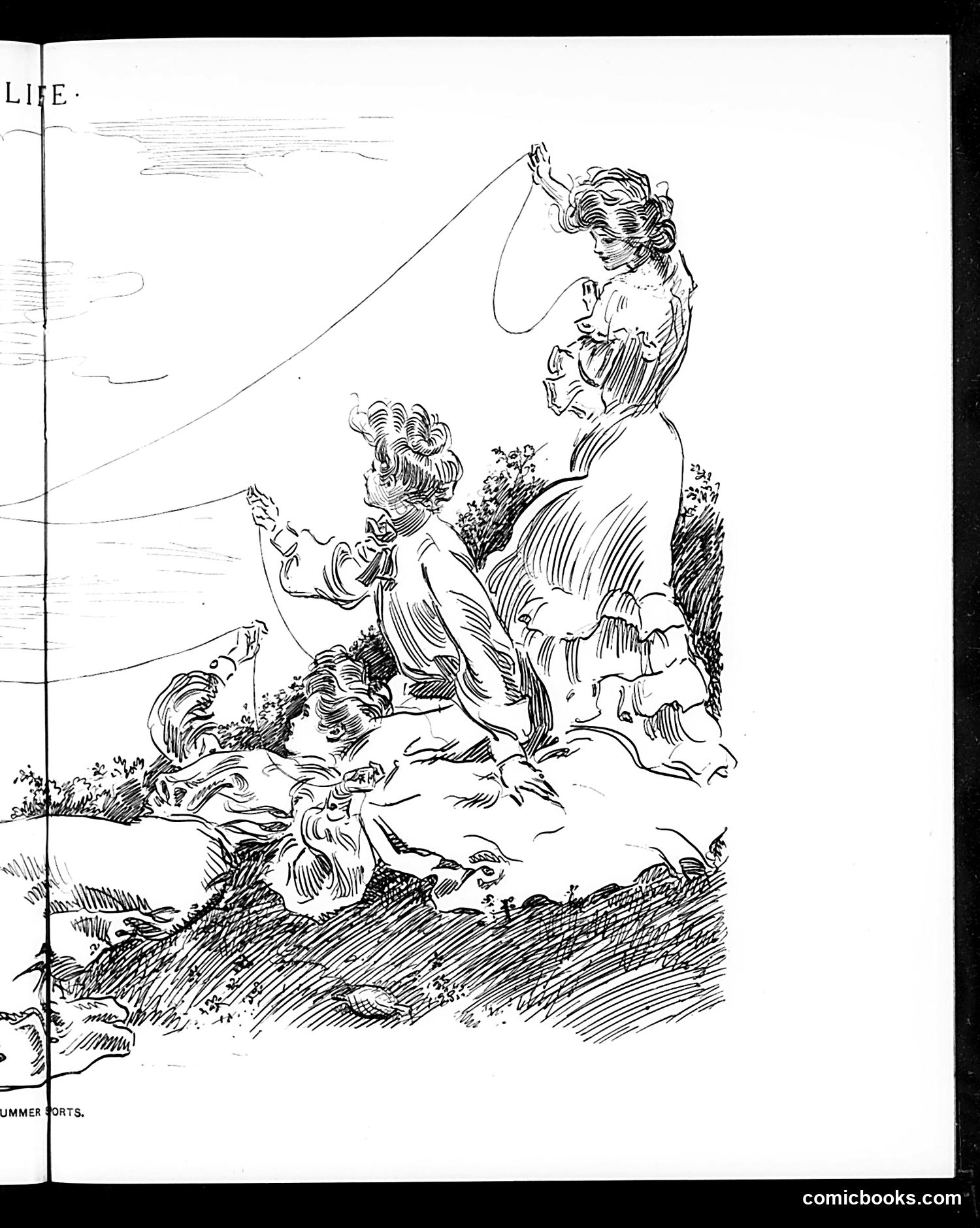
This page from *Life* magazine shows an illustration titled "SUMMER SPORTS" depicting a woman flying a kite with children. The OCR text is too fragmentary to read clearly, but the image itself appears to be a gentle, domestic scene rather than political satire. The drawing shows an adult woman (rendered in the magazine's typical early-20th-century illustration style) engaged in outdoor recreation with children, likely representing leisurely summer activities. Without clearer text or identifying captions, the specific satirical point remains unclear—though it may comment on gender roles, childhood recreation, or leisure culture of the period. The artistic style and "LIFE" masthead suggest this is from the magazine's lighter, illustrative content rather than its more pointed political cartoons.
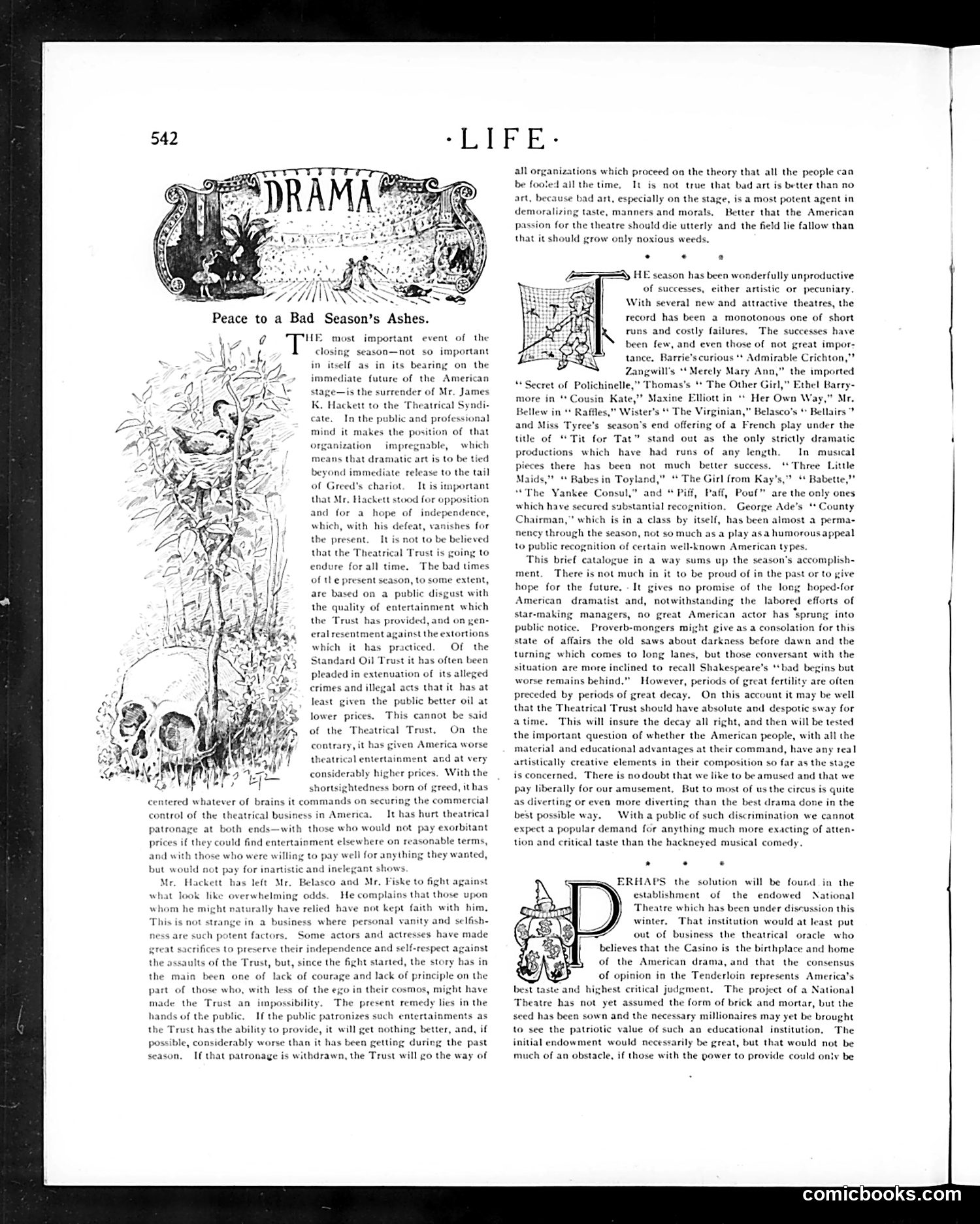
This page critiques the **Theatrical Trust**, a monopolistic cartel controlling American theater at the turn of the 20th century. The article mourns the defeat of actor **James Hackett**, who opposed the Trust's grip on the stage. The main argument: The Trust has degraded American theater by prioritizing profit over art, charging exorbitant prices while delivering poor entertainment. Unlike Standard Oil (which at least provided cheaper, better product), the Trust offers worse theater at higher costs—a damaging combination. The decorative illustration shows a skeleton wrapped in theatrical ropes, symbolizing theater's death under Trust control. The article names several contemporary productions that survived the season's general commercial failure, including works by Barrie, Zangwill, and Thomas, and performances by actors like Ethel Barrymore and David Belasco. The satire's point: monopolistic greed kills the very art it claims to control, and only public refusal to attend bad theater can break the Trust's stranglehold.
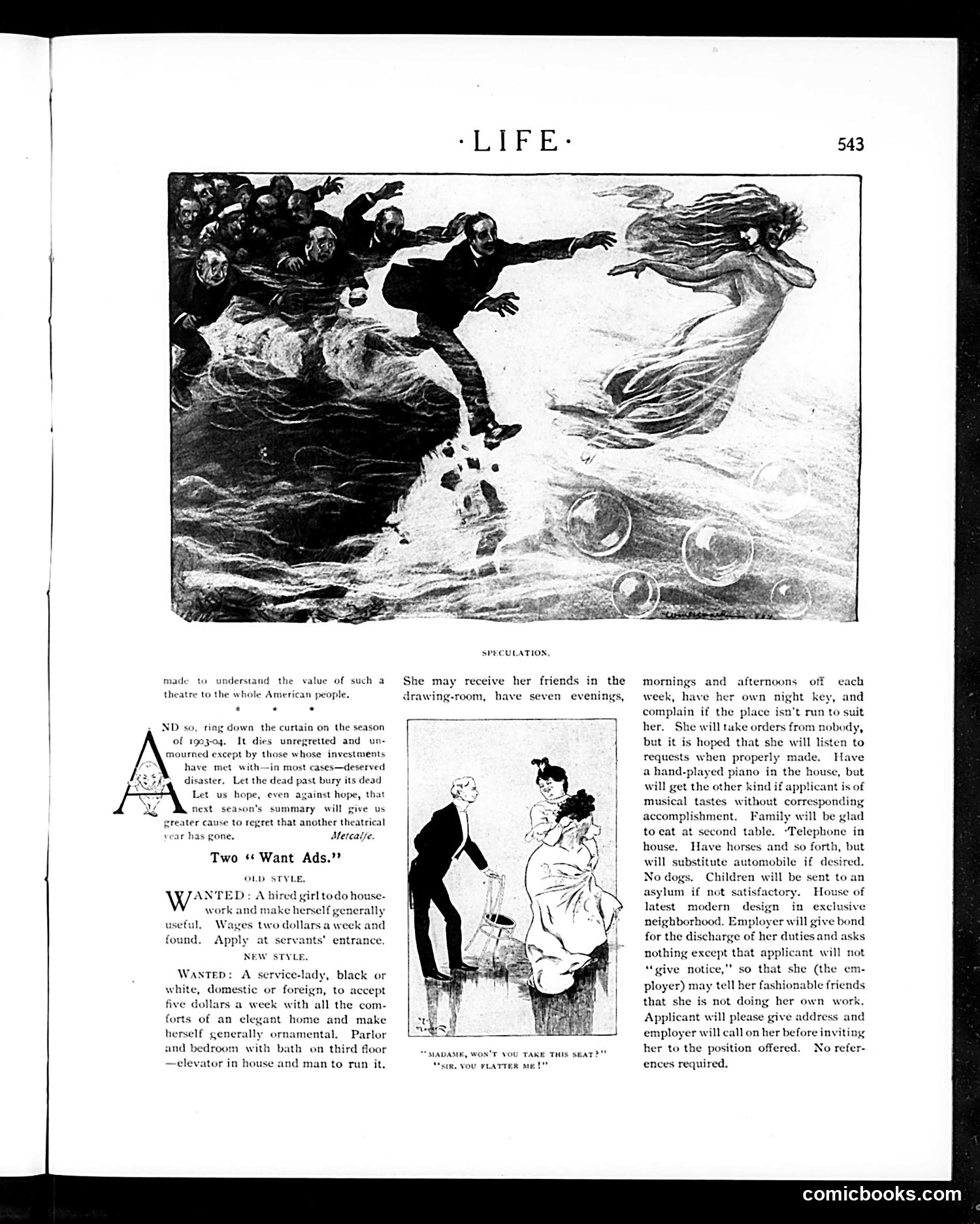
This page satirizes the dramatic shift in domestic service expectations between the "old style" and "new style" of hiring household help. **The "Two Want Ads" Satire:** The **old advertisement** reflects traditional employer dominance: a hired girl works for $2/week with minimal amenities, entering through servants' entrances. The **new advertisement** mockingly exaggerates the reverse—now employers must offer a "service-lady" $5/week, private bedroom with bath, drawing-room access, seven evenings off weekly, a piano, automobile, and no children. Absurdly, she "will take orders from nobody" and the employer can only hope she'll listen to "requests." **The Social Point:** This reflects early 1900s labor dynamics where domestic workers—increasingly scarce and demanding better conditions—had gained negotiating power. Employers had to offer improved terms to attract help, inverting the traditional servant-master relationship. The exaggerated "new style" ad ridicules how far employer concessions had gone, portraying servants as now making unreasonable demands. The top illustration labeled "SPECULATION" appears unrelated—showing figures in dramatic poses, possibly theatrical commentary matching the season-end editorial text above.
This is a **book review section**, not a political cartoon. The prominent masthead "The Latest Books" with decorative illustrations of children reading is purely ornamental—establishing the page's literary focus rather than delivering satire. The content discusses recent publications, notably lamenting writer Guy Wetmore Carryl's death and reviewing works by Alice Brown, Sir Philip Burne-Jones (a visiting English baronet), and others. **Key satirical moment**: The reviewer jokes that philosophy is "like Belgian hare"—many people find it delicious when they don't know what it's called. This mocks pretentious readers who enjoy intellectual concepts while avoiding the word itself. **Social context**: The reviews emphasize character development and literary merit in the realist tradition (comparing works to Howells and Henry James). The page reflects early 1900s American literary tastes and the magazine's role as cultural arbiter for educated readers. This is primarily **literary criticism with light humor**, not political satire.
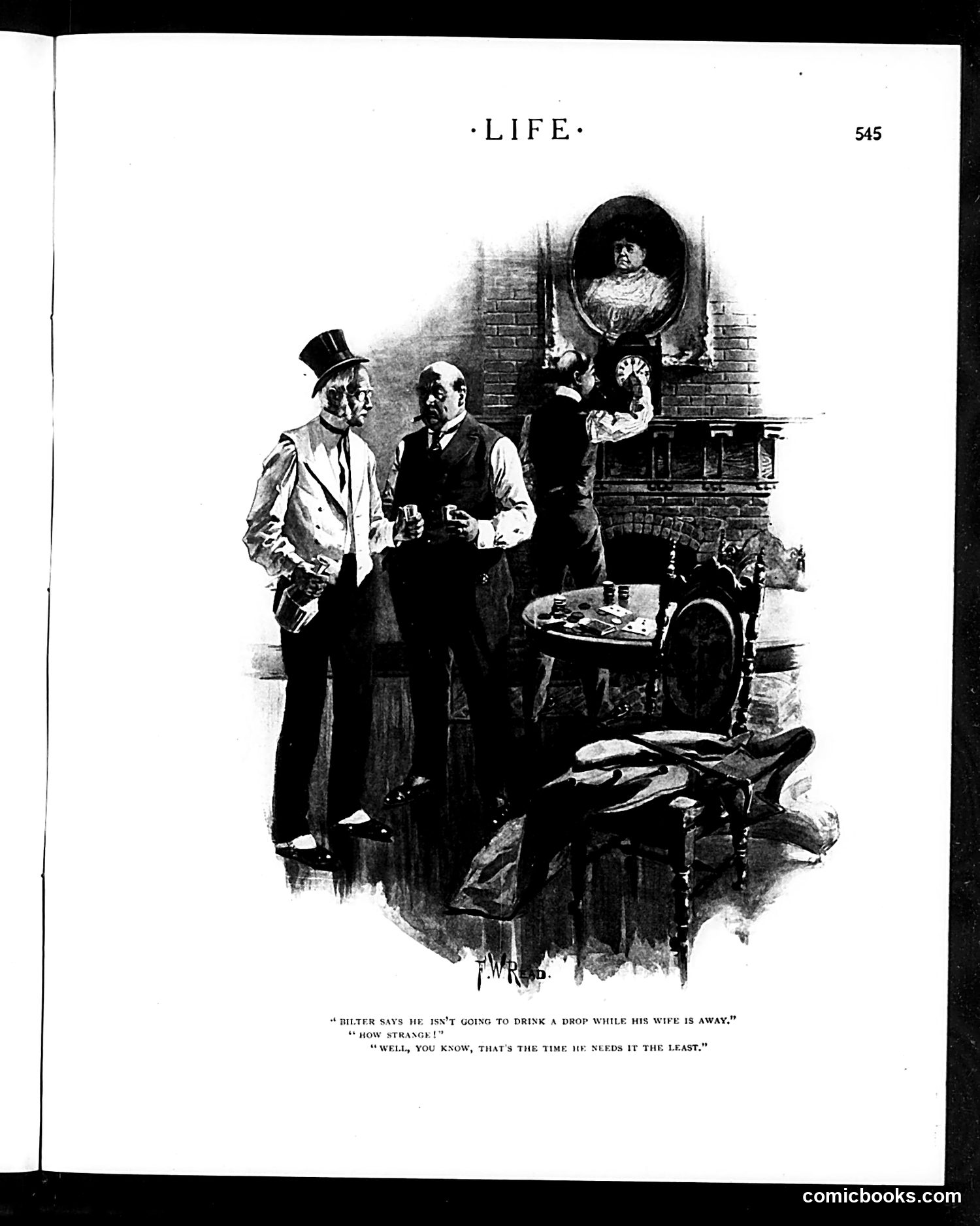
This is a single-panel cartoon satirizing male drinking habits and marital dynamics. Two men discuss a third man named "Bilter" who claims he won't drink while his wife is away. The joke inverts common expectations: typically, a husband might drink *more* when his wife leaves (freedom from oversight). Instead, the cartoon suggests that Bilter needs alcohol *least* when alone—implying he drinks primarily to cope with his wife's presence or their marital tension. The humor relies on the assumption that wives are sources of stress requiring alcohol to endure. This reflects early 20th-century attitudes about marriage as potentially burdensome for men, particularly regarding domestic control. The brick setting and period dress suggest working or middle-class characters.
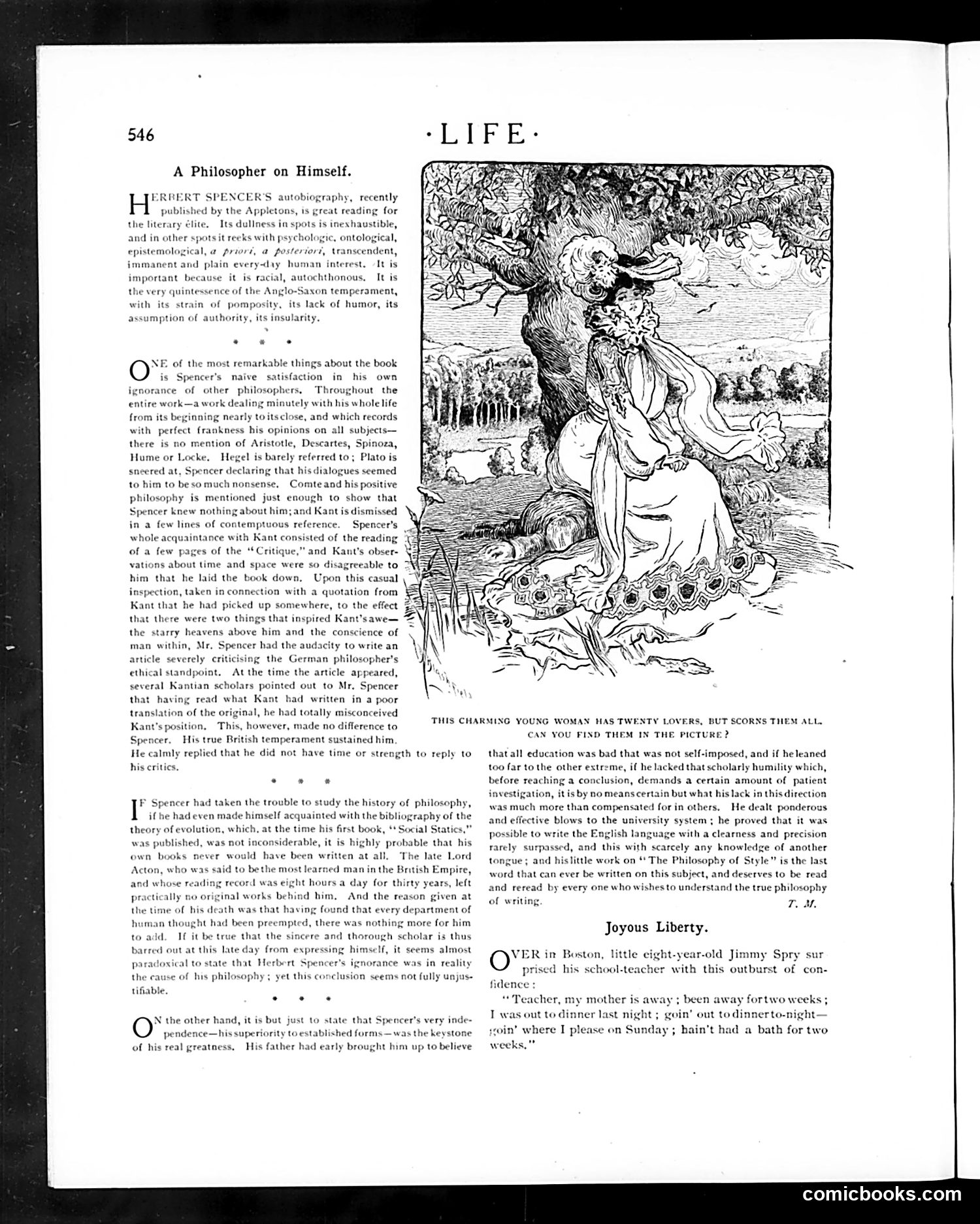
This page critiques philosopher Herbert Spencer's autobiography and intellectual arrogance. The main article, "A Philosopher on Himself," ridicules Spencer's **naive ignorance of other philosophers**—he dismisses Plato as "nonsense," barely mentions Hegel, sneers at Kant, and largely ignores Aristotle, Descartes, Spinoza, and Hume despite writing extensively on philosophy. The satire highlights Spencer's **supreme confidence despite scholarly gaps**: when Kantian scholars corrected his misreading of Kant (from a poor translation), Spencer dismissively replied he "did not have time" to respond. The piece credits him with effective writing and attacking universities, but suggests his influence might have been prevented had he studied philosophy's actual history. The accompanying illustration shows a young woman with multiple male suitors—a visual pun matching the theme of unwarranted self-satisfaction and overconfidence.
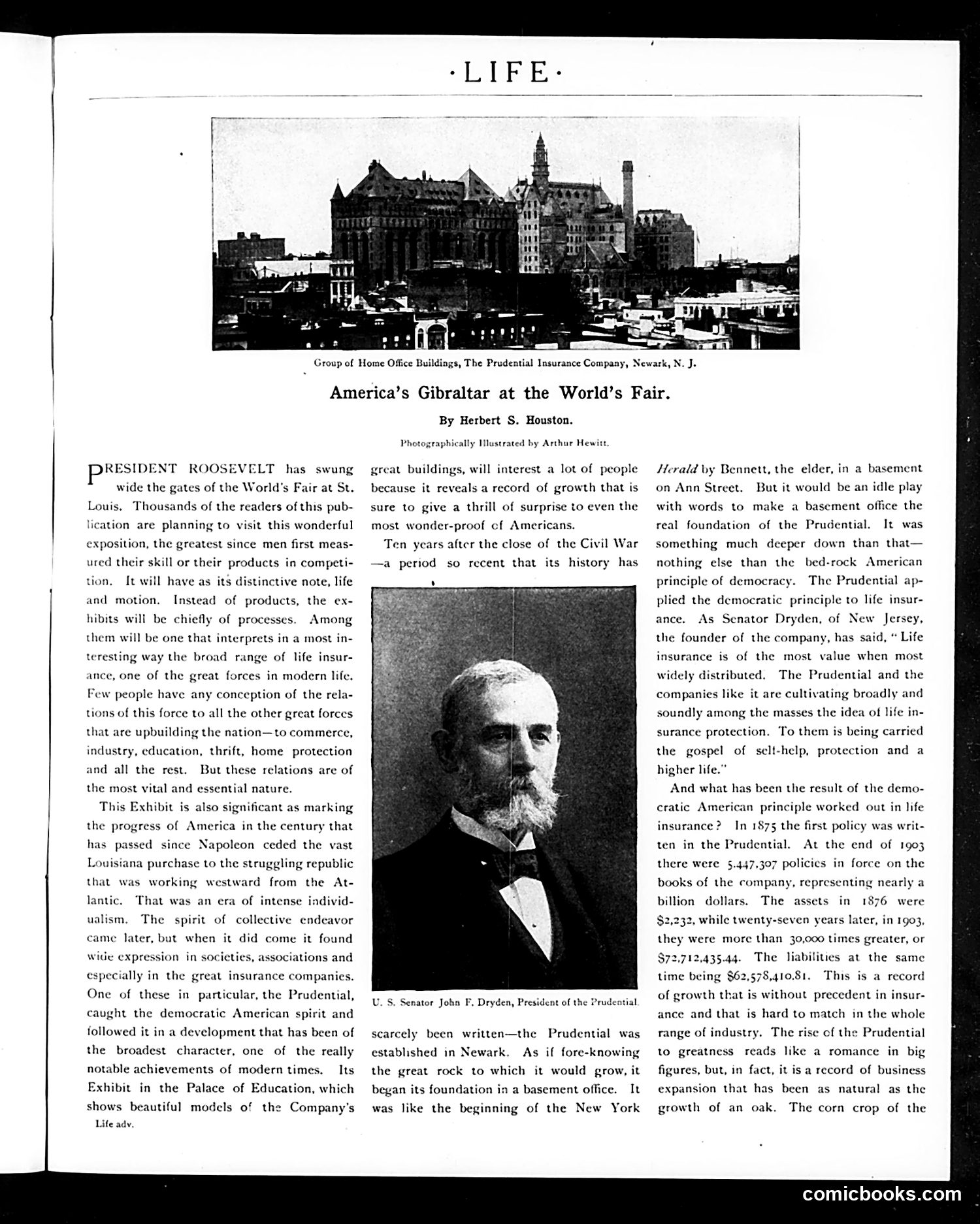
This is primarily **advertorial content** for the Prudential Insurance Company, disguised as journalism. The image shows Newark's skyline; the text is a promotional article by Herbert S. Houston. **Key context:** - Written around the 1904 World's Fair in St. Louis - The article celebrates Prudential's growth since its 1875 founding by Senator John F. Dryden (pictured) - The "democratic principle" referenced means life insurance for ordinary Americans, not just the wealthy—a novel concept then - The article compares Prudential's basement-office origins to James Gordon Bennett's *New York Herald*, romanticizing humble beginnings - Statistics emphasize explosive growth: from one 1875 policy to 5.4 million by 1903, assets exploding from $2,232 to $72 million **The pitch:** Life insurance embodies American democracy and collective spirit, making Prudential a "Gibraltar"—an immovable fortress of financial security. This is essentially corporate propaganda celebrating American capitalism and mutual aid societies.
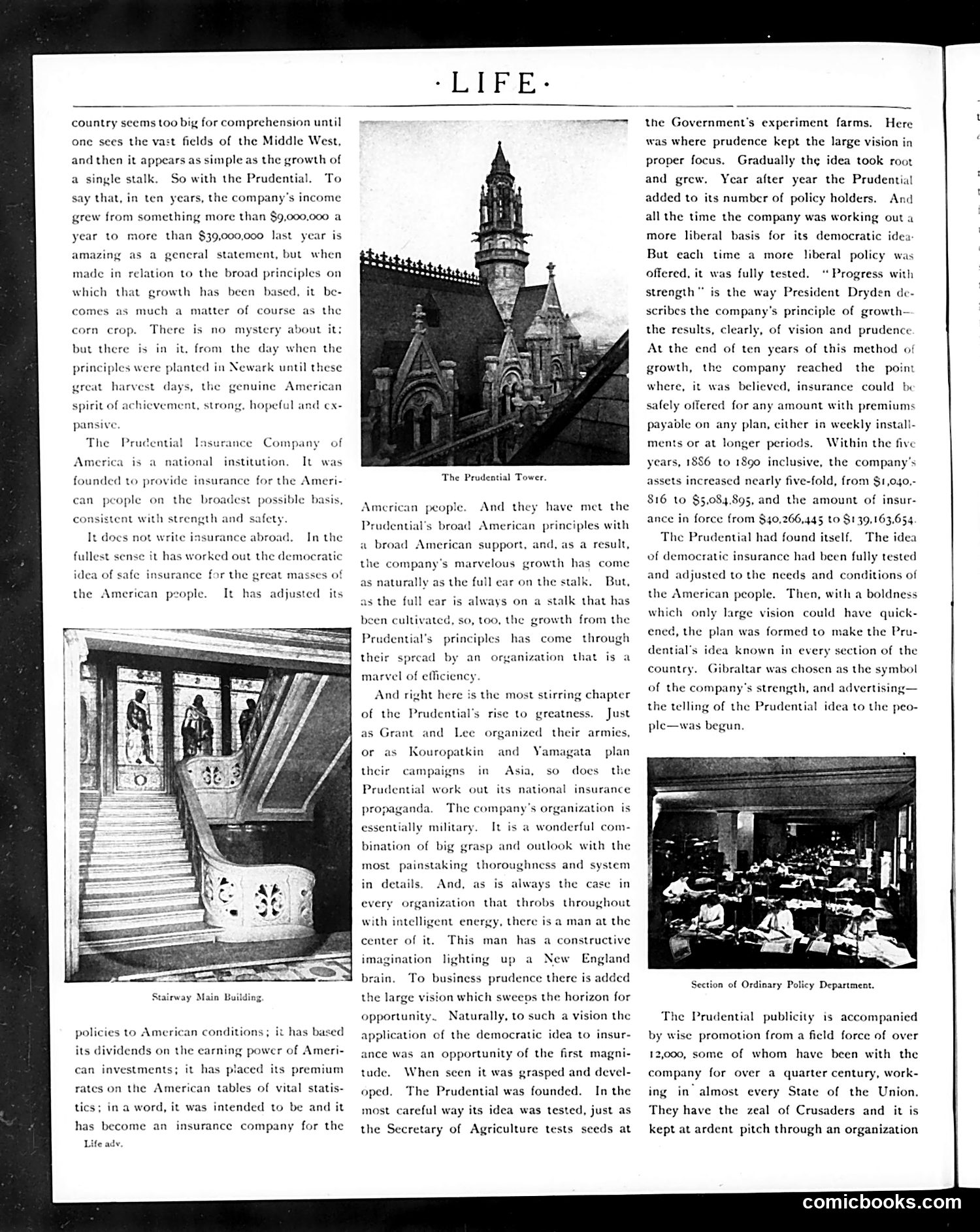
This is **corporate promotional content**, not satire or political commentary. The page celebrates the Prudential Insurance Company's rapid growth from $9 million to $39 million in a decade. The text employs patriotic rhetoric, comparing the company's expansion to agricultural growth and military organization (referencing Grant, Lee, Kouropatkin, and Yamagata—historical military figures). It frames Prudential as a democratizing force, bringing life insurance to "the great masses of the American people" rather than just the wealthy. The three photographs show: - The Prudential Tower (company headquarters) - An ornate stairway in the main building - An office department with many workers The article emphasizes the company's American character—investments, dividend structure, and premium rates all based on American conditions—positioning it as a patriotic institution. The unnamed leader (likely President Dryden, mentioned in text) represents visionary "big grasp" combined with prudence, presented as quintessentially American virtues.
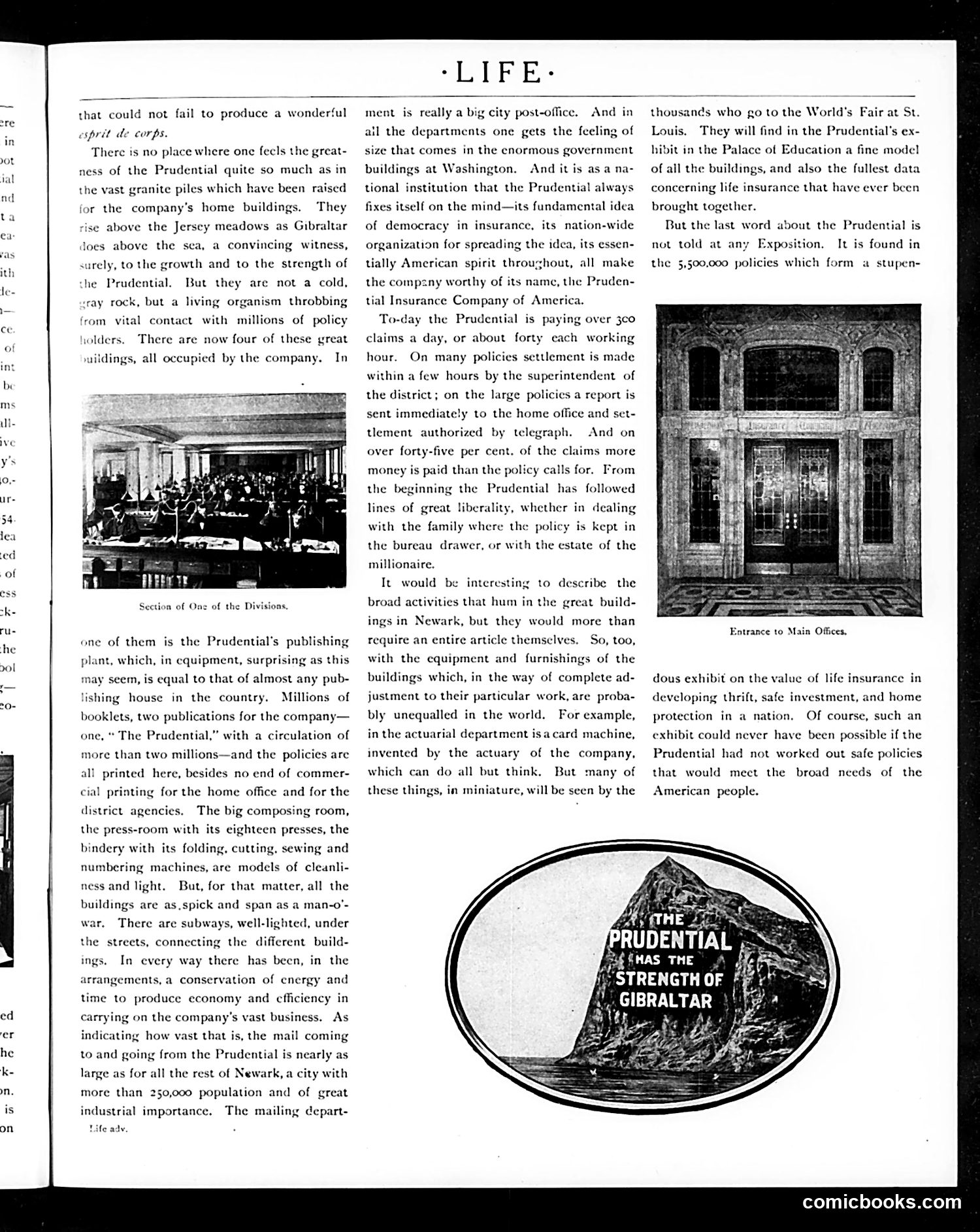
This is corporate promotional content about the Prudential Insurance Company, disguised as editorial material in *Life* magazine. The text praises Prudential's Newark headquarters as architectural marvels, comparing them to Gibraltar—meant to convey unshakeable strength and permanence. The bottom illustration shows Gibraltar with text reading "THE PRUDENTIAL HAS THE STRENGTH OF GIBRALTAR," making this metaphor explicit. It's a visual trademark/slogan. The page celebrates Prudential's scale (paying 300+ claims daily), efficiency, and philanthropic generosity, positioning insurance as democratizing and patriotic. The photographs show bustling office work and an elegant entrance, emphasizing modernity and respectability. The reference to a World's Fair exhibit suggests Prudential was using the fair as advertising space—a common practice then. This blurs editorial and advertising in ways modern readers would immediately recognize as marketing propaganda.
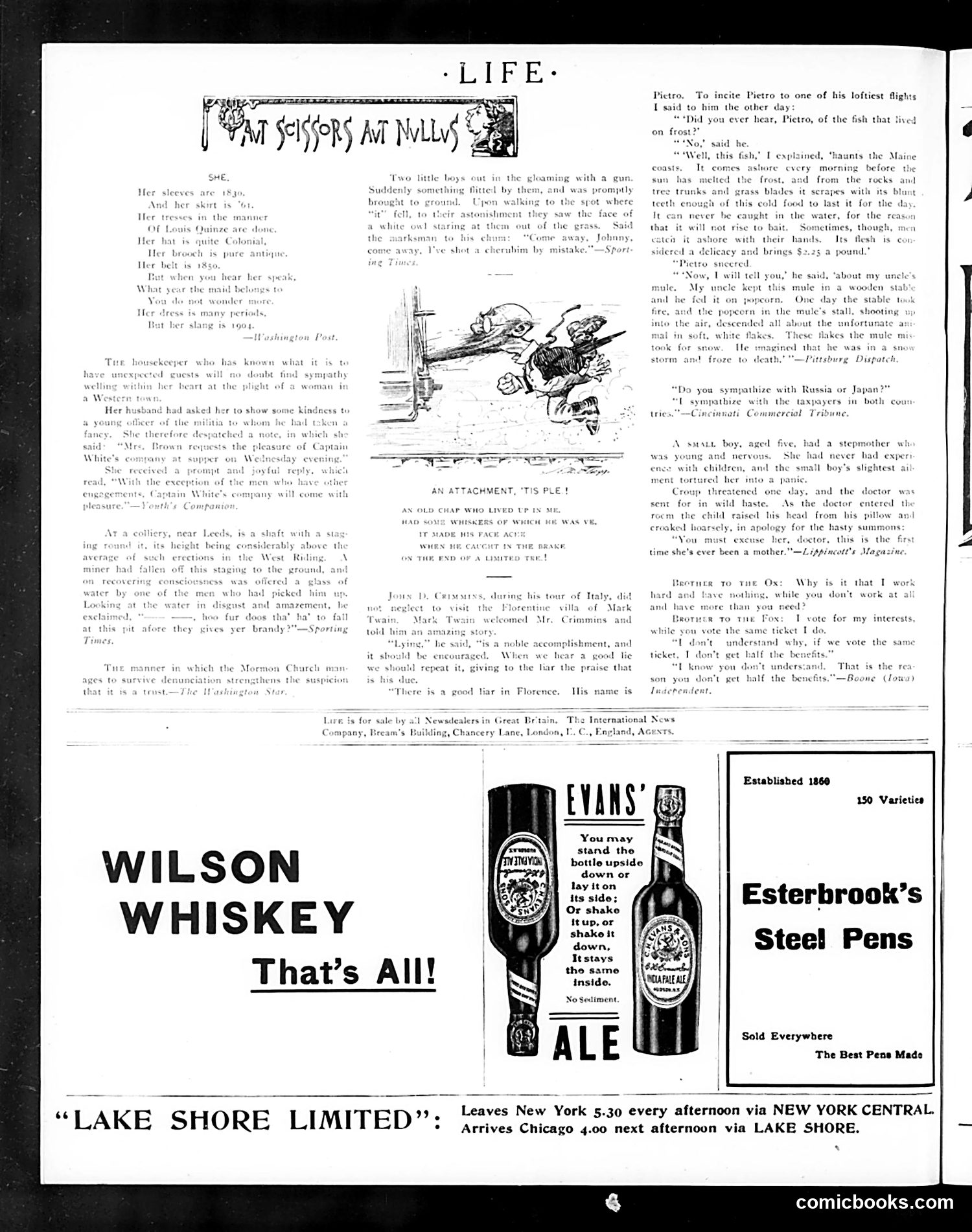
This page from *Life* magazine contains **humorous anecdotes** rather than political cartoons. The main content features several short, joke-format stories illustrated with sketches. The central narrative, "An Attachment, 'Tis Ple!" depicts two boys with a gun who encounter a fish with an unusually long beard of icicles—a whimsical tall tale playing on the absurdity of exaggerated frontier stories. Another anecdote involves a mule fed popcorn that explodes when the kernels pop inside its stomach, again emphasizing humor through grotesque exaggeration. Additional brief dialogues mock pretension: one exchanges between characters "Pietro" and "An Old Chap," trading increasingly ridiculous fish stories; another satirizes hypocrisy through a conversation between an Ox and Fox about voting and labor. The page is primarily **advertising-driven**, featuring promotions for Wilson Whiskey, Evans' Ale, Esterbrook's Steel Pens, and the Lake Shore Limited railroad—typical of period *Life* magazine layouts. The humor relies on **tall-tale traditions** and gentle social satire rather than sharp political commentary.
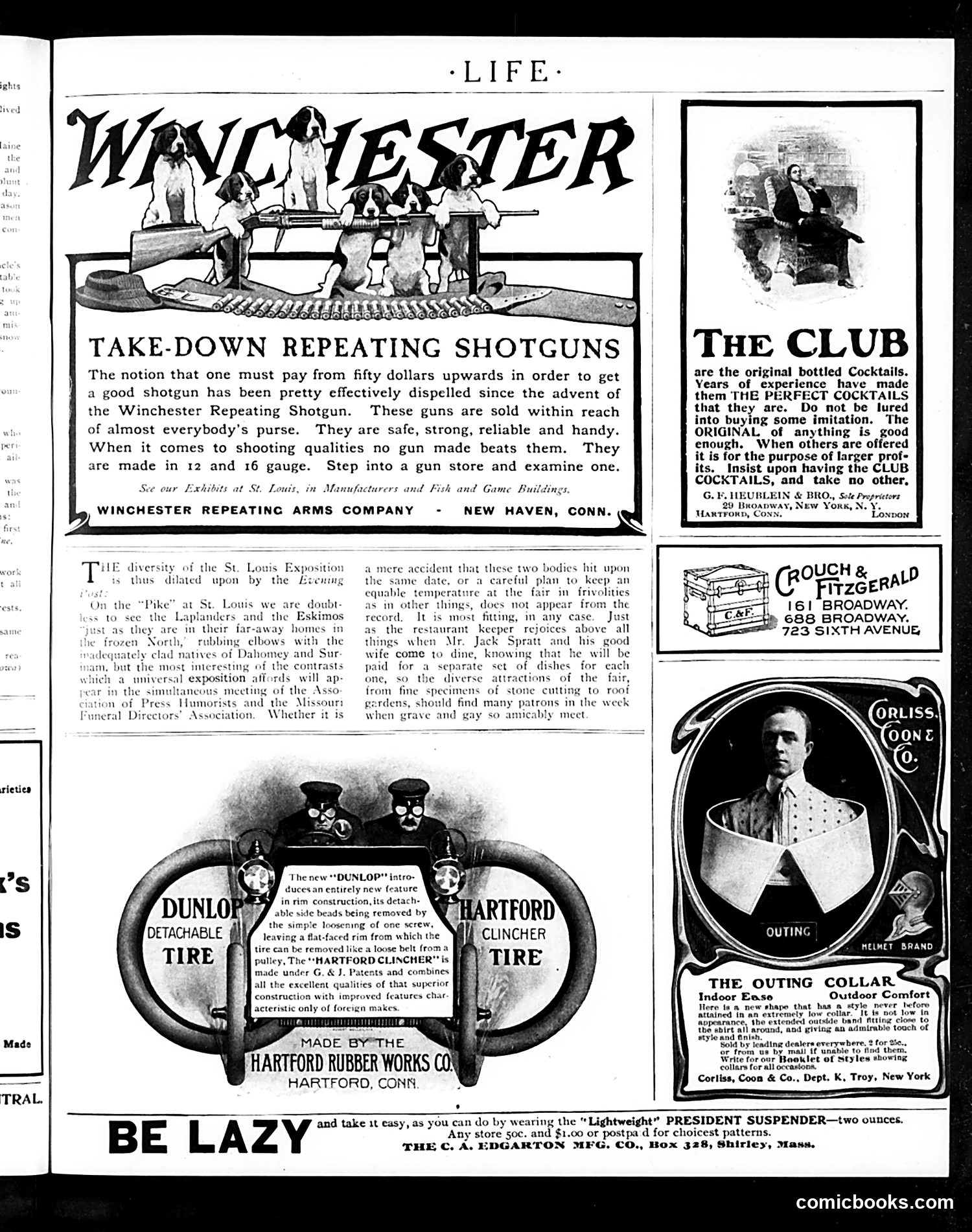
This page is primarily **advertising** rather than editorial content or political satire. It features multiple product advertisements from the early 1900s: The dominant Winchester shotgun ad uses a clever marketing strategy, comparing their affordable firearms to "original bottled Cocktails"—suggesting reliability and quality through the Heublein Brothers' well-known cocktail brand. Other ads include Hartford tire products, Corliss clothing (the "Outing Collar"), Rough & Fitzgerald luggage, and President Suspenders. The only editorial content is a brief passage about the St. Louis Exposition, mentioning diverse attractions and the "Pike" (a fair section featuring ethnographic exhibits), which reflects period attitudes toward displaying non-Western peoples as curiosities. The page exemplifies early 1900s Life magazine advertising, where manufacturers purchased space to reach affluent readers through brand association and comparative claims about quality and affordability.
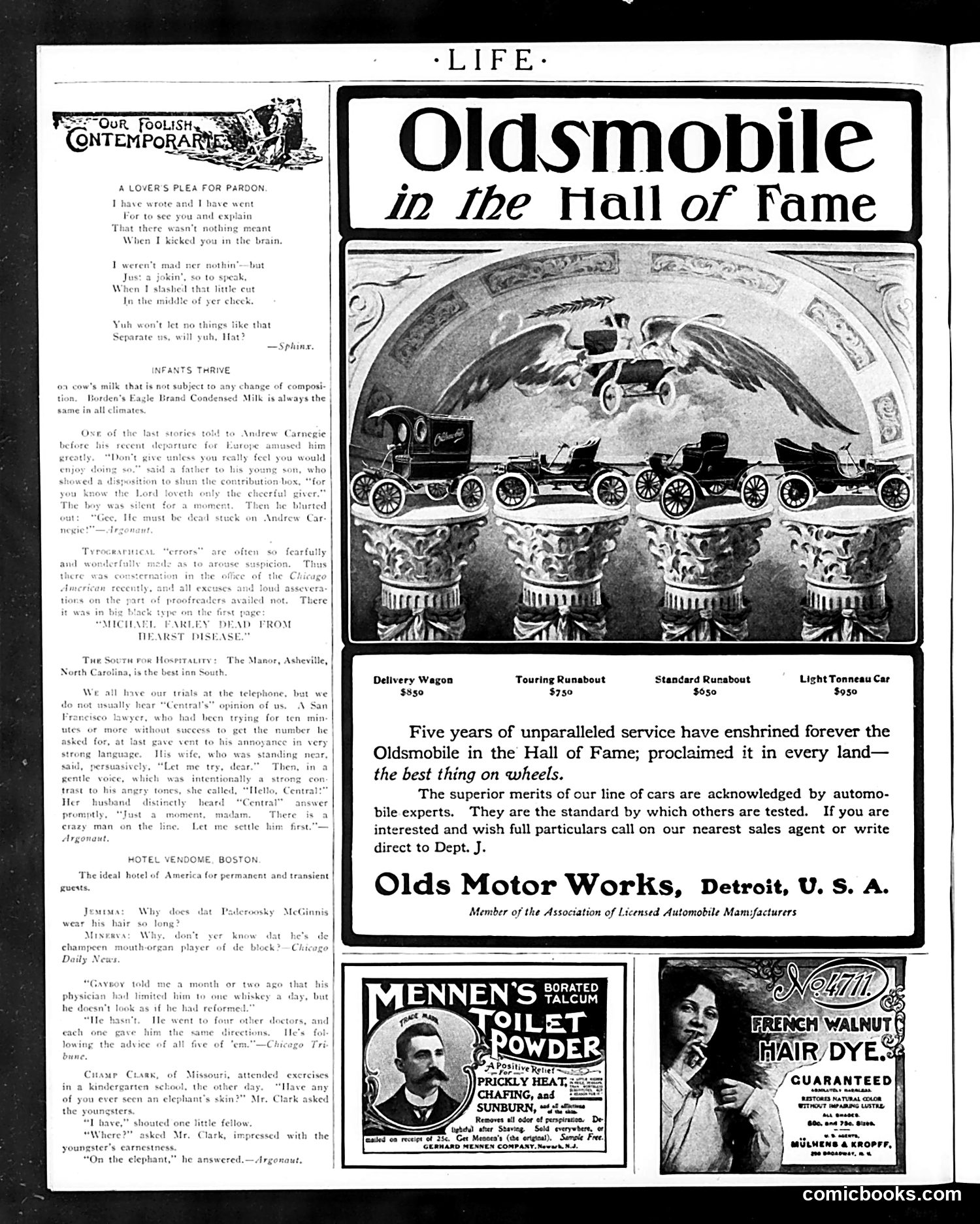
This page is primarily **advertising**, not political satire. The dominant content is a full-page Oldsmobile advertisement featuring an illustrated "Hall of Fame" scene with four car models paraded like classical sculptures on pedestals. The ad copy claims Oldsmobile has achieved legendary status through "five years of unparalleled service," positioning the brand as the standard against which competitors are measured. Four models are displayed with prices ($650-$950), emphasizing variety and quality. The page's left column contains miscellaneous humor pieces unrelated to the main advertisement—brief anecdotes and jokes about social situations and human behavior. Below the Oldsmobile ad are two smaller product advertisements: Mennen's Borated Talcum Toilet Powder and French Walnut Hair Dye. The "Hall of Fame" framing uses classical architectural imagery to elevate commercial products to artistic status—a common advertising strategy of the early 1900s capitalizing on consumer aspirations.
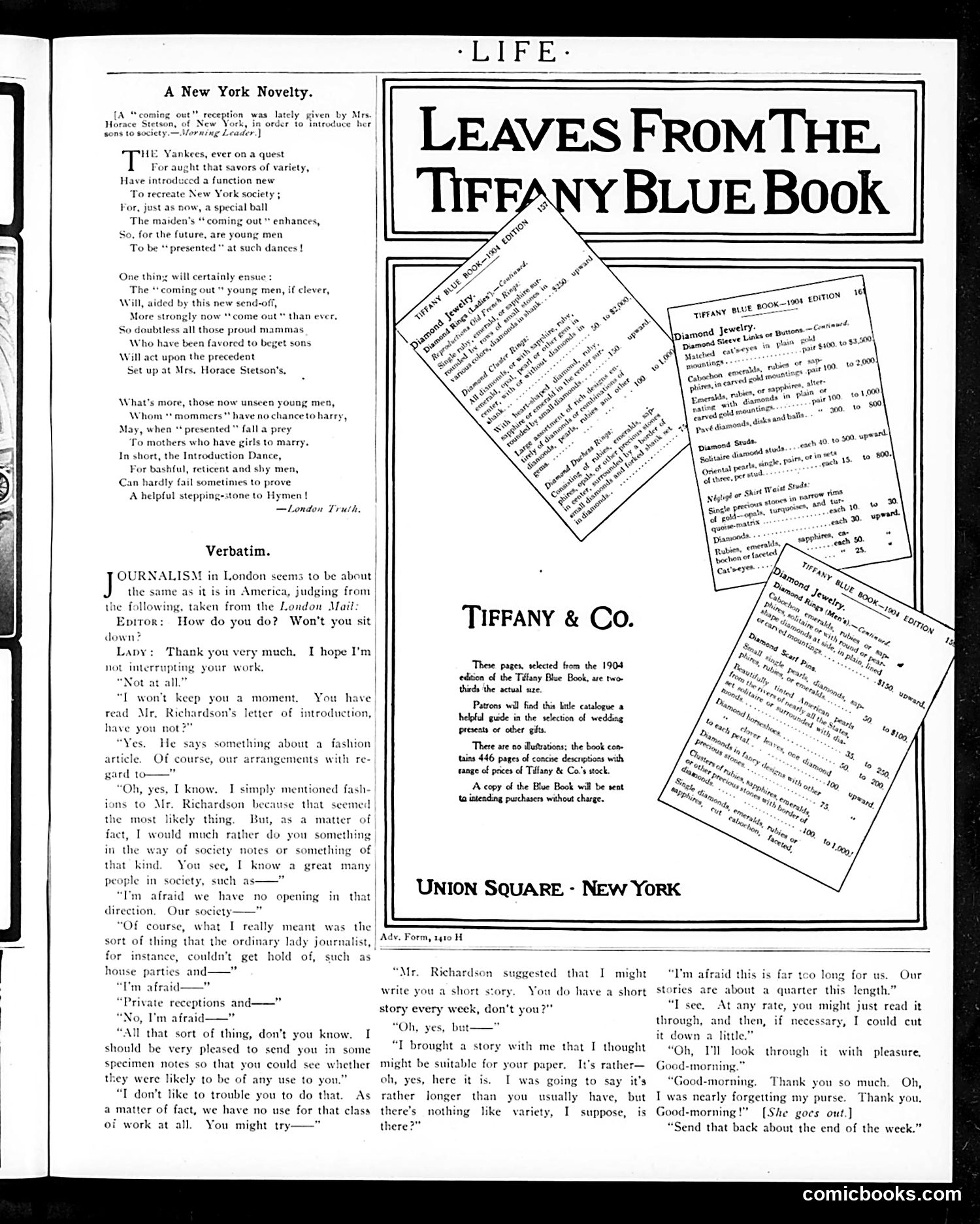
This page contains two satirical pieces: **"A New York Novelty"** mocks the recent American custom of formal "coming out" balls for young men, mirroring the established tradition for debutante women. The satire suggests this new practice will intensify competition in the marriage market—shy young men will now be "presented" to society, making it easier for mothers with unmarried daughters to pursue them. The joke is that what was invented as a social refinement will actually increase matrimonial pressure and awkwardness. **"Verbatim"** presents a humorous dialogue between a London newspaper editor and a female job applicant. She suggests writing fashion articles or covering private society events (gatherings journalists typically couldn't access). The editor repeatedly rejects her ideas as unsuitable, then hypocritically asks *her* to write short stories—work she clearly doesn't want to do. The satire critiques how editors dismiss women's professional suggestions while exploiting their labor. Both pieces satirize social pretension and gender dynamics of the Edwardian era.
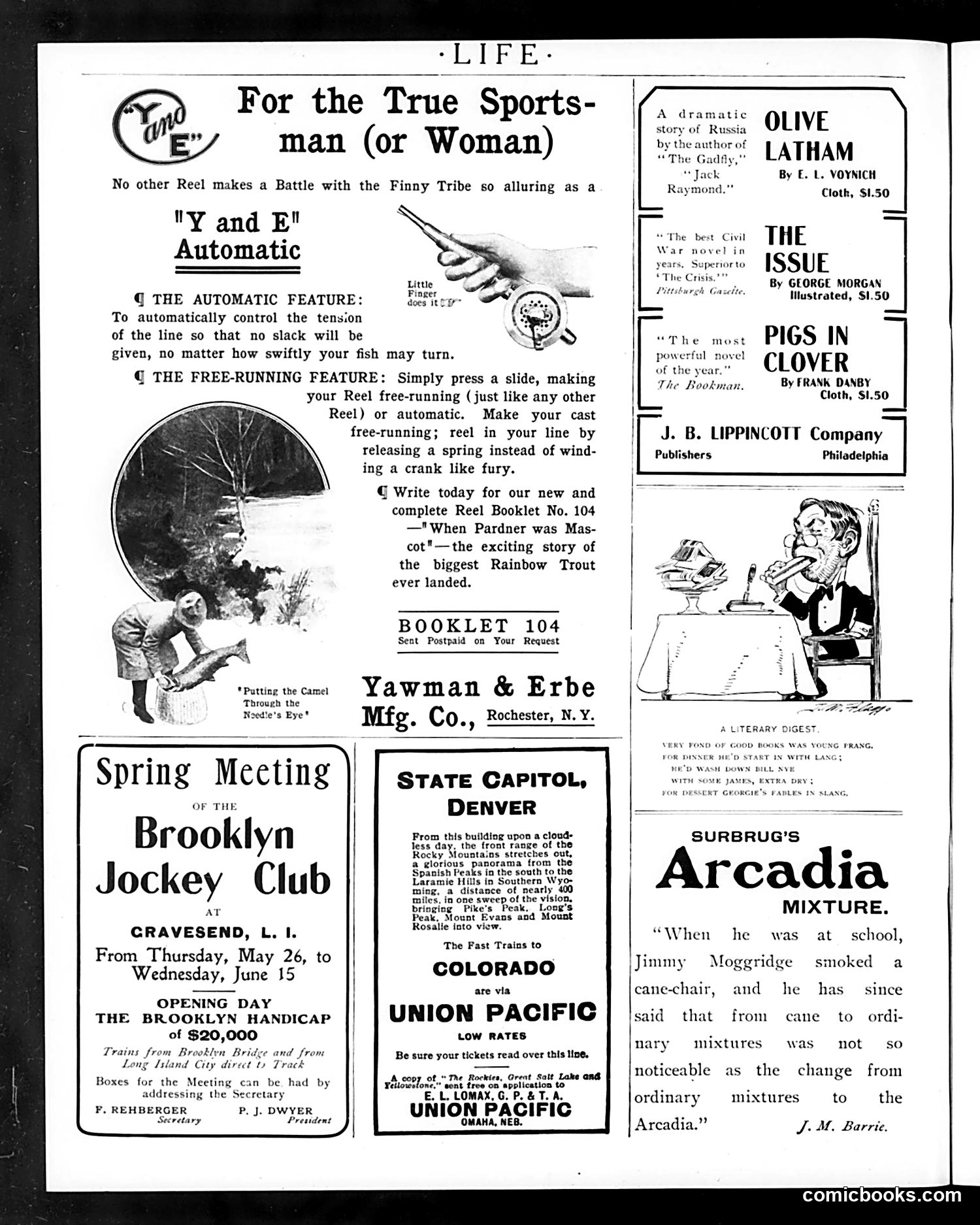
This page is primarily **advertising and book promotions** rather than political satire. The main content includes: **Left side:** A fishing reel advertisement ("Y and E" Automatic) featuring a small illustration of someone fishing, with technical copy about automatic line tension and free-running features. **Center:** Announcements for sporting events—a Brooklyn Jockey Club spring meeting and Colorado travel via Union Pacific Railroad, promoting Denver's State Capitol building views. **Right side:** Book advertisements from J.B. Lippincott Company, including titles like "Olive Latham" and "Pigs in Clover." **Bottom right:** A literary digest featuring a J.M. Barrie quote about pipe tobacco mixtures, with a cartoon of a well-dressed man at a dining table smoking. The cartoon is humorous rather than political—it's a light joke about how smokers graduate from unconventional materials (cane furniture) to tobacco blends. There's no significant satire or political commentary on this page; it's a standard early-20th-century magazine layout mixing advertisements with light humor.
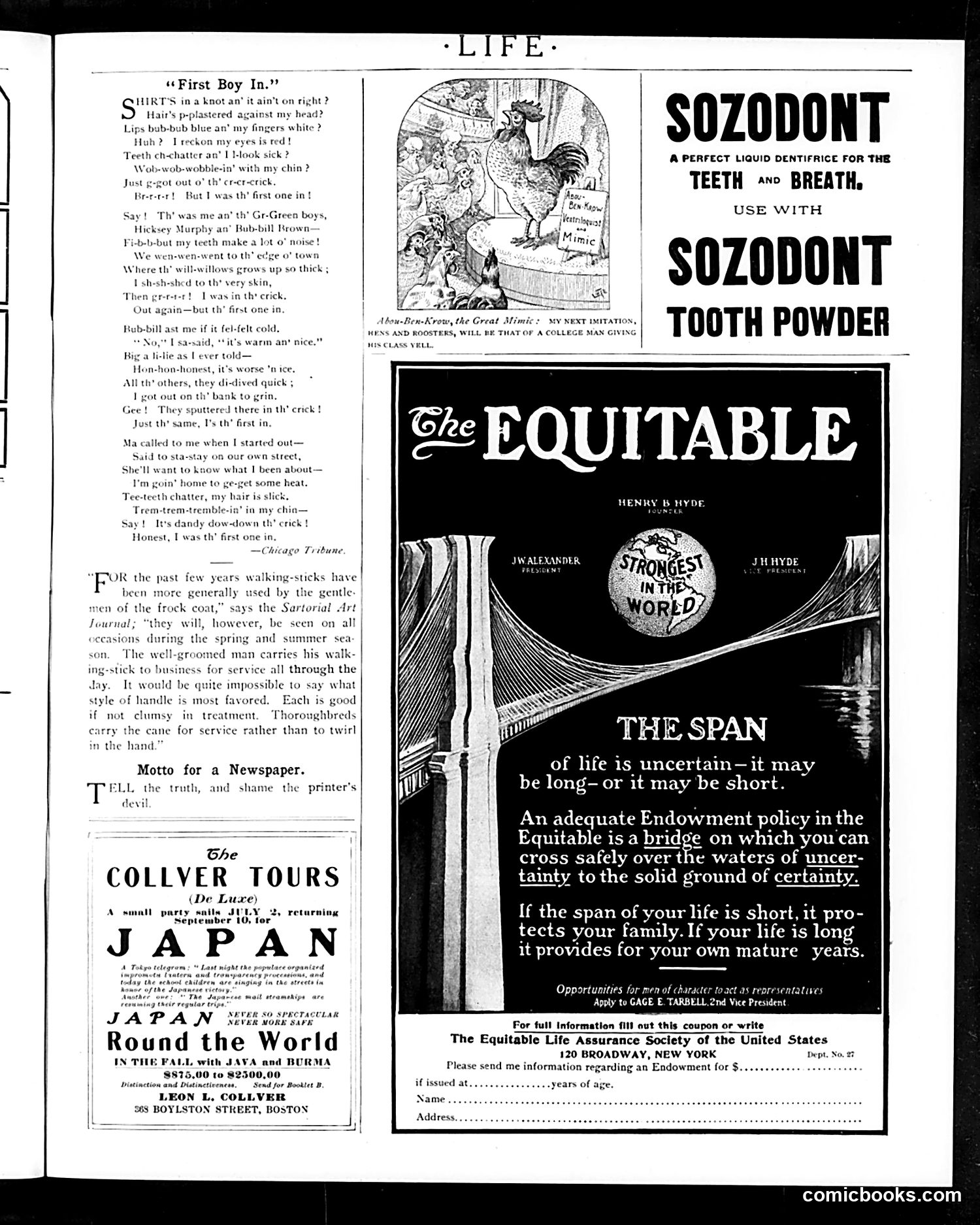
The left side features a comic poem titled "First Boy In," originally from the *Chicago Tribune*. It depicts a nervous boy experiencing all the physical anxieties of his first day at school—stammering, trembling, racing heart, sweating—as he boasts about being "first in" at various activities. The satire mocks youthful bravado masking genuine terror: the boy claims superiority while describing unmistakable panic symptoms. It's humorous commentary on adolescent masculinity and the gap between pretended confidence and actual fear. The remaining page content is primarily **period advertising** (Sozodont toothpaste, Equitable Life Insurance, Collver world tours, walking-stick commentary). The Life magazine page structure mixed editorial humor with commercial sponsorship, typical of early 20th-century publications. The Equitable Insurance ad notably uses bridge imagery to sell endowment policies—visualizing financial security as crossing from uncertainty to safety.
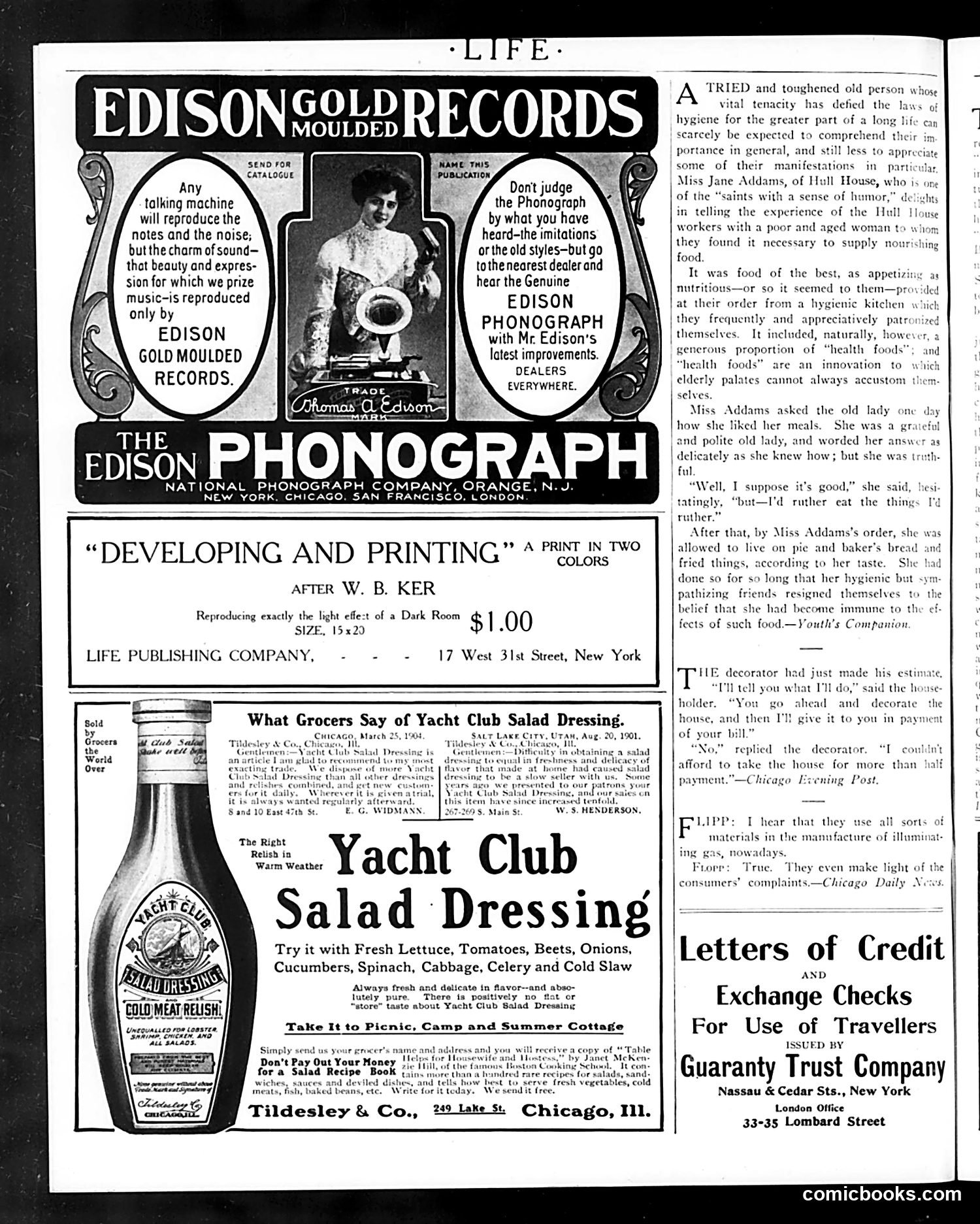
This is primarily an **advertising page** with one embedded satirical article about Jane Addams of Hull House. **The Main Content:** The article mocks well-intentioned Progressive Era reformers—specifically Jane Addams—who impose "health foods" on poor elderly residents. An elderly woman receiving charity meals from Addams's kitchen finds the "health foods" unpalatable and longs for fried foods she's eaten her whole life. When asked her opinion, she diplomatically says the food is "good" but admits she'd "rather eat the things I ruther [rather]"—a gentle jab at paternalistic charity that ignores recipients' actual preferences. **The Satire:** Life ridicules the disconnect between reformers' good intentions and the reality that forcing dietary changes on poor people disrespects their autonomy and cultural food traditions. The joke is that Addams's "scientific" approach to helping the poor backfires through condescension. **Surrounding Advertisements:** Edison phonographs, photograph printing services, Yacht Club Salad Dressing, and travel services fill the remainder of the page—typical early 1900s Life magazine advertising.
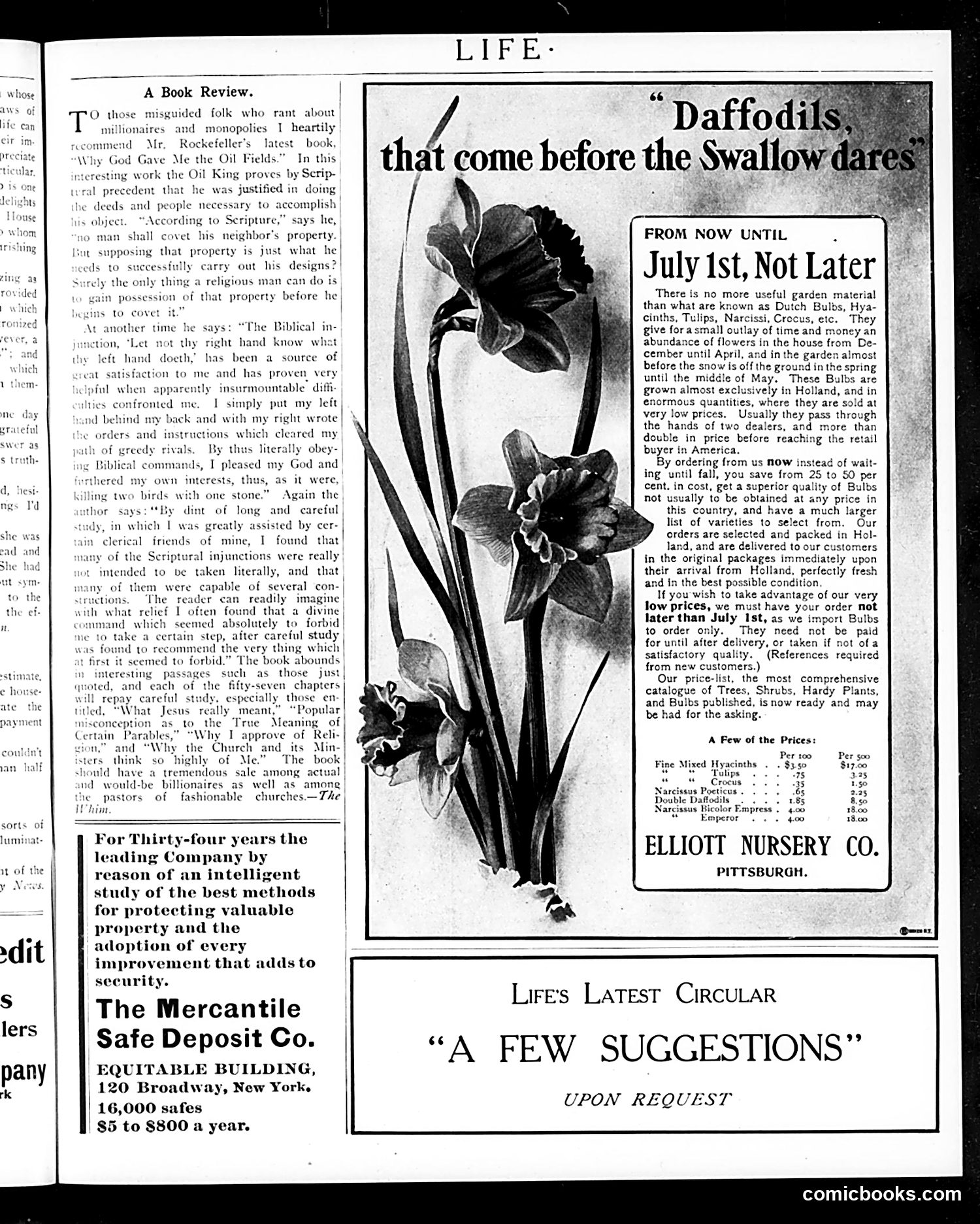
This page contains a **satirical book review** of John D. Rockefeller's memoir "Why God Gave Me the Oil Fields." The reviewer mocks Rockefeller's use of Biblical justification for his ruthless business practices and monopolistic behavior. The satire's central joke: Rockefeller allegedly claims Scripture permits his acquisitions, then cherry-picks verses to rationalize his methods. The reviewer notes the absurd irony—Rockefeller interprets "Thou shalt not covet thy neighbor's property" as justification for *taking* that property, and claims divine commandments actually *endorsed* his aggressive tactics when read carefully enough. The piece attacks wealthy industrialists generally, suggesting the book will appeal primarily to "actual and would-be billionaires as well as among the pastors of fashionable churches"—implying both corrupt businessmen and complicit clergy embrace such convenient theology. The bulk of the page is **advertising**: a daffodil bulb company and a safe deposit bank, unrelated to the satire.
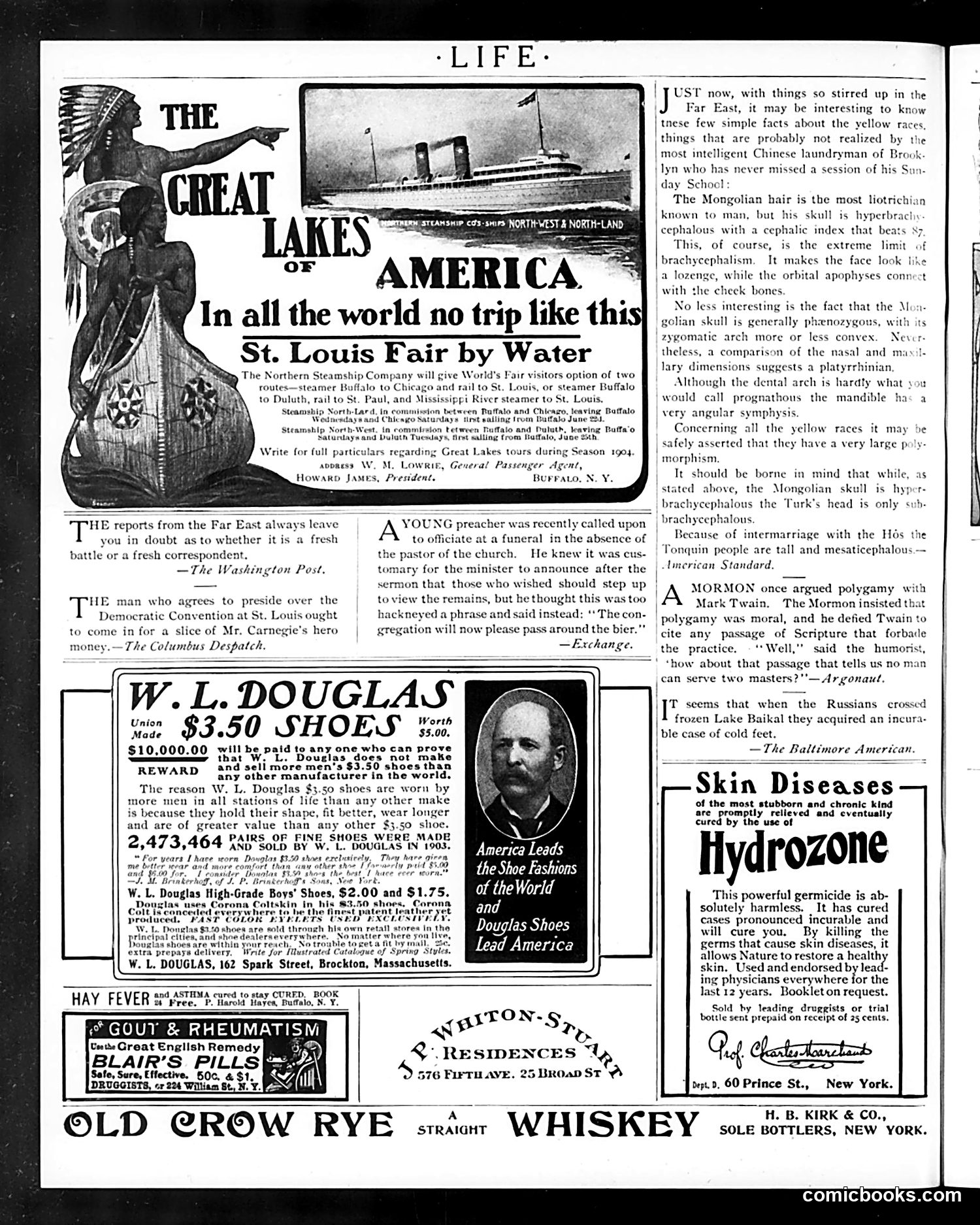
This page is primarily **advertising and miscellaneous content** rather than a cohesive satirical cartoon. The main editorial content is a pseudo-scientific screed about "yellow races," using fabricated anthropological terminology ("liotrichian," "brachycephalous," "zygomatic arch") to discuss Mongolian and Asian physical characteristics. This appears to be satirizing contemporary pseudo-scientific racism—the absurdly technical jargon about skull shapes and racial classification was parody of the era's "scientific racism," which used false craniology to justify racial hierarchies. Supporting this interpretation: included anecdotes mock earnest debates (a Mormon defending polygamy to Mark Twain; a preacher's awkward funeral announcement), suggesting the page mocks overconfident pontification generally. The remaining content is straightforward advertising: W.L. Douglas shoes, Old Crow whiskey, Hydrozone skin treatment, and a St. Louis Fair riverboat cruise promotion. The page reflects Life's formula: satire of contemporary attitudes mixed with commercial revenue.
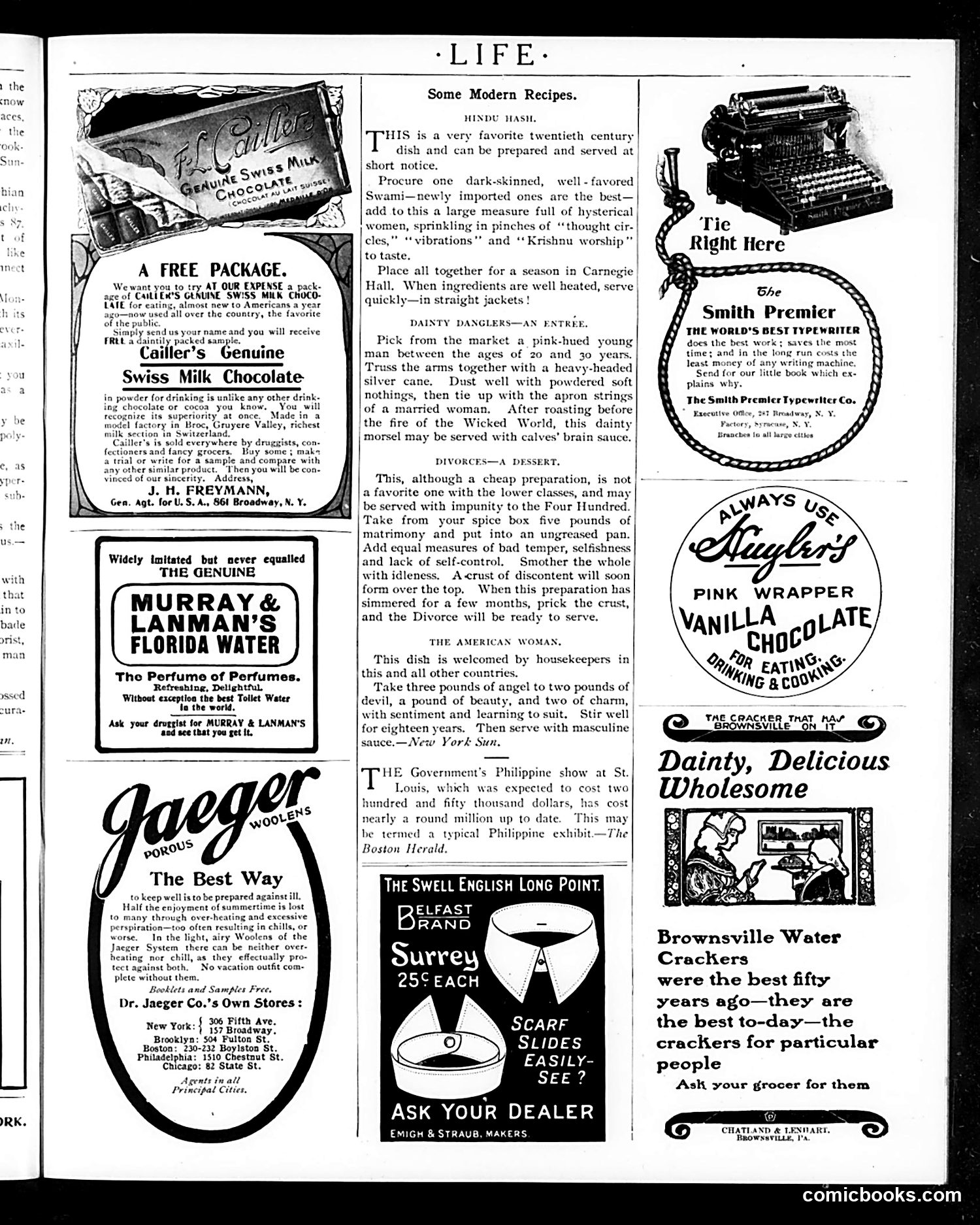
This page contains satirical "recipes" mocking early 20th-century social trends and types: **"Hindu Hash"** ridicules the fascination with Indian spirituality and imported "Swamis," depicting them as exotic curiosities that attract "hysterical women" interested in mysticism and Eastern philosophy. **"Dainty Danglers"** is a cynical take on young men seduced by marriage, portraying them as helpless victims "trussed" and controlled by their wives. **"Divorces—A Dessert"** satirizes divorce among the wealthy ("Four Hundred"), treating marital dissolution as a recipe requiring ingredients like "bad temper" and "selfishness," suggesting divorces result from character flaws rather than incompatibility. **"The American Woman"** (partially visible) likely continues mocking female behavior or social roles. The format uses cooking metaphors to ridicule contemporary social anxieties: anxiety about Eastern religions, gender dynamics in marriage, and divorce's rise among the elite. The recipes mock both the subjects of satire and the readers who recognize these social types.
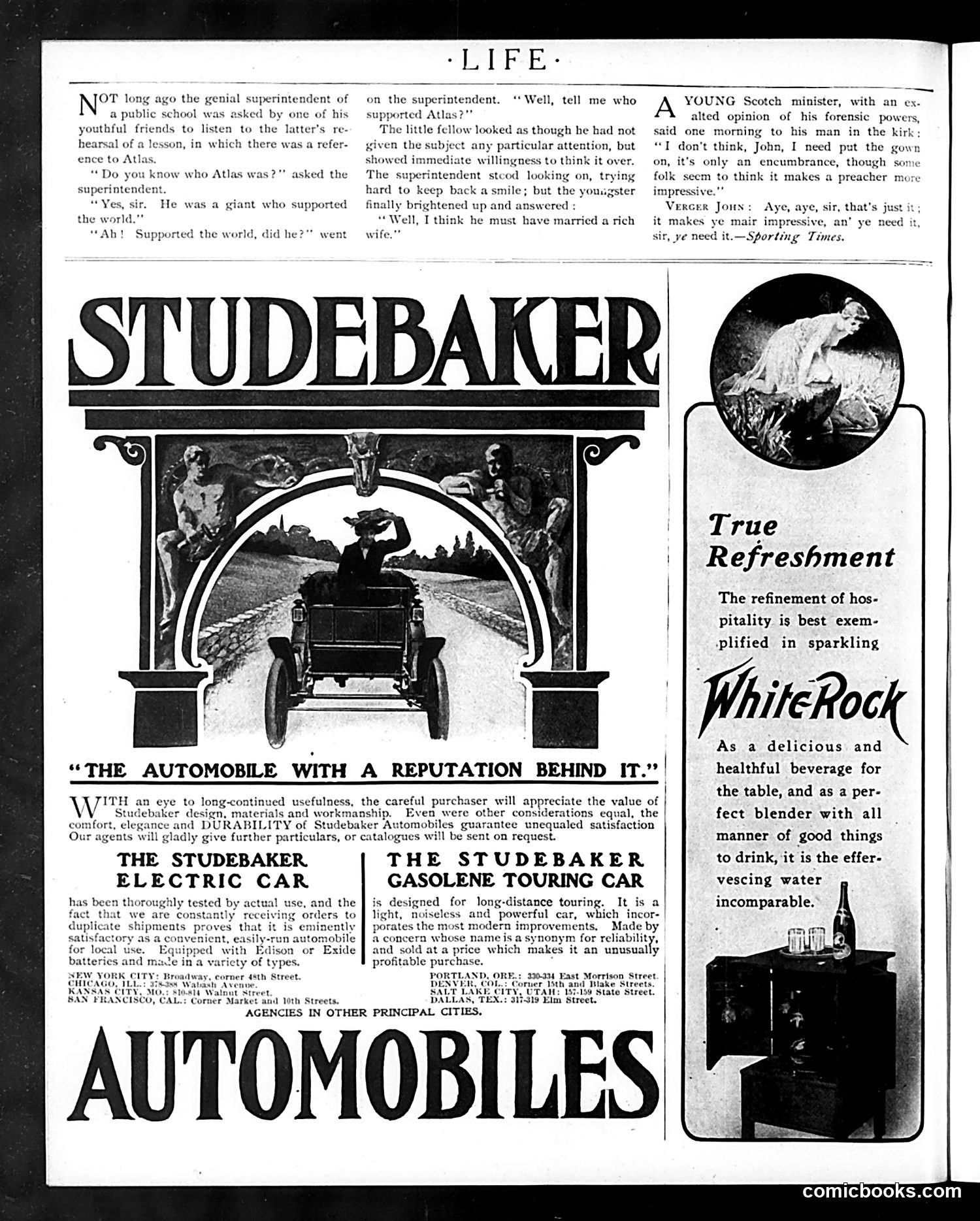
This page contains two brief humorous anecdotes at the top, followed by advertisements. The first joke plays on a child's misunderstanding of classical mythology. When asked who Atlas was, the boy correctly identifies him as "a giant who supported the world" but then adds the punchline: he "must have married a rich wife"—implying Atlas needed financial support to continue his labor. The humor lies in the child's innocent, literal logic applied to mythology. The second anecdote features a Scottish minister boasting that his sermon notes are unnecessary encumbrances, with his servant deadpan agreeing that "it makes ye mair impressive, an' ye need it"—a gentle jab at the minister's overconfidence in his preaching abilities. The remainder is advertising: Studebaker automobiles (electric and gasoline models) and White Rock sparkling water. These ads are period-appropriate promotions emphasizing reliability and refinement, typical of early 20th-century marketing.
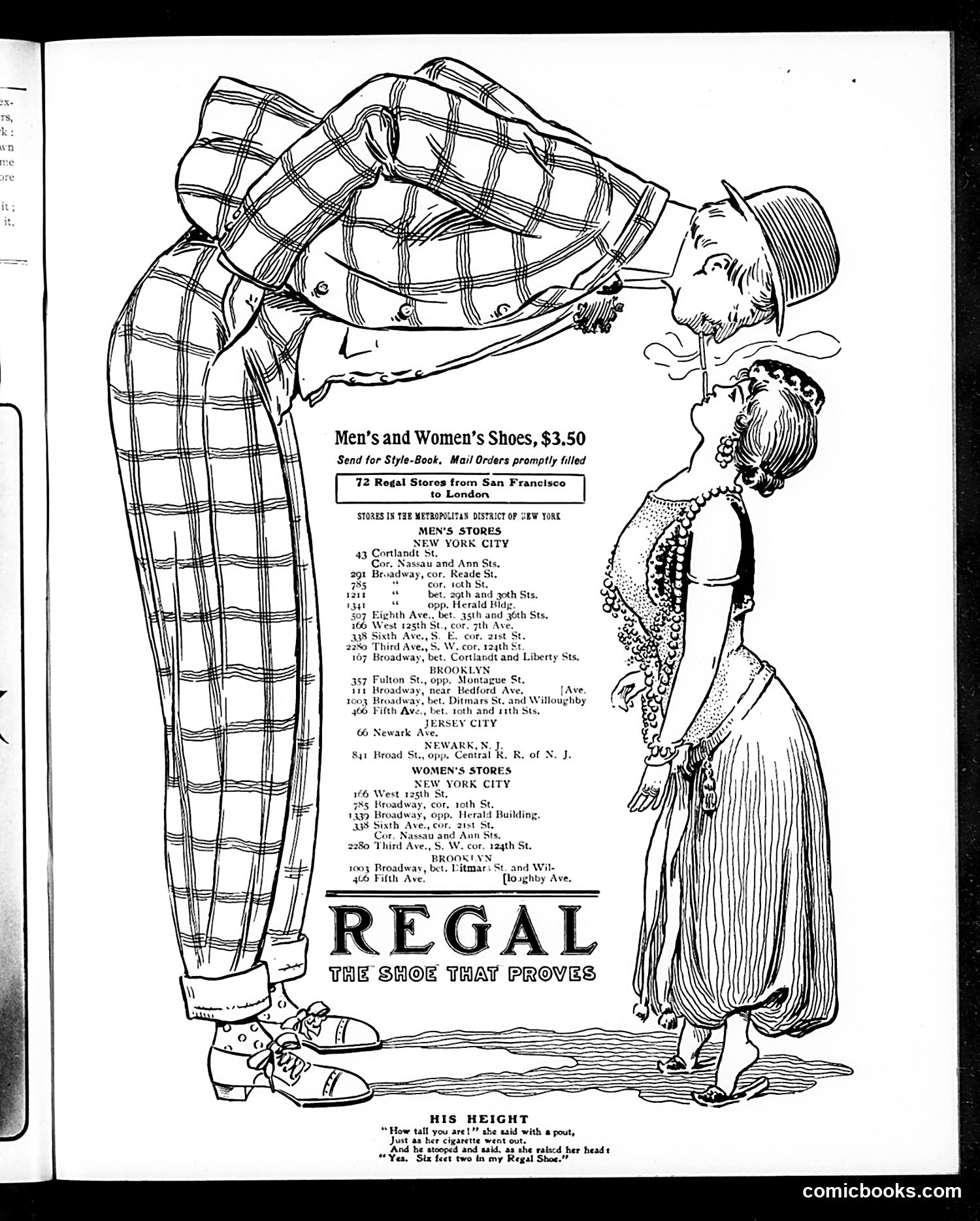
This page is primarily a **shoe advertisement** for Regal Shoes ($3.50 for men's and women's shoes), not political satire. The illustration depicts a humorous romantic scenario: a tall man in oversized checkered pants bends down to a woman who comments on his height. The accompanying verse reveals the joke—his impressive stature is exaggerated by Regal Shoes, which apparently add height to the wearer. The cartoon satirizes male vanity and shoe advertising claims. The man's comedically oversized appearance, combined with the caption "The Shoe That Proves," mocks both masculine insecurity about height and the shoe industry's tendency to make exaggerated promises about their products' transformative powers. This reflects early 20th-century advertising humor, where comic illustrations in magazines like *Life* used gentle satire to promote consumer goods while entertaining readers.

This is primarily an **advertisement**, not a political cartoon. It's a 1904 Life magazine ad for Armour & Company's "Veribest" brand canned meats. The image shows a cheerful young girl in a cook's outfit sitting on a chair, holding a telephone receiver—the "Do it now / Phone your dealer" headline encourages immediate purchase. The visual joke relies on the novelty of using a telephone for shopping, still relatively new technology in 1904. The actual innovation being advertised appears in the text: recipe instructions printed on wrapper reverses, offering "new, simple and practical" uses for canned meats beyond conventional preparations. This was positioned as a significant convenience feature—essentially early instructional packaging. There is no political satire here; it's straightforward commercial messaging using period-appropriate humor (a child playing housewife with modern technology) to promote a consumer product.