
Life, 1904-06-02 · page 22 of 50
Life — June 2, 1904 — page 22: what you’re looking at
What you’re looking at
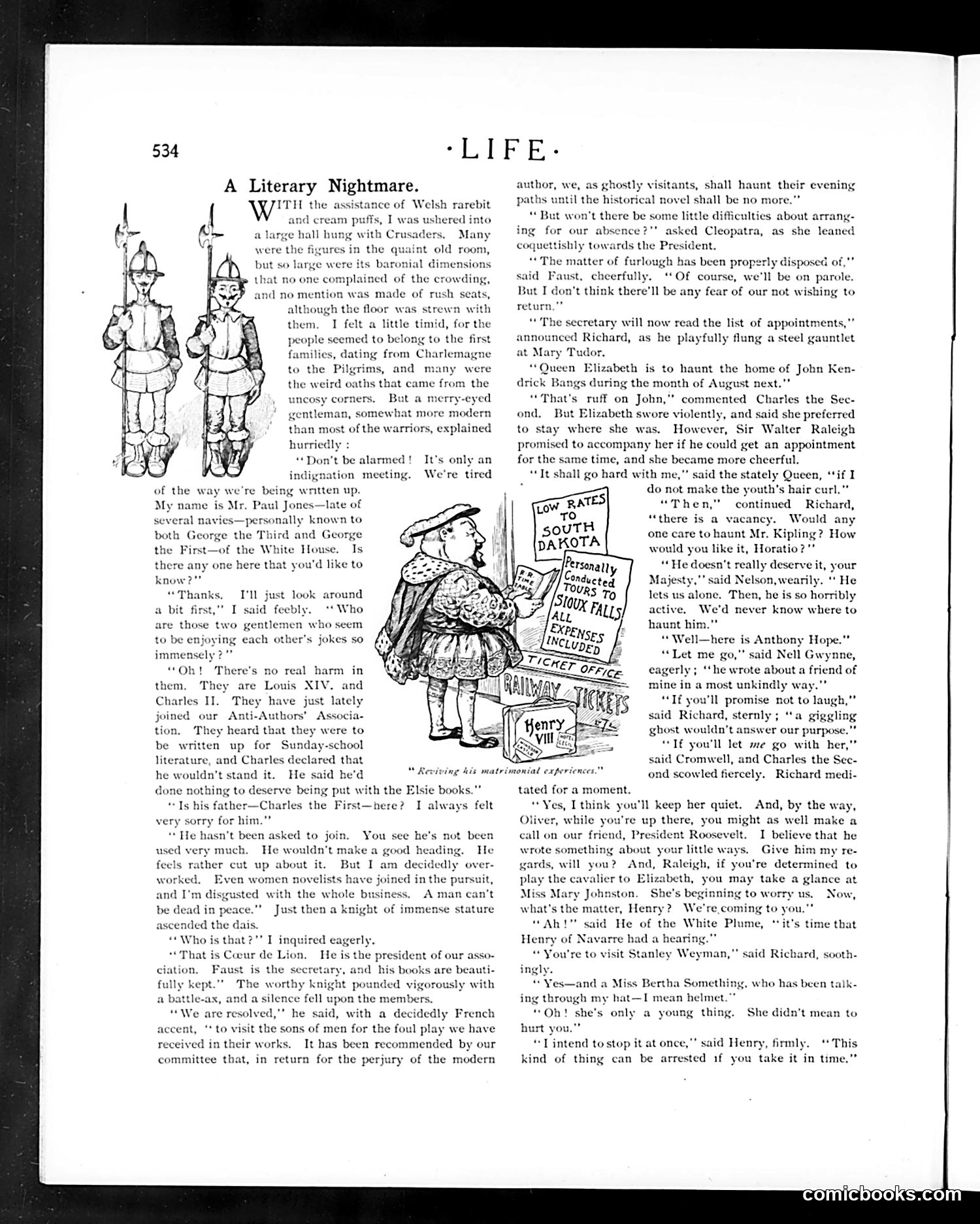
This satirical story mocks authors who exploit historical figures in their writing. The cartoon depicts historical and literary characters—Louis XIV, Charles II, Coeur de Lion (Richard the Lionheart), Cleopatra, Mary Tudor, Elizabeth I, Nelson, and others—meeting as ghosts to form an "Anti-Authors' Association." Their complaint: they're tired of being "written up" in novels, particularly Sunday-school literature and popular fiction. The satire targets authors (especially novelists of the era) for profiting from and distorting the realities of famous people's lives. Characters like Charles II refuse to be associated with "Elsie books" (wholesome children's literature), finding it demeaning. The resolution shows the ghosts planning to haunt authors' "evening paths" until "the historical novel shall be no more"—exaggerating writers' invasive use of real historical figures for commercial fiction. This reflects contemporary anxiety about biographical novels and literary appropriation.
📄 Transcribed text from this page (OCR, searchable)
Machine-transcribed from the original scan — historical spelling and the odd misread are preserved.
‘LIFE. A Literary Nightmare. ITH the assistance of Welsh rarebit ushered into with Crusaders. Many es in the quaint old room, s baronial di that no one complained of the c but so la ensions wing, and no mention was made of rush sea although the floor was strewn \ them. I felt a little timid, for the people seemed to belong to the first families, dating from Charlema; to the Pilgrims, and many were hs that came from the But a merry-eyed 1, Somewhat more modern than most of the warriors, explained hurriedly : ‘Don't be alarmed ! indignation meeting. It’s only an We're tired being written up. ate of " i and George > First—of the White House. Is re any one here that you'd like to know “Thanks, a bit firs are those T'll just look around I said feebly. ‘Who wo gentlemen who seem to be enjoying each other's jokes so immensely ?"” “Oh! e's no real harm in them. They are Louis XIV. and Charles IH. They have just lately joined our Anti-Authors’ Associ tion. They heard that they were to be written up for Sunday-school literature, and Charles declared that he wouldn't stand it. He said he'd done nothing to deserve being put with the Elsie books “Is his f. Charles the First—here? I al very sorry for him.” ** He hasn't been asked to join. You see bh used very much. He wouldn't make a good h feels rather cut up about it. But I worked. Even women novelists hav and I'm disgusted with the whole business. joined in the pursuit, Aman can't be dead in peace.” Just then a knight of immense stature ascended the dai “* Who is that?’' I inquired eagerly. “That is Coeur de Lion, is the president of our ciation. Faust is the se and his books are b fully kept." The worthy knight pounded vigoro s-ax, and a silence fell upon the members. ¢ resolved,"’ he said, with a decidedly French “+ to visit the sons of men for the foul play we have ed in their works. It has been recommended by our committee that, in return for the perjury of the modern y with ng his matrimonial experiences.” author, we, as ghostly visitants, shall haunt their evening paths until the historical novel shall be no more.” “ But won't there be some little difficultie: ing for our bout arrang- * asked Cleopatra, as she leaned coquettishly towards the President. “The matter of furlough has been properly disposed of,"” said Faust, cheerful Of course, we'll be on parole. But I don't think there'll be any fear of our not wishing to return, “The secretary will now read the list of appointments,”’ announced Richard, as he playfully flung a steel gauntlet at Mary Tudor. beth is to haunt the home of John Ken- s during the month of August next."' F ruff on John,” commented Charles the Sec- ond, But Elizabeth swore violently, and said she preferred to stay where she was. , Sir Walter Raleigh promised to accompany her if he could get an appointment for the same time, and she became more cheerful. “It shall go hard with me,” said the stately Queen, ‘if I . do not make the youth's hair curl."" “Then, continued Richard, “there is a vacancy. Would any one ¢ tohaunt Mr. Kipling? How would you like it, Horatio?"’ Howev “He doesn't really deserve it, your Majesty,” said Nelson, wearily. “ He lets us alone. Then, he is so horribly active. We'd never know where to haunt him." ““Well—here is Anthony Hoy “Let me go,” said Nell Gwynne, eager! mine in a most unkindly way. “If you'll promise not to laugh,” aid Richard, sternly ; ‘a giggling ghost wouldn't answer our purpose “If you'll let me go with her,” said Cromwell, and Charles the Sec- ond scowled fiercely. Richard medi- tated for a moment. “Yes, [think you'll Oliver, while y cep her quiet. And, by the way, y're up there, you might as well make a call on our friend, President Roosevelt. I believe that he wrote something about your little w: Give him my re- gards, will you? And, Raleigh, if you're determined to play the cavalier to Elizabeth, you may take a glance at Miss Mary Johnston. She's beginning to worry us. Now, what's the matter, Henry? We're,coming to you."* “Ah!” said He of the White Plume, ‘it’s time that Henry of Navarre had a hearing.” “You're to visit Stanley Weyman,” ingly * Yes—and a Miss Bertha Somethi ing through my hat—I mean helmet “Oh! she’s only a young thing. hurt you.” “T intend to stop it at once, id Henry, firmly.“ This kind of thing can be arrested if you take it in time. said Richard, sooth- . who has been talk- She didn't mean to