
Life, 1904-06-02 · page 30 of 50
Life — June 2, 1904 — page 30: what you’re looking at
What you’re looking at
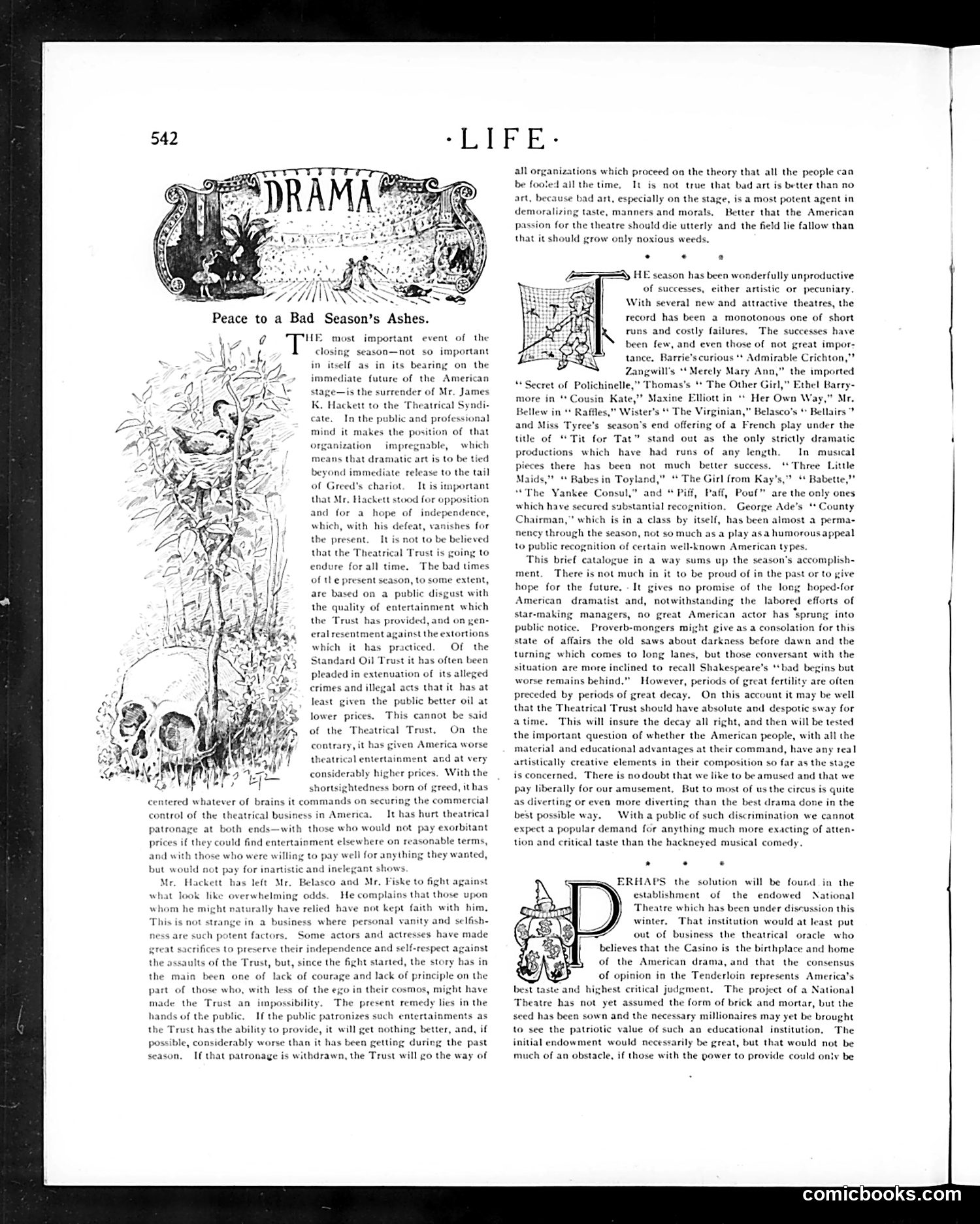
This page critiques the **Theatrical Trust**, a monopolistic cartel controlling American theater at the turn of the 20th century. The article mourns the defeat of actor **James Hackett**, who opposed the Trust's grip on the stage. The main argument: The Trust has degraded American theater by prioritizing profit over art, charging exorbitant prices while delivering poor entertainment. Unlike Standard Oil (which at least provided cheaper, better product), the Trust offers worse theater at higher costs—a damaging combination. The decorative illustration shows a skeleton wrapped in theatrical ropes, symbolizing theater's death under Trust control. The article names several contemporary productions that survived the season's general commercial failure, including works by Barrie, Zangwill, and Thomas, and performances by actors like Ethel Barrymore and David Belasco. The satire's point: monopolistic greed kills the very art it claims to control, and only public refusal to attend bad theater can break the Trust's stranglehold.
📄 Transcribed text from this page (OCR, searchable)
Machine-transcribed from the original scan — historical spelling and the odd misread are preserved.
Peace to a Bad Season’s Ashes. ILE most important event of the season—not so important f as in its bearing on the immediate future of the American 1 of Mr. Jame: atrical Syn in i cate. In the public and professional mind it makes the position of that or which ation impregnable, means that dramatic art is to be tied beyond immediate release to the tail of Greed’s chariot. It is important that Mr, Hackett stood for opposition and for a hope of indepen which, with his defeat, vanishes for the present. It is not to be believed th endure for all time. the Theatrical Trust is going to The bad times of tle present season, to some extent, are based on a public disgust with the quality of entertainment which the Trust has provided, and on gen- eral resentment against the extortions which it has practiced. Of the andard Oil Trust it has often been of its alleged pleaded in extenuatio crimes and illegal acts that it has at least given the public better oil at This cannot be said On the lower price of the Theatrical Trust. contrary, it has given America worse theatrical entertainment and at very considerably higher prices. With the shortsightedness born of greed, ithas ed whatever of brains it commands on securing the commercial control of the theatrical business in America. It has hurt theatrical patronage at both ends—with those who would not pay exorbitant where on reasonable terms, prices if they could find entertainment ¢ y well for anything th and with those who were willing to p y wanted, but would not pay for inartistic and i Mr. Hackett has left Mr, Belasco and Mr, Fiske to fight against t look like overwh that those upon whom he might naturally have relied have not kept faith with him, ant shows. y He complair ning odds. This is not strange in a business where personal vanity and selfish- ness are s Some actors and actresses have made h potent factors, at sacrifices to preserve their independe 1 self-respect against fight started, the story bas in and lack of principle on the >, with less of the ego in their cosmos, might have the ults of the Trust, but, since th the main been one of lack of courag: part of those w ade the Trust ar The present remedy lies in the impossibility. tainments as hands of the public the Trust hast! possible, considerably worse than it has been get If the public patronizes such ¢ ability to provide, it will get nothing better, and, if the past g durin If that patronage is withdrawn, the Trust will go the way of nizations which proceed on the theory that all the people can be footed ail the time, It is not true that bad art is better than no art, because bad art, especially on the stage, is a most potent agent in Better that the American id lie fallow than demoralizing taste, manners and morals, passion for the theatre should die utterly and the fi that it should grow only noxious weeds. . . * FA FAD HE season has been wonderfully unproductive at of successes, either artistic or pecuniary. With several new and attractive theatres, the record has been a monotonous one of short runs and costly failures, been few, a tance, Barrie’scurious ** Admirable Crichton, Zangwill’s ** Merely Mary Ann,” the imported “+ Secret of Polichinelle,” Thomas's ** The Other Girl,” Ethel Barry- more in ‘Cousin Kate,” Maxine Elliott in ** Her Own Way,” Mr. Bellew in * Raffles,” Wister's * The Virginian,” Belasco’s * Bellairs ” and Miss Tyree’s season's end offering of a French play under the title of “Tit for Tat” stand out as the only strictly dramatic productions which have had runs of any pieces there has been not much better success, Three Little Maids,” © Babes in Toyland,” ‘ The Girl from Kay’s,” ‘ Babette,” “The Yankee Consul,” and “ Piff, Paff, Pouf” are the only ones George Ade’s an,” which is in a class by itself, has been almost a perma- The successes have d even those of not great impor- length, In_ musical which have secured substantial recognition, Chair nency through the season, not so much as a play asa humorous appeal * County to public recognition of certain well-known American types This brief catalogue in a way su ment, There is not much in it to be proud of in the past or to give hope for the future, It gives no promise of the long hoped-for American dramatist and, notwithstanding the labored efforts of star-making managers, no great American actor has ‘sprung into publ $ up the sea son's accomplish- notice, Proverb-mongers might give as a consolation for this state of affairs the old saws about darkaess before dawn and the turning which comes to long lanes, but those conversant with the situation are more inclined to recall Shakespeare’s “bad begins but However, periods of great fertility are often preceded by periods of great decay. that the Theatrical Trust should have absolute and despotic sway for ‘This will insure the decay all right, and then will be tested the important question of whether the American people, with all the t their command, ha artistically creative elements in their composition so far as the stage worse remains behind.” On this account it may be well atime, material and educational advantag any teal is concerned. There is no doubt that we like to be amused and that we pay liberally for our amusement, But to most of us the circus is quite as diverting or even more diverting than the best drama done in the best possible way, With a public of such discrimination we cannot expect a popular demand for anything much more exacting of atten tion and critical taste than the hackneyed musical comedy. RHAPS the solution will be found in the establishment of the endowed National Theatre which bas been under discussion this winter, That institution would at least put out of business the theatrical oracle who believes that the Casino is the birthplace and home of the American drama, and that the consensus of opinion in the Tenderloin represents America’s The project of a National Theatre has not yet assumed the form of brick and mortar, but the seed has been sown and the necessary millionaires may yet be brought to see the patriotic value of such an educational institution, The initial endowment would necessarily be great, but that would not be much of an obstacle, if those with the power to provide could onty be best taste and highest critical judgment, comicbooks.com