
Life, 1904-06-02 · page 32 of 50
Life — June 2, 1904 — page 32: what you’re looking at
What you’re looking at
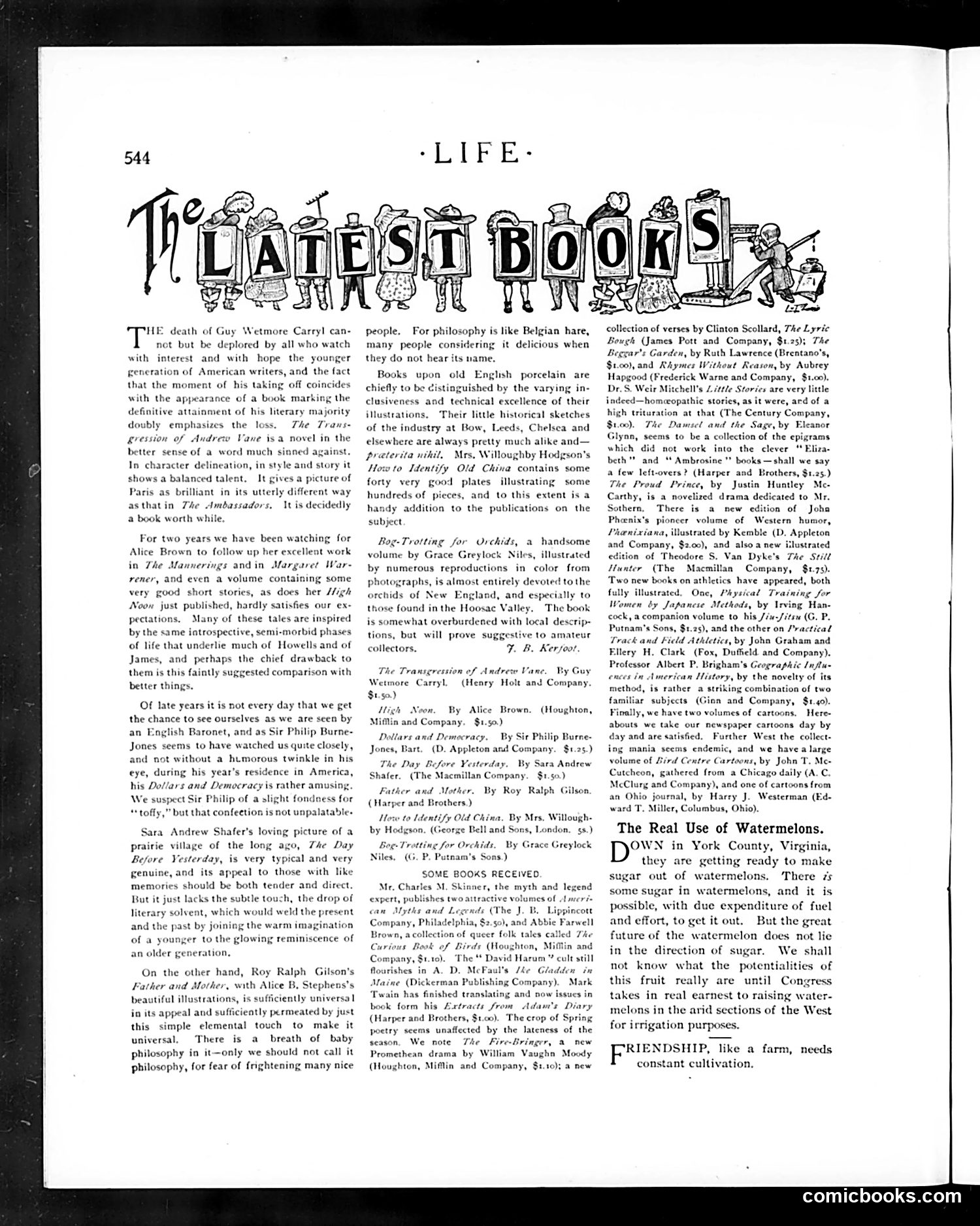
This is a **book review section**, not a political cartoon. The prominent masthead "The Latest Books" with decorative illustrations of children reading is purely ornamental—establishing the page's literary focus rather than delivering satire. The content discusses recent publications, notably lamenting writer Guy Wetmore Carryl's death and reviewing works by Alice Brown, Sir Philip Burne-Jones (a visiting English baronet), and others. **Key satirical moment**: The reviewer jokes that philosophy is "like Belgian hare"—many people find it delicious when they don't know what it's called. This mocks pretentious readers who enjoy intellectual concepts while avoiding the word itself. **Social context**: The reviews emphasize character development and literary merit in the realist tradition (comparing works to Howells and Henry James). The page reflects early 1900s American literary tastes and the magazine's role as cultural arbiter for educated readers. This is primarily **literary criticism with light humor**, not political satire.
📄 Transcribed text from this page (OCR, searchable)
Machine-transcribed from the original scan — historical spelling and the odd misread are preserved.
HE: death of Guy Wetmore Carryl can- not but be deplored by all who watch with interest and with hope the younger gener ers, and the fact that the moment of his taking off coincides with th definitive attainment of his literary majority doubly The Trans- gression of Andrew Vane isa novel in the on of American w appearance of a book marking the emphasizes the loss. better sense of a word much sinned against, In character delineation, in style and story it It gives a picture of Paris as brilliant in its utterly different way It is decidedly shows a balanced talent. asthatin Zhe Ambassadors, a book worth while, For two years we have been watching for Alice Brown to follow up her excellent work in The rener, and even a volume containing some very good short stories, as does her /igh Noon just published, hardly satisfies our ex- pectations, by the same iatrospective, semi-morbid phases of life that underlie much of Howells and of James, and perhaps the chief drawback to them is this faintly suggested comparison with better things. Mannerings andin Margaret War- Many of these tales are inspired Of late years it is not every day that we get the chance to see ourselves as we are seen by an English Baronet, and as Sir Philip Burne- Jones seems to have watched us quite closely, and not without a humorous twinkle in his eye, during his year’s residence in America, his Do//ars and Democra We su *toffy is rather amusin ect Sir Philip of a slight fondness ” but that confeetion is not unpalatable+ Sara Andrew Shafer’s loving picture of a prairie village of The Day Before Yesterday, is very typical and very genuine, and its appeal to those with like memories should be both tender and direct. But it just lacks the subtle touch, the drop of the long ago, literary solvent, which would weld the present and the past by joining the warm imagination of a younger to the glowing reminiscence of an older generation, On the other hand, Roy Ralph Gilson’s Father and Mother, with Alice B, Stephens's beautiful illustrations, is sufficiently universal in its appeal and sufficiently permeated by just this simple elemental touch to make it universal, There is a breath of baby philosophy in it—only we should not call it philosophy, for fear of frightening many nice people. For philosophy is like Belgian hare, many people considering it delicious when they do not hear its name, Books chiefly to be distinguished by the varying in- clusiveness and technical excellence of their illustrations, ‘Their little historical sketches of the industry at Bow, Leeds, Chelsea and elsewhere are always pretty much alike and— praterita nihil, Mrs, Willoughby Hodgson’s How to Identify Old China contains some forty very good plates illustrating hundreds of pieces, and to this extent is a upon old English porcelain. are some handy addition to the publications on the subject Bog-Trotting for Orchids, a handsome volume by Grace Greylock Niles, illustrated by numerous reproductions in color from photographs, is almost entirely devoted to the ids of New England, and especially to those found in the Hoosac Valley, The book is somewhat overburdened with local descrip- orc! tions, but will prove suggestive to amateur collectors. 7. B. Kersoot. The Transcression of Andrew Va Wetmore Carryl (Henry $t.s0.) High Noon. By Mifflin and Company By Guy Holt and Company Alice $1.50.) By Sir Ph (D. Appleton and Company Brown. (Houghton, Dollars and Democracy. Jones, Bart The Day Before Yesterday. By Sara Andrew Shafer. (The Macmillan Company. $1.50.) By Roy Ralph Gilson, p Burnes $1.25.) Father and Mother. (Harper and Brothers.) Horw to Identify Old China, By Mrs, Willough- by Hodgson. (George Bell and Sons, London. 5s.) Bog. Trotting for Orchids. By Grace Greylock les. (G. P, Putnam's Sons.) SOME BOOKS RECEIVED Mr. Charles M, Skinner, the myth expert, pub can Myths and L Company, Phila Brown, a collection of q led The Curious Book of Birds (Houghton, Miffiin Company, $1.10). The * David Harum” cult flourishes in A. D. MeFaul’s Me Gladden in Maine (Dickerman Publishing Company). Mark has finished translating and now issues in book form his Extracts from Adam's Diary (Harper and Brothers, $1.00). ‘The crop of Spring poetry scems unaffected by the lateness of the We note The Fire Promethean drama by William Vaughn Moody (Houghton, Mifflin and Co id legend ¢ volumes of ‘season. Bringer, & new pany, $1.10); a new collection of verses by Clinton Scollard, The Lyric Bough (James Pott and Company, $1.25); The Beggar's Garden, by Ruth Lawrence (Brentano's, $1.00), and Rhymes Without Reason, by Aubrey od (Frederick Warne and Company, $1.00). S. Weir Mitchell’s Little Stories are very little deed—homeopathic stories, as it were, ard of a high trituration at that (The Century Company, $1.00). The Damsct and the Sage, by Eleanor Glynn, seems to be a collection of the epi which did not work into the clever beth? and “ Ambrosine "* books —shall we say a few left-overs? (Harper and Brothers, $1.25.) The Proud Prince, by Justin Huntley Me- Carthy, is a novelized drama dedicated to Mr. Sothern, There is a new edition of Joho Phenix's pioneer volume of Western humor, Phanixia illustrated by Kemble (D. Appleton and Company, $2.00), and also a new illustrated edition of Theodore S. Van Dyke's The Stilt Hunter (The Macmillan Company, $1.75). | ‘Two new books on athletics have appeared, both fully illustrated. Onc, Physical Training for Women by Japanese Methods, by Irving Han- cock, a companion volume to his /éw-/itsu (G. P. Putnam's Sons, $1.25), and the other on Practical Track and Field Athletics, by John Graham and Ellery H. Clark (Fox, Duffield and Company). Professor Albert P. Brigham’s Geographic Influ- ences in American History, by the novelty of its method, is rather a striking combination of two familiar subjects (Gion and Company, $1.40). Finally, we have two volumes of cartoons. Here- abouts we take our newspaper cartoons day by y and are satisfied, Further West the collect: and we havea large tre Cartoons, by John T. Me~ Cutcheon, gathered from a Chicago daily (A.C. McClurg and Company), and one of cartoons f an Ohio journal, by Harry J. Westerman (Ed- ward T. Miller, Columbus, Ohio). The Real Use of Watermelons. OWN in York County, Virginia they are getting ready to make sugar out of watermelons. There 7s some sugar in watermelons, and it is possible, with due expenditure of fuel and effort, to get it out. But the great future of the watermelon does not lie in the direction of sugar. We shall not know what the potentialities of this fruit really are until Congress takes in real earnest to raising water- melons in the arid sections of the Wes for irrigation purpose RIENDSHIP, like a constant cultivation. farm, needs comicbooks.com