
Life, 1904-06-02 · page 34 of 50
Life — June 2, 1904 — page 34: what you’re looking at
What you’re looking at
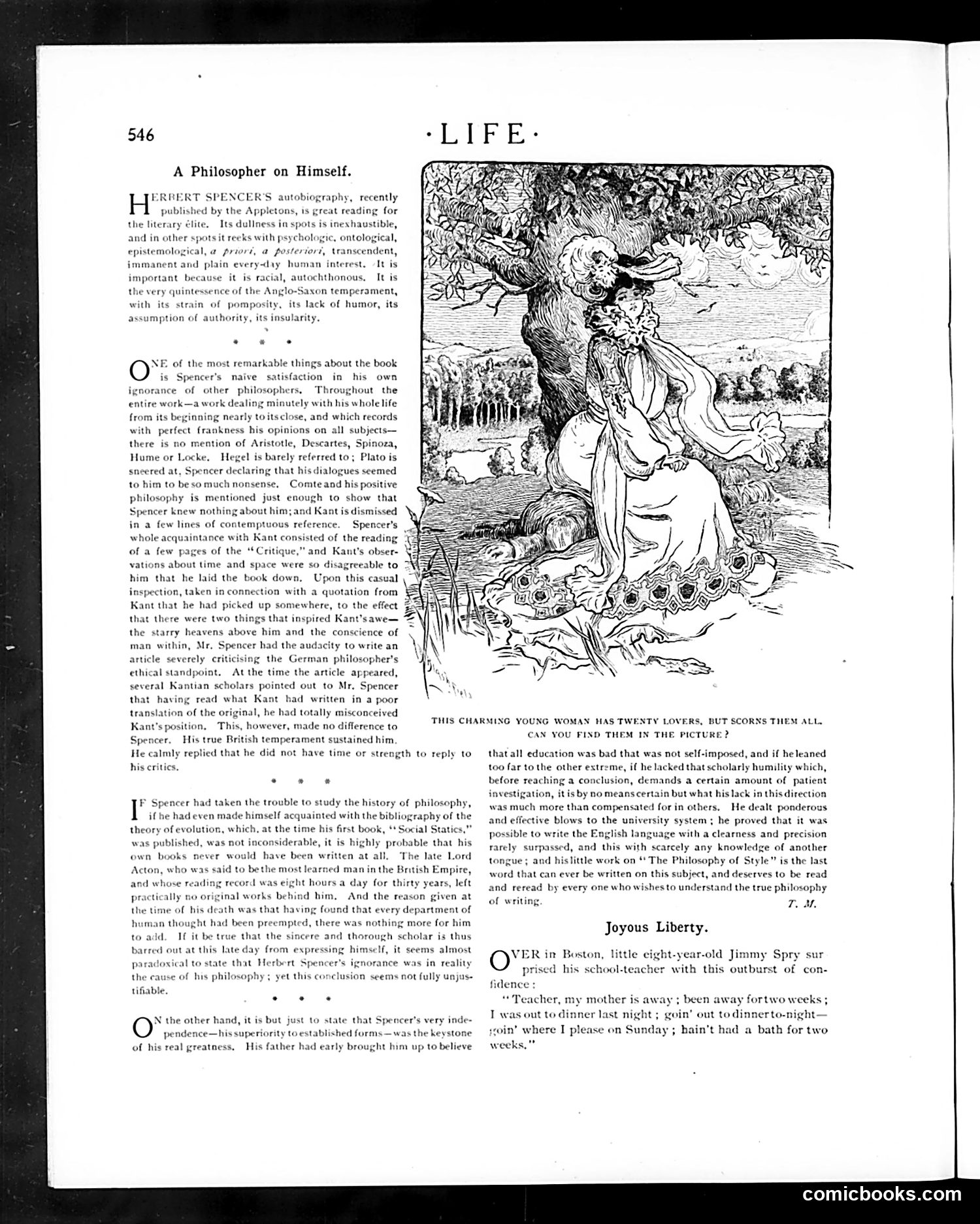
This page critiques philosopher Herbert Spencer's autobiography and intellectual arrogance. The main article, "A Philosopher on Himself," ridicules Spencer's **naive ignorance of other philosophers**—he dismisses Plato as "nonsense," barely mentions Hegel, sneers at Kant, and largely ignores Aristotle, Descartes, Spinoza, and Hume despite writing extensively on philosophy. The satire highlights Spencer's **supreme confidence despite scholarly gaps**: when Kantian scholars corrected his misreading of Kant (from a poor translation), Spencer dismissively replied he "did not have time" to respond. The piece credits him with effective writing and attacking universities, but suggests his influence might have been prevented had he studied philosophy's actual history. The accompanying illustration shows a young woman with multiple male suitors—a visual pun matching the theme of unwarranted self-satisfaction and overconfidence.
📄 Transcribed text from this page (OCR, searchable)
Machine-transcribed from the original scan — historical spelling and the odd misread are preserved.
A Philosopher on Himself. ERRERT SPENCER'S autobic published by t the literary élit exhaustib! and in other ntol epistemological, a prior’, a posterior’, transcendent, It is tochthonous, It is raphy, recently reat reading for pletons, is Its dullness in spots is s it reeks with psycholo, sical, immanent and plain every-day human int important because it is racial nce of the Anglo-Saxon temperament, ity, its lack of humor, its sumption of authority, its insularity. e very quint h its strain of pomp NE of the most remarkable things about the book is Spencer's naive satisfaction in his own jout the ly with his whole life ignorance of other philosophers, Throug! entire work—a work de: zm from its beginning nearly toitsclose, and which records with perfect frankness his opinions on all subjects— there is no mention of Aristotle, Descartes, Spinoza, Hume or Locke, Hegel is barely referred to; Plato is encer dei sneered at, Sp aring that his dialogues seemed to him to beso much nonsense, Comte and his positive philosophy is mentioned just enough to show that er knew nothing about him; and Kant is dismissed in a few lines of contemptuous reference. Spencer's intance with Kant consisted of the reading s of the “Critiq nd Kant’s obser- vations about time and space were so di whole acqu: of a few p agreeable to him that he laid the book down, Upon this casual inspection, taken in connection with a quotation from Kant that he had picked up somewhere, to the effect 3 that there were two things that inspired Kant’sawe— wens above him and the conscience of . Mr. Spenc article severely crit the starry man with had the au y to write an the German philosopher's ethical standpoint. At the time the article appeared, al Kantian scholars pointed out to Mr. Spencer that having read what Kant had written in a poor translation of the original, he had totally misconceived Kant’s position, This, how Spencer, His true Bri He calmly replied th: seve THIS CHARMING YOUNG WOMAN HAS TWENTY LOVERS, BUT SCORNS THEM ALL. CAN YOU FIND THEM IN THE PICTURE? er, made no difference to sh temperament sustained him the did not have time or strength to reply to thatall education was bad that was not self-imposed, and if he leaned his critics. too far to the other extreme, if he lacked that scholarly humility which, o 8 @ before reaching a conclusion, demands a certain amount of patient investigation, it is by no meanscertain but what his lack in thisdirection was much more than compensated for in others, He dealt ponderous and effective blows to the university system; he proved that it was possible to write the English language with a clearness and precision rarely surpassed, and this with scarcely any knowledge of another tongue ; and hislittle work on The Philosophy of Style” is the last word that can ever be written on this subject, and deserves to be read Spencer had taken the trouble to study the history of philosophy, I if he had even made himself acquainted with the bibliography of theory of evolution, which, at the time his first book, ** Social Statics, ble, it is highly probable that his own books never would have been written at all, The late Lord Act earned man inthe British Empire, and whose reading record was eight hours a day for thirty years, left was published, was not inconside who was said to be the mo: and reread by every one who wishesto u stand the true philosophy ad him, And the ven at z found that ev of ht had been preempted, the more for him gh scholar is thus day from expressing himself, it seems almost VER in Boston, little ance was in reality prised his school-te lence : practically no original works be of writing, 7. af. the time of his death was that havin human tho: Joyous Liberty. to al If it be true that the sincere and thoro! t this late barred out tey rold Jimmy Spry sur 2 with this outburst of con- oxical to state that Herbert Spencer's cof his philosophy ; yet this cor on seems not fully unjus- tifiable. . . . ; been ar “Teacher, my mother is aw ut to dinner in’ where I pl ‘ay fortwo weeks ; t night ; goin’ out todinnerto-night— ase on Sunday ; ain't had a bath for two O the other pende of his real greatness, His father had early brou nd, it is but just to state that Spencer's very inde- established forms —was the keystone ht him up tobelieve — weeks,"" —his superior: comicbooks.com