A complete issue · 37 pages · 1937
Judge — July 1937
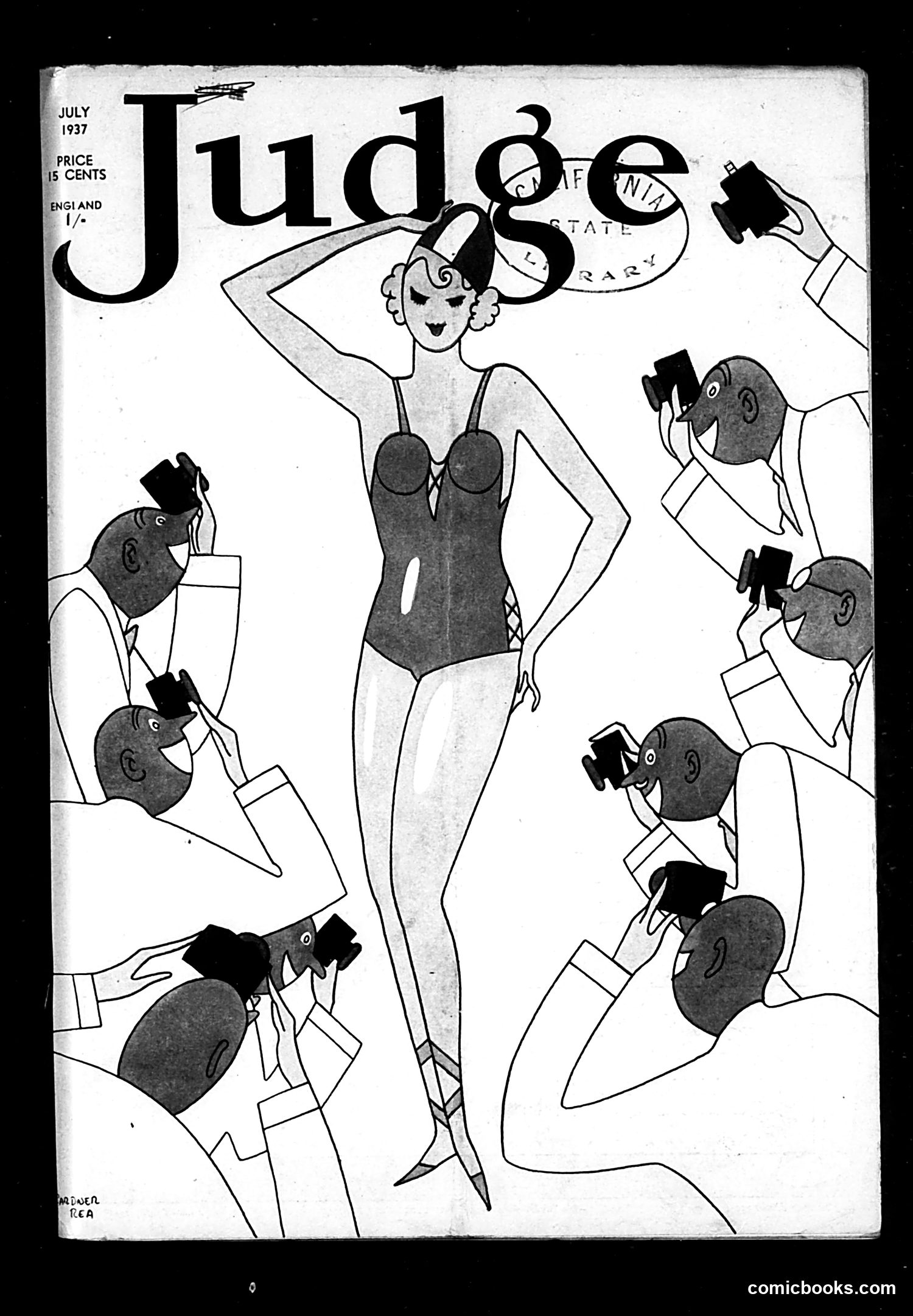
# Judge Magazine Cover Analysis (July 1937) This cover depicts a woman in a swimsuit surrounded by men holding cameras and flashbulbs—a satirical commentary on celebrity photography and media attention. The exaggerated caricatures of the photographers, with their prominent features and eager poses, mock the invasive nature of press coverage during this era. The satire likely targets the intense media scrutiny of Hollywood starlets and public figures in the 1930s, when tabloid journalism and celebrity culture were rapidly expanding. The woman's confident pose contrasts with the frenzied activity around her, suggesting commentary on either the absurdity of such attention or the commodification of female celebrity. Without identifying the specific woman depicted, the cartoon critiques press culture and the spectacle surrounding entertainers of that period.
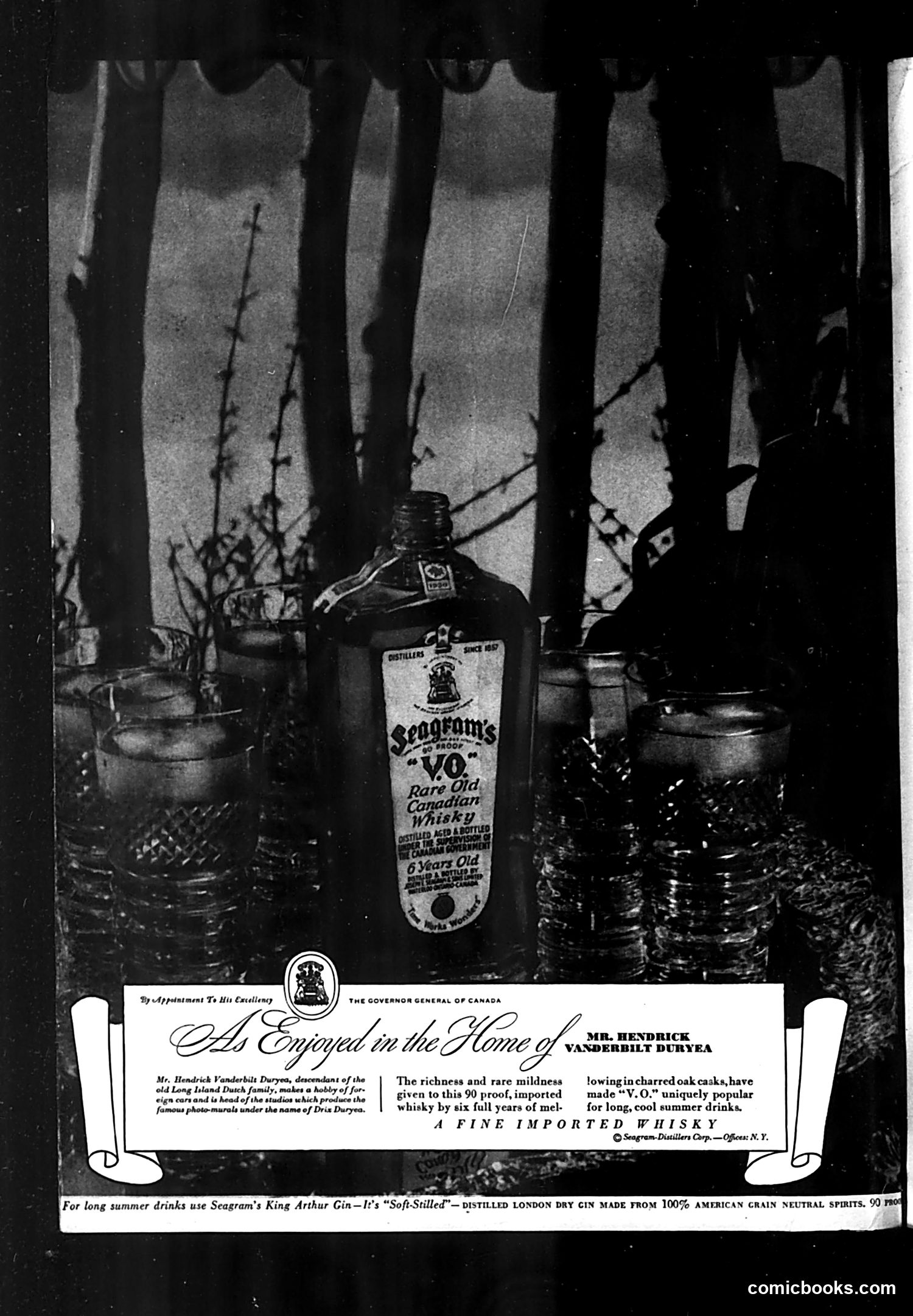
# Analysis This page is primarily **advertising rather than political satire**. It features an endorsement advertisement for Seagram's "V.O." Canadian whisky, presented as "As Enjoyed in the Home of Mr. Hendrick Vanderbilt Duryea." The ad uses social prestige marketing common to the era—invoking a prominent wealthy family name (Vanderbilt Duryea) to suggest the product's exclusivity and quality. The advertisement emphasizes the whisky's "richness and rare mildness" achieved through aging in charred oak casks. At the bottom, there's a secondary advertisement for Seagram's King Arthur Gin marketed for summer consumption. The image shows the whisky bottle surrounded by glasses with ice and garnishes. This reflects pre-Prohibition or post-Prohibition era advertising (likely 1930s-40s based on style), when luxury alcohol brands used celebrity endorsements and aspirational lifestyle marketing to reach consumers.
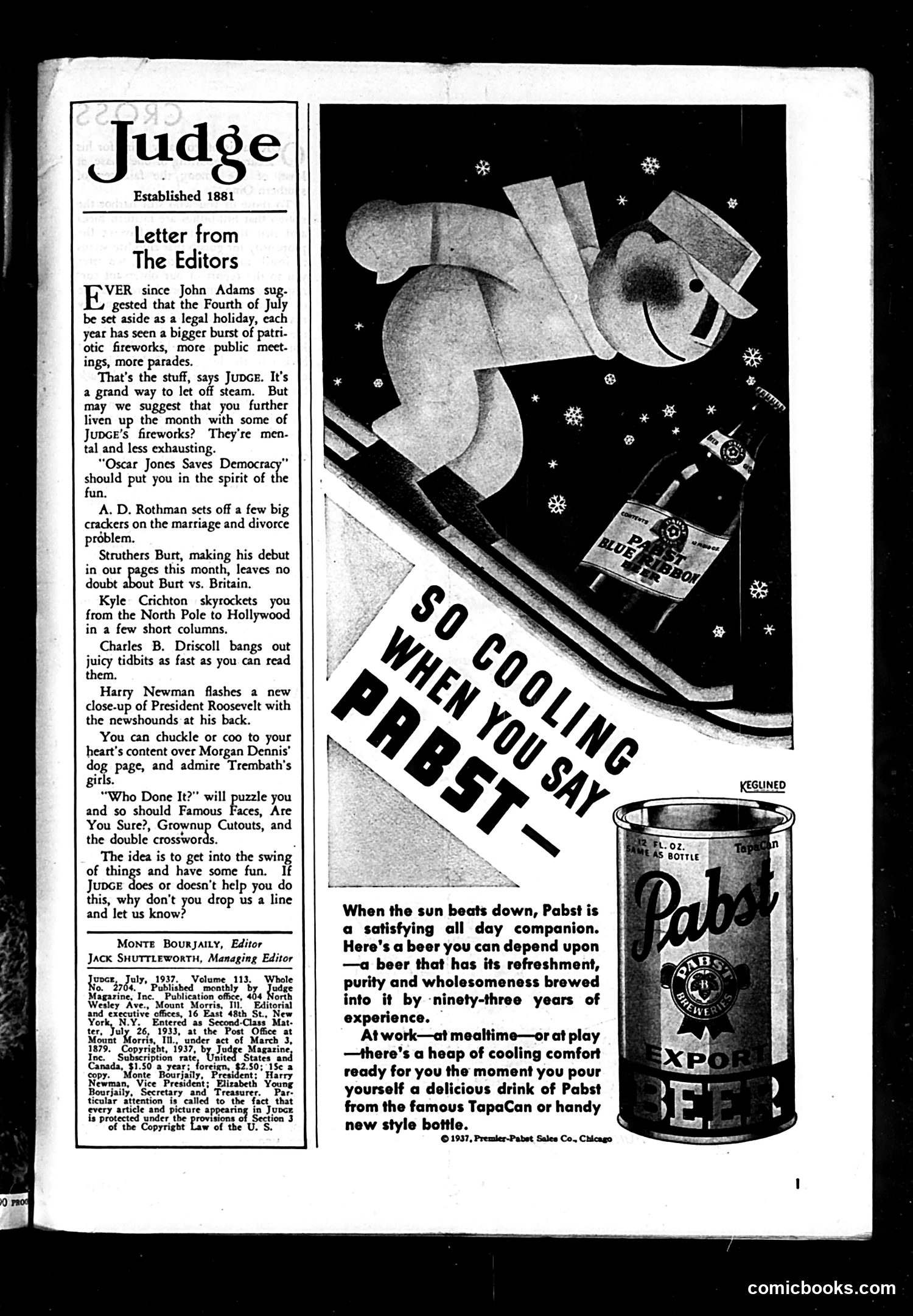
# Analysis This page is primarily a **Pabst beer advertisement** rather than political satire. The main image shows a cartoon Santa Claus figure skiing down a snowy slope with a Pabst beer bottle, captioned "SO COOLING WHEN YOU SAY 'PABST!'" The left column contains "Letter from The Editors," which previews Judge magazine's upcoming content, including pieces by various writers about topics like President Roosevelt, marriage/divorce issues, and Hollywood. The advertisement's humor relies on seasonal timing and the incongruity of Santa promoting beer as a "cooling comfort" drink. The messaging emphasizes Pabst's 93 years of brewing experience and its availability in a new "TopsCan" bottle style. This represents typical 1930s advertising strategy: using humor and celebrity/character association to market products.
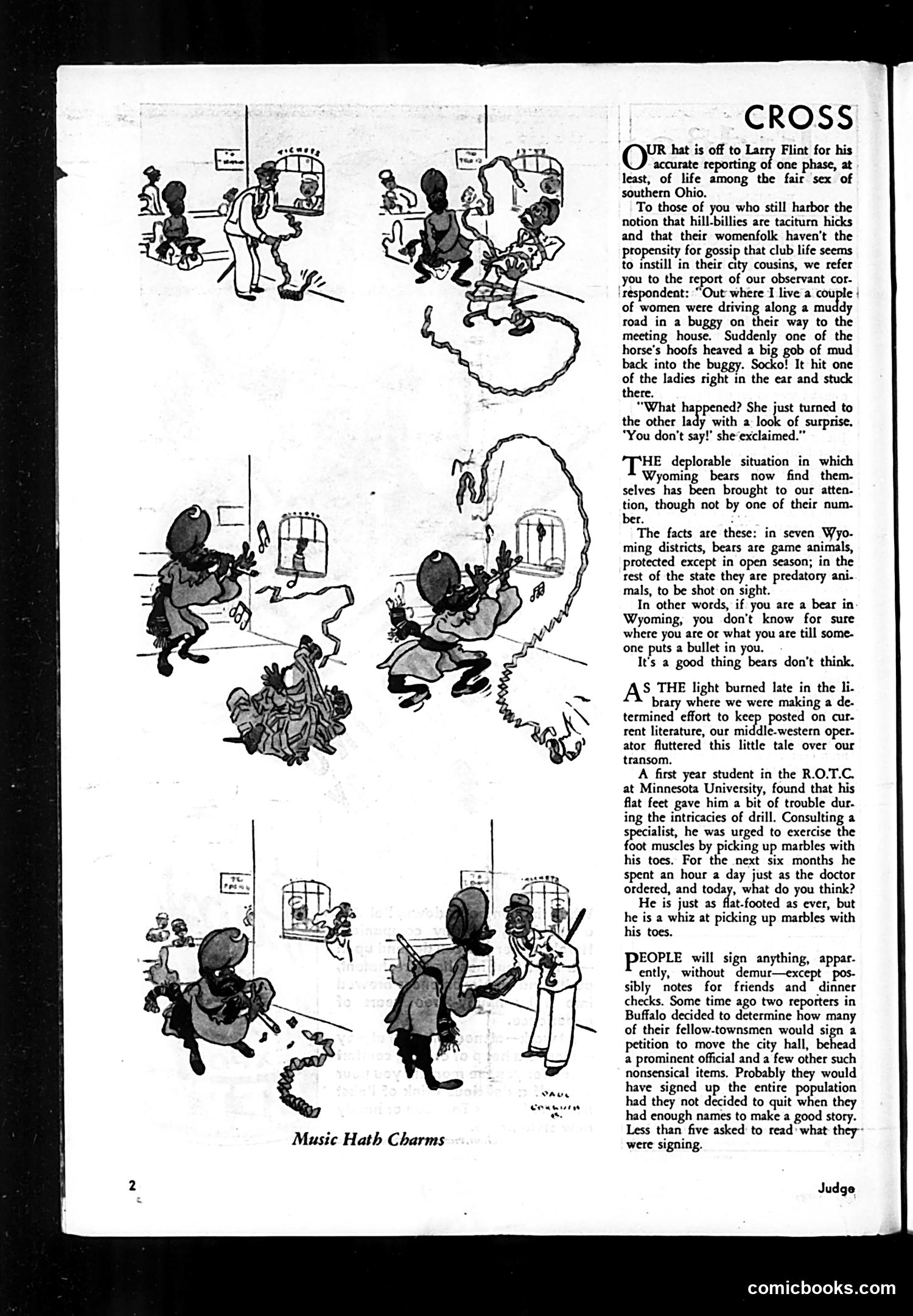
# "Cross" Page Analysis This page contains editorial commentary and cartoon vignettes titled "Music Hath Charms" rather than a single political cartoon. The "Cross" column discusses three unrelated social observations: Wyoming's bear problem (bears shot on sight, creating danger for residents), a Minnesota R.O.T.C. student with flat feet who exercises by picking up marbles with his toes, and Buffalo residents who apparently signed a petition to move city hall without reading what they were signing. The accompanying cartoons illustrate these anecdotes with humor—showing the bear incident, the marble-picking exercise, and people mindlessly signing documents. The satire targets gullibility and absurd situations in American life rather than specific political figures. The overall tone is lighthearted, mocking human foolishness and bureaucratic absurdity rather than partisan politics.
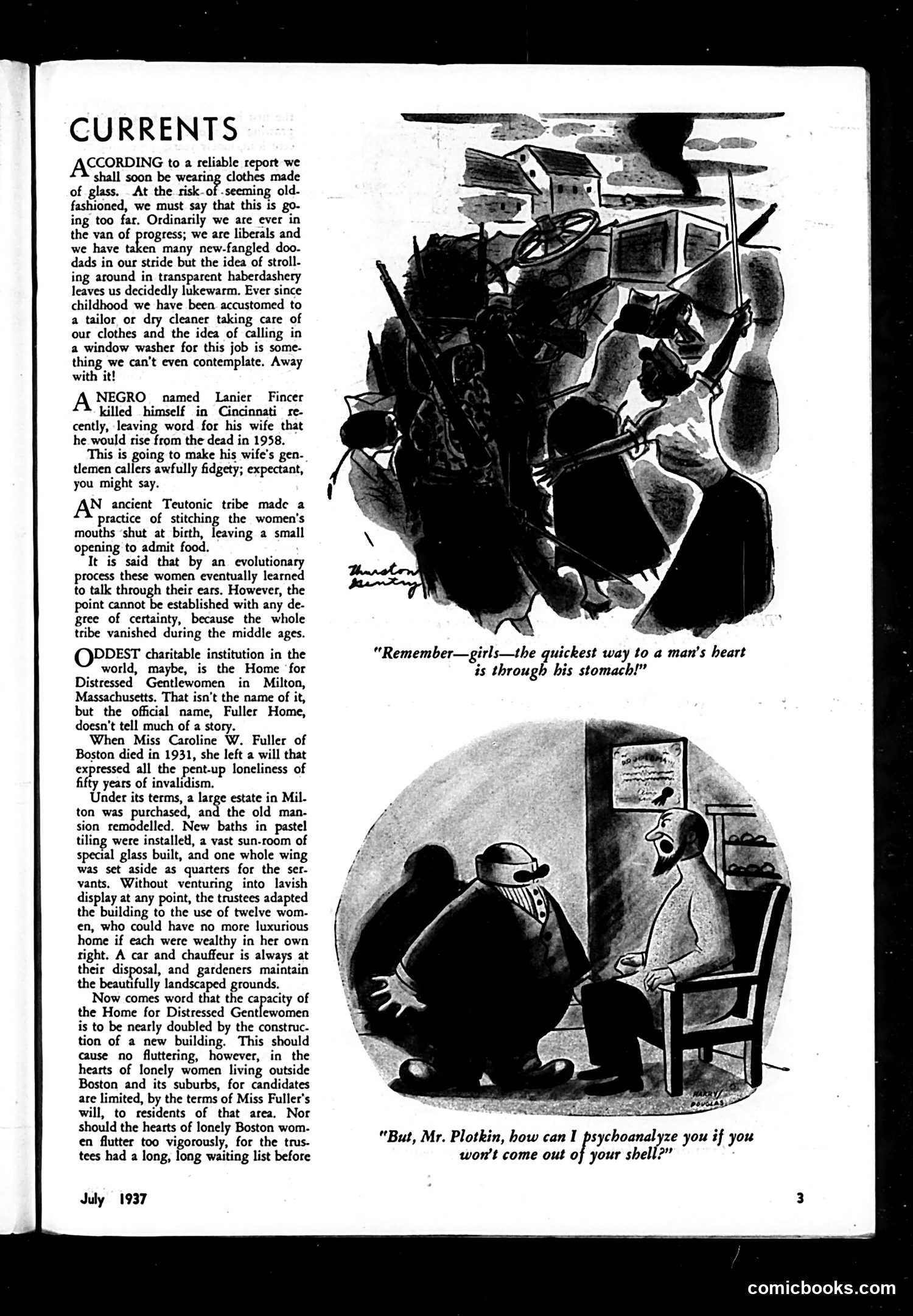
# Judge Magazine Page Analysis (July 1937) This page contains a "Currents" column of short satirical items plus two cartoon illustrations. The top cartoon depicts a car crash with the caption "Remember—girls—the quickest way to a man's heart is through his stomach!" This appears to satirize both dating advice clichés and dangerous driving. The bottom cartoon shows a man reluctant to leave his chair, captioned "But, Mr. Plotkin, how can I psychoanalyze you if you won't come out of your shelf?" This mocks both psychoanalysis (then a fashionable but suspect practice) and a man's laziness. The "Currents" column includes brief items on glass clothing, a suicide note, ancient tribal practices, and a Boston charitable home for distressed gentlewomen—miscellaneous social commentary typical of the magazine's satirical approach.
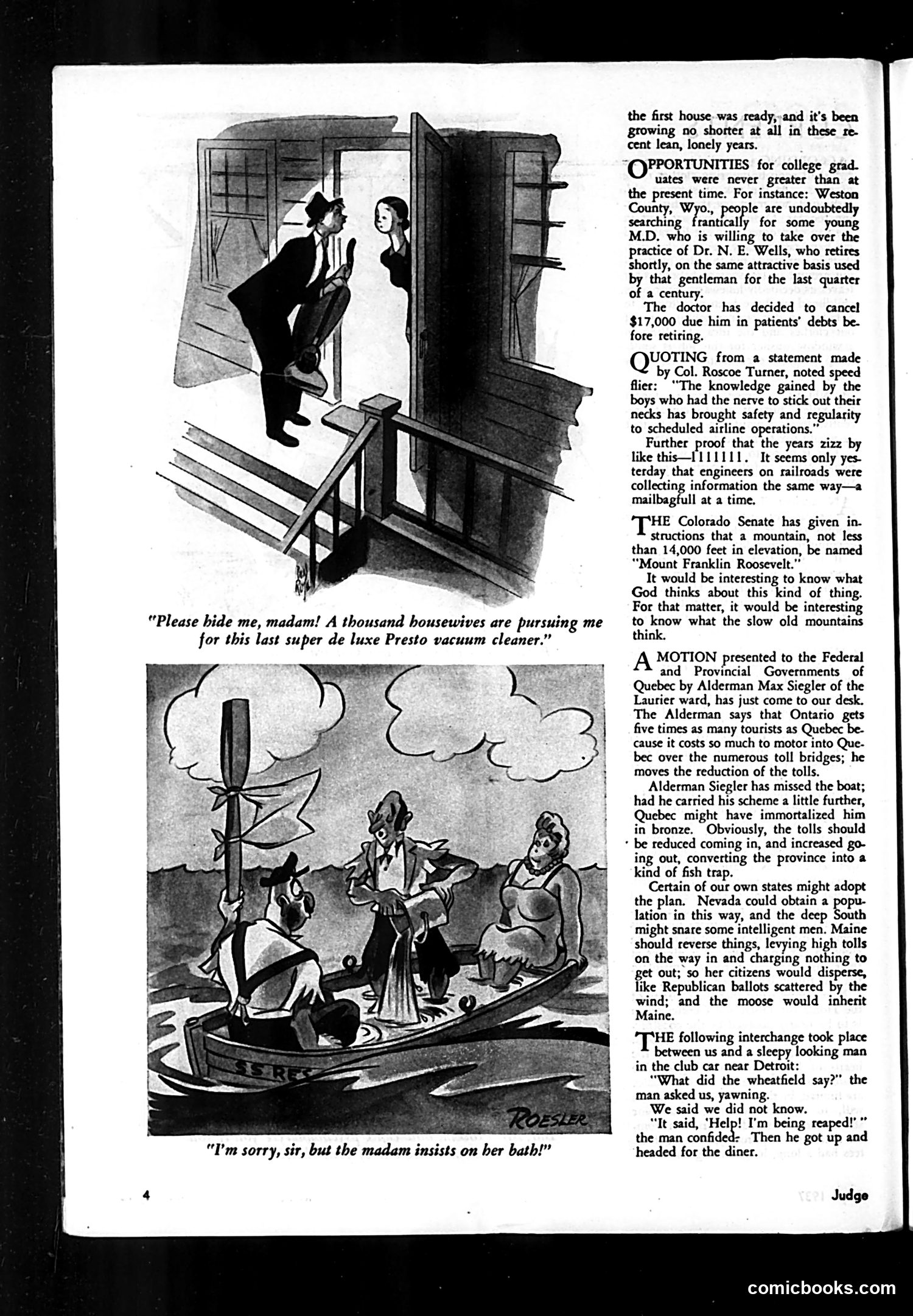
# Analysis of Judge Magazine Page This page contains two cartoons and satirical commentary from an early 20th-century American humor magazine. **Top cartoon**: A man in formal dress hides from a woman, with caption "Please hide me, madam! A thousand housewives are pursuing me for this last super de luxe Presto vacuum cleaner." This satirizes the commercial craze for a popular new vacuum cleaner model—suggesting it's so desirable that even one remaining unit creates a frenzied mob of housewives. **Bottom cartoon**: Shows people in a boat amid clouds, captioned "I'm sorry, sir, but the madam insists on her bath!" This appears to mock wealthy travelers' excessive demands for luxury amenities during leisure activities. The right column contains miscellaneous satirical commentary on contemporary topics: doctor shortages, aviation safety, and a humorous anecdote about a sleepy man mishearing "wheatfield" as "Help! I'm being reaped!"
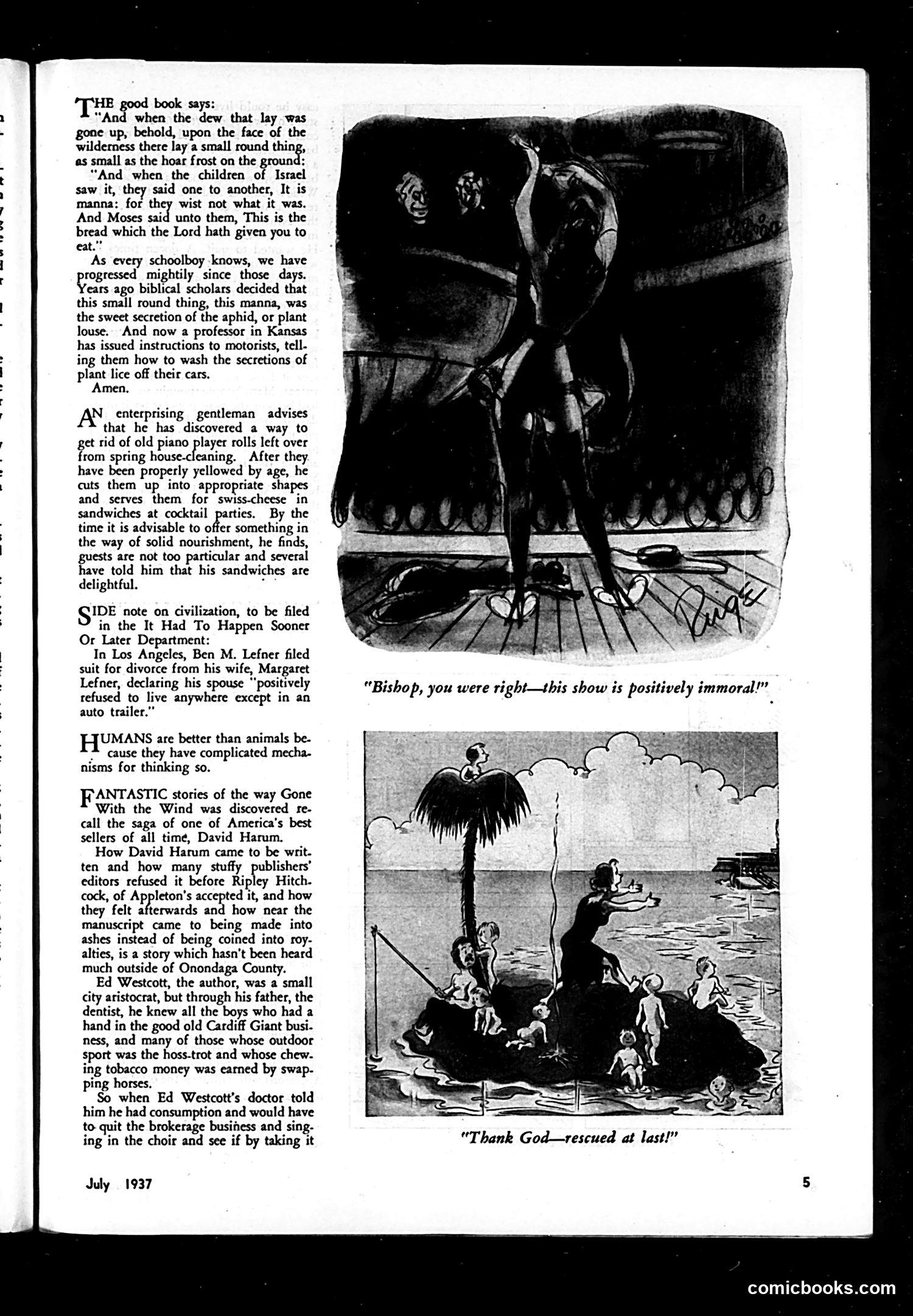
# Analysis of Judge Magazine Page (July 1937) This page contains three separate pieces of satirical content: 1. **Top illustration**: Shows what appears to be a theatrical or musical performance scene with the caption "Bishop, you were right—this show is positively immoral!" The satire likely mocks either censorious religious figures or heated cultural debates about entertainment standards in the 1930s. 2. **Bottom illustration**: Depicts a rescue scene with the caption "Thank God—rescued at last!" The context is unclear from the image alone, though it may reference a contemporary news event or satirize sensationalized rescue narratives. 3. **Text sections**: Include humorous anecdotes about manna identification, piano player disposal tips, and the publication history of "Gone with the Wind." These mock pseudoscientific claims and publishing industry tribulations of the era. The overall tone is light satirical humor rather than hard political commentary.
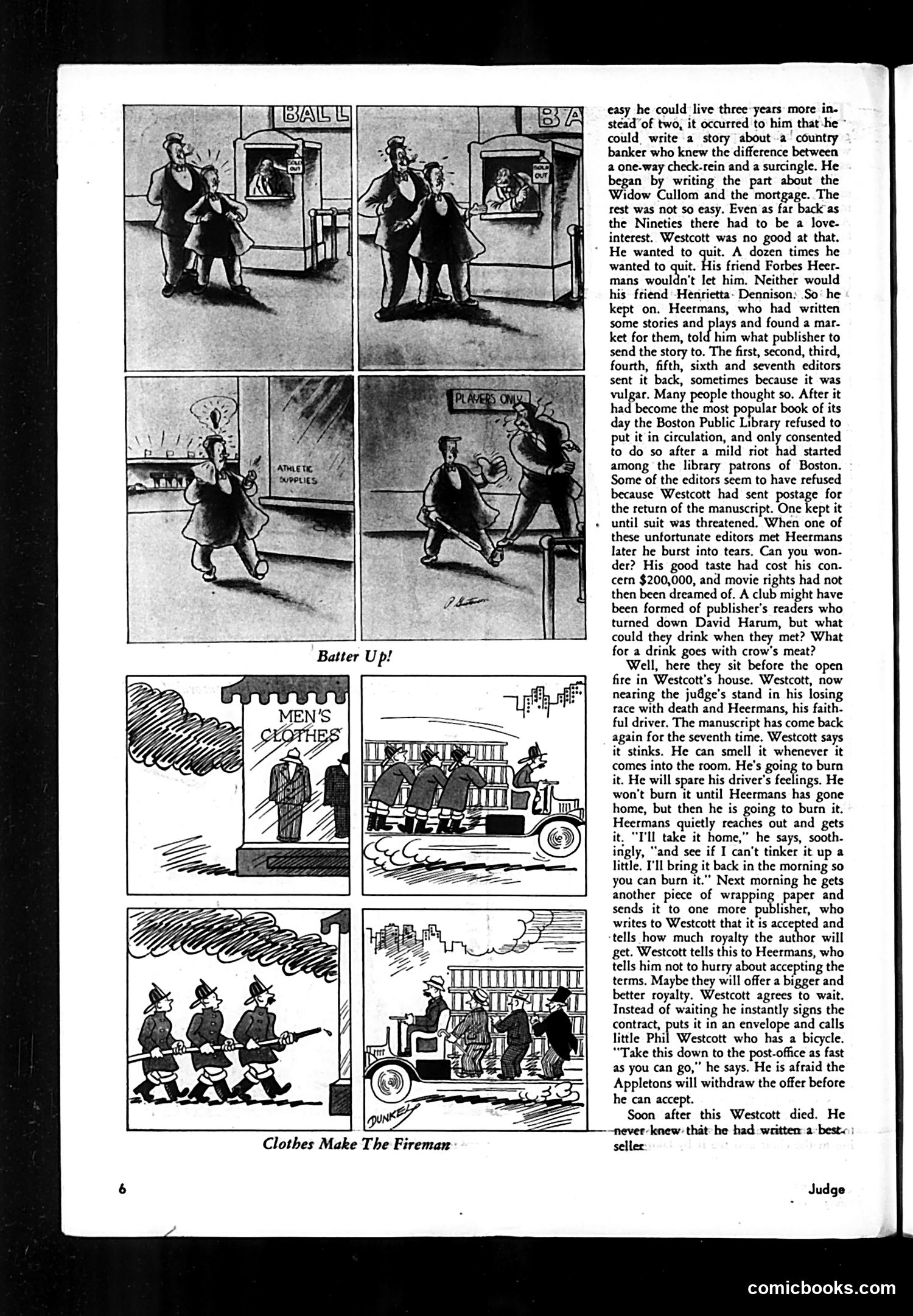
# Analysis of "Batter Up!" and "Clothes Make The Fireman" This page contains two sequential comic strips satirizing American publishing and commercial life, likely from the 1920s-30s based on style. "Batter Up!" follows a struggling writer named Westcott whose manuscript gets rejected repeatedly by seven editors. The satire mocks the publishing industry's indifference—editors lose or ignore his work, one publisher demands payment for return postage. Eventually Westcott's house catches fire; his loyal friend Heermans retrieves the manuscript from the flames. The irony: after this dramatic rescue, a publisher finally accepts it, though Westcott dies before learning of his success. The cartoon satirizes how commercial success requires luck or tragedy rather than merit. "Clothes Make The Fireman" (bottom) appears to show firefighters or emergency workers, likely making a visual pun about uniforms conferring authority or identity—though the specific narrative is unclear from this page fragment.
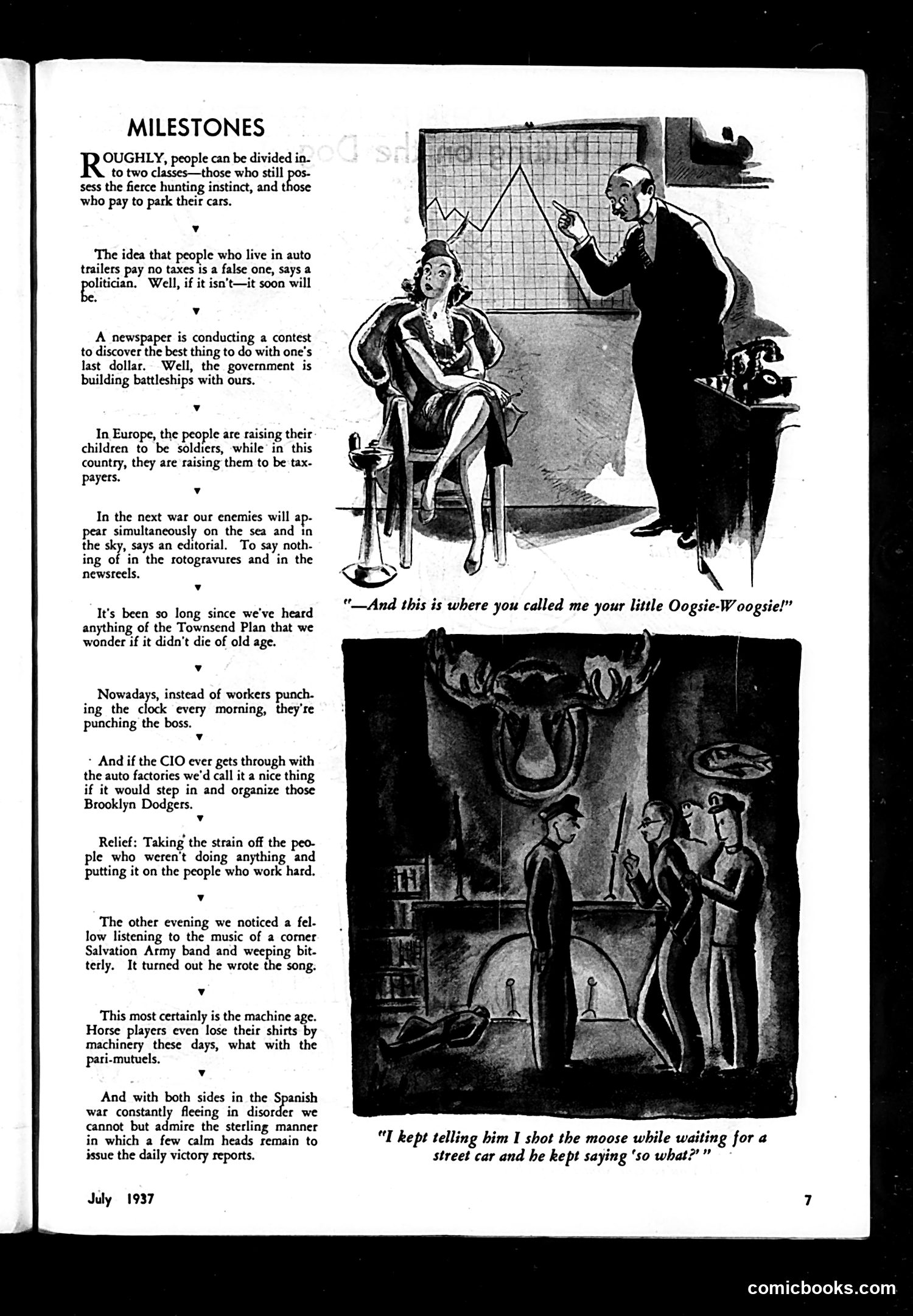
# "Milestones" Satire - Judge Magazine, July 1937 This page collects brief satirical observations on contemporary issues. The top cartoon shows a man pointing at an economic chart while a woman sits nearby, captioned "And this is where you called me your little Oogie-Woogie!" - likely satirizing how economic depression has affected romantic relationships or domestic situations. The bottom cartoon depicts what appears to be a Salvation Army scene with the caption about shooting a moose while waiting for a streetcar - absurdist humor mocking tall tales or exaggeration. The "Milestones" section itself critiques 1937 concerns: auto trailers evading taxes, government spending on battleships, European militarization versus American taxation, potential warfare, the failed Townsend Plan (elderly pension proposal), labor unrest, and the Spanish Civil War's chaotic reporting. The satire targets political hypocrisy and economic inequality of Depression-era America.
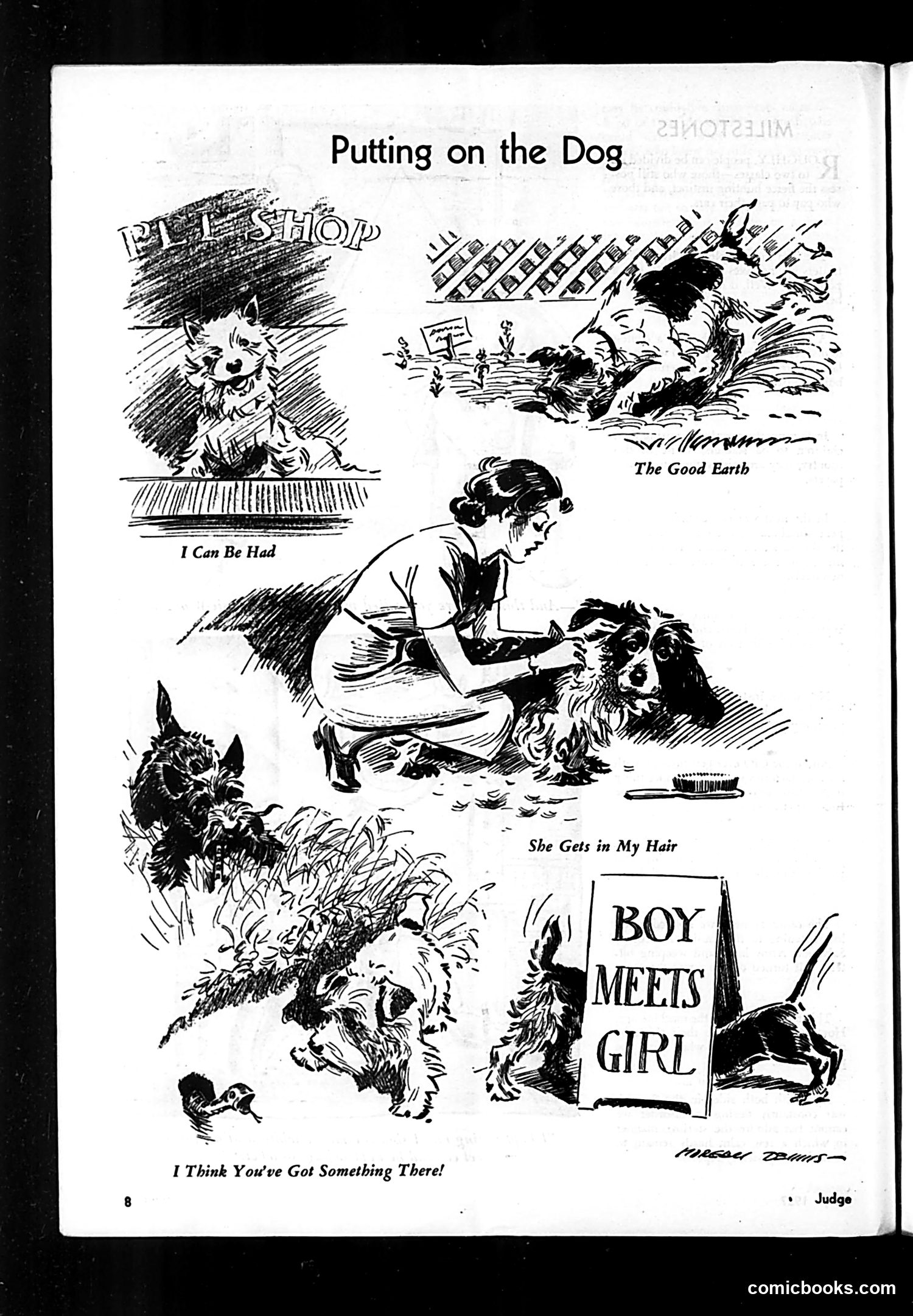
# "Putting on the Dog" This page presents a series of humorous illustrations about dog grooming and pet care, using the idiom "putting on the dog" (meaning to dress up or show off). The cartoons depict: - A dog at a pet shop ("I Can Be Had") - A child getting dirty with a dog ("The Good Earth") - A woman grooming a dog's fur ("She Gets in My Hair") - Dogs meeting near a "Boy Meets Girl" sign The humor relies on visual puns and double meanings—treating dog care activities as if they were human social situations. The final panel's "I Think You've Got Something There!" suggests the dogs have mud or dirt on them, playing on the messy reality of pet ownership versus the idealized notion of "putting on" a well-groomed appearance. This is straightforward domestic humor without political satire, typical of Judge's lighter entertainment content.
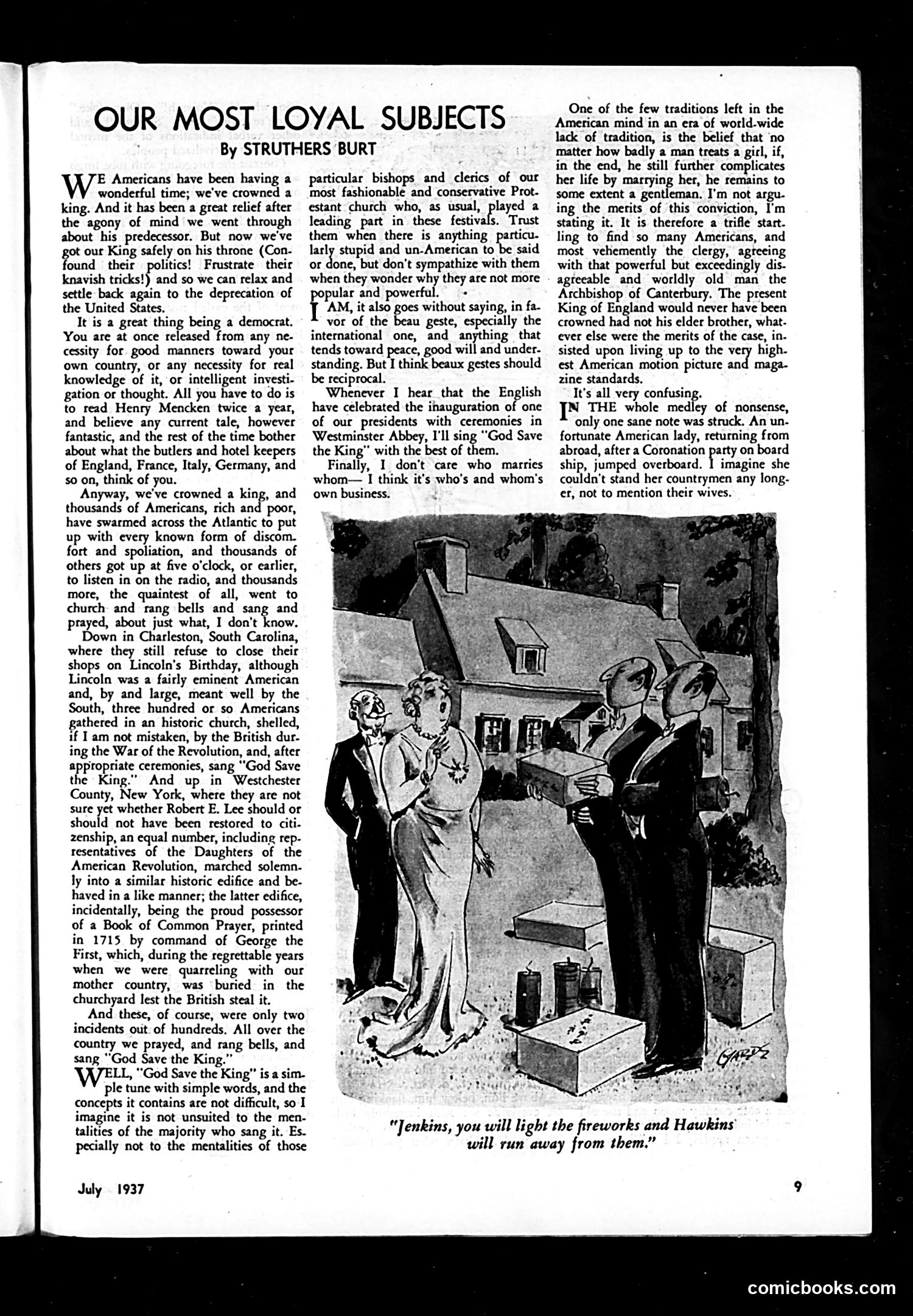
# Analysis of Judge Magazine, July 1937 **The Article's Satire:** Struthers Burt's essay mocks Americans who participated in elaborate ceremonies celebrating the British coronation (likely Edward VIII's abdication crisis and George VI's coronation in 1937). Burt sarcastically criticizes the hypocrisy of patriotic Americans—including Daughters of the American Revolution—traveling to England or holding ceremonial services while routinely denigrating their own country. He notes with contempt that Charleston refused to honor Lincoln's birthday yet gathered to sing "God Save the King," and that New Yorkers questioned Robert E. Lee's citizenship while reverencing British traditions. **The Cartoon:** The accompanying illustration shows what appears to be a woman in formal dress nervously clutching a man's arm as they encounter what seem to be officials or authorities (the "Jenkins" and "Hawkins" referenced). The caption suggests anxious anticipation of fireworks—a visual pun on explosive social consequences. **The Point:** Burt argues such gestures are meaningless unless reciprocal, ultimately suggesting these Americans are absurdly obsequious toward Britain while neglecting their own nation's dignity.
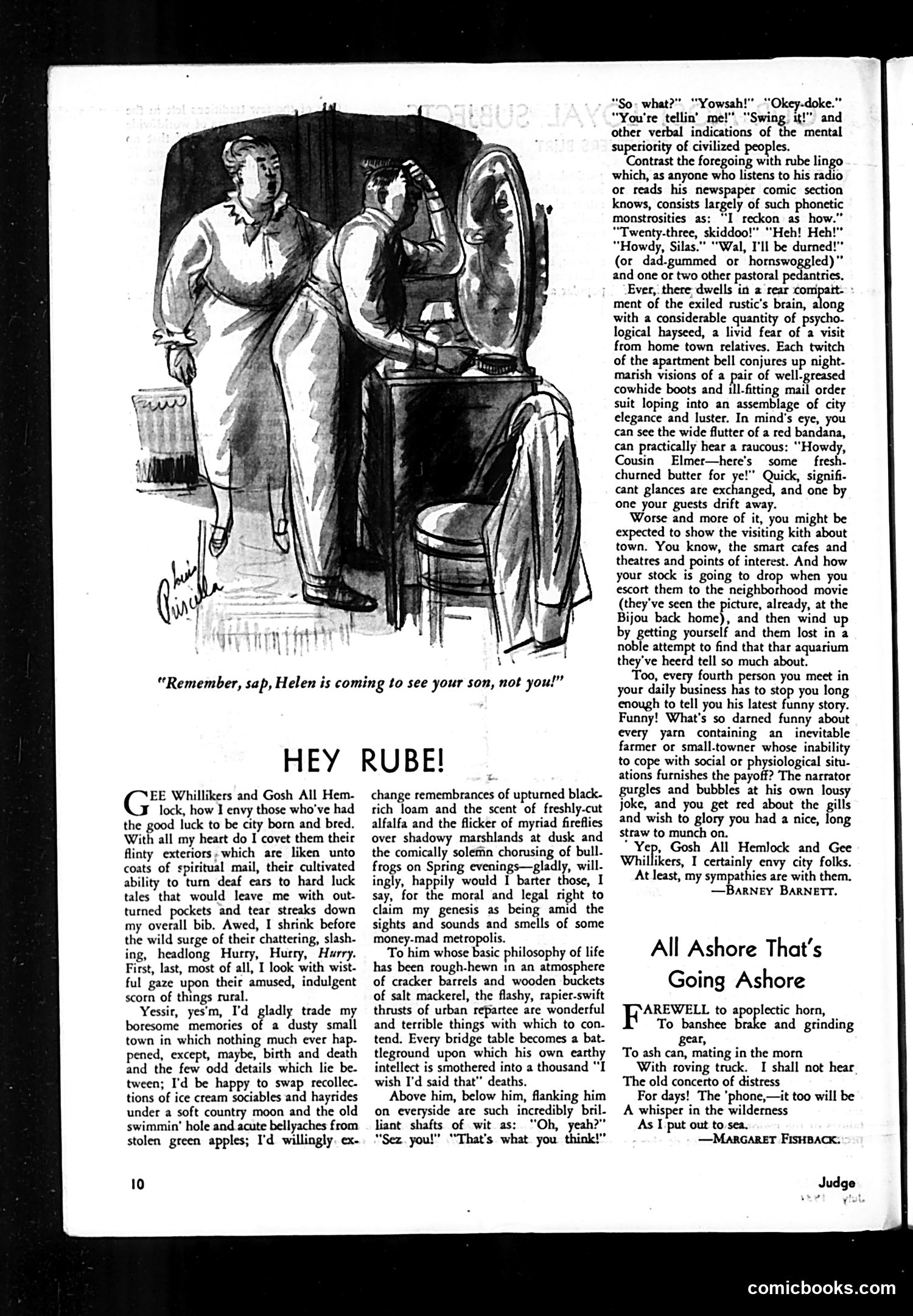
# "Hey Rube!" - A City-Dweller's Anxiety About Rural Relatives This humorous essay, illustrated with a sketch of a visitor meeting a nervous host, satirizes the social embarrassment urban dwellers experience when rural relatives visit. The piece contrasts "city wit"—rapid-fire slang like "Oh yeah?" and "That's what you think!"—with rural speech patterns ("I reckon," "Howdy Silas," "dad-gummed"). The author, writing from a small-town perspective, ironically claims to admire city sophistication while revealing the real fear: that visiting country relatives will embarrass him before his urban friends through their unsophisticated manners, appearance (greased boots, mail-order suits, red bandanas), and behavior. The cartoon caption ("Remember, sap, Helen is coming to see your son, not you!") drives home the point—the protagonist's anxiety about impression-management is self-centered; guests care about the younger generation, not his social standing. This reflects 1920s-30s anxieties about rural-urban cultural divisions in America.