
Judge, 1937-07 · page 8 of 37
Judge — July 1937 — page 8: what you’re looking at
What you’re looking at
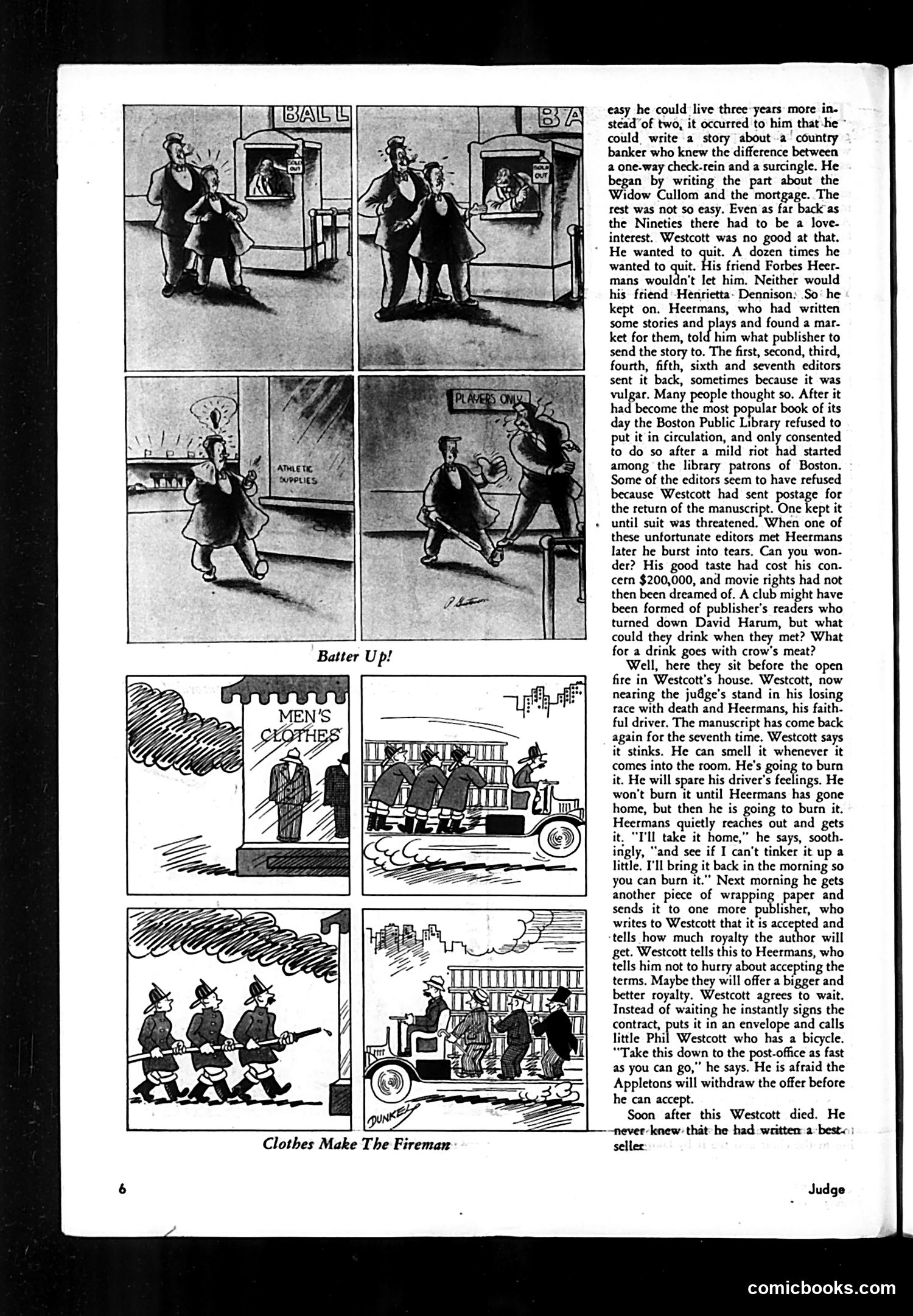
# Analysis of "Batter Up!" and "Clothes Make The Fireman" This page contains two sequential comic strips satirizing American publishing and commercial life, likely from the 1920s-30s based on style. "Batter Up!" follows a struggling writer named Westcott whose manuscript gets rejected repeatedly by seven editors. The satire mocks the publishing industry's indifference—editors lose or ignore his work, one publisher demands payment for return postage. Eventually Westcott's house catches fire; his loyal friend Heermans retrieves the manuscript from the flames. The irony: after this dramatic rescue, a publisher finally accepts it, though Westcott dies before learning of his success. The cartoon satirizes how commercial success requires luck or tragedy rather than merit. "Clothes Make The Fireman" (bottom) appears to show firefighters or emergency workers, likely making a visual pun about uniforms conferring authority or identity—though the specific narrative is unclear from this page fragment.
📄 Transcribed text from this page (OCR, searchable)
Machine-transcribed from the original scan — historical spelling and the odd misread are preserved.
easy he could live three-years more in- stéad”of two, it occurred to him that -he ~ could write a story about a country banker who knew the difference between a one-way check-rein and a surcingle. He began by writing the part about the Widow Cullom and the mortgage. The rest was not so easy. Even as far back as the Nineties there had to be a love- interest. Westcott was no good at that. * He wanted to quit. A dozen times he wanted to quit. His friend Forbes Heer- mans wouldn't let him. Neither would his friend -Henrietta- Dennison: So‘ he kept on. Heermans, who had written some stories and plays and found a mar- ket for them, told him what publisher to send the story to. The first, second, third, fourth, fifth, sixth and seventh editors sent it back, sometimes because it was vulgar. Many people thought so. After it had become the most popular book of its day the Boston Public Library refused to put it in circulation, and only consented to do so after a mild riot had started among the library patrons of Boston. Some of the editors seem to have refused because Westcott had sent postage for the return of the manuscript. One kept it until suit was threatened. When one of these unfortunate editors met Heermans later he burst into tears. Can you won- der? His good taste had cost his con- cern $200,000, and movie rights had not then been dreamed of. A club might have been formed of publisher's readers who turned down David Harum, but what could they drink when they met? What for a drink goes with crow’s meat? Well, here they sit before the open fire in Westcott’s house. Westcott, now nearing the ju@ge’s stand in his losing race with death and Heermans, his faith. ful driver. The manuscript has come back again for the seventh time. Westcott says it stinks. He can smell it whenever it comes into the room. He's going to burn it. He will spare his driver's feelings. He won't burn it until Heermans has gone home, but then he is going to burn it. Heermans quietly reaches out and gets it, “I'll take it home,” he says, sooth. ingly, “and see if I can't tinker it up a little. I'll bring it back in the morning so you can burn it.” Next morning he gets another piece of wrapping paper and sends it to one more publisher, who writes to Westcott that it is accepted and tells how much royalty the author will get. Westcott tells this to Heermans, who tells him not to hurry about accepting the TH LOTT terms. Maybe they will offer a bigger and Zh TRS TT BAT better royalty. Westcott agrees to wait. fe IBoete dl Instead of waiting he instantly signs the eet iT contract, pots it in an envelope and calls ia little Phil Westcott who has a bicycle. “Take this down to the post-office as fast as you can go,” he says. He is afraid the Appletons will withdraw the offer before he can accept. Soon after this Westcott died. He —never-knew: that: he had written: a-best« | Clothes Make The Fireman seller Judge comicbooks.com