
Judge, 1937-07 · page 18 of 37
Judge — July 1937 — page 18: what you’re looking at
A restored page from Judge, 1937-07. Page through the whole issue in the reader above.
📄 Transcribed text from this page (OCR, searchable)
Machine-transcribed from the original scan — historical spelling and the odd misread are preserved.
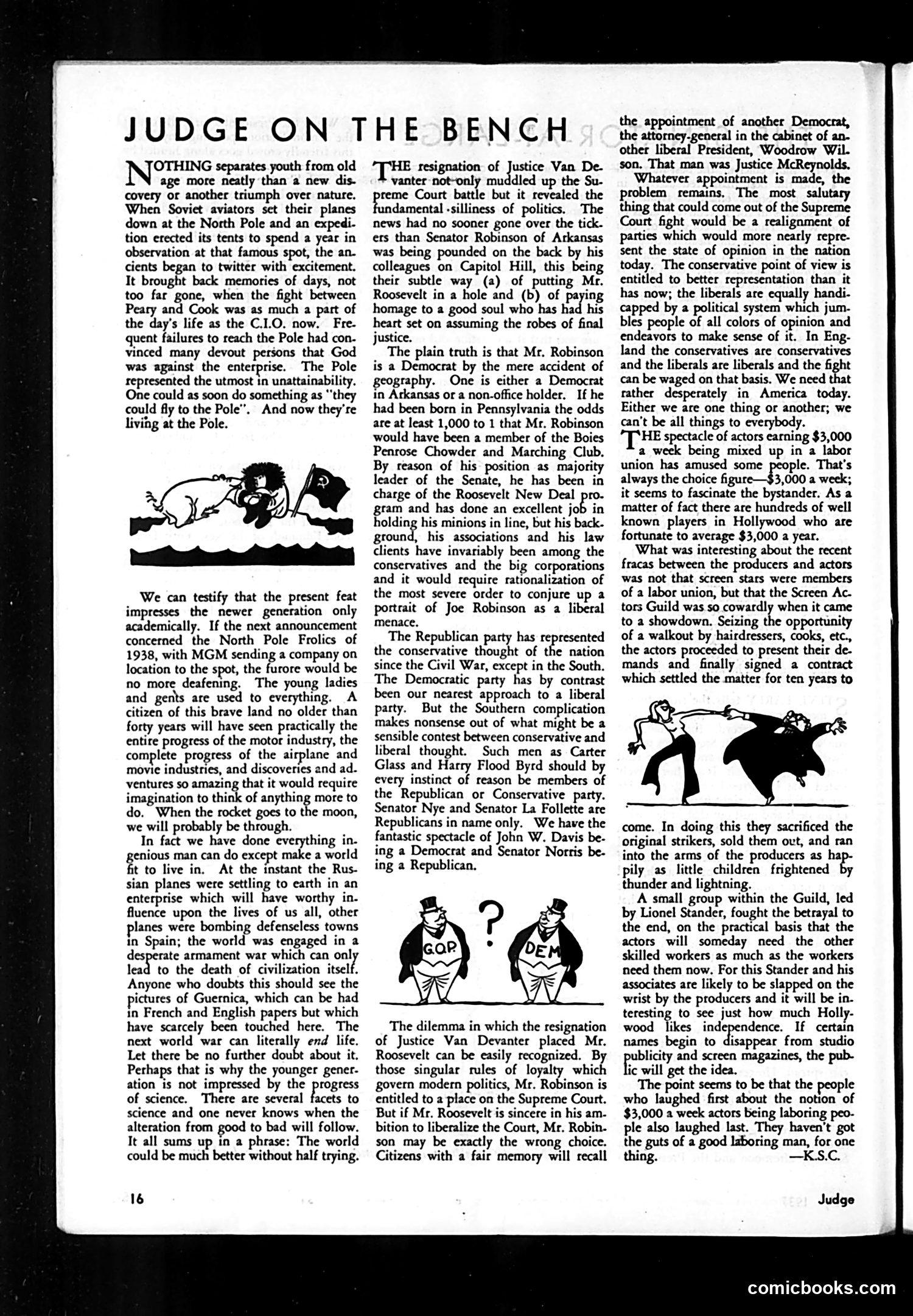
JUDGE ON THE BENCH OTHING separates youth from old ING oes ty deere oer covery or another triumph over nature. When Soviet aviators set their planes down at the North Pole and an expedi- tion erected its tents to spend a year in observation at that famous spot, the an. cients began to twitter with excitement. Tt brought back memories of days, not too far gone, when the fight between Peary and Cook was as much a part of the day's life as the C.1.O. now. Fre. quent failures to reach the Pole had con. vinced many devout persons that God was against the enterprise. The Pole represented the utmost in unattainability. One could as soon do something as “they could fly to the Pole”. And now they're living at the Pole. x fai al We can testify that the present feat impresses the newer generation only academically. If the next announcement concerned the North Pole Frolics of 1938, with MGM sending a company on location to the spot, the furore would be no more deafening. The young ladies and gents are used to everything. A citizen of this brave land no older than forty years will have seen practically the entire progress of the motor industry, the complete progress of the airplane and movie industries, and discoveries and ad. ventures so amazing that it would require imagination to think of anything more to do. When the rocket goes to the moon, we will probably be through. In fact we have done everything in- genious man can do except make a world fit to live in. At the instant the Rus- sian planes were settling to earth in an enterprise which will have worthy in. fluence upon the lives of us all, other planes were bombing defenseless towns in Spain; the world was engaged in a desperate armament war which can onl: lead to the death of civilization itself. Anyone who doubts this should see the ictures of Guernica, which can be had in French and English papers but which have scarcely been touched here. The next world war can literally end life. Let there be no further doubt about it. Perhaps that is why the younger gener- ation is not impressed by the progress of science. There are several facets to science and one never knows when the alteration from to bad will follow. Tt all sums up in a phrase: The world could be much better without half trying. 16 resignation of Justice Van De. vanter-not-only muddled up the Su- reme Court battle but it revealed the damental -silliness of politics. The news had no sooner gone over the tick. ers than Senator Robinson of Arkansas was being pounded on the back by his colleagues on Capitol Hill, this being their subtle way (a) of putting Mr. Roosevelt in a hole and (b) of paying homage to a good soul who has thd his heart set on assuming the robes of final justice. The plain truth is that Mr. Robinson is a Democrat by the mere accident of geography. One is either a Democrat in Arkansas or a non-office holder. If he had been born in Pennsylvania the odds are at least 1,000 to 1 that Mr. Robinson would have been a member of the Boies Penrose Chowder and Marching Club. By reason of his position as majority leader of the Senate, he has been in charge of the Roosevelt New Deal pro. gram and has done an excellent job in holding his minions in line, but his back- ground, his associations and his law clients have invariably been among the conservatives and the big corporations and it would require rationalization of the most severe order to conjure up a portrait of Joe Robinson as a liberal menace. The Republican party has represented the conservative thought of the nation since the Civil War, except in the South. The Democratic party has by contrast been our nearest approach to a liberal party. But the Southern complication makes nonsense out of what might be a sensible contest between conservative and liberal thought. Such men as Carter Glass and Harry Flood Byrd should by every instinct of reason be members of the Republican or Conservative party. Senator Nye and Senator La Follette are Republicans in name only. We have the fantastic spectacle of John W. Davis be- ing a Democrat and Senator Norris be- ing a Republican. The dilemma in which the resignation of Justice Van Devanter placed Mr. Roosevelt can be easily recognized. B those singular rules of loyalty which govern modern politics, Mr. Robinson is entitled to 2 place on the Supreme Court. But if Mr. Roosevelt is sincere in his am. bition to liberalize the Court, Mr. Robin. son may be exactly the wrong choice. Citizens with a fair memory will recall the appointment of another Democrat, the attorney-general in the cabinet of an- other liberal President, Woodrow Wil. son. That man was Justice McReynolds. Whatever appointment is made, the problem remains, The most salutary thing that could come out of the Supreme Court fight would be a realignment of parties which would more nearly repre- sent the state of opinion in the nation today. The conservative point of view is entitled to better representation than it has now; the liberals are ly handi- capped by a political system which jum- bles people of all colors of opinion and endeavors to make sense of it. In Eng- land the conservatives are conservatives and the liberals are liberals and the fight can be waged on that basis. We need that rather desperately in America today. Either we are one thing or another; we can't be all things to everybody. ‘THE spectacle of actors earning $3,000 a week being mixed up in a labor union has amused some people. That's always the choice figure-$3,000 a week; it seems to fascinate the bystander. As a matter of fact there are hundreds of well known players in Hollywood who are fortunate to average $3,000 a year. What was interesting about the recent fracas between the producers and actors was not that screen stars were members of a labor union, but that the Screen Ac- tors Guild was so cowardly when it came to a showdown. Seizing the opportunity of a walkout by hairdressers, cooks, etc., the actors proceeded to present their de- mands and finally signed a contract which settled the matter for ten years to come. In doing this they sacrificed the original strikers, sold them ovt, and ran into the arms of the producers as nap pily as little children frightened by thunder and lightning. A small group within the Guild, led by Lionel Stander, fought the betrayal to the end, on the practical basis that the actors will someday need the other skilled workers as much as the workers need them now. For this Stander and his associates are likely to be slapped on the wrist by the producers and it will be in. teresting to see just how much Holly- wood likes independence. If certain names begin to disappear from studio licity and screen magazines, the pub- ic will get the idea. The point seems to be that the people who laughed first about the notion of $3,000 a week actors being laboring peo- ple also laughed last. They haven't got the guts of a good laboring man, for one thing. —KS.C. Judge comicbooks.com