
Judge, 1937-07 · page 22 of 37
Judge — July 1937 — page 22: what you’re looking at
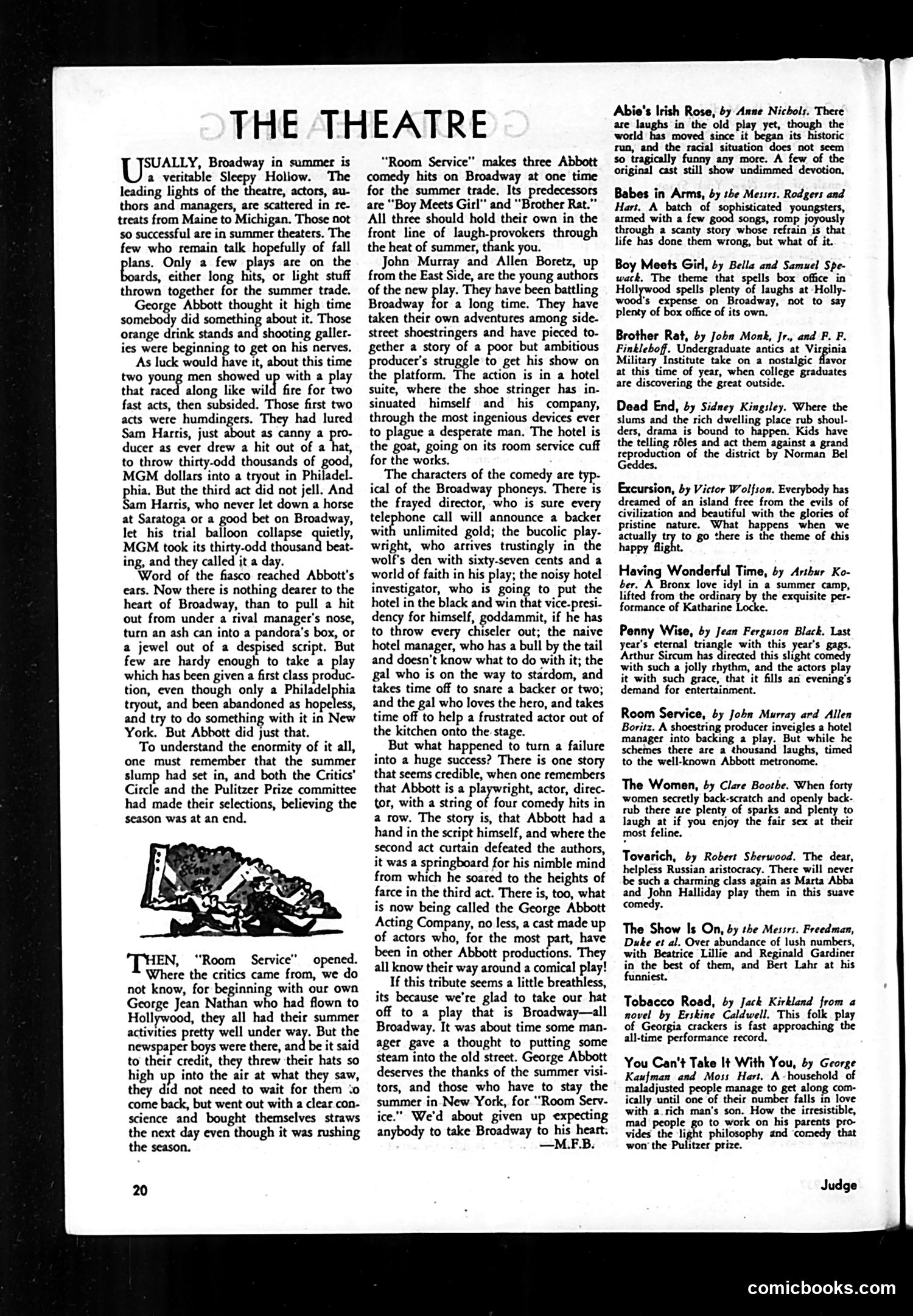
A restored page from Judge, 1937-07. Page through the whole issue in the reader above.
📄 Transcribed text from this page (OCR, searchable)
Machine-transcribed from the original scan — historical spelling and the odd misread are preserved.
THE THEATRE SUALLY, Broadway in summer is a veritable Sleepy Holiow. The leading lights of the theatre, actors, au- thors and managers, are scattered in re- treats from Maine to Michigan. Those not so successful are in summer theaters. The few who remain talk hopefully of fall lans. Only a few plays are on the Poards, either long hits, or light stuff thrown together for the summer trade. George Abbott thought it high time somebody did something about it. Those orange drink stands and shooting galler- ies were beginning to get on his nerves. As luck would have it, about this time two young men showed up with a play that raced along like wild fire for two fast acts, then subsided. Those first two acts were humdingers. They had lured Sam Harris, just ut as canny a pre: ducer as ever drew a hit out of a hat, to throw thirty-odd thousands of good, MGM dollars into a tryout in Philadel. phia. But the third act did not jell. And Sam Harris, who never let down a horse at Saratoga or a good bet on Broadway, let his trial balloon collapse quietly, MGM took its thirty-odd thousand beat- ing, and they called it a day. Word of the fiasco reached Abbott's ears. Now there is nothing dearer to the heart of Broadway, than to pull a hit out from under a rival manager's nose, turn an ash can into a pandora’s box, or a jewel out of a despised script. But few are hardy enough to take a play which has been given a first class produc. tion, even though only a Philadelphia tryout, and been abandoned as hopeless, and try to do something with it in New York. But Abbott did just that. To understand the enormity of it all, one must remember that the summer slump had set in, and both the Critics’ Circle and the Pulitzer Prize committee had made their selections, believing the season was at an end. EN, “Room Service” opened. Where the critics came from, we do not know, for beginning with our own George Jean Nathan who had flown to Hollywood, they all had their summer activities pretty well under way. But the newspaper boys were there, and be it said to their credit, they threw their hats so high up into the air at what they saw, they did not need to wait for them ‘o come back, but went out with a clear con- science and bought themselves straws the next day even though it was rushing the season. 20 “Room Service"? makes three Abbott comedy hits on Broadway at one time for the summer trade. Its predecessors are “Boy Meets Girl” and “Brother Rat.”” All three should hold their own in the front line of laugh-provokers through the heat of summer, thank you. John Murray and Allen Boretz, up from the East Side, are the young authors of the new play. They have been battling Broadway for a long time. They have taken their own adventures among side- street shoestringers and have pieced to- gether a story of a poor but ambitious producer’s struggle to get his show on the platform. The action is in a hotel suite, where the shoe stringer has in- sinuated himself and his company, through the most ingenious devices ever to plague a desperate man. The hotel is the goat, going on its room service cuff for the works. The characters of the comedy are typ- ical of the Broadway phoneys. There is the frayed director, who is sure every telephone call will announce a backer with unlimited gold; the bucolic play- wright, who arrives trustingly in the wolf's den with sixty-seven cents and a world of faith in his play; the noisy hotel investigator, who is going to put the hotel in the black and win that vice-presi- dency for himself, goddammit, if he has to throw every chiseler out; the naive hotel manager, who has a bull by the tail and doesn’t know what to do with it; the gal who is on the way to stardom, and takes time off to snare a backer or two; and the gal who loves the hero, and takes time off to help a frustrated actor out of the kitchen onto the. stage. But what happened to turn a failure into a huge success? There is one story that seems credible, when one remembers that Abbott is a playwright, actor, direc- tor, with a string of four comedy hits in a row. The story is, that Abbott had a hand in the script himself, and where the second act curtain defeated the authors, it was a springboard for his nimble mind from which he soared to the heights of farce in the third act. There is, too, what is now being called the George Abbott Acting Company, no less, a cast made up of actors who, for the most part, have been in other Abbott productions. They all know their way around a comical play! If this tribute seems a little breathless, its because we're glad to take our hat off to a play that is Broadway—all Broadway. It was about time some man- ager gave a thought to putting some steam into the old street. George Abbott deserves the thanks of the summer visi- tors, and those who have to stay the summer in-New York, for “Room Serv- ice.” We'd about given up expecting anybody to take Broadway to re 's Irish Rose, by Anne Nichols. There in the old play yet, though the moved since it began its historic So tragically any more. A few of original cast still show undimmed devotion. Babes in Arms, by the Messrs. Rodgers and Hart, A batch of sophisticated youngsters, songs, romp joyously through a scanty story whose refrain is that life has done them wrong, but what of it. Boy Meets Girl, by Bella and Samuel Spe- wack. The theme that spells box office in Hollywood spells plenty of laughs at -Holly- 's expense on Broadway, not to say plenty of box office of its own. Brother Rat, by Joba Monk, Jr., and P. P. Finkleboff. Undergraduate antics at Virginia Military Institute take on a nostalgic dese at this time of year, when college graduates are discovering the great outside. Dead End, by Sidney Kingsley. Where the slums and the rich dwelling place rub shoul- ders, drama is bound to happen. Kids have the telling réles and act them against a grand reproduction of the district by Norman Bel Geddes. Excursion, by Victor Wolfson. Everybody has dreamed of an island free from the evils of civilization and beautiful with the glories of pristine nature. What happens when we actually try to go there is the theme of this happy flight. Having Wonderful Time, by Arthur Ko- fee Broan love dart fa eases camp, ifted from ordi exquisite per- formance of Katharine Locke. ™ Ee Penny Wise, by Jean Ferguson Black. Last year's eternal triangle with this year's gags. Arthur Sircum has directed this slight comedy with such a jolly rhythm, and the actors play it with such grace, that it fills an evening's demand for entertainment. Room Service, by John Murray ard Allen Boritz. A shoestring producer inveigles a hotel manager into backing a play. But while he schemes there are a thousand laughs, timed to the well-known Abbott metronome. The Women, by Clare Boothe. When forty women secretly back-scratch and openly back- rub there are plenty of sparks plenty to laugh at if you enjoy the fair sex at their most feline. Tovarich, by Robert Sherwood. The dear, helpless Russian aristocracy. There will never be such a charming class again as Marta Abba and John Halliday play them in this suave comedy. The Show Is On, by the Messrs. Freedman, Duke et al. Over abundance of lush numbers, with Beatrice Lillie and Reginald Gardiner in the best of them, and Bert Lahr at his funniest. Tobacco Road, by Jack Kirkland from a novel by Erskine Caldwell. This folk play of Georgia crackers is fast approaching the all-time performance record. You Can't Take It With You, by George Kexines saad Mess Hart. A bouschotd of maladjusted people manage to get along com- ically ‘until ‘one of their number falls A love with a.rich man’s soar How the irresistible, mad people to work on his parents pro- vides the Tight philosophy and ‘comedy that won’ the Pulitzer prize. Judge comicbooks.com