
Judge, 1937-07 · page 12 of 37
Judge — July 1937 — page 12: what you’re looking at
What you’re looking at
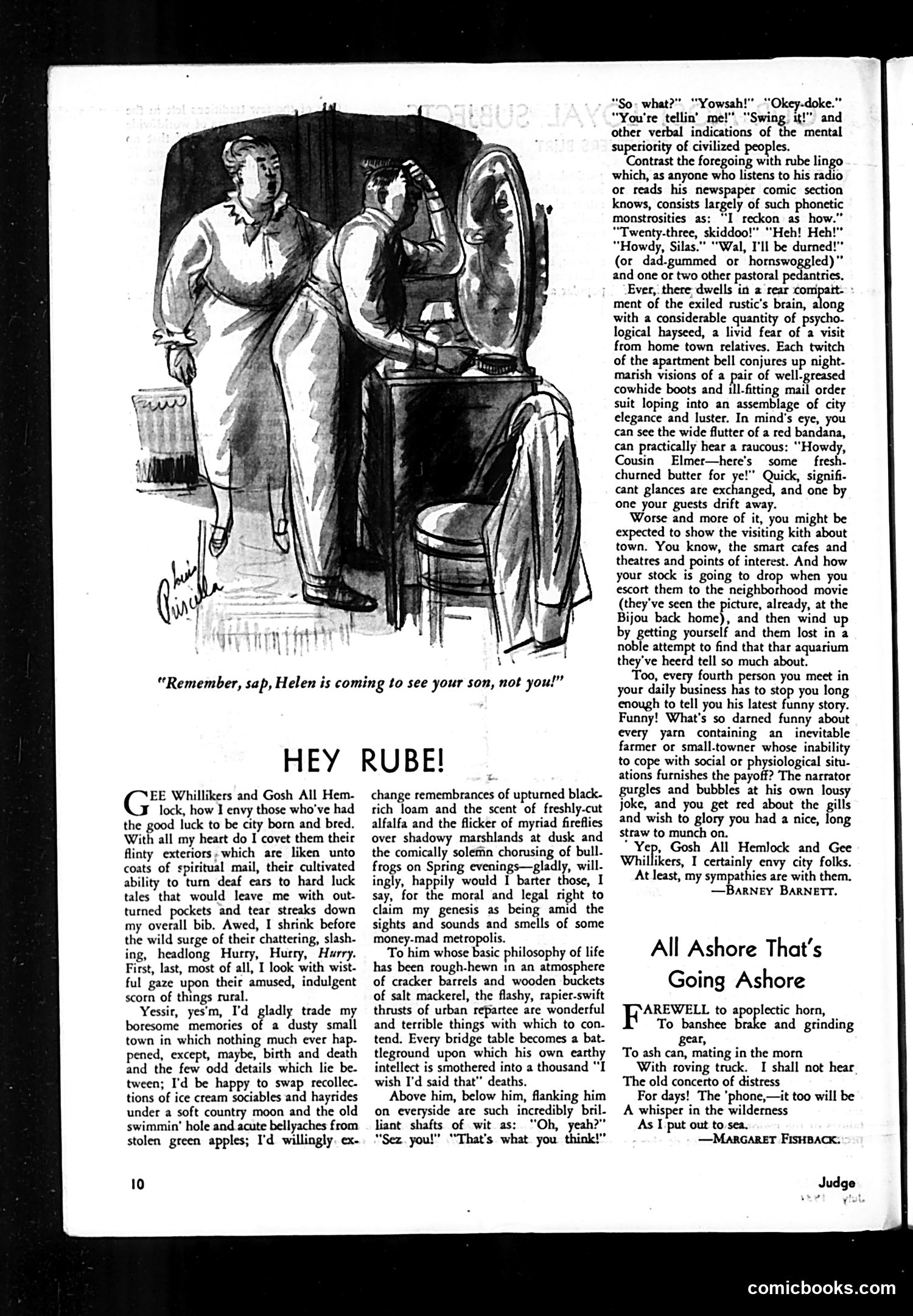
# "Hey Rube!" - A City-Dweller's Anxiety About Rural Relatives This humorous essay, illustrated with a sketch of a visitor meeting a nervous host, satirizes the social embarrassment urban dwellers experience when rural relatives visit. The piece contrasts "city wit"—rapid-fire slang like "Oh yeah?" and "That's what you think!"—with rural speech patterns ("I reckon," "Howdy Silas," "dad-gummed"). The author, writing from a small-town perspective, ironically claims to admire city sophistication while revealing the real fear: that visiting country relatives will embarrass him before his urban friends through their unsophisticated manners, appearance (greased boots, mail-order suits, red bandanas), and behavior. The cartoon caption ("Remember, sap, Helen is coming to see your son, not you!") drives home the point—the protagonist's anxiety about impression-management is self-centered; guests care about the younger generation, not his social standing. This reflects 1920s-30s anxieties about rural-urban cultural divisions in America.
📄 Transcribed text from this page (OCR, searchable)
Machine-transcribed from the original scan — historical spelling and the odd misread are preserved.
“Remember, sap, Helen is coming to see your son, not you!” HEY RUBE! EE Whillikers and Gosh All Hem. lock, how I envy those who've had the good luck to be city born and bred. With all my heart do I covet them their flinty exteriors, which are liken unto coats of spiritual mail, their cultivated ability to turn deaf ears to hard luck tales that would leave me with out- turned pockets and tear streaks down my overall bib. Awed, I shrink before the wild surge of their chattering, slash. ing, headlong Hurry, Hurry, Hurry. First, last, most of all, I look with wist- ful gaze upon their amused, indulgent scorn of things rural. Yessir, yes'm, I'd gladly trade my boresome memories of a dusty small town in which nothing much ever hap- pened, except, maybe, birth and death and the few odd details which lie be- tween; I'd be happy to swap recollec. tions of ice cream sociables and hayrides under a soft country moon and the old swimmin’ hole and acute bellyaches from stolen green apples; I'd willingly. ex- 10 change remembrances of upturned black. rich loam and the scent of freshly-cut alfalfa and the flicker of myriad fireflies over shadowy marshlands at dusk and the comically solerin chorusing of bull. frogs on Spring evenings—gladly, will- ingly, happily would I barter those, I say, for the moral and legal right to claim my genesis as being amid the sights and sounds and smells of some money-mad metropolis. To him whose basic philosophy of life has been rough-hewn in an atmosphere of cracker barrels and wooden buckets of salt mackerel, the flashy, rapier-swift thrusts of urban repartee are wonderful and terrible things with which to con. tend. Every bridge table becomes a bat. tleground upon which his own earthy intellect is smothered into a thousand “I wish I'd said that” deaths. Above him, below him, flanking him on everyside are such incredibly bril- liant shafts of wit as: “Oh, yeah?” “Sez. you!” “That's what you think!” “So. what?” “Yowsah!”’ “'Okey-doke.” “You're tellin’ me!" “Swing. it!" and other verbal indications of the mental superiority of civilized peoples. Contrast the foregoing with rube lin, which, as anyone who listens to his radio or reads his newspaper comic section knows, consists largely of such phonetic monstrosities as: “I reckon as how.” “Twenty-three, skiddoo!”” ‘Heh! Heh!” “Howdy, Silas.” “Wal, I'll be durned!”* (or dad-gummed or hornswoggled)” and one or two other pastoral pedantries. Ever, there, dwells in 2 rear com; ment of the exiled rustic’s brain, along with a considerable quantity of psycho. logical hayseed, a livid fear of a visit from home town relatives. Each twitch of the apartment bell conjures up night. marish visions of a pair of well-greased cowhide boots and ill-fitting mail order suit loping into an assemblage of city elegance and luster. In mind's eye, you can see the wide flutter of a red bandana, can practically hear a raucous: “Howdy, Cousin Elmer—here’s some fresh. churned butter for ye!" Quick, signifi. cant glances are exchanged, and one by one your guests drift away. Worse and more of it, you might be expected to show the visiting kith about town. You know, the smart cafes and theatres and points of interest. And how your stock is going to drop when you escort them to the neighborhood movie (they've seen the picture, already, at the Bijou back home), and then wind up by getting yourself and them lost in a noble attempt to find that thar aquarium they've heerd tell so much about. Too, every fourth person you meet in your daily business has to stop you long enough to tell you his latest faa story. Funny! What's so darned funny about every yarn containing an_ inevitable farmer or small-towner whose inability to cope with social or physiological situ- ations furnishes the payoff? The narrator gurgles and bubbles at his own lousy joke, and you get red about the gills and wish to glory you had a nice, long straw to munch on. xep. Gosh All Hemlock and Gee Whillikers, I certainly envy city folks. At least, my sympathies are with them. —Barney BARNETT. All Ashore That's Going Ashore eee to spoplettic horn, To banshee brake and grinding r, To ash can, madag in the morn With roving truck. I shall not hear The old concerto of distress For days! The 'phone,—it too will be A whisper in the wilderness As I put out to sea. —Mancar er FisHBAck. Judge comicbooks.com