
Judge, 1937-07 · page 21 of 37
Judge — July 1937 — page 21: what you’re looking at
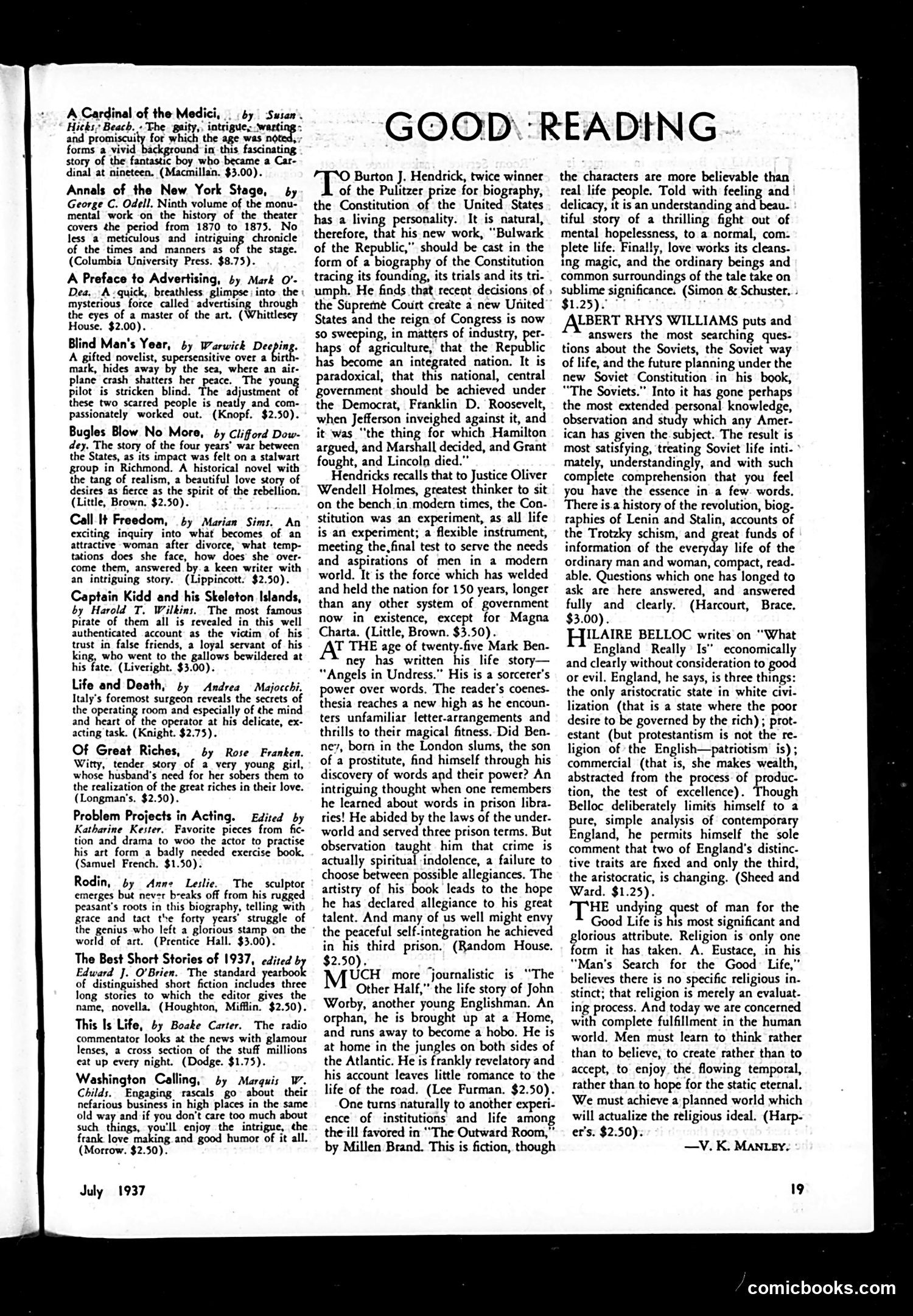
A restored page from Judge, 1937-07. Page through the whole issue in the reader above.
📄 Transcribed text from this page (OCR, searchable)
Machine-transcribed from the original scan — historical spelling and the odd misread are preserved.
A Cardinal of the Medici, by Sui Hicks; Beach. + The gaity,, intrigue; ‘wart and promiscuity for which the age was forms a vivid ground: in. this fascinating story of the fantastic boy who became a Car- dinal at nineteen. (Macmillan. $3.00). Annals of the New York Stage, by George C. Odell. Ninth volume of the monu- mental work on the history of the theater covers the period from 1870 to 1875. No less a meticulous and intriguing chronicle of the times and manners as of the stage. (Columbia University Press. $8.75). A Preface to Advertising, by Mark O’- Dea. A-quick, breathless glimpse; into the mysterious force called advertising through the eyes of a master of the art. (Whittlesey House. $2.00). Blind Man's Year, by Warwick Decpin . A gifted novelist, supersensitive over a inte mark, hides away by the sea, where an air- plane crash shatters her peace. The youn, pilot is stricken blind. The adjustment of these two scarred people is neatly and com- passionately worked out. (Knopf. $2.50). Bugles Blow No More, by Clifford Dow- dey. The story of the four years’ war between the States, as its impact was felt on a stalwart group in Richmond. A historical novel with the tang of realism, a beautiful love story of desires as fierce as the spirit of the rebellion. (Little, Brown. $2.50). Call It Freedom, ty Marian Sims. An exciting inquiry into what comes of an attractive woman after divorce, what temp- tations does she face, how does she over- come them, answered by.a keen writer with an intriguing story. (Lippincott. $2.50). Captain Kidd and his Skeleton Islands, by Harold T. Wilkins. The most famous pirate of them all is revealed in this well authenticated account as the victim of his trust in false friends, a loyal servant of his king, who went to the gallows bewildered at his fate. (Liveright. $3.00). Life and Death, sy Andrea Majocchi. Italy's foremost surgeon reveals the secrets of the operating room and especially of the mind and heart of the operator at his delicate, ex- acting task. (Knight. $2.75). Of Greeti Riches, , 7, Rote | Franken, Witty, tender story of a very young girl, whose husband's need for her sobers them to the realization of the great riches in their love. (Longman’s. $2.50). Problem Projects in Acting. Edited by Katharine Kester. Favorite pieces from fic- tion and drama to woo the actor to practise his art form a badly needed exercise book. (Samuel French. $1.50). Rodin, by Anne Leslie. The sculptor emerges but never breaks off from his rugged peasant’s roots in this biography, telling with grace and tact the forty years’ struggle of the genius who left a glorious stamp on the world of art. (Prentice Hall. $3.00). The Best Short Stories of 1937, edited by Edward J. O’Brien. ‘The standard yearboo! of distinguished short fiction includes three long stories to which the editor gives the name, novella. (Houghton, Mifflin. $2.50). This Is Life, by Boake Carter. The radio commentator looks at the news with glamour lenses, a cross section of the stuff millions cat up every night. (Dodge. $1.75). Washington Calling, by Marquis W. Childs. Engaging rascals go about their nefarious business in high places in the same old way and if you don’t care too much about such things, you'll enjoy the intrigue, the frank love making and good humor of it all. (Morrow. $2.50). July 1937 GOOD\:READING c Be Burton J. Hendrick, twice winner of the Pulitzer sprize for biography, the Constitution of the United States has a living personality. It is natural, therefore, that his new work, “Bulwark of the Republic,” should be cast in the form of a biography of the Constitution tracing its founding, its trials and its tri- umph. He finds that recent decisions of the Supremé Court create a new United States and the reign of Congress is now so sweeping, in matters of industry, per- haps of agriculture, that the Republic has become an integrated nation. It is paradoxical, that this national, central government should be achieved under the Democrat, Franklin D. Roosevelt, when Jefferson inveighed against it, and it was “the thing for which Hamilton argued, and Marshall decided, and Grant fought, and Lincoln died.” Hendricks recalls that to Justice Oliver Wendell Holmes, greatest thinker to sit on the bench. in modern times, the Con- stitution was an experiment, as all life is an experiment; a flexible instrument, meeting the,final test to serve the needs and aspirations of men in a modern world. It is the force which has welded and held the nation for 150 years, longer than any other system of government now in existence, except for Magna Charta. (Little, Brown. $3.50). A THE age of twenty-five Mark Ben- ney has written his life story— “Angels in Undress.” His is a sorcerer's power over words. The reader's coenes- thesia reaches a new high as he encoun. ters unfamiliar letter-arrangements and thrills to their magical fitness. Did Ben. nev, born in the London slums, the son of a prostitute, find himself through his discovery of words and their power? An intriguing thought when one remembers he learned about words in prison libra- ties! He abided by the laws of the under- world and served three prison terms. But observation taught him that crime is actually spiritual indolence, a failure to choose between possible allegiances. The artistry of his book leads to the hope he has declared allegiance to his great talent. And many of us well might envy the peaceful self-integration he achieved in his third prison. (Random House. $2.50). _ MUCH more journalistic is “The Other Half,” the life story of John Worby, another young Englishman. An orphan, he is brought up at a Home, and runs away to become a hobo. He is at home in the jungles on both sides of the Atlantic. He is frankly revelatory and his account leaves little romance to the life of the road. (Lee Furman. $2.50). One turns naturally to another experi- ence of institutions and life among the ill favored in ‘The Outward Room,” by Millen Brand. This is fiction, though the characters are more believable than real life people. Told with feeling and delicacy, it is an understanding and beau- tiful story of a thrilling fight out of mental hopelessness, to a normal, com: plete life. Finally, love works its cleans. ing magic, and the ordinary beings and common surroundings of the tale take on sublime significance. (Simon & Schuster. : $1.25). : ALBERT RHYS WILLIAMS puts and answers the most searching ques- tions about the Soviets, the Soviet way of life, and the future planning under the new Soviet Constitution in his book, “The Soviets.” Into it has gone perhaps the most extended personal knowledge, observation and study which any Amer- ican has given the. subject. The result is most satisfying, treating Soviet life inti- » mately, understandingly, and with such complete comprehension that you feel you have the essence in a few. words, There is.a history of the revolution, biog- raphies of Lenin and Stalin, accounts of the Trotzky schism, and great funds of information of the meyer life of the ordinary man and woman, compact, read- able. Questions which one has longed to ask are here answered, and answered fully and clearly. (Harcourt, Brace. $3.00). ILAIRE BELLOC writes on “What England Really Is” economically and clearly without consideration to good or evil. England, he says, is three things: the only aristocratic state in white civi- lization (that is a state where the desire to be governed by the rich) ; prot- estant (but protestantism is not the re- ligion of the English—patriotism is) ; commercial (that is, she makes wealth, abstracted from the process of produc- tion, the test of excellence). Fhough Belloc deliberately limits himself to a pure, simple analysis of contemporary England, he permits himself the sole comment that two of England's distinc. tive traits are fixed and only the third, the aristocratic, is changing. (Sheed and Ward. $1.25). ‘THE undying quest of man for the Good Life is his most significant and glorious attribute. Religion is only one form it has taken. A. Eustace, in his “Man's Search for the Good: Life,” believes there is no specific religious in- stinct; that religion is merely an evaluat- ing process. And today we are concerned with complete fulfillment in the human world. Men must learn to think rather than to believe, to create rather than to accept, to enjoy the. flowing temporal, rather than to hope for the static eternal. We must achieve a planned world which will actualize the religious ideal. (Harp- er’s. $2.50). —V. K. Mantey. 19 comicbooks.com