
Judge, 1937-07 · page 11 of 37
Judge — July 1937 — page 11: what you’re looking at
What you’re looking at
# Analysis of Judge Magazine, July 1937 **The Article's Satire:** Struthers Burt's essay mocks Americans who participated in elaborate ceremonies celebrating the British coronation (likely Edward VIII's abdication crisis and George VI's coronation in 1937). Burt sarcastically criticizes the hypocrisy of patriotic Americans—including Daughters of the American Revolution—traveling to England or holding ceremonial services while routinely denigrating their own country. He notes with contempt that Charleston refused to honor Lincoln's birthday yet gathered to sing "God Save the King," and that New Yorkers questioned Robert E. Lee's citizenship while reverencing British traditions. **The Cartoon:** The accompanying illustration shows what appears to be a woman in formal dress nervously clutching a man's arm as they encounter what seem to be officials or authorities (the "Jenkins" and "Hawkins" referenced). The caption suggests anxious anticipation of fireworks—a visual pun on explosive social consequences. **The Point:** Burt argues such gestures are meaningless unless reciprocal, ultimately suggesting these Americans are absurdly obsequious toward Britain while neglecting their own nation's dignity.
📄 Transcribed text from this page (OCR, searchable)
Machine-transcribed from the original scan — historical spelling and the odd misread are preserved.
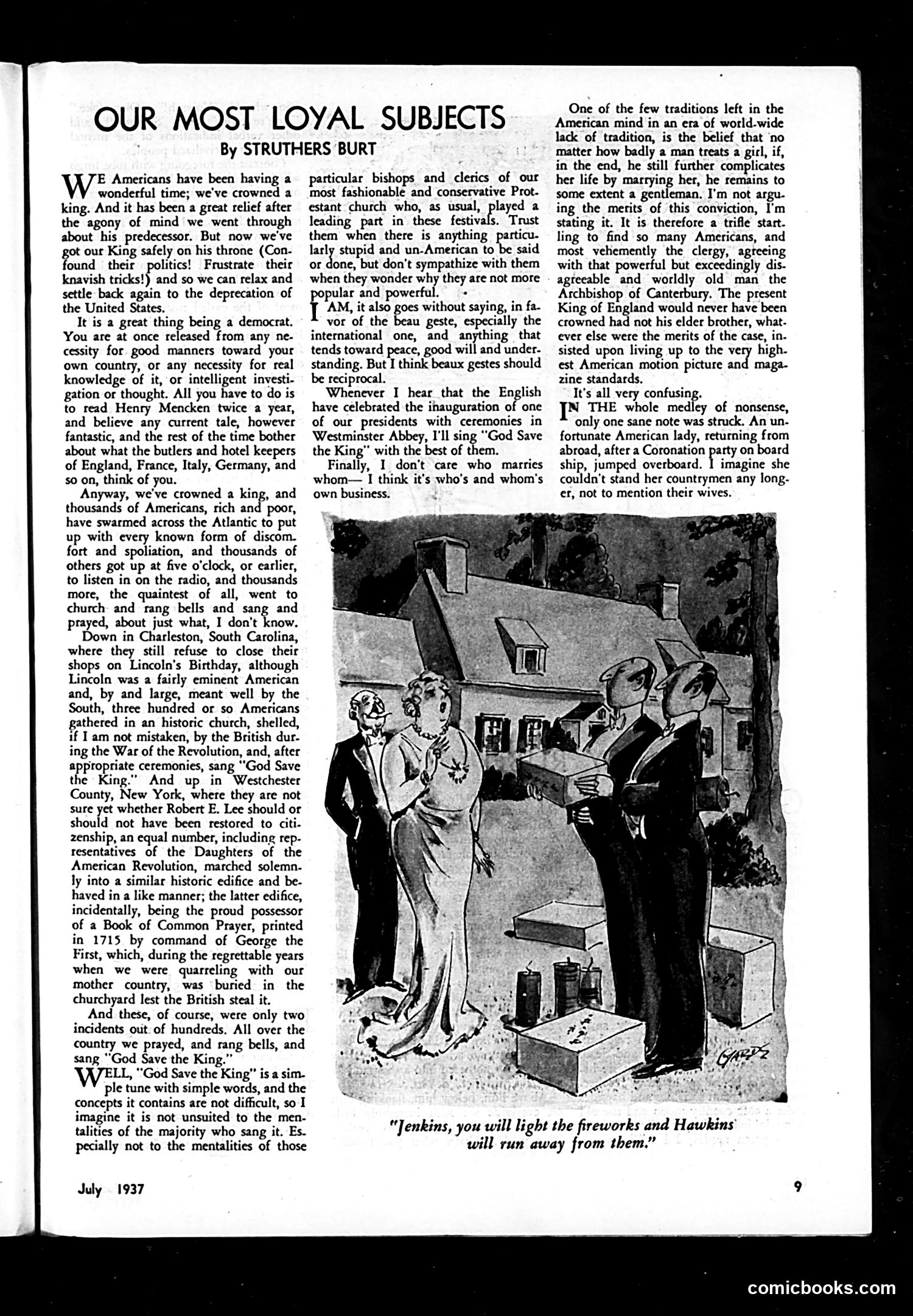
OUR MOST LOYAL SUBJECTS By STRUTHERS BURT : E Americans have been having a wonderful time; we've crowned a king. And it has been a great relief after the agony of mind we went through about his predecessor. But now we've ot our King safely on his throne (Con- found their politics! Frustrate their knavish tricks!) and so we can relax and settle back again to the deprecation of the United States. It is a great thing being a democrat. You are at once released from any ne- cessity for good manners toward your own country, or any necessity for real knowledge of it, or intelligent investi- gation or thought. All you have to do is to read Henry Mencken twice a year, and believe any current tale, however fantastic, and the rest of the time bother about what the butlers and hotel keepers of England, France, Italy, Germany, and so on, think of you. Anyway, we've crowned a king, and thousands of Americans, rich and poor, have swarmed across the Atlantic to put up with every known form of discom. fort and spoliation, and thousands of others got up at five o'clock, or earlier, to listen in on the radio, and thousands more, the quaintest of all, went to church and rang bells and sang and prayed, about just what, I don’t know. Down in Charleston, South Carolina, where they still refuse to close their shops on Lincoln's Birthday, although Lincoln was a fairly eminent American and, by and large, meant well by the South, three hundred or so Americans gathered in an historic church, shelled, if I am not mistaken, by the British dur- ing the War of the Revolution, and, after appropriate ceremonies, sang “God Save the King.” And up in Westchester County, New York, where they are not sure yet whether Robert E. Lee should or should not have been restored to citi- zenship, an equal number, including rep- resentatives of the Daughters of the American Revolution, marched solemn- Jy into a similar historic edifice and be- haved in a like manner; the latter edifice, incidentally, being the proud possessor of a Book of Common Prayer, printed in 1715 by command of George the First, which, during the regrettable years when we were quarreling with our mother country, was buried in the churchyard lest the British steal it. And these, of course, were only two incidents out. of hundreds. All over the country we prayed, and rang bells, and sang “God Save the King.” WELL, “God Save the King” is a sim. ple tune with simple words, and the concepts it contains are not difficult, so I imagine it is not unsuited to the men- talities of the majority who sang it. Es. pecially not to the mentalities of those July 1937 particular bishops and clerics of our most fashionable and conservative Prot- estant church who, as usual, played a leading part in these festivals. Trust them when there is anything particu. larly stupid and un-American to be said or done, but don’t sympathize with them when they wonder why they are not more popular and powerful. - AM, it also goes without saying, in fa- vor of the beau geste, especially the international one, and anything that tends toward peace, good will and under. standing. But I think beaux gestes should be reciprocal. Whenever I hear that the English have celebrated the inauguration of one of our presidents with ceremonies in Westminster Abbey, I'll sing “God Save the King” with the best of them. Finally, I don’t care who marries whom— I think it’s who's and whom's own business. One of the few traditions left in the American mind in an era of world-wide lack of tradition, is the belief that ‘no matter how badly a man treats a gitl, if, in the end, he still further complicates her life by marrying her, he remains to some extent a gentleman. I’m not argu- ing the merits of this conviction, I'm stating it. It is therefore a trifle start. ling to find so many Americans, and most vehemently the clergy, agreeing with that powerful but exceedingly dis- agreeable and worldly old man the Archbishop of Canterbury. The present King of England would never have been crowned had not his elder brother, what- ever else were the merits of the case, in- sisted upon living up to the very high. est American motion picture and maga- zine standards. It's all very eonfusing. N THE whole medley of nonsense, only one sane note was struck. An un. fortunate American lady, returning from abroad, after a Coronation pay on board ship, jumped overboard. I imagine she couldn't stand her countrymen any long- er, not to mention their wives. "Jenkins, you will light the fireworks and Hawkins will run away from them.” comicbooks.com