
Judge, 1937-07 · page 23 of 37
Judge — July 1937 — page 23: what you’re looking at
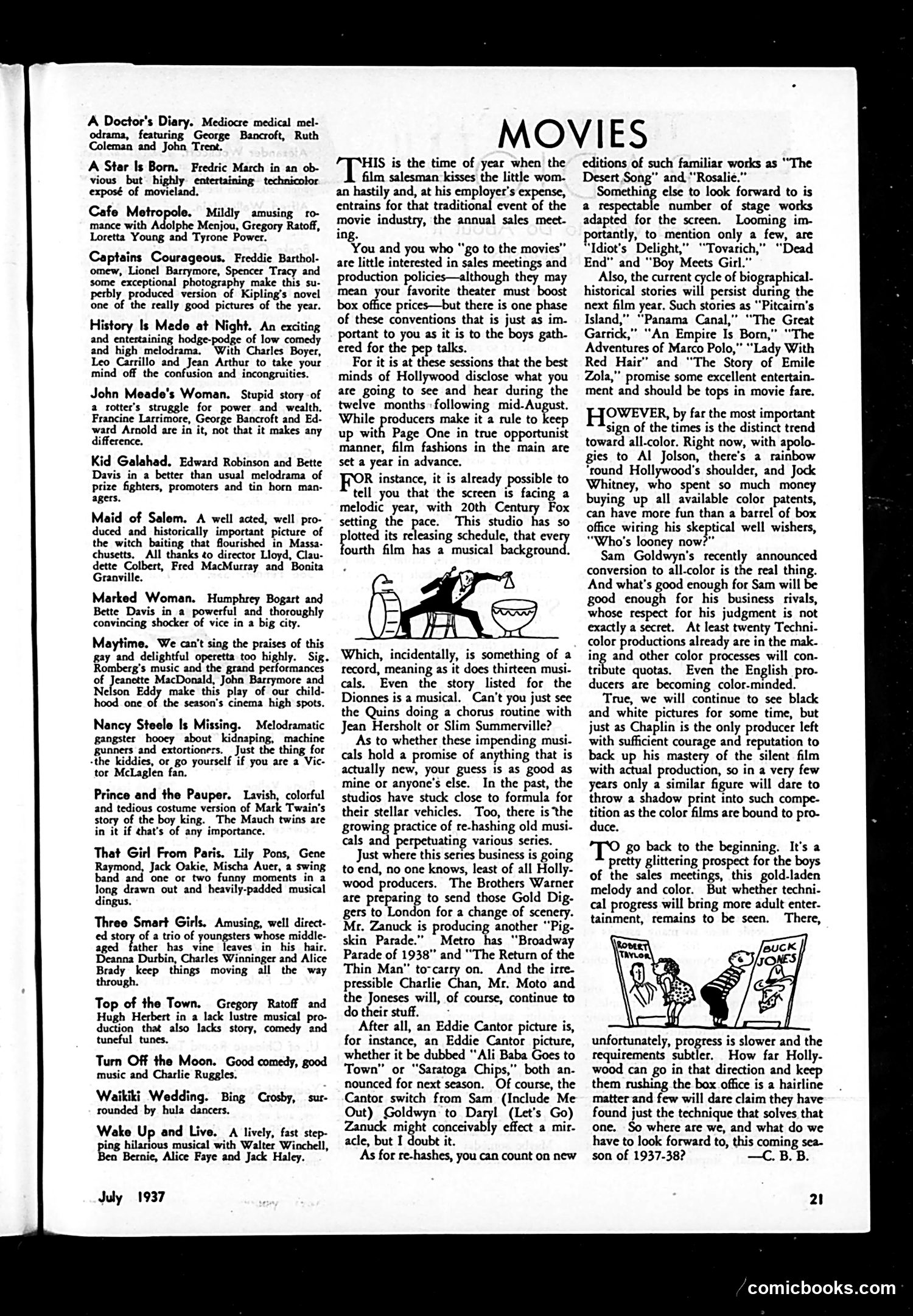
A restored page from Judge, 1937-07. Page through the whole issue in the reader above.
📄 Transcribed text from this page (OCR, searchable)
Machine-transcribed from the original scan — historical spelling and the odd misread are preserved.
by Doctors Diary. Mediocre medical mel- rama, featuring George Bancroft, Ruth Coleman and John Trent a A Star Is Born, Fredric March in an ob- vious but highly entertaining technicolor exposé of movieland. Cafe Metropole. Mildly amusing ro- mance with Adolphe Menjou, Gregory Ratoff, Loretta Young and Tyrone Power. Captains Courageous. Freddie Barthol- omew, Lionel Barrymore, Spencer Tracy and some exceptional photography make this su- perbly produced version of Kipling’s novel one of the really good pictures of the year. History Is Mede at Night. An exciting and entertaining hodge-podge of low comedy and high melodrama. With Charles Boyer, Leo Carrillo and Jean Arthur to take your mind off the confusion and incongruities. John Meade's Woman. Stupid story of a rotter’s struggle for power and wealth. Francine Larrimore, George Bancroft and Ed- ward Arnold are in it, not that it makes any difference. Kid Galahad. Edward Robinson and Bette Davis in a better than usual melodrama of prize fighters, promoters and tin horn man- agers. Maid of Salem. A well acted, well pro- duced and historically important picture of the witch baiting that flourished in Massa- chusetts. All thanks éo director Lloyd, Clau- dette Colbert, Fred MacMurray and Bonita Granville. Marked Woman. Humphrey Bogart and Bette Davis in a powerful and thoroughly convincing shocker of vice in a big city. Maytime. We can't sing the praises of this gay and delightful operetta too highly. Sig. Romberg’s music and the grand performances of Jeanerts MacDonald, John Barrymore and Nelson Eddy make this play of our child- one of the season's cinema high spots. Nancy Steele Is Missing. Melodramatic gangster hooey about kidnaping, machine gunners and extortioners. Just the thing for -the kiddies, or go yourself if you are a Vic- tor McLaglen fan. Prince and the Pauper. Lavish, colorful and tedious costume version of Mark Twain's story of the boy king. The Mauch twins are in it if ¢hat’s of any importance. That Girl From Paris. Lily Pons, Gene Raymond, Jack Oakie, Mischa Auer, a swing band and one or two funny moments in a Jong drawn out and heavily-padded musical dingus. Three Smart Girls. Amusing, well direct- ed story of a trio of youngsters whose middle- aged ‘Father has vine leaves in his hair. Deanna Durbin, Charles Winninger and Alice Brady keep things moving all the way through. Top of the Town. Gregory Ratoff and Hugh Herbert in a lack lustre musical pro- duction that also lacks story, comedy and tuneful tunes. Turn Off the Moon. Good comedy, good music and Charlie Ruggles. Waikiki Wedding. Bing Crosby, sur- rounded by hula dancers. Wake Up and Live. A lively, fast step- ing hilarious musical with Walter Winchell, Bernie, Alice Faye and Jack Haley. July 1937 MOVIES esis is the time of year when the film salesman: kisses the little wom. an hastily and, at his employer's expense, entrains for that traditional event of the movie industry, the annual sales meet- ing. You and you who “go to the movies” are little interested in sales meetings and production policies—although they may mean your favorite theater must boost box office prices—but there is one phase of these conventions that is just as im. rtant to you as it is to the boys gath- Pred for the pep talks. ue For it is at these sessions that the best minds of Hollywood disclose what you are going to see and hear during the twelve months following mid-August. While producers make it a rule to keep up with Page One in true opportunist manner, film fashions in the main are set a year in advance. R instance, it is already possible to tell you that the screen is facing a melodic year, with 20th Century Fox setting the pace. This studio has so lotted its releasing schedule, that eve! fourth film has a musical Eackgrousd. Which, incidentally, is something of a record, meaning as it does thirteen musi- cals. Even the story listed for the Dionnes is a musical. Can't you just see the Quins doing a chorus routine with Jean Hersholt or Slim Summerville? As to whether these impending musi- cals hold a promise of anything that is actually new, your guess is as good as mine or anyone's else. In the past, the studios have stuck close to formula for their stellar vehicles. Too, there is the growing practice of re-hashing old musi- cals and perpetuating various series. Just where this series business is going to end, no one knows, least of all Holly- wood producers. The Brothers Warner are preparing to send those Gold Dig- gers to London for a change of scenery. Mr. Zanuck is producing another “‘Pig- skin Parade.” Metro “Broadway Parade of 1938” and ‘The Return of the Thin Man” to-carry on. And the irre- pressible Charlie Chan, Mr. Moto and the Joneses will, of course, continue to do their stuff. After all, an Eddie Cantor picture is, for instance, an Eddie Cantor picture, whether it be dubbed “Ali Baba to Town” or “Saratoga Chips,” both an. nounced for next season. Of course, the Cantor switch from Sam (Include Me Out) Goldwyn to Daryl (Let’s Go) Zanuck might conceivably effect a mir- acle, but I doubt it. As for re-hashes, you can count on new editions of such familiar works as “The Desert Song” and “‘Rosalié.” Something else to look forward to is a respectable number of stage works adapted for the screen. Looming im- portantly, to mention only a few, are ‘Idiot's Delight,” “Tovarich,” “Dead End” and “Boy Meets Girl.” Also, the current cycle of biographical- historical stories will persist during the next film year. Such stories as ‘Pitcairn's Island,” “Panama Canal,” “The Great Garrick,” “An Empire Is Born,” "The Adventures of Marco Polo,” “Lady With Red Hair” and “The Story of Emile Zola,” promise some excellent entertain- ment and should be tops in movie fare. HOWEVER, by far the most important sign of the times is the distinct trend toward all-color. Right now, with apolo- gies to Al Jolson, there's a rainbow ‘round Hollywood's shoulder, and Jock Whitney, who spent so much money buying up all available color patents, can have more fun than a barrel of box office wiring his skeptical well wishers, “Who's looney now?” Sam Goldwyn’s recently announced conversion to all-color is the real thing. And what's good enough for Sam will be good enough for his business rivals, whose respect for his judgment is not exactly a secret. At least twenty Techni- color productions already are in the mak- ing and other color processes will con- tribute quotas. Even the English pro- ducers are becoming color-minded. True, we will continue to see black and white pictures for some time, but just as Chaplin is the only producer left with sufficient courage and reputation to back up his mastery of the silent film with actual production, so in a very few years only a similar figure will dare to throw a shadow print into such compe- tion as the color films are bound to pro- luce. T° go back to the beginning. It’s a pretty glittering prospect for the boys of the sales meetings, this gold-laden melody and color. But whether techni- cal progress will bring more adult enter- tainment, remains to be seen. There, unfortunately, progress is slower and the requirements subtler. How far Holly- wood can go in that direction and keep them rushing the box office is a hairline matter and few will dare claim they have found just the technique that solves that one. So where are we, and what do we have to look forward to, this coming sea- son of 1937-38? —C. B.B. 21 comicbooks.com