
Judge, 1937-07 · page 24 of 37
Judge — July 1937 — page 24: what you’re looking at
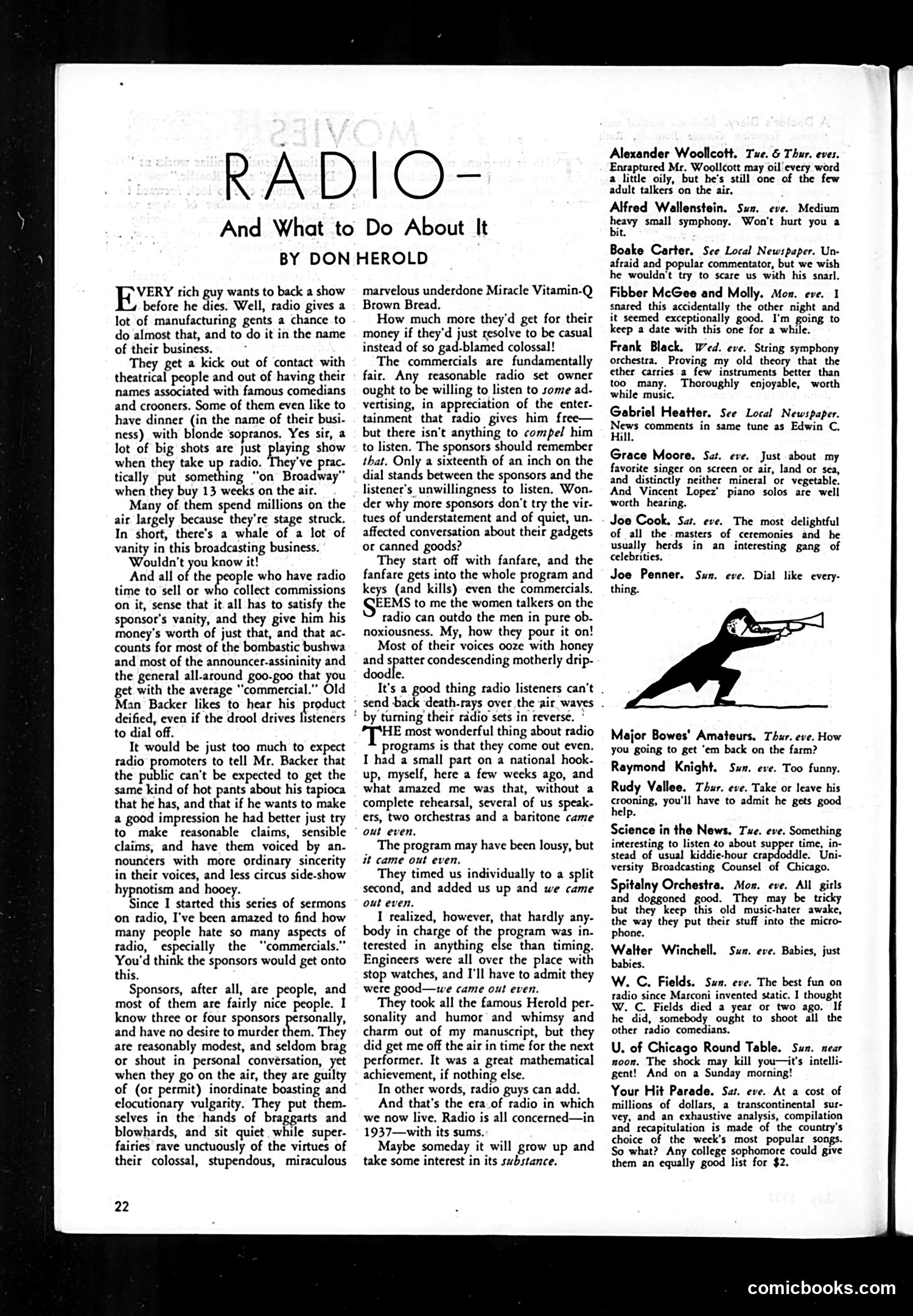
A restored page from Judge, 1937-07. Page through the whole issue in the reader above.
📄 Transcribed text from this page (OCR, searchable)
Machine-transcribed from the original scan — historical spelling and the odd misread are preserved.
RADIO- And What to Do About It BY DON HEROLD BEY rich guy wants to back a show before he dies. Well, radio gives a lot of manufacturing gents a chance to do almost that, and to do it in the name of their business. e They get a kick out of contact with theatrical people and out of having their names associated with famous comedians and crooners. Some of them even like to have dinner (in the name of their busi- ness) with blonde sopranos. Yes sir, a lot of big shots are just playing show when they take up radio. They've prac. tically put something “on Broadway” when they buy 13 weeks on the air. Many of them spend millions on the air largely because they're stage struck. In short, there’s a whale of a lot of vanity in this broadcasting business. Wouldn't you know it! And all of the people who have radio time to sell or who collect commissions on it, sense that it all has to satisfy the sponsor's vanity, and they give him his money's worth of just that, and that ac- counts for most of the bombastic bushwa and most of the announcer-assininity and the general all-around goo-goo that you get with the average “commercial.” Old Man Backer likes to hear his product deified, even if the drool drives listeners to dial off. It would be just too much to expect radio promoters to tell Mr. Backer that the public can’t be expected to get the same kind of hot pants about his tapioca that he has, and that if he wants to make a good impression he had better just try to make reasonable claims, sensible claims, and have them voiced by an- nouncers with more ordinary sincerity in their voices, and less circus side-show hypnotism and hooey. Since I started this series of sermons on radio, I've been amazed to find how many people hate so many aspects of radio, especially the “commercials.” You'd think the sponsors would get onto this. Sponsors, after all, are people, and most of them are fairly nice people. I know three or four sponsors Personally, and have no desire to murder them. They are reasonably modest, and seldom brag or shout in personal conversation, yet when they go on the air, they are guilty of (or permit) inordinate boasting and elocutionary vulgarity. They put them. selves in the hands of braggarts and blowhards, and sit quiet while super- fairies rave unctuously of the virtues of their colossal, stupendous, miraculous 22 marvelous underdone Miracle Vitamin-Q Brown Bread. How much more they'd get for their money if they'd just resolve to be casual instead of so gad-blamed colossal! The commercials are fundamentally fair. Any reasonable radio set owner ought to be willing to listen to some ad- vertising, in appreciation of the enter- tainment that radio gives him free— but there isn’t anything to compel him to listen. The sponsors should remember that. Only a sixteenth of an inch on the dial stands between the sponsors and the listener's unwillingness to listen. Won. der why more sponsors don’t try the vir- tues of understatement and of quiet, un- affected conversation about their gadgets or canned goods? They start off with fanfare, and the fanfare gets into the whole program and keys (and kills) even the commercials, SEEMS to me the women talkers on the radio can outdo the men in pure ob- noxiousness. My, how they pour it on! Most of their voices ooze with honey and spatter condescending motherly drip- doodle. send b; TH most wonderful thing about radio programs is that they come out even. I had a small part on a national hook- up, myself, here a few weeks ago, and what amazed me was that, without a complete rehearsal, several of us speak- ers, two orchestras and a baritone came out even. The program may have been lousy, but it came out even. They timed us individually to a split second, and added us up and we came out even. I realized, however, that hardly any- body in charge of the program was in. terested in anything else than timing. Engineers were all over the place with stop watches, and I'll have to admit they were good—1we came out even. They took all the famous Herold per- sonality and humor and whimsy and charm out of my manuscript, but they did get me off the air in time for the next performer. It was a great mathematical achievement, if nothing else. In other words, radio guys can add. And that’s the era_of radio in which we now live. Radio is all concerned—in 1937—with its sums. Maybe someday it will grow up and take some interest in its substance. It's # good thing radio listeners can’t . death.rays over the air waves . * by turning their radio sets in reverse. Alexander Woollcott. Tue. & Thur. eves. Enraptured Mr. Woollcott may oil'every word a little oily, but he’s still one of the few adult talkers on the air, Alfred Wallenstein. Suz. eve. Medium beavy small symphony. Won't hurt you a it. Boake Carter. See Local Newspaper. Un- afraid and popular commentator, but we wish he wouldn't try to scare us with his snarl. Fibber McGee and Molly. Mon. eve. 1 snared this accidentally the other night and it seemed exceptionally good. I'm going to keep a date with this one for a while. Frank Black. Wed. eve. String symphony orchestra. Proving my old theory that the ether carries a few instruments better than too many. Thoroughly enjoyable, worth while music, Gabriel Heatter. See Local Newspaper. News comments in same tune as Edwin C. Hill. Grace Moore. Sat. eve. Just about my favorite singer on screen or air, land or sea, and distinctly neither mineral or vegetable. And Vincent Lopez’ piano solos are well worth hearing. Joe Cook. Sat. eve. The most delightful of all the masters of ceremonies and he usually herds in an interesting gang of celebrities, Joe Penner. thing. Sun. eve. Dial like every- Major Bowes’ Amateurs. Thur. eve. How you going to get ‘em back on the farm? Raymond Knight. Suz. eve. Too funny. Rudy Vallee. Thur. eve. Take or leave his crooning, you'll have to admit he gets good ep, Science in the News. Tue. eve. Something interesting to listen ¢o about supper time, in- stead of usual kiddie-hour crapdoddle. Uni- versity Broadcasting Counsel of Chicago. Spitalny Orchestra. Moz. eve. All girls and doggoned good. They may be tricky but they keep this old music-hater awake, the way they put their stuff into the micro- phone. Walter Winchell. babies. W. C. Fields. Sun. eve. The best fun on radio since Marconi invented static. I thought W. C. Fields died a year or two ago. If he did, somebody ought to shoot all the other radio comedians. U, of Chicago Round Table. Sun. near noon. The shock may kill you—it's intelli- gent! And on a Sunday morning! Your Hit Parade. Sat. eve. At a cost of millions of dollars, a transcontinental sur- vey, and an exhaustive analysis, compilation and recapitulation is made of the country’s choice of the week's most popular songs. So what? Any college sophomore could give them an equally good list for $2. Sun. eve. Babies, just comicbooks.com