
Judge, 1937-07 · page 13 of 37
Judge — July 1937 — page 13: what you’re looking at
What you’re looking at
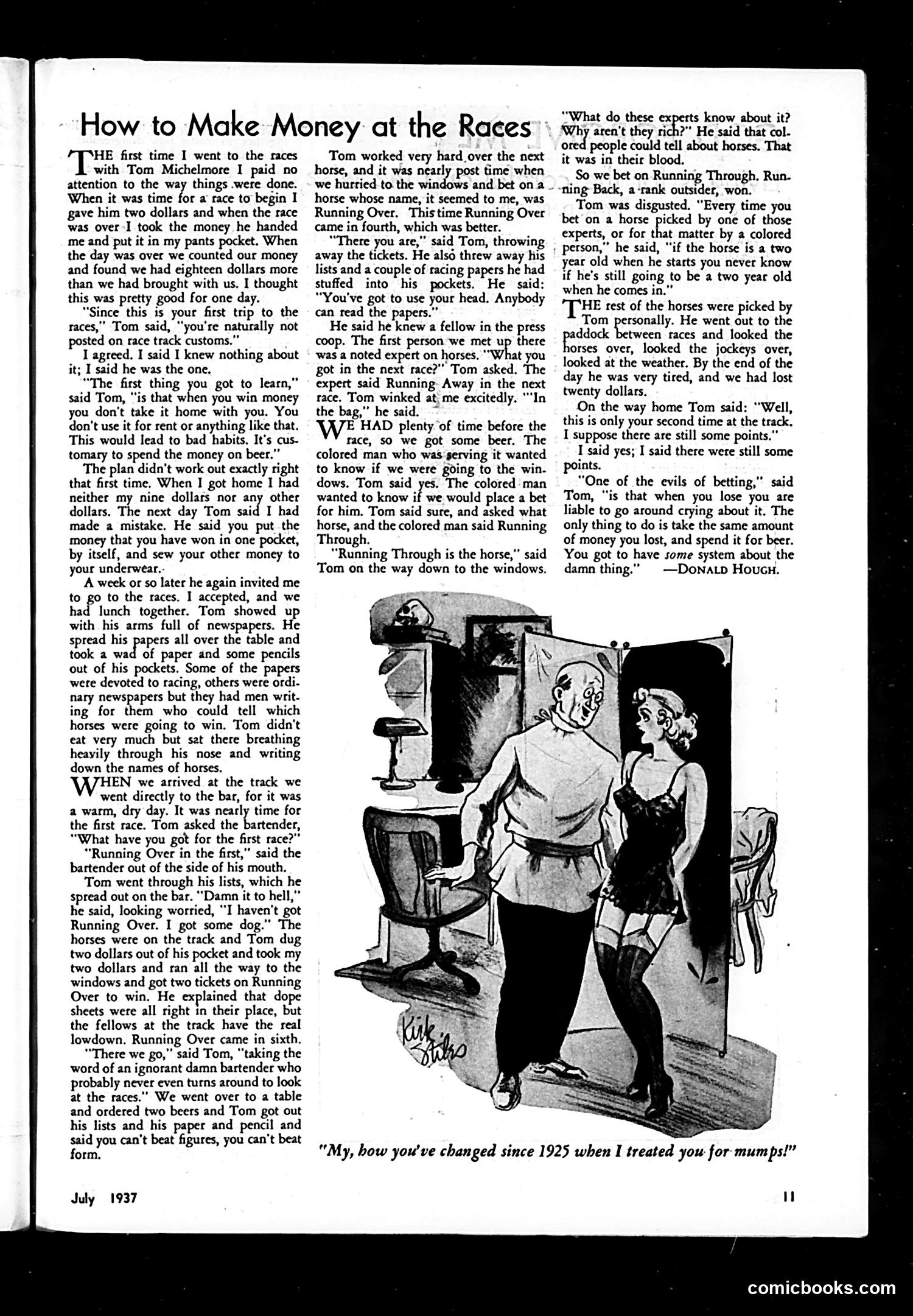
# Explanation for Modern Readers This 1937 Judge magazine article satirizes amateur horse racing gamblers and their various "systems" for winning. The narrator accompanies his friend Tom to the racetrack. Tom employs contradictory strategies—first consulting racing "dope sheets" and expert predictions, then dismissing them as useless and relying instead on bartender tips or "inside" information from track insiders. Each approach fails spectacularly (horses finishing sixth, fourth, etc.). The satire targets the delusional confidence of casual bettors who constantly shift methods while losing money, convinced each new approach is foolproof. Tom's behavior—obsessively analyzing papers, breathing heavily while researching, discarding systems on whims—portrays the compulsive irrationality underlying gambling addiction. The accompanying cartoon (captioned about treating someone for "mumps" in 1925) appears to be a separate joke about physical transformation or aging. The piece mocks the universal gambler's self-deception: that luck can be systematized through research, expertise, or insider knowledge.
📄 Transcribed text from this page (OCR, searchable)
Machine-transcribed from the original scan — historical spelling and the odd misread are preserved.
-'How to Make Money at the Races” HE first time I went to the races with Tom Michelmore I paid no attention to the way things .were done. When it was time for a race to begin I gave him two dollars and when the race was over-I took the money he handed me and put it in my pants pocket. When the day was over we counted our money and found we had eighteen dollars more than we had brought with us. I thought this was pretty good for one day. “Since this is your first trip to the races,” Tom said, “you're naturally not posted on race track customs.” I agreed. I said I knew nothing about it; I said he was the one, “The first thing you got to learn,” said Tom, “is that 5 vhen you win money you don’t take it home with you. You don’t use it for rent or anything like that. This would lead to bad habits. It’s cus- tomary to spend the money on beer.” The plan didn’t work out exactly right that first time. When I got home I had neither my nine dollars nor any other dollars. The next day Tom said I had made a mistake. He said you put the money that you have won in one pocket, by itself, and sew your other money to your underwear.- A week or so later he again invited me to £ to the races. I accepted, and we had lunch together. Tom showed up with his arms full of newspapers. He spread Ais papers all over the table and took a wad of paper and some pencils out of his pockets. Some of the papers were devoted to racing, others were ordi- nary newspapers but they had men writ- ing for them who could tell which horses were going to win. Tom didn’t eat very much but sat there breathing heayily through his nose and writing down the names of horses. EN we arrived at the track we went directly to the bar, for it was a warm, dry day. It was nearly time for the first race. Tom asked the bartender, “What have you got for the first race?” “Running Over in the first,” said the bartender out of the side of his mouth. Tom went through his lists, which he spread out on the bar. “Damn it to hell,” he said, looking worried, “I haven't got Running Over. I got some dog.” The horses were on the track and Tom dug two dollars out of his pocket and took my two dollars and ran all the way to the windows and got two tickets on Running Over to win. He explained that dope sheets were all right in their place, but the fellows at the track have the real lowdown. Running Over came in sixth. “There we go,” said Tom, “taking the word of an ignorant damn bartender who probably never even turns around to look at the races.” We went over to a table and ordered two beers and Tom got out his lists and his paper and pencil and said you can’t beat figures, you can’t beat form. July 1937 Tom worked very hard over the next horse, and it was nearly post time when we hurried to the windows and bet ona horse whose name, it seemed to me, was Running Over. This time Running Over came in fourth, which was better. “There you are,” said Tom, throwing away the tickets. He also threw away his lists and a couple of racing papers he had stuffed into his ets. He said: “You've got to use your head. Anybody can read the papers.” He said he knew a fellow in the press coop. The first person we met up there was a noted expert on horses. “What you got in the next race?" Tom asked. The expert said Running: Away in the next race. Tom winked at, me excitedly. “In the bag,” he said. ~ WE HAD plenty. of time before the face, so we got some beer. The colored man who was:serving it wanted to know if we were going to the win- dows. Tom said yes. The colored man wanted to know if we would place a bet for him. Tom said sure, and asked what horse, and the colored man said Running Through. “Running Through is the horse,” said Tom on the way down to the windows. “"What do these experts know about it? Why aren't they rich?” He said that col- ored people could tell about horses. That it was in their blood. So we bet on Running Through. Run- - «ning Back, a-rank outsider, won. Tom was disgusted. “Every time you bet'on a horse picked by one of those experts, or for that matter by a colored ; person,” he said, “if the horse is a two year old when he starts you never know if he’s still going to be a two year old when he comes in.” ‘THE test of the horses were picked by Tom personally. He went out to the ddock between races and looked the orses over, looked the jockeys over, looked at the weather. By the end of the day he was very tired, and we had lost twenty dollars. On the way home Tom said: “Well, this is only your second time at the track, I suppose there are still some points.” I said yes; I said there were still some points. “One of the evils of betting,” said Tom, “is that when you lose you are liable to go around crying about it. The only thing to do is take the same amount of money you lost, and spend it for beer. You got to have some system about the damn thing.” —Donatp HoucH. “My, how you've changed since 1925 when I treated you for mumps!” comicbooks.com