
Judge, 1937-07 · page 17 of 37
Judge — July 1937 — page 17: what you’re looking at
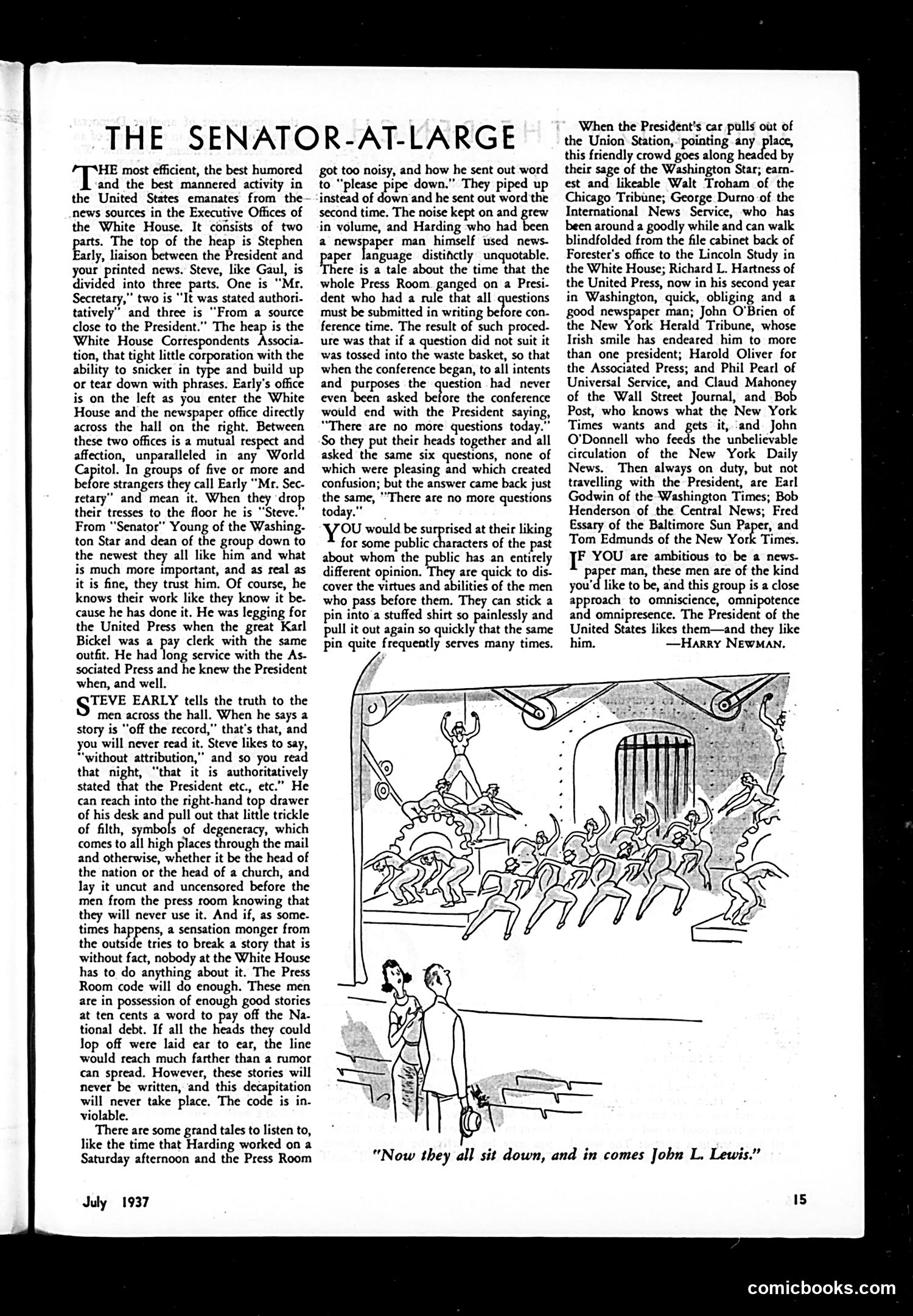
A restored page from Judge, 1937-07. Page through the whole issue in the reader above.
📄 Transcribed text from this page (OCR, searchable)
Machine-transcribed from the original scan — historical spelling and the odd misread are preserved.
THE SENATOR-AT-LARGE ‘HE most efficient, the best humored and the best mannered activity in the United States emanates from the- news sources in the Executive Offices of the White House. It consists of two ps, The top of the heap is Stephen ly, liaison een the President and your printed news. Steve, like Gaul, is divided into three parts. One is “Mr. Secretary,” two is “It was stated authori- tatively” and three is “From a source close to the President.” The heap is the White House Correspondents Associa. tion, that tight little corporation with the ability to snicker in type and build up or tear down with phrases. Early's office is on the left as you enter the White House and the newspaper office directly across the hall on the right. Between these two offices is a mutual respect and affection, unparalleled in any World Capitol. In groups of five or more and before strangers they call Early “Mr. Sec- retary” and mean it. When they ‘dro their tresses to the floor he is “Steve.” From “Senator” Young of the Washing- ton Star and dean of the group down to the newest they all like him and what is much more important, and as real as it is fine, they trust him. Of course, he knows their work like they know it be. cause he has done it. He was legging for the United Press when the great Karl Bickel was a pay clerk with the same outfit. He had long service with the As- sociated Press and he knew the President when, and well. TEVE EARLY tells the truth to the men across the hall. When he says a story is “off the record,” that’s that, and you will never read it. Steve likes to say, “without attribution,” and so you read that night, “that it is authoritatively stated that the President etc., etc.” He can reach into the right-hand top drawer of his desk and pull out that little trickle of filth, symbols of degeneracy, which comes to all high places through the mail and otherwise, whether it be the head of the nation or the head of a church, and lay it uncut and uncensored before the men from the press room knowing that they will never use it. And if, as some. times ha Ss, a sensation monger from the outside tries to break a story that is without fact, nobody at the White House has to do anything about it. The Press Room code will do enough. These men are in possession of enough good stories at ten cents a word to pay off the Na- tional debt. If all the heads they could lop off were laid ear to ear, the line would reach much farther than a rumor can spread. However, these stories will never be written, and this decapitation will never take place. The code is in- violable. There are some grand tales to listen to, like the time that Harding worked on a Saturday afternoon and the Press Room July 1937 got too noisy, and how he sent out word to “please pipe down.” They piped up instead of down and he sent out word the second time. The noise kept on and Sew in volume, and Harding who had been a newspaper man himself used news- aper language distifctly unquotable. ere is a tale about the time that the whole Press Room. ganged on a Presi- dent who had a rule that all questions must be submitted in writing before con- ference time. The result of such proced- ure was that if a question did not suit it was tossed into the waste basket, so that when the conference began, to all intents and purposes the question had never even been asked before the conference would end with the President saying, “There are no more questions today.” So they put their heads together and all asked the same six questions, none of which were pleasing and which created confusion; but the answer came back just the same, ‘There are no more questions today.” you would be surprised at their liking for some public characters of the past about whom the public has an entirely different opinion. They are quick to dis- cover the virtues and abilities of the men who pass before them. They can stick a pin into a stuffed shirt so painlessly and pull it out again so quickly that the same pin quite frequently serves many times. When the President's car pulls out of the Union Station, pointing any eS this friendly crowd goes along headed by their sage of the Washington Star; earn- est and likeable Walt Troham of the Chicago Tribune; George Durno:of the International News Service, who has been around a goodly while and can walk blindfolded from the file cabinet back of Forester's office to the Lincoln Study in the White House; Richard L. Hartness of the United Press, now in his second year in Washington, quick, obliging and a good newspaper man; John O'Brien of the New York Herald Tribune, whose Irish smile has endeared him to more than one president; Harold Oliver for the Associated Press; and Phil Pearl of Universal Service, and Claud Mahon of the Wall Street Journal, and Bol Post, who knows what the New York Times wants and gets it, ‘and John O'Donnell who feeds the unbelievable circulation of the New York Daily News. Then always on duty, but not travelling with the President, are Earl Godwin of the Washington Times; Bob Henderson of the Central News; Fred Essary of the Baltimore Sun Paper, and Tom Edmunds of the New York Times. F YOU are ambitious to be a news- paper man, these men are of the kind you'd like to be, and this group is a close approach to omniscience, omnipotence and omnipresence. The President of the United States likes them—and they like —Harry Newman. “Now they all sit down, and in comes Jobn L. Lewis.” comicbooks.com