A complete issue · 37 pages · 1937
Judge — May 1937
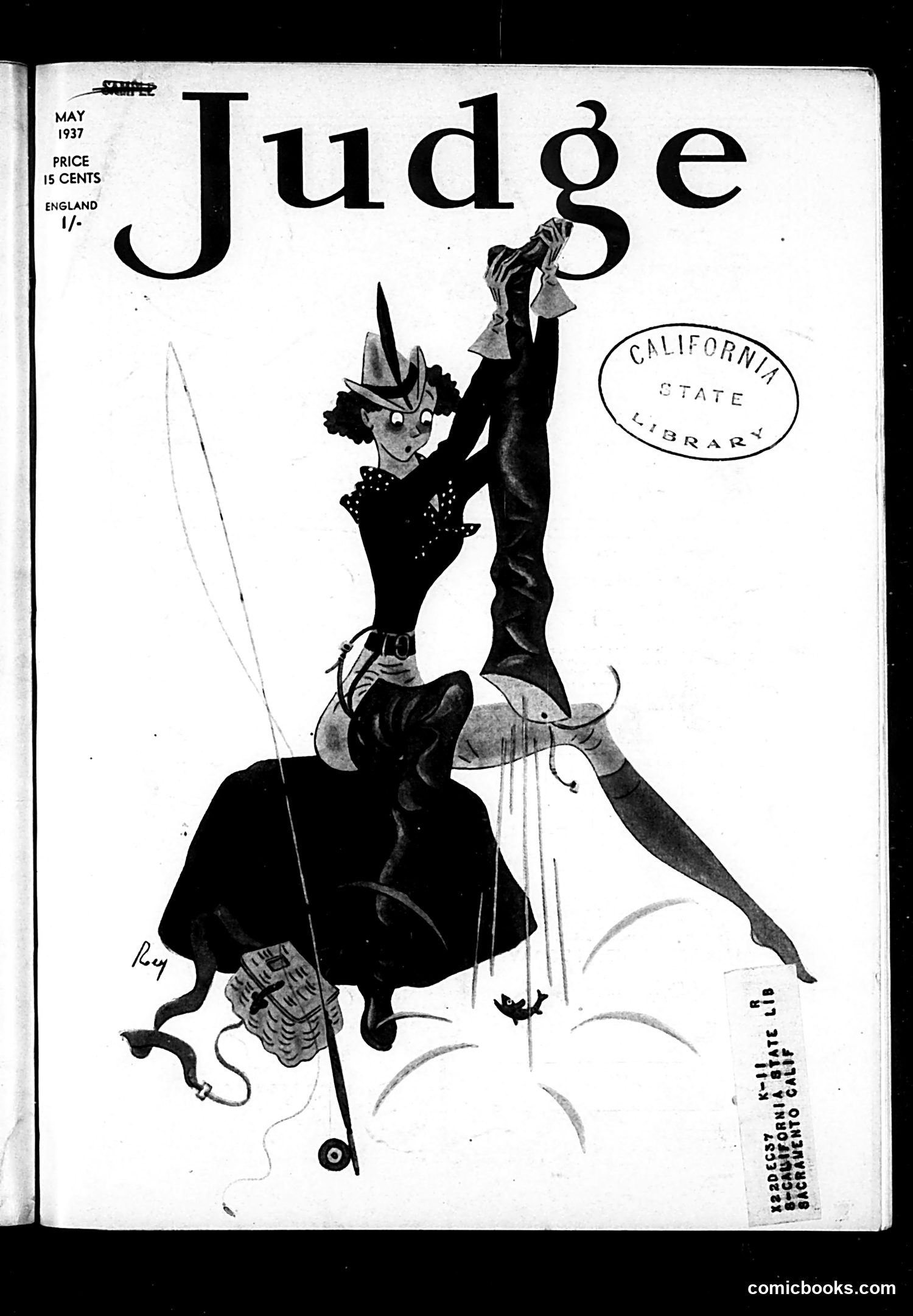
# Judge Magazine Cover - May 1937 This is the cover of Judge, a satirical magazine from May 1937, priced at 15 cents in England (1 shilling). The illustration, signed "Roy," depicts a stylized figure in fashionable 1930s attire—wearing a decorative hat and elegant black outfit—standing atop what appears to be a fishing rod or pole, holding up a large fish or catch triumphantly. The exact satire is unclear without additional context, but the imagery likely comments on either a contemporary social trend, fashion absurdity, or a political figure of the era. The exaggerated pose and theatrical costume suggest mockery of vanity or pretension. The "Judge" masthead confirms this is satirical commentary typical of the magazine's humorous approach to 1930s American society and politics.
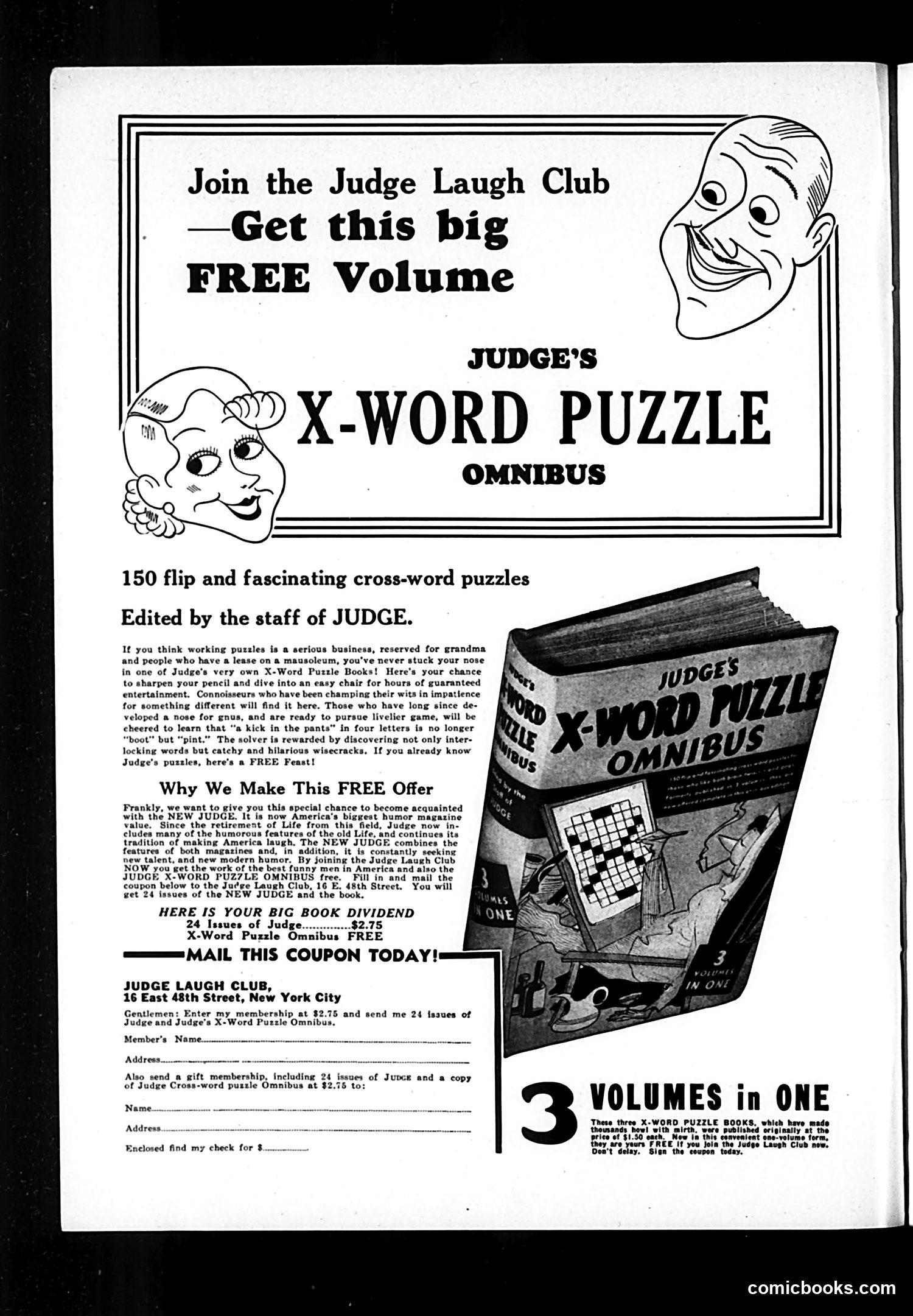
# Analysis This is primarily **advertising content**, not political satire. The page promotes Judge magazine's "Laugh Club" membership and a free X-Word Puzzle Omnibus book containing 150 crossword puzzles. The two cartoon faces shown are generic **smiling character mascots**—not identifiable political figures. They appear designed simply to convey humor and friendliness to attract subscribers. The text emphasizes that Judge was "America's biggest humor magazine" and that puzzle-solving was considered serious intellectual recreation for the era. The offer—24 issues of Judge plus a free puzzle book for $2.75—represents a Depression-era or pre-WWII marketing promotion targeting middle-class readers seeking affordable home entertainment. There is no identifiable political commentary or satire on this particular page.
# Political Commentary on American Democracy (Judge, May 1937) This letters page features readers debating whether Americans are "wiry" enough to defend democracy against fascism and authoritarianism. One correspondent analyzes humor's role in society, arguing that comic strips and vaudeville provide important social commentary—noting that regular exposure to jokes about crime and misbehavior helps people understand vice in full color. The editors respond to complaints about a previous article on A.D. Rothman, clarifying his availability for dating while reassuring readers that Judge magazine provides essential humor to counterbalance the grim political climate. The overall concern reflects 1937 anxieties about whether American democratic society possessed sufficient moral and intellectual resilience against rising fascist and communist threats abroad.
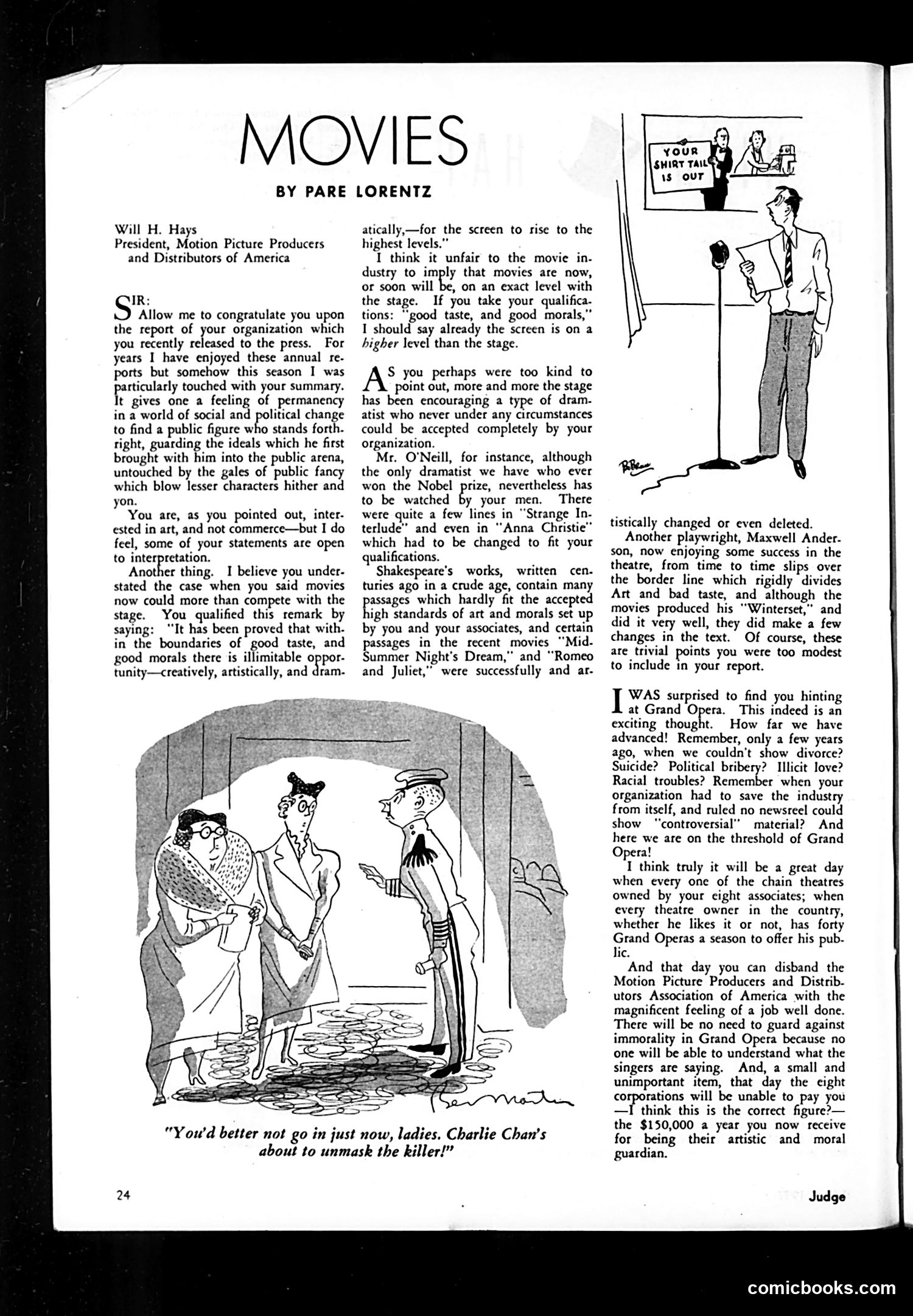
# Analysis of Judge Magazine Page This page is primarily **entertainment content and reviews**, not political satire. It features two sections: **THEATRE** reviews of contemporary plays, including works by Samuel Shipman, Raymond Van Sickle, and others—typical early 20th-century Broadway fare. **MOVIES** reviews of silent films and early talkies, including "Pare Lorentz" productions. The small **cartoon** at bottom left appears to show a figure with a suitcase labeled "JUDGE," possibly self-referential to the magazine itself, though its specific meaning is unclear without additional context. This is primarily a **entertainment/culture page** rather than political commentary—Judge functioned as both satirical magazine and general-interest publication covering theater and cinema for educated readers of the era.
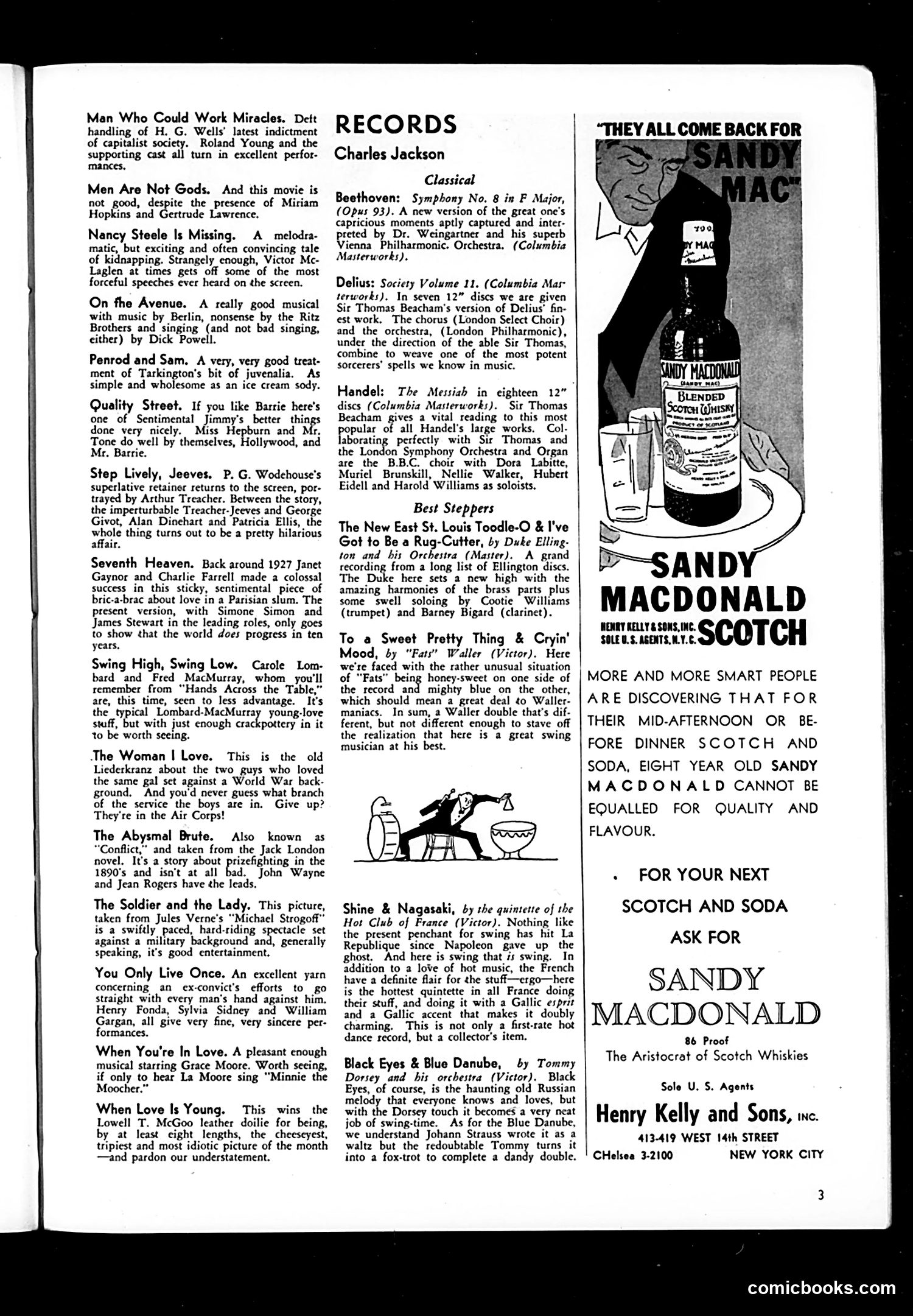
# Judge Magazine Page Analysis This page is primarily **advertising and record reviews**, not political satire. The dominant content is a large advertisement for Sandy Macdonald Scotch whisky, featuring a bottle and glass with the slogan "They All Come Back For Sandy Macdonald." The left column contains Charles Jackson's record reviews discussing classical music (Beethoven, Delius, Handel) and jazz recordings (Duke Ellington, Fats Waller, Tommy Dorsey). These are straightforward critical assessments. The small illustration accompanying the reviews appears to be a generic musical scene—a pianist or musician at an instrument—rather than political commentary. **This page reflects Judge's evolution** toward lighter entertainment content and advertising revenue during the 1930s, moving away from its earlier satirical focus.
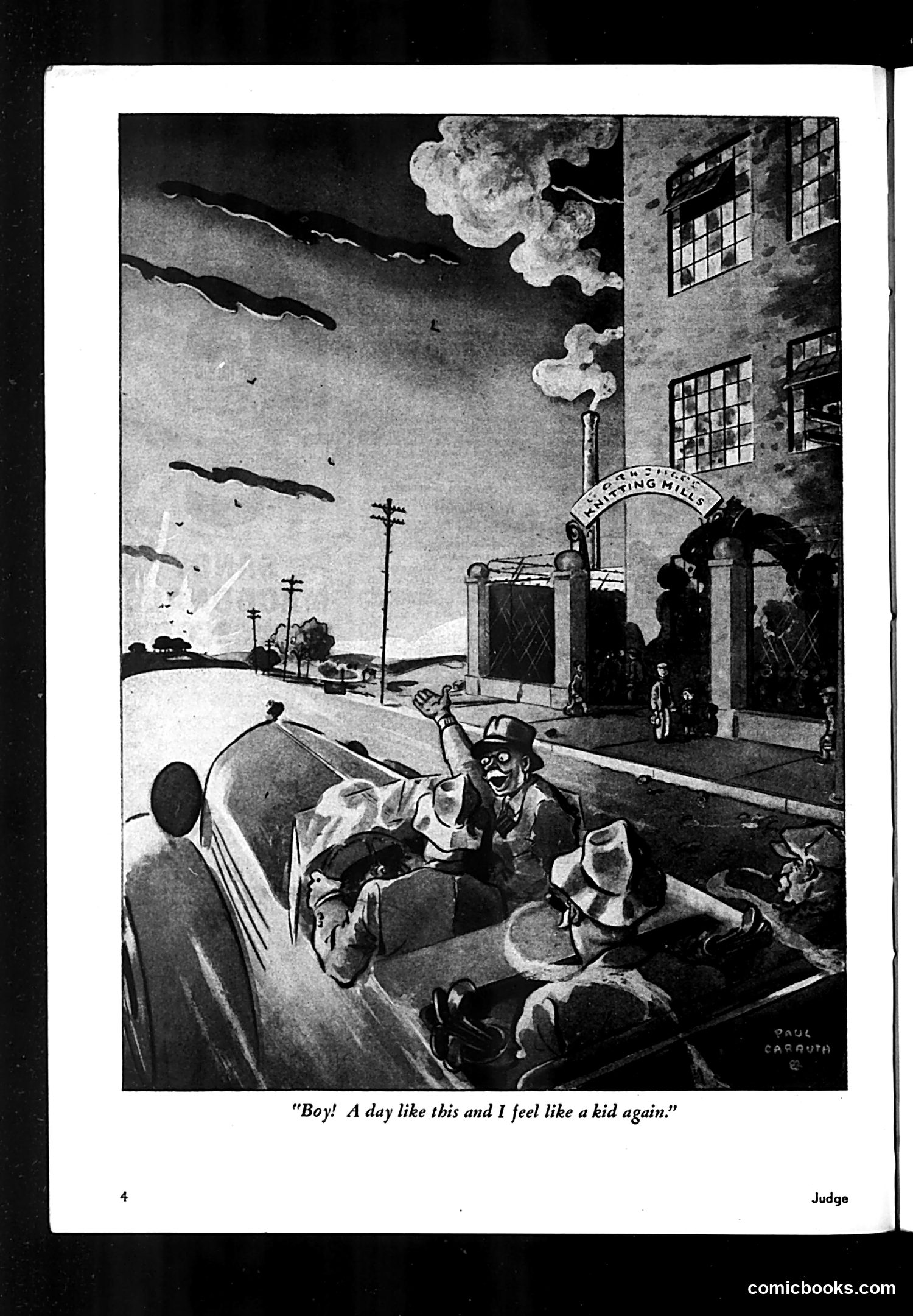
# Analysis This illustration depicts a man in a car experiencing childlike joy during what appears to be a joyride. The caption—"Boy! A day like this and I feel like a kid again!"—suggests the cartoon celebrates the rejuvenating effects of automotive pleasure and freedom. The setting includes an industrial mill building (labeled "printing mill"), utility poles, and crosses on the horizon, establishing an ordinary American landscape. The figure's exuberant gesture and the car's open-air design emphasize the liberating sensation of driving. This likely satirizes the cultural phenomenon of automobiles as symbols of American freedom, leisure, and escape from industrial/urban routine in the early 20th century. The joke plays on how driving temporarily restores youthful vitality to an older man, reflecting broader American enthusiasm for motorization and modern consumer goods.
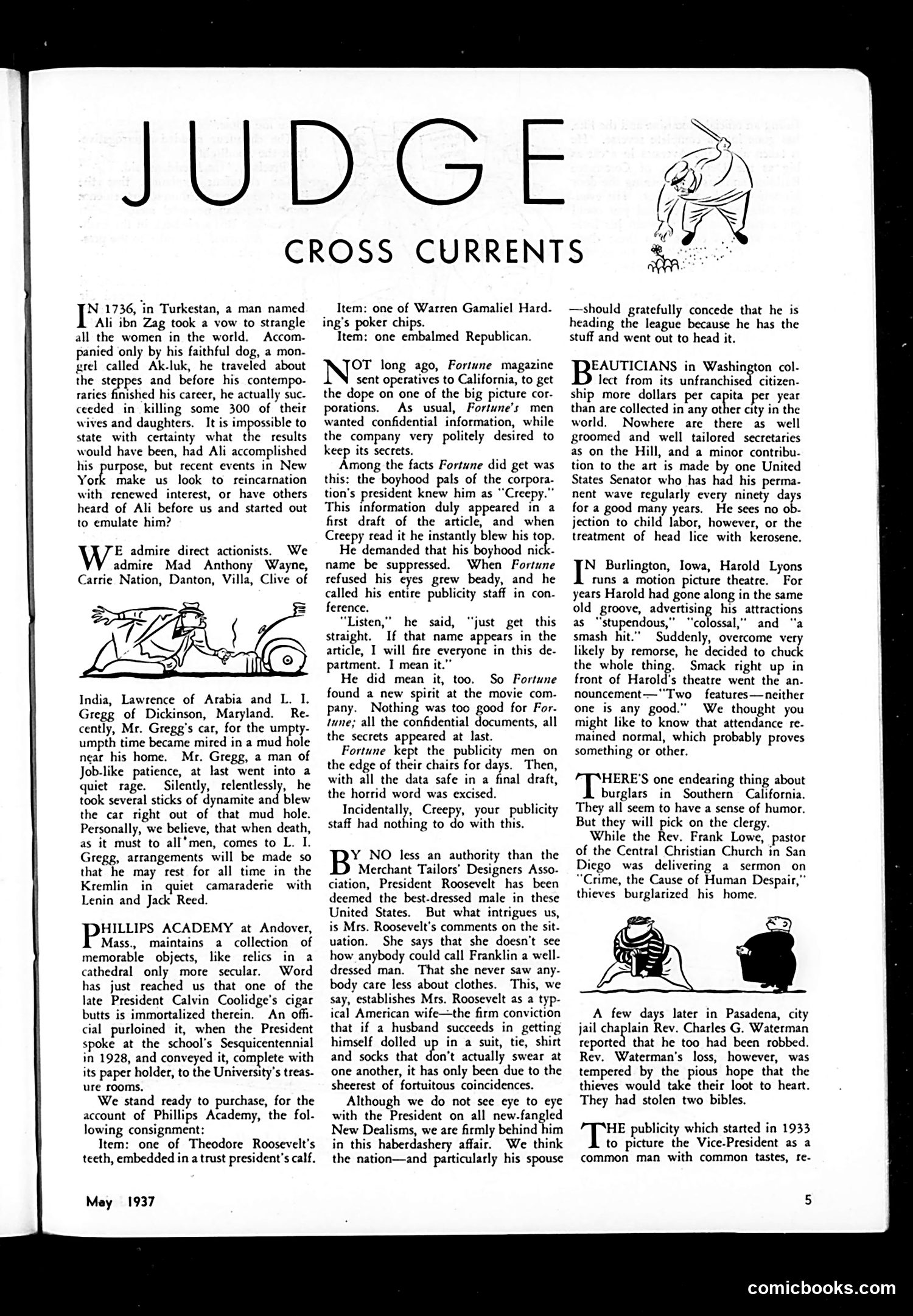
# Judge Magazine "Cross Currents" - May 1937 This page contains multiple satirical gossip items targeting 1930s public figures and institutions. The text mocks: **Fortune Magazine's corporate espionage**: A "Creepy" executive was embarrassed when Fortune revealed he knew about confidential business matters. The satire criticizes corporate secrecy-breaking journalism. **Mrs. Franklin Roosevelt's fashion commentary**: The piece notes her claim that President Roosevelt is well-dressed, sarcastically implying she's being diplomatic rather than honest—a jab at both the First Lady and the President's appearance. **Clergy theft**: A San Diego church pastor's home was robbed, with ironic commentary on burglars targeting "the clergy" alongside other victims. **Phillips Academy**: A humorous item about acquiring Theodore Roosevelt's teeth as a relic. The cartoons (small illustrations visible) appear to accompany these gossipy items with visual humor. Overall, this represents Judge's typical satirical approach to lampooning politics, society, and public figures.
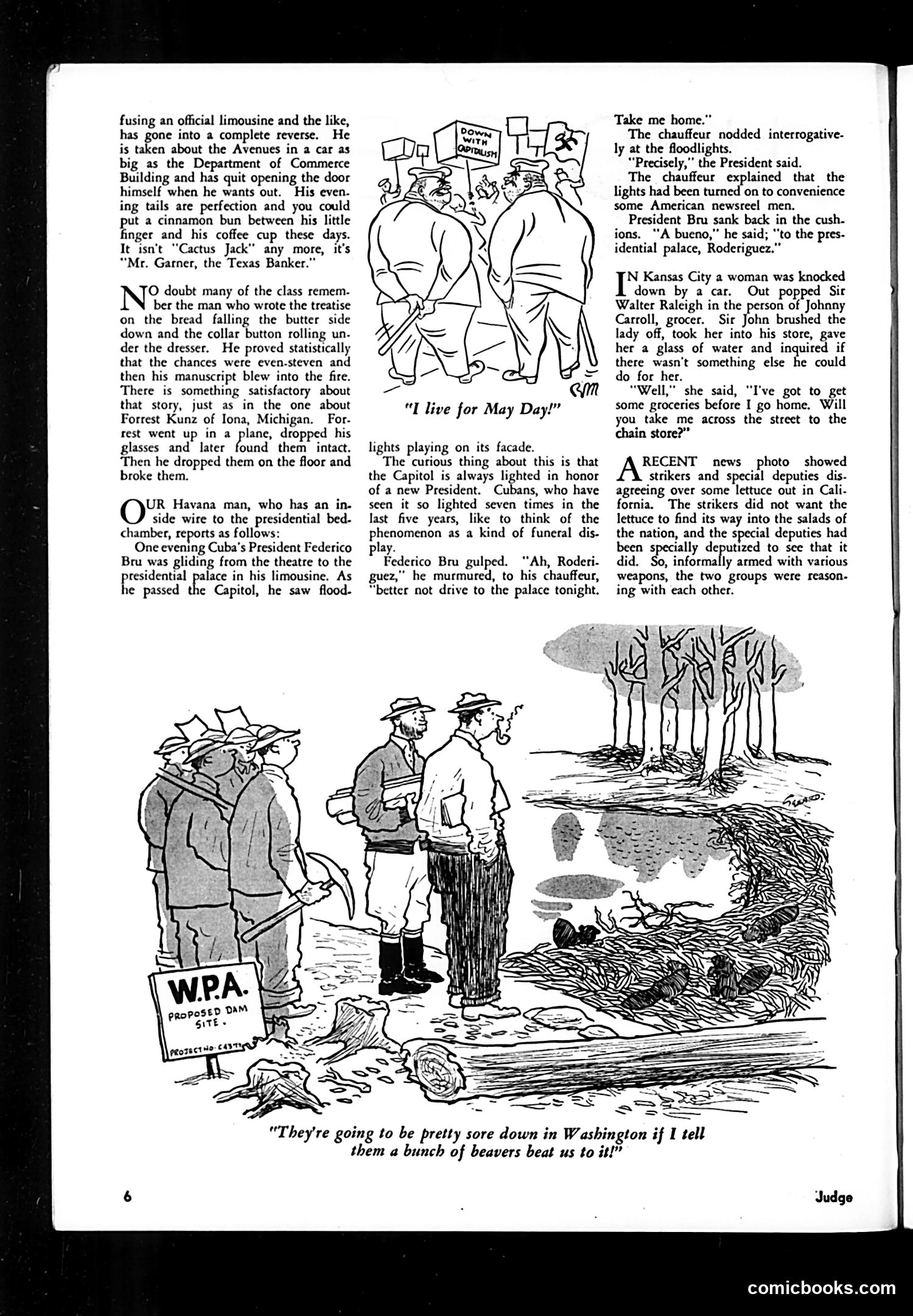
# Political Satire Analysis This Judge magazine page contains two distinct pieces of political satire from the New Deal era. **Top cartoon**: Shows two large figures labeled "I live for May Day," satirizing communist sympathizers or labor radicals. The context suggests mockery of May Day celebrations and leftist politics. **Bottom cartoon**: Depicts WPA (Works Progress Administration) officials at a "proposed dam site." One man threatens to tell Washington "a bunch of beavers beat us to it!"—mocking the WPA's infrastructure projects by comparing government workers unfavorably to beavers' engineering abilities. This ridicules the effectiveness and competence of Roosevelt's New Deal programs, a common conservative critique. Both cartoons reflect Judge's skeptical, often hostile stance toward 1930s New Deal policies and communist/labor movements.
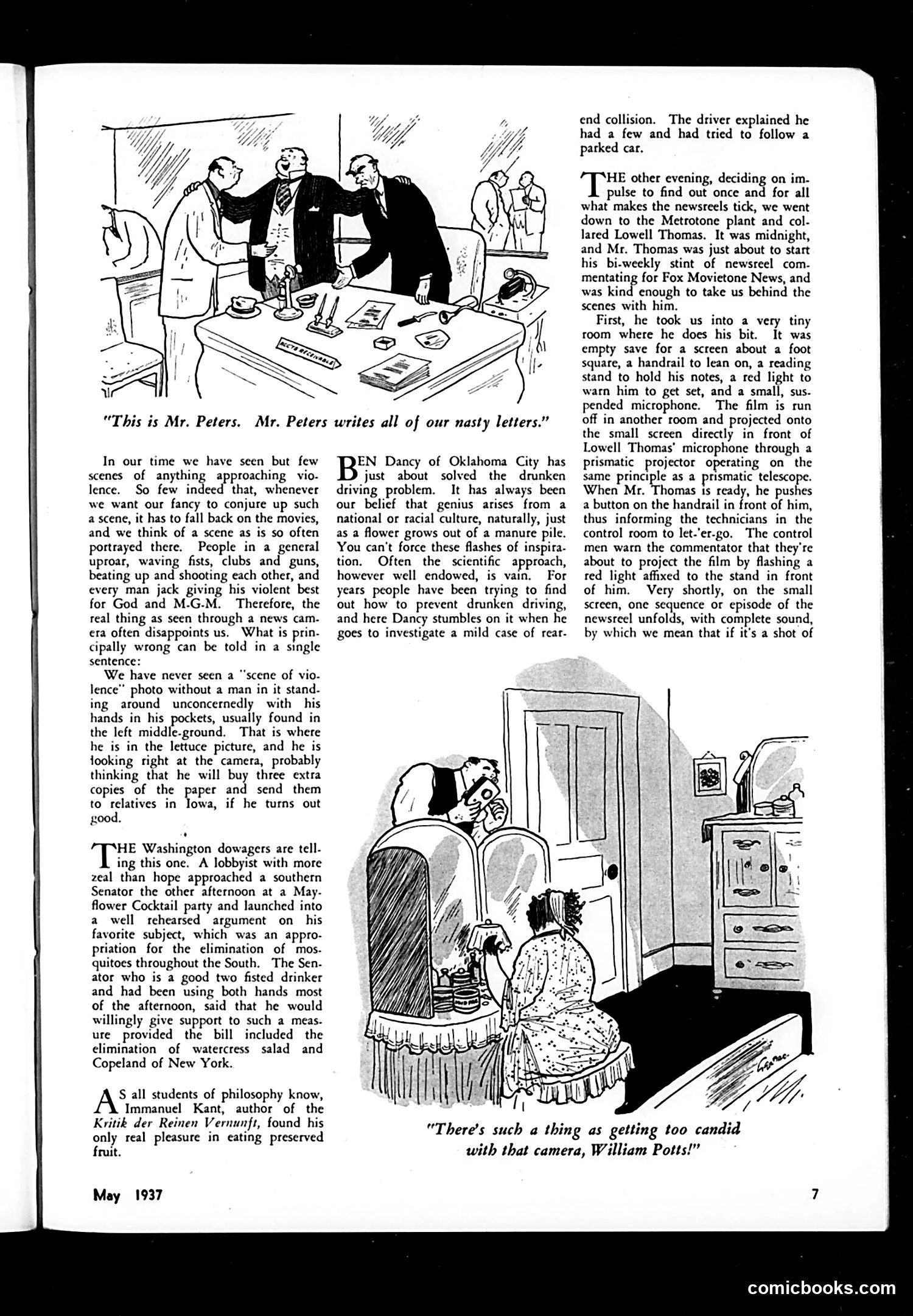
# Analysis of Judge Magazine Page, May 1937 This page contains satirical anecdotes about American life rather than political cartoons. The top illustration shows a newsroom scene introducing "Mr. Peters," who writes complaint letters—a joke about the proliferation of reader mail. The main story discusses Ben Dancy of Oklahoma City solving "the drunken driving problem" through unconventional scientific methods, satirizing both amateur inventors and genuine social concerns about drunk driving (a growing 1930s issue). The bottom cartoon depicts someone filming with an early camera, captioning "There's such a thing as getting too candid with that camera, William Potts!" This mocks the era's new amateur filmmaking technology and overzealous home cinematographers. The page satirizes ordinary Americans' obsessions: complaint-writing, homespun problem-solving, and the novelty of accessible cameras.
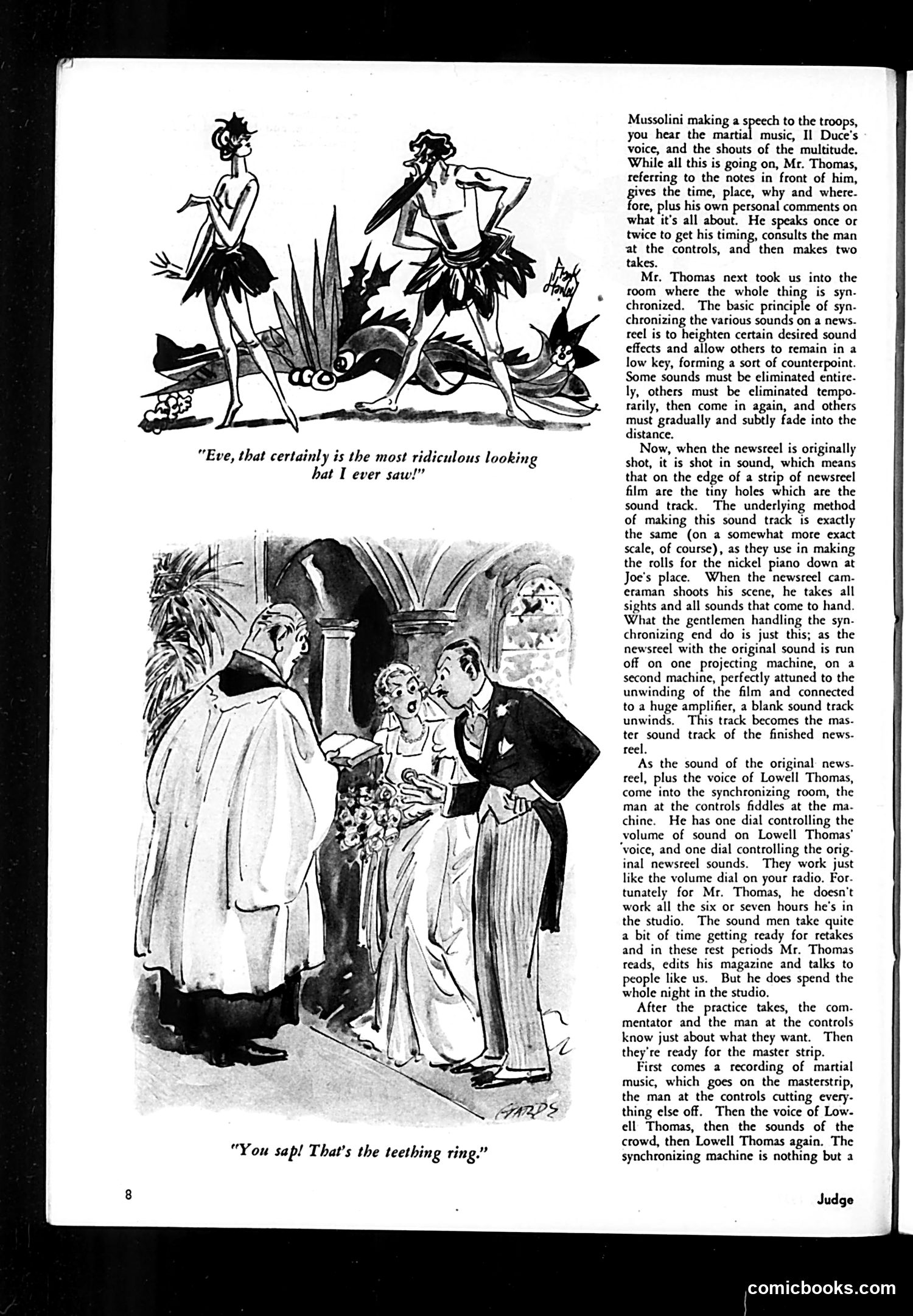
# Judge Magazine Page Explanation This page describes newsreel production techniques, specifically how sound is synchronized to film footage. The top cartoon depicts two figures in what appears to be a comedic domestic scene (caption: "Eve, that certainly is the most ridiculous looking hat I ever saw!"). The lower cartoon shows priests or religious figures with the caption "You sap! That's the teething ring." The main article discusses **Lowell Thomas**, a famous radio commentator and newsreel narrator, explaining how he records voiceovers for newsreels featuring Mussolini's speeches. It details the technical process: multiple sound elements (martial music, Thomas's voice, crowd noise) are synchronized on a blank sound track using dials and controls, similar to player piano technology. The process involves recording, editing, mixing different audio layers, and creating a "master strip" for the finished newsreel. This appears to be an educational piece about emerging sound film technology, circa the early 1930s.
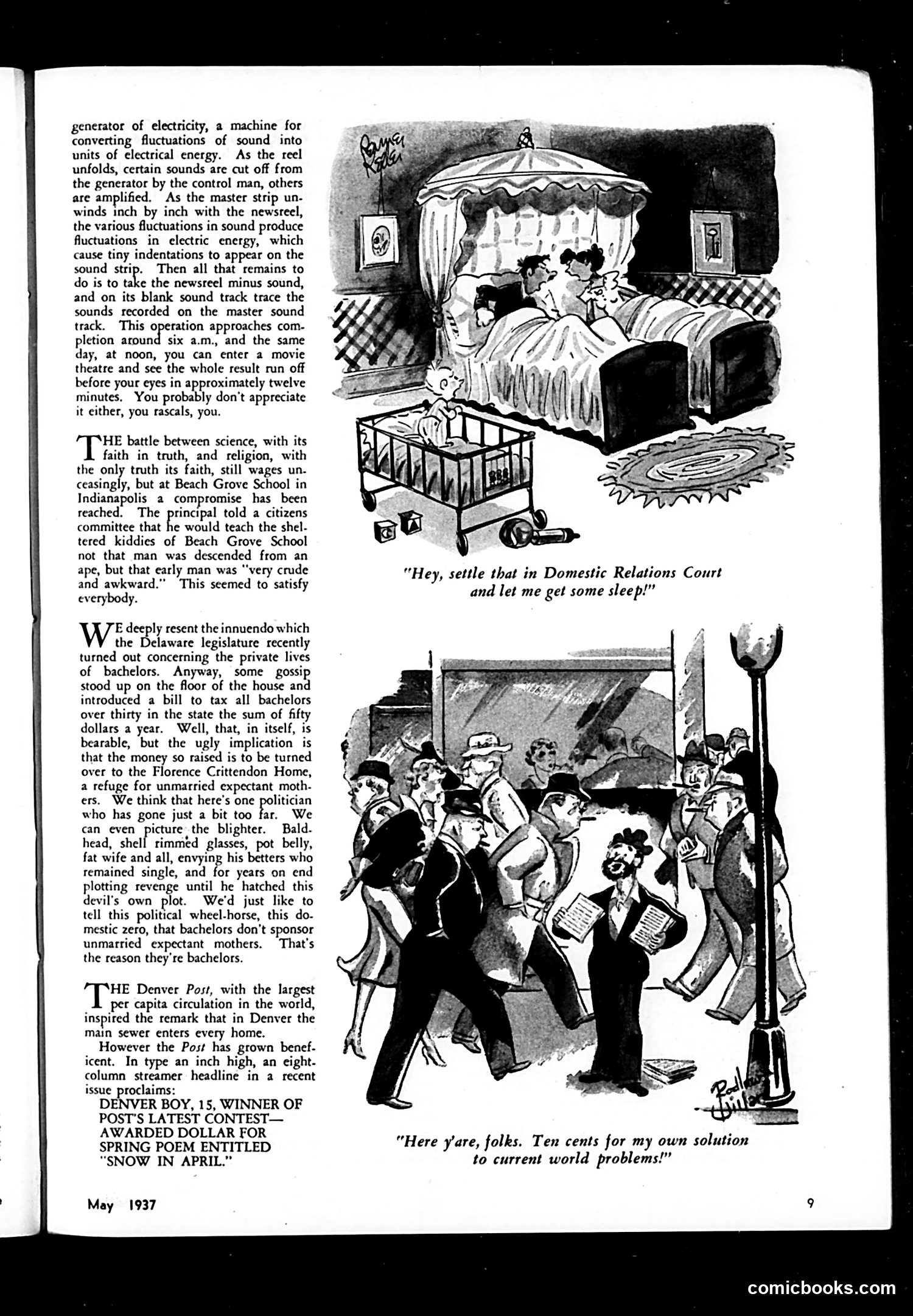
# Judge Magazine, May 1937 - Page Analysis This page contains three satirical pieces: **Top cartoon**: Depicts a couple arguing in bed while a baby cries nearby. The joke mocks marital disputes by suggesting they take their argument to "Domestic Relations Court"—implying divorce/separation litigation is so common it should happen in court rather than at home. **Middle section**: Critiques a Delaware legislature bill proposing a $50 annual tax on unmarried men over 30, with revenue going to the Florence Crittenden Home (a shelter for unwed mothers). The author sarcastically notes the bill implies bachelors cause such pregnancies, when in fact "bachelors don't sponsor unmarried expectant mothers"—the satire being that single men aren't responsible. **Bottom cartoon**: Shows a street vendor selling his "solutions to current world problems" for ten cents, likely satirizing Depression-era charlatans or politicians offering cheap fixes to serious economic/social crises. The page also includes a paragraph about sound recording technology advancement in newsreels—presented matter-of-factly amid the satire.
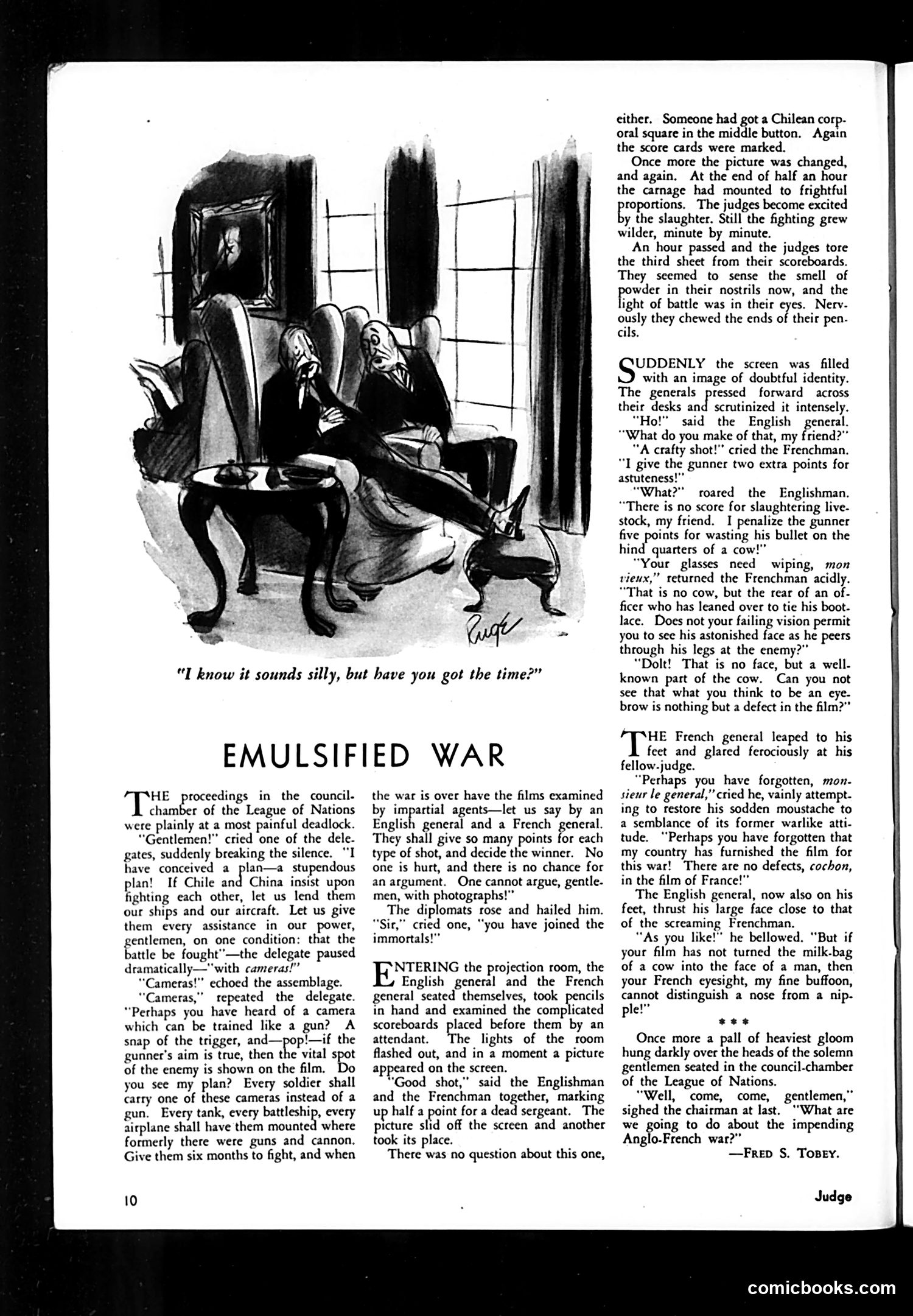
# "Emulsified War": League of Nations Satire This story satirizes the League of Nations' ineffectual response to international conflicts. The setup: delegates propose replacing actual warfare between Chile and China with a "camera war"—soldiers photograph each other instead of fighting, then judges score the "shots" from film footage. The satire deepens when English and French judges review the footage. They become emotionally invested, cheering kills and arguing over scoring. A critical moment: they debate whether an image shows a dead officer or a cow's rear end—revealing that photographs are ambiguous, subjective, and unreliable as objective evidence. The joke: the League hoped film evidence could settle disputes "scientifically" without argument. Instead, judges squabble identically to how nations quarrel. The satire mocks both the League's naive faith in objective documentation and the deeper truth that international disputes stem from conflicting interests, not lack of evidence. **Author**: Fred S. Tobey