
Judge, 1937-05 · page 9 of 37
Judge — May 1937 — page 9: what you’re looking at
What you’re looking at
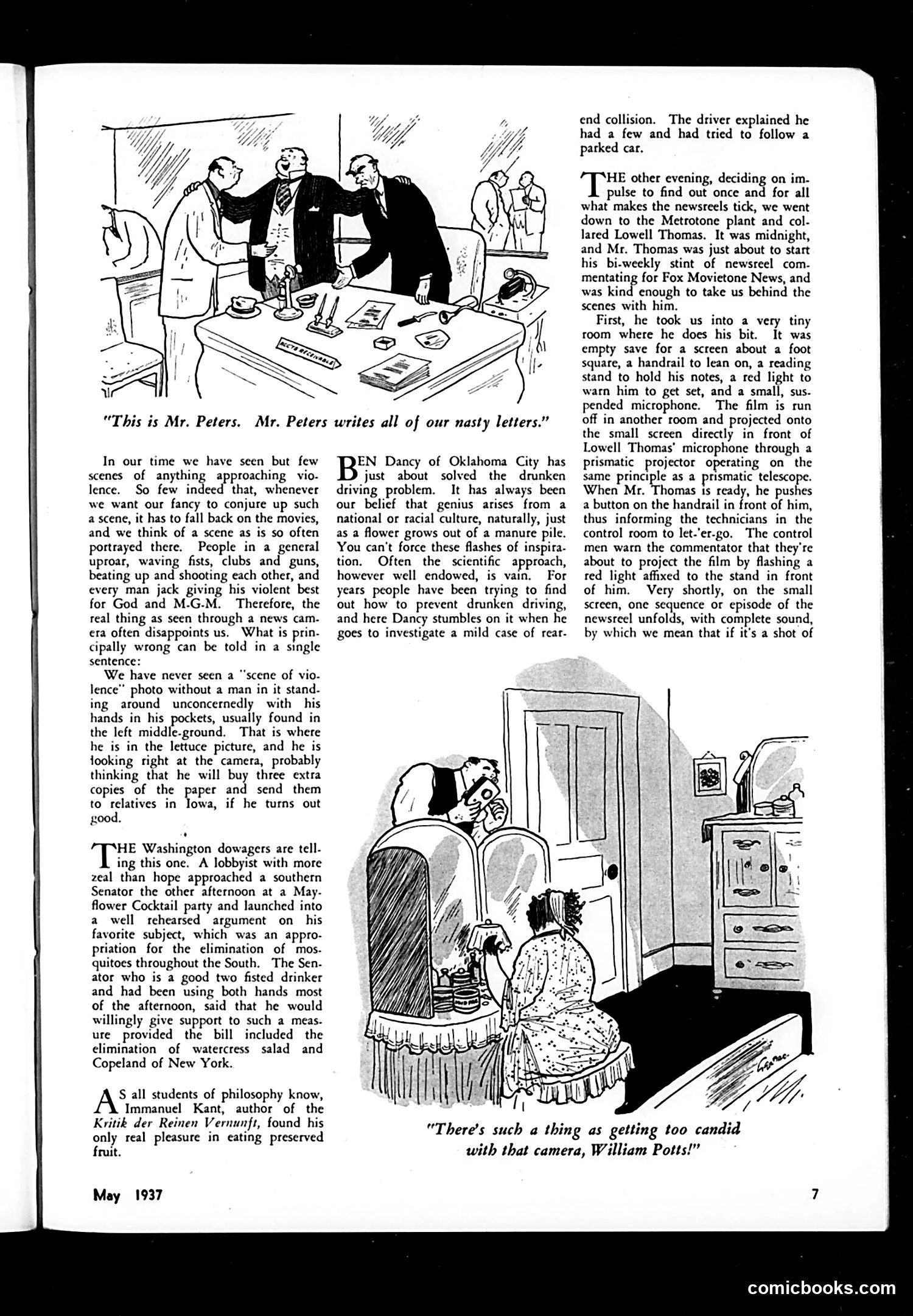
# Analysis of Judge Magazine Page, May 1937 This page contains satirical anecdotes about American life rather than political cartoons. The top illustration shows a newsroom scene introducing "Mr. Peters," who writes complaint letters—a joke about the proliferation of reader mail. The main story discusses Ben Dancy of Oklahoma City solving "the drunken driving problem" through unconventional scientific methods, satirizing both amateur inventors and genuine social concerns about drunk driving (a growing 1930s issue). The bottom cartoon depicts someone filming with an early camera, captioning "There's such a thing as getting too candid with that camera, William Potts!" This mocks the era's new amateur filmmaking technology and overzealous home cinematographers. The page satirizes ordinary Americans' obsessions: complaint-writing, homespun problem-solving, and the novelty of accessible cameras.
📄 Transcribed text from this page (OCR, searchable)
Machine-transcribed from the original scan — historical spelling and the odd misread are preserved.
“This is Mr. Peters. Mr. Peters writes all of our nasty letters.” In our time we have seen but few scenes of anything approaching vio- lence. So few indeed that, whenever we want our fancy to conjure up such a scene, it has to fall back on the movies, and we think of a scene as is so often portrayed there. People in a general uproar, waving fists, clubs and guns, beating up and shooting each other, and every man jack giving his violent best for God and M-G-M. Therefore, the real thing as seen through a news cam. era often disappoints us. What is prin- cipally wrong can be told in a single sentence: We have never seen a “scene of vio- lence” photo without a man in it stand- ing around unconcernedly with his hands in his pockets, usually found in the left middle-ground, That is where he is in the lettuce picture, and he is fooking right at the camera, probably thinking that he will buy three extra copies of the paper and send them to relatives in Iowa, if he turns out good. ‘Te Washington dowagers are tell- ing this one. A lobbyist with more zeal than hope approached a southern Senator the other afternoon at a May- flower Cocktail party and launched into a well rehearsed argument on_ his favorite subject, which was an appro- priation for the elimination of mos- quitoes throughout the South. The Sen- ator who is a good two fisted drinker and had been using both hands most of the afternoon, said that he would willingly give support to such a meas. ure provided the bill included the elimination of watercress salad and Copeland of New York. AS all students of philosophy know, Immanuel Kant, author of the Kritik der Reinen Vernunft, found his only real pleasure in eating preserved fruit. May 1937 BN Dancy of Oklahoma City has just about solved the drunken driving problem. It has always been our belief that genius arises from a national or racial culture, naturally, just as a flower grows out of a manure pile. You can’t force these flashes of inspira- tion. Often the scientific approach, however well endowed, is vain. For years people have been trying to find out how to prevent drunken driving, and here Dancy stumbles on it when he goes to investigate a mild case of rear- Nh “There's such a thing as getting too candid end collision. The driver explained he had a few and had tried to follow a parked car. HE other evening, deciding on im. pulse to find out once and for all what makes the newsreels tick, we went down to the Metrotone plant and col- lared Lowell Thomas. It was midnight, and Mr. Thomas was just about to start his bi-weekly stint of newsreel com- mentating for Fox Movietone News, and was kind enough to take us behind the scenes with him. First, he took us into a very tiny room where he does his bit. It was empty save for a screen about a foot square, a handrail to lean on, a reading stand to hold his notes, a red light to warn him to get set, and a small, sus- pended microphone. The film is run off in another room and projected onto the small screen directly in front of Lowell Thomas’ microphone through a prismatic projector operating on the same principle as a prismatic telescope. When Mr. Thomas ts ready, he pushes a button on the handrail in front of him, thus informing the technicians in the control room to let.’er-go. The control men warn the commentator that they're about to project the film by flashing a red light affixed to the stand in front of him. Very shortly, on the small screen, one sequence or episode of the newsreel unfolds, with complete sound, by which we mean that if it’s a shot of with that camera, William Potts!” comicbooks.com