
Judge, 1937-05 · page 24 of 37
Judge — May 1937 — page 24: what you’re looking at
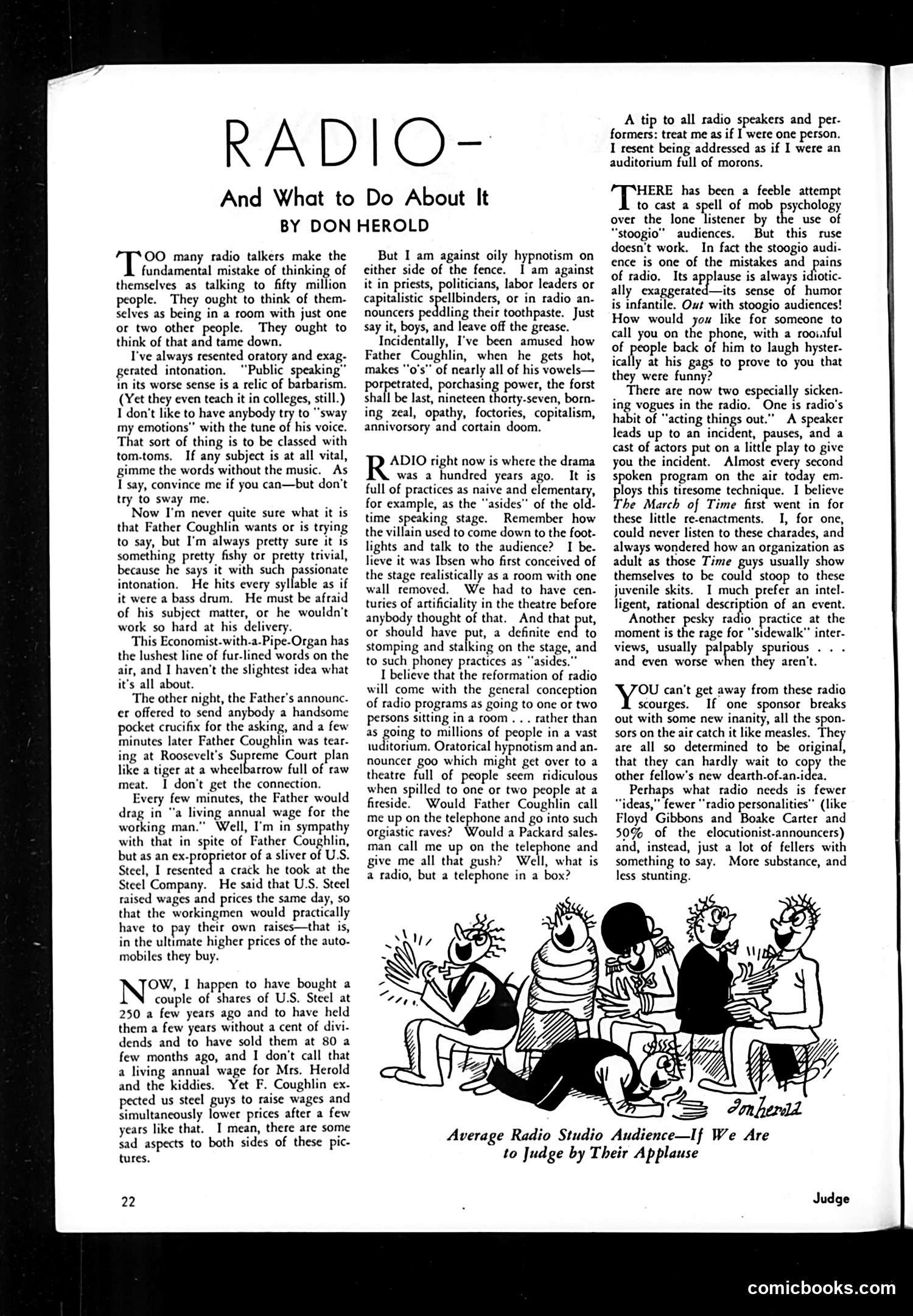
A restored page from Judge, 1937-05. Page through the whole issue in the reader above.
📄 Transcribed text from this page (OCR, searchable)
Machine-transcribed from the original scan — historical spelling and the odd misread are preserved.
RADIO- And What to Do About It BY DON HEROLD Tre many radio talkers make the fundamental mistake of thinking of themselves as talking to fifty million people. They ought to think of them- selves as being in a room with just one or two other people. They ought to think of that and tame down. I've always resented oratory and exag- gerated intonation. ‘Public speaking” in its worse sense is a relic of barbarism. (Yet they even teach it in colleges, still.) I don't like to have anybody try to “sway my emotions’ with the tune of his voice. That sort of thing is to be classed with tom-toms, If any subject is at all vital, gimme the words without the music. As I say, convince me if you can—but don't try to sway me. Now I'm never quite sure what it is that Father Coughlin wants or is trying to say, but I'm always pretty sure it is something pretty fishy or pretty trivial, because he says it with such passionate intonation. He hits every syllable as if it were a bass drum. He must be afraid of his subject matter, or he wouldn't work so hard at his delivery. This Economist-with-a-Pipe-Organ has the lushest line of fur-lined words on the air, and I haven't the slightest idea what it’s all about. The other night, the Father's announc. er offered to send anybody a handsome pocket crucifix for the asking, and a few minutes later Father Coughlin was tear. ing at Roosevelt's Supreme Court plan like a tiger at a wheelbarrow full of raw meat. I don’t get the connection. Every few minutes, the Father would drag in “a living annual wage for the working man." Well, I'm in sympathy with that in spite of Father Coughlin, but as an ex-proprietor of a sliver of U.S. Steel, I resented a crack he took at the Steel Company. He said that U.S. Steel raised wages and prices the same day, so that the workingmen would practically have to pay their own raises—that is, in the ultimate higher prices of the auto- mobiles they buy. Nc. I happen to have bought a couple of shares of U.S. Steel at 250 a few years ago and to have held them a few years without a cent of divi- dends and to have sold them at 80 a few months ago, and I don’t call that a living annual wage for Mrs. Herold and the kiddies. Yet F. Coughlin ex. pected us steel guys to raise wages and simultaneously lower prices after a few years like that. I mean, there are some sad aspects to both sides of these pic- tures. 22 But I am against oily hypnotism on either side of the fence. I am against it in priests, politicians, labor leaders or capitalistic spellbinders, or in radio an. nouncers peddling their toothpaste. Just say it, boys, and leave off the grease. Incidentally, I've been amused how Father Coughlin, when he gets hot, makes “o's” of nearly all of his vowels— rpetrated, porchasin; wer, the forst Fall be last, Prneteen ty seven, born- ing zeal, opathy, foctories, copitalism, annivorsory and cortain doom. Rize right now is where the drama was a hundred years ago. It is full of practices as naive and elementary, for example, as the “asides” of the old- time speaking stage. Remember how the villain used to come down to the foot- lights and talk to the audience? I be. lieve it was Ibsen who first conceived of the stage realistically as a room with one wall removed. We had to have cen- turies of artificiality in the theatre before anybody thought of that. And that put, or should have pet a definite end to stomping and stalking on the stage, and to such phoney practices as “asides.” I believe that the reformation of radio will come with the general conception of radio programs as going to one or two persons sitting in a room. . . rather than as going to millions of people in a vast wuditorium. Oratorical hypnotism and an. nouncer goo which might get over to a theatre full of people seem ridiculous when spilled to one or two people at a fireside. Would Father Coughlin call me up on the telephone and go into such orgiastic raves? Would a Packard sales. man call me up on the telephone and give me all that gush? Well, what is a radio, but a telephone in a box? A tip to all radio speakers and per- formers: treat me as if I were one person. I resent being addressed as if I were an auditorium full of morons. Te has been a feeble attempt to cast a spell of mob porcholosy over the lone listener by the use of “stoogio” audiences. But this ruse doesn’t work. In fact the stoogio audi- ence is one of the mistakes and pains of radio. Its applause is always idiotic- ally exaggerated —its sense of humor is infantile. Out with stoogio audiences! How would you like for someone to call you on the phone, with a rooiaful of people back of him to laugh hyster- ically at his gags to prove to you that they were funny? There are now two especially sicken- ing vogues in the radio. One is radio's habit of “acting things out.” A speaker leads up to an incident, pauses, and a cast of actors put on a little play to give you the incident. Almost every second spoken program on the air today em- loys this tiresome technique. I believe ‘he March of Time first went in for these little re-enactments. I, for one, could never listen to these charades, and always wondered how an organization as adult as those Time guys usually show themselves to be could stoop to these juvenile skits. I much prefer an intel- ligent, rational description of an event. Another pesky radio practice at the moment is the rage for “sidewalk” inter- views, usually palpably Spurious . . . and even worse when they aren't. ‘OU can't get away from these radio scourges. If one sponsor breaks out with some new inanity, all the spon- sors on the air catch it like measles. They are all so determined to be original, that they can hardly wait to copy the other fellow's new dearth-of-an-idea. Perhaps what radio needs is fewer “ideas,” fewer “radio personalities” (like Floyd Gibbons and Boake Carter and 50% of the elocutionist-announcers) and, instead, just a lot of fellers with something to say. More substance, and less stunting. Average Radio Studio Audience—If We Are to Judge by Their Applause comicbooks.com