
Judge, 1937-05 · page 12 of 37
Judge — May 1937 — page 12: what you’re looking at
What you’re looking at
# "Emulsified War": League of Nations Satire This story satirizes the League of Nations' ineffectual response to international conflicts. The setup: delegates propose replacing actual warfare between Chile and China with a "camera war"—soldiers photograph each other instead of fighting, then judges score the "shots" from film footage. The satire deepens when English and French judges review the footage. They become emotionally invested, cheering kills and arguing over scoring. A critical moment: they debate whether an image shows a dead officer or a cow's rear end—revealing that photographs are ambiguous, subjective, and unreliable as objective evidence. The joke: the League hoped film evidence could settle disputes "scientifically" without argument. Instead, judges squabble identically to how nations quarrel. The satire mocks both the League's naive faith in objective documentation and the deeper truth that international disputes stem from conflicting interests, not lack of evidence. **Author**: Fred S. Tobey
📄 Transcribed text from this page (OCR, searchable)
Machine-transcribed from the original scan — historical spelling and the odd misread are preserved.
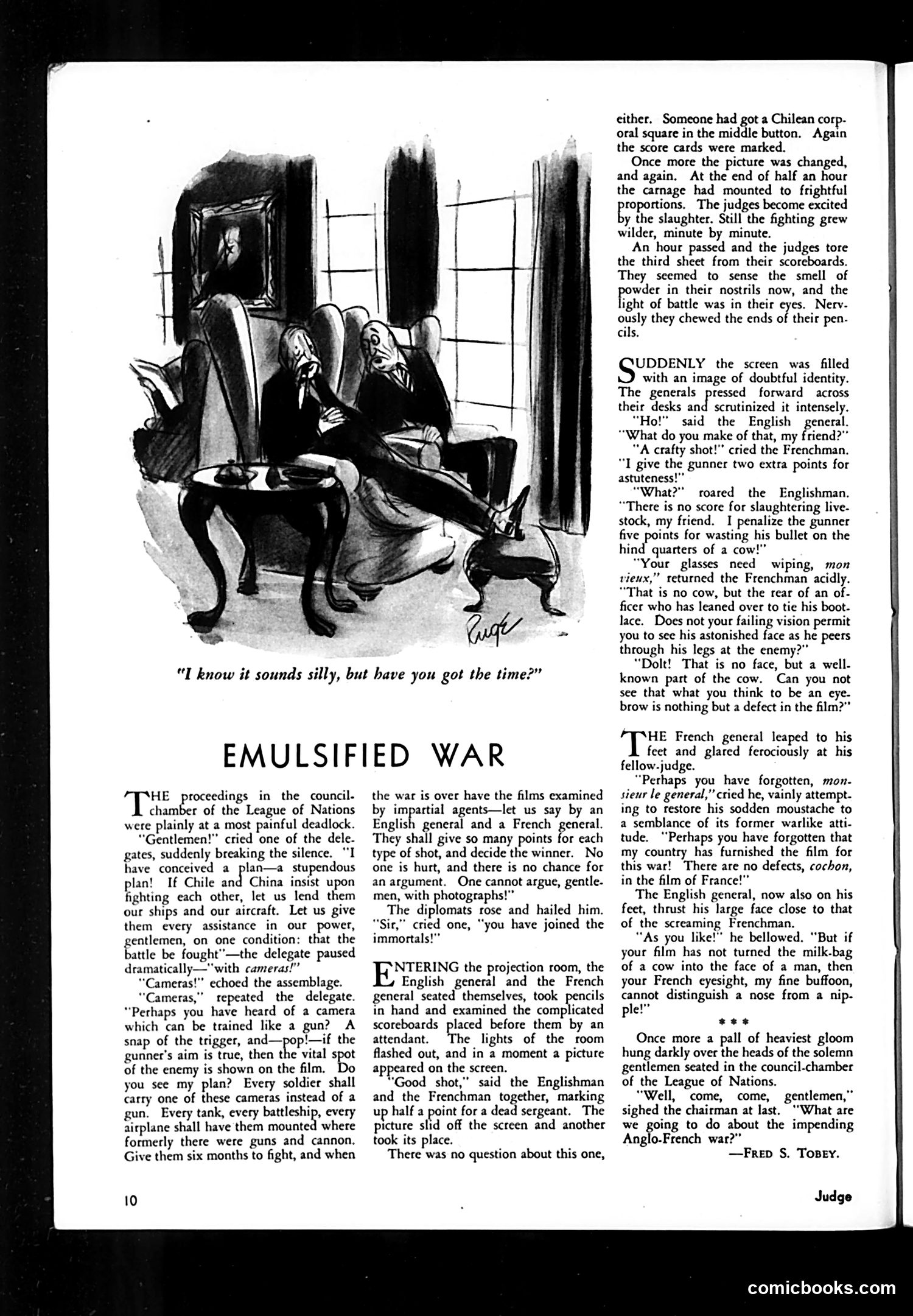
"I know it sounds silly, but have you got the time?” EMULSIFIED WAR "Te proceedings in the council. chamber of the League of Nations were plainly at a most painful deadlock. “Gentlemen!” cried one of the dele. gates, suddenly breaking the silence. “I have conceived a plan—a stupendous plan! If Chile and China insist upon fighting each other, let us lend them our ships and our aircraft. Let us give them every assistance in our power, gentlemen, on one condition: that the battle be fought”—the delegate paused dramatically—"with cameras!” “Cameras!” echoed the assemblage. “Cameras,” repeated the delegate. “Perhaps you have heard of a camera which can be trained like a gun? A snap of the trigger, and—pop!—if the gunner's aim is true, then the vital spot of the enemy is shown on the film. Do you see my plan? Every soldier shall carry one of these cameras instead of a gun. Every tank, every battleship, every airplane shall have them mounted where formerly there were guns and cannon. Give them six months to fight, and when 10 the war is over have the films examined by impartial agents—let us say by an English general and a French general. They shall give so many points for each type of shot, and decide the winner. No one is hurt, and there is no chance for an argument. One cannot argue, gentle- men, with photographs!” The diplomats rose and hailed him. “Sir,” cried one, “you have joined the immortals!” PNENING the projection room, the English general and the French general seated themselves, took pencils in hand and examined the complicated scoreboards placed before them by an attendant. he lights of the room flashed out, and in a moment a picture appeared on the screen. “Good shot,” said the Englishman and the Frenchman together, marking up half a point for a dead sergeant. The picture slid off the screen and another took its place. There was no question about this one, either. Someone had got a Chilean corp- oral square in the middle button. Again the score cards were marked. Once more the picture was changed, and again. At the end of half an hour the carnage had mounted to frightful proportions. The judges become excited y the slaughter. Still the fighting grew wilder, minute by minute. An hour passed and the judges tore the third sheet from their scoreboards. They seemed to sense the smell of wder in their nostrils now, and the ight of battle was in their eyes. Nerv- ously they chewed the ends of their pen- cils. UDDENLY the screen was filled with an image of doubtful identity. The generals pressed forward across their desks and scrutinized it intensely. “Ho!” said the English general. “What do you make of that, my friend?” “A crafty shot!" cried the Frenchman. “I give the gunner two extra points for astuteness!"” “What?” roared the Englishman. “There is no score for slaughtering live- stock, my friend. I penalize the gunner five points for wasting his bullet on the hind quarters of a cow!” “Your glasses need wiping, mon rieux,” returned the Frenchman acidly. “That is no cow, but the rear of an of- ficer who has leaned over to tie his boot- lace. Does not your failing vision permit you to see his astonished face as he peers through his legs at the enemy?” “Dolt! That is no face, but a well- known part of the cow. Can you not see that what you think to be an eye. brow is nothing but a defect in the film?” "TE French general leaped to his feet and glared ferociously at his fellow-judge. “Perhaps you have forgotten, mon- sieur le general,” cried he, vainly attempt- ing to restore his sodden moustache to a semblance of its former warlike atti- tude. “Perhaps you have forgotten that my country has furnished the film for this war! There are no defects, cochon, in the film of France!” The English general, now also on his feet, thrust his large face close to that of the screaming Frenchman. “As you like!” he bellowed. “But if your film has not turned the milk-bag of a cow into the face of a man, then your French eyesight, my fine buffoon, cannot distinguish a nose from a nip. ple!” tee Once more a pall of heaviest gloom hung darkly over the heads of the solemn gentlemen seated in the council-chamber of the League of Nations. “Well, come, come, gentlemen,” sighed the chairman at last. ‘What are we going to do about the impending Anglo-French war?” —Frep S. Toney. Judge comicbooks.com