
Judge, 1937-05 · page 34 of 37
Judge — May 1937 — page 34: what you’re looking at
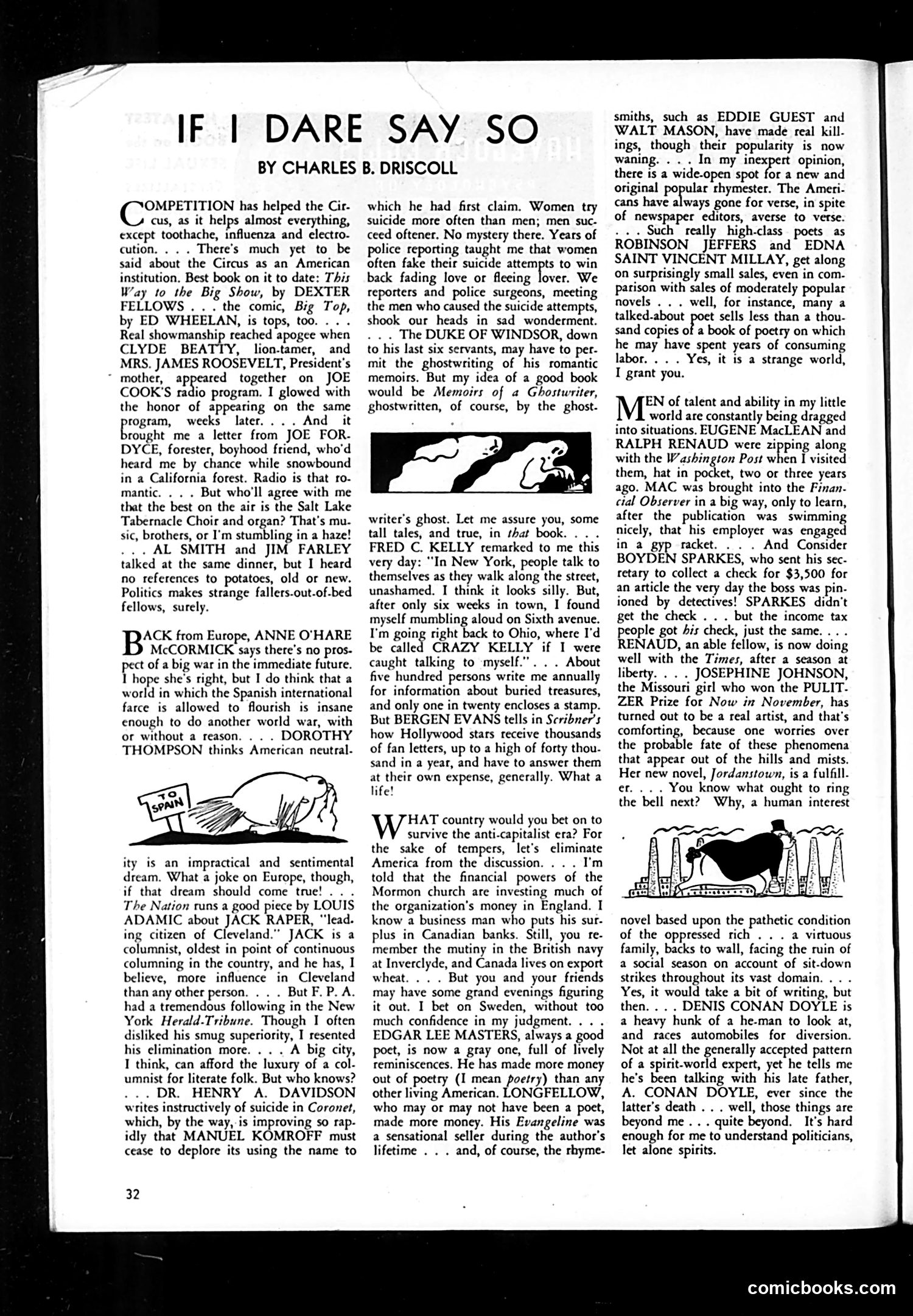
A restored page from Judge, 1937-05. Page through the whole issue in the reader above.
📄 Transcribed text from this page (OCR, searchable)
Machine-transcribed from the original scan — historical spelling and the odd misread are preserved.
IF | DARE SAY SO BY CHARLES B. DRISCOLL OMPETITION has helped the Cir- cus, as it helps almost everything, except toothache, influenza and electro. cution. . . . There's much yet to be said about the Circus as an American institution, Best book on it to date: This Way to the Big Show, by DEXTER FELLOWS . . . the comic, Big Top, by ED WHEELAN, is tops, too. . . . Real showmanship reached apogee when CLYDE BEATTY, lion-tamer, and MRS. JAMES ROOSEVELT, President's ~ mother, appeared together on JOE COOK'S radio program. I glowed with the honor of appearing on the same prostam, weeks later... . And it rought me a letter from JOE FOR. DYCE, forester, boyhood friend, who'd heard me by chance while snowbound in a California forest. Radio is that ro- mantic. . . . But who'll agree with me that the best on the air is the Salt Lake Tabernacle Choir and organ? That's mu- sic, brothers, or I'm stumbling in a haze! . . . AL SMITH and JIM FARLEY talked at the same dinner, but I heard no references to potatoes, old or new. Politics makes strange fallers-out-of-bed fellows, surely. ACK from Europe, ANNE O'HARE McCORMICK says there's no pros- pect of a big war in the immediate future. I hope she’s right, but I do think that a world in which the Spanish international farce is allowed to flourish is insane enough to do another world war, with or without a reason. . . . DOROTHY THOMPSON thinks American neutral- ity is an impractical and sentimental dream. What a joke on Europe, though, if that dream should come tre! . . . The Nation runs a good piece by LOUIS ADAMIC about JACK RAPER, “lead. ing citizen of Cleveland.” JACK is a columnist, oldest in point of continuous columning in the country, and he has, I believe, more influence in Cleveland than any other person. . . . But F. P. A. had a tremendous following in the New York Herald-Tribune. Though I often disliked his smug superiority, I resented his elimination more. . . . A big city, I think, can afford the luxury of a col- umnist for literate folk. But who knows? . .. DR. HENRY A. DAVIDSON writes instructively of suicide in Coronet, which, by the way, is improving so rap- idly that MANUEL KOMROFF must cease to deplore its using the name to 32 which he had first claim. Women try suicide more often than men; men suc- ceed oftener. No mystery there. Years of police reporting taught me that women often fake their suicide attempts to win back fading love or fleeing lover. We reporters and police surgeons, meeting the men who caused the suicide attempts, shook our heads in sad wonderment. . . . The DUKE OF WINDSOR, down to his last six servants, may have to per- mit the ghostwriting of his romantic memoirs. But my idea of a good book would be Memoirs of a Ghostwriter, ghostwritten, of course, by the ghost. writer's ghost. Let me assure you, some tall tales, and true, in that book... . FRED C. KELLY remarked to me this very day: “In New York, people talk to themselves as they walk along the street, unashamed. I think it looks silly. But, after only six weeks in town, I found myself mumbling aloud on Sixth avenue. I'm going right back to Ohio, where I'd be called CRAZY KELLY if I were caught talking to myself... . About five hundred persons write me annually for information about buried treasures, and only one in twenty encloses a stamp. But BERGEN EVANS tells in Scribner's how Hollywood stars receive thousands of fan letters, up to a high of forty thou- sand in a year, and have to answer them at their own expense, generally. What a life! HAT country would you bet on to survive the anti-capitalist era? For the sake of tempers, let's eliminate America from the discussion. . . . I'm told that the financial powers of the Mormon church are investing much of the organization’s money in England. I know a business man who puts his sur- plus in Canadian banks. Still, you re- member the mutiny in the British navy at Inverclyde, and Canada lives on export wheat. . . . But you and your friends may have some grand evenings figuring it out. I bet on Sweden, without too much confidence in my judgment. . . . EDGAR LEE MASTERS, always a good poet, is now a gray one, full of lively reminiscences. He has made more money out of poetry (I mean poetry) than any other living American. LONGFELLOW, who may or may not have been a poet, made more money. His Evangeline was a sensational seller during the author's lifetime . . . and, of course, the rhyme- smiths, such as EDDIE GUEST and WALT MASON, have made real kill- ings, though their popularity is now waning. . . . In my inexpert opinion, there is a wide-open spot or a new and original popular rhymester. The Ameri- cans have always gone for verse, in spite of newspaper editors, averse to verse. . .. Such really high-class poets as ROBINSON JEFFERS and EDNA SAINT VINCENT MILLAY, get along on surprisingly small sales, even in com. parison with sales of moderately popular novels . . . well, for instance, many a talked-about poet sells less than a thou- sand copies of a book of poetry on which he may have spent years of consuming labor. . . . Yes, it 1s a strange world, I grant you. MX of talent and ability in my little world are constantly being dragged into situations. EUGENE MacLEAN and RALPH RENAUD were zipping along with the Washington Post aie T visited them, hat in pocket, two or three years ago. MAC was brought into the Finan- cial Observer in a big way, only to learn, after the publication was swimming nicely, that his employer was engaged in a racket. . . . And Consider BOYDEN SPARKES, who sent his sec- retary to collect a check for $3,500 for an article the very day the boss was pin- ioned by detectives! SPARKES didn’t get the check . . . but the income tax people got bis check, just the same... . RENAUD, an able fellow, is now doing well with the Times, after a season at liberty. . . . JOSEPHINE JOHNSON, the Missouri girl who won the PULIT- ZER Prize for Now in November, has turned out to be a real artist, and that's comforting, because one worries over the probable fate of these phenomena that appear out of the hills and mists. Her new novel, Jordanstown, is a fulfill. er... . You know what ought to ring the bell next? Why, a human interest novel based upon the pathetic condition of the oppressed rich . . . a virtuous family, backs to wall, facing the ruin of a social season on account of sit-down strikes throughout its vast domain. . . . Yes, it would take a bit of writing, but then. . .. DENIS CONAN DOYLE is a heavy hunk of a he-man to look at, and races automobiles for diversion. Not at all the senerally accepted pattern of a spirit-world expert, yet he tells me he’s been talking with his late father, A. CONAN DOYLE, ever since the latter’s death . . . well, those things are beyond me . . . quite beyond. It’s hard enough for me to understand politicians, let alone spirits. comicbooks.com