
Judge, 1937-05 · page 13 of 37
Judge — May 1937 — page 13: what you’re looking at
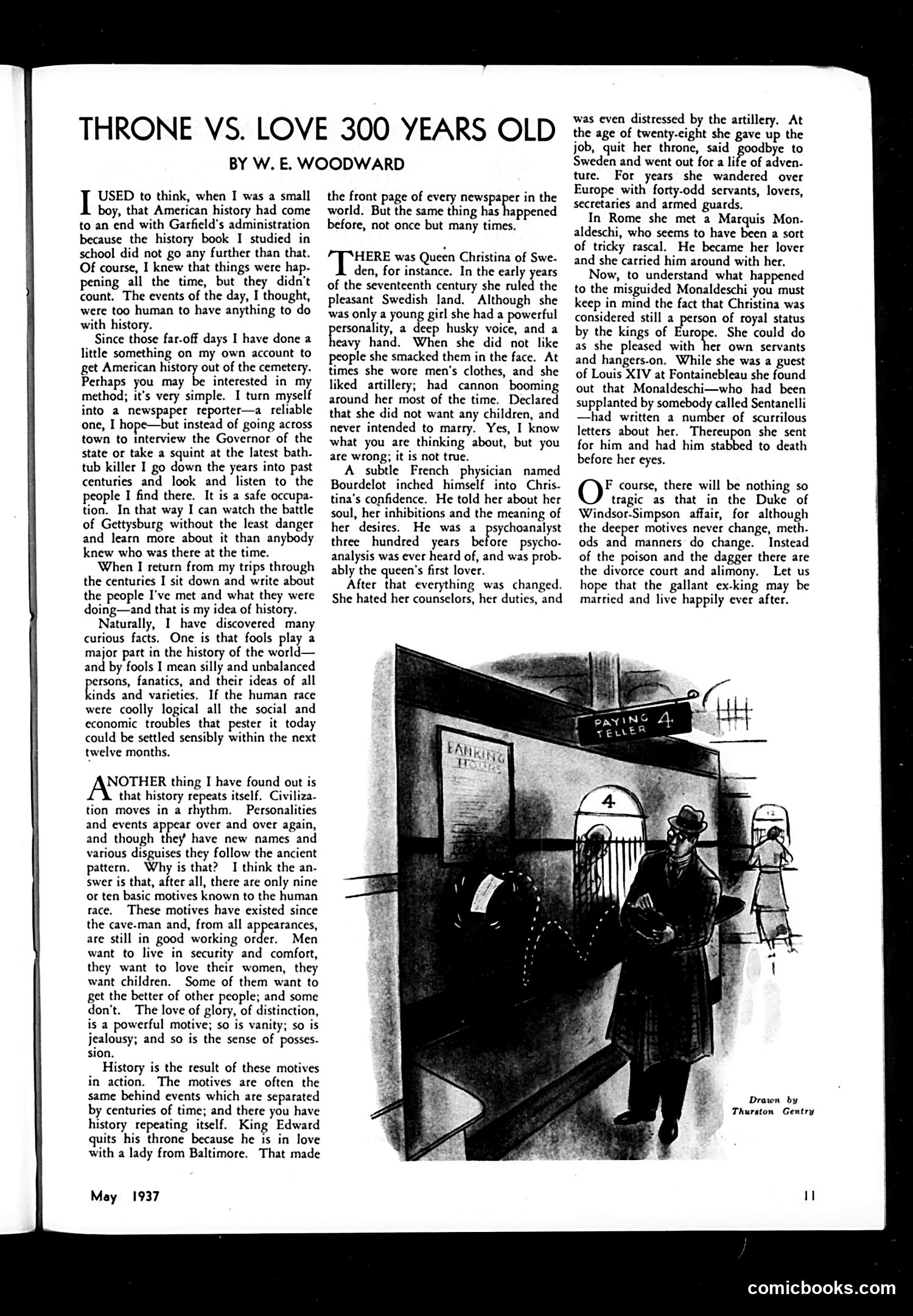
A restored page from Judge, 1937-05. Page through the whole issue in the reader above.
📄 Transcribed text from this page (OCR, searchable)
Machine-transcribed from the original scan — historical spelling and the odd misread are preserved.
THRONE VS. LOVE 300 YEARS OLD BY W. E. WOODWARD USED to think, when I was a small boy, that American history had come to an end with Garfield's administration because the history book I studied in school did not go any further than that. Of course, I knew that things were hap- pening all the time, but they didn’t count. The events of the day, I thought, were too human to have anything to do with history. Since those far-off days I have done a little something on my own account to get American Tutory out of the cemetery. Perhaps you may interested in my method; it’s very simple. I turn myself into a newspaper reporter—a reliable one, I hope—but instead of going across town to interview the Governor of the state or take a squint at the latest bath. tub killer I go down the years into past centuries and look and listen to the people I find there. It is a safe occupa- tion. In that way I can watch the battle of Gettysburg without the least danger and learn more about it than anybody knew who was there at the time. When I return from my trips through the centuries I sit down and write about the people I've met and what they were doing—and that is my idea of history. Naturally, I have discovered many curious facts. One is that fools play a major part in the history of the world— and by fools I mean silly and unbalanced ersons, fanatics, and their ideas of all inds and varieties. If the human race were coolly logical all the social and economic troubles that pester it today could be settled sensibly within the next twelve months, ASGTBER thing I have found out is that history repeats itself. Civiliza- tion moves in a rhythm. Personalities and events appear over and over again, and though they have new names and various disguises they follow the ancient pattern. Why is that? I think the an. swer is that, after all, there are only nine or ten basic motives known to the human race. These motives have existed since the cave-man and, from all appearances, are still in good working order. Men want to live in security and comfort, they want to love their women, they want children. Some of them want to get the better of other people; and some don’t. The love of glory, of distinction, is a powerful motive; so is vanity; so is jealousy; and so is the sense of posses- sion. History is the result of these motives in action. The motives are often the same behind events which are separated by centuries of time; and there you have history repeating itself. King Edward quits his throne because he is in love with a lady from Baltimore. That made May 1937 the front page of every newspaper in the world. But the same thing has happened before, not once but many times. “TE was Queen Christina of Swe. den, for instance. In the early years of the seventeenth century she ruled the pleasant Swedish land. Although she was only a young girl she had a powerful personaly. a deep husky voice, and a eavy hand. When she did not like people she smacked them in the face. At times she wore men's clothes, and she liked artillery; had cannon booming around her most of the time. Declared that she did not want any children, and never intended to marry. Yes, I know what you are thinking about, but you are wrong; it is not true. A subtle French physician named Bourdelot inched himself into Chris- tina’s confidence. He told her about her soul, her inhibitions and the meaning of her desires. He was a psychoanalyst three hundred years before psycho- analysis was ever heard of, and was prob. ably the queen's first lover. After that everything was changed. She hated her counselors, her duties, and was even distressed by the artillery. At the age of twenty-eight she gave up the job, quit her throne, said goodbye to Sweden and went out fora life of adven- ture. For years she wandered over Europe with forty-odd servants, lovers, secretaries and armed guards, In Rome she met a Marquis Mon. aldeschi, who seems to have been a sort of tricky rascal. He became her lover and she carried him around with her. Now, to understand what happened to the misguided Monaldeschi you must keep in mind the fact that Christina was considered still a person of royal status by the kings of Europe. She could do as she pleased with her own servants and hangers-on. While she was a guest of Louis XIV at Fontainebleau she found out that Monaldeschi—who had been supplanted by somebody called Sentanelli —had written a number of scurrilous letters about her. Thereupon she sent for him and had him stabbed to death before her eyes. F course, there will be nothing so tragic as that in the Duke of Windsor-Simpson affair, for although the deeper motives never change, meth. ods and manners do change. Instead of the poison and the dagger there are the divorce court and alimony. Let us hope that the gallant ex-king may be married and live happily ever after. Drawn by Thurston Gentry comicbooks.com