
Judge, 1937-05 · page 10 of 37
Judge — May 1937 — page 10: what you’re looking at
What you’re looking at
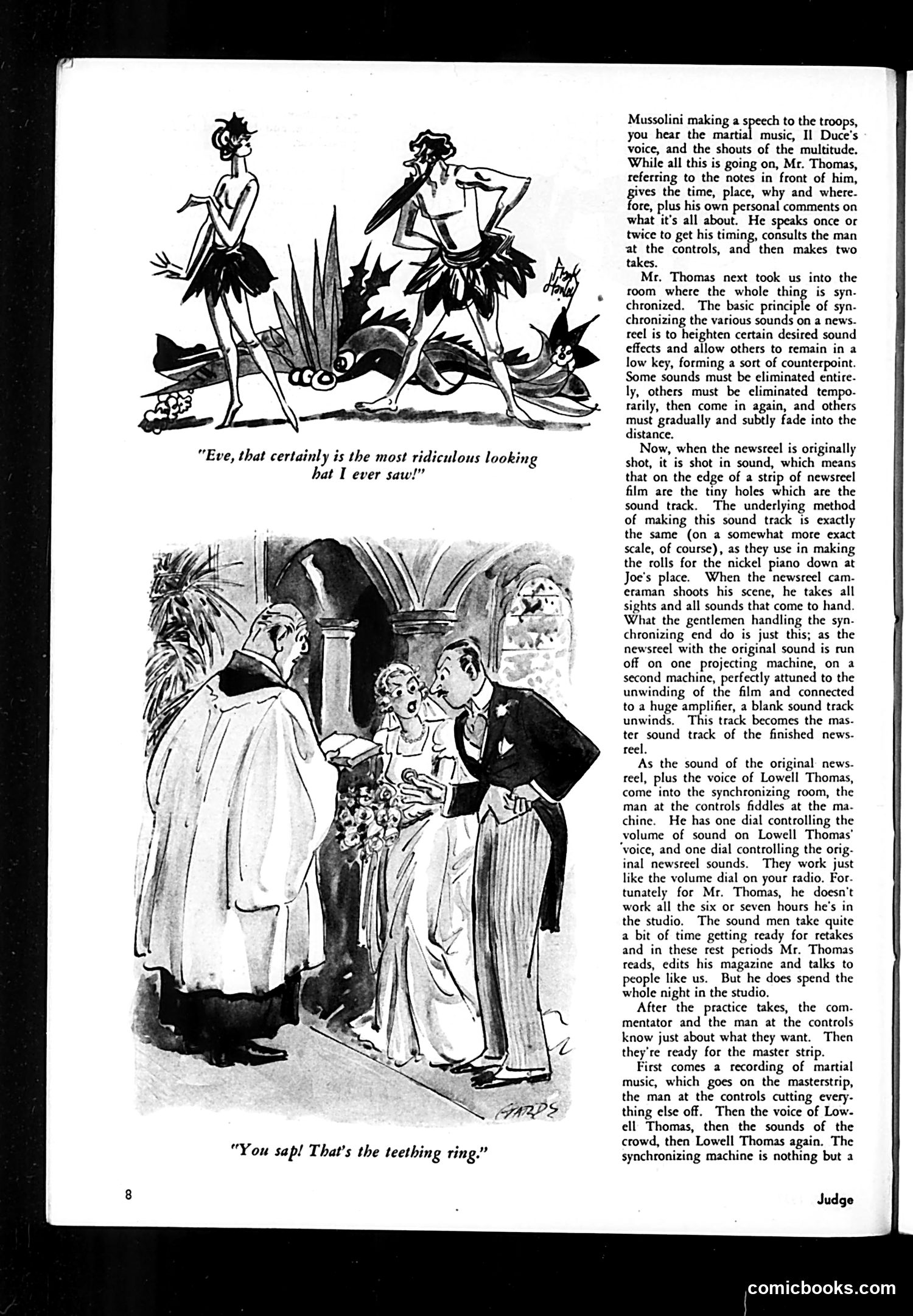
# Judge Magazine Page Explanation This page describes newsreel production techniques, specifically how sound is synchronized to film footage. The top cartoon depicts two figures in what appears to be a comedic domestic scene (caption: "Eve, that certainly is the most ridiculous looking hat I ever saw!"). The lower cartoon shows priests or religious figures with the caption "You sap! That's the teething ring." The main article discusses **Lowell Thomas**, a famous radio commentator and newsreel narrator, explaining how he records voiceovers for newsreels featuring Mussolini's speeches. It details the technical process: multiple sound elements (martial music, Thomas's voice, crowd noise) are synchronized on a blank sound track using dials and controls, similar to player piano technology. The process involves recording, editing, mixing different audio layers, and creating a "master strip" for the finished newsreel. This appears to be an educational piece about emerging sound film technology, circa the early 1930s.
📄 Transcribed text from this page (OCR, searchable)
Machine-transcribed from the original scan — historical spelling and the odd misread are preserved.
Mussolini making a spent to the troops, you hear the aarti music, Il Duck's voice, and the shouts of the multitude. While all this is going on, Mr. Thomas, referring to the notes in front of him, gives the time, place, why and where. fore, plus his own personal comments on what it's all about. He speaks once or twice to get his timing, consults the man at the controls, and then makes two takes. Mr. Thomas next took us into the toom where the whole thing is syn. chronized. The basic principle of syn. chronizing the various sounds on a news. reel is to heighten certain desired sound effects and allow others to remain in a low key, forming a sort of counterpoint. Some sounds must be eliminated entire- ly, others must be eliminated tempo- rarily, then come in again, and others must gradually and subtly fade into the distance. "Eve, that certainl ly is the most ridiculous looking ioe we hen le cee whith meat hat I ever saw!” that on the edge of a strip of newsreel film are the tiny holes which are the sound track. The underlying method of making this sound track is exactly the same (on a somewhat more exact scale, of course), as they use in making the rolls for the nickel piano down at Joe's place. When the newsreel cam- eraman shoots his scene, he takes all sights and all sounds that come to hand. What the gentlemen handling the syn- chronizing end do is just this; as the newsreel with the original sound is run off on one projecting machine, on a second machine, perfectly attuned to the unwinding of the film and connected to a huge amplifier, a blank sound track unwinds. This track becomes the mas- ter sound track of the finished news- reel. As the sound of the original news- reel, plus the voice of Lowell Thomas, come into the synchronizing room, the man at the controls fiddles at the ma- chine. He has one dial controlling the volume of sound on Lowell Thomas’ ‘voice, and one dial controlling the orig- inal newsreel sounds. They work just like the volume dial on your radio. For. tunately for Mr. Thomas, he doesn't work all the six or seven hours he's in the studio. The sound men take quite a bit of time getting ready for retakes and in these rest periods Mr. Thomas reads, edits his magazine and talks to people like us. But he does spend the whole night in the studio. After the practice takes, the com. mentator and the man at the controls know just about what they want. Then they're ready for the master strip. First comes a recording of martial music, which goes on the masterstrip, the man at the controls cutting every- thing else off. Then the voice of Low- ell Thomas, then the sounds of the . . crowd, then Lowell Thomas again. The "You sap! That's the teething ring.” synchronizing machine is nothing but a Judge ;comicbooks.com