
Judge, 1937-05 · page 22 of 37
Judge — May 1937 — page 22: what you’re looking at
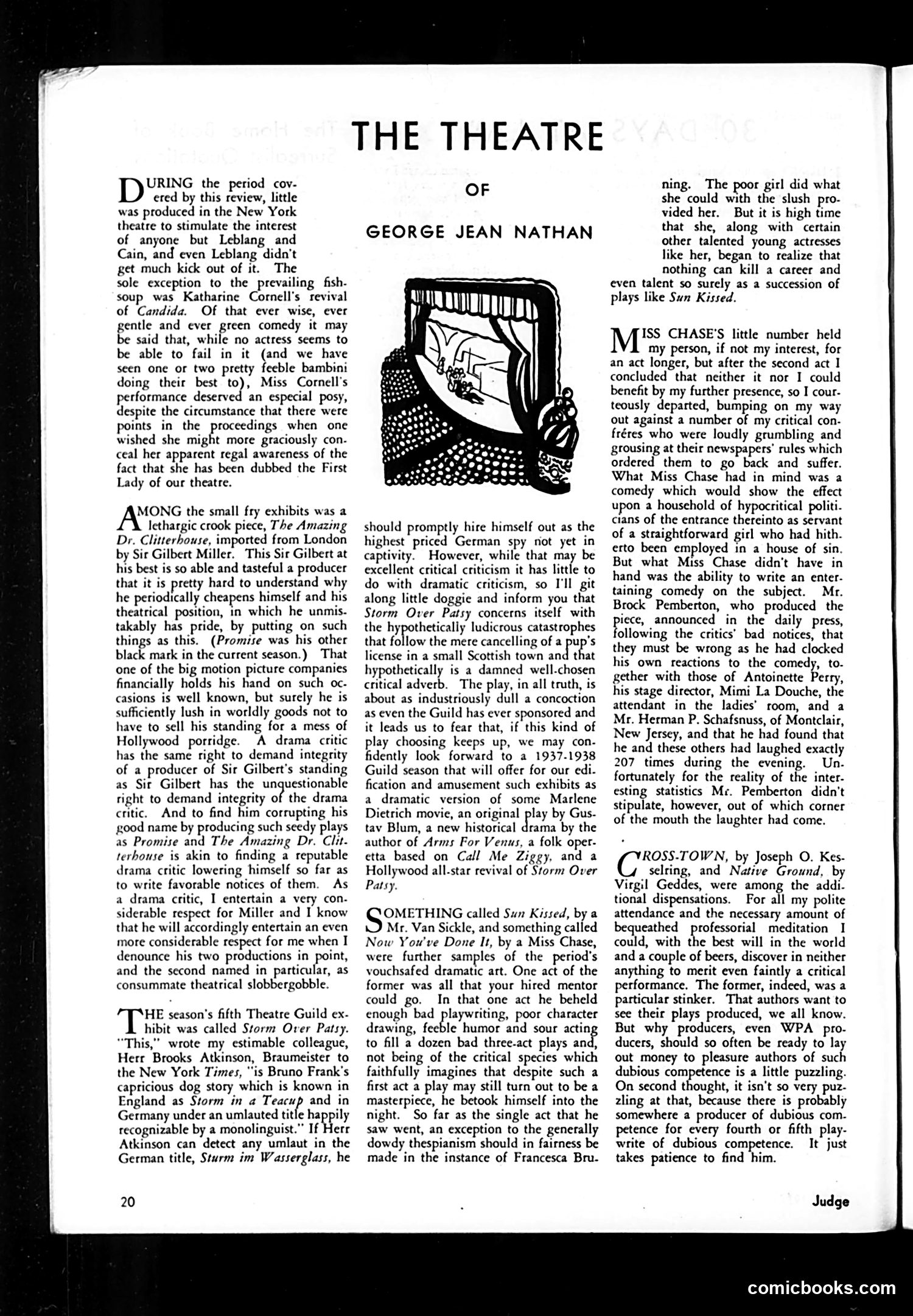
A restored page from Judge, 1937-05. Page through the whole issue in the reader above.
📄 Transcribed text from this page (OCR, searchable)
Machine-transcribed from the original scan — historical spelling and the odd misread are preserved.
Des the period cov- ered by this review, little was produced in the New York theatre to stimulate the interest of anyone but Leblang and Cain, and even Leblang didn’t get much kick out of it. The sole exception to the prevailing fish- soup was Katharine Cornell's revival of Candida. Of that ever wise, ever gentle and ever green comedy it may be said that, while no actress seems to be able to fail in it (and we have seen one or two pretty feeble bambini doing their best to), Miss Cornell's performance deserved an especial posy, despite the circumstance that there were points in the proceedings when one wished she might more graciously con- ceal her apparent regal awareness of the fact that she has been dubbed the First Lady of our theatre. MONG the small fry exhibits was a lethargic crook piece, The Amazing Dr. Clitterhouse, imported from London by Sir Gilbert Miller. This Sir Gilbert at his best is so able and tasteful a producer that it is pretty hard to understand why he periodically cheapens himself and his theatrical position, in which he unmis- takably has pride, by putting on such things as this. (Promise was his other black mark in the current season.) That one of the big motion picture companies financially holds his hand on such oc. casions is well known, but surely he is sufficiently lush in worldly goods not to have to sell his standing for a mess of Hollywood porridge. A drama critic has the same right to demand integrity of a producer of Sir Gilbert's standing as Sir Gilbert has the unquestionable right to demand integrity of the drama critic. And to find him corrupting his good name by producing such seedy plays as Promise and The Amazing Dr. Clit- terhouse is akin to finding a reputable drama critic lowering himself so far as to write favorable notices of them. As a drama critic, I entertain a very con- siderable respect for Miller and I know that he will accordingly entertain an even more considerable respect for me when I denounce his two productions in point, and the second named in particular, as consummate theatrical slobbergobble. HE season's fifth Theatre Guild ex- hibit was called Storm Over Patsy. “This,” wrote my estimable colleague, Herr Brooks Atkinson, Braumeister to the New York Times, “is Bruno Frank's capricious dog story which is known in England as Storm in a Teacup and in Germany under an umlauted title happily recognizable by a monolinguist.” If Herr Atkinson can detect any umlaut in the German title, Sturm im Wasserglass, he 20 THE THEATRE OF GEORGE JEAN NATHAN K QUOT ee! oy) should promptly hire himself out as the highest priced German spy not yet in captivity. However, while that may be excellent critical criticism it has little to do with dramatic criticism, so I'll git along little doggie and inform you that Storm Over Patsy concerns itself with the hypothetically ludicrous catastrophes that follow the mere cancelling of a pups license in a small Scottish town and that hypothetically is a damned well-chosen critical adverb. The play, in all truth, is about as industriously dull a concoction as even the Guild has ever sponsored and it leads us to fear that, if this kind of play choosing keeps up, we may con- fidently look forward to a 1937-1938 Guild season that will offer for our edi. fication and amusement such exhibits as a dramatic version of some Marlene Dietrich movie, an original play by Gus- tav Blum, a new historical drama by the author of Arms For Venus, a folk oper- etta based on Call Me Ziggy, and a Hollywood all-star revival of Storm Over Patsy. OMETHING called Sun Kissed, by a Mr. Van Sickle, and something called Now You've Done It, by a Miss Chase, were further samples of the period's vouchsafed dramatic art. One act of the former was all that your hired mentor could go. In that one act he beheld enough bad playwriting, poor character drawing, feeble humor and sour actin, to fill a dozen bad three-act plays and, not being of the critical species which faithfully imagines that despite such a first act a play may still turn out to be a masterpiece, he betook himself into the night. So far as the single act that he saw went, an exception to the generally dowdy thespianism should in fairness be made in the instance of Francesca Bru. ning. The poor girl did what she could wath the slush pro- vided her. But it is high time that she, along with certain other talented young actresses like her, began to realize that nothing can kill a career and even talent so surely as a succession of plays like Sun Kissed. ISS CHASE'S little number held my person, if not my interest, for an act longer, but after the second act I concluded that neither it nor I could benefit by my further presence, so I cour- teously departed, bumping on my way out against a number of my critical con- fréres who were loudly grumbling and grousing at their newspapers’ rules which ordered them to go back and suffer. What Miss Chase had in mind was a comedy which would show the effect upon a household of hypocritical politi. cians of the entrance thereinto as servant of a straightforward girl who had hith. erto been employed in a house of sin. But what Miss Chase didn’t have in hand was the ability to write an enter- taining comedy on the subject. Mr. Brock Pemberton, who produced the iece, announced in the daily press, ‘ollowing the critics’ bad notices, that they must be wrong as he had clocked his own reactions to the comedy, to- gether with those of Antoinette Perey, his stage director, Mimi La Douche, the attendant in the ladies’ room, and a Mr. Herman P. Schafsnuss, of Montclair, New Jersey, and that he had found that he and these others had laughed exactly 207 times during the evening. Un. fortunately for the reality of the inter- esting statistics Mc. Pemberton didn’t stipulate, however, out of which corner of the mouth the laughter had come. (masromsy, by Joseph O. Kes. selring, and Native Ground, by Virgil Geddes, were among the addi- tional dispensations. For all my polite attendance and the necessary amount of bequeathed professorial meditation I could, with the best will in the world and a couple of beers, discover in neither anything to merit even faintly a critical performance. The former, indeed was a particular stinker. That authors want to see their plays produced, we all know. But why producers, even WPA pro- ducers, should so often be ready to lay out money to pleasure authors of such dubious competence is a little puzzling. On second thought, it isn’t so very puz- zling at that, because there is probably somewhere a producer of dubious com. petence for every fourth or fifth play- write of dubious competence. It just takes patience to find him. Judge comicbooks.com