
Judge, 1937-05 · page 27 of 37
Judge — May 1937 — page 27: what you’re looking at
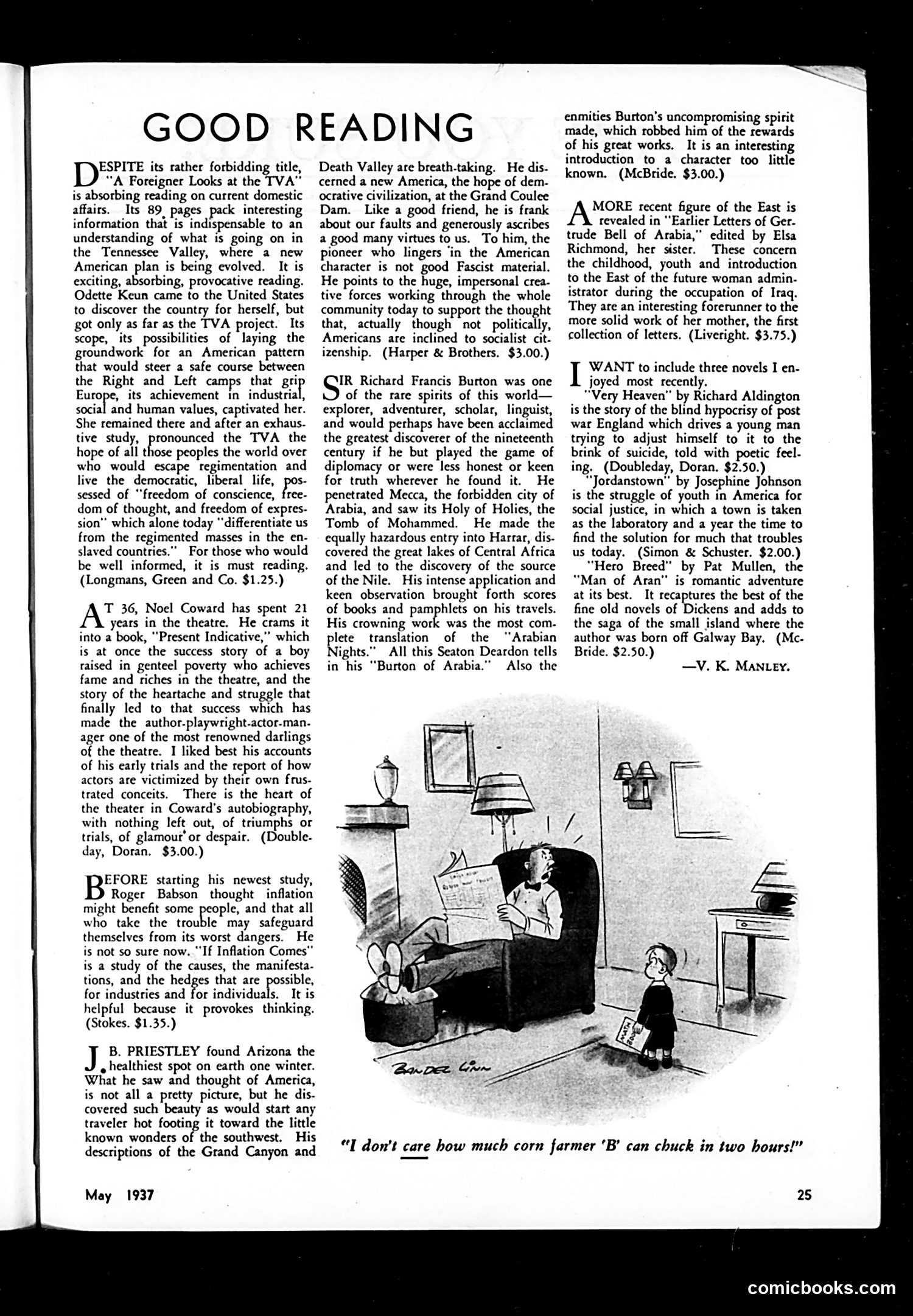
A restored page from Judge, 1937-05. Page through the whole issue in the reader above.
📄 Transcribed text from this page (OCR, searchable)
Machine-transcribed from the original scan — historical spelling and the odd misread are preserved.
GOOD READING Dn its rather forbidding title, “A Foreigner Looks at the TVA” is absorbing reading on current domestic affairs. Its 89, pages pack interesting information that is indispensable to an understanding of what is going on in the Tennessee Valley, where a new American plan is being evolved. It is exciting, absorbing, provocative reading. Odette Keun came to the United States to discover the country for herself, but got only as far as the TVA project. Its scope, its possibilities of laying the groundwork for an American pattern that would steer a safe course between the Right and Left camps that Brip Europe, its achievement in industrial, social and human values, captivated her. She remained there and after an exhaus- tive study, pronounced the TVA the hope of all those peoples the world over who would escape regimentation and live the democratic, liberal life, pos- sessed of ‘freedom of conscience, tree- dom of thought, and freedom of expres- sion” which alone today “differentiate us from the regimented masses in the en- slaved countries.” For those who would be well informed, it is must reading. (Longmans, Green and Co. $1.25.) AY 36, Noel Coward has spent 21 years in the theatre. He crams it into a book, “Present Indicative,” which is at once the success story of a boy raised in genteel poverty who achieves fame and riches in the theatre, and the story of the heartache and struggle that finally led to that success which has made the author-playwright-actor-man- ager one of the most renowned darlings of the theatre. I liked best his accounts of his early trials and the report of how actors are victimized by their own frus- trated conceits. There is the heart of the theater in Coward’s autobiography, with nothing left out, of triumphs or trials, of glamour’ or despair. (Double- day, Doran. $3.00.) EFORE starting his newest study, Roger Babson thought inflation might benefit some people, and that all who take the trouble may safeguard themselves from its worst dangers. He is not so sure now. “If Inflation Comes” is a study of the causes, the manifesta- tions, and the hedges that are possible, for industries and for individuals. It is helpful because it provokes thinking. (Stokes. $1.35.) B. PRIESTLEY found Arizona the healthiest spot on earth one winter. What he saw and thought of America, is not all a pretty picture, but he dis- covered such beauty as would start any traveler hot footing it toward the little known wonders of the southwest. His descriptions of the Grand Canyon and May 1937 Death Valley are breath-taking. He dis- cerned a new America, the hope of dem- ocrative civilization, at the Grand Coulee Dam. Like a good friend, he is frank about our faults and generously ascribes a good many virtues to us. To him, the pioneer who lingers ‘in the American character is not good Fascist material. He points to the huge, impersonal crea- tive forces working through the whole community today to support the thought that, actually though not politically, Americans are inclined to socialist cit- izenship. (Harper & Brothers. $3.00.) IR Richard Francis Burton was one of the rare spirits of this world— explorer, adventurer, scholar, linguist, and would perhaps have been acclaimed the greatest discoverer of the nineteenth century if he but played the game of diplomacy or were less honest or keen for truth wherever he found it. He penetrated Mecca, the forbidden city of Arabia, and saw its Holy of Holies, the Tomb of Mohammed. He made the equally hazardous entry into Harrar, dis- covered the great lakes of Central Africa and led to the discovery of the source of the Nile. His intense application and keen observation brought forth scores of books and pamphlets on his travels. His crowning work was the most com. lete translation of the “Arabian Nights.” All this Seaton Deardon tells in his “Burton of Arabia.” Also the enmities Burton's uncompromising spirit made, which robbed him of the rewards of his great works. It is an interesting introduction to a character too little known. (McBride. $3.00.) A MORE recent figure of the East is revealed in “Earlier Letters of Ger- trude Bell of Arabia,” edited by Elsa Richmond, her sister. These concern the childhood, youth and introduction to the East of the future woman admin- istrator during the occupation of Iraq. They are an interesting forerunner to the more solid work of her mother, the first collection of letters. (Liveright. $3.75.) WANT to include three novels I en- joyed most recently. “Very Heaven” by Richard Aldington is the story of the blind hypocrisy of post war England which drives a young man trying to adjust himself to it to the brink of suicide, told with poetic feel- ing. (Doubleday, Doran. $2.50.) “Jordanstown” by Josephine Johnson is the struggle of youth in America for social justice, in which a town is taken as the laboratory and a year the time to find the solution for much that troubles us today. (Simon & Schuster. $2.00.) “Hero Breed” by Pat Mullen, the “Man of Aran” is romantic adventure at its best. It recaptures the best of the fine old novels of Dickens and adds to the saga of the small island where the author was born off Galway Bay. (Mc- Bride. $2.50.) —V. K. Mantey. I don't care how much corn farmer 'B’ can chuck in two hours!” 25 comicbooks.com