
Judge, 1937-05 · page 7 of 37
Judge — May 1937 — page 7: what you’re looking at
What you’re looking at
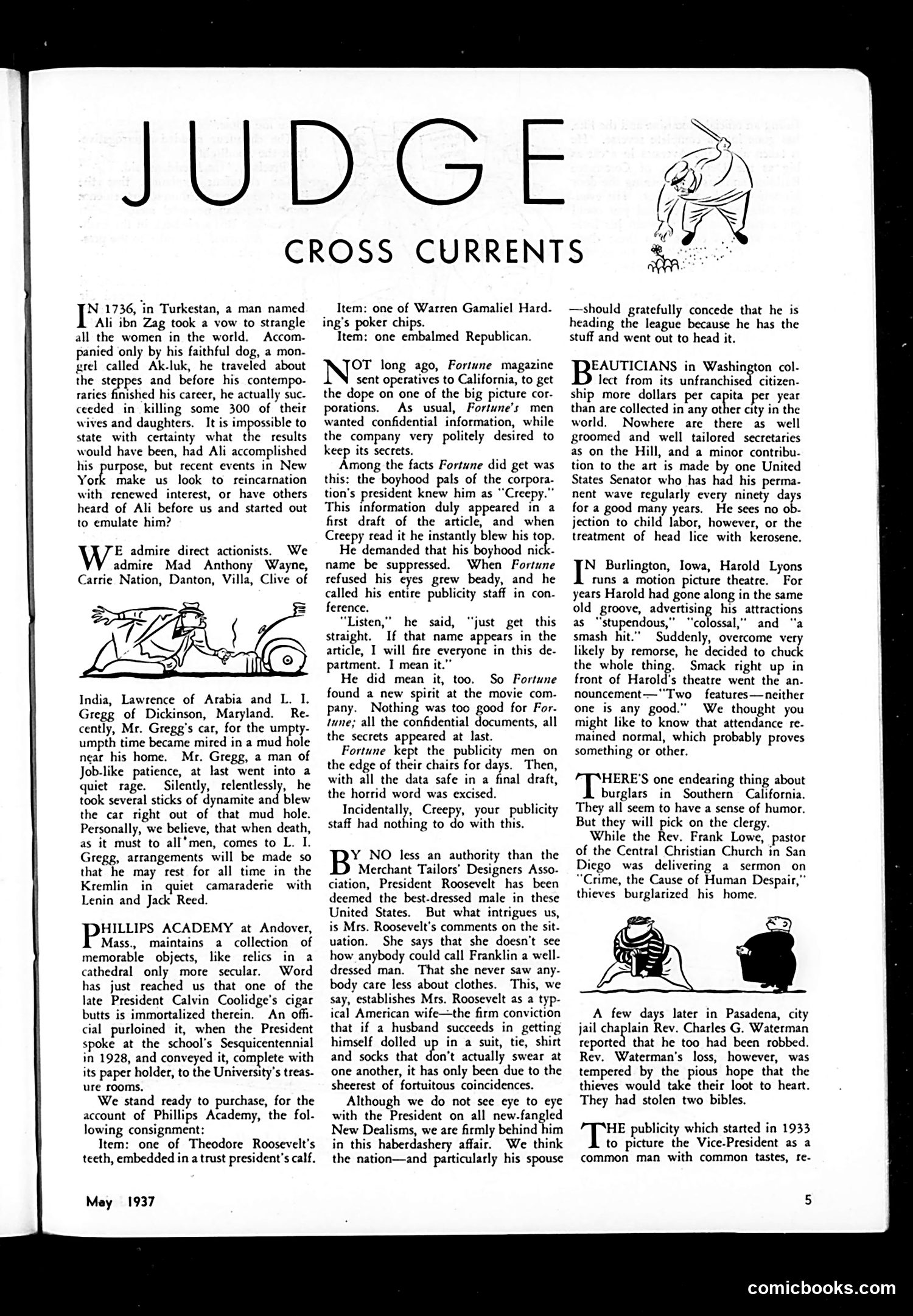
# Judge Magazine "Cross Currents" - May 1937 This page contains multiple satirical gossip items targeting 1930s public figures and institutions. The text mocks: **Fortune Magazine's corporate espionage**: A "Creepy" executive was embarrassed when Fortune revealed he knew about confidential business matters. The satire criticizes corporate secrecy-breaking journalism. **Mrs. Franklin Roosevelt's fashion commentary**: The piece notes her claim that President Roosevelt is well-dressed, sarcastically implying she's being diplomatic rather than honest—a jab at both the First Lady and the President's appearance. **Clergy theft**: A San Diego church pastor's home was robbed, with ironic commentary on burglars targeting "the clergy" alongside other victims. **Phillips Academy**: A humorous item about acquiring Theodore Roosevelt's teeth as a relic. The cartoons (small illustrations visible) appear to accompany these gossipy items with visual humor. Overall, this represents Judge's typical satirical approach to lampooning politics, society, and public figures.
📄 Transcribed text from this page (OCR, searchable)
Machine-transcribed from the original scan — historical spelling and the odd misread are preserved.
CROSS CURRENTS N 1736, in Turkestan, a man named Ali ibn Zag took a vow to strangle all the women in the world. Accom. panied only by his faithful dog, a mon. gtel called Ak-luk, he traveled about the Seppe and before his contempo- raries finished his career, he actually suc- ceeded in killing some 300 of their wives and daughters. It is impossible to state with certainty what the results would have been, had Ali accomplished his purpose, but recent events in New York make us look to reincarnation with renewed interest, or have others heard of Ali before us and started out to emulate him? E admire direct actionists. We admire Mad Anthony Wayne, Carrie Nation, Danton, Villa, Clive of India, Lawrence of Arabia and L. 1. Gregg of Dickinson, Maryland. Re- cently, Mr. Gregg’s car, for the umpty- umpth time became mired in a mud hole near his home. Mr. Gregg, a man of Job-like patience, at last went into a quiet rage. Silently, relentlessly, he took several sticks of dynamite and blew the car right out of that mud hole. Personally, we believe, that when death, as it must to all’men, comes to L. I. Gregg, arrangements will be made so that he may rest for all time in the Kremlin in quiet camaraderie with Lenin and Jack Reed. HILLIPS ACADEMY at Andover, Mass., maintains a collection of memorable objects, like relics in a cathedral only more secular. Word has just reached us that one of the late President Calvin Coolidge’s cigar butts is immortalized therein. An offi. cial purloined it, when the President spoke at the school’s Sesquicentennial in 1928, and conveyed it, complete with its paper holder, to the University’s treas- ure rooms, We stand ready to purchase, for the account of Phillips Academy, the fol- lowing consignment: Item: one of Theodore Roosevelt's teeth, embedded in a trust president's calf. Mey 1937 Item: one of Warren Gamaliel Hard- ing’s poker chips. Item: one embalmed Republican. No long ago, Fortune magazine sent operatives to California, to get the dope on one of the big picture cor- porations. As usual, Fortune's men wanted confidential information, while the company very politely desired to keep its secrets. Among the facts Fortune did get was this: the boyhood pals of the corpora- tion's president knew him as “Creepy.” This information duly appeared in a first. draft of the article, and when Creepy read it he instantly blew his top. He demanded that his boyhood nick- name be suppressed. When Fortune refused his eyes grew beady, and he called his entire publicity staff in con. ference. “Listen,” he said, “just get this straight. If that name appears in the article, I will fire everyone in this de- partment. I mean it.” He did mean it, too. So Fortune found a new spirit at the movie com- pany. Nothing was too good for For- tune; all the confidential documents, all the secrets appeared at last. Fortune kept the publicity men on the edge of their chairs for days. Then, with all the data safe in a final draft, the horrid word was excised. Incidentally, Creepy, your publicity staff had nothing to do with this. B* NO less an authority than the Merchant Tailors’ Designers Asso- ciation, President Roosevelt has been deemed the best-dressed male in these United States. But what intrigues us, is Mrs. Roosevelt's comments on the sit- uation. She says that she doesn’t see how anybody could call Franklin a well- dressed man. That she never saw any- body care less about clothes. This, we say, establishes Mrs. Roosevelt as a typ- ical American wife—the firm conviction that if a husband succeeds in_ getting himself dolled up in a suit, tie, shirt and socks that don’t actually swear at one another, it has only been due to the sheerest of fortuitous coincidences. Although we do not see eye to eye with the President on all new-fangled New Dealisms, we are firmly behind him in this haberdashery affair. We think the nation—and particularly his spouse —should gratefully concede that he is heading the league because he has the stuff and went out to head it. EAUTICIANS in Washin; lect from its unfranchised citizen- ship more dollars per capita per year than are collected in any other city in the world. Nowhere are there as well groomed and well tailored secretaries as on the Hill, and a minor contribu- tion to the art is made by one United States Senator who has had his perma- nent wave regularly every ninety days for a good many years. He sees no ob. jection to child labor, however, or the treatment of head lice with kerosene. on col- N Burlington, Iowa, Harold Lyons runs a motion picture theatre. For years Harold had gone along in the same old groove, advertising his attractions as “‘stupendous,” “‘colossal,” and “a smash hit.” Suddenly, overcome very likely by remorse, he decided to chuck the whole thing. Smack right up in front of Harold's theatre went the an- nouncement—“Two features—neither one is any good.” We thought you might like to know that attendance re- mained normal, which probably proves something or other. id fers one endearing thing about burglars in Southern California. They all seem to have a sense of humor. But they will pick on the clergy. While the Rev. Frank Lowe, pastor of the Central Christian Church in San Diego was delivering a sermon on “Crime, the Cause of Human Despair,” thieves burglarized his home. A few days later in Pasadena, city jail chaplain Rev. Charles G. Waterman reported that he too had been robbed. Rev. Waterman's loss, however, was tempered by the pious hope that the thieves would take their loot to heart. They had stolen two bibles. v I ‘HE publicity which started in 1933 to picture the Vice-President as a common man with common tastes, re- comicbooks.com