
Judge, 1937-05 · page 4 of 37
Judge — May 1937 — page 4: what you’re looking at
What you’re looking at
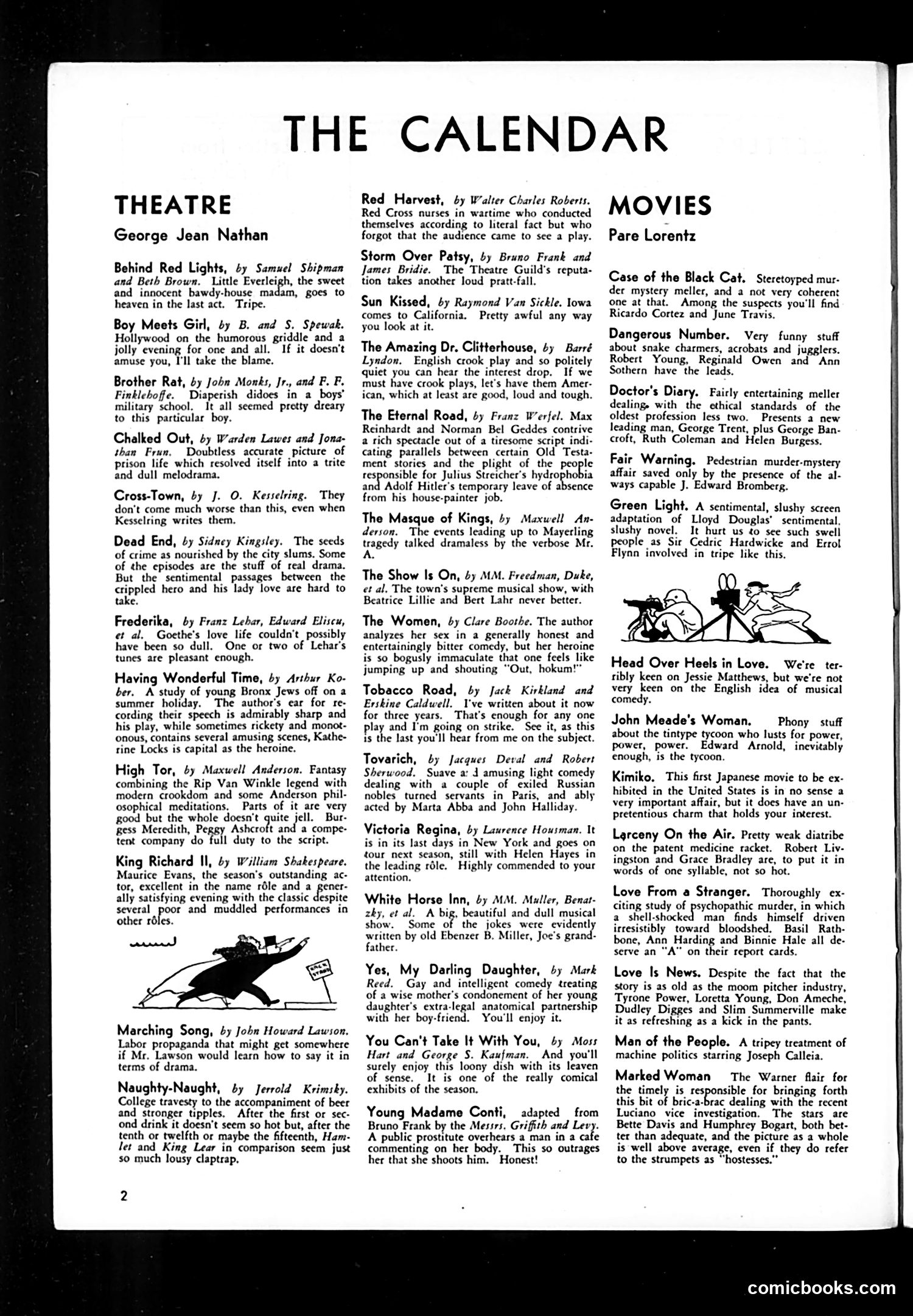
# Analysis of Judge Magazine Page This page is primarily **entertainment content and reviews**, not political satire. It features two sections: **THEATRE** reviews of contemporary plays, including works by Samuel Shipman, Raymond Van Sickle, and others—typical early 20th-century Broadway fare. **MOVIES** reviews of silent films and early talkies, including "Pare Lorentz" productions. The small **cartoon** at bottom left appears to show a figure with a suitcase labeled "JUDGE," possibly self-referential to the magazine itself, though its specific meaning is unclear without additional context. This is primarily a **entertainment/culture page** rather than political commentary—Judge functioned as both satirical magazine and general-interest publication covering theater and cinema for educated readers of the era.
📄 Transcribed text from this page (OCR, searchable)
Machine-transcribed from the original scan — historical spelling and the odd misread are preserved.
THE CALENDAR THEATRE George Jean Nathan Behind Red Lights, by Samuel Shipman and Beth Brown. Little Everleigh, the sweet and innocent bawdy-house madam, goes to heaven in the last act. Tripe. Boy Meets Girl, by B. and S. Spewak. Hollywood on the humorous griddle and a jolly evening for one and all. If it doesn’t amuse you, I'll take the blame. Brother Rat, by Jobn Monks, Jr., and F. F. Finkleboffe. Diaperish didoes in a boys’ military school. It all seemed pretty dreary to this particular boy. Chalked Out, by Warden Lawes and Jona- than Frun, Doubtless accurate picture of prison life which resolved itself into a trite and dull melodrama. Cross-Town, by J. O. Kesselring. They don’t come much worse than this, even when Kesselring writes them. Dead End, by Sidney Kingsley. The seeds of crime as nourished by the city slums. Some of the episodes are the stuff of real drama. But the sentimental passages between the crippled hero and his lady love are hard to take. Frederika, by Franz Lebar, Edward Eliscu, et al, Goethe's love life couldn't possibly have been so dull. One or two of Lehar’s tunes are pleasant enough. Having Wonderful Time, 6y Arthur Ko- ber. A study of young Bronx Jews off on a summer holiday. The author's ear for re- cording their speech is admirably sharp and his play, while sometimes rickety and monot- onous, contains several amusing scenes, Kathe- rine Locks is capital as the heroine. High Tor, 6y Maxwell Anderson. Fantasy combining the Rip Van Winkle legend with modern crookdom and some Anderson phil- osophical meditations, Parts of it are very good but the whole doesn’t guite jell. Bur- gess Meredith, Peggy Ashcroft and a compe- tent company do full duty to the script. King Richard II, by William Shakespeare. Maurice Evans, the season's outstanding ac- tor, excellent in the name rdle and a gener- ally satisfying evening with the classic despite several poor and muddled performances in other réles. Marching Song, by John Howard Lawson, Labor propaganda that might get somewhere if Mr. Lawson would learn how to say it in terms of drama. Naughty-Naught, by Jerrold Krimsky. College travesty to the accompaniment of beer and stronger tipples. After the first or sec- ond drink it doesn’t seem so hot but, after the tenth or twelfth or maybe the fifteenth, Ham- Jet and King Lear in comparison seem just so much lousy claptrap, Red Harvest, by Walter Charles Roberts. Red Cross nurses in wartime who conducted themselves according to literal fact but who forgot that the audience came to see a play. Storm Over Patsy, 4y Bruno Frank and James Bridie. The Theatre Guild’s reputa- tion takes another loud pratt-fall. Sun Kissed, by Raymond Van Sickle. lowa comes to California, Pretty awful any way you look at it. The Amazing Dr. Clitterhouse, by Barré Lyndon. English crook play and so politely quiet you can hear the interest drop. If we must have crook plays, let's have them Amer- ican, which at least are good, loud and tough. The Eternal Road, by Franz Werfel. Max Reinhardt and Norman Bel Geddes contrive a rich spectacle out of a tiresome script indi- cating parallels between certain Old Testa- ment stories and the plight of the people responsible for Julius Streicher’s hydrophobia and Adolf Hitler's temporary leave of absence from his house-painter job. The Masque of Kings, by Maxwell An- derson. The events leading up to Mayerling tragedy talked dramaless by the verbose Mr. A, The Show Is On, by MM. Freedman, Duke, et al, The town’s supreme musical show, with Beatrice Lillie and Bert Lahr never better. The Women, by Clare Boothe. The author analyzes her sex in a generally honest and entertainingly bitter comedy, but her heroine is so bogusly immaculate that one feels like jumping up and shouting “Out, hokum!” Tobacco Road, by Jack Kirkland and Erskine Caldwell. I've written about it now for three years. That's enough for any one play and I'm going on strike. See it, as this 1s the last you'll hear from me on the subject. Tovarich, by Jacques Deval and Robert Sherwood. Suave a: d amusing light comedy dealing with a couple of exiled Russian nobles turned servants in Paris, and ably acted by Marta Abba and John Halliday. Victoria Regina, by Laurence Housman. It is in its last days in New York and goes on tour next season, still with Helen Hayes in the leading réle. Highly commended to your attention, White Horse Inn, by MM. Muller, Benat- zky, et al. A big, beautiful and dull musical show. Some of the jokes were evidently eriteen by old Ebenzer B. Miller, Joe's grand- father. Yes, My Darling Daughter, 6y Mark Reed. Gay and intelligent comedy treating of a wise mother's condonement of her young daughter's extra-legal anatomical partnership with her boy-friend. You'll enjoy it. You Can't Take It With You, 4y Moss Hart and George S. Kaufman. And you'll surely enjoy this loony dish with its leaven of sense. It is one of the really comical exhibits of the season, Young Madame Conti, adapted from Bruno Frank by the Messrs. Griffith and Ey: A public prostitute overhears a man in a cafe commenting on her body. This so outrages her that she shoots him. Honest! MOVIES Pare Lorentz Case of the Black Cat. Steretoyped mur- der mystery meller, and a not very coherent one at that. Among the suspects you'll find Ricardo Cortez and June Travis. Dangerous Number. Very funny stuff about snake charmers, acrobats and jugglers. Robert Young, Reginald Owen and Ann Sothern have the leads. Doctor's Diary. Fairly entertaining meller dealings with the ethical standards of the oldest profession less two. Presents a new leading man, George Trent, plus George Ban- croft, Ruth Coleman and Helen Burgess. Fair Warning. Pedestrian murder-mystery affair saved only by the presence of the al- ways capable J. Edward Bromberg. Green Light. A sentimental, slushy screen adaptation of Lloyd Douglas’ sentimental, slushy novel, It hurt us to see such swell people as Sir Cedric Hardwicke and Errol Flynn involved in tripe like this. Head Over Heels in Love. We're ter- ribly keen on Jessie Matthews, but we're not very keen on the English idea of musical comedy. John Meade'’s Woman. Phony stuff about the tintype tycoon who lusts for power, power, power. Edward Arnold, inevitably enough, is the tycoon. Kimiko. This first Japanese movie to be ex- hibited in the United States is in no sense a very important affair, but it does have an un- pretentious charm that holds your interest. Larceny On the Air. Pretty weak diatribe on the patent medicine racket. Robert Liv- ingston and Grace Bradley are, to put it in words of one syllable, not so hot. Love From a Stranger. Thoroughly ex- citing study of psychopathic murder, in which a shell-shocked man finds himself driven irresistibly toward bloodshed. Basil Rath- bone, Ann Harding and Binnie Hale all de- serve an “A” on their report cards. Love Is News. Despite the fact that the story is as old as the moom pitcher industry, Tyrone Power, Loretta Young, Don Ameche, Dudley Digges and Slim Summerville make it as refreshing as a kick in the pants. Man of the People. A tripey treatment of machine politics starring Joseph Calleia. Marked Woman = The Warner flair for the timely is responsible for bringing forth this bit of bric-a-brac dealing with the recent Luciano vice investigation. The stars are Bette Davis and Hamu pheey Bogart, both bet- ter than adequate, and the picture as a whole is well above average, even if they do refer to the strumpets as “hostesses.” comicbooks.com